REVIEW 3 major objections 6 minor 162 references
On Understanding, Identifying, and Mitigating Vulnerabilities in Agentic Large Language Models
T0 review · 3 major / 6 minor · reviewed 2026-08-15 · deepseek-v4-flash
Pith's one-line read A systematic review of 85 papers on agentic LLM security finds the field structurally imbalanced: 66% of work targets perception-layer attacks, only 4.7% targets action-layer attacks, and attack research outnumbers defense research by 3.9…
desk verdict The paper's headline ratios don't reproduce from its own tables; the taxonomy is useful but the quantitative synthesis needs major repair before it can be cited. read the letter →
The pith
A machine-rendered reading of the paper's core claim, the machinery that carries it, and where it could break.
The reading
What carries the argument
The load-bearing object is a four-layer architectural taxonomy — perception, brain, action, interaction — built by open-coding the 85-paper corpus into 13 vulnerability types, with every agent component assigned to exactly one layer by its primary function. The taxonomy's core move is to count, per layer, how many papers study that layer's vulnerabilities, which converts narrative review into quantitative gap analysis: the perception/action ratio, the attack/defense ratio, and the near-zero coverage of code-execution and embodied agents are all produced by this counting scheme. The companion mechanism is a systematic screening pipeline (743 records screened down to 85 studies) that defines the population the counts describe.
What would settle it
Re-run the same review with the full search strings, two independent coders on 100% of the corpus, and a pre-registered coding protocol; if the action-layer share rises above roughly 15% or the perception-layer share drops below 50%, the claimed fourteen-fold imbalance collapses. A cheaper check: take the 85 papers and count how many require a full execution environment (tools, code, sandbox) as part of their evaluation — if that number is large, the 'action layer is unstudied' claim is an artifact of how papers were classified.
Extended reading notes
Core claim
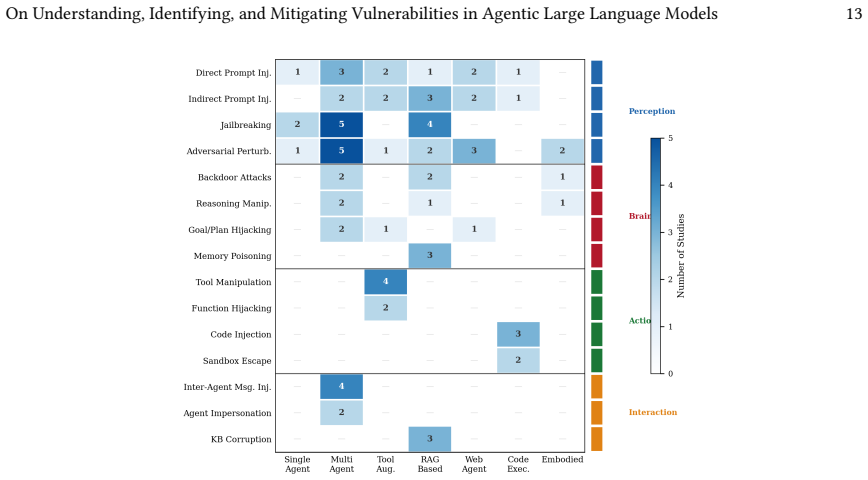
The central claim is that agentic LLM security research is structurally misaligned with real-world risk. Coding 85 retained papers by primary attack mechanism, the authors find that perception-layer vulnerabilities (direct and indirect prompt injection, jailbreaking, adversarial perturbations) appear in 65.9% of papers, while action-layer vulnerabilities (tool manipulation, function hijacking, code injection, sandbox escape) appear in only 4.7% — a fourteen-fold gap. Defense-focused papers number 12 against 47 attack-focused ones, a 3.9:1 ratio, and code-execution agents appear in just 3 (3.5%) papers while embodied agents appear in none. The authors attribute the imbalance to methodological accessibility: perception attacks can be studied black-box with API access, whereas action-layer attacks require full execution environments. They interpret the insecurity itself as architectural coupling: because agent layers feed one another, a compromise at any layer can propagate, so the field's singular focus on input filtering is misplaced, and containment boundaries across all four layers are what needs building.
Load-bearing premise
The ratios are only as good as the paper collection they count; the exact search strings used across the six databases are not reported, inclusion and exclusion decisions are summarized rather than documented per record, and only 17% of the corpus was independently coded by a second reviewer, so a different search or a different coder could shift the headline percentages.
Editorial extensions
If this is right
- If the imbalance is real, defensive research priorities are inverted: the attack classes with the most irreversible consequences (code injection, sandbox escape, tool misuse) currently receive the least investigation.
- Tool-augmented agents, at 12% of the corpus despite being the dominant production deployment pattern, are a pending security liability as their adoption scales.
- The absence of standardized benchmarks and adaptive-adversary evaluation means published detection and defense numbers are not comparable across studies and likely overstate robustness.
- Implementing the paper's seven open problems amounts to a containment strategy: sandboxing code execution, privilege separation for tools, runtime policy engines, human-in-the-loop governance, and authenticated inter-agent communication.
- Because failures propagate across layers, input filtering alone cannot secure an agent; defenses must be placed at each architectural boundary, including the action layer where verification is currently absent.
Reading between the lines
- The 14-fold gap probably measures experimental convenience as much as genuine neglect: perception attacks need only an API, while action-layer research requires building full agent environments, so the ratio may narrow quickly once standardized execution-aware benchmarks become the norm.
- A testable extension is to run the same coding scheme on the 2026 literature; if the action-layer share rises sharply, the imbalance is a lagging indicator, but if it stays below 10%, accessibility, not field maturity, is the binding constraint.
- The taxonomy's component-based framing predicts that the next high-impact vulnerabilities will appear in the parts of the stack with no coverage at all — inter-agent message authentication and tool-invocation protocols — where the paper finds zero or near-zero studies.
- The paper's own quality assessment rates real-world applicability as the weakest of its four quality dimensions, so many published defenses are unlikely to survive deployment and the reported success rates should be read as upper bounds.
Signed reviews
Editorial analysis
A structured set of objections, weighed in public.
Referee Report
Summary. This manuscript is a systematic literature review, conducted under PRISMA 2020 guidelines, of 85 papers (2023--2025) on security vulnerabilities in agentic large language models. The authors propose a four-layer architectural taxonomy (perception, brain, action, interaction) covering 13 vulnerability types, report quantitative imbalances in the literature—notably a 3.9:1 attack-to-defense ratio and a roughly 14-fold gap between perception-layer and action-layer research coverage—and identify seven open research problems centered on containment. The paper positions itself as the first PRISMA-based systematic review dedicated to agentic LLM security and claims to provide a component-based foundation for future defense research.
Significance. If the quantitative claims were internally consistent, this would be a valuable contribution. The paper is commendable for attempting a systematic, PRISMA-structured review of a rapidly emerging area, for reporting inter-coder reliability statistics (Cohen's kappa 0.88 and 0.93), and for offering a taxonomy that organizes vulnerabilities by architectural function rather than by attack name. The seven open problems, especially the security of code-execution and embodied agents, are reasonable and useful for shaping future research. However, the headline numerical claims—the 3.9:1 attack-to-defense ratio and the 14x perception/action gap—are not reproducible from the paper's own tables and narrative, and the missing search strings and per-record coding details prevent independent audit. The central contribution is therefore currently undermined by reporting inconsistencies that must be resolved before the quantitative conclusions can be accepted.
major comments (3)
- [Section 4.7, Table 4, Table 11] The layer-coverage figures are internally inconsistent. Section 4.7 states that 56 of 85 papers (66%) discuss perception-layer risks, 35 (41%) brain-layer risks, 4 (4.7%) action-layer risks, and 24 (28%) interaction-layer risks, and the abstract and Table 11 repeat these paper-level counts. However, Table 4 reports component-level occurrence counts that sum to 95 for the perception layer (12+15+26+42), 109 for the brain layer (24+21+41+23), 82 for the action layer (54+7+13+8), and 17 for the interaction layer (12+5). The table note states that these are occurrence counts and that a single paper can contribute to multiple counts, but the paper never defines how occurrence counts are converted to the paper-level percentages used in Section 4.7 and the abstract. In particular, the claim that action-layer vulnerabilities 'appear in only 4.7%' of papers is not auditable when Table 4 alone shows 82 action-layer occurrences. The authors should report both units explicitly—unique-paper primary-layer counts and component-occurrence counts—and reconcile the abstract's prevalence language with the table's counting convention.
- [Section 5.1, Section 6.1, Table 11, Section 7.1] The attack-to-defense ratio is not reproducible because the paper reports different defense counts in different places. Section 5.1 says 47 research papers (55.3%) focus on vulnerability discovery and attacks while 12 papers (14.1%) focus on defense and mitigation, yielding the headline 3.9:1 ratio; Table 11 repeats 47 and 12. Yet Section 6.1 states that the review identified 17 defense-focused studies (12 detection and 5 mitigation-only), and Section 7.1, Problem 4, refers to '10 detection methods vs 52 attacks' (a 5:1 ratio). These numbers cannot all describe the same corpus under one coding scheme. The authors must specify the mutually exclusive paper categories (attack, defense, framework, mitigation-only, detection-only), apply them consistently, and recompute the ratio; until then, the 3.9:1 claim in the abstract and conclusion is unsupported.
- [Section 2.4, Section 2.5] The review's reproducibility is insufficient for the strength of the quantitative claims. Section 2.4 describes the search strategy only at the level of query groups ('Group 1 AND Group 2 NOT Group 3') with illustrative terms, and it does not provide the full Boolean queries adapted to each of the six databases. PRISMA 2020 requires the complete search strategy, typically in an appendix or supplement, and the exclusion decisions are summarized only at the flow level (540 excluded at title/abstract, 71 at full-text) without per-record documentation. Because the inclusion criteria define the population from which every ratio in the paper is computed, the absence of these details is a load-bearing limitation. A supplement containing verbatim search strings, the full list of excluded records with reasons, and the coding protocol should be added.
minor comments (6)
- [Section 1.6] The organization paragraph states that the methodology is presented in Section 3, but the search and coding methodology actually appears in Sections 2.4--2.6; the cross-reference should be corrected.
- [Figure 4 caption] Figure 4 is described as a 'visual representation of Table 2,' but Table 2 maps existing agent frameworks to the four-layer taxonomy, while the figure appears to depict the vulnerability distribution in Table 3; the caption and table reference should be checked.
- [Table 1] Table 1 contains duplicate rows for references [81] and [125] with different years, which appears to be an editing artifact; the table should list each survey once with consistent metadata.
- [Section 7.1, Problem 4] The statement '10 detection methods vs 52 attacks' is not tied to any table or definition and does not match the 47 attack papers counted in Table 11; either define the unit of counting or correct the number.
- [Section 3.2] The text refers to 'LangeChain-based agents'; this should be 'LangChain-based agents.'
- [Section 1.3] The sentence 'This literature considered in this study spans January 2023 through December 2025' is ungrammatical; it should read 'The literature considered in this study spans...'.
Circularity Check
No circularity found: the quantitative claims are direct tabulations of a coded corpus, and the apparent contradictions are internal-consistency issues, not reductions of outputs to inputs.
full rationale
This paper is a PRISMA-based systematic literature review, so its central quantitative claims (66% perception-layer papers, 4.7% action-layer papers, 3.9:1 attack-to-defense ratio) are counts of papers coded by the authors, not values derived from fitted parameters or from the taxonomy by definition. The four-layer taxonomy is described as an organizing framework developed through open coding, and the vulnerability types within layers were not predefined from the target percentages. No load-bearing self-citations or imported uniqueness theorems appear; the review positions itself against prior surveys without relying on the authors' own prior results. The main concerns identified in the paper and by the reader are internal consistency problems: Section 4.7 reports only 4 action-layer papers while Table 4 lists 82 action-layer component occurrences, and Section 5.1 uses 12 defense papers for the 3.9:1 ratio while Section 6.1 reports 17 defense-focused studies. These are discrepancies in how occurrence counts, primary-layer counts, and defense-paper counts were operationalized, and they affect the reliability of the headline ratios, but they do not make any derivation equivalent to its input by construction. The conclusion that research effort is misaligned with real-world risk is an interpretation layered on top of the counts, not a quantity fitted from or defined by those counts. Under the standard for circularity, the derivation chain is self-contained as a coding-and-counting exercise, even though its numerical backbone is not fully reproducible from the paper's own tables.
Assumptions & free parameters
assumptions (3)
- domain assumption PRISMA 2020 is a valid and appropriate framework for conducting and reporting this security literature review.
- domain assumption The four-layer decomposition (perception, brain, action, interaction) is an exhaustive and meaningful partition of agentic LLM architecture for security analysis.
- ad hoc to paper The inclusion criteria for 'agentic LLM security papers' (Section 1.3) define the correct population for measuring attack and defense imbalance.
Cite this review
Pith. "Pith review of On Understanding, Identifying, and Mitigating Vulnerabilities in Agentic Large Language Models." pith.science (2026). https://pith.science/paper/P4BIF5MY
@misc{pith2026260810530,
  author       = {Pith},
  title        = {Pith review of: On Understanding, Identifying, and Mitigating Vulnerabilities in Agentic Large Language Models},
  year         = {2026},
  howpublished = {\url{https://pith.science/paper/P4BIF5MY}},
  note         = {Machine review of arXiv:2608.10530}
}
read the original abstract
Large Language Models (LLMs) have undergone a shift from stateless conversational interfaces to autonomous agents capable of multi-step planning, tool invocation, code execution, and maintaining persistent memory. When these agents operate with real-world privileges---calling APIs, modifying files, and querying databases---a compromised reasoning step can trigger unauthorized data access, irreversible state changes, or cascading failures, yet the security research community has not kept pace. To quantify the state of the field, we conducted a systematic literature review under PRISMA 2020 guidelines across six databases, screening 743 records and retaining 85 papers (2023--2025) on agentic LLM security. Attack research outpaces defense work by 3.9:1. Perception-layer vulnerabilities (prompt injection, jailbreaking, adversarial perturbations) dominate, accounting for 66\% of papers, while action-layer vulnerabilities (tool misuse, code injection, sandbox escape) appear in only 4.7\%, misaligned with real-world risk. Code execution security accounts for 3.5\%, and tool-augmented agents 12\%. We contribute a four-layer taxonomy mapping 13 vulnerability types across perception, brain, action, and interaction layers, and identify seven open problems centered on containment. Agentic LLM insecurity stems from architectural coupling, where weak isolation allows vulnerabilities to propagate across layers.
Figures


Figures from the paper (6 more)


Reference graph
Works this paper leans on
-
[125]
Shang Wang, Tianqing Zhu, Bo Liu, Ming Ding, Dayong Ye, Wanlei Zhou, and Philip S. Yu. 2025. Unique security and privacy threats of large language models: a comprehensive survey.ACM Computing Surveys, 58, 4, 1–36. doi:10.1145/3764113
doi:10.1145/3764113 2025
-
[27]
Zehang Deng, Yongjian Guo, Changzhou Han, Wanlun Ma, Junwu Xiong, Sheng Wen, and Yang Xiang. 2024. Ai agents under threat: a survey of key security challenges and future pathways.arXiv (Cornell University), (June 2024). doi:10.48550/arxiv.2406.02630
-
[28]
Zehang Deng, Yongjian Guo, Changzhou Han, Wanlun Ma, Junwu Xiong, Sheng Wen, and Yang Xiang. 2025. AI agents under threat: a survey of key security challenges and future pathways.ACM Computing Surveys, 57, 7, 1–36. doi:10.1145/3716628
doi:10.1145/3716628 2025
-
[1]
Sara Abdali, Richard Anarfi, CJ Barberan, and Jia He. 2024. Securing large language models: threats, vulnerabilities and responsible practices. arXiv (Cornell University), (Mar. 2024). doi:10.48550/arxiv.2403.12503
-
[2]
Alsharif Abuadbba, Chris Hicks, Kristen Moore, Vasilios Mavroudis, Burak Hasırcıoglu, Diksha Goel, and Paul Jennings. 2025. From promise to peril: rethinking cybersecurity red and blue teaming in the age of llms.arXiv (Cornell University), (June 2025). doi:10.48550/arxiv.2506.13434. Manuscript submitted to ACM On Understanding, Identifying, and Mitigating...
-
[3]
IBRAHIM ADABARA, Bashir Olaniyi Sadiq, Aliyu Nuhu Shuaibu, Yale Ibrahim Danjuma, and Maninti Venkateswarlu. 2025. Trustworthy agentic ai systems: a cross-layer review of architectures, threat models, and governance strategies for real-world deployment. (Sept. 2025). doi:10.12688/f1000research.169927.1
-
[4]
Mohamad Abou Ali and Fadi Dornaika. 2025. Agentic ai: a comprehensive survey of architectures, applications, and future directions.arXiv (Cornell University), (Oct. 2025). doi:10.48550/arxiv.2510.25445
-
[5]
Daniel Ayzenshteyn, Roy Weiss, and Yisroel Mirsky. 2024. The best defense is a good offense: countering LLM-Powered cyberattacks.arXiv preprint arXiv:2410.15396. doi:10.48550/arxiv.2410.15396
work page Pith review arXiv doi:10.48550/arxiv.2410.15396 2024
Show all 162 references
-
[6]
Ajay Bandi, Bhavani Kongari, Roshini Naguru, Sahitya Pasnoor, and Sri Vidya Vilipala. 2025. The rise of agentic AI: a review of definitions, frameworks, architectures, applications, evaluation metrics, and challenges. (2025). doi:10.3390/fi17090404
2025 doi
- [7]
-
[8]
Kaufman, Tyler Tracy, Vasil Georgiev, Dávid Matolcsi, Akbir Khan, and Buck Shlegeris
Aryan Bhatt, Cody Rushing, Adam M. Kaufman, Tyler Tracy, Vasil Georgiev, Dávid Matolcsi, Akbir Khan, and Buck Shlegeris. 2025. Ctrl-z: controlling ai agents via resampling.arXiv (Cornell University), (Apr. 2025). doi:10.48550/arxiv.2504.10374
- [9]
- [10]
-
[11]
Sarfraz Nawaz Brohi, Qurat-ul-ain Mastoi, N. Z. Jhanjhi, and Thulasyammal Ramiah Pillai. 2025. A research landscape of agentic AI and large language models: applications, challenges and future directions.Algorithms, 18, 8, 499. doi:10.3390/a18080499
2025 doi
-
[12]
Robin Buchta, George Gkoktsis, Felix Heine, and Carsten Kleiner. 2024. Advanced persistent threat attack detection systems: a review of approaches, challenges, and trends. (Sept. 2024). doi:10.1145/3696014
2024 doi
-
[13]
Verma, Atieh Taheri, Radha Kumaran, Zichen Chen, Jiaao Chen, Tobias Höllerer, and Misha Sra
Arthur Caetano, Krishna K. Verma, Atieh Taheri, Radha Kumaran, Zichen Chen, Jiaao Chen, Tobias Höllerer, and Misha Sra. 2025. Agentic workflows for conversational human-ai interaction design.arXiv (Cornell University), (Jan. 2025). doi:10.48550/arxiv.2501.18002
- [14]
-
[15]
Tri Cao et al. 2025. Vpi-bench: visual prompt injection attacks for computer-use agents.arXiv (Cornell University), (June 2025). doi:10.48550/arxiv .2506.02456
2025 doi
- [16]
- [17]
-
[19]
do anything now
Wan Chong Choi, Cyril F. Chang, Sze May Ng, and Iek Chong Choi. 2025. A review of “do anything now” jailbreak attacks in large language models.Preprints.org. doi:10.20944/preprints202509.0081.v1
2025
-
[20]
Mihai Christodorescu, Earlence Fernandes, Ashish Hooda, Somesh Jha, Johann Rehberger, and Khawaja Shams. 2025. Systems security foundations for agentic computing.arXiv preprint arXiv:2512.01295. doi:10.48550/arxiv.2512.01295
2025 doi
- [21]
- [22]
- [23]
- [24]
- [25]
- [26]
- [29]
-
[30]
Christian Schroeder de Witt. 2025. Open challenges in multi-agent security: towards secure systems of interacting ai agents.arXiv (Cornell University), (May 2025). doi:10.48550/arxiv.2505.02077. Manuscript submitted to ACM 28 Md Jafrin Hossain, Mohammad Arif Hossain, and Nirwan Ansari
-
[31]
Luigi Gianpio Di Maggio. 2025. Toward autonomous LLM-Based AI agents for predictive maintenance.Applied Sciences, 15, 21, 11515. doi:10.3390 /app152111515
2025
- [32]
- [33]
-
[34]
Fadi Dornaika. 2025. Agentic AI: a comprehensive survey of architectures, applications, and future directions.Artificial Intelligence Review, 59, 1. doi:10.1007/s10462-025-11422-4
2025 doi
-
[35]
Iddo Drori et al. 2025. Diverse inference and verification for advanced reasoning.arXiv (Cornell University), (Feb. 2025). doi:10.48550/arxiv.2502.0 9955
2025 doi
- [36]
-
[37]
Demarcus Edwards and Danda B. Rawat. 2024. Agent deprogramming: finetuning away backdoor triggers for secure machine learning mod- els/LLMs. InProceedings of the IEEE International Conference on Communications and Networking (ICCCN). doi:10.1109/icccn61486.2024.10637573
2024
-
[38]
Herman Errico, Jiquan Ngiam, and Shanita Sojan. 2025. Securing the model context protocol (mcp): risks, controls, and governance.arXiv (Cornell University), (Nov. 2025). doi:10.48550/arxiv.2511.20920
2025 doi
- [39]
- [40]
-
[41]
Mohammad Fasha et al. 2024. Mitigating the OWASP top 10 for large language models applications using intelligent agents. InProceedings of the IEEE International Conference on Communications and Computing Research (ICCR). doi:10.1109/iccr61006.2024.10532874
2024 arXiv
- [42]
-
[43]
He Feng, Tianqing Zhu, Dayong Ye, Bo Liu, Wanlei Zhou, and Philip S. Yu. 2024. The emerged security and privacy of llm agent: a survey with case studies.arXiv (Cornell University), (July 2024). doi:10.48550/arxiv.2407.19354
2024 doi
-
[44]
He Feng, Tianqing Zhu, Dayong Ye, Bo Liu, Wanlei Zhou, and Philip S. Yu. 2025. The emerged security and privacy of LLM agent: a survey with case studies.ACM Computing Surveys, 58, 6, 1–36. doi:10.1145/3773080
2025 doi
- [45]
-
[46]
Mohamed Amine Ferrag, Djallel Hamouda, and Mérouane Debbah. 2025. From prompt injections to protocol exploits: threats in LLM-Powered AI agents workflows.arXiv preprint arXiv:2506.23260. doi:10.48550/arxiv.2506.23260
2025 doi
-
[47]
David Ferraiolo, Vijayalakshmi Atluri, and Serban I. Gavrila. 2010. The policy machine: a novel architecture and framework for access control policy specification and enforcement.Journal of Systems Architecture, 57, (May 2010), 412–424, 4, (May 2010). doi:10.1016/j.sysarc.2010.04.005
2010 doi
- [48]
- [50]
-
[51]
Soham Ghosh and Gaurav Mittal. 2025. Agentic AI systems in electrical power systems engineering.arXiv preprint arXiv:2511.14478
2025
- [52]
- [53]
-
[54]
Pengfei He, Yue Xing, Jonathan Li, et al. 2025. Comprehensive vulnerability analysis is necessary for trustworthy LLM-MAS.arXiv preprint arXiv:2506.01245. doi:10.48550/arxiv.2506.01245
2025 doi
- [55]
- [56]
- [57]
- [58]
- [59]
-
[60]
Strahinja Janjusevic, Anna Baron Garcia, and Sohrob Kazerounian. 2025. Hiding in the AI traffic: abusing MCP for LLM-Powered agentic red teaming.arXiv preprint arXiv:2511.15998. doi:10.48550/arxiv.2511.15998
2025 doi
-
[61]
Pappas, Hamed Hassani, Shuicheng Yan, Eric Wong, and Shiyu Chang
Jiabao Ji, Bairu Hou, Alexander Robey, George J. Pappas, Hamed Hassani, Shuicheng Yan, Eric Wong, and Shiyu Chang. 2024. Defending large language models against jailbreak attacks via semantic smoothing.arXiv (Cornell University), (Feb. 2024). doi:10.48550/arxiv.2402.16192
- [62]
-
[63]
Yu-Gang Jiang, Xingjun Ma, et al. 2025. Safety at scale: a comprehensive survey of large model safety.SuperIntelligence: Robotics, Safety and Alignment, 2, 2. doi:10.70777/si.v2i2.14609
2025 doi
- [64]
- [65]
- [66]
- [67]
- [68]
- [69]
- [70]
-
[71]
Gaotang Li, Ting-Wei Li, and Xuying Ning. 2025. Mind the agent: a comprehensive survey on large language model-based agent safety
2025
- [72]
- [73]
- [74]
- [75]
- [76]
- [77]
- [79]
- [80]
-
[81]
Xingjun Ma, Yifeng Gao, Yixu Wang, et al. 2025. Safety at scale: a comprehensive survey of large model and agent safety.Foundations and Trends in Privacy and Security, 8, 254–469. doi:10.1561/3300000051
2025 doi
- [83]
- [84]
-
[85]
McIntosh, Teo Sušnjak, Tong Liu, Paul Watters, and Malka N
Timothy R. McIntosh, Teo Sušnjak, Tong Liu, Paul Watters, and Malka N. Halgamuge. 2024. Inadequacies of large language model benchmarks in the era of generative artificial intelligence.arXiv (Cornell University), (Feb. 2024). doi:10.48550/arxiv.2402.09880
- [86]
- [87]
-
[88]
Gaëlle Molinari and Fabio Ciravegna. 2025. Towards pervasive distributed agentic generative AI: a state of the art.arXiv preprint arXiv:2506.13324. doi:10.48550/arxiv.2506.13324
2025 doi
- [89]
- [90]
- [91]
- [92]
-
[93]
Haitham Ameen Noman and Osama M. F. Abu-Sharkh. 2023. Code injection attacks in wireless-based internet of things (IoT): a comprehensive review and practical implementations. (2023). doi:10.3390/s23136067
2023 doi
- [94]
- [95]
-
[96]
Devansh Pandya, Hitika Teckani, and Shreyas Sanjay Raybole. 2024. Limiting prompt bypass in llm-integrated applications.International Journal for Research in Applied Science and Engineering Technology, 12, (Dec. 2024), 2168–2183, 12, (Dec. 2024). doi:10.22214/ijraset.2024.66176
2024
-
[97]
Ashwin Hebbar, Prateek Mittal, and Pramod Viswanath
Atharv Singh Patlan, Peiyao Sheng, S. Ashwin Hebbar, Prateek Mittal, and Pramod Viswanath. 2025. Real AI agents with fake memories: fatal context manipulation attacks on Web3 agents.arXiv preprint arXiv:2503.16248. doi:10.48550/ARXIV.2503.16248
- [98]
- [99]
- [100]
- [101]
- [102]
- [103]
- [104]
-
[105]
Shaina Raza, Ranjan Sapkota, Manoj Karkee, and Christos Emmanouilidis. 2025. TRiSM for agentic AI: a review of trust, risk, and security management.arXiv preprint arXiv:2506.04133. doi:10.48550/arxiv.2506.04133
2025 doi
-
[106]
Zhenzhen Ren, Zhenxing Qian, Yan Gao, Yu Shi, Shuxin Zheng, and J. He. 2025. GTM: simulating the world of tools for AI agents.arXiv preprint arXiv:2512.04535. doi:10.48550/arxiv.2512.04535
2025 doi
- [107]
- [108]
- [109]
-
[110]
Zhen Shang and William Wei. 2025. Evolving security in llms: a study of jailbreak attacks and defenses.arXiv (Cornell University), (Apr. 2025). doi:10.48550/arxiv.2504.02080
2025 doi
- [111]
- [113]
- [114]
- [116]
-
[117]
Sudhir Shrestha, Chipiliro Banda, Amit Kumar Mishra, Fatiha Djebbar, and Deepak Puthal. 2025. Investigation of cybersecurity bottlenecks of ai agents in industrial automation.Computers, 14, (Oct. 2025), 456–456, 11, (Oct. 2025). doi:10.3390/computers14110456
2025 doi
- [118]
-
[119]
Tobin South, Samuele Marro, Thomas Hardjono, Robert Mahari, Cedric Deslandes Whitney, Dazza Greenwood, Alan Chan, and Alex Pentland
- [120]
- [121]
-
[122]
Lei Wang et al. 2024. A survey on large language model based autonomous agents.Frontiers of Computer Science, 18, (Mar. 2024), 6, (Mar. 2024). doi:10.1007/s11704-024-40231-1
2024 doi
-
[123]
Mengxiao Wang, Yuxuan Zhang, and Guofei Gu. 2025. Promptsleuth: detecting prompt injection via semantic intent invariance.arXiv (Cornell University), (Aug. 2025). doi:10.48550/arxiv.2508.20890
2025 doi
-
[124]
Shang Wang, Tianqing Zhu, Bo Liu, Ming Ding, Xu Guo, Dayong Ye, and Wanlei Zhou. 2024. Unique security and privacy threats of large language model: a comprehensive survey.arXiv (Cornell University), (June 2024). doi:10.48550/arxiv.2406.07973
2024 doi
- [126]
- [127]
-
[128]
Tianyang Wang et al. 2024. Deep learning model security: threats and defenses.arXiv (Cornell University), (Dec. 2024). doi:10.48550/arxiv.2412.08 969
2024 doi
-
[129]
Wang, Sizhe Chen, Raghad Alkhudair, Basel Alomair, and David Wagner
Y.-M. Wang, Sizhe Chen, Raghad Alkhudair, Basel Alomair, and David Wagner. 2025. Defending against prompt injection with datafilter.arXiv (Cornell University), (Oct. 2025). doi:10.48550/arxiv.2510.19207
2025 doi
-
[130]
Yingxu Wang, Siwei Liu, Jinyuan Fang, and Zaiqiao Meng. 2025. EvoAgentX: an automated framework for evolving agentic workflows.arXiv preprint arXiv:2507.03616. doi:10.48550/arxiv.2507.03616
2025 doi
- [131]
-
[132]
Luan, Jiawen Kang, and Dusit Niyato
Yuntao Wang, Yanghe Pan, Zhou Su, Yi Deng, Quan Zhao, Linkang Du, Tom H. Luan, Jiawen Kang, and Dusit Niyato. 2025. Large model based agents: state-of-the-art, cooperation paradigms, security and privacy, and future trends.IEEE Communications Surveys & Tutorials, (Jan. 2025), ...
2025
- [133]
- [134]
-
[135]
Emily Wenger, Josephine Passananti, Arjun Nitin Bhagoji, Yuanshun Yao, Hai-Tao Zheng, and Ben Y. Zhao. 2021. Backdoor attacks against deep learning systems in the physical world. In (June 2021). doi:10.1109/cvpr46437.2021.00614
2021
- [136]
- [137]
- [138]
- [139]
- [140]
-
[141]
Ping Xia, Kai Zeng, Jiaqi Liu, Can Qin, and Fang Wu. 2025. Agent0: unleashing self-evolving agents from zero data via tool-integrated reasoning. arXiv preprint arXiv:2511.16043. doi:10.48550/arxiv.2511.16043
2025 doi
- [142]
-
[143]
Haiyang Xu, Shenao Wang, Ningke Li, et al. 2025. Large language models for cyber security: a systematic literature review.ACM Transactions on Software Engineering and Methodology. doi:10.1145/3769676. Manuscript submitted to ACM 32 Md Jafrin Hossain, Mohammad Arif Hossain, and...
2025 doi
- [144]
- [145]
- [146]
-
[147]
Li, Chenhao Lin, Zhengyu Zhao, Chao Shen, and Tianwei Zhang
Yulong Yang, Xinshan Yang, S. Li, Chenhao Lin, Zhengyu Zhao, Chao Shen, and Tianwei Zhang. 2024. Security matrix for multimodal agents on mobile devices: a systematic and proof of concept study.arXiv preprint arXiv:2407.09295. doi:10.48550/arxiv.2407.09295
- [148]
- [149]
- [150]
- [151]
-
[152]
Mohammad Zahid and Taran Singh Bharati. 2025. Enhancing cybersecurity in IoT systems: a hybrid deep learning approach for real-time attack detection.Discover Internet of Things, 5, 1. doi:10.1007/s43926-025-00156-y
2025 doi
-
[153]
IGI Global, 277–300
2024.Large language models in cybersecurity. IGI Global, 277–300. doi:10.4018/979-8-3373-1102-9.ch009
2024 doi
- [154]
- [155]
- [156]
-
[157]
Hanrong Zhang, Jingyuan Huang, Kai Mei, Yifei Yao, Zhenting Wang, Chenlu Zhan, Hongwei Wang, and Yongfeng Zhang. 2024. Agent security bench (asb): formalizing and benchmarking attacks and defenses in llm-based agents.arXiv (Cornell University), (Oct. 2024). doi:10.48550/arxiv....
2024 doi
- [158]
- [159]
- [160]
- [161]
- [162]
-
[163]
Titzer, Heather Miller, and Phillip B
Peter Yong Zhong, Siyuan Chen, Ruiqi Wang, McKenna McCall, Ben L. Titzer, Heather Miller, and Phillip B. Gibbons. 2025. Rtbas: defending llm agents against prompt injection and privacy leakage.arXiv (Cornell University), (Feb. 2025). doi:10.48550/arxiv.2502.08966
- [164]
- [165]
- [166]
- [167]
- [2025]
Reviewed August 15, 2026 · model on record in the stance chip above.
Discussion (0). Continue with ORCID to comment.