REVIEW 3 major objections 6 minor 29 references
Anomalous current fluctuations in the stochastic XNOR hopping model
T0 review · 3 major / 6 minor · reviewed 2026-08-15 · deepseek-v4-flash
Pith's one-line read The paper conjectures exact long-time laws for spin-current fluctuations in the stochastic XNOR model: Gaussian on the $t^{1/4}$ scale, half-normal for domain walls, and an M-Wright law on the $t^{1/8}$ scale at zero magnetization.
desk verdict Honest, useful paper: the new amplitudes are concrete and the exact maps to SSEP are clean, but the load-bearing uniform counting estimate is deferred to an unverified AI companion, so the results are well-supported conjectures rather than a completed derivation. read the letter →
The pith
A machine-rendered reading of the paper's core claim, the machinery that carries it, and where it could break.
The reading
What carries the argument
The load-bearing construction is an exact coordinate change. In bond variables $d_j = \mathbf{1}\{\eta_j \ne \eta_{j+1}\}$, the allowed XNOR move becomes $011 \leftrightarrow 110$, so zero bonds (equal-spin pairs) are conserved, non-overtaking objects that move through runs of $11$ pairs. Counting complete $11$ pairs between zero bonds gives gap occupations $\xi_i$ with a product geometric stationary law evolving as a constant-rate zero-range process; squeezing each $11$ rod to a point maps the system to SSEP, with each zero bond a labelled hole. The tagged-hole displacement $Q_t$ obeys the classical $t^{1/4}$ Gaussian limit. An order-statistic identity converts $Q_t$ into the active-zero current $N_t$ across the cut via $N_t = -\delta Q_t + o_P(t^{1/4})$, and colour decoration then produces the three laws: multiplying by the mean colour $\delta\vartheta_m = m$ gives the Gaussian, folding through the absolute value gives the half-normal, and summing an independent fair colour random walk over the random block $|N_t|$ gives the Brownian-time M-Wright law.
What would settle it
Measure the residual $E_t$ from Eq. (32) in a simulation that also records the tagged zero-bond displacement: for homogeneous $0<m<1$ and for the domain wall, the ratio $|E_t|\,t^{-1/4}$ should converge to zero in probability. If instead it stays bounded away from zero, the identity $N_t = -\delta Q_t + o_P(t^{1/4})$ fails and all three conjectures lose their derivation. Independently, at $m=0.5$ the ratio $\mathbb{E}[(t^{-1/4}J_{\rm hom}(t))^2]/\sigma_m^2$ should approach 1; the paper's own data show it about 16.6% above the target at $t=16384$, so longer runs with $L\ge1024$ to $t\gtrsim 10^5$ would settle whether the amplitude is correct.
Extended reading notes
Core claim
The paper's central claim is that for the continuous-time stochastic XNOR process started from a homogeneous Bernoulli measure with magnetization $m \in (0,1)$, the rescaled current $t^{-1/4}J_{\rm hom}(t)$ converges weakly to a centered Gaussian with variance $\sigma_m^2 = 2m^2(1-m^2)/((3+m^2)\sqrt{\pi})$; started from a biased domain wall, $t^{-1/4}J_{\rm dw}(t)$ converges to the half-normal variable $|G_m|$ with the same scale parameter; and at $m=0$, $t^{-1/8}J_{\rm hom}(t)$ converges to the M-Wright variable $X_0$ with scale $a_0 = 1/(\sqrt{6}\,\pi^{1/4})$, representable as $B_{-G^{(0)}/2}$ with $G^{(0)}\sim N(0, 2/(3\sqrt{\pi}))$. Each conjecture includes convergence of every fixed-order moment, not just weak convergence of the law.
Load-bearing premise
The derivation assumes that the number of equal-spin pairs in the region swept out by a moving marker differs from the average density times the marker displacement by an error that is negligible on the main fluctuation scale, and this uniform density-fluctuation bound is deferred to an unverified companion manuscript.
Editorial extensions
If this is right
- For every fixed $r$, the domain-wall cumulants obey $\kappa_r[J_{\rm dw}(t)] = \kappa_r(H_m)\,t^{r/4} + o(t^{r/4})$, so after dividing by the variance scale $t^{1/2}$, all higher-order cumulants diverge in time.
- At $m=0$ the current fluctuations occur on the $t^{1/8}$ scale and the variance grows linearly in $t^{1/4}$ with coefficient $\mathrm{Var}(X_0) = a_0\sqrt{2/\pi}$.
- No $t^{1/2}$ drift appears in the XNOR domain-wall current; the leading motion is already the $t^{1/4}$ half-normal fluctuation, in contrast to SSEP where a deterministic $t^{1/2}$ current dominates.
- The three conjectures place stochastic XNOR in the same anomalous full-counting-statistics universality class as charged single-file systems, with model-specific amplitudes fixed by the parameter-free reduction to a tagged SSEP particle.
Reading between the lines
- A testable extension beyond the paper: any kinetically constrained hopping model whose zero-bond and gap sector reduces to the same constant-rate zero-range process with the same $\phi$ should show the same variance coefficient $\sigma_m^2$ after colour decoration, making the amplitude a fingerprint of the tracer sector rather than of the XNOR rule itself.
- At $m=0$, a sharper test than the marginal density is conditional: conditionally on the tracer current $Q_t$, the rescaled spin current should be Gaussian with variance proportional to $|Q_t|/\sqrt{t}$; this conditional structure is a direct consequence of the Brownian-time representation and could be checked in the same trajectories.
- The paper leaves open the exact time-dependent magnetization profile for the domain wall; the same coordinate map should at least produce its asymptotic form, since the tracer and colour sectors are already separated.
Signed reviews
Editorial analysis
A structured set of objections, weighed in public.
Referee Report
Summary. The paper studies the fixed-cut spin current of the continuous-time stochastic XNOR process, in which a block abca with b≠c exchanges its middle spins at rate one, and formulates three conjectures with explicit amplitudes. For homogeneous Bernoulli initial data with 0<m<1, Conjecture 3.1 asserts t^{-1/4}J_hom(t) converges weakly to a centred Gaussian with variance σ²_m = 2m²(1-m²)/((3+m²)√π), together with convergence of all fixed moments; for a Bernoulli domain wall, Conjecture 3.2 asserts the half-normal limit H_m with the same scale; and for homogeneous data at m=0, Conjecture 3.3 asserts that t^{-1/8}J_hom(t) converges to the M-Wright law with scale a₀ = 1/(√6π^{1/4}), represented as B_{-G(0)/2} with G(0) independent of B. Section 4 derives the amplitudes through an exact chain of coordinate maps (spin → bond variables → zero-range gap variables → squeezed SSEP). The fixed-cut current is expressed through the displacement of a tagged SSEP hole via the reduction N_t = -δQ_t + o_P(t^{1/4}) (Eq. (33)), and the coefficients follow from the equilibrium geometric gap distribution (ρ = (1-m²)/(3+m²)) and the classical tagged-particle variance (2ρ/√π). Section 5 reports parameter-free simulations: Wasserstein distances decrease monotonically with time in all three settings, and the intermediate reductions (J_hom + mQ_t and N_t + Q_t/2 residuals) are checked directly. The proofs of the key uniform density-fluctuation estimate for E_t (Eq.
Significance. If the conjectures hold, the paper provides the first complete, model-specific full counting statistics for the continuous-time XNOR process: previous work [18,19,20] anticipated the t^{1/4}/t^{1/8} scales and the half-normal and M-Wright shapes, but not the amplitudes. The amplitudes are genuinely derived rather than fitted — σ²_m combines the equilibrium geometric gap parameter ρ with the classical SSEP tagged-particle variance, and a₀ follows from the same input at ρ=1/3, δ=1/2 — and all internal constants (variance, standardized kurtosis 3π/2, E|X₀|, E[X₀⁴]) are mutually consistent. The numerical strategy is a strength: it tests the conjectured laws parameter-free, checks the intermediate tracer reductions directly (Eqs. (44)–(45) and (51)), reports finite-volume controls, and clearly discloses the companion's unverified status. The main reservations are that the single reduction (33) on which all three conjectures rest depends on a uniform counting estimate deferred to an unverified document, and that the m=0.5 numerics converge markedly more slowly than at the other parameter values.
major comments (3)
- [§4.4, Eqs. (32)–(33)] All three conjectures pass through the single reduction N_t = -δQ_t + o_P(t^{1/4}) in Eq. (33). The error term E_t in Eq. (32) is a density fluctuation over a contiguous interval whose endpoint A_0(t) is the random tracer position of order t^{1/4}; the text asserts |E_t| = O_P(t^{1/8}) in the homogeneous cases and an o_P(t^{1/4}) estimate for the domain-wall seam, and defers the proofs to companion [22]. Section 1.2 states that [22] is an AI-generated draft, not peer-reviewed, for which the author has not completed an independent line-by-line verification. Within the present manuscript, Eq. (33) is therefore an assumption rather than a derived statement, and the abstract's claim that the amplitudes are obtained 'starting from the microscopic XNOR dynamics' overstates the status of the derivation. The homogeneous-case bound appears provable with standard random-walk sup-fluctuation estimates (the active-zero field ζ_y(t) is i.i.d. at fixed t under the stationary product measure, and the tracer displacement is tight at scale t^{1/4} by the classical tagged-particle theorem), and I ask that it be supplied in an appendix. The domain-wall seam bound must then either be proved or explicitly labelled as a conjecture-level input, with the abstract and Section 4 reworded accordingly.
- [§5.1, Table 1; §5.2, Table 3] At the largest common time t=16384 the m=0.5 rows deviate from the parameter-free predictions far beyond Monte Carlo error: the homogeneous fourth moment is 0.02012 versus the predicted 0.01271 (roughly 18 standard errors from unity), the domain-wall second moment is 0.07606 versus 0.06510 (16.8% high), and 2.89% of the domain-wall currents retain negative sign. The trends in the reported time grid are decreasing, and the directly tested tracer reduction reproduces the predicted variance of Q_t/t^{1/4} very well (Eq. (45)), so slow finite-time convergence — the colour-sum fluctuation contributes relative corrections of order t^{-1/8} to t^{-1/4} — is the most plausible interpretation. Nevertheless, on the data shown the abstract's sentence that the simulations 'provide numerical support for all three conjectures' is stronger than the m=0.5 evidence warrants. I recommend extending the m=0.5 runs to longer times (the paper itself identifies this as the most useful further test) or, alternatively, adding a quantitative comparison of the observed overshoot with the expected finite-time corrections.
- [§3.1–3.3, Eqs. (12), (14), (18)] The fixed-moment convergence statements are part of the conjectures, and the paper tests them numerically, but the required uniform integrability estimates are also deferred to [22]. The numerical tables show that fourth-moment convergence is markedly slower than second-moment convergence in all three settings: Table 1 (m=0.5) gives a fourth-moment ratio of 1.58 at t=16384, and Table 6 shows the m=0 fourth moment at t=65536 still 8–15% below prediction for L=512 and L=1024. I recommend either providing the moment estimates (for the Gaussian cases at least, standard concentration arguments should suffice) or restating the conjectures as weak convergence plus the specific moments for which the numerics actually provide support.
minor comments (6)
- [§5.1, Fig. 3; §5.2, Fig. 5] The captions of Figures 3 and 5 end with 'm = 0.284248'; the value 0.284248 is σ_{0.7} = sqrt(σ²_{0.7}), so the symbol should be σ, not m.
- [§6] In the Conclusions, 'estabilishing' should be 'establishing'.
- [§5.1 and §5.2, first paragraphs] The sentences describing the ensembles ('10,000, 20,000, and 10,000 trajectories, respectively') should state explicitly that these sample sizes correspond to m = 0.5, 0.7, 0.8 in that order; the current phrasing is ambiguous on first reading.
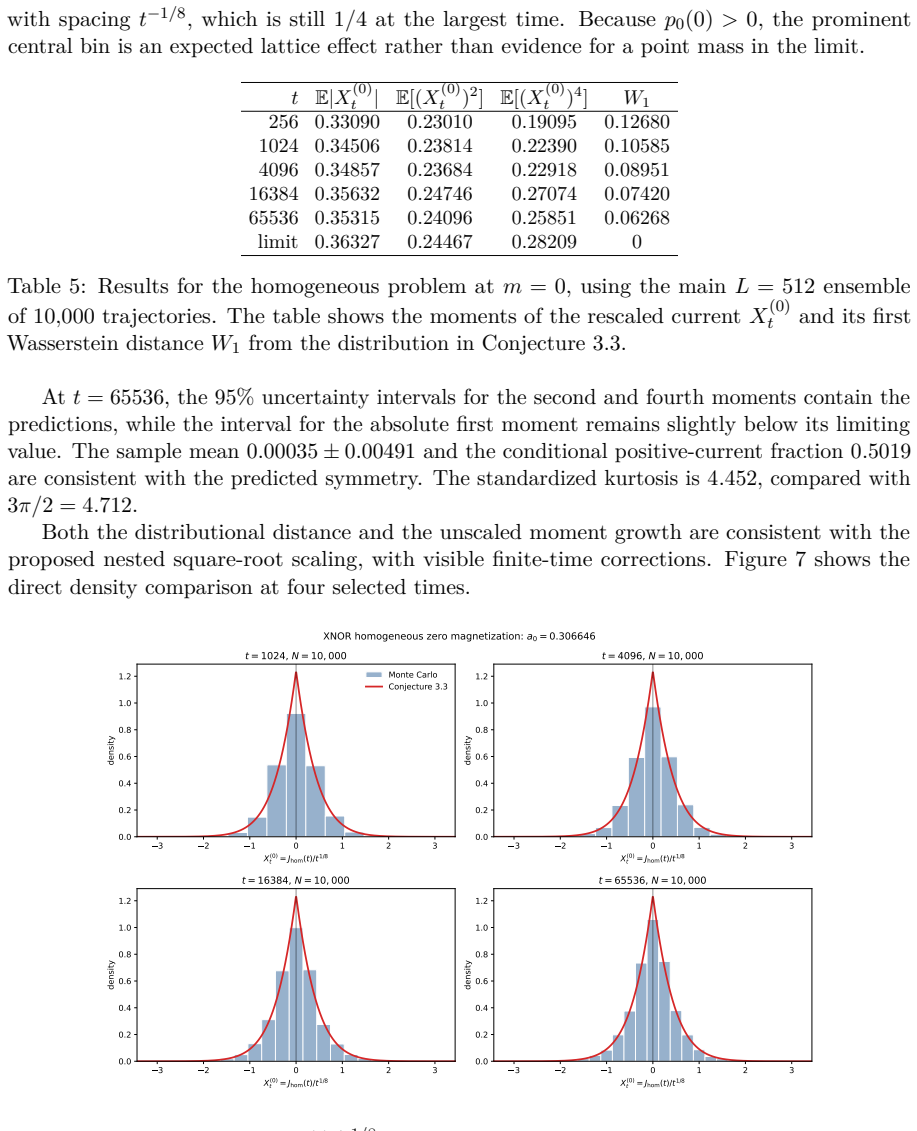
- [§5.3] At the largest m=0 time the lattice spacing t^{-1/8} = 1/4 is the same order as the reported W1 distance (0.0627); a sentence explaining how the lattice discretisation is excluded from the W1 comparison would help the reader interpret the remaining distance.
- [§4.4, Ref. [22]] Given that the pivotal estimates of Section 4 are delegated to [22], the manuscript would benefit from identifying which numbered statements in [22] correspond to the uniform bound on E_t and to the bound Q_t - Q̄_t = O_P(1) used in Section 4.6, so that the dependency structure is checkable.
- [§3.4, Eq. (23)] The SSEP domain-wall fluctuation variance Σ²_{SSEP,dw}(m) is quoted without a pointer to the exact expression in Ref. [26]; a one-line indication would help the reader verify the formula.
Circularity Check
No circularity: the amplitudes are derived from the classical SSEP tagged-particle variance and microscopic gap statistics; no fitted parameter is relabeled as a prediction.
full rationale
All three conjectures' constants are obtained by explicit algebra from independent inputs, not by fitting or by importing the target law. Eq. (40) multiplies the classical SSEP tagged-hole variance 2ρ/√π (Arratia [27]; Peligrad–Sethuraman [28]) by δϑ_m = m, with ρ=(1−m²)/(3+m²) from the geometric gap law (24); this yields σ_m² exactly as in Eq. (6). At m=0, Eq. (26) with ρ=1/3 gives G(0) variance 2/(3√π), and Eq. (36) gives V0=|G(0)|/2 with scale a0=1/(√6 π^{1/4}); averaging the conditional Gaussian reproduces p0(x) in Eq. (15). The local-equilibrium correction (Sec. 4.6) is a coupling bound |Q_b−Q̄_b|≤2D with an exponentially-tailed D, independent of the target distributions. The weak-convergence inputs come from external classical SSEP results, not from this paper or its self-citations. The admitted unverified companion [22] is used only for the candidate proof of technical endpoint estimates (Eq. (32), domain-wall seam, moment convergence); Sec. 1.2 explicitly labels it unverified, and the claims are presented as conjectures with parameter-free numerics. A deferral of proof is a rigor gap, not a circular reduction, because no equation is assumed equal to the claimed conclusion. Hence score 0.
Assumptions & free parameters
assumptions (3)
- standard math SSEP tagged-particle CLT: t^(-1/4) Q_t converges to N(0, 2 rho/sqrt(pi)) for equilibrium SSEP (Arratia; Peligrad-Sethuraman).
- ad hoc to paper Uniform counting fluctuation estimate |E_t| = O_P(t^(1/8)) over random tracer endpoints in the homogeneous cases, and the analogous t^(1/4)-scale estimate for the domain-wall seam.
- ad hoc to paper Uniform integrability and moment convergence estimates for the current variables.
Cite this review
Pith. "Pith review of Anomalous current fluctuations in the stochastic XNOR hopping model." pith.science (2026). https://pith.science/paper/D2ZZVILP
@misc{pith2026260810536,
  author       = {Pith},
  title        = {Pith review of: Anomalous current fluctuations in the stochastic XNOR hopping model},
  year         = {2026},
  howpublished = {\url{https://pith.science/paper/D2ZZVILP}},
  note         = {Machine review of arXiv:2608.10536}
}
abstract
We consider fluctuations of the spin current in the stochastic XNOR process, a kinetically constrained hopping model in one spatial dimension. We formulate three conjectures with explicit amplitudes for the long-time current distributions: a Gaussian limit on the $t^{1/4}$ scale for homogeneous initial states with nonzero magnetization, a half-normal limit on the $t^{1/4}$ scale for domain-wall states with opposite magnetizations, and an M-Wright limit on the $t^{1/8}$ scale for homogeneous initial states at zero magnetization. Earlier work identified the tracer mechanism and anticipated the scaling exponents and limiting shapes in the domain-wall and zero-magnetization settings. Starting from the microscopic XNOR dynamics, we predict the missing amplitudes for the continuous-time process and extend the picture to homogeneous biased initial data. Simulations provide numerical support for all three conjectures without fitted parameters. A separate mathematical companion paper presents an extensively AI-generated candidate proof. Generative-AI tools were used in the research and writing workflow.
Figures


Figures from the paper (5 more)



Reference graph
Works this paper leans on
-
[22]
Current fluctuations in the stochastic XNOR hopping process (An AI-generated candidate proof)
B. Pozsgay, “Current fluctuations in the stochastic XNOR hopping process (An AI-generated candidate proof).” Zenodo, July, 2026. https://doi.org/10.5281/zenodo.21496322
-
[1]
Absence of Normal Fluctuations in an Integrable Magnet
Ž. Krajnik, E. Ilievski, and T. Prosen, “Absence of Normal Fluctuations in an Integrable Magnet,”Phys. Rev. Lett.128(2022) 090604,arXiv:2109.13088 [cond-mat.stat-mech]
work page Pith review arXiv 2022
-
[2]
Exact Anomalous Current Fluctuations in a Deterministic Interacting Model,
Ž. Krajnik, J. Schmidt, V. Pasquier, E. Ilievski, and T. Prosen, “Exact Anomalous Current Fluctuations in a Deterministic Interacting Model,”Phys. Rev. Lett.128(2022) 160601, arXiv:2201.05126 [cond-mat.stat-mech]
arXiv 2022
-
[3]
Universal anomalous fluctuations in charged single-file systems,
Ž. Krajnik, J. Schmidt, V. Pasquier, T. Prosen, and E. Ilievski, “Universal anomalous fluctuations in charged single-file systems,”Phys. Rev. Research6(2024) 013260, arXiv:2208.01463 [cond-mat.stat-mech]
arXiv 2024
-
[4]
Fluctuations of stochastic charged cellular automata
Ž. Krajnik, K. Klobas, B. Bertini, and T. Prosen, “Fluctuations of stochastic charged cellular automata,”J. Stat. Mech.2025(2025) 053209,arXiv:2502.02509 [cond-mat.stat-mech]
work page Pith review arXiv 2025
-
[5]
Full Counting Statistics of Charge in Chaotic Many-Body Quantum Systems,
E. McCulloch, J. D. Nardis, S. Gopalakrishnan, and R. Vasseur, “Full Counting Statistics of Charge in Chaotic Many-Body Quantum Systems,”Phys. Rev. Lett.131(2023) 210402, arXiv:2302.01355 [quant-ph]
arXiv 2023
-
[6]
Non-Gaussian diffusive fluctuations in Dirac fluids
S. Gopalakrishnan, E. McCulloch, and R. Vasseur, “Non-Gaussian diffusive fluctuations in Dirac fluids,”Proc. Natl. Acad. Sci. U.S.A.121(2024) e2403327121,arXiv:2401.05494 [cond-mat.stat-mech]
work page Pith review arXiv 2024
-
[7]
Ballistic modes as a source of anomalous charge noise,
E. McCulloch, R. Vasseur, and S. Gopalakrishnan, “Ballistic modes as a source of anomalous charge noise,”Phys. Rev. E111(2025) 015410,arXiv:2407.03412 [cond-mat.stat-mech]
arXiv 2025
Show all 29 references
-
[8]
Ballistic macroscopic fluctuation theory,
B. Doyon, G. Perfetto, T. Sasamoto, and T. Yoshimura, “Ballistic macroscopic fluctuation theory,”SciPost Phys.15(2023) 136,arXiv:2206.14167 [cond-mat.stat-mech]. 25
2023 arXiv
-
[9]
Anomalous current fluctuations from Euler hydrodynamics,
T. Yoshimura and Ž. Krajnik, “Anomalous current fluctuations from Euler hydrodynamics,” Phys. Rev. E111(2025) 024141,arXiv:2406.20091 [cond-mat.stat-mech]
2025 arXiv
-
[10]
Exact Anomalous Current Fluctuations in Quantum Many-Body Dynamics,
K. Fujimoto, T. Ishiyama, T. Kurose, T. Yoshimura, and T. Sasamoto, “Exact Anomalous Current Fluctuations in Quantum Many-Body Dynamics,”arXiv e-prints(2026) , arXiv:2602.24008 [cond-mat.stat-mech]
2026
-
[11]
The Folded Spin-1/2 XXZ Model: I. Diagonalisation, Jamming, and Ground State Properties,
L. Zadnik and M. Fagotti, “The Folded Spin-1/2 XXZ Model: I. Diagonalisation, Jamming, and Ground State Properties,”SciPost Phys. Core4(2021) 010,arXiv:2009.04995 [cond-mat.stat-mech]
2021 arXiv
-
[12]
An integrable spin chain with Hilbert space fragmentation and solvable real time dynamics,
B. Pozsgay, T. Gombor, A. Hutsalyuk, Y. Jiang, L. Pristyák, and E. Vernier, “An integrable spin chain with Hilbert space fragmentation and solvable real time dynamics,” Phys. Rev. E104(2021) 044106,arXiv:2105.02252 [cond-mat.stat-mech]
2021 arXiv
-
[13]
Integrable hard rod deformation of the Heisenberg spin chains,
B. Pozsgay, T. Gombor, and A. Hutsalyuk, “Integrable hard rod deformation of the Heisenberg spin chains,”Phys. Rev. E104(2021) 064124,arXiv:2108.13724 [cond-mat.stat-mech]
2021 arXiv
-
[14]
Ergodicity Breaking Arising from Hilbert Space Fragmentation in Dipole-Conserving Hamiltonians,
P. Sala, T. Rakovszky, R. Verresen, M. Knap, and F. Pollmann, “Ergodicity Breaking Arising from Hilbert Space Fragmentation in Dipole-Conserving Hamiltonians,”Phys. Rev. X10(2020) 011047,arXiv:1904.04266 [cond-mat.str-el]
2020 arXiv
-
[15]
Localization from Hilbert space shattering: From theory to physical realizations,
V. Khemani, M. Hermele, and R. Nandkishore, “Localization from Hilbert space shattering: From theory to physical realizations,”Phys. Rev. B101(2020) 174204,arXiv:1910.01137 [cond-mat.stat-mech]
2020 arXiv
-
[16]
Hilbert Space Fragmentation and Commutant Algebras,
S. Moudgalya and O. I. Motrunich, “Hilbert Space Fragmentation and Commutant Algebras,”Phys. Rev. X12(2022) 011050,arXiv:2108.10324 [cond-mat.stat-mech]
2022 arXiv
-
[17]
Conservation laws and integrability of a one-dimensional model of diffusing dimers,
G. I. Menon, M. Barma, and D. Dhar, “Conservation laws and integrability of a one-dimensional model of diffusing dimers,”Journal of Statistical Physics86(1997) 1237–1263,arXiv:cond-mat/9703059 [cond-mat.stat-mech]
1997 arXiv
-
[18]
Subdiffusion and Many-Body Quantum Chaos with Kinetic Constraints,
H. Singh, B. A. Ware, R. Vasseur, and A. J. Friedman, “Subdiffusion and Many-Body Quantum Chaos with Kinetic Constraints,”Phys. Rev. Lett.127(2021) 230602, arXiv:2108.02205 [cond-mat.stat-mech]
2021 arXiv
-
[19]
Emergent tracer dynamics in constrained quantum systems,
J. Feldmeier, W. Witczak-Krempa, and M. Knap, “Emergent tracer dynamics in constrained quantum systems,”Phys. Rev. B106(2022) 094303,arXiv:2205.07901 [cond-mat.str-el]
2022 arXiv
-
[20]
Distinct universality classes of diffusive transport from full counting statistics,
S. Gopalakrishnan, A. Morningstar, R. Vasseur, and V. Khemani, “Distinct universality classes of diffusive transport from full counting statistics,”Phys. Rev. B109(2024) 024417, arXiv:2203.09526 [cond-mat.stat-mech]
2024 arXiv
-
[21]
Anomalous transport from hot quasiparticles in interacting spin chains,
S. Gopalakrishnan and R. Vasseur, “Anomalous transport from hot quasiparticles in interacting spin chains,”Rep. Prog. Phys.86(2023) 036502,arXiv:2208.11133 [cond-mat.str-el]
2023 arXiv
-
[23]
Leiden Declaration on Artificial Intelligence and Mathematics
J. Alper, M. J. Barany, A. C. Villarello, S. Dahmen, W. Dean, K. Ganapathy, M. Harris, D. Holmes, M. Jamnik, S. Kelk, B. Kra, U. Martin, B. Naskręcki, R. Ochigame, J. Portegies, and J. Schmitt, “Leiden Declaration on Artificial Intelligence and Mathematics.” Zenodo, June, 2026...
2026 doi
-
[24]
Spohn,Large Scale Dynamics of Interacting Particles
H. Spohn,Large Scale Dynamics of Interacting Particles. Springer, 1991
1991
-
[25]
Kipnis and C
C. Kipnis and C. Landim,Scaling Limits of Interacting Particle Systems. Springer, 1999
1999
-
[26]
Current Fluctuations of the One Dimensional Symmetric Simple Exclusion Process with Step Initial Condition,
B. Derrida and A. Gerschenfeld, “Current Fluctuations of the One Dimensional Symmetric Simple Exclusion Process with Step Initial Condition,”Journal of Statistical Physics136 (2009) no. 1, 1–15,arXiv:0902.2364 [cond-mat.stat-mech]
2009 arXiv
-
[27]
The motion of a tagged particle in the simple symmetric exclusion system on Z,
R. Arratia, “The motion of a tagged particle in the simple symmetric exclusion system on Z,”Annals of Probability11(1983) 362–373
1983
-
[28]
On fractional Brownian motion limits in one-dimensional nearest-neighbor symmetric simple exclusion,
M. Peligrad and S. Sethuraman, “On fractional Brownian motion limits in one-dimensional nearest-neighbor symmetric simple exclusion,”ALEA Latin American Journal of Probability and Mathematical Statistics4(2008) 245–255,arXiv:0711.0017 [math.PR]
2008 arXiv
-
[29]
A General Method for Numerically Simulating the Stochastic Time Evolution of Coupled Chemical Reactions,
D. T. Gillespie, “A General Method for Numerically Simulating the Stochastic Time Evolution of Coupled Chemical Reactions,”Journal of Computational Physics22(1976) no. 4, 403–434. 27
1976
Reviewed August 15, 2026 · model on record in the stance chip above.
Discussion (0). Continue with ORCID to comment.