REVIEW 3 major objections 4 minor 42 references
Self-Geometry: GT-Free and Plug-and-Play Test-Time Adaptation for Geometrically Consistent 3D Vision Foundation Models
T0 review · 3 major / 4 minor · reviewed 2026-08-12 · deepseek-v4-flash
Pith's one-line read This paper claims that pretrained 3D vision foundation models can be made geometrically consistent at test time, without any ground truth, by using 2D pixel correspondences as pseudo ground truth, and that this adaptation improves both…
desk verdict Genuinely new TTA recipe for 3D VFMs, but the headline numbers rest on selecting the checkpoint that minimizes the adaptation loss itself, so the 'consistent improvements' claim is not yet established. read the letter →
The pith
A machine-rendered reading of the paper's core claim, the machinery that carries it, and where it could break.
The reading
What carries the argument
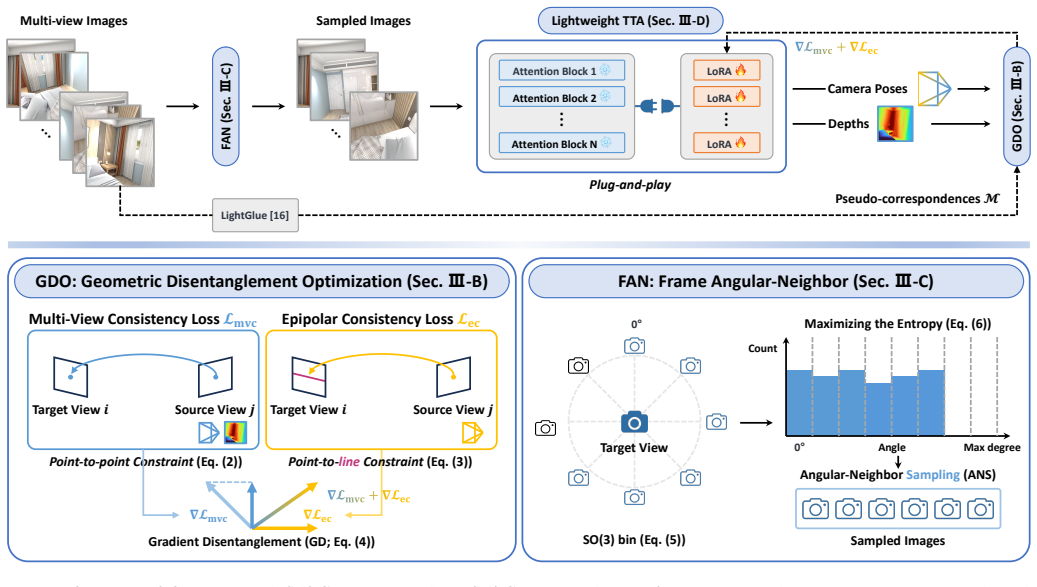
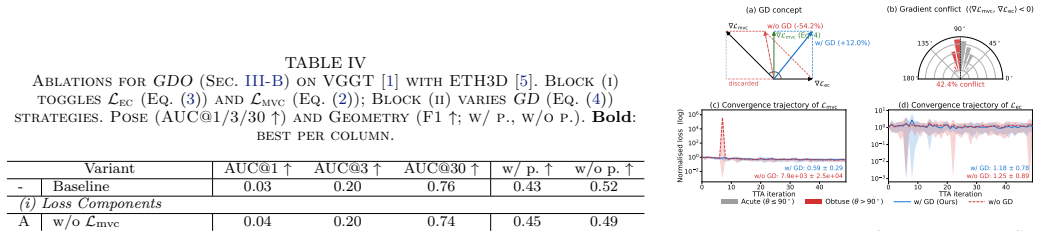
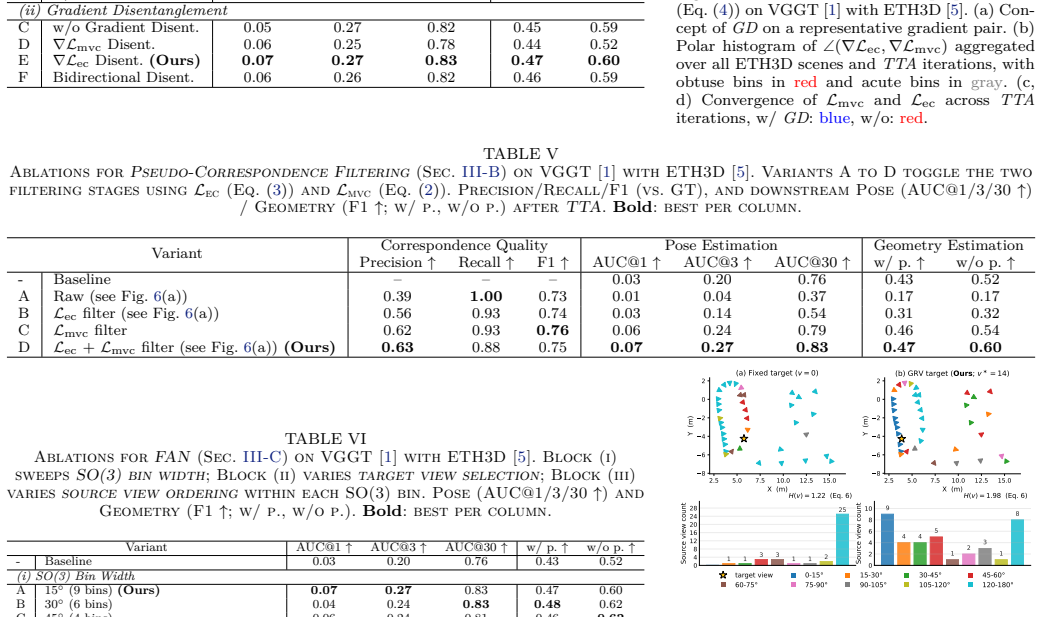
The central machinery is Geometric Disentanglement Optimization, which pairs a point-to-point Multi-View Consistency Loss (reprojection error against pseudo-correspondences) with a point-to-line Epipolar Consistency Loss (Sampson distance against predicted fundamental matrices) and applies Gradient Disentanglement—projecting the Multi-View gradient onto the orthogonal complement of the Epipolar gradient—so the two losses refine pose and depth complementarily. Frame Angular-Neighbor sampling uses SO(3) geodesic distances to select a target view with maximum angular-bin entropy and to sample source views uniformly across bins, and Lightweight Test-Time Adaptation updates only LoRA parameters inserted into the attention blocks' QKV weights, keeping the pretrained model frozen and enabling per-scene adaptation within two minutes.
What would settle it
Run Self-Geometry on a benchmark of textureless or repetitive-texture scenes with known camera poses, measure LightGlue correspondence precision against ground truth, and check whether pose AUC and geometry F1 improvements vanish when precision falls below a threshold; alternatively, replace the LightGlue correspondences with random matches of the same count—if adaptation still improves, the pseudo-correspondences are not the cause, and if it degrades sharply, the claim's reliance on matcher quality is confirmed.
Extended reading notes
Core claim
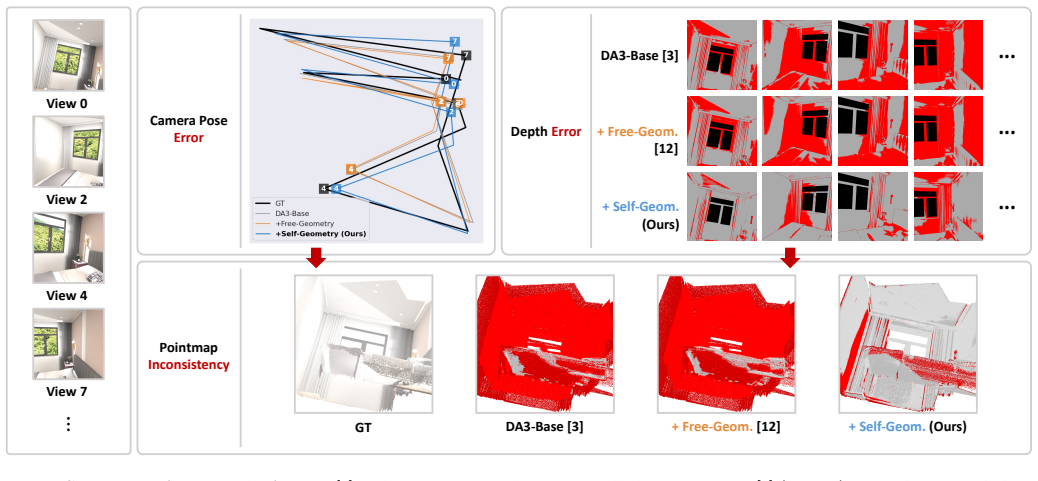
Self-Geometry establishes that 2D pixel correspondences—extracted once by LightGlue at scene initialization—provide explicit multi-view geometric supervision that can be imposed on any pretrained vision foundation model at test time without ground-truth labels or a teacher model. The Multi-View Consistency Loss supervises both camera pose and depth through point-to-point reprojection, while the Epipolar Consistency Loss supervises pose alone through a point-to-line Sampson distance, resolving the pose-depth ambiguity. Because both losses act on pose, the method projects the Multi-View Consistency gradient onto the orthogonal complement of the Epipolar Consistency gradient, preventing the gradient conflict that otherwise appears in 42.4% of iterations on the ETH3D scenes tested. Frame Angular-Neighbor sampling selects a target view with maximal SO(3)-bin entropy and samples source views across angular bins, while LoRA adapters inserted into QKV attention weights keep the model mostly frozen. The combination yields consistent Mean improvements in pose AUC and geometry F1 over six VFMs—VGGT, pi3, and four Depth Anything 3 variants—and four benchmarks, with the largest relative gains on wide-baseline outdoor scenes and on smaller, under-fitted models.
Load-bearing premise
The external feature matcher's 2D pixel correspondences are accurate and dense enough to serve as ground truth for geometric supervision; if the matcher returns sparse or wrong matches on textureless, repetitive, or wide-baseline scenes, both the epipolar and reprojection losses give weak or misleading gradients and the filtering step can reinforce the model's own errors.
Editorial extensions
If this is right
- Frozen 3D vision foundation models can be specialized to a target scene using only image pairs and a matcher, with no ground-truth poses, depths, or teacher networks, which removes the main data bottleneck for scene-level adaptation.
- Explicit geometric constraints outperform implicit self-consistency from model outputs, so future test-time adaptation methods should consider directly supervising with epipolar and reprojection errors rather than distilling predictions.
- The gains concentrate where the pretrained model is weakest: wide-baseline outdoor scenes and small under-fitted model variants, suggesting the method is a practical way to extend the useful range of smaller deployable models.
- The pipeline is architecture-agnostic, working on VGGT, pi3, and Depth Anything 3 variants without per-backbone redesign, so it can be attached to newly released geometric foundation models as a plug-in.
- Per-scene adaptation on a single GPU within roughly two minutes makes the method usable in practical reconstruction pipelines, where it competes with per-scene optimization costs at a fraction of the compute.
Reading between the lines
- The method's dependence on matcher quality suggests a natural stress test: on textureless or repetitive-texture scenes where LightGlue precision drops, improvement should shrink; if it does not, the losses are not actually driven by the pseudo-correspondences, which would indicate a different mechanism is at work.
- The gradient-disentanglement idea is not specific to epipolar versus reprojection losses; it could transfer to other multi-task test-time settings where two losses supervise overlapping parameters with conflicting gradients, though the paper does not claim this.
- The success of per-scene adaptation with explicit geometric losses hints that the same supervision could be added directly to VFM pretraining on pseudo-correspondences from unlabeled video, potentially making test-time adaptation unnecessary for the most common failure modes.
- Because the largest relative gains appear on small, under-fitted models, the method could also serve as a diagnostic signal for where a foundation model's geometric prior is weak, guiding where more pretraining data or capacity is needed.
Signed reviews
Editorial analysis
A structured set of objections, weighed in public.
Referee Report
Summary. The paper proposes Self-Geometry, a test-time adaptation (TTA) pipeline for pretrained multi-view 3D vision foundation models (VFMs). The method extracts 2D pixel correspondences with LightGlue and uses them as pseudo ground truth for explicit geometric losses: a point-to-point Multi-View Consistency (MVC) loss on reprojection and a point-to-line Epipolar Consistency (EC) loss based on the Sampson distance. Gradient Disentanglement projects the MVC gradient away from the EC gradient to reduce conflict, Frame Angular-Neighbor (FAN) selects target/source views using SO(3) geodesic distances, and lightweight LoRA adapters are updated per scene. The authors report pose and geometry improvements over frozen VFMs and two TTA baselines across six VFMs (VGGT, π3, DA3-Giant/Large/Base/Small) and four datasets (7Scenes, ETH3D, ScanNet++, HiRoom).
Significance. If the reported gains are robust, Self-Geometry would be a practically valuable, GT-free, teacher-free, architecture-agnostic test-time adaptation recipe, and the explicit-use of correspondences as pseudo-GT is a well-motivated departure from implicit self-consistency methods. The paper is commendable for its clear component-wise ablations (Tables IV–VI), a complexity analysis (Table VII), and for evaluating across a broad set of VFMs and benchmarks. However, the central empirical claim of 'consistent improvements' currently rests on a checkpoint-selection rule that is itself based on the training objective, and the small effect sizes in many settings make this a load-bearing issue rather than a presentation concern.
major comments (3)
- [§IV-A and Algorithm 1 (lines 15–17)] The reported results select, per scene, the TTA checkpoint that minimizes the self-supervised metric sqrt(L_ec * L_mvc), i.e., the best of 50 iterations with respect to the very objective being optimized. Because L_ec and L_mvc are computed from the same LightGlue pseudo-correspondences that drive adaptation, this is a form of self-selection that can artifactually favor the iteration most overfit to match noise. The paper provides no per-iteration ground-truth curves and no evaluation at a fixed iteration count, so it is unknown whether the best-training-loss checkpoint is also the best ground-truth checkpoint. This is load-bearing for the abstract claim of 'consistent improvements,' especially where mean gains are small (e.g., DA3-Giant-Ours Mean AUC@3 +1.5% in Table II and Mean geometry w/o p. +0.9% in Table III). Please report results with a fixed iteration rule (e.g., iteration 50) alongside the selection-based results, and provide per-iteration GT curves or a scatter plot of training-loss vs. GT error across iterations; error bars across scenes are also needed.
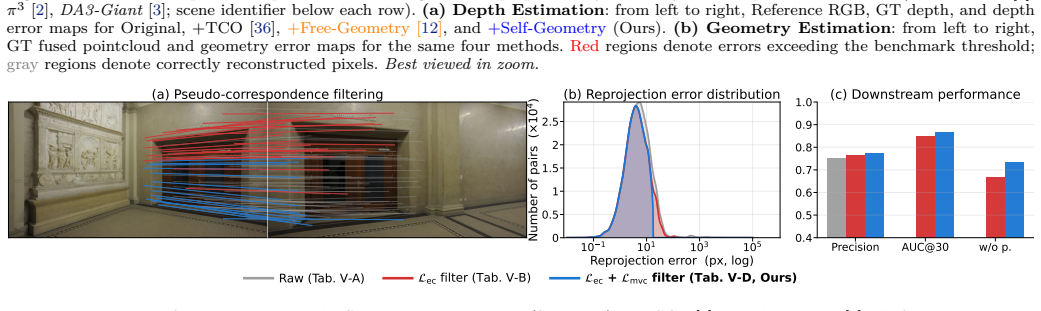
- [§III-B 'Pseudo-Correspondence Filtering' vs. Algorithm 1] There is a direct inconsistency between the method description and the algorithm. The text states that filtering is applied 'before every TTA iteration' using the model's current predictions, but Algorithm 1 applies filtering only once at initialization (line 2), before the loop begins. These two readings have different implications: per-iteration filtering creates a feedback loop in which the adapted model's own (possibly erroneous) poses/depths prune the supervision set, which could reinforce drift; one-time filtering keeps the pseudo-GT fixed during adaptation. The paper must clarify which implementation is actually used. If filtering is per-iteration, report the sensitivity to filter thresholds and demonstrate that the adapted model's predictions do not progressively bias the correspondence set; if it is one-time, correct the text in §III-B.
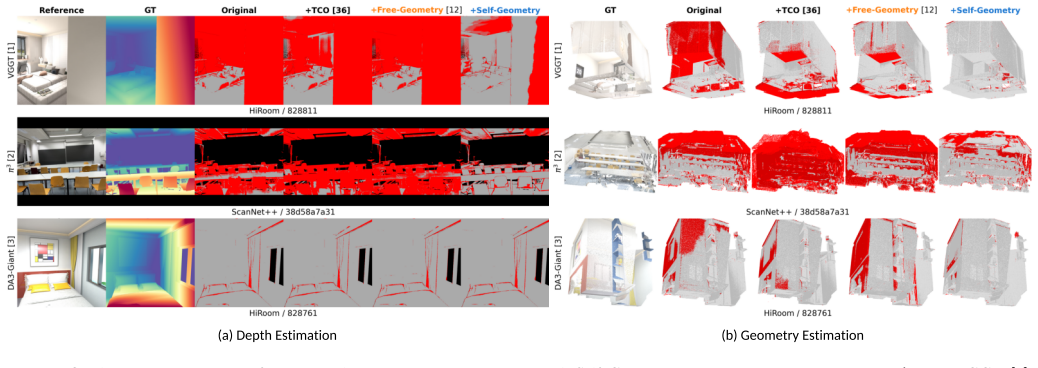
- [Tables II and III] The claim of 'consistent improvements' is weakened by several negative entries that the text acknowledges but does not statistically assess: for VGGT-Ours, AUC@3 drops by 2.9% on ScanNet++ and 8.2% on HiRoom (Table II), and geometry F1 w/o p. drops by 10.6% and 7.5% (Table III); DA3-Giant-Ours and DA3-Large-Ours show near-zero or negative changes on several columns. The authors argue these are 'small absolute drops,' but without per-scene breakdowns, confidence intervals, or significance tests, it is not possible to distinguish genuine degradation from noise or to verify that the positive means are robust. Please supply per-scene results and a statistical summary (e.g., paired differences with confidence intervals or a sign-test across scenes).
minor comments (4)
- [Eq. (4)] The projection in Eq. (4) divides by ||∇Lec||^2; if ∇Lec is exactly zero, the update is undefined. Add a small epsilon or a guard for the zero-gradient case.
- [Table S.1 and §S.V] The text says every hyperparameter is used identically across all VFMs, but for π3 LoRA is inserted only into the encoder. Please clarify whether the 'identical settings' claim refers only to optimization hyperparameters and not to the adapter configuration.
- [Abstract and Table VII] The abstract and contributions state 'within two minutes per-scene,' but Table VII reports ETH3D totals of 3.29 min for VGGT and 5.36 min on 7Scenes for VGGT, with several other entries above two minutes. Please qualify the timing claim to the specific configuration for which it holds, or report the full distribution.
- [Figure 4 caption] The caption of Figure 4 contains a garbled string of Unicode escape-like tokens ('/uni00000150/...'), which appears to be a rendering artifact; it should be replaced with the intended scene identifiers or removed.
Circularity Check
Mild evaluation-loop circularity: the reported checkpoint is chosen as the minimizer of the TTA loss itself, and pseudo-GT filtering uses the adapting model's own predictions; the GT-based central claim is not definitionally forced.
-
fitted input called prediction
[Sec. IV-A Training Details; Algorithm 1 lines 15-17]
"We optimize each scene with AdamW [38] for 50 TTA iterations, selecting the checkpoint minimizing the scale-invariant√Lec·Lmvc (Eqs. (3) and (2))."
By Algorithm 1, the adapted model whose pose/geometry numbers are reported in Tables II and III is the argmin over 50 iterations of √(Lec·Lmvc), i.e., the same pseudo-correspondence losses that constitute the training objective. The reported 'consistent improvements' are therefore the best-of-50 checkpoint with respect to the self-supervised training signal, not a fixed-iteration or GT-validated selection rule. Without per-iteration GT curves, a fixed-iteration baseline, or error bars, the best self-supervised checkpoint may simply be the iteration most overfit to LightGlue noise, so the headline improvement is partly an artifact of this self-referential selection.
-
other
[Sec. III-B Pseudo-Correspondence Filtering]
"To remove them, before every TTA iteration, we sequentially apply the proposed EC Loss-based filter (Eq. (3)), followed by the proposed MVC Loss-based filter (Eq. (2)), to M."
The filter prunes the pseudo-correspondence supervision set using residuals computed from the very camera poses and depths that are being adapted; the EC and MVC losses are then minimized on the remaining set. A small final loss can therefore indicate that the model has become self-consistent with a correspondence set that the model itself selected, rather than that the supervision independently certifies geometric correctness. Since the initial correspondences come from an external matcher (LightGlue) and the final pose/geometry metrics are evaluated against GT, this is a feedback loop rather than a definitional equivalence, but it is a genuine self-referential element of the derivation chain.
full rationale
The central derivation is not circular in the strong sense: the pseudo-GT comes from an external feature matcher (LightGlue), the EC and MVC losses are standard epipolar and reprojection constraints, and the reported pose/geometry improvements are measured against GT, so the headline result is not equal by construction to the loss being minimized. There is no load-bearing self-citation chain and no imported uniqueness theorem. However, two self-referential choices weaken the derivation: (1) checkpoint selection is performed by minimizing the same √(Lec·Lmvc) objective used for adaptation, and the paper provides no per-iteration GT curves, fixed-iteration baseline, or error bars to show that the training-loss-optimal checkpoint is also GT-optimal; (2) pseudo-correspondence filtering uses the adapting model's current predictions to prune the supervision set, allowing the model to influence which pseudo-GT it is supervised by. Both issues are disclosed in the paper and are best characterized as evaluation-loop and robustness concerns rather than definitional circularity; the multi-benchmark GT improvements retain independent empirical content. The paper's own Limitations section (Sec. S.VI) acknowledges the matcher-dependence bound, which is a correctness risk rather than a circularity. Score 3 reflects the mild but real self-referential evaluation loop.
Assumptions & free parameters
free parameters (8)
- SO(3) bin width (delta_theta) =
15 degrees
- LoRA rank r =
64
- LoRA alpha =
64
- Learning rate =
5e-5
- TTA iterations T =
50
- Baseline depth consistency quantile q =
0.5
- DWA temperature T =
1.0
- Huber threshold estimation =
MAD-based with top 10% outlier removal
assumptions (6)
- domain assumption 2D pixel correspondences from LightGlue are sufficiently accurate and dense to serve as pseudo ground-truth for geometric supervision.
- domain assumption The predicted camera intrinsics K_i from the VFM are accurate, since both losses use K_i to compute reprojections and the fundamental matrix.
- domain assumption The pretrained VFM provides a strong prior such that small LoRA updates around it (0.7-3.4% params) can improve scene-specific geometry without catastrophic drift.
- domain assumption SO(3) geodesic distance alone (ignoring translation) is a sufficient proxy for scene coverage and information gain in view sampling.
- standard math Epipolar geometry and Sampson distance correctly quantify geometric inconsistency under the pinhole model.
- standard math Gradient projection onto the orthogonal complement preserves the beneficial effect of the projected gradient while removing conflict.
Cite this review
Pith. "Pith review of Self-Geometry: GT-Free and Plug-and-Play Test-Time Adaptation for Geometrically Consistent 3D Vision Foundation Models." pith.science (2026). https://pith.science/paper/A4T6TPDS
@misc{pith2026260810708,
  author       = {Pith},
  title        = {Pith review of: Self-Geometry: GT-Free and Plug-and-Play Test-Time Adaptation for Geometrically Consistent 3D Vision Foundation Models},
  year         = {2026},
  howpublished = {\url{https://pith.science/paper/A4T6TPDS}},
  note         = {Machine review of arXiv:2608.10708}
}
abstract
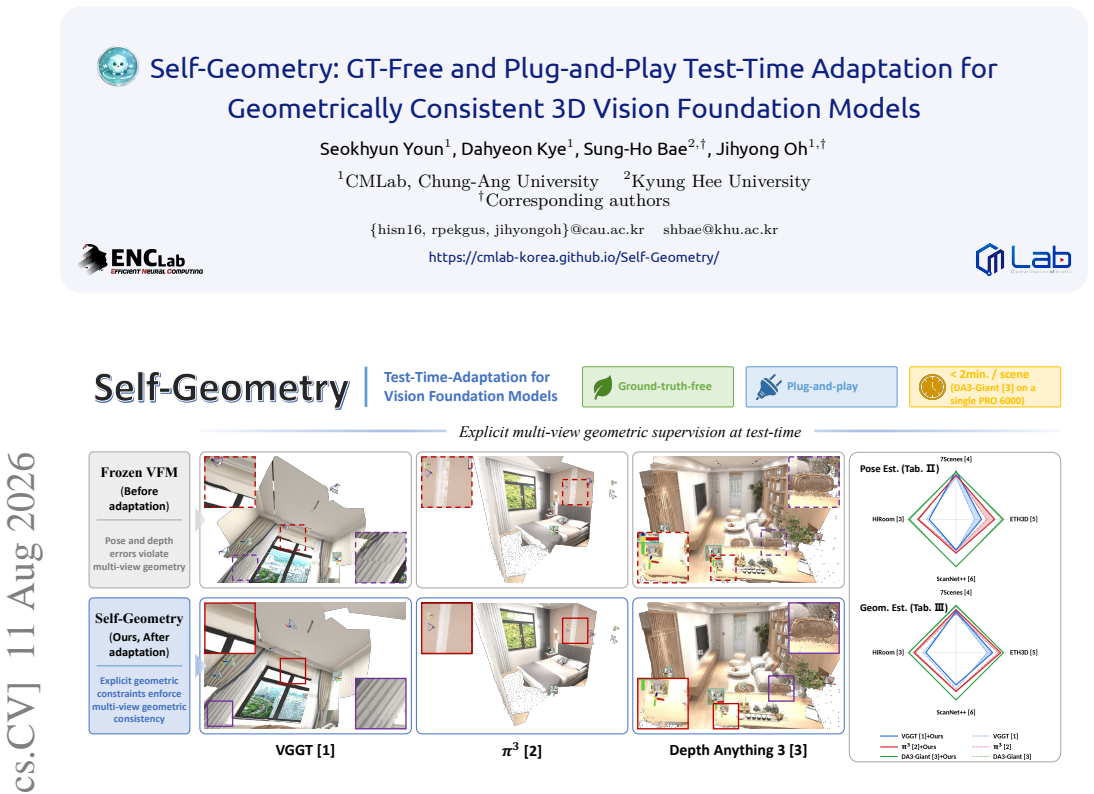
Recent Vision Foundation Models (VFMs) predict depth, camera pose, and pointmap in a single forward pass without per-scene optimization, achieving strong generalization. However, enforcing explicit multi-view geometric consistency, e.g., through bundle adjustment, is computationally costly and is thus not imposed during VFM pretraining, so such inconsistency can arise. To address this, implicit self-consistency derived from model outputs (e.g., pointmaps, features), though enforced at test-time in prior work, delivers inherently limited performance gain, especially on scenes where the pretrained VFM is highly inaccurate. In contrast to this implicit signal, we propose Self-Geometry, a plug-and-play test-time adaptation pipeline that directly imposes explicit multi-view geometric constraints using 2D pixel correspondences as pseudo ground-truth. Our proposed Self-Geometry consists of Geometric Disentanglement Optimization, which combines Multi-View Consistency and Epipolar Consistency losses with Gradient Disentanglement to prevent gradient conflict; Frame Angular-Neighbor, a view sampler based on SO(3) geodesic distances for lightly imposing these constraints; and Lightweight TTA, which adapts VFMs via LoRA. Our method achieves consistent improvements in both pose and geometry estimation across six VFMs (VGGT, $\pi^3$, DA3-Giant/Large/Base/Small) and four benchmarks (7Scenes, ETH3D, ScanNet++, HiRoom).
Figures
Figures from the paper (4 more)
Reference graph
Works this paper leans on
-
[1]
VGGT: Visual geometry grounded transformer,
J. Wang, M. Chen, N. Karaev, A. Vedaldi, C. Rupprecht, and D. Novotny, “VGGT: Visual geometry grounded transformer,” in CVPR, 2025
work page 2025
-
[2]
π3: Scalable permutation-equivariant visual geometry learning,
Y. Yang et al. , “ π3: Scalable permutation-equivariant visual geometry learning,” arXiv, 2025
work page 2025
-
[3]
Depth anything 3: Recovering the visual space from any views,
H. Lin et al. , “Depth anything 3: Recovering the visual space from any views,” arXiv, 2025
work page 2025
-
[4]
Scene coordinate regression forests for camera relocalization in RGB-D images,
J. Shotton, B. Glocker, C. Zach, S. Izadi, A. Criminisi, and A. Fitzgibbon, “Scene coordinate regression forests for camera relocalization in RGB-D images,” in CVPR, 2013
work page 2013
-
[5]
A multi-view stereo benchmark with high-resolution images and multi-camera videos,
T. Schöps, J. L. Schönberger, S. Galliani, T. Sattler, K. Schindler, M. Pollefeys, and A. Geiger, “A multi-view stereo benchmark with high-resolution images and multi-camera videos,” in CVPR, 2017
work page 2017
-
[6]
ScanNet++: A high-fidelity dataset of 3D indoor scenes,
C. Yeshwanth, Y.-C. Liu, M. Nießner, and A. Dai, “ScanNet++: A high-fidelity dataset of 3D indoor scenes,” in ICCV, 2023
work page 2023
-
[7]
R. Hartley and A. Zisserman, Multiple View Geometry in Com- puter Vision , 2nd ed. Cambridge University Press, 2003
work page 2003
-
[8]
Structure-from-motion revisited,
J. L. Schönberger and J.-M. Frahm, “Structure-from-motion revisited,” in CVPR, 2016
work page 2016
Show all 42 references
-
[9]
Bundle adjustment — a modern synthesis,
B. Triggs, P. F. McLauchlan, R. I. Hartley, and A. W. Fitzgib- bon, “Bundle adjustment — a modern synthesis,” in Vision Algorithms: Theory and Practice , 2000
2000
-
[10]
On geometric understanding and learned data priors in vggt,
J. Bratulić, S. Mittal, T. Brox, and C. Rupprecht, “On geometric understanding and learned data priors in vggt,” arXiv preprint arXiv:2512.11508, 2025
2025
-
[11]
Selfi: Self improving reconstruc- tion engine via 3D geometric feature alignment,
H. Deng, Y. Song, J. Jiang, K. Heal, T. Sun, J. Flynn, S. Marschner, and L. Chai, “Selfi: Self improving reconstruc- tion engine via 3D geometric feature alignment,” arXiv, 2025, arXiv:2512.08930
2025
-
[12]
Free geometry: Test-time adaptation for multi-view 3D reconstruction,
Y. Dai and X. Yang, “Free geometry: Test-time adaptation for multi-view 3D reconstruction,” arXiv, 2026, arXiv:2604.14048
2026 arXiv
-
[13]
Test-time training with self-supervision for generalization un- der distribution shifts,
Y. Sun, X. Wang, Z. Liu, J. Miller, A. A. Efros, and M. Hardt, “Test-time training with self-supervision for generalization un- der distribution shifts,” in ICML, 2020
2020
-
[14]
Tent: Fully test-time adaptation by entropy minimization,
D. Wang, E. Shelhamer, S. Liu, B. Olshausen, and T. Darrell, “Tent: Fully test-time adaptation by entropy minimization,” in ICLR, 2021
2021
-
[15]
Continual test- time domain adaptation,
Q. Wang, O. Fink, L. Van Gool, and D. Dai, “Continual test- time domain adaptation,” in CVPR, 2022
2022
-
[16]
LightGlue: Local feature matching at light speed,
P. Lindenberger, P.-E. Sarlin, and M. Pollefeys, “LightGlue: Local feature matching at light speed,” in ICCV, 2023
2023
-
[17]
Digging into self-supervised monocular depth estimation,
C. Godard, O. Mac Aodha, M. Firman, and G. J. Brostow, “Digging into self-supervised monocular depth estimation,” in ICCV, 2019
2019
-
[18]
Unsupervised learning of depth and ego-motion from video,
T. Zhou, M. Brown, N. Snavely, and D. G. Lowe, “Unsupervised learning of depth and ego-motion from video,” in CVPR, 2017
2017
-
[19]
A computer algorithm for reconstruct- ing a scene from two projections,
H. C. Longuet-Higgins, “A computer algorithm for reconstruct- ing a scene from two projections,” Nature, 1981
1981
-
[20]
Gradient surgery for multi-task learning,
T. Yu, S. Kumar, A. Gupta, S. Levine, K. Hausman, and C. Finn, “Gradient surgery for multi-task learning,” in NeurIPS, 2020
2020
-
[21]
A micro Lie theory for state estimation in robotics,
J. Solà, J. Deray, and D. Atchuthan, “A micro Lie theory for state estimation in robotics,” arXiv, 2018. 10
2018
-
[22]
LoRA: Low-rank adaptation of large language models,
E. J. Hu, Y. Shen, P. Wallis, Z. Allen-Zhu, Y. Li, S. Wang, L. Wang, and W. Chen, “LoRA: Low-rank adaptation of large language models,” in ICLR, 2022
2022
-
[23]
NVIDIA RTX PRO 6000 Blackwell Workstation Edition,
NVIDIA Corporation, “NVIDIA RTX PRO 6000 Blackwell Workstation Edition,” https://www.nvidia.com/ en-us/products/workstations/professional-desktop-gpus/ rtx-pro-6000/ , 2025, product datasheet
2025
-
[24]
DUSt3R: Geometric 3D vision made easy,
S. Wang, V. Leroy, Y. Cabon, B. Chidlovskii, and J. Revaud, “DUSt3R: Geometric 3D vision made easy,” in CVPR, 2024
2024
-
[25]
Grounding image matching in 3D with MASt3R,
V. Leroy, Y. Cabon, and J. Revaud, “Grounding image matching in 3D with MASt3R,” in ECCV, 2024
2024
-
[26]
Continuous 3D perception model with persistent state,
Q. Wang, Y. Zhang, A. Holynski, A. A. Efros, and A. Kanazawa, “Continuous 3D perception model with persistent state,” arXiv, 2025, arXiv:2501.12387
2025 arXiv
-
[27]
Align3R: Aligned monocular depth estimation for dynamic videos,
J. Lu, T. Huang, P. Li, Z. Dou, C. Lin, Z. Cui, Z. Dong, S.-K. Ye- ung, W. Wang, and Y. Liu, “Align3R: Aligned monocular depth estimation for dynamic videos,” arXiv, 2024, arXiv:2412.03079
2024 arXiv
-
[28]
Pow3R: Empowering unconstrained 3D reconstruction with camera and scene priors,
W. Jang, P. Weinzaepfel, V. Leroy, L. Agapito, and J. Revaud, “Pow3R: Empowering unconstrained 3D reconstruction with camera and scene priors,” arXiv, 2025, arXiv:2503.17316
2025 arXiv
-
[29]
Mono3R: Exploiting monocular cues for geometric 3D reconstruction,
W. Li, S. Liu, P. Qiao, and Y. Dou, “Mono3R: Exploiting monocular cues for geometric 3D reconstruction,” arXiv, 2025, arXiv:2504.13419
2025 arXiv
-
[30]
Fin3R: Fine-tuning feed-forward 3D reconstruction models via monocular knowl- edge distillation,
W. Ren, H. Wang, X. Tan, and K. Han, “Fin3R: Fine-tuning feed-forward 3D reconstruction models via monocular knowl- edge distillation,” in NeurIPS, 2025
2025
-
[31]
Test3R: Learning to reconstruct 3D at test time,
Y. Yuan et al. , “Test3R: Learning to reconstruct 3D at test time,” arXiv, 2025
2025
-
[32]
SelfEvo: Self-improving 4D perception via self-distillation,
SelfEvo Authors, “SelfEvo: Self-improving 4D perception via self-distillation,” arXiv, 2026, arXiv:2604.08532
2026 arXiv
-
[33]
TTT3R: 3D reconstruction as test-time training,
TTT3R Authors, “TTT3R: 3D reconstruction as test-time training,” arXiv, 2025, arXiv:2509.26645
2025 arXiv
-
[34]
Online3R: Online test-time learning for sequen- tial 3D reconstruction,
X. Zhou et al., “Online3R: Online test-time learning for sequen- tial 3D reconstruction,” arXiv, 2026, arXiv:2604.09480
2026 arXiv
-
[35]
LoRA3D: Low-rank self-calibration of 3D geomet- ric foundation models,
Z. Lu et al. , “LoRA3D: Low-rank self-calibration of 3D geomet- ric foundation models,” arXiv, 2024, arXiv:2412.07746
2024 arXiv
-
[36]
Learning 3D reconstruction with priors in test time,
L. Zhou, H. Wu, A. Dave, and D. Samaras, “Learning 3D reconstruction with priors in test time,” in CVPR, 2026
2026
-
[37]
Large scale multi-view stereopsis evaluation,
R. Jensen, A. Dahl, G. Vogiatzis, E. Tola, and H. Aanæs, “Large scale multi-view stereopsis evaluation,” in CVPR, 2014
2014
-
[38]
Decoupled weight decay regular- ization,
I. Loshchilov and F. Hutter, “Decoupled weight decay regular- ization,” in ICLR, 2019
2019
-
[39]
Image quality assessment: From error visibility to structural similarity,
Z. Wang, A. C. Bovik, H. R. Sheikh, and E. P. Simoncelli, “Image quality assessment: From error visibility to structural similarity,” IEEE Transactions on Image Processing , vol. 13, no. 4, pp. 600–612, 2004
2004
-
[40]
Szeliski, Computer Vision: Algorithms and Applications , 2nd ed
R. Szeliski, Computer Vision: Algorithms and Applications , 2nd ed. Springer, 2022
2022
-
[41]
End-to-end multi-task learning with attention,
S. Liu, E. Johns, and A. J. Davison, “End-to-end multi-task learning with attention,” in CVPR, 2019. 11 Supplementary Materials S.I. GitHub Repository The code will be released soon at https://github.com/ CMLab-Korea/Self-Geometry . S.II. Preliminary: Epipolar Geometry In this...
2019
-
[42]
Edge-aware Depth Smoothness Loss, Leds
(S.6) Here, SSIM denotes the structural similarity index [ 39] between two images, and α∈ [0, 1] is the mixing weight (α = 0.85). Edge-aware Depth Smoothness Loss, Leds. Follow- ing Monodepth2 [ 17], this loss encourages the depth map to remain discontinuous along image edges ...
Reviewed August 12, 2026 · model on record in the stance chip above.
Discussion (0). Continue with ORCID to comment.