REVIEW 4 major objections 4 minor 31 references
TACTICL: Task-Aware Compression of Tabular ICL Models
T0 review · 4 major / 4 minor · reviewed 2026-08-12 · deepseek-v4-flash
Pith's one-line read TACTICL replaces up to 85% of transformer layers with lightweight adapters while keeping tabular accuracy and cutting inference cost.
desk verdict Useful, honestly-reported compression method for tabular ICL models — solid core experiments, but the ICL-preservation claim is only tested before fine-tuning, and the authors admit the gap. read the letter →
The pith
A machine-rendered reading of the paper's core claim, the machinery that carries it, and where it could break.
The reading
What carries the argument
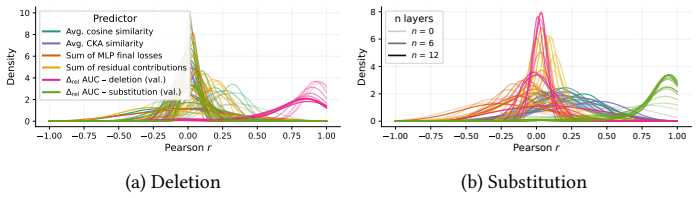
The engine of the method is layer substitution with a lightweight two-layer MLP adapter (hidden width 128, GELU activation, skip connection) that is trained, before the search, to approximate the input–output mapping of the transformer layer it will replace. A greedy search then iteratively removes the layer whose substitution hurts validation AUC (or RMSE) least, relying on the locality assumption that each layer decision can be made independently of the others. Optionally, a final fine-tuning stage updates only the adapter weights with a few epochs of AdamW on a mixture of downstream data and synthetic data from the model's pretraining prior, deliberately keeping all transformer weights frozen so that learning is confined to the in-weight pathway. The paper's evidence that cheap structural proxies such as cosine similarity, CKA similarity, residual contributions, or adapter reconstruction loss fail to predict which layers can be removed is what motivates using the task's own validation metric as the guiding signal.
What would settle it
Take a TACTICL-compressed and fine-tuned model at 85% compression, then evaluate it as a few-shot learner on a held-out tabular dataset from a different domain than the one used for compression, under the same context perturbations used in the paper (feature-order permutation, injected random features, label flips). If its performance on that new task is substantially worse than the full uncompressed model's performance under the same conditions, and the gap grows with compression depth, the claim that in-context ability remains intact would be falsified. A cheaper calculation would be to compare the fine-tuned compressed model's accuracy-versus-number-of-in-context-examples slope on an unseen task against the full model's slope; a flattened slope indicates the in-context circuitry was damaged rather than preserved.
Extended reading notes
Core claim
The central claim is that transformer depth in tabular in-context-learning models is highly redundant for any given task, and that the redundancy can be exploited task-by-task without collapsing the model into a pure in-weight learner. TACTICL does this by searching over which layers to drop or substitute, replacing removed layers with small MLP adapters trained to reconstruct the removed layer's hidden-state mapping, and then optionally fine-tuning only those adapters while every original transformer weight stays frozen. The authors report that on TabPFNv2.5, substituting up to 15 of 25 layers produces negligible performance degradation, and even at 85% compression classification AUC drops by only about 4% in the median, with inference speed-ups of 1.25x, 1.63x, and 2.83x at 25%, 50%, and 85% compression. They interpret the robustness of compressed models to perturbations and their negative cross-dataset transfer as evidence that the model has specialized to the downstream task while retaining in-context learning: the retained transformer layers can still read new contexts, and the adapters supply task-specific in-weight knowledge.
Load-bearing premise
The load-bearing premise is that a model's ability to learn from examples shown at inference time (in-context learning) and its ability to store task knowledge in its weights (in-weight learning) use separate internal circuits, so freezing all transformer layers and training only the small adapters can specialize the model to a task without damaging its in-context flexibility.
Editorial extensions
If this is right
- Tabular ICL models can be deployed at a fraction of their original inference cost: classification speed-ups are 1.25x, 1.63x, and 2.83x at 25%, 50%, and 85% compression, with median AUC effectively unchanged at 25–50% and roughly 4% lower at 85%.
- Because the transformer backbone is frozen, the compressed model is not a one-shot distillation artifact: a new task can be handled by training new adapters and rerunning the greedy search, keeping the model's in-context capability available for later tasks.
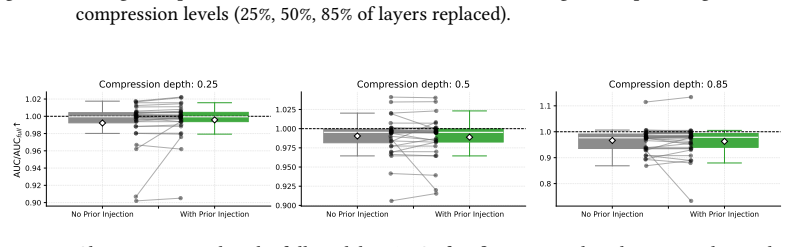
- Fine-tuning at low compression rates can recover performance lost during pruning and sometimes improve on the full model, so the same machinery doubles as a domain-adaptation mechanism rather than only a compression tool.
- No universal layer-removal order exists across datasets, so task-aware selection is necessary; the greedy search recovers more than 90% of the oracle configuration's AUC for up to eight substituted layers on TabPFNv2.
Reading between the lines
- Our inference: if the in-context/in-weight independence assumption transfers, the same layer-substitution recipe could be applied to other tabular in-context-learning models, and possibly to ICL-capable language models, with the adapter architecture and search metric adapted to each backbone.
- Our inference: because the paper offers no principled rule for choosing a compression budget, one could predict the accuracy-versus-depth tradeoff from dataset meta-features (sample size, feature count, class balance) and stop the greedy search at a target cost.
- Our inference: the authors note that they never directly measure the fine-tuned model's few-shot ICL performance; running that test before and after fine-tuning, with and without prior-data injection, would settle whether freezing the backbone truly protects in-context ability.
Signed reviews
Editorial analysis
A structured set of objections, weighed in public.
Referee Report
Summary. The paper introduces TACTICL, a framework for task-aware compression of tabular in-context-learning (ICL) transformers such as TabPFNv2.5. The method trains lightweight MLP adapters to approximate removed transformer layers, uses a greedy search guided by a held-out validation split to select which layers to substitute, and optionally fine-tunes only the adapter weights while freezing the backbone, with periodic injection of synthetic prior-distribution data. Experiments on 47 TabArena datasets (34 classification, 13 regression) are used to support claims of up to 85% layer substitution with modest median performance loss, inference speed-ups of about 1.25x/1.63x/2.83x at 25%/50%/85% compression, and retained robustness to input perturbations and cross-dataset transfer. The paper also reports that common structural proxies fail to predict layer importance and that the best layers to delete differ from the best layers to substitute.
Significance. If the central claims hold, TACTICL is practically valuable: it offers a way to reduce inference cost of tabular foundation models while retaining some in-context adaptability, with a structured search that avoids exhaustive enumeration. The paper has notable strengths: exhaustive oracle evaluation on TabPFNv2, a held-out search split for configuration selection, three folds for TabPFNv2.5, comparison against a distillation baseline and several selection strategies, and ablations of fine-tuning and prior-data injection. The main differentiator from standard distillation, however, is the claim that ICL ability remains intact, and that claim is not empirically established for the full pipeline. The quantitative headline about 85% compression also rests on median ratios with wide dataset spread and no significance testing, so the strength of the evidence is currently below the level of the abstract's claims.
major comments (4)
- [Section 3 F, Section 4.3, Section 4.4, Appendix H] The abstract's claim that TACTICL 'leaves its in-context ability intact' is not tested for the full method. The perturbation and cross-dataset evaluations in Section 4.3 (Figure 6) are performed on the compressed model selected by the greedy search before the fine-tuning stage F. Section 4.4 evaluates fine-tuned models only on in-distribution AUC/RMSE (Figure 7), and Appendix H explicitly states that assessing the ICL performance of the fine-tuned model is left to future work. Since F is presented as part of TACTICL (Figure 1, step 4; Section 3 F), and since the paper itself cites Singh et al. (2023) to note that ICL-to-IWL transitions can be sharp during fine-tuning, the current evidence does not support the claim that the full pipeline preserves ICL. Please add an ICL evaluation of the fine-tuned model (for example, re-running the perturbation and cross-dataset tests after F) or restrict the claim to the unfine-tuned compressed model.
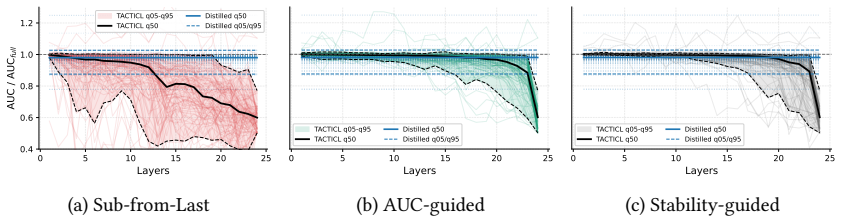
- [Section 4.2, Figure 5, Figure 8, submission checklist] The headline result of 'up to 85% of layers without substantial performance drop' is supported only by median AUC ratios with wide dataset-to-dataset spread and no statistical significance testing. In Figure 5b the 0.05-0.95 quantile band widens considerably as the number of substituted layers grows, and Figure 8a shows median AUC/AUCfull near 0.96 at 85% compression while the spread is not quantified beyond quantiles. The submission checklist states that statistical significance was not reported. Because 'substantial' is a quantitative threshold and the claim is central, please report per-dataset changes, paired confidence intervals or effect sizes, and a pre-specified definition of 'substantial'. The statement in Section 4.2 that TACTICL can 'replace up to 15 layers with negligible performance degradation' should also be qualified by the same uncertainty.
- [Section 4.3, Figure 6b] The cross-dataset experiment is interpreted as evidence that TACTICL 'specializes the model' for the source task, but negative transfer is also exactly what would be observed if compression damaged the in-context circuitry while leaving the source-task in-weight pathway intact. The perturbation tests in Figure 6a use feature permutations, added random features, and label flips on the same underlying task; these are useful sanity checks but do not disambiguate task specialization from ICL damage. Since the paper's novelty claim is that ICL remains intact rather than merely that the model is robust to those perturbations, please report the fine-tuned model in the cross-dataset test, or measure ICL on held-out tasks sampled from the pretraining prior, or otherwise provide evidence that the negative transfer is not a symptom of broken ICL.
- [Section 4.2, Figures 4 and 5] The claim that greedy search finds 'near-optimal configurations in our small-scale setting as well as on state-of-the-art models' is not fully supported on TabPFNv2.5. The oracle comparison in Figure 4 is performed only on TabPFNv2, where exhaustive enumeration is feasible; for TabPFNv2.5 the paper compares against the full model and baselines but not against any oracle or lower bound. The word 'near-optimal' should therefore be restricted to the TabPFNv2 setting, or the v2.5 section should clearly state that optimality is not evaluated there.
minor comments (4)
- [Section 4.1, Figure 2] The caption 'Minimal, maximal, and Median of maximal relative performance change' is confusing, and the text says both 'maximum change' and 'median, maximum, and minimum of this metric across all datasets.' Please clarify the aggregation direction: is the maximum taken over configurations per dataset and then summarized across datasets, or is the maximum taken across datasets as well?
- [Appendix H, Figure 10] The caption of Figure 10 says 'Change compared to the full model in AUC' but the figure reports RMSE for regression tasks. Please correct the caption.
- [Section 4.5] The sentence 'the overhead for substitution is minimal compared to deletion' in the Figure 15 caption is not obvious from the plotted panels; please specify which overhead is being compared (e.g., adapter execution vs. pure deletion) and quantify it in the text.
- [Section 1] The introduction cites 'TabPFNv3 (Grinsztajn et al., 2026)' but the reference list entry is titled 'Tabpfn-3: Technical report'; please make the citation and reference title consistent.
Circularity Check
No significant circularity: TACTICL's compression results come from held-out search and independent test evaluation; the main caveat is an empirical coverage gap in the ICL claim, not a definitional or self-citational reduction.
full rationale
The core derivation chain is self-contained. TACTICL chooses layer configurations by greedy search on a held-out search split using AUC/RMSE, then reports performance on held-out test data; the search metric is not the test metric, so the main 'substitute up to 85%' claim is an empirical result rather than a quantity fitted to its own target. Adapters are trained to reconstruct hidden states of dropped layers, and the fine-tuning stage updates only adapter weights on a downstream-data/prior-data mixture; none of these steps defines the reported accuracy or speedup in terms of the search criterion. The self-citations to Balef et al. (2025, 2026) are used as motivation for layer redundancy, but Section 4.1 independently exhaustively evaluates all configurations on TabPFNv2, so the redundancy premise is re-established within the paper rather than imported as an unverified load-bearing theorem. The cited ICL/IWL independence result (Nguyen and Nallamala, 2025) is external and is treated as motivation, while the paper's own perturbation and cross-dataset experiments provide direct evidence at the compression stage. The one genuine weakness is that Appendix H admits: 'We have realized that an experiment that assesses the ICL performance of the fine-tuned model might shine more light on the benefits of the prior injection, and leave this to the future work.' This means the abstract's ICL-preservation claim is not fully verified for the final fine-tuned pipeline, and the perturbation evidence covers only the pre-fine-tuning compressed model. However, this is an empirical gap or over-claim, not circularity: no equation, fitted parameter, or self-citation chain makes the ICL claim true by construction. Under the hard rules requiring a specific reduction, no circular step is identified, so the circularity score is 0.
Assumptions & free parameters
free parameters (4)
- Adapter architecture C3_wide(128) =
hidden width 128, depth 2, GELU, skip connection
- Search split ratio 8:1:1 =
Dtrain2:Dval:Dsearch = 8:1:1
- Prior injection cadence =
every 10 epochs, 2 batches per prior epoch
- Adapter pretraining hyperparameters =
lr 4e-3, weight decay 1.5e-5, max 2000 epochs, patience 150
assumptions (5)
- domain assumption Layer decisions are local: the benefit of removing or replacing one layer does not depend on which other layers are removed or replaced.
- domain assumption ICL and IWL sub-circuits are largely independent, so freezing transformer weights and training only adapters preserves ICL.
- domain assumption A two-layer MLP adapter trained on cached hidden states can approximate the input-output mapping of a dropped transformer layer well enough to heal the model.
- domain assumption AUC/RMSE on a held-out search set is a reliable proxy for test performance when selecting layers.
- domain assumption The 47 TabArena datasets that fit TabPFNv2.5 pretraining limits are representative enough to support general claims about tabular ICL compression.
Cite this review
Pith. "Pith review of TACTICL: Task-Aware Compression of Tabular ICL Models." pith.science (2026). https://pith.science/paper/7SN2QPAV
@misc{pith2026260810837,
  author       = {Pith},
  title        = {Pith review of: TACTICL: Task-Aware Compression of Tabular ICL Models},
  year         = {2026},
  howpublished = {\url{https://pith.science/paper/7SN2QPAV}},
  note         = {Machine review of arXiv:2608.10837}
}
read the original abstract
The strong performance of foundation models for tabular tasks comes at substantial inference costs. Distilling models into task-specific architectures reduces model size and computational demands but also sacrifices in-context adaptability. Here we introduce TACTICL, an automated task-aware compression framework for tabular in-context learning models that jointly prunes transformer layers and replaces them with lightweight adapters trained on downstream tasks, thus blending in-context with in-weight learning. We study TACTICL on 47 benchmark datasets and show that we can substitute up to 85% of layers without substantial performance drop on a given downstream task. We further show that TACTICL maintains robustness to data shifts, leaving its in-context ability intact. Overall, TACTICL provides a robust framework for exploiting the depth-wise redundancy of tabular foundation models by combining task-specific adaptation and structured compression. We provide the code at: https://github.com/Hebog/tfm_compression
Figures


Figures from the paper (16 more)





Reference graph
Works this paper leans on
-
[1]
R., Koshil, M., and Eggensperger, K
Balef, A. R., Koshil, M., and Eggensperger, K. (2025). Towards understanding layer contributions in tabular in-context learning models. In EurIPS 2025 Workshop: AI for Tabular Data
work page 2025
-
[2]
R., Koshil, M., and Eggensperger, K
Balef, A. R., Koshil, M., and Eggensperger, K. (2026). Is one layer enough? understanding inference dynamics in tabular foundation models. In ICML 2026
work page 2026
-
[3]
B \'e thune, L., Grangier, D., Busbridge, D., Gualdoni, E., Cuturi, M., and Ablin, P. (2025). Scaling laws for forgetting during finetuning with pretraining data injection. In ICML 2025
work page 2025
-
[4]
M., Rodol \`a , E., Rieck, B., and Vogt, J
Cannistraci, I., Antonelli, S., Palumbo, E., Sutter, T. M., Rodol \`a , E., Rieck, B., and Vogt, J. E. (2026). TOAST : Transformer optimization using adaptive and simple transformations. Transactions on Machine Learning Research
work page 2026
-
[5]
Chen, X., Hu, Y., Zhang, J., Wang, Y., Li, C., and Chen, H. (2025). Streamlining redundant layers to compress large language models. In ICLR 2025
work page 2025
-
[6]
Elhage, N., Nanda, N., Olsson, C., Henighan, T., Joseph, N., Mann, B., Askell, A., Bai, Y., Chen, A., Conerly, T., DasSarma, N., Drain, D., Ganguli, D., Hatfield-Dodds, Z., Hernandez, D., Jones, A., Kernion, J., Lovitt, L., Ndousse, K., Amodei, D., Brown, T., Clark, J., Kaplan, J., McCandlish, S., and Olah, C. (2021). A mathematical framework for transfor...
work page 2021
-
[7]
M., Salinas, D., and Hutter, F
Erickson, N., Purucker, L., Tschalzev, A., Holzm \"u ller, D., Desai, P. M., Salinas, D., and Hutter, F. (2026). Tabarena: A living benchmark for machine learning on tabular data. In NeurIPS 2025 Datasets and Benchmarks Track
work page 2026
-
[8]
Gangwani, I. and Bansal, A. (2025). Light-weight benchmarks reveal the hidden hardware cost of zero-shot tabular foundation models. arXiv preprint arXiv:2512.00888
Show all 31 references
-
[9]
Garg, A., Ali, M., Hollmann, N., Purucker, L., M \"u ller, S., and Hutter, F. (2025). Real-tabpfn: Improving tabular foundation models via continued pre-training with real-world data. In 1st ICML Workshop on Foundation Models for Structured Data
2025
-
[10]
o ge, K., Key, O., Birkel, F., Jund, P., Roof, B., Manium, M., Hoo, S. B., B \
Grinsztajn, L., Fl \"o ge, K., Key, O., Birkel, F., Jund, P., Roof, B., Manium, M., Hoo, S. B., B \"u hler, M., Garg, A., et al. (2026). Tabpfn-3: Technical report. arXiv preprint arXiv:2605.13986
2026 arXiv
-
[11]
B., Garg, A., Robertson, J., Bühler, M., Moroshan, V., Purucker, L., Cornu, C., Wehrhahn, L
Grinsztajn, L., Flöge, K., Key, O., Birkel, F., Jund, P., Roof, B., Jäger, B., Safaric, D., Alessi, S., Hayler, A., Manium, M., Yu, R., Jablonski, F., Hoo, S. B., Garg, A., Robertson, J., Bühler, M., Moroshan, V., Purucker, L., Cornu, C., Wehrhahn, L. C., Bonetto, A., Schölkop...
2025 arXiv
-
[12]
Gromov, A., Tirumala, K., Shapourian, H., Glorioso, P., and Roberts, D. (2025). The unreasonable ineffectiveness of the deeper layers. In ICLR 2025
2025
-
[13]
Guo, D., Rush, A., and Kim, Y. (2021). Parameter-efficient transfer learning with diff pruning. In ACL-IJCNLP 2021
2021
-
[14]
Hollmann, N., M \"u ller, S., Eggensperger, K., and Hutter, F. (2023). Tabpfn: A transformer that solves small tabular classification problems in a second. In ICLR 2023
2023
-
[15]
u ller, S., Purucker, L., Krishnakumar, A., K \
Hollmann, N., M \"u ller, S., Purucker, L., Krishnakumar, A., K \"o rfer, M., Hoo, S. B., Schirrmeister, R. T., and Hutter, F. (2025). Accurate predictions on small data with a tabular foundation model. Nature , 637(8045):319--326
2025
-
[16]
Houlsby, N., Giurgiu, A., Jastrzebski, S., Morrone, B., De Laroussilhe, Q., Gesmundo, A., Attariyan, M., and Gelly, S. (2019). Parameter-efficient transfer learning for NLP . In ICML 2019
2019
-
[17]
Kolberg, C., Kreuer, J., Huurdeman, J., Ouaari, S., Eggensperger, K., and Pfeifer, N. (2026). Tabpfn-wide: Continued pre-training for extreme feature counts. arXiv preprint arXiv:2510.06162v2
2026
-
[18]
K \"u ken, J., Purucker, L., and Hutter, F. (2025). Early stopping tabular in-context learning. In 1st ICML Workshop on Foundation Models for Structured Data
2025
-
[19]
H., Gurnee, W., and Tegmark, M
Lad, V., Lee, J. H., Gurnee, W., and Tegmark, M. (2025). Remarkable robustness of LLM s: Stages of inference? In NeurIPS 2025
2025
-
[20]
Li, Y., Yang, S., Tan, S., Mishra, M., Panda, R., Zhou, J., and Kim, Y. (2026). Distilling to hybrid attention models via KL -guided layer selection. In ICLR 2026
2026
-
[21]
Liu, S.-Y., Cai, H.-R., Zhou, Q.-L., Yin, H.-H., Zhou, T., Jiang, J.-P., and Ye, H.-J. (2025). Talent: A tabular analytics and learning toolbox. Journal of Machine Learning Research , 26(226)
2025
-
[22]
and Ye, H.-J
Liu, S.-Y. and Ye, H.-J. (2026). Tabswift: An efficient tabular foundation model with row-wise attention. In ICML 2026
2026
-
[23]
Men, X., Xu, M., Zhang, Q., Yuan, Q., Wang, B., Lin, H., Lu, Y., Han, X., and Chen, W. (2025). S hort GPT : Layers in large language models are more redundant than you expect. In ACL 2025
2025
-
[24]
Muralidharan, S., Turuvekere Sreenivas, S., Joshi, R., Chochowski, M., Patwary, M., Shoeybi, M., Catanzaro, B., Kautz, J., and Molchanov, P. (2024). Compact language models via pruning and knowledge distillation. In NeurIPS 2024
2024
-
[25]
and Nallamala, G
Nguyen, A. and Nallamala, G. R. (2025). Differential learning kinetics govern the transition from memorization to generalization during in-context learning. In ICLR 2025
2025
-
[26]
Qu, J., Holzm \"u ller, D., Varoquaux, G., and Le Morvan, M. (2026). TabICLv2 : A better, faster, scalable, and open tabular foundation model. In ICML 2026
2026
-
[27]
Rubachev, I., Kotelnikov, A., Kartashev, N., and Babenko, A. (2025). On finetuning tabular foundation models. arXiv preprint arXiv:2506.08982
2025 arXiv
-
[28]
Sajjad, H., Dalvi, F., Durrani, N., and Nakov, P. (2023). On the effect of dropping layers of pre-trained transformer models. Computer Speech & Language , 77
2023
-
[29]
Shopkhoev, D., Ali, A., Zhussip, M., Malykh, V., Lefkimmiatis, S., Komodakis, N., and Zagoruyko, S. (2025). Replaceme: Network simplification via depth pruning and transformer block linearization. In NeurIPS 2025
2025
-
[30]
Singh, A., Chan, S., Moskovitz, T., Grant, E., Saxe, A., and Hill, F. (2023). The transient nature of emergent in-context learning in transformers. In NeurIPS 2023
2023
-
[31]
Tanna, A., Seth, P., Bouadi, M., and Sankarapu, V. K. (2026). Exploring fine-tuning for tabular foundation models. In ACM Web Conference 2026
2026
Reviewed August 12, 2026 · model on record in the stance chip above.
Discussion (0). Continue with ORCID to comment.