REVIEW 4 major objections 6 minor 23 references
ReLTEx: Reliable LLM-based Taxonomy Expansion
T0 review · 4 major / 6 minor · reviewed 2026-08-12 · deepseek-v4-flash
Pith's one-line read ReLTEx shows that a path-aware classifier plus a confidence-stable recursion stopper turn raw LLM taxonomy additions into human-acceptable insertions, at low recall.
desk verdict ReLTEx has a genuinely useful validator idea and honest evaluation, but the main benchmark numbers may be inflated by an unstated classifier training split that overlaps the masked test edges. read the letter →
The pith
A machine-rendered reading of the paper's core claim, the machinery that carries it, and where it could break.
The reading
What carries the argument
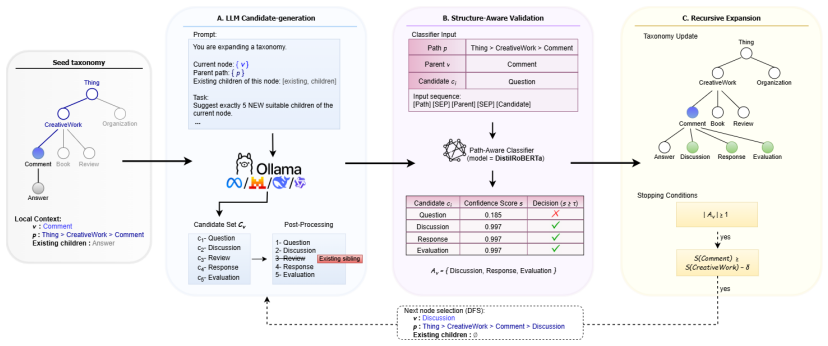
The load-bearing object is the structure-aware validation classifier. It is a DistilRoBERTa binary classifier fine-tuned on positive parent–child edges from the seed taxonomy plus hierarchy-aware hard negatives: reversed edges, sibling confusions, grandparent–child confusions, same-depth mismatches, nearby-branch confusions, and random invalid pairs. Its input is the ancestor path, the parent, and the candidate child, joined as Path [SEP] Parent [SEP] Child, and its output is the probability that the relation is a valid taxonomy edge in that context. That probability does double duty: threshold $\tau=0.90$ decides which generated children are inserted, and the mean of the accepted children's probabilities at a node feeds the recursion rule $S(v)\geq S(\mathrm{parent}(v))-\delta$, which decides whether the branch may expand further. This single score is what converts open-ended LLM generation into a bounded, checkable taxonomy.
What would settle it
Inspect the classifier's training splits for any positive example whose child is a masked leaf node from the same evaluation fold; if such edges occur, the reported $R@K$ and $MRR$ values are inflated by leakage. A clean re-run that holds out all edges to masked leaves during classifier training, then recomputes Table 2, would settle the claim.
Extended reading notes
Core claim
The core discovery is that the dominant failure mode in LLM-based taxonomy expansion is not missing concepts but accepting bad parent–child relations, and that this failure can be intercepted before insertion. ReLTEx stages each expansion in three steps: an LLM proposes $k$ candidate children for a node using the root-to-node path and the node's existing children; a DistilRoBERTa classifier, given Path [SEP] Parent [SEP] Child, scores each candidate relation with $s(p,v,c_i)\in[0,1]$; and only candidates with $s(p,v,c_i)\geq\tau=0.90$ enter the taxonomy. Recursive expansion then proceeds depth-first only for nodes whose mean accepted-child confidence $S(v)$ satisfies $S(v)\geq S(\mathrm{parent}(v))-\delta$, so a branch that starts producing less certain children stops growing. The benchmark hides 20% of leaf nodes, regenerates them, and measures both recovery ($R@K$, $SR@K$, $MRR$) and attachment quality ($WuP$), with human and LLM-based judges on top. The paper's conclusion is that this loop yields taxonomies whose accepted edges are overwhelmingly judged correct, consistent in granularity, and non-redundant, while recursive growth adds breadth rather than runaway depth.
Load-bearing premise
The results assume that the validation classifier never saw the exact parent–child edges it is later scored against, and that edges learned from the seed taxonomy transfer to never-seen LLM-generated candidates.
Editorial extensions
If this is right
- A taxonomy curator can set the confidence threshold high and insert accepted nodes automatically, reserving human review for borderline scores.
- Branches that start producing less certain children stop expanding, so recursive enrichment adds breadth — 211 to 4,883 nodes on SemEval Environment and 912 to 38,603 on Schema.org — while adding only one depth level.
- Local context, consisting of the parent path and existing children, outperforms giving the model the parent subtree or the full taxonomy, so the cheapest prompting strategy is also the most effective.
- Classifier validation beats both semantic-similarity filters and an LLM-as-judge validator on recovery, indicating that structural signals carry more information than semantic closeness alone.
- Because accepted nodes are highly reliable while many hidden concepts are never generated, the practical bottleneck shifts from insertion quality to recall.
Reading between the lines
- Editorial inference: the paper's acceptance-focused numbers imply that a high-threshold deployment trades a substantial fraction of true concepts for near-perfect precision on accepted nodes; a production system would couple the filter with a recall-oriented second pass or human review.
- Editorial inference: the same confidence signal could drive a budget-aware stopping rule — for instance, stopping a branch when the expected number of additional accepted nodes per generated candidate falls below a threshold — a variant the paper does not test.
- Editorial inference: a head-to-head run against the closest recursive generation approach under identical masked splits would isolate how much path-aware structural validation adds over embedding-based semantic filtering.
- Editorial inference: because the classifier is trained on the seed taxonomy, the framework's applicability to novel domains depends on the availability of a small seed structure; a cold-start experiment with a minimal seed would test that boundary.
Signed reviews
Editorial analysis
A structured set of objections, weighed in public.
Referee Report
Summary. ReLTEx is a framework for LLM-based taxonomy expansion that combines zero-shot candidate generation with a DistilRoBERTa classifier that validates parent-child relations using hierarchical context, plus a recursive expansion stopping rule based on classifier confidence. The paper evaluates the framework on SemEval-2016 Task 13 Environment and Schema.org under a masked-leaf recovery protocol, reporting R@K, SR@K, MRR, and WuP scores across four LLMs, along with human annotation and LITE-based LLM evaluation. The central claim is that ReLTEx improves reliability and semantic coherence of taxonomy expansion by filtering structurally inconsistent LLM-generated candidates and controlling recursive growth.
Significance. If the reported results are trustworthy, ReLTEx would be a useful contribution to taxonomy enrichment: it addresses an underexplored setting where candidates are generated rather than provided, and it ships openly with code and benchmark splits. The human evaluation with three annotators and Fleiss' kappa is a strength, as is the multi-LLM comparison across four open-source generators. However, the paper's central quantitative claim rests on a masked-recovery benchmark whose train/test separation is never stated, and the ablation-calibrated thresholds introduce additional optimism. These issues are load-bearing rather than cosmetic, so the significance of the contribution can only be assessed after the leakage and baseline concerns are resolved.
major comments (4)
- [§4.2 and §6.1] The classifier is trained on 'positive and negative examples derived from the seed taxonomy' (§4.2), while §6.1 removes 20% of leaf nodes from 'the seed taxonomy' and treats them as hidden test concepts. The paper never states whether masking is performed before classifier training. If the positive training examples include edges to the hidden leaves, then the classifier has already seen the exact (parent, child) pairs it is later scored against, and the R@K, SR@K, and MRR values in Table 2 are inflated by direct leakage. Even if exact edges are excluded, the hard negatives in §4.2 are generated by perturbing valid edges, so training on edges incident to hidden nodes can leak structural information. Please state the exact split and, if masking is not already applied before training, rerun the benchmark with a leakage-free split.
- [§6.1 and Table 2] The paper claims 'no directly comparable baseline exists for our setting' and Table 2 contains no baseline, yet §2 cites Taxoria (Ghamlouch and Alam, 2025) as 'the closest work to ours' that 'recursively generates novel concepts based on an existing taxonomy without relying on a predefined candidate pool.' Taxoria is directly runnable on the same masked setting, and at minimum a comparison with Taxoria (and possibly a no-validation or semantic-similarity baseline) is necessary to support the abstract's claim that ReLTEx produces 'more reliable' expansions. Without such a baseline, Table 2 only shows that the pipeline recovers some fraction of hidden nodes, not that it improves on existing approaches.
- [Appendix D and §5.2] The validation thresholds (τ = 0.90 for the classifier, 0.83 for semantic validators) are chosen 'based on the resulting recovery performance' on the same SemEval Environment benchmark used for the main reported results. This is test-set tuning: the absolute numbers in Table 2 and the ablation comparisons in Table 7 are optimistic because the thresholds are fitted to the same masked leaves. The SR@K threshold ρ = 0.85 is also set without a stated calibration procedure. Please calibrate thresholds on a held-out split (e.g., a separate masking fold) and report results for a fixed, pre-registered threshold, or justify why the chosen values are not benchmark-specific.
- [§6.2 and Table 3] The human evaluation scores HC, GC, and NR are high (roughly 0.86–1.00), but the exact recovery (ER) and semantic recovery (SR) scores are low (mostly 0.076–0.40), and the text states that these 'demonstrate that the generated concepts frequently recover or closely match the hidden taxonomy concepts.' Given that ER/SR are measured only on the masked subset and are below 0.5 in every configuration, the wording 'frequently recover' is an overstatement. The human evaluation also only judges accepted concepts from the same potentially leaked pipeline, so it does not independently validate the recovery claim.
minor comments (6)
- [§6.1] In the sentence 'Llama3.2 performs best on the smaller SemEval taxonomy, achieving the highest R@K, S@K, and WuPo,' 'S@K' is not a defined metric; the table reports SR@K.
- [§5.2] The abbreviations MRRo, MRRf, WuPo, and WuPf are used in Table 2 and text without being spelled out at first use; please define them as 'MRR overall', 'MRR found', 'WuP overall', and 'WuP found' in the metric definitions.
- [§6.3] The LITE evaluation uses k=3 for recursive expansion while the benchmark uses k=5, and the thresholds are tuned under the k=5 setting; the paper does not discuss whether the recursive-expansion results are sensitive to this change in the branching factor.
- [Appendix D] The ablation reports R@K and SR@K but omits MRR and WuP, even though the main benchmark emphasizes these metrics; including them would show whether the validation-strategy ranking holds beyond recovery.
- [§6.1] Table 2 reports standard deviations across masking configurations, but the paper does not state how many masking configurations were used or how the random seeds were varied; please specify this for reproducibility.
- [Appendix E] The statistics in Table 8 show a very large expansion for Schema.org (from 912 to 38,603 nodes) under recursive expansion; a brief discussion of how validation and stopping rules prevent semantic drift at this scale would help.
Circularity Check
Validation threshold is tuned on the benchmark's recovery metric, so Table 2 recovery numbers are partly fitted rather than independently predicted; no load-bearing self-citation found.
-
fitted input called prediction
[Appendix D (Ablation Study), threshold calibration; used in Section 6.1 and Table 2]
"Threshold calibration is performed through a sweep over a fixed set of generated candidates. Based on the resulting recovery performance, we select acceptance thresholds of 0.83 for both semantic validators and 0.90 for the classifier. These thresholds are used throughout all experiments reported in the paper."
The acceptance threshold is a decision boundary of the validation module, and the paper selects it by optimizing recovery performance on the masked benchmark. The same benchmark then produces the Table 2 R@K, SR@K, MRR, and WuP numbers reported as evidence that ReLTEx produces more reliable and semantically coherent taxonomy expansions. Thus the headline recovery metric is not an independent test of the validation strategy: the reported values incorporate the threshold that was chosen to maximize them. This is a fitted input called a prediction rather than a fully out-of-sample result. The circularity is partial because the threshold alone does not generate the recovered concepts, and the model comparison, human evaluation, and LITE assessment retain independent content.
full rationale
The only demonstrated circular step is the threshold calibration in Appendix D: the acceptance threshold is swept to maximize recovery performance on the masked benchmark, and the same benchmark's Table 2 is then reported using the selected threshold. This makes the reported R@K and related metrics partially fitted rather than independently predicted. I do not count this as a full reduce-by-construction case because the threshold is a single scalar, and the LLM candidate generation, classifier training, and recursive expansion control still contribute independently; the human evaluation in Section 6.2 and the LITE-based assessment in Section 6.3 also provide evidence not derived from the masked benchmark. The citation to the authors' prior work (Taxoria, Ghamlouch and Alam 2025) is used only to motivate structural validation and is not load-bearing for the reported results. A separate concern, not counted as demonstrated circularity, is that Section 4.2 trains the classifier on positive and negative examples derived from the seed taxonomy, while Section 6.1 hides 20% of leaf nodes from the same taxonomies; the paper never states whether the classifier's training edges include edges to the hidden nodes. If they do, Table 2 would be inflated by direct leakage, but because the masking order is unstated, the specific reduction cannot be exhibited, so I leave it as a correctness risk rather than a demonstrated circular step.
Assumptions & free parameters
free parameters (4)
- k (candidate children per parent) =
5 (benchmark), 3 (recursive expansion)
- tau (classifier acceptance threshold) =
0.90
- rho (SoftRecall@K cosine threshold) =
0.85
- m (minimum accepted children) and delta (allowed confidence drop) =
not reported
assumptions (6)
- domain assumption Zero-shot LLM prompting with local path and sibling context yields semantically relevant candidate children at the correct granularity.
- domain assumption A binary classifier fine-tuned on the seed taxonomy's own edges discriminates valid from invalid novel parent-child relations.
- ad hoc to paper The six hand-constructed hard-negative types (reversed edges, sibling confusions, grandparent-child, same-depth, nearby-branch, random) represent the real space of invalid relations.
- ad hoc to paper Stability of average classifier confidence across levels, S(v) >= S(parent(v)) - delta, is a valid proxy for expansion reliability.
- domain assumption Cosine similarity above 0.85 on bge-small-en-v1.5 embeddings captures semantic equivalence for SoftRecall@K.
- domain assumption Masking only leaf nodes with at least one retained sibling and at most five hidden children per parent approximates the difficulty of real expansion.
Cite this review
Pith. "Pith review of ReLTEx: Reliable LLM-based Taxonomy Expansion." pith.science (2026). https://pith.science/paper/JJ2IYTJI
@misc{pith2026260810970,
  author       = {Pith},
  title        = {Pith review of: ReLTEx: Reliable LLM-based Taxonomy Expansion},
  year         = {2026},
  howpublished = {\url{https://pith.science/paper/JJ2IYTJI}},
  note         = {Machine review of arXiv:2608.10970}
}
read the original abstract
Recent advances in Large Language Models (LLMs) have demonstrated strong capabilities in generating semantically relevant concepts and relations, making them promising tools for taxonomy enrichment. However, directly relying on LLM-generated expansions often leads to noisy, redundant, or hierarchically inconsistent structures, limiting their reliability for automated taxonomy expansion. In this paper, we present ReLTEx, a framework for reliable LLM-based taxonomy expansion. ReLTEx combines LLM-driven candidate generation with structure-aware validation and recursive expansion control to improve the consistency and quality of generated taxonomies by reducing hallucinations. We evaluate the proposed framework using benchmark taxonomies under a masked taxonomy expansion setting and compare multiple validation strategies. Experimental results, supported by both adapted evaluation metrics and human evaluation, demonstrate that ReLTEx produces more reliable and semantically coherent taxonomy expansions.
Figures

Reference graph
Works this paper leans on
-
[1]
ECAI 2025-28th European Conference on Artificial Intelligence (Demo Track) , year=
Enriching Taxonomies using Large Language Models , author=. ECAI 2025-28th European Conference on Artificial Intelligence (Demo Track) , year=
work page 2025
-
[2]
Proceedings of the web conference 2020 , pages=
TaxoExpan: Self-supervised taxonomy expansion with position-enhanced graph neural network , author=. Proceedings of the web conference 2020 , pages=
2020
-
[3]
Proceedings of the 26th ACM SIGKDD International Conference on Knowledge Discovery & Data Mining , pages=
Steam: Self-supervised taxonomy expansion with mini-paths , author=. Proceedings of the 26th ACM SIGKDD International Conference on Knowledge Discovery & Data Mining , pages=
-
[4]
Proceedings of the 47th international ACM SIGIR conference on research and development in information retrieval , pages=
Yago 4.5: A large and clean knowledge base with a rich taxonomy , author=. Proceedings of the 47th international ACM SIGIR conference on research and development in information retrieval , pages=
-
[5]
Proceedings of the 48th annual meeting of the association for computational linguistics , pages=
BabelNet: Building a very large multilingual semantic network , author=. Proceedings of the 48th annual meeting of the association for computational linguistics , pages=
-
[6]
COLING 1992 volume 2: The 14th international conference on computational linguistics , year=
Automatic acquisition of hyponyms from large text corpora , author=. COLING 1992 volume 2: The 14th international conference on computational linguistics , year=
work page 1992
-
[7]
Belgium netherlands conference on artificial intelligence , year=
Non-parametric path based model for taxonomy induction in knowledge graphs , author=. Belgium netherlands conference on artificial intelligence , year=
-
[8]
Taxogen: Constructing topical concept taxonomy by adaptive term embedding and clustering , author=. Proc. KDDI , year=
Show all 23 references
-
[9]
Proceedings of the 2021 conference on empirical methods in natural language processing , pages=
TEMP: Taxonomy expansion with dynamic margin loss through taxonomy-paths , author=. Proceedings of the 2021 conference on empirical methods in natural language processing , pages=
2021
-
[10]
International Conference on Deep Learning Theory and Applications , pages=
Taxosbert: Unsupervised taxonomy expansion through expressive semantic similarity , author=. International Conference on Deep Learning Theory and Applications , pages=. 2023 , organization=
2023
-
[11]
arXiv preprint arXiv:2406.11131 , year=
Are large language models a good replacement of taxonomies? , author=. arXiv preprint arXiv:2406.11131 , year=
-
[12]
Proceedings of the 33rd ACM International Conference on Information and Knowledge Management , pages=
Chain-of-layer: Iteratively prompting large language models for taxonomy induction from limited examples , author=. Proceedings of the 33rd ACM International Conference on Information and Knowledge Management , pages=
-
[13]
ACM Transactions on Intelligent Systems and Technology , year=
Flame: Self-supervised low-resource taxonomy expansion using large language models , author=. ACM Transactions on Intelligent Systems and Technology , year=
-
[14]
arXiv preprint arXiv:2504.01369 , year=
LITE: LLM-Impelled efficient Taxonomy Evaluation , author=. arXiv preprint arXiv:2504.01369 , year=
-
[15]
Findings of the association for computational linguistics: ACL 2024 , pages=
FUSE: Measure-theoretic compact fuzzy set representation for taxonomy expansion , author=. Findings of the association for computational linguistics: ACL 2024 , pages=
2024
-
[16]
Proceedings of the web conference 2021 , pages=
Enquire one’s parent and child before decision: Fully exploit hierarchical structure for self-supervised taxonomy expansion , author=. Proceedings of the web conference 2021 , pages=
2021
-
[17]
Neural Processing Letters , volume=
PEB-TAXO: Projecting entities as boxes for taxonomy expansion , author=. Neural Processing Letters , volume=. 2024 , publisher=
2024
-
[18]
Proceedings of the 58th annual meeting of the Association for Computational Linguistics , pages=
Taxonomy construction of unseen domains via graph-based cross-domain knowledge transfer , author=. Proceedings of the 58th annual meeting of the Association for Computational Linguistics , pages=
-
[19]
, author=
Contrastive Representation Learning for Self-Supervised Taxonomy Completion. , author=. IJCAI , volume=
-
[20]
Proceedings of the 2021 Conference on Empirical Methods in Natural Language Processing , pages=
Low-resource taxonomy enrichment with pretrained language models , author=. Proceedings of the 2021 Conference on Empirical Methods in Natural Language Processing , pages=
2021
-
[21]
S em E val-2016 Task 13: Taxonomy Extraction Evaluation ( TE x E val-2)
Bordea, Georgeta and Lefever, Els and Buitelaar, Paul. S em E val-2016 Task 13: Taxonomy Extraction Evaluation ( TE x E val-2). Proceedings of the 10th International Workshop on Semantic Evaluation ( S em E val-2016). 2016. doi:10.18653/v1/S16-1168
2016 doi
-
[22]
2023 , eprint=
C-Pack: Packaged Resources To Advance General Chinese Embedding , author=. 2023 , eprint=
2023
-
[23]
biometrics , pages=
The measurement of observer agreement for categorical data , author=. biometrics , pages=. 1977 , publisher=
1977
Reviewed August 12, 2026 · model on record in the stance chip above.
Discussion (0). Continue with ORCID to comment.