REVIEW 4 major objections 8 minor 55 references
ReRound: Reconstructive Rounding to Resolve Midpoint Ambiguity in Calibration-Free LLM Quantization
T0 review · 4 major / 8 minor · reviewed 2026-08-12 · deepseek-v4-flash
Pith's one-line read ReRound uses a diffusion prior learned from the model's own weights to resolve midpoint-ambiguous rounding decisions, consistently improving 3- and 4-bit weight-only LLM quantization without any calibration data.
desk verdict Novel diffusion-guided rounding that likely helps small-LLM PTQ, but per-model hyperparameters and missing error bars make the 'calibration-free, consistent improvement' claim softer than stated. read the letter →
The pith
A machine-rendered reading of the paper's core claim, the machinery that carries it, and where it could break.
The reading
What carries the argument
The central mechanism is the conditional diffusion prior over weight patches. A U-Net diffusion model is trained on 64×64 patches of the LLM's full-precision weight matrices, conditioned on 2-bit stochastic-rounding versions of the same patches, and at inference reconstructs continuous weights from deterministic 2-bit RTN conditions. The reconstruction signal is filtered by a position-dependent tolerance metric $\tau_{\mathrm{pos}}(r;\tau)=\tau\exp\!\left[-\beta\left(\frac{[0.5-\delta-d(r)]_+}{0.5-\delta}\right)^2\right]$, which allows flips only near the midpoint $r=0.5$ and increasingly defers to RTN toward the interval ends; the flip cost $c_{\mathrm{flip}}(r)=\Delta^2|1-2r|$ justifies why midpoints are the low-cost place to revise. The selection rule compares candidates through the spectral discrepancy $D_{\mathrm{spec}}(\tau)=\|\sigma_{1:k}(W_\tau)-\sigma_{1:k}(W)\|_2/\|\sigma_{1:k}(W)\|_2$, and because $\tau=0$ (pure RTN) is always included, the chosen candidate never has larger spectral discrepancy than RTN itself.
What would settle it
Find a model, bit width, and task combination where the spectral-selected candidate has lower downstream accuracy than plain RTN while a weight-MSE-selected or randomly flipped candidate does better; or run the same ReRound pipeline on a larger model (e.g., 7B) and observe the gains over RTN vanish or reverse.
Extended reading notes
Core claim
The central claim is that the ambiguity of round-to-nearest at interval midpoints is a useful, exploitable degree of freedom in post-training quantization: flipping a small number of RTN assignments (at most 1% per matrix) can improve downstream accuracy, provided the flips are guided by a learned prior over the model's own weight structure. ReRound implements this with a conditional diffusion model that, given a low-bit observation of a weight patch, produces a continuous reconstruction; the reconstruction proposes an alternative assignment only when it contradicts RTN, and the proposal is accepted only within a tolerance region around the midpoint. Among the candidate matrices generated by sweeping the tolerance, ReRound picks the one whose de-quantized leading singular values best match the original full-precision matrix. The paper reports consistent average-accuracy gains over group-wise RTN across eight LLMs at 3 and 4 bits, and competitive or better results than calibration-based rounding methods on the evaluated tasks.
Load-bearing premise
The load-bearing premise is that the candidate whose de-quantized weight matrix best matches the full-precision weights' leading singular values will also be the candidate with the best downstream task accuracy; the paper validates this on one ablation but gives no theoretical reason why spectral preservation should track language modeling or commonsense performance.
Editorial extensions
If this is right
- ReRound consistently improves group-wise RTN for every tested model at both 3 and 4 bits, including models outside the main comparison such as Llama 3.2 1B, Pythia 1.4B, and Phi-2 2.7B.
- ReRound matches or exceeds calibration-based PTQ methods (SignRound, AdaRound) on the evaluated small LLMs despite using no activation or text calibration data.
- The selected candidate has no larger spectral discrepancy than RTN, since the $\tau=0$ candidate is always in the set; the offline PTQ cost is modest (42–124 seconds per model).
- ReRound can also improve quantization setups produced by other PTQ methods, as demonstrated on top of SINQ's scales on Qwen3 1.7B.
- Because only selected floor-or-ceiling assignments change, any deployment stack supporting group-wise RTN can adopt the improvement with no inference-side changes.
Reading between the lines
- If the spectral-preservation proxy is the true driver of the gains, then cheaper matrix-structure criteria (e.g., low-rank projections or randomized SVD) might replace the diffusion prior, making the diffusion model just a way to generate diverse candidate matrices.
- The paper evaluates only models with 1B–2.7B parameters; an untested implication is whether the advantage persists at 7B+ scale, where wider matrices may require larger patch context for the diffusion prior.
- The tolerance metric's hyperparameters ($\beta$, candidate sets) are tuned per model in the appendix; a principled calibration-free procedure for setting them would be needed before the method can be applied without task accuracy feedback.
- Since the reconstructed matrix is computed once and reused across bit widths, the approach could support runtime selection of bit width with no additional diffusion training.
Signed reviews
Editorial analysis
A structured set of objections, weighed in public.
Referee Report
Summary. The paper proposes ReRound, a calibration-free post-training quantization method for LLMs that revises round-to-nearest (RTN) assignments near quantization-interval midpoints. ReRound trains a per-model conditional diffusion model (a ControlNet attached to a frozen, image-pretrained U-Net, conditioned on 2-bit stochastic-rounding patches) to reconstruct continuous weights from low-bit observations. For each weight matrix, reconstructed entries propose flipping the RTN floor-or-ceiling decision; a position-dependent tolerance metric tau_pos(r;tau) (Eq. 13) admits only proposals near the midpoint, and sweeping tau generates candidate quantized integer matrices. The candidate whose dequantized matrix most closely matches the full-precision matrix's leading singular values under D_spec (Eqs. 17-18) is selected, with tau=0 (RTN) always included in the candidate set. Experiments on eight small LLMs at 3 and 4 bits report positive four-task-average gains over matched group-wise RTN in every model-bit pair (0.1-1.6 points), best-in-table results at 3 bits on all five main models, competitive results against GPTQ/AdaRound/SignRound at 4 bits, and improvements when applied on top of SINQ quantization parameters. Appendix J provides derivations of the conditional-denoising relation, bounds on the scalar error of accepted revisions, and a spectral-selection guarantee relative to RTN.
Significance. If the claims hold, ReRound makes a concrete contribution: it shows that a weight-computed diffusion prior can disambiguate midpoint rounding without any activation or text calibration data, while preserving the low-bit representation and inference procedure. The paper is strong on reproducibility: Algorithms 1-2 fully specify the procedure, Tables 7, 8, 9, and 12 give software versions and per-model settings, code is released, and offline runtime is reported (Table 6). Section J's derivations are correct and useful, including Tweedie's relation for the conditional denoiser (Eqs. 29-38), the bound that every accepted revision lies within tau of the midpoint (Eq. 48), the scalar flip-cost bound (Eq. 51), and the guarantee D_spec(tau*) <= D_spec(0) (Eq. 56). The main risk is empirical: the headline 'consistent improvement' rests on single-run four-task averages with no variance estimates, some with margins as small as 0.1-0.2 points, and the method's per-model hyperparameters (Table 8) lack a disclosed calibration-free selection rule.
major comments (4)
- [§4.1; Appendix D (Table 8)] The manuscript states that ReRound 'uses the same formulation across models' and claims 'consistent improvement' over RTN, but Table 8 assigns different tolerance candidate sets (T_linear, T_head) and different beta values to every model (e.g., beta=8 for Gemma 2 2B versus beta=128 for Qwen3 1.7B), and no weight-only selection rule for these hyperparameters is described anywhere. Because tau=0 makes RTN an always-available candidate, these per-model settings are not outputs of the spectral selection; they are inputs chosen outside the method. If T and beta were set using the task accuracies in Tables 1-2 and 10, then the 'without activation or text calibration data' claim is violated at the hyperparameter level, and the claim 'ReRound consistently improves RTN' would be better stated as 'for each model there exist settings under which ReRound improves RTN.' The paper should either (a) disclose a fixed, calibration-free protocol for choosing T and beta, (b) supply a fixed-configuration experiment (one T and one beta for all eight models) showing the gains survive, or (c) temper the abstract and conclusion claims accordingly.
- [Tables 1-3, 10] All task accuracies are single-run with no variance estimates, and several headline gains are small: the W3 gain is 0.1 points on Qwen3 1.7B and 0.2 points on Gemma 3 1B, and the W4 gain is 0.2 points on SmolLM2 1.7B. Individual tasks within those averages move in the opposite direction; for example, Table 10 shows Llama 3.2 1B W3 WinoGrande dropping from 53.6 (RTN) to 51.4 (ReRound), and Table 1 shows Gemma 3 1B W4 BoolQ dropping from 62.6 to 61.9. With four-task averages and no seed variance, a 0.1-0.4 point difference is within the typical noise of these benchmarks. The sign-consistency across eight models and two bit widths is suggestive, but the quantitative claim 'consistently improves' needs either multiple seeds (or a variance estimate) on at least a subset of models, or a more modest framing of the claim.
- [Eqs. (17)-(18); Table 4; Appendix J.4] The selection rule that distinguishes ReRound from RTN is the spectral proxy D_spec, but its empirical validation is a single ablation on OLMo 2 1B. Table 4 shows that the proxy outperforms weight-MSE selection and matched random flips on that model, which is encouraging, yet the paper's own Section 5 concedes that 'spectral selection operates only in weight space and may not identify the best candidate for every downstream task,' and Appendix J.4 states that the derived scalar bound 'does not characterize changes in model outputs or downstream task accuracy.' Since tau=0 is always a candidate, Eq. (56) protects against spectral regression but not against task-accuracy regression. A direct check without calibration data—for example, for several models, reporting the rank correlation between D_spec(tau) and the four-task average across the candidate set, or the fraction of matrices where the selected tau* differs from 0—would substantiate the proxy.
- [§3.2; Appendix C; Figure 1] The claim that ReRound 'learns a diffusion prior from the pretrained LLM's own weights' is incomplete as stated: the U-Net backbone is frozen and initialized from the image-pretrained IF-II-M-v1.0 checkpoint, and only the ControlNet is trained on LLM weight patches (Appendix C). This means an external, image-domain generative prior is part of the method, and the main text should state this in Section 3.2 rather than only in the appendix. A control experiment (for example, a randomly initialized backbone with the same ControlNet training, or a from-scratch diffusion model) would clarify how much of the reconstruction signal comes from the learned weight statistics versus the frozen generic backbone.
minor comments (8)
- [Abstract; Tables 1-2] The abstract's claim of 'superior accuracy compared to an extensive set of calibration-free methods' overstates Tables 1-2: at W4 on OLMo 2 1B, both HQQ (60.4) and BNB FP4 (61.1) exceed ReRound (59.4). I suggest rewording to 'best or near-best average accuracy on most models.'
- [§4.1; Tables 1-3] CafeQ is listed among the calibration-free baselines in Section 4.1, but Tables 1 and 2 contain no CafeQ rows; CafeQ appears only in Table 3 for Gemma 2 2B at W4. Please state explicitly the coverage of the CafeQ comparison.
- [§4.4; Table 4] The 'Midpoint window' ablation variant is under-specified: it is not stated whether the acceptance threshold inside [0.5-delta, 0.5+delta] is still tau and what happens outside the window. There is also a typo in the text, '[0.5-delta, ,0.5+delta]', with a doubled comma.
- [§3.3; Appendix A; Appendix J] The main text's sentence 'Using l, u, and r from Eq. (19)' refers to an appendix equation, while the same quantities are defined in Eq. (1) in the main text; cite Eq. (1) instead. The duplicate numbering between the main text and Appendix J (Eqs. (17)-(18) vs (54)-(55), and Eqs. (13) vs (44)) is confusing and should be unified.
- [Appendix D; Table 8] The differing treatment of the output logit layer deserves an explicit sentence: for several models T_head={0}, meaning no revisions are considered for lm_head; please explain whether this was decided per model and why.
- [§5; Abstract] The abstract's statement that 'the method applies to AI models beyond LLMs' is conjectural, as the experiments cover only small LLMs and Section 5 appropriately limits the claim; either add a small non-LLM proof-of-concept or move this sentence to future work.
- [Appendix D; Table 9] Table 9 uses per-bit-width candidate sets for the SINQ experiments (W4 {0,0.15} vs W3 {0,0.15,0.25,0.35}), while Table 8's caption says the same settings are used at 3 and 4 bits; please disambiguate the scope of that statement in the caption.
- [Table 6 caption] The caption should state explicitly that diffusion training uses two GPUs while diffusion inference and ReRound PTQ use one GPU, to avoid the impression that the listed hours are single-GPU times.
Circularity Check
No significant circularity: the central accuracy claim is validated on held-out task benchmarks, and the in-sample diffusion and spectral fitting steps are not presented as independent predictions.
full rationale
ReRound's central claim is an empirical accuracy claim: that the method consistently improves RTN for 3- and 4-bit weight-only PTQ across multiple LLMs. The diffusion prior is trained on the target model's own full-precision and 2-bit stochastic patches (Section 3.2), and the final candidate is selected by spectral discrepancy against the original weight matrix (Eqs. 17-18). These are fitting steps, not external predictions, but the paper does not present them as first-principles derivations of downstream task accuracy. The load-bearing result is measured on held-out task benchmarks (WinoGrande, PIQA, BoolQ, SIQA in Tables 1-3, 10, and 11), so it is externally grounded rather than forced by construction. The only near-tautological statement is Appendix J.5's inequality D_spec(tau*) <= D_spec(0), which follows immediately from tau=0 being in the candidate set and from the arg-min selection rule; the paper explicitly says this inequality 'applies only to the spectral discrepancy used for candidate selection' and does not use it as evidence for task accuracy. This is a property of the selection rule, not a circular derivation of the paper's accuracy claims. No self-citations appear in the reference list, and the cited diffusion architecture (Vavilala et al. 2025; DeepFloyd IF) is used as an external implementation choice rather than as a load-bearing uniqueness or correctness argument. The per-model hyperparameters in Table 8 are a reproducibility concern, not a circularity: no quoted rule defines tau or beta in terms of the reported task accuracies, and the accuracy comparisons are external benchmarks.
Assumptions & free parameters
free parameters (4)
- Tolerance candidate set T =
Per-model sets (e.g., {0,0.15,0.25} for Gemma 2 2B)
- Tolerance decay beta =
8, 32, 64, or 128
- Midpoint region delta =
0.1
- Maximum revision ratio eta =
0.01
assumptions (4)
- domain assumption Spectral preservation of leading singular values is a good proxy for preserving downstream task accuracy.
- domain assumption A diffusion model trained on 2-bit stochastic-rounding conditions transfers to 2-bit RTN conditions and to 3/4-bit rounding guidance.
- domain assumption 64x64 patch-based reconstruction captures the structural information in LLM weight matrices needed for rounding decisions.
- standard math Standard DDPM forward process and Tweedie's formula are valid for conditional diffusion.
Cite this review
Pith. "Pith review of ReRound: Reconstructive Rounding to Resolve Midpoint Ambiguity in Calibration-Free LLM Quantization." pith.science (2026). https://pith.science/paper/XLRWS6V2
@misc{pith2026260811045,
  author       = {Pith},
  title        = {Pith review of: ReRound: Reconstructive Rounding to Resolve Midpoint Ambiguity in Calibration-Free LLM Quantization},
  year         = {2026},
  howpublished = {\url{https://pith.science/paper/XLRWS6V2}},
  note         = {Machine review of arXiv:2608.11045}
}
read the original abstract
ReRound (Reconstructive Rounding) is a post-training quantization method that addresses the midpoint ambiguity inherent in standard round-to-nearest (RTN) schemes when quantizing weights near the centers of quantization intervals. Starting from a pretrained LLM, ReRound trains a conditional diffusion model to produce continuous reconstructions of low-bit weights for the LLM. These reconstructed weights act as a guidance signal to disambiguate the rounding direction of weights located close to interval midpoints. To integrate this reconstruction-guided rounding with conventional RTN, ReRound introduces a tolerance metric measuring how far the quantized weight (not the final quantized integer) is away from the midpoint: quantized weights within a tolerance region around midpoints are quantized using diffusion-based reconstructions, whereas weights closer to quantization boundaries are quantized with RTN. By sweeping the tolerance parameter, ReRound generates multiple candidate quantized integer weight matrices and selects the de-quantized weight matrix candidate whose leading singular values most closely match those of the original full-precision weights. This selected candidate determines the tolerance parameter ReRound uses. ReRound is particularly effective for smaller LLMs. Across a range of such models, it consistently outperforms standard RTN for 3-bit and 4-bit weight quantization. ReRound achieves superior accuracy compared to an extensive set of calibration-free methods, remains competitive with calibration-dependent approaches, and operates entirely offline, introducing no additional overhead during low-bit inference. The ReRound strategy represents a new approach for low-bit quantization. The method applies to AI models beyond LLMs. This paper focuses on its applications to small LLMs.
Figures


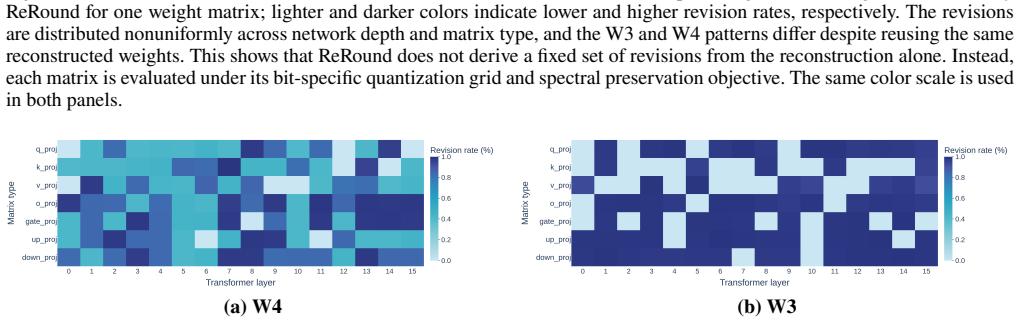
Figures from the paper (3 more)


Reference graph
Works this paper leans on
-
[1]
Chitwan Saharia and William Chan and Saurabh Saxena and Lala Li and Jay Whang and Emily L. Denton and Kamyar Ghasemipour and Raphael Gontijo Lopes and Burcu Karagol Ayan and Tim Salimans and others , title =. NeurIPS , pages =
-
[2]
2023 , howpublished =
2023
-
[3]
Jonathan Ho and Ajay Jain and Pieter Abbeel , title =. NeurIPS , pages =
-
[4]
Fleet and Mohammad Norouzi , title =
Chitwan Saharia and Jonathan Ho and William Chan and Tim Salimans and David J. Fleet and Mohammad Norouzi , title =. IEEE Transactions on Pattern Analysis and Machine Intelligence , pages =
-
[5]
Journal of the American Statistical Association , pages =
Bradley Efron , title =. Journal of the American Statistical Association , pages =
-
[6]
The Falcon 3 Family of Open Models , year =
-
[7]
The Llama 3 Herd of Models , journal =
Aaron Grattafiori and Abhimanyu Dubey and Abhinav Jauhri and Abhinav Pandey and Ahmad Al. The Llama 3 Herd of Models , journal =
-
[8]
Stella Biderman and Hailey Schoelkopf and Quentin Gregory Anthony and Herbie Bradley and Kyle O'Brien and Eric Hallahan and Mohammad Aflah Khan and Shivanshu Purohit and USVSN Sai Prashanth and Edward Raff and others , title =. ICML , pages =
Show all 55 references
-
[9]
Phi-2: The Surprising Power of Small Language Models , year =
Mojan Javaheripi and S. Phi-2: The Surprising Power of Small Language Models , year =
-
[10]
SmolLM2: When Smol Goes Big---Data-Centric Training of a Fully Open Small Language Model , booktitle =
Loubna Ben Allal and Anton Lozhkov and Elie Bakouch and Gabriel Martin Bl. SmolLM2: When Smol Goes Big---Data-Centric Training of a Fully Open Small Language Model , booktitle =
-
[11]
OLMo 2 Furious , journal =
-
[12]
arXiv preprint arXiv:2505.09388 , year =
An Yang and Anfeng Li and Baosong Yang and Beichen Zhang and Binyuan Hui and Bo Zheng and Bowen Yu and Chang Gao and Chengen Huang and Chenxu Lv and others , title =. arXiv preprint arXiv:2505.09388 , year =
-
[13]
Gemma 3 Technical Report , journal =
-
[14]
Gemma 2: Improving Open Language Models at a Practical Size , journal =
-
[15]
Croci and Bo Li and Pashmina Cameron and Martin Jaggi and Dan Alistarh and Torsten Hoefler and James Hensman , title =
Saleh Ashkboos and Amirkeivan Mohtashami and Maximilian L. Croci and Bo Li and Pashmina Cameron and Martin Jaggi and Dan Alistarh and Torsten Hoefler and James Hensman , title =. NeurIPS , pages =
-
[16]
NeurIPS , pages =
Tim Dettmers and Artidoro Pagnoni and Ari Holtzman and Luke Zettlemoyer , title =. NeurIPS , pages =
-
[17]
Lorenz K. M. SINQ: Sinkhorn-Normalized Quantization for Calibration-Free Low-Precision LLM Weights , booktitle =
-
[18]
2023 , month =
Hicham Badri and Appu Shaji , title =. 2023 , month =
2023
-
[19]
ICML , year =
Yuxuan Sun and Ruikang Liu and Haoli Bai and Han Bao and Kang Zhao and Yuening Li and Xianzhi Yu and Lu Hou and Chun Yuan and Xin Jiang and others , title =. ICML , year =
-
[20]
ICLR , year =
Zechun Liu and Changsheng Zhao and Igor Fedorov and Bilge Soran and Dhruv Choudhary and Raghuraman Krishnamoorthi and Vikas Chandra and Yuandong Tian and Tijmen Blankevoort , title =. ICLR , year =
-
[21]
ICML , pages =
Guangxuan Xiao and Ji Lin and Mickael Seznec and Hao Wu and Julien Demouth and Song Han , title =. ICML , pages =
-
[22]
ICLR , year =
Wenqi Shao and Mengzhao Chen and Zhaoyang Zhang and Peng Xu and Lirui Zhao and Zhiqian Li and Kaipeng Zhang and Gao Peng and Yu Qiao and Ping Luo , title =. ICLR , year =
-
[23]
GetMobile: Mobile Computing and Communications , pages =
Ji Lin and Jiaming Tang and Haotian Tang and Shang Yang and Guangxuan Xiao and Song Han , title =. GetMobile: Mobile Computing and Communications , pages =
-
[24]
arXiv preprint arXiv:2210.17323 , year =
Elias Frantar and Saleh Ashkboos and Torsten Hoefler and Dan Alistarh , title =. arXiv preprint arXiv:2210.17323 , year =
-
[25]
arXiv preprint arXiv:2511.19705 , year =
Ziteng Sun and Adrian Benton and Samuel Kushnir and Asher Trockman and Vikas Singh and Suhas Diggavi and Ananda Theertha Suresh , title =. arXiv preprint arXiv:2511.19705 , year =
-
[26]
Findings of EMNLP , pages =
Wenhua Cheng and Weiwei Zhang and Haihao Shen and Yiyang Cai and Xin He and Kaokao Lv and Yi Liu , title =. Findings of EMNLP , pages =
-
[27]
arXiv preprint arXiv:2512.04746 , year =
Wenhua Cheng and Weiwei Zhang and Heng Guo and Haihao Shen , title =. arXiv preprint arXiv:2512.04746 , year =
-
[28]
ICML , pages =
Jung Hyun Lee and Jeonghoon Kim and Se Jung Kwon and Dongsoo Lee , title =. ICML , pages =
-
[29]
ICML , pages =
Markus Nagel and Rana Ali Amjad and Mart van Baalen and Christos Louizos and Tijmen Blankevoort , title =. ICML , pages =
-
[30]
Efros and Kfir Aberman , title =
Amil Dravid and Yossi Gandelsman and Kuan-Chieh Wang and Rameen Abdal and Gordon Wetzstein and Alexei A. Efros and Kfir Aberman , title =. NeurIPS , pages =
-
[31]
ICLR , year =
Bedionita Soro and Bruno Andreis and Hayeon Lee and Wonyong Jeong and Song Chong and Frank Hutter and Sung Ju Hwang , title =. ICLR , year =
-
[32]
arXiv preprint arXiv:2402.13144 , year =
Kai Wang and Dongwen Tang and Boya Zeng and Yida Yin and Zhaopan Xu and Yukun Zhou and Zelin Zang and Trevor Darrell and Zhuang Liu and Yang You , title =. arXiv preprint arXiv:2402.13144 , year =
-
[33]
arXiv preprint arXiv:2505.21135 , year =
Anqi Tang and Youming Chen and Shuchen Xue and Zhaoqiang Liu , title =. arXiv preprint arXiv:2505.21135 , year =
-
[34]
arXiv preprint arXiv:2211.13006 , year =
Xiangming Meng and Yoshiyuki Kabashima , title =. arXiv preprint arXiv:2211.13006 , year =
-
[35]
ICLR , year =
Hyungjin Chung and Jeongsol Kim and Michael Thompson McCann and Marc Louis Klasky and Jong Chul Ye , title =. ICLR , year =
-
[36]
AAAI , pages =
Youming Chen and Zhaoqiang Liu , title =. AAAI , pages =
-
[37]
Forsyth , title =
Vaibhav Vavilala and Faaris Shaik and David A. Forsyth , title =. WACV , pages =
-
[38]
BoolQ: Exploring the Surprising Difficulty of Natural Yes/No Questions , booktitle =
Christopher Clark and Kenton Lee and Ming. BoolQ: Exploring the Surprising Difficulty of Natural Yes/No Questions , booktitle =
-
[39]
EMNLP-IJCNLP , pages =
Maarten Sap and Hannah Rashkin and Derek Chen and Ronan Le Bras and Yejin Choi , title =. EMNLP-IJCNLP , pages =
-
[40]
AAAI , pages =
Yonatan Bisk and Rowan Zellers and Ronan Le Bras and Jianfeng Gao and Yejin Choi , title =. AAAI , pages =
-
[41]
AAAI , pages =
Keisuke Sakaguchi and Ronan Le Bras and Chandra Bhagavatula and Yejin Choi , title =. AAAI , pages =
-
[42]
ICLR , year =
Stephen Merity and Caiming Xiong and James Bradbury and Richard Socher , title =. ICLR , year =
-
[43]
Liu , title =
Colin Raffel and Noam Shazeer and Adam Roberts and Katherine Lee and Sharan Narang and Michael Matena and Yanqi Zhou and Wei Li and Peter J. Liu , title =. Journal of machine learning research , volume =
-
[44]
2026 , howpublished =
Leo Gao and Jonathan Tow and Baber Abbasi and Stella Biderman and Sid Black and Anthony DiPofi and Charles Foster and Laurence Golding and Jeffrey Hsu and Alain Le Noac'h and Haonan Li and Kyle McDonell and Niklas Muennighoff and Chris Ociepa and Jason Phang and Laria Reynolds...
2026
-
[45]
Communication, Simulation, and Intelligent Agents: Implications of Personal Intelligent Machines for Medical Education
Clancey, William J. Communication, Simulation, and Intelligent Agents: Implications of Personal Intelligent Machines for Medical Education. Proceedings of the Eighth International Joint Conference on Artificial Intelligence (IJCAI-83)
-
[46]
Classification Problem Solving
Clancey, William J. Classification Problem Solving. Proceedings of the Fourth National Conference on Artificial Intelligence
-
[47]
, title =
Robinson, Arthur L. , title =. 1980 , doi =. https://science.sciencemag.org/content/208/4447/1019.full.pdf , journal =
1980
-
[48]
New Ways to Make Microcircuits Smaller---Duplicate Entry
Robinson, Arthur L. New Ways to Make Microcircuits Smaller---Duplicate Entry. Science
-
[49]
Clancey and Glenn Rennels , abstract =
Diane Warner Hasling and William J. Clancey and Glenn Rennels , abstract =. Strategic explanations for a diagnostic consultation system , journal =. 1984 , issn =. doi:https://doi.org/10.1016/S0020-7373(84)80003-6 , url =
1984 doi
-
[50]
and Rennels, Glenn R
Hasling, Diane Warner and Clancey, William J. and Rennels, Glenn R. and Test, Thomas. Strategic Explanations in Consultation---Duplicate. The International Journal of Man-Machine Studies
-
[51]
Poligon: A System for Parallel Problem Solving
Rice, James. Poligon: A System for Parallel Problem Solving
-
[52]
Transfer of Rule-Based Expertise through a Tutorial Dialogue
Clancey, William J. Transfer of Rule-Based Expertise through a Tutorial Dialogue
-
[53]
The Engineering of Qualitative Models
Clancey, William J. The Engineering of Qualitative Models
-
[54]
2023 , eprint=
Attention Is All You Need , author=. 2023 , eprint=
2023
-
[55]
Pluto: The 'Other' Red Planet
NASA. Pluto: The 'Other' Red Planet
Reviewed August 12, 2026 · model on record in the stance chip above.
Discussion (0). Continue with ORCID to comment.