REVIEW 3 major objections 6 minor 59 references
A Dynamical Mechanism for Irreversibility in Cyclically Driven Amorphous Solids
T0 review · 3 major / 6 minor · reviewed 2026-08-12 · deepseek-v4-flash
Pith's one-line read Cyclically sheared amorphous solids do not become irreversible through chaos; they remain locally stable and split through rare branching events caused by competition between nearly degenerate plastic instabilities.
desk verdict The no-chaos result from particle simulations is a real contribution; the mechanism story leans too hard on a model with planted branching. read the letter →
The pith
A machine-rendered reading of the paper's core claim, the machinery that carries it, and where it could break.
The reading
What carries the argument
The ordering of plastic events is controlled by the distance to instability $x_i$, the gap between each soft spot's current stress and its activation threshold; the next event is the soft spot with the smallest (most negative inside an avalanche) $x_i$. Branching occurs when two sites form a nearly-degenerate pair, quantified by the competition variable $\Delta = x_{187} - x_{157}$ in the example: a perturbation of order $10^{-5}$ flips the sign of $\Delta$, changing which instability activates first. The mean-field soft-spot model with hysteretic elements gives direct access to soft-spot identities and activation order, allowing the paper to watch the competition event by event, while the derivation of the exponential waiting-time distribution uses the known exponential distribution of strain intervals between plastic events under AQS loading.
What would settle it
Run the soft-spot model with the probability of adding a competing instability set to zero and remeasure the post-yield branching rate; if branching disappears, the planted randomness rather than natural threshold disorder is the source of the branching statistics, and the microscopic competition mechanism would not be established.
Extended reading notes
Core claim
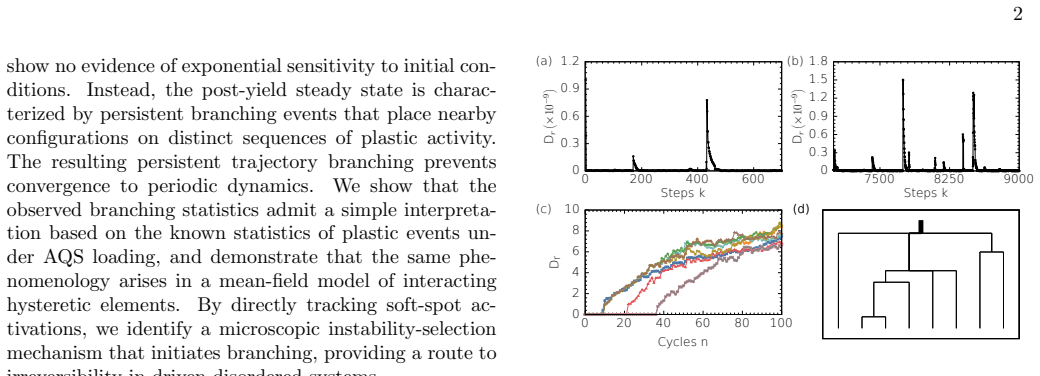
The central discovery is that irreversibility in the post-yield regime of cyclically sheared amorphous solids is produced by persistent trajectory branching, not by exponential sensitivity to initial conditions. Under athermal quasistatic shear, a small perturbation of a trajectory decays rapidly even when the system never returns to a periodic limit cycle; the trajectory is locally stable in the sense of contracting perturbations. Separation happens only when a plastic event selects between two nearly-degenerate instabilities: each unstable soft spot has a distance to instability $x_i=\sigma_i^+ - \sigma_i$, and when two sites are almost tied for the smallest $x_i$, a perturbation of order $10^{-9}$ in the particle model or $10^{-5}$ in the soft-spot model flips which one activates first. The losing instability is not erased but acts later, so the entire sequence of plastic events is reordered and the trajectories land on different branches. After branching the trajectories decorrelate and separate diffusively, with the squared separation growing with slope $8D$ in two dimensions, twice the self-diffusion coefficient. Waiting times between branchings are exponentially distributed, which the paper derives from a constant per-event branching probability, and the branching rate grows as a power law of strain amplitude above yield.
Load-bearing premise
The load-bearing premise is that the soft-spot model's rule—injecting a competing instability with probability 0.01 whenever a new configuration appears—faithfully represents how real amorphous solids resolve nearly simultaneous plastic events; if that injected randomness is what creates the branching statistics, the claimed microscopic mechanism would be weakened.
Editorial extensions
If this is right
- Above yielding, a positive Lyapunov exponent is not required for irreversibility; local stability can coexist with persistent trajectory separation.
- The branching rate factorizes as $\lambda_b = p_b \lambda_{pl}$, so the irreversibility transition can be described by a constant per-plastic-event probability of branching once the plastic-event rate is known.
- Post-branching separation grows diffusively with slope $S = 8D$ in two dimensions, meaning branched trajectories are statistically independent and the separation directly measures the material's self-diffusion.
- The branching rate increases as $\lambda_b \sim (\gamma_{\max} - \gamma_c)^\beta$ with $\beta = 1.34(7)$, connecting the dynamical mechanism to the critical behavior of the irreversibility transition.
- The same exponential waiting-time statistics appear in both a particle-based model and a mean-field soft-spot model, suggesting the mechanism is generic across driven disordered systems such as colloids, granular materials, and emulsions.
Reading between the lines
- If near-degeneracy is the real trigger, widening the disorder in instability thresholds should suppress branching at fixed strain amplitude; this is a direct prediction the paper does not test.
- The soft-spot model adds a competing instability with probability $p_{ir}=0.01$ only when a new configuration appears; varying this probability as a control parameter would separate the contribution of planted randomness from that of the natural threshold disorder, a distinction the current simulations do not resolve.
- Because the mechanism reorders activation sequences, it may unify the irreversibility transition with multi-periodic memory and cascade-scrambling phenomena in the same systems; the paper notes the relation but leaves the common statistical description for future work.
- A direct experimental test in colloidal or granular cyclically sheared systems would be to track pairs of nearby tracer particles: the paper's picture predicts plateaus of near-constant separation punctuated by sudden jumps, rather than smooth exponential growth.
Editorial analysis
A structured set of objections, weighed in public.
Referee Report
Summary. The paper studies athermal quasistatic oscillatory shear of a two-dimensional Kob-Andersen glass and a mean-field soft-spot model. Using direct perturbation experiments, the authors report that post-yield trajectories do not exhibit sustained exponential divergence: typical perturbations decay, and irreversibility instead occurs through rare branching events with exponentially distributed waiting times, after which the separation grows diffusively. The soft-spot model reproduces the branching statistics, and by tracking soft-spot activations the authors attribute branching to competition between nearly-degenerate plastic instabilities, where a small perturbation changes which instability activates first and thereby rearranges the subsequent sequence of plastic events. The paper concludes that instability-selection-induced branching, rather than chaos, is the dynamical mechanism for irreversibility.
Significance. The central observational claim—that post-yield AQS trajectories are locally stable and that irreversibility arises through rare branching events—is direct, well-posed, and supported by the particle simulations, which contain no injected stochastic source. The verification that the post-branching separation diffuses with S ≈ 8D provides a quantitative and falsifiable check. If the microscopic mechanism claim is also sustained, the paper would provide a valuable bridge between deterministic dynamics and stochastic descriptions of the irreversibility transition. The main weakness is that the proposed instability-competition mechanism is demonstrated almost entirely in a soft-spot model that contains an explicit stochastic branching injection, so the central mechanistic conclusion is not yet fully supported.
major comments (3)
- [Supplementary Material, 'Soft-spot model' paragraph after Eq. (12)] The soft-spot model contains an explicit stochastic branching source: a competing soft spot is added with probability p_ir = 0.01 whenever the dynamics reaches a system-wide configuration that has not been visited previously, and without this injection the model reaches a limit cycle for any amplitude (Ref. [30]). The paper's central mechanistic claim—that branching originates from competition between nearly-degenerate plastic instabilities—is therefore partly constructed, because the competing instability is injected stochastically rather than emerging from the natural threshold disorder. The manuscript does not report how the waiting-time distribution or the branching rate depend on p_ir, nor does it show in the particle simulations that a small perturbation reverses the ordering of two nearly-degenerate instabilities. To support the mechanism claim, the authors should either vary p_ir and show that the branching statistics are robust as p_ir is reduced (with near-degenerate pairs arising from threshold disorder), or present direct evidence in the particle simulations that a perturbation changes which of two nearly-degenerate instabilities activates first.
- [Results, 'waiting times' paragraph and Fig. 2b; Supplementary Material] The branching event is not quantitatively defined. The waiting-time distribution and the branching rate λ_b (Fig. 3a) depend on a criterion for when two trajectories 'separate,' but the paper does not state it—for example, a threshold value of Dr, a stress-signal mismatch, or the first plastic event with a different activation sequence. Without an explicit criterion, the exponential fit in Fig. 2b and the power-law exponent β = 1.34(7) cannot be independently reproduced or checked for robustness against the choice of threshold. A precise definition and a sensitivity analysis should be added.
- [Results, 'trajectory stability' paragraphs and Fig. 1] The negative claim that sustained exponential sensitivity to initial conditions is ruled out is stronger than the data support. The experiment uses N = 1000 particles, δ = 10^-9, and about 100 cycles; a finite-time Lyapunov analysis over this horizon, with rare branching events, can rule out large positive exponents but not arbitrarily small ones, and the absence of exponential divergence could be size- or protocol-dependent. The authors should soften the claim or provide a quantitative upper bound on the finite-time Lyapunov exponent consistent with their data.
minor comments (6)
- [Fig. 1 caption] The caption contains a typo: 'becoms' should be 'becomes'.
- [Main text after Eq. (6)] The sentence 'we calculated the slope for the squared distance (Fig. 3a)' appears to reference the wrong panel; the mean-square distance is shown in Fig. 3b.
- [Supplementary Material, 'Soft-spot model' paragraph] The statement 'Once a previously visited system-wide configuration is reached, we set p_ir = 0' is ambiguous: it is unclear whether p_ir is set to zero for the remainder of the simulation after the first return, or only at that specific step. This affects whether branching can occur after a return and should be clarified.
- [Supplementary Material, Eqs. (17)-(26)] The derivation of the exponential waiting-time distribution assumes that strain intervals between successive plastic events are exponentially distributed. This assumption should be verified explicitly for the present particle simulations, since the cited observations were made in other settings.
- [Results, Fig. 3 and perturbation protocols] The perturbation magnitude differs between the particle simulations (δ = 10^-9) and the soft-spot model (δ = 10^-5), and no test of the sensitivity of the branching rate to δ is reported. Since branching is threshold-mediated, δ may enter the rate; the authors should state the expected insensitivity or provide a check.
- [Fig. 1(d)] The branching diagram uses line thickness to represent the number of perturbed trajectories along a path, but no quantitative key is provided.
Circularity Check
The no-chaos result is independently supported by particle simulations, but the microscopic competition mechanism is built into the soft-spot model via the explicit p_ir branching injection.
-
self definitional
[Supplementary Material, 'Soft-spot model' section; main-text abstract and Results paragraph on the soft-spot model]
"In the absence of competing soft spots, the hierarchical multi-well dynamics described above eventually reaches a limit cycle under cyclic driving, for any driving amplitude [30]. However, atomistic simulations reveal cases in which overlapping soft spots do not follow this switching order [30]. To represent such events, whenever the dynamics reaches a system-wide configuration that has not been visited previously, a competing soft spot ˜n is added with probability p_ir = 0.01, with a randomly drawn threshold σ+˜n < σ+n that is lower than that of the incumbent soft spot n."
The paper uses the soft-spot model to 'reveal the microscopic origin' of branching and concludes that 'branching originates from competition between nearly-degenerate plastic instabilities.' But the model's branching is generated by an explicit injection rule: without p_ir the model always reaches a limit cycle, and with p_ir a new competitor with a deliberately lower threshold is created, guaranteeing an alternative branch. The near-degenerate pair in Fig. 5 (sites 157 and 187) is therefore produced by the p_ir rule rather than by emergent instability selection from natural threshold disorder. The particle-based simulations, which contain no p_ir, demonstrate that branching occurs but do not directly observe the proposed soft-spot competition.
full rationale
The paper's primary dynamical-systems claim—that post-yield trajectories are locally stable and that irreversibility arises through rare branching rather than sustained exponential sensitivity—is supported directly by the particle-based AQS simulations, which contain no injected randomness. That part is self-contained and not circular. The exponential waiting-time calculation in the Supplementary Material is a standard compound-distribution derivation; it is not itself circular, but its interpretation as evidence for the microscopic mechanism inherits the problem of the model. The circularity is concentrated in the identification of the microscopic origin: the soft-spot model, previously introduced by the same authors, includes the explicit stochastic branching source p_ir = 0.01, which is exactly the phenomenon the paper claims to explain. The observation of near-degenerate competing instabilities in Fig. 5 is a direct consequence of this injection rule, making the 'instability-selection-induced branching' mechanism partially definitional rather than emergent. The particle simulations support the existence of branching, but not the specific competition mechanism, so the central microscopic claim reduces, in part, to the model's built-in branching input.
Assumptions & free parameters
free parameters (7)
- p_ir =
0.01
- Threshold distribution width =
sigma = 0.09 in folded normal distribution
- Stress-drop factor and random fraction =
0.5 and Y ~ U[0,1)
- Interaction kernel amplitude =
eta ~ U[-0.2, 0.2)
- Perturbation magnitude delta =
1e-9 (particles), 1e-5 (soft-spot stress)
- Branching probability per plastic event p_b =
Not independently measured; inferred from lambda_b = p_b lambda_pl
- Branching rate power-law exponent beta =
1.34(7)
assumptions (5)
- domain assumption AQS dynamics, consisting of strain increments followed by energy minimization, contracts perturbations between nearby configurations.
- domain assumption In finite AQS systems, strain intervals between successive plastic events are approximately exponentially distributed.
- domain assumption After a branching event, the plastic-event sequences of the two trajectories become statistically decorrelated.
- domain assumption The soft-spot model's hysteretic elements and their interactions faithfully represent plastic instabilities in amorphous solids.
- ad hoc to paper Once a previously visited system-wide configuration is reached in the soft-spot model, the probability of adding competing soft spots is set to zero, preserving determinism.
invented entities (1)
-
Competing soft spot added with probability p_ir
Cite this review
Pith. "Pith review of A Dynamical Mechanism for Irreversibility in Cyclically Driven Amorphous Solids." pith.science (2026). https://pith.science/paper/XK5YGV3Q
@misc{pith2026260811073,
  author       = {Pith},
  title        = {Pith review of: A Dynamical Mechanism for Irreversibility in Cyclically Driven Amorphous Solids},
  year         = {2026},
  howpublished = {\url{https://pith.science/paper/XK5YGV3Q}},
  note         = {Machine review of arXiv:2608.11073}
}
read the original abstract
Amorphous solids subjected to athermal quasistatic oscillatory shear undergo a transition from periodic reversible dynamics to irreversible diffusive dynamics at yielding. How irreversibility arises in such deterministic, dissipative dynamics remains unclear. Here we show that trajectories remain locally stable, with perturbations decaying rather than growing even in the irreversible regime, ruling out the sustained exponential sensitivity to initial conditions associated with chaotic dynamics. Rather than diverging continuously, nearby trajectories initially remain close before eventually separating through rare branching events, after which their separation grows diffusively. A mean-field soft-spot model reproduces the same branching statistics and reveals their microscopic origin. We find that branching originates from competition between nearly-degenerate plastic instabilities, in which a small perturbation changes which instability activates first and thereby alters the subsequent sequence of plastic events. These results identify instability-selection-induced branching as a dynamical mechanism for irreversibility in cyclically driven amorphous solids.
Figures


Figures from the paper (4 more)


Reference graph
Works this paper leans on
-
[30]
Asaf Szulc and Ido Regev. Overlapping plastic events as a mechanism for irreversible dynamics in amorphous solids under oscillatory shear.Physical Review Research, 6(3):033129, 2024
work page 2024
-
[1]
Onset of irreversibility and chaos in amorphous solids under periodic shear.Physical Review E, 88(6):062401, 2013
Ido Regev, Turab Lookman, and Charles Reichhardt. Onset of irreversibility and chaos in amorphous solids under periodic shear.Physical Review E, 88(6):062401, 2013
2013
-
[2]
Daniel Hexner, Andrea J Liu, and Sidney R Nagel. Pe- riodic training of creeping solids.Proceedings of the Na- tional Academy of Sciences, 117(50):31690–31695, 2020
work page 2020
-
[3]
En- coding of memory in sheared amorphous solids.Physical Review Letters, 112(2):025702, 2014
Davide Fiocco, Giuseppe Foffi, and Srikanth Sastry. En- coding of memory in sheared amorphous solids.Physical Review Letters, 112(2):025702, 2014
work page 2014
-
[4]
Os- cillatory athermal quasi-static deformation of a model glass.Phys
Davide Fiocco, Giuseppe Foffi, and Srikanth Sastry. Os- cillatory athermal quasi-static deformation of a model glass.Phys. Rev. E, (88):020301(R), 2013
work page 2013
-
[5]
Nathan C Keim and Paulo E Arratia. Yielding and mi- crostructure in a 2d jammed material under shear defor- mation.Soft Matter, 9:6222, 2013
work page 2013
-
[6]
Elsen Tjhung and Ludovic Berthier. Criticality and cor- related dynamics at the irreversibility transition in peri- odically driven colloidal suspensions.Journal of Statisti- cal Mechanics: Theory and Experiment, 2016(3):033501, 2016
work page 2016
-
[7]
Carl F Schreck, Robert S Hoy, Mark D Shattuck, and Corey S O’Hern. Particle-scale reversibility in athermal particulate media below jamming.Physical Review E, 88(5):052205, 2013
work page 2013
Show all 59 references
-
[8]
Reversible to irreversible transitions in periodic driven many-body systems and future directions for classical and quantum systems.Physical Review Research, 5(2):021001, 2023
Charles Reichhardt, Ido Regev, K Dahmen, Satoshi Okuma, and Cynthia Jane Olson Reichhardt. Reversible to irreversible transitions in periodic driven many-body systems and future directions for classical and quantum systems.Physical Review Research, 5(2):021001, 2023
2023
-
[9]
Reversible plastic events during oscil- latory deformation of amorphous solids.Physical Review E, 93(1):013001, 2016
Nikolai V Priezjev. Reversible plastic events during oscil- latory deformation of amorphous solids.Physical Review E, 93(1):013001, 2016
2016
-
[10]
Self-organization, memory, and learning: From driven disordered systems to living matter.Annual Review of Condensed Matter Physics, 17, 2025
Muhittin Mungan, Eric Cl´ ement, Damien Vandem- broucq, and Srikanth Sastry. Self-organization, memory, and learning: From driven disordered systems to living matter.Annual Review of Condensed Matter Physics, 17, 2025
2025
-
[11]
Cort´ e, PM Chaikin, JP Gollub, and DJ Pine
L. Cort´ e, PM Chaikin, JP Gollub, and DJ Pine. Ran- dom organization in periodically driven systems.Nature Physics, 4(5):420–424, 2008
2008
-
[12]
Chaos and threshold for irreversibility in sheared sus- pensions.Nature, 438(7070):997–1000, 2005
DJ Pine, JP Gollub, JF Brady, and AM Leshansky. Chaos and threshold for irreversibility in sheared sus- pensions.Nature, 438(7070):997–1000, 2005
2005
-
[13]
Precisely cyclic sand: Self-organization of periodically sheared frictional grains.Proceedings of the National Academy of Sciences, 112(1):49–53, 2015
John R Royer and Paul M Chaikin. Precisely cyclic sand: Self-organization of periodically sheared frictional grains.Proceedings of the National Academy of Sciences, 112(1):49–53, 2015
2015
-
[14]
(ir) reversibility in dense granular systems driven by oscillating forces.Soft matter, 2014
Ronny M¨ obius and Claus Heussinger. (ir) reversibility in dense granular systems driven by oscillating forces.Soft matter, 2014
2014
-
[15]
Slotterback, M
S. Slotterback, M. Mailman, K. Ronaszegi, M. van Hecke, M. Girvan, and W. Losert. Onset of irreversibility in cyclic shear of granular packings.Physical Review E, 85(2):021309, 2012
2012
-
[16]
Emergent hyperuniformity in periodically driven emulsions.Physical review letters, 115(10):108301, 2015
Joost H Weijs, Rapha¨ el Jeanneret, R´ emi Dreyfus, and Denis Bartolo. Emergent hyperuniformity in periodically driven emulsions.Physical review letters, 115(10):108301, 2015. 7
2015
-
[17]
Geometrically protected reversibility in hydrodynamic loschmidt-echo experiments.Nature communications, 5, 2014
Rapha¨ el Jeanneret and Denis Bartolo. Geometrically protected reversibility in hydrodynamic loschmidt-echo experiments.Nature communications, 5, 2014
2014
-
[18]
Mangan, C
N. Mangan, C. Reichhardt, and C.J.O. Reichhardt. Re- versible to irreversible flow transition in periodically driven vortices.Physical review letters, 100(18):187002, 2008
2008
-
[19]
Yielding and memory in a driven mean-field model of glasses.Physical Review Letters, 135(25):258201, 2025
Makoto Suda, Edan Lerner, and Eran Bouchbinder. Yielding and memory in a driven mean-field model of glasses.Physical Review Letters, 135(25):258201, 2025
2025
-
[20]
Contact processes in crowded environments.Physical Review E—Statistical, Nonlinear, and Soft Matter Physics, 88(5):052130, 2013
S-L-Y Xu and JM Schwarz. Contact processes in crowded environments.Physical Review E—Statistical, Nonlinear, and Soft Matter Physics, 88(5):052130, 2013
2013
-
[21]
Mem- ory from coupled instabilities in unfolded crumpled sheets.Proceedings of the National Academy of Sciences, 119(28):e2200028119, 2022
Dor Shohat, Daniel Hexner, and Yoav Lahini. Mem- ory from coupled instabilities in unfolded crumpled sheets.Proceedings of the National Academy of Sciences, 119(28):e2200028119, 2022
2022
-
[22]
Mean- field theory of yielding under oscillatory shear.Physical Review Letters, 128(19):198001, 2022
Jack T Parley, Srikanth Sastry, and Peter Sollich. Mean- field theory of yielding under oscillatory shear.Physical Review Letters, 128(19):198001, 2022
2022
-
[23]
Relationships between structure, memory and flow in sheared disordered materials.Nature Physics, 18(5):565–570, 2022
KL Galloway, EG Teich, XG Ma, Ch Kammer, IR Gra- ham, NC Keim, C Reina, DJ Jerolmack, AG Yodh, and PE Arratia. Relationships between structure, memory and flow in sheared disordered materials.Nature Physics, 18(5):565–570, 2022
2022
-
[24]
Yield stress materials in soft condensed matter.Reviews of Modern Physics, 89(3):035005, 2017
Daniel Bonn, Morton M Denn, Ludovic Berthier, Thibaut Divoux, and S´ ebastien Manneville. Yield stress materials in soft condensed matter.Reviews of Modern Physics, 89(3):035005, 2017
2017
-
[25]
Experimental signatures of a nonequilibrium phase transition governing the yielding of a soft glass.Physical Review E, 89(6):062308, 2014
K Hima Nagamanasa, Shreyas Gokhale, AK Sood, and Rajesh Ganapathy. Experimental signatures of a nonequilibrium phase transition governing the yielding of a soft glass.Physical Review E, 89(6):062308, 2014
2014
-
[26]
Glass stability changes the nature of yielding under oscillatory shear
Wei-Ting Yeh, Misaki Ozawa, Kunimasa Miyazaki, Takeshi Kawasaki, and Ludovic Berthier. Glass stability changes the nature of yielding under oscillatory shear. Physical review letters, 124(22):225502, 2020
2020
-
[27]
Pallabi Das, HA Vinutha, and Srikanth Sastry. Unified phase diagram of reversible–irreversible, jamming, and yielding transitions in cyclically sheared soft-sphere pack- ings.Proceedings of the National Academy of Sciences, 117(19):10203–10209, 2020
2020
-
[28]
The yielding transition in amorphous solids under oscillatory shear deformation.Nature com- munications, 8(1):1–8, 2017
Premkumar Leishangthem, Anshul DS Parmar, and Srikanth Sastry. The yielding transition in amorphous solids under oscillatory shear deformation.Nature com- munications, 8(1):1–8, 2017
2017
-
[29]
Mapping out the glassy landscape of a mesoscopic elasto- plastic model.The Journal of Chemical Physics, 157(17), 2022
Dheeraj Kumar, Sylvain Patinet, Craig E Maloney, Ido Regev, Damien Vandembroucq, and Muhittin Mungan. Mapping out the glassy landscape of a mesoscopic elasto- plastic model.The Journal of Chemical Physics, 157(17), 2022
2022
-
[31]
Absorbing-state transitions in granular materials close to jamming.Phys- ical review letters, 124(8):088004, 2020
Christopher Ness and Michael E Cates. Absorbing-state transitions in granular materials close to jamming.Phys- ical review letters, 124(8):088004, 2020
2020
-
[32]
Macroscopic yielding in jammed solids is accompanied by a nonequilib- rium first-order transition in particle trajectories.Phys- ical Review E, 94(2):022615, 2016
Takeshi Kawasaki and Ludovic Berthier. Macroscopic yielding in jammed solids is accompanied by a nonequilib- rium first-order transition in particle trajectories.Phys- ical Review E, 94(2):022615, 2016
2016
-
[33]
Metastability as a mechanism for yielding in amorphous solids under cyclic shear.Physical review letters, 127(24):248002, 2021
Muhittin Mungan and Srikanth Sastry. Metastability as a mechanism for yielding in amorphous solids under cyclic shear.Physical review letters, 127(24):248002, 2021
2021
-
[34]
Kantz, T
H. Kantz, T. Schreiber, and R.S. Mackay.Nonlinear time series analysis, volume 2000. Cambridge university press Cambridge, 1997
2000
-
[35]
Mechanical yield in amorphous solids: a first-order phase transition.arXiv preprint arXiv:1601.02196, 2016
Prabhat Jaiswal, Itamar Procaccia, Corrado Rainone, and Murari Singh. Mechanical yield in amorphous solids: a first-order phase transition.arXiv preprint arXiv:1601.02196, 2016
2016 arXiv
-
[36]
Glass transitions in one-, two-, three-, and four-dimensional binary lennard-jones systems.Journal of Physics: Condensed Matter, 21(3):035117, 2009
Ralf Br¨ uning, Denis A St-Onge, Steve Patterson, and Walter Kob. Glass transitions in one-, two-, three-, and four-dimensional binary lennard-jones systems.Journal of Physics: Condensed Matter, 21(3):035117, 2009
2009
-
[37]
Maloney and A
C.E. Maloney and A. Lema ˆ ıtre. Amorphous systems in athermal, quasistatic shear.Physical Review E, 74(1):016118, 2006
2006
-
[38]
Ott.Chaos in dynamical systems
E. Ott.Chaos in dynamical systems. Cambridge univer- sity press, 2002
2002
-
[39]
Vibrational modes identify soft spots in a sheared disordered packing.Phys- ical Review Letters, 107(10):108302, 2011
M Lisa Manning and Andrea J Liu. Vibrational modes identify soft spots in a sheared disordered packing.Phys- ical Review Letters, 107(10):108302, 2011
2011
-
[40]
Networks and hierarchies: How amorphous materials learn to remember.Physical review letters, 123(17):178002, 2019
Muhittin Mungan, Srikanth Sastry, Karin Dahmen, and Ido Regev. Networks and hierarchies: How amorphous materials learn to remember.Physical review letters, 123(17):178002, 2019
2019
-
[41]
Dynamics of viscoplastic de- formation in amorphous solids.Physical Review E, 57(6):7192, 1998
ML Falk and JS Langer. Dynamics of viscoplastic de- formation in amorphous solids.Physical Review E, 57(6):7192, 1998
1998
-
[42]
Critical diffusivity in the reversibility–irreversibility transition of amorphous solids under oscillatory shear.Journal of Physics: Condensed Matter, 31(4):045101, 2019
Ido Regev and Turab Lookman. Critical diffusivity in the reversibility–irreversibility transition of amorphous solids under oscillatory shear.Journal of Physics: Condensed Matter, 31(4):045101, 2019
2019
-
[43]
Avalanches, thresholds, and diffusion in mesoscale amorphous plasticity.Physical Review E, 100(4):043003, 2019
Botond Tyukodi, Damien Vandembroucq, and Craig E Maloney. Avalanches, thresholds, and diffusion in mesoscale amorphous plasticity.Physical Review E, 100(4):043003, 2019
2019
-
[44]
An introduction to probability theory and its applications, 1958
William Feller and Philip M Morse. An introduction to probability theory and its applications, 1958
1958
-
[45]
On the density of shear transforma- tions in amorphous solids.EPL (Europhysics Letters), 105(2):26003, 2014
Jie Lin, Alaa Saade, Edan Lerner, Alberto Rosso, and Matthieu Wyart. On the density of shear transforma- tions in amorphous solids.EPL (Europhysics Letters), 105(2):26003, 2014
2014
-
[46]
Mean-field description of plastic flow in amorphous solids.Physical review X, 6(1):011005, 2016
Jie Lin and Matthieu Wyart. Mean-field description of plastic flow in amorphous solids.Physical review X, 6(1):011005, 2016
2016
-
[47]
Coopera- tive effects driving the multi-periodic dynamics of cycli- cally sheared amorphous solids.The Journal of Chemical Physics, 156(16):164506, 2022
Asaf Szulc, Muhittin Mungan, and Ido Regev. Coopera- tive effects driving the multi-periodic dynamics of cycli- cally sheared amorphous solids.The Journal of Chemical Physics, 156(16):164506, 2022
2022
-
[48]
Complex path- ways and memory in compressed corrugated sheets
Hadrien Bense and Martin van Hecke. Complex path- ways and memory in compressed corrugated sheets. Proceedings of the National Academy of Sciences, 118(50):e2111436118, 2021
2021
-
[49]
Lindeman and Sidney R
Chloe W. Lindeman and Sidney R. Nagel. Multiple mem- ory formation in glassy landscapes.Science Advances, 7(33):7133, 2021
2021
-
[50]
Keim and Joseph D
Nathan C. Keim and Joseph D. Paulsen. Multiperiodic orbits from interacting soft spots in cyclically sheared amorphous solids.Science Advances, 7(33):7685, 2021
2021
-
[51]
Simple unified view of branching pro- cess statistics: Random walks in balanced logarithmic potentials.Physical Review E, 95(3):032115, 2017
Serena Di Santo, Pablo Villegas, Raffaella Burioni, and Miguel A Mu˜ noz. Simple unified view of branching pro- cess statistics: Random walks in balanced logarithmic potentials.Physical Review E, 95(3):032115, 2017
2017
-
[52]
Probability and random processes
Geoffrey Grimmett and David Stirzaker. Probability and random processes. 2001. 8
2001
-
[53]
Springer Berlin, 1963
Theodore Edward Harris et al.The theory of branching processes, volume 6. Springer Berlin, 1963
1963
-
[54]
Lammps-a flexible simulation tool for particle-based materials modeling at the atomic, meso, and continuum scales.Computer physics commu- nications, 271:108171, 2022
Aidan P Thompson, H Metin Aktulga, Richard Berger, Dan S Bolintineanu, W Michael Brown, Paul S Crozier, Pieter J In’t Veld, Axel Kohlmeyer, Stan G Moore, Trung Dac Nguyen, et al. Lammps-a flexible simulation tool for particle-based materials modeling at the atomic, meso, and c...
2022
-
[55]
The computer study of trans- port processes under extreme conditions.Journal of Physics C: Solid State Physics, 5(15):1921, 1972
A W Lees and SF Edwards. The computer study of trans- port processes under extreme conditions.Journal of Physics C: Solid State Physics, 5(15):1921, 1972
1921
-
[56]
Bitzek, P
E. Bitzek, P. Koskinen, F. G¨ ahler, M. Moseler, and P. Gumbsch. Structural relaxation made simple.Physical review letters, 97(17):170201, 2006
2006
-
[57]
Profusion of transition pathways for interacting hysterons.Physical Review E, 104(5):054608, 2021
Martin van Hecke. Profusion of transition pathways for interacting hysterons.Physical Review E, 104(5):054608, 2021
2021
-
[58]
The fate of shear-oscillated amorphous solids.The Journal of Chem- ical Physics, 156(10), 2022
Chen Liu, Ezequiel E Ferrero, Eduardo A Jagla, Kirsten Martens, Alberto Rosso, and Laurent Talon. The fate of shear-oscillated amorphous solids.The Journal of Chem- ical Physics, 156(10), 2022
2022
-
[59]
soft spots
L. Bocquet, A. Colin, and A. Ajdari. Kinetic theory of plastic flow in soft glassy materials.Physical review letters, 103(3):36001, 2009. SUPPLEMENT AR Y MA TERIAL Simulation details Particle based simulations We used LAMMPS [54] to simulate a system of 1000 point particles in...
2009
Reviewed August 12, 2026 · model on record in the stance chip above.
Discussion (0). Continue with ORCID to comment.