REVIEW 4 major objections 6 minor 66 references
Self-Evolving Embodied Agents via Skill-Harness Evolution
T0 review · 4 major / 6 minor · reviewed 2026-08-15 · deepseek-v4-flash
Pith's one-line read SHAPER shows that a frozen embodied agent can be adapted by evolving the textual skill and context-code harness around it, without any weight updates.
desk verdict Useful method paper with consistent held-out gains, but the missing no-feedback control undercuts the specific self-evolution claim. read the letter →
The pith
A machine-rendered reading of the paper's core claim, the machinery that carries it, and where it could break.
The reading
What carries the argument
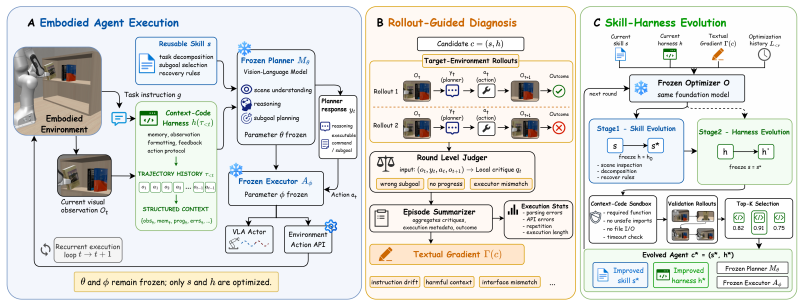
The load-bearing mechanism is the artifact pair $(s,h)$: a persistent textual skill $s$ that tells the frozen planner how to inspect, decompose, act, and recover, and a context-code harness $h$, a Python context builder that selects and formats trajectory history before each planner call. Around this pair, SHAPER builds a closed loop: rollouts are judged round-by-round on before/after observations, condensed into episode summaries plus aggregate statistics to form a textual gradient $\Gamma(c)$, and fed to the same frozen model prompted as an optimizer $O$, which proposes replacement skills and harnesses. The two-stage schedule (skill first with the harness fixed, then harness with the skill fixed), sandboxed validation, and top-K beam search turn this into a discrete optimization over artifacts while the planner and executor weights stay frozen.
What would settle it
Take the same evolution protocol and re-run it on a second, disjoint batch of training episodes of equal size; if the selected skill and harness do not reproduce the reported held-out gains (or if artifacts evolved on one batch fail on another), the textual gradient is overfitting to particular episodes rather than capturing generalizable failures. A second check is to apply the evolved artifacts to a different executor of comparable ability and see whether the gains persist when the planner's command interface changes.
Extended reading notes
Core claim
The central discovery is that the bottleneck for a frozen embodied agent is not only the model but the procedural guidance and context it is given, and that this non-parametric part can be optimized by the model itself. SHAPER factorizes an agent into a frozen planner, a frozen executor, a reusable textual skill $s$, and a context-code harness $h$, then solves an optimization problem for $(s,h)$ over expected rollout reward using target-environment episodes. The same frozen vision-language model is prompted as an artifact optimizer that consumes a 'textual gradient'—round-level critiques and episode summaries—and proposes candidate skills and harnesses, which are sandboxed, validated on a held-out set, and kept in a top-K beam. The paper reports that this two-stage skill-then-harness evolution improves performance over the seed agent, over training on the same data, and over test-time sampling or voting baselines in two embodied environments with different action interfaces.
Load-bearing premise
The load-bearing premise is that the same frozen model that makes planning mistakes can, from a few rollouts, write accurate critiques of those mistakes and propose skill and harness changes that generalize beyond the handful of training episodes.
Editorial extensions
If this is right
- Skill-and-harness evolution can improve a frozen planner both when the executor is a vision-language-action model and when the agent acts through a fixed action API, so the route does not depend on programmable robot interfaces.
- Gains persist under distribution shift: on VLABench the largest improvements over the seed appear when the target category or task form is unseen (+6.0, +10.0, and +6.5 points on splits C2, C3, and C4).
- The evolved artifacts are acquired once and reused across all held-out episodes, so the adaptation cost (about $2.25 on VLABench and $2.83 on ESI-Bench here) does not grow with the number of deployments.
- Sampling or voting at inference time does not replicate the gains, which suggests artifact evolution changes something test-time scaling does not.
Reading between the lines
- Beyond the paper: if the self-generated textual gradient is unbiased, the loop should scale with planner capability: a stronger frozen model should produce sharper diagnoses and larger gains, which is directly testable by swapping the frozen planner while keeping the rest of the pipeline fixed.
- Beyond the paper: evolved skills and harnesses are portable artifacts, so one testable extension is transferring an artifact evolved on one benchmark or executor to another environment without re-optimization; the paper leaves cross-embodiment transfer as future work.
- Beyond the paper: the same artifact-optimization loop could be applied to non-embodied agents whose behavior is also shaped by textual procedures and context construction, though the paper only evaluates embodied settings.
Signed reviews
Editorial analysis
A structured set of objections, weighed in public.
Referee Report
Summary. The paper introduces SHAPER, a train-free framework for adapting frozen embodied agents by evolving a textual skill and a context-code harness through target-environment rollouts. The agent is factored into a frozen VLM planner, a frozen executor, a skill, and a harness. SHAPER uses the same frozen model in two roles: as the planner during interaction, and as an optimizer that revises artifacts based on hierarchical textual diagnoses of rollouts. The method is evaluated on VLABench and ESI-Bench, where it reports higher success than the seed agent, same-data SFT, and test-time scaling baselines.
Significance. If the results are robust, SHAPER offers a practical, low-cost alternative to parameter updates for adapting embodied agents. The paper's controlled case studies, prompt templates, and cost accounting are strengths that support reproducibility. However, the central mechanism--rollout-derived textual feedback as the driver of improvement--is not isolated experimentally, and the lack of error bars makes the quantitative claims fragile. The work is a useful contribution to train-free agent adaptation, but the evidence currently falls short of establishing that the gains come from self-evolution rather than offline prompt optimization.
major comments (4)
- [3.2-3.3, Eq. (3)-(5), Fig. A8] The paper's central claim is that skill-and-harness optimization is driven by target-environment rollouts, yet no experiment ablates the rollout-derived feedback Γ(c). The skill optimizer receives episode summaries, execution statistics, and (on VLABench) a description of the VLA actor's command distribution; a no-feedback control in which the optimizer sees only the current artifact and executor description would determine whether the gains arise from the model's priors rather than from self-evolution. This control is load-bearing because it separates SHAPER from ordinary offline prompt optimization.
- [Tables 2 and 3] The main quantitative claims are made without repeated runs, error bars, or significance tests. On VLABench, the overall gain of SHAPER over the seed is 6.25 points, but the difference between skill-only and full SHAPER is 1.00 point, and several split-level differences are smaller (C1 42.5 vs 40.0). On ESI-Bench, category-level differences such as Specular Reflection 20.0 to 60.0 rest on 20 questions and Action Sequencing on 5. Without confidence intervals or multiple evolution runs, the reported improvements cannot be distinguished from noise.
- [4.1 Compared methods, Table 2] The same-data SFT baseline fine-tunes only the low-level VLA actor, whereas SHAPER optimizes the upper-level planner's textual skill and harness. This is not a like-for-like comparison for the claim that SHAPER is a competitive alternative to fine-tuning, because the planner remains unadapted in the SFT arm. Please add an SFT baseline that also adapts the planner (e.g., LoRA or full fine-tuning) or explicitly scope the claim to executor-level SFT.
- [4.1 Optimization protocol] The method's hyperparameters (beam width K=3, branch factor 2, evolution rounds 4, minibatch size 4, 15 train / 24 validation episodes on VLABench, 10/10 on ESI-Bench) are fixed without sensitivity analysis. Since the paper proposes a generic self-evolving framework, it would be informative to report how performance varies with the rollout count and validation set size on at least one benchmark.
minor comments (6)
- [3.2, Eq. (3)] The definition of Stats(c) is omitted; please specify what aggregate statistics are included in the textual gradient.
- [3.3, Eq. (6)] The notation TopK uses K, but the beam width is also called K in Section 4.1; clarify that they are the same quantity or rename one of them.
- [4.2] The claim that 'the improvements from artifact evolution are not reproduced by additional inference-time sampling' should be softened, because the test-time scaling baselines are only evaluated on VLABench and with fixed configurations; no error bars support the comparison.
- [4.3] The comparison with GPT-5 PS is external, as the paper notes, but the abstract and conclusion might state more explicitly that the two numbers are not directly comparable due to different evaluation sets.
- [Appendix A.3.1] The skill-optimizer prompt includes a description of the VLA actor's command distribution; this is a form of interface knowledge that should be disclosed in the main text, as it may already encode part of the improvement.
- [Throughout] The term 'textual gradient' is used as a central concept but never formally defined; consider adding a definition box or a one-sentence formalization.
Circularity Check
No circularity: reported gains are measured on held-out environment rollouts disjoint from the validation signal used for artifact selection.
full rationale
The paper's claimed derivation chain is an empirical optimization loop rather than an analytic derivation. Equation (3)-(5) define a textual gradient and optimizer proposals, but the central reported quantities are external success rates and accuracy on held-out splits (800 VLABench episodes across C1-C4; 231 ESI-Bench questions) that are disjoint from the 15/10 training episodes and 24/10 validation episodes used for selection. No fitted parameter is renamed as a prediction: the only optimized objects are the textual skill and harness code, and their quality is measured by environment rewards on a fixed validation set (Eq. 6), with final evaluation held out. The fact that the same frozen model serves as planner, judge, and optimizer is an explicit design choice and does not make the evaluation circular, because the judge/summarizer outputs are diagnostic text while selection is driven by the environment's success signal, not by the model's self-report. The skeptic's concern that no no-feedback control exists is an ablation and attribution issue, not a circularity step: it questions whether the rollout-derived feedback, rather than the optimizer's priors, causes the gain, but it does not identify any reported prediction that is equivalent to an input by construction. Related-work citations such as SkillOpt, EmbodiSkill, and AutoHarness are contextual and not load-bearing in the derivation; no uniqueness theorem or derived identity is imported from the authors' prior work. Therefore no circular step meets the evidentiary bar, and the honest finding is no significant circularity.
Assumptions & free parameters
free parameters (7)
- beam width K =
3
- branch factor =
2
- evolution rounds =
4
- feedback minibatch size =
4
- VLABench training rollout count =
15
- VLABench validation set size =
24
- ESI-Bench training and validation counts =
10 each
assumptions (4)
- domain assumption A frozen VLM can serve as both planner and artifact optimizer without parameter updates.
- domain assumption Textual summaries of rollouts capture enough information to direct artifact improvements.
- domain assumption The validation set is representative of the held-out evaluation distribution.
- domain assumption The executor and environment are reliable enough that failures can be attributed to skill or harness rather than stochastic or environmental noise.
invented entities (1)
-
textual gradient
Cite this review
Pith. "Pith review of Self-Evolving Embodied Agents via Skill-Harness Evolution." pith.science (2026). https://pith.science/paper/ZH3TM4KN
@misc{pith2026260811350,
  author       = {Pith},
  title        = {Pith review of: Self-Evolving Embodied Agents via Skill-Harness Evolution},
  year         = {2026},
  howpublished = {\url{https://pith.science/paper/ZH3TM4KN}},
  note         = {Machine review of arXiv:2608.11350}
}
read the original abstract
Embodied agents are increasingly built as systems around foundation models, where performance depends not only on model weights but also on the skills, context, action interfaces, and execution harness surrounding the model. While supervised fine-tuning and reinforcement learning can adapt agents to new environments, they require additional data, rewards, and training runs; meanwhile, many train-free code-centric approaches rely on programmable robot APIs that may be unavailable in fixed-interface settings. We propose SHAPER, a self-evolving framework for train-free embodied adaptation that keeps model parameters frozen and improves the non-parametric agent system by evolving reusable skills and a context-code harness through target-environment rollouts. In SHAPER, the same frozen model can serve as both planner and optimizer, refining its external skills and context-code harness without parameter updates. We evaluate SHAPER on VLABench and ESI-Bench, covering embodied agents with different low-level action interfaces, and compare against pure execution, supervised fine-tuning, and test-time-scaling baselines such as verifier-free selection and voting. Our results suggest that skill-and-harness optimization is a practical route to self-evolving embodied agents when model training is expensive, unavailable, or undesirable.
Figures


Figures from the paper (1 more)

Reference graph
Works this paper leans on
-
[1]
and Salazar, Grecia and Ryoo, Michael S
Zitkovich, Brianna and Yu, Tianhe and Xu, Sichun and Xu, Peng and Xiao, Ted and Xia, Fei and Wu, Jialin and Wohlhart, Paul and Welker, Stefan and Wahid, Ayzaan and Vuong, Quan and Vanhoucke, Vincent and Tran, Huong and Soricut, Radu and Singh, Anikait and Singh, Jaspiar and Sermanet, Pierre and Sanketi, Pannag R. and Salazar, Grecia and Ryoo, Michael S. a...
2023
-
[2]
Kim, Moo Jin and Pertsch, Karl and Karamcheti, Siddharth and Xiao, Ted and Balakrishna, Ashwin and Nair, Suraj and Rafailov, Rafael and Foster, Ethan P and Sanketi, Pannag R and Vuong, Quan and Kollar, Thomas and Burchfiel, Benjamin and Tedrake, Russ and Sadigh, Dorsa and Levine, Sergey and Liang, Percy and Finn, Chelsea , booktitle =. 2025 , volume =
work page 2025
-
[3]
Octo: An Open-Source Generalist Robot Policy , author =. 2024 , eprint =
work page 2024
- [4]
-
[5]
Black, Kevin and Brown, Noah and Darpinian, James and Dhabalia, Karan and Driess, Danny and Esmail, Adnan and Equi, Michael Robert and Finn, Chelsea and Fusai, Niccolo and Galliker, Manuel Y. and Ghosh, Dibya and Groom, Lachy and Hausman, Karol and ichter, brian and Jakubczak, Szymon and Jones, Tim and Ke, Liyiming and LeBlanc, Devin and Levine, Sergey an...
work page 2025
-
[6]
Gemini Robotics: Bringing AI into the Physical World , author =. 2025 , eprint =
work page 2025
-
[7]
Yuan, Haoqi and Liang, Zhixuan and Chen, Anzhe and Wang, Ye and Li, Haoyang and Lin, Pei and Huang, Yiyang and Lei, Zixing and Zhang, Tong and Zhang, Jiazhao and Zhang, Jie and Fan, Jingyang and Zhou, Gengze and Peng, Qihang and Lv, Chenxu and Chen, Xiaoyue and Yang, An and Huang, Fei and Lin, Junyang and Liu, Dayiheng and Zhou, Jingren and Wu, Chenfei an...
-
[8]
Zhang, Shiduo and Xu, Zhe and Liu, Peiju and Yu, Xiaopeng and Li, Yuan and Gao, Qinghui and Fei, Zhaoye and Yin, Zhangyue and Wu, Zuxuan and Jiang, Yu-Gang and Qiu, Xipeng , year =. 2412.18194 , archivePrefix =
Show all 66 references
-
[9]
2605.18746 , archivePrefix =
Hong, Yining and Liu, Jiageng and Yin, Han and Li, Manling and Guibas, Leonidas and Fei-Fei, Li and Wu, Jiajun and Choi, Yejin , year =. 2605.18746 , archivePrefix =
-
[10]
2023 , eprint =
Open X-Embodiment: Robotic Learning Datasets and. 2023 , eprint =
2023
-
[11]
2403.12945 , archivePrefix =
Khazatsky, Alexander and Pertsch, Karl and Nair, Suraj and Balakrishna, Ashwin and Dasari, Sudeep and Karamcheti, Siddharth and Nasiriany, Soroush and Srirama, Mohan Kumar and Chen, Lawrence Yunliang and Ellis, Kirsty and others , year =. 2403.12945 , archivePrefix =
-
[12]
2025 , eprint =
Improving Vision-Language-Action Model with Online Reinforcement Learning , author =. 2025 , eprint =
2025
-
[13]
2505.18719 , archivePrefix =
Lu, Guanxing and Guo, Wenkai and Zhang, Chubin and Zhou, Yuheng and Jiang, Haonan and Gao, Zifeng and Tang, Yansong and Wang, Ziwei , year =. 2505.18719 , archivePrefix =
-
[14]
2601.03044 , archivePrefix =
Pan, Mingjie and Feng, Siyuan and Zhang, Qinglin and Li, Xinchen and Song, Jianheng and Qu, Chendi and Wang, Yi and Li, Chuankang and Xiong, Ziyu and Chen, Zhi and Liu, Yi and Luo, Jianlan , year =. 2601.03044 , archivePrefix =
-
[15]
Beyond Imitation: Reinforcement Learning-Based Sim-Real Co-Training for
Shi, Liangzhi and Chen, Shuaihang and Gao, Feng and Chen, Yinuo and Chen, Kang and Zhang, Tonghe and Zang, Hongzhi and Zhou, Jiakai and Zhang, Weinan and Yu, Chao and Wang, Yu , year =. Beyond Imitation: Reinforcement Learning-Based Sim-Real Co-Training for. 2602.12628 , archi...
-
[16]
2022 , eprint =
Do As I Can, Not As I Say: Grounding Language in Robotic Affordances , author =. 2022 , eprint =
2022
-
[17]
2023 IEEE International Conference on Robotics and Automation (ICRA) , pages =
Code as Policies: Language Model Programs for Embodied Control , author =. 2023 IEEE International Conference on Robotics and Automation (ICRA) , pages =. 2023 , organization =. doi:10.1109/ICRA48891.2023.10160591 , url =
2023
-
[18]
Proceedings of The 7th Conference on Robot Learning , pages =
VoxPoser: Composable 3D Value Maps for Robotic Manipulation with Language Models , author =. Proceedings of The 7th Conference on Robot Learning , pages =. 2023 , volume =
2023
-
[19]
2023 , eprint =
Voyager: An Open-Ended Embodied Agent with Large Language Models , author =. 2023 , eprint =
2023
-
[20]
2607.00272 , archivePrefix =
Lu, Runyu and Wu, Yubo and Kou, Ethan and Fu, Letian and Xiao, Wenli and Mandlekar, Ajay and Xu, Yinzhen and Shi, Guanya and Goldberg, Ken and Chen, Ang and Chowdhury, Mosharaf and Zhu, Yuke and Fan, Linxi and Wang, Guanzhi , year =. 2607.00272 , archivePrefix =
-
[21]
and Wettig, Alexander and Lieret, Kilian and Yao, Shunyu and Narasimhan, Karthik and Press, Ofir , year =
Yang, John and Jimenez, Carlos E. and Wettig, Alexander and Lieret, Kilian and Yao, Shunyu and Narasimhan, Karthik and Press, Ofir , year =. 2405.15793 , archivePrefix =
-
[22]
2606.14674 , archivePrefix =
Chen, Jixuan and others , year =. 2606.14674 , archivePrefix =
-
[23]
2026 , eprint =
Natural-Language Agent Harnesses , author =. 2026 , eprint =
2026
-
[24]
2026 , eprint =
Meta-Harness: End-to-End Optimization of Model Harnesses , author =. 2026 , eprint =
2026
-
[25]
2026 , eprint =
AutoHarness: improving LLM agents by automatically synthesizing a code harness , author =. 2026 , eprint =
2026
-
[26]
2026 , eprint =
The Interplay of Harness Design and Post-Training in LLM Agents , author =. 2026 , eprint =
2026
-
[27]
2024 , eprint =
TextGrad: Automatic ``Differentiation'' via Text , author =. 2024 , eprint =
2024
-
[28]
2026 , eprint =
SkillOpt: Executive Strategy for Self-Evolving Agent Skills , author =. 2026 , eprint =
2026
-
[29]
2026 , eprint =
SkillRL: Evolving Agents via Recursive Skill-Augmented Reinforcement Learning , author =. 2026 , eprint =
2026
-
[30]
2026 , eprint =
Skill1: Unified Evolution of Skill-Augmented Agents via Reinforcement Learning , author =. 2026 , eprint =
2026
-
[31]
2026 , eprint =
CoEvoSkills: Self-Evolving Agent Skills via Co-Evolutionary Verification , author =. 2026 , eprint =
2026
-
[32]
2604.03964 , archivePrefix =
Shen, Shuaike and Cheng, Wenduo and Ma, Mingqian and Turcan, Alistair and Zhang, Martin Jinye and Ma, Jian , year =. 2604.03964 , archivePrefix =
-
[33]
2026 , eprint =
EmbodiSkill: Skill-Aware Reflection for Self-Evolving Embodied Agents , author =. 2026 , eprint =
2026
-
[34]
2602.03973 , archivePrefix =
Liu, Shuo and Singh, Ishneet Sukhvinder and Xu, Yiqing and Duan, Jiafei and Krishna, Ranjay , year =. 2602.03973 , archivePrefix =
-
[35]
2606.03127 , archivePrefix =
Zhang, Wenbo and Li, Jianxiong and Yang, Shuai and Chen, Sijin and Liu, Jiajun and Liu, Lingqiao and Ma, Xiao , year =. 2606.03127 , archivePrefix =
-
[36]
Recurrent-Depth
Tur, Yalcin and Naghiyev, Jalal and Fang, Haoquan and Tsai, Wei-Chuan and Duan, Jiafei and Fox, Dieter and Krishna, Ranjay , year =. Recurrent-Depth. 2602.07845 , archivePrefix =
-
[37]
2026 , eprint =
Think Twice, Act Once: Verifier-Guided Action Selection For Embodied Agents , author =. 2026 , eprint =
2026
-
[38]
Proceedings of The 9th Conference on Robot Learning , pages =
RoboMonkey: Scaling Test-Time Sampling and Verification for Vision-Language-Action Models , author =. Proceedings of The 9th Conference on Robot Learning , pages =. 2025 , volume =
2025
-
[39]
2025 , eprint =
Verifier-free Test-Time Sampling for Vision Language Action Models , author =. 2025 , eprint =
2025
-
[40]
2507.05116 , archivePrefix =
Lin, Juyi and Taherin, Amir and Akbari, Arash and Akbari, Arman and Lu, Lei and Chen, Guangyu and Padir, Taskin and Yang, Xiaomeng and Chen, Weiwei and Li, Yiqian and Lin, Xue and Kaeli, David and Zhao, Pu and Wang, Yanzhi , year =. 2507.05116 , archivePrefix =
-
[41]
2025 , eprint =
Steering Vision-Language-Action Models as Anti-Exploration: A Test-Time Scaling Approach , author =. 2025 , eprint =
2025
-
[42]
2022 , eprint =
Self-Consistency Improves Chain of Thought Reasoning in Language Models , author =. 2022 , eprint =
2022
-
[43]
2024 , eprint =
Inference Scaling Laws: An Empirical Analysis of Compute-Optimal Inference for Problem-Solving with Language Models , author =. 2024 , eprint =
2024
-
[44]
arXiv preprint arXiv:2502.19417 , year =
Hi Robot: Open-Ended Instruction Following with Hierarchical Vision-Language-Action Models , author =. arXiv preprint arXiv:2502.19417 , year =
-
[45]
arXiv preprint arXiv:2510.03342 , year =
Gemini Robotics 1.5: Pushing the Frontier of Generalist Robots with Advanced Embodied Reasoning, Thinking, and Motion Transfer , author =. arXiv preprint arXiv:2510.03342 , year =
-
[46]
2025 , url =
Zhao, Han and Zhang, Jiaxuan and Song, Wenxuan and Ding, Pengxiang and Wang, Donglin , journal =. 2025 , url =
2025
-
[47]
and Wang, Haohuan and Tang, Jiaming and Stachowicz, Kyle and others , journal =
Torne, Marcel and Pertsch, Karl and Walke, Homer and Vedder, Kyle and Nair, Suraj and Ichter, Brian and Ren, Allen Z. and Wang, Haohuan and Tang, Jiaming and Stachowicz, Kyle and others , journal =. 2026 , url =
2026
-
[48]
2011 , publisher =
Thinking, Fast and Slow , author =. 2011 , publisher =
2011
-
[49]
2025 , url =
Fei, Senyu and Wang, Siyin and Shi, Junhao and Dai, Zihao and Cai, Jikun and Qian, Pengfang and Ji, Li and He, Xinzhe and Zhang, Shiduo and Fei, Zhaoye and Fu, Jinlan and Gong, Jingjing and Qiu, Xipeng , journal =. 2025 , url =
2025
-
[50]
arXiv preprint arXiv:2207.05608 , year =
Inner Monologue: Embodied Reasoning through Planning with Language Models , author =. arXiv preprint arXiv:2207.05608 , year =
-
[51]
2025 , url =
Li, Haozhan and Zuo, Yuxin and Yu, Jiale and Zhang, Yuhao and Yang, Zhaohui and Zhang, Kaiyan and Zhu, Xuekai and Zhang, Yuchen and Chen, Tianxing and Cui, Ganqu and others , journal =. 2025 , url =
2025
-
[52]
Embodied-
Yuan, Yifu and Cui, Haiqin and Huang, Yaoting and Chen, Yibin and Ni, Fei and Dong, Zibin and Li, Pengyi and Zheng, Yan and Tang, Hongyao and Hao, Jianye , journal =. Embodied-. 2025 , url =
2025
-
[53]
2025 , url =
Chen, Kang and Liu, Zhihao and Zhang, Tonghe and Guo, Zhen and Xu, Si and Lin, Hao and Zang, Hongzhi and Li, Xiang and Zhang, Quanlu and Yu, Zhaofei and others , journal =. 2025 , url =
2025
-
[54]
2025 , url =
Zhang, Hongyin and Zhang, Shuo and Jin, Junxi and Zeng, Qixin and Li, Runze and Wang, Donglin , journal =. 2025 , url =
2025
-
[55]
Conference on Robot Learning (CoRL) , year =
Steering Your Generalists: Improving Robotic Foundation Models via Value Guidance , author =. Conference on Robot Learning (CoRL) , year =
-
[56]
Towards Deploying
Li, Zhuo and Liu, Junjia and Dong, Zhipeng and Teng, Tao and Rouxel, Quentin and Caldwell, Darwin and Chen, Fei , journal =. Towards Deploying. 2025 , url =
2025
-
[57]
Empirical Methods in Natural Language Processing (EMNLP) , year =
Automatic Prompt Optimization with ``Gradient Descent'' and Beam Search , author =. Empirical Methods in Natural Language Processing (EMNLP) , year =
-
[58]
International Conference on Learning Representations (ICLR) , year =
Large Language Models as Optimizers , author =. International Conference on Learning Representations (ICLR) , year =
-
[59]
and Moazam, Hanna and Miller, Heather and Zaharia, Matei and Potts, Christopher , booktitle =
Khattab, Omar and Singhvi, Arnav and Maheshwari, Paridhi and Zhang, Zhiyuan and Santhanam, Keshav and Vardhamanan, Sri and Haq, Saiful and Sharma, Ashutosh and Joshi, Thomas T. and Moazam, Hanna and Miller, Heather and Zaharia, Matei and Potts, Christopher , booktitle =
-
[60]
2023 , url =
Guo, Qingyan and Wang, Rui and Guo, Junliang and Li, Bei and Song, Kaitao and Tan, Xu and Liu, Guoqing and Bian, Jiang and Yang, Yujiu , journal =. 2023 , url =
2023
-
[61]
and Hu, Zhiting , booktitle =
Wang, Xinyuan and Li, Chenxi and Wang, Zhen and Bai, Fan and Luo, Haotian and Zhang, Jiayou and Jojic, Nebojsa and Xing, Eric P. and Hu, Zhiting , booktitle =
-
[62]
Advances in Neural Information Processing Systems (NeurIPS) , year =
Reflexion: Language Agents with Verbal Reinforcement Learning , author =. Advances in Neural Information Processing Systems (NeurIPS) , year =
-
[63]
International Conference on Learning Representations (ICLR) , year =
Eureka: Human-Level Reward Design via Coding Large Language Models , author =. International Conference on Learning Representations (ICLR) , year =
-
[64]
Advances in Neural Information Processing Systems (NeurIPS) , year =
Self-Refine: Iterative Refinement with Self-Feedback , author =. Advances in Neural Information Processing Systems (NeurIPS) , year =
-
[65]
and Stoica, Ion and Gonzalez, Joseph E
Packer, Charles and Wooders, Sarah and Lin, Kevin and Fang, Vivian and Patil, Shishir G. and Stoica, Ion and Gonzalez, Joseph E. , booktitle =
-
[66]
2025 , url =
Shi, Hao and Xie, Bin and Liu, Yingfei and Sun, Lin and Liu, Fengrong and Wang, Tiancai and Zhou, Erjin and Fan, Haoqiang and Zhang, Xiangyu and Huang, Gao , journal =. 2025 , url =
2025
Reviewed August 15, 2026 · model on record in the stance chip above.
Discussion (0). Continue with ORCID to comment.