REVIEW 3 major objections 4 minor 40 references
Strain-controlled magnetism and magnetoelasticity in monolayer NiPS$_3$ and CrPS$_4$
T0 review · 3 major / 4 minor · reviewed 2026-08-15 · deepseek-v4-flash
Pith's one-line read A first-principles strain-dependent Heisenberg model predicts that monolayer CrPS4 switches between spin-spiral and ferromagnetic order under a few percent strain, accompanied by a nearly 0.1% magnetostrictive jump.
desk verdict Useful material-specific magnetoelastic study of NiPS3 and CrPS4; the CrPS4 spiral-state numbers rest on an untested FM-to-spiral transferability. read the letter →
The pith
A machine-rendered reading of the paper's core claim, the machinery that carries it, and where it could break.
The reading
What carries the argument
The load-bearing object is the strain-dependent Heisenberg Hamiltonian with isotropic exchange, Dzyaloshinskii-Moriya, and single-ion anisotropy terms, whose exchange couplings are computed by density functional theory as functions of applied Voigt strain and fitted quadratically. The machinery is the pair of strain derivatives: first derivatives form the magnetoelastic force $B$, second derivatives form the magnetic stiffness correction $A$, both weighted by spin products $\mathbf{e}_i\cdot\mathbf{e}_j$, summed over neighbor shells, and combined with the bare elastic tensor $C$ to give the magnetostrictive strain and the effective tensor $C_M$. This makes the magnetic-state dependence explicit and allows shell-by-shell convergence of the magnetoelastic response.
What would settle it
Measure the in-plane lattice parameters of a CrPS4 monolayer as it is driven through the spiral-to-ferromagnetic transition by magnetic field or strain: the framework predicts a jump of about 0.08\% in the y-axis magnetostrictive strain, from roughly -0.103\% in the spiral state to -0.187\% in the ferromagnetic state. A lattice change an order of magnitude smaller would falsify the predicted strong anisotropic magnetoelastic coupling.
Extended reading notes
Core claim
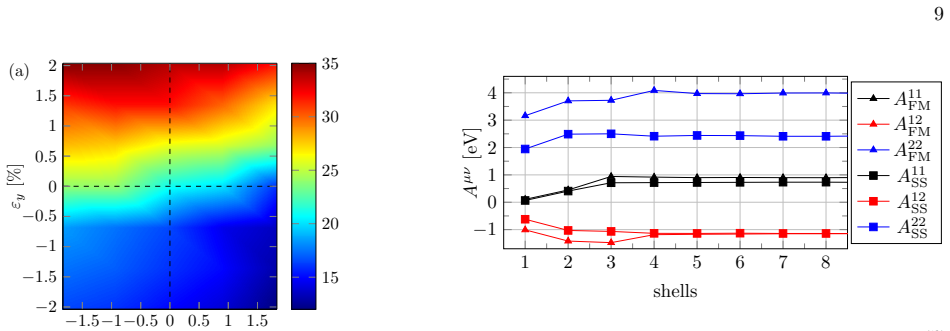
The paper argues that a strain-dependent classical Heisenberg Hamiltonian, with isotropic exchange $J_{ij}(\varepsilon)$ expanded to second order in strain, is enough to capture magnetoelasticity. The first strain derivatives form a generalized magnetoelastic force $B_\mu = \sum_{i,j} (\partial J_{ij}/\partial \varepsilon_\mu)\, \mathbf{e}_i\cdot\mathbf{e}_j$, which sets the magnetostrictive strain $\varepsilon_M = (VC + A)^{-1} B$, while the second derivatives form $A_{\mu\nu} = \sum_{i,j} (\partial^2 J_{ij}/\partial \varepsilon_\mu \partial \varepsilon_\nu)\, \mathbf{e}_i\cdot\mathbf{e}_j$, which renormalizes the elastic tensor through $C_M = C + A/V$. Applying this to monolayers, the paper finds that NiPS3 has magnetostrictive strains of only about 0.01\% to 0.02\%, whereas CrPS4 shows strains of order 0.05\% to 0.19\% and a change of nearly 0.1\% between the spin-spiral and ferromagnetic states, making the magnetoelastic effect experimentally detectable.
Load-bearing premise
For CrPS4, the exchange constants and their strain derivatives are extracted from density functional calculations in the collinear ferromagnetic state, then used to predict the spin-spiral phase and its magnetoelastic coefficients; the transferability of these couplings to the spiral state is assumed.
Editorial extensions
If this is right
- For monolayer NiPS3, strain of a few percent switches the zigzag propagation direction between the 0 degrees and ±120 degrees states and can drive a transition to stripy antiferromagnetic order near 3\% biaxial tension, with the critical temperature changing by more than 10\%.
- For monolayer CrPS4, strain along the b direction reduces the dimerization of the first-neighbor exchange interactions, destabilizes the spin-spiral state, and stabilizes an out-of-plane ferromagnet, with a magnetic-anisotropy sign reversal near 0.6\% strain.
- The magnetostrictive strain in CrPS4 is roughly an order of magnitude larger than in NiPS3, and the magnetic renormalization of the elastic tensor reaches about 2\% along the chain direction, so the structural change across the spiral-to-ferromagnetic transition should be observable.
- Because $A$ and $B$ depend on the magnetic configuration through the factors $\mathbf{e}_i\cdot\mathbf{e}_j$, the elastic tensor and magnetostriction are magnetic-state dependent, giving a microscopic explanation for why different magnetic phases have different lattice responses.
Reading between the lines
- Extension: because the framework attributes the strong anisotropy to first-neighbor Cr-S-Cr exchange pathways along the chain direction, the same pathways should dominate spin-phonon coupling in CrPS4; Raman or inelastic neutron measurements across the ordering temperature could test this directly.
- Extension: the second-derivative sums predict magnetic-order-dependent sound velocities, so ultrasonic or Brillouin measurements on CrPS4 should show a change in the chain-direction longitudinal mode when the spiral orders.
- Extension: by using strain along the b direction as a control parameter, the roughly 0.1\% magnetostrictive jump could act as a strain-actuated structural switch without an applied magnetic field, provided the spiral-to-ferromagnetic transition is reversible.
Signed reviews
Editorial analysis
A structured set of objections, weighed in public.
Referee Report
Summary. The manuscript develops a first-principles framework for magnetoelasticity in two-dimensional magnets, in which the first and second strain derivatives of Heisenberg exchange interactions define a generalized magnetoelastic force B and a magnetic correction A to the elastic tensor. The authors apply this framework to monolayer NiPS3 and CrPS4, combining DFT with a long-range exchange mapping and Monte Carlo simulations. They conclude that NiPS3 has weak, nearly isotropic spin-lattice coupling with magnetostrictive strains around 0.01–0.02%, while CrPS4 shows strong anisotropic coupling, a strain-driven spiral-to-ferromagnetic phase diagram, and a magnetostrictive jump of nearly 0.1% at the FM–SS transition. The framework is general, and the shell-resolved convergence analyses for A and B are a useful contribution.
Significance. If correct, this work provides a practical first-principles route to compute magnetostrictive strains and magnetic elastic renormalizations from strain-dependent exchange interactions, complementing existing spin-phonon treatments. The explicit tabulation of exchange derivatives, the convergence checks with interaction shells (Figs. 6 and 11), and the contrasting material predictions are valuable and likely to guide experiments on strain engineering in CrPS4. The central physical distinction between weak coupling in NiPS3 and strong, anisotropic coupling in CrPS4 is plausible. However, the quantitative claims, especially for CrPS4, rest on a sign issue, an incomplete subtraction of magnetic contributions, and an untested transferability assumption, as detailed below.
major comments (3)
- [§II.B, Eqs. (8)–(10)] There is a sign error in the definition of the magnetostrictive strain. Minimizing E_tot = (V/2) ε^T C ε + B^T ε + (1/2) ε^T A ε with respect to ε gives ε_eq = −(VC + A)^−1 B, because ∂E/∂ε = (VC + A)ε + B = 0. Equation (9) instead defines ε_M = +(VC + A)^−1 B, which has the opposite sign. Since Eq. (8) writes the elastic energy as (V/2)(ε + ε_M)^T C_M (ε + ε_M) + ΔE_ms, the equilibrium strain is actually −ε_M. The manuscript nevertheless reports the values obtained from Eq. (9) as the magnetostrictive strains in Eqs. (12)–(13). Consequently the sign of every reported magnetostrictive strain, and the direction of the magnetostrictive jump across the FM–SS transition, is reversed. This is not a harmless convention choice: inserting the value from Eq. (9) into the derivative of Eq. (8) gives a nonzero force. The sign convention must be corrected and all numerical predictions re-evaluated.
- [§II.B, Eq. (11), and the extraction of the 'bare' tensor in §§III–IV] The subtraction C = C_M − A/V does not yield a genuinely bare nonmagnetic elastic tensor. The DFT total energies from which C_M is obtained are computed in the spin-polarized magnetic state, so C_M contains the strain response of all magnetic interactions, including exchange anisotropy, Dzyaloshinskii–Moriya terms, and single-ion anisotropy. The tensor A in Eq. (6), however, includes only the isotropic Heisenberg exchange contribution. Subtracting A/V therefore removes only part of the magnetic contribution and leaves all non-isotropic magnetic terms inside the quantity called 'bare' C. This is numerically unimportant for NiPS3, where A/V components are of order 1 meV/Ų against C components of order 5000 meV/Ų, but for CrPS4 the A_22/V component is about 50 meV/Ų against C_22 ≈ 2500 meV/Ų, so an omitted magnetic contribution of comparable magnitude would change the extracted C and hence the magnetostrictive strains in Eq. (13). The paper should either compute a non-spin-polarized reference tensor or include the full magnetic interaction tensor in A and B.
- [§IV, Fig. 8, Eq. (13), and Table III] The spin-spiral predictions for CrPS4 are built from exchange couplings and strain derivatives extracted from DFT calculations constrained to the collinear ferromagnetic state, as stated in Sec. IV. These parameters are then weighted by the phase factor cos(q·r_ij) to construct A_SS and B_SS, and they are used to predict the strain-driven SS–FM phase boundaries, the SS critical temperatures, and the SS magnetostrictive strains in Eq. (13). The text acknowledges that the true ground state is the SS, but no test is provided of whether the FM-constrained J_N(ε), b_μ, and a_μν transfer to the noncollinear state. Changes of 20–30% in these parameters, which are plausible given that the FM and SS states may differ in self-consistent charge and orbital occupations, would shift the phase boundaries and the reported ≈0.1% magnetostrictive jump proportionally. I request a concrete transferability test: for example, compute exchange couplings for a commensurate shorter-period spiral at one or two representative strains and compare with the FM values, or compare a direct DFT FM–SS total-energy difference with the model prediction. If such a test is not computationally feasible, the SS-specific quantitative claims should be presented as model extrapolations rather than as robust predictions.
minor comments (4)
- [Fig. 11 caption] The caption reads 'Converge of the magnetic elastic contributions'; this should be 'Convergence of the magnetic elastic contributions'.
- [§II.B, paragraph after Eq. (11)] The statement that magnetic contributions are 'already included at the electronic-structure level and must not be added separately' is confusing because A is later subtracted to obtain the bare tensor. Please rewrite this paragraph to clarify what is subtracted and why only the isotropic-exchange part is used.
- [Introduction, Refs. [20]–[21]] Reference [21] (Bonca et al., spin-stiffness calculation) does not appear related to strain-induced phase transitions or noncollinear spin textures; please verify that this citation is intended in that context.
- [§III, magnetostrictive strains] The text states that the difference between the zigzag and stripy magnetostrictive strains is 'below 0.01%', but the values in Eq. (12) differ by about 0.003% in x and 0.007% in y; consider stating the actual differences to avoid ambiguity.
Circularity Check
No significant circularity: magnetoelastic response is computed from independently extracted strain derivatives of exchange interactions, not from the predicted quantities themselves.
full rationale
The derivation chain is self-contained. Section II.B defines A and B from strain derivatives of exchange interactions (Eqs. 6-7), and Eqs. 8-11 are algebraic consequences of expanding the Heisenberg energy; magnetostrictive strains and magnetic elastic renormalizations are then evaluated from DFT-computed J_N(ε) and its quadratic fits (Tbls. II-III). The target quantities (εM, C_M, phase diagrams) are not inputs to the fits. The CrPS4 calculations admittedly use FM-constrained DFT because the spin-spiral state is 'computationally inaccessible within conventional first-principles calculations,' and the SS magnetoelastic coefficients use the MC-obtained spiral wave vector q through the phase factor cos(q·r_ij). This is an acknowledged transferability assumption, not a circular reduction: the SS magnetostriction and strain-dependent phase diagram are outputs of the model, not fitted data. Reliance on the authors' previous paper [23] is for methodological details, zero-strain ground states, and context; the paper recomputes strained exchange parameters and obtains phase diagrams and T_c from its own Monte Carlo runs, so no load-bearing conclusion reduces to a self-citation chain. Self-citation of the grogucode [38] is a code/method reference, not a substituted derivation. Overall, the central results are derived, not assumed, and score low.
Assumptions & free parameters
free parameters (2)
- Hubbard U values for Ni and Cr d states =
not reported in this paper (deferred to Ref. [23])
- In-house norm-conserving pseudopotentials for Cr, Ni, P, S =
fitted case by case to ELK all-electron lattice constants, magnetic moments, and bands
assumptions (4)
- domain assumption The classical Heisenberg Hamiltonian with isotropic exchange, Dzyaloshinskii-Moriya, and single-ion anisotropy fully describes the magnetic energetics of the two monolayers.
- domain assumption Isotropic exchange interactions dominate the magnetoelastic response; strain derivatives of DM and anisotropy are neglected.
- domain assumption Exchange interactions and their strain derivatives computed in the collinear FM state are valid for the spin-spiral state of CrPS4.
- domain assumption Total energies and exchange couplings are parabolic in strain within the tested +/-3 percent range.
Cite this review
Pith. "Pith review of Strain-controlled magnetism and magnetoelasticity in monolayer NiPS$_3$ and CrPS$_4$." pith.science (2026). https://pith.science/paper/OJUT3NJ4
@misc{pith2026260811356,
  author       = {Pith},
  title        = {Pith review of: Strain-controlled magnetism and magnetoelasticity in monolayer NiPS$_3$ and CrPS$_4$},
  year         = {2026},
  howpublished = {\url{https://pith.science/paper/OJUT3NJ4}},
  note         = {Machine review of arXiv:2608.11356}
}
abstract
We develop a first-principles framework for magnetoelastic coupling in two-dimensional magnets based on a strain-dependent Heisenberg model. In this approach, strain derivatives of the exchange interactions provide direct access to magnetostriction and to the magnetic renormalization of the elastic tensor, establishing a microscopic link between spin interactions and elastic response. We apply the method to monolayer NiPS$_3$ and CrPS$_4$, which exhibit contrasting magnetoelastic behavior. NiPS$_3$ shows weak and nearly isotropic spin-lattice coupling, consistent with a robust zigzag antiferromagnetic ground state. In contrast, CrPS$_4$ displays strong anisotropic coupling, leading to strain-driven transitions between spin-spiral and ferromagnetic phases and significant changes in the critical temperature and elastic response. Our results demonstrate a general route to quantify magnetoelastic effects in low-dimensional magnets and highlight CrPS$_4$ as a promising platform for strain engineering of magnetic order.
Figures


Figures from the paper (7 more)



Reference graph
Works this paper leans on
-
[23]
Magnetic ground states of CrPS$_4$ and NiPS$_3$ monolayers from long-range exchange interactions
B. Nagyfalusi, R. Das, A. Bermejillo-Seco, H. S. J. van der Zant, Y. M. Blanter, A. Garcia-Fuente, and J. Ferrer, Magnetic ground states of CrPS 4 and NiPS3 monolayers from long-range exchange interactions (2026), arXiv:2607.20631 [cond-mat.mtrl-sci]
work page Pith review arXiv 2026
-
[1]
Y. Tian, M. J. Gray, H. Ji, R. J. Cava, and K. S. Burch, Magneto-elastic coupling in a potential ferromagnetic 2D atomic crystal, 2D Materials3, 025035 (2016)
work page 2016
-
[2]
T. Li, S. Jiang, N. Sivadas, Z. Wang, Y. Xu, D. Weber, J. E. Goldberger, K. Watanabe, T. Taniguchi, C. J. Fen- nie, K. Fai Mak, and J. Shan, Pressure-controlled inter- 11 layer magnetism in atomically thin cri3, Nature Materials 18, 1303 (2019)
work page 2019
- [3]
-
[4]
M. J. A. Houmes, G. Baglioni, M. ˇSiˇ skins, M. Lee, D. L. Esteras, A. M. Ruiz, S. Ma˜ nas-Valero, C. Boix- Constant, J. J. Baldov´ ı, E. Coronado, Y. M. Blanter, P. G. Steeneken, and H. S. J. van der Zant, Magnetic order in 2D antiferromagnets revealed by spontaneous anisotropic magnetostriction, Nature Communications 14, 8503 (2023)
work page 2023
-
[5]
Z. He, S. P. Poudel, S. Stolz, T. Wang, A. Rossi, F. Wang, S.-K. Mo, A. Weber-Bargioni, Z. Q. Qiu, S. Barraza- Lopez, T. Zhu, and M. F. Crommie, Synthesis and Poly- morph Manipulation of FeSe2 Monolayers, Nano Letters 24, 8535 (2024)
work page 2024
- [6]
-
[7]
C. A. Marques, L. C. Rhodes, W. Osmolska, H. Lane, I. Benediˇ ciˇ c, M. Naritsuka, S. A. Berge, R. Fitti- paldi, M. Lettieri, A. Vecchione, and P. Wahl, Emergent exchange-driven giant magnetoelastic coupling in a cor- related itinerant ferromagnet, Nature Physics21, 1243 (2025)
work page 2025
Show all 40 references
-
[8]
X. Z. Lu, X. Wu, and H. J. Xiang, General microscopic model of magnetoelastic coupling from first principles, Phys. Rev. B91, 100405 (2015)
2015
-
[9]
Sivadas, M
N. Sivadas, M. W. Daniels, R. H. Swendsen, S. Okamoto, and D. Xiao, Magnetic ground state of semiconducting transition-metal trichalcogenide monolayers, Phys. Rev. B91, 235425 (2015)
2015
-
[10]
Y. Yu, Z. Zhang, H. Ye, D. Zhang, L. Chen, G. P. Zhang, and J. Wang, Strain-tunable magnetic anisotropy and magneto-optical effects in a room-temperature Cr 2Te3 monolayer spin valve, Phys. Rev. B112, 144431 (2025)
2025
-
[11]
Henr´ ıquez-Guerra, A
E. Henr´ ıquez-Guerra, A. M. Ruiz, M. Galbiati, A. Cort´ es-Flores, D. Brown, E. Zamora-Amo, L. Al- monte, A. Shumilin, J. Salvador-S´ anchez, A. P´ erez- Rodr´ ıguez, I. n. Orue, A. Cantarero, A. Castellanos- Gomez, F. Mompe´ an, M. Garcia-Hernandez, E. Navarro- Moratalla, E....
-
[12]
J. Li, J. Feng, P. Wang, E. Kan, and H. Xiang, Nature of spin-lattice coupling in two-dimensional CrI3 and Cr- GeTe3, Science China Physics, Mechanics & Astronomy 64, 286811 (2021)
2021
-
[13]
S. J. Callori, S. Hu, J. Bertinshaw, Z. J. Yue, S. Danilkin, X. L. Wang, V. Nagarajan, F. Klose, J. Seidel, and C. Ulrich, Strain-induced magnetic phase transition in SrCoO3−δ thin films, Phys. Rev. B91, 140405(R) (2015)
2015
-
[14]
Z. Wu, J. Yu, and S. Yuan, Strain-tunable magnetic and electronic properties of monolayer CrI3, Phys. Chem. Chem. Phys.21, 7750 (2019)
2019
-
[15]
T. Song, Z. Fei, M. Yankowitz, Z. Lin, Q. Jiang, K. Hwangbo, Q. Zhang, B. Sun, T. Taniguchi, K. Watan- abe, M. A. McGuire, D. Graf, T. Cao, J.-H. Chu, D. H. Cobden, C. R. Dean, D. Xiao, and X. Xu, Switching 2d magnetic states via pressure tuning of layer stacking, Na- ture Mat...
2019
-
[16]
S. Yang, Y. Chen, and C. Jiang, Strain engineering of two-dimensional materials: Methods, properties, and ap- plications, InfoMat3, 397 (2021)
2021
-
[17]
Z. Ni, A. V. Haglund, H. Wang, B. Xu, C. Bern- hard, D. G. Mandrus, X. Qian, E. J. Mele, C. L. Kane, and L. Wu, Imaging the N´ eel vector switching in the monolayer antiferromagnet MnPSe3 with strain- controlled Ising order, Nature Nanotechnology16, 782 (2021)
2021
-
[18]
Cenker, S
J. Cenker, S. Sivakumar, K. Xie, A. Miller, P. Thijssen, Z. Liu, A. Dismukes, J. Fonseca, E. Anderson, X. Zhu, X. Roy, D. Xiao, J.-H. Chu, T. Cao, and X. Xu, Re- versible strain-induced magnetic phase transition in a van der Waals magnet, Nature Nanotechnology17, 256 (2022)
2022
-
[19]
Ebrahimian, A
A. Ebrahimian, A. Dyrda l, and A. Qaiumzadeh, Control of magnetic states and spin interactions in bilayer CrCl3 with strain and electric fields: an ab initio study, Scien- tific Reports13, 5336 (2023)
2023
-
[20]
A. J. Bhasu, S. Kumar, M. T¨ or¨ ok, D. T. Pozs´ ar, B. Ny´ ari, L. Udvardi, G. Mart´ ınez-Carracedo, B. Nagyfalusi, A. Garc´ ıa-Fuente, J. Ferrer, Z. Tajkov, L. Oroszl´ any, L. R´ ozsa, and L. Szunyogh, Strain induced mag- netic phase transitions in Fe3GeTe2 monolayer (2026),...
2026 arXiv
-
[21]
Bonca, J
K. Bonca, J. P. Rodr´ ıguez, J. Ferrer, and K. S. Bedell, Di- rect calculation of Spin-stiffness for spin-1/2 Heisenberg models, Phys. Rev. B50, 3415 (1994)
1994
-
[22]
X. Bo, F. Li, X. Yin, Y. Chen, X. Wan, and Y. Pu, Mag- netic structure and exchange interactions of the van der Waals CrPS4 monolayer under strain: A first-principles study, Phys. Rev. B108, 024405 (2023)
2023
-
[24]
P. A. Joy and S. Vasudevan, Magnetism in the layered transition-metal thiophosphates MPS 3 (M=Mn, Fe, and Ni), Phys. Rev. B46, 5425 (1992)
1992
-
[25]
F. Y. Gao, D. S. Kim, C. Lei, A. Kumar, X. Peng, X. Liu, F. Barantani, S. Zhang, K. P. Lee, K. Raju, D. Lujan, S. Arash, S. Raman, S.-F. Lee, M. Ye, X. Li, A. H. MacDonald, and E. Baldini, Six-state clock physics in an atomically thin antiferromagnet, Nature Materials 10.1038/...
2026 doi
-
[26]
Louisy, G
A. Louisy, G. Ouvrard, D. Schleich, and R. Brec, Physical properties and lithium intercalates of CrPS4, Solid State Communications28, 61 (1978)
1978
-
[27]
H. L. Zhuang and J. Zhou, Density functional theory study of bulk and single-layer magnetic semiconductor CrPS4, Phys. Rev. B94, 195307 (2016)
2016
-
[28]
Calder, A
S. Calder, A. V. Haglund, Y. Liu, D. M. Pajerowski, H. B. Cao, T. J. Williams, V. O. Garlea, and D. Mandrus, Mag- netic structure and exchange interactions in the layered semiconductor CrPS4, Phys. Rev. B102, 024408 (2020)
2020
-
[29]
Y. Peng, S. Ding, M. Cheng, Q. Hu, J. Yang, F. Wang, M. Xue, Z. Liu, Z. Lin, M. Avdeev, Y. Hou, W. Yang, Y. Zheng, and J. Yang, Magnetic Structure and Metam- agnetic Transitions in the van der Waals Antiferromagnet CrPS4, Advanced Materials32, 2001200 (2020)
2020
-
[30]
J. Son, S. Son, P. Park, M. Kim, Z. Tao, J. Oh, T. Lee, S. Lee, J. Kim, K. Zhang, K. Cho, T. Kamiyama, J. H. Lee, K. F. Mak, J. Shan, M. Kim, J.-G. Park, and 12 J. Lee, Air-Stable and Layer-Dependent Ferromagnetism in Atomically Thin van der Waals CrPS4,ACS Nano, ACS Nano15, 1...
2021
-
[31]
D. Hou, Z. Jiang, R.-C. Xiao, C. Liu, X. Chang, Y. Liu, Z. Wang, B. Li, X. Liu, X. Hu, W. Ding, J. Hu, X. Luo, Y. Sun, and Z. Sheng, Extraordinary Magnetic Second Harmonic Generation in Monolayer CrPS4, Advanced Optical Materials12, 2400943 (2024)
2024
-
[32]
Miranda, M
I. Miranda, M. Pankratova, M. Weißenhofer, A. Klautau, D. Thonig, M. Pereiro, E. Sj¨ oqvist, A. Delin, M. Katsnel- son, O. Eriksson, and A. Bergman, Spin-lattice couplings in 3d ferromagnets: Analysis from first principles, Phys- ical Review Materials9(2025)
2025
-
[33]
J. M. Soler and E. Artacho and J. D. Gale and A. Gar- cia and J. Junquera and P. Ordejon and D. Sanchez- Portal, The SIESTA method for ab initio order-N mate- rials simulations, Journal of Physics: Condensed Matter 14, 10.1088/0953-8984/14/11/302 (2002)
2002 doi
-
[34]
and Cerda, J
Cuadrado, R. and Cerda, J. I., Fully relativistic pseu- dopotential formalism under an atomic orbital basis: spin-orbit splittings and magnetic anisotropies, Jour- nal of Physics: Condensed Matter24, 10.1088/0953- 8984/24/8/086005 (2012)
2012 doi
-
[35]
The Elk Code,http://elk.sourceforge.net/
-
[36]
J. P. Perdew, K. Burke, and M. Ernzerhof, Generalized gradient approximation made simple, Phys. Rev. Lett. 77, 3865 (1996)
1996
-
[37]
S. L. Dudarev, G. A. Botton, S. Y. Savrasov, C. J. Humphreys, and A. P. Sutton, Electron-energy-loss spec- tra and the structural stability of nickel oxide: An LSDA+U study, Physical Review B57, 10.1103/Phys- RevB.57.1505 (1998)
1998 doi
-
[38]
Mart´ ınez-Carracedo, L
G. Mart´ ınez-Carracedo, L. Oroszl´ any, A. Garc´ ıa-Fuente, B. Ny´ ari, L. Udvardi, L. Szunyogh, and J. Ferrer, Rel- ativistic magnetic interactions from nonorthogonal basis sets, Phys. Rev. B108, 214418 (2023)
2023
-
[39]
C.-T. Kuo, M. Neumann, K. Balamurugan, H. J. Park, S. Kang, H. W. Shiu, J. H. Kang, B. H. Hong, M. Han, T. W. Noh, and J.-G. Park, Exfoliation and Raman Spec- troscopic Fingerprint of Few-Layer NiPS3 Van der Waals Crystals, Scientific Reports6, 20904 (2016)
2016
-
[40]
Zhang, Y
W. Zhang, Y. Zhang, X. Leng, Q. Jing, and Q. Wen, CrPS4 Nanoflakes as Stable Direct-Band-Gap 2D Mate- rials for Ultrafast Pulse Laser Applications, Nanomateri- als13, 10.3390/nano13061128 (2023)
2023 doi
Reviewed August 15, 2026 · model on record in the stance chip above.
Discussion (0). Continue with ORCID to comment.