REVIEW 3 major objections 4 minor 46 references
Dion3: Full-Stack Orthogonal Updates
T0 review · 3 major / 4 minor · reviewed 2026-08-16 · deepseek-v4-flash
Pith's one-line read Dion3 shows a full-stack redesign of Muon's orthogonalization step can match or beat its loss while cutting optimizer step time up to 6x.
desk verdict The speed side of Dion3 is solid and worth taking seriously; the 'matches or improves loss' claim is a single-seed, single-dataset result that the abstract overstates. read the letter →
The pith
A machine-rendered reading of the paper's core claim, the machinery that carries it, and where it could break.
The reading
What carries the argument
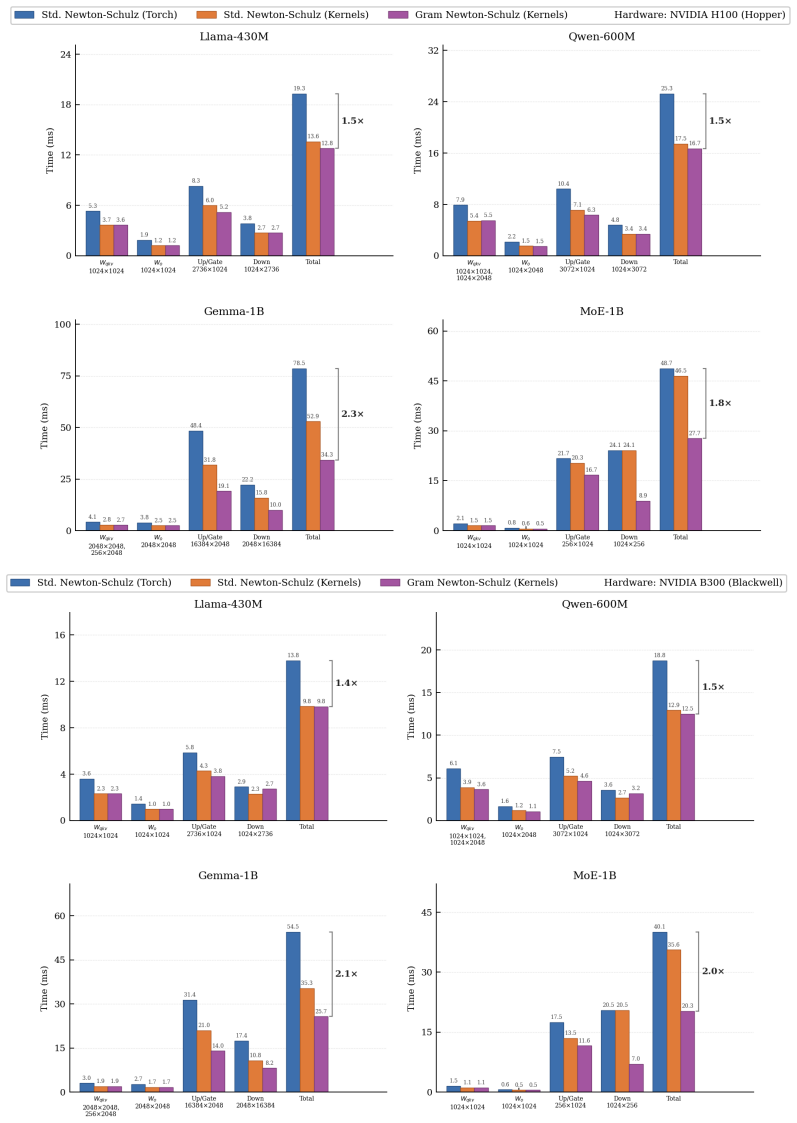
The load-bearing mechanism is the identity polar(X) = (XX^T)^(-1/2)X combined with the factorization of odd polynomials p_t(x)=x h_t($x^{2}$). That factorization lets Newton-Schulz run on the small symmetric Gram matrix R_t = X_t X_t^T while keeping a cumulative Q_t, producing the same output as standard Newton-Schulz in exact arithmetic. The other half is the row-selection update rule: pick k=ceil(fn) rows of M with largest L1 norm, polarize the submatrix with Gram Newton-Schulz, update only those rows, and apply error feedback by decaying only selected momentum rows so unselected rows can build up and be chosen later. A restart after the second iteration stabilizes the Gram iteration against spurious negative eigenvalues introduced by half-precision arithmetic.
What would settle it
Train a 7B dense transformer on a second data mixture, such as FineWeb-Edu, with Dion3 at f=1/4 versus a tuned NorMuon, running several seeds; if Dion3's final validation loss is not at most NorMuon's, the claim that Dion3 matches or improves the loss fails to transfer outside the paper's setting.
Extended reading notes
Core claim
The central claim is that Muon's polarization step can be replaced by a mathematically equivalent Gram-matrix iteration plus a coarser, cheaper update rule without losing Muon's optimization quality. Writing polar(X)=(XX^T)^(-1/2)X, Gram Newton-Schulz iterates on the n by n Gram matrix and needs only two rectangular matrix multiplications instead of the usual ten, while the fractional update rule selects k=ceil(fn) rows of largest L1 norm, orthogonalizes just those rows, updates only those weights, and dampens only those momentum rows via error feedback. The paper's experiments show that for 1B-14B dense transformers trained on ClimbMix, tuned fractional updates track below NorMuon's loss throughout training, and the optimizer step time falls by up to 6x, with communication volume scaling as the fraction f. It further establishes a transfer rule eta' = eta/$\sqrt$(f) that keeps the Frobenius norm of the update matched to full Muon.
Load-bearing premise
The quality claim stands on the premise that updating only a fraction of momentum rows each step, with error feedback for the rest, is a harmless or slightly helpful approximation across architectures, data, and scales; the experiments cover one data mixture and dense transformers from 1B to 14B.
Editorial extensions
If this is right
- Using Dion3 at f=1/4 as a drop-in replacement for Muon should give essentially the same or slightly lower training loss while cutting optimizer step time by about 3.7x on top of Gram Newton-Schulz and kernel gains, for large dense models.
- The eta*sqrt(f) approximately 0.01 rule means users do not need a full learning-rate sweep for each new fraction; set eta' = eta/sqrt(f).
- In communication-bound regimes, megabatching collapses communication rounds to a constant and fractional selection reduces communication volume by a factor of 1/f, so the benefits should be largest when many small matrices are sharded across many GPUs.
- Gram Newton-Schulz applies to any Muon variant, including NorMuon and MoE training, so improvements to the orthogonalization step compose with other optimizers that use Newton-Schulz as a black box.
Reading between the lines
- The improved final loss at f<1 suggests row selection acts as an implicit regularizer; if so, the same trick could be ported to other cubic-time update rules that orthogonalize or whiten momentum, but the paper does not test that.
- Because the paper reports single-seed runs on one data mixture, the quality edge at 14B (-0.027) may be within run-to-run noise; a multi-seed replication on a second data mixture would settle whether the improvement is systematic.
- Communication savings grow linearly in 1/f, so in settings where weights are sharded across data-center networks rather than local NVLink interconnects, the end-to-end speedup could exceed the 6x reported; the paper's benchmarks use local interconnects.
Signed reviews
Editorial analysis
A structured set of objections, weighed in public.
Referee Report
Summary. The paper presents Dion3, a revision of the Muon optimizer that targets the cost of the Newton–Schulz orthogonalization step at four levels: a Gram-matrix reformulation of Newton–Schulz (Gram Newton–Schulz), custom symmetric GEMM kernels written in CuteDSL, a fractional row-selection update rule with error feedback, and megabatched communication for distributed training. The authors prove an algebraic equivalence between standard Newton–Schulz and the Gram iteration (Theorem 2), provide a stability analysis with a restart schedule, and report experiments on 1B–14B dense transformers trained on ClimbMix. The headline claims are that Dion3 matches or improves the loss of Muon/NorMuon while reducing optimizer step time by up to 6x, and that the update rule improves on Dion in both speed and performance.
Significance. If the speed results hold, the practical significance is high: reducing Muon's optimizer-step overhead from roughly 26x AdamW to about 4x at 7B scale would make orthogonal optimizers substantially more accessible in distributed training. The paper has clear strengths: the Gram Newton–Schulz equivalence is a clean algebraic result; the FLOP accounting is careful (up to a typo noted below); the stability analysis, restart schedule, and benchmark methodology with interquartile ranges are well specified; and the authors provide open-source packages for the optimizer and kernels. The weak link is the loss-quality component of the central claim, which currently rests on single-seed, single-dataset experiments, and the abstract's claim of improvement over Dion is not backed by any direct Dion baseline experiment.
major comments (3)
- [§8.1, Fig. 3, Table 2] The claim that Dion3 'matches or improves on the loss achieved by Muon' is supported only by single-seed runs on a single data mixture (ClimbMix) with dense transformers at 1B–14B, and the hyperparameters (f, η) are selected from the same sweep whose best values are then reported (Figure 3). No repeated seeds or confidence intervals are given for the final losses in Figure 3, Figure 4, or Table 2, and the larger-scale runs in Table 2 use the learning rate from the 1B transfer rule η√f = 0.01 without per-scale validation. Section 9 itself states that 'Further work is needed to determine how widely this improvement generalizes.' Because this loss-quality claim is load-bearing for the abstract, the paper should either add repeated-seed or multi-dataset evidence, or explicitly restrict the claim to the tested setting.
- [Abstract, §3.2] The abstract states that the update rule 'improves on Dion ... in both speed and performance,' and Section 3.2 says the update rule is 'simpler and faster than Dion,' but no experiment in the paper compares Dion3 against the Dion baseline. The comparisons to NorMuon/Muon in Section 8 do not support a claim about Dion. Add a direct Dion baseline to the speed and loss experiments, or remove the performance claim from the abstract and intro.
- [§4.1] The FLOP comparison in the text says 'For a typical Muon application (T = 5, α = 43), it saves 55% of the FLOPs used by standard Newton-Schulz with symmetric GEMMs, or 68% compared to a typical implementation without symmetric GEMMs.' Plugging α = 43 into the paper's own formulas gives T(3α+1) = 650 and (4T+3α−3) = 146, i.e., a 77.5% saving, not 55%; the stated 55%/68% correspond to α = 4. Please correct the aspect-ratio typo and recompute any downstream percentages.
minor comments (4)
- [§8.2, Fig. 6] The text reports 'overall speedups of 3.6× and 6.5×,' while Figure 6 and the abstract say '6×.' Please harmonize these numbers so the abstract, figure, and body agree.
- [Algorithm 4, §8.1] Section 6 says the distributed implementation selects the top-f fraction of rows from each shard, with global selection as an option, but Section 8.1 does not state which selection mode was used in the reported runs. Please specify this for reproducibility.
- [Figure 3] The heatmap reports one number per (f, η) cell with no indication of the number of runs or run-to-run variability. With single runs, a bolded 'best' cell is not evidence of a significant difference from neighboring cells; please state the number of seeds per cell or add error bars.
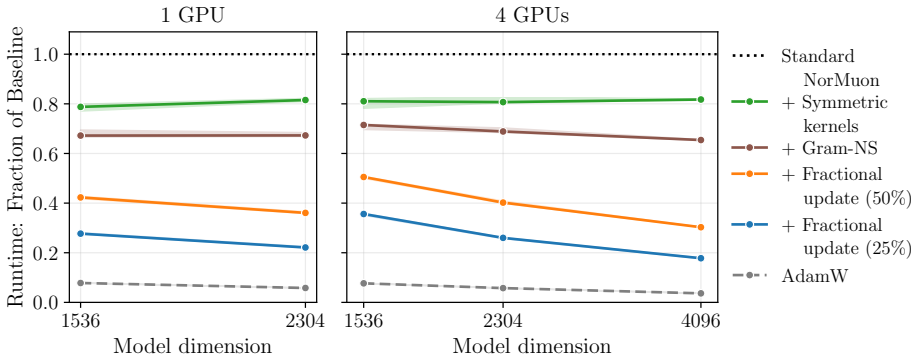
- [Appendix B.2.1] The restart schedule is derived under the empirical bound that spurious negative eigenvalues are at least −4 × 10⁻⁴. Please add a sentence noting that this is an empirical assumption that should be re-validated if the precision, architecture, or coefficient set changes.
Circularity Check
No construction-level circularity: Gram Newton-Schulz is a proven algebraic equivalence and the learning-rate rule follows from Frobenius norm matching; only minor, non-load-bearing self-citations were found.
full rationale
The paper's central derivation chain is self-contained at the level of algebra and cost analysis. Theorem 2 proves the scalar iteration underlying Gram Newton-Schulz directly from the polynomial decomposition p_t(x) = x h_t(x^2), with no fitted quantity or target loss entering the equivalence; the same holds for the FLOP counts and the restart analysis, where the assumed spurious eigenvalue bound of about -4e-4 is an observed numerical input used to choose a schedule, not a prediction derived from the method itself. The learning-rate transfer rule eta' = eta/sqrt(f) is obtained by equating the Frobenius norms of the Muon and Dion3 updates, so it is not fitted to the validation losses that are later reported; using this rule at 3B-14B is extrapolation rather than circularity. The main caveats are evidential rather than circular: the claim that f<1 improves loss is based on a single-seed, single-dataset sweep in which the best f and eta are selected from the same grid that produces the reported minima, and the abstract asserts improvement over Dion without a direct benchmark against Dion. The paper also relies on two overlapping-author prior works, Ahn et al. for error feedback and Amsel et al. for Polar Express coefficients, but both are used as implemented components and are themselves tested or simulated within the present paper rather than invoked as uniqueness theorems or as substitutes for the experimental comparison. These self-citations are real prior-art inputs but are not load-bearing in a way that makes any result true by construction. Overall, the specific equations do not reduce to their own inputs, so the appropriate finding is no significant circularity, with a small score adjustment only for the presence of minor non-load-bearing self-citations.
Assumptions & free parameters
free parameters (4)
- selection fraction f =
1/4 recommended; 1/8 best at 1B
- Gram-NS restart location =
after iteration 2 of 5
- assumed spurious eigenvalue bound =
-4e-4
- Polar Express safety factor =
1.05
assumptions (5)
- standard math polar(M) = (M M^T)^-1/2 M when M has full row rank.
- domain assumption The Polar Express Newton-Schulz coefficients drive singular values in [0,1] to approximately 1.
- ad hoc to paper Half-precision spurious negative eigenvalues of the Gram matrix are bounded by -4e-4 and are reset by restarting every two iterations.
- ad hoc to paper L1-norm row selection with error feedback approximates full Muon to within acceptable quality.
- domain assumption Single-seed training comparisons are representative of run-to-run variance.
Cite this review
Pith. "Pith review of Dion3: Full-Stack Orthogonal Updates." pith.science (2026). https://pith.science/paper/2CCZWEKD
@misc{pith2026260811612,
  author       = {Pith},
  title        = {Pith review of: Dion3: Full-Stack Orthogonal Updates},
  year         = {2026},
  howpublished = {\url{https://pith.science/paper/2CCZWEKD}},
  note         = {Machine review of arXiv:2608.11612}
}
read the original abstract
The Muon optimizer incurs a significant overhead cost due to its cubic-time Newton-Schulz orthogonalization step. When weights are sharded, communication overhead compounds this computational cost, eroding the benefits of Muon in many settings. We present Dion3, a revision of Muon that targets this overhead at every level of the stack. Our Gram Newton-Schulz algorithm reduces the FLOP cost of orthogonalization, our CuteDSL kernels accelerate it by exploiting symmetry, and our megabatching strategy reduces communication overhead. Moreover, we propose a simple change to the update rule that cuts costs even further: selecting only a fraction of the momentum matrix's rows to orthogonalize at each step. This update rule improves on Dion (another "compressed" version of Muon), in both speed and performance. Overall, Dion3 matches or improves on the loss achieved by Muon but reduces optimizer step time by up to 6x. Dion3 is available via the dion package (https://github.com/microsoft/dion) as a drop-in replacement for Muon.
Figures


Figures from the paper (20 more)




Reference graph
Works this paper leans on
-
[1]
Julien Abadji, Marah Abdin, Connor Adams, Eric Alcaide, Mustafa Altun, Michele Artoni, Junze Bao, Uday Barar, Vassilis Bekiaris, Arkadii Bessonov, et al.Laguna M.1/XS.2 Technical Report. 2026. arXiv: 2605.27605
arXiv 2026
-
[2]
Kwangjun Ahn, Byron Xu, Natalie Abreu, Ying Fan, Gagik Magakyan, Pratyusha Sharma, Zheng Zhan, and John Langford.Dion: Distributed Orthonormalized Updates. 2025. arXiv:2504.05295
arXiv 2025
-
[3]
The Polar Express: Optimal Matrix Sign Methods and their Application to the Muon Algorithm
Noah Amsel, David Persson, Christopher Musco, and Robert M. Gower. “The Polar Express: Optimal Matrix Sign Methods and their Application to the Muon Algorithm”. In:The Fourteenth International Conference on Learning Representations. 2026. https://openreview.net/forum?id=yRtgZ1K8hO
work page 2026
-
[4]
Google DeepMind, 2025.https://jax-ml.github.io/scaling-book/
Jacob Austin, Sholto Douglas, Roy Frostig, Anselm Levskaya, Charlie Chen, Sharad Vikram, Federico Lebron, Peter Choy, Vinay Ramasesh, Albert Webson, and Reiner Pope.How to Scale Your Model. Google DeepMind, 2025.https://jax-ml.github.io/scaling-book/
work page 2025
-
[5]
Jeremy Bernstein. Deriving Muon. 2025. https://jeremybernste.in/writing/deriving-muon
work page 2025
-
[6]
Thibaut Boissin, Thomas Massena, Franck Mamalet, and Mathieu Serrurier.Turbo-Muon: Accelerating Orthogonality-Based Optimization with Pre-Conditioning. 2025. arXiv:2512.04632
arXiv 2025
-
[7]
Towards understanding of orthogonalization in Muon
Valentyn Boreiko, Zhiqi Bu, and Sheng Zha. “Towards understanding of orthogonalization in Muon”. In: Tiny Titans: The next wave of On-Device Learning for Foundation Models (TTODLer-FM). 2025. https://openreview.net/forum?id=4vzhqq5hpX
work page 2025
-
[8]
Franz Louis Cesista, Jiacheng You, and Keller Jordan.Squeezing 1-2% Efficiency Gains Out of Muon by Optimizing the Newton-Schulz Coefficients. 2025. http://leloykun.github.io/ponder/muon-opt- coeffs/. 17
work page 2025
Show all 46 references
-
[9]
DeepSeek-AI, Aixin Liu, Bei Feng, Bing Xue, Bingxuan Wang, Bochao Wu, Chengda Lu, Chenggang Zhao, Chengqi Deng, Chenyu Zhang, et al.DeepSeek-V3 Technical Report. 2025. arXiv:2412.19437
2025 arXiv
-
[10]
Nemotron-CLIMB: Clustering-based Iterative Data Mixture Bootstrapping for Language Model Pre- training
Shizhe Diao, Yu Yang, Yonggan Fu, Xin Dong, Dan Su, Markus Kliegl, Zijia Chen, Peter Belcak, Yoshi Suhara, Hongxu Yin, Mostofa Patwary, Yingyan Celine Lin, Jan Kautz, and Pavlo Molchanov. “Nemotron-CLIMB: Clustering-based Iterative Data Mixture Bootstrapping for Language Model...
2025
-
[11]
Essential AI.Layer Sharding for Large-Scale Training with Muon. 2025. https://www.essential.ai/ research/infra
2025
-
[12]
Gemma Team, Aishwarya Kamath, Johan Ferret, Shreya Pathak, Nino Vieillard, Ramona Merhej, Sarah Perrin, Tatiana Matejovicova, Alexandre Ramé, Morgane Rivière, et al.Gemma 3 Technical Report. 2025. arXiv:2503.19786
2025 arXiv
-
[13]
GLM-5 Team, Aohan Zeng, Xin Lv, Zhenyu Hou, Zhengxiao Du, Qinkai Zheng, Bin Chen, Da Yin, Chendi Ge, Chenghua Huang, et al.GLM-5: from Vibe Coding to Agentic Engineering. 2026. arXiv: 2602.15763
2026 arXiv
-
[14]
Aaron Grattafiori, Abhimanyu Dubey, Abhinav Jauhri, Abhinav Pandey, Abhishek Kadian, Ahmad Al-Dahle, Aiesha Letman, Akhil Mathur, Alan Schelten, Alex Vaughan, et al.The Llama 3 Herd of Models. 2024. arXiv:2407.21783
2024 arXiv
-
[15]
Ekaterina Grishina, Matvey Smirnov, and Maxim Rakhuba.Accelerating Newton-Schulz Iteration for Orthogonalization via Chebyshev-type Polynomials. 2026. arXiv:2506.10935
2026
-
[16]
Wentao Guo, Mayank Mishra, Xinle Cheng, Ion Stoica, and Tri Dao.SonicMoE: Accelerating MoE with IO and Tile-aware Optimizations. 2026. arXiv:2512.14080
2026
-
[17]
Higham.Functions of Matrices: Theory and Computation
Nicholas J. Higham.Functions of Matrices: Theory and Computation. Society for Industrial and Applied Mathematics, 2008. doi: 10.1137/1.9780898717778
2008 doi
-
[18]
Taejong Joo, Wenhan Xia, Cheolmin Kim, Ming Zhang, and Eugene Ie.On Surprising Effectiveness of Masking Updates in Adaptive Optimizers. 2026. arXiv:2602.15322
2026
-
[19]
Muon: An optimizer for hidden layers in neural networks
Keller Jordan, Yuchen Jin, Vlado Boza, Jiacheng You, Franz Cesista, Laker Newhouse, and Jeremy Bernstein. Muon: An optimizer for hidden layers in neural networks. 2024. https://kellerjordan. github.io/posts/muon/
2024
-
[20]
MuonBP: Faster Muon via Block-Periodic Orthogonalization
Ahmed Khaled, Kaan Ozkara, Tao Yu, Mingyi Hong, and Youngsuk Park. “MuonBP: Faster Muon via Block-Periodic Orthogonalization”. In: The Fourteenth International Conference on Learning Representations. 2026. https://openreview.net/forum?id=mHouLSUQP5
2026
-
[21]
Charles, Cheng Chen, Guanduo Chen, Haiting Chen, Huarong Chen, Jiahao Chen, Ningxin Chen, et al.Kimi K2: Open Agentic Intelligence
Kimi Team, Yifan Bai, Yiping Bao, Y. Charles, Cheng Chen, Guanduo Chen, Haiting Chen, Huarong Chen, Jiahao Chen, Ningxin Chen, et al.Kimi K2: Open Agentic Intelligence. 2025. arXiv:2507.20534
2025 arXiv
-
[22]
On the Computation of the Matrix k-th Root
Slobodan Lakić. “On the Computation of the Matrix k-th Root”. In: Zeitschrift für Angewandte Mathematik und Mechanik78.3 (1998), pp. 167–172.https://onlinelibrary.wiley.com/doi/abs/ 10.1002/%28SICI%291521-4001%28199803%2978%3A3%3C167%3A%3AAID-ZAMM167%3E3.0.CO%3B2-R
1998
-
[23]
NorMuon: Making Muon more efficient and scalable
Zichong Li, Liming Liu, Chen Liang, Weizhu Chen, and Tuo Zhao. “NorMuon: Making Muon more efficient and scalable”. In:Forty-third International Conference on Machine Learning. 2026. https: //openreview.net/forum?id=m1IRWFAMsa
2026
-
[24]
Junghwan Lim, Sungmin Lee, Dongseok Kim, Taehyun Kim, Eunhwan Park, Jeesoo Lee, Jeongdoo Lee, Junhyeok Lee, Wai Ting Cheung, Dahye Choi, et al.Motif 2 12.7B technical report. 2025. arXiv: 2511.07464
2025
-
[25]
Tianyang Lin.Flash-Muon: An Efficient Implementation of Muon Optimizer. 2025. https://github. com/nil0x9/flash-muon
2025
-
[26]
Pull Request #1428, NVIDIA/Megatron-LM
Jingyuan Liu.A proof of concept for Distributed Muon. Pull Request #1428, NVIDIA/Megatron-LM. Accessed: 2026-07-10. 2025.https://github.com/NVIDIA/Megatron-LM/pull/1428
2026
-
[27]
Jingyuan Liu, Jianlin Su, Xingcheng Yao, Zhejun Jiang, Guokun Lai, Yulun Du, Yidao Qin, Weixin Xu, Enzhe Lu, Junjie Yan, et al.Muon is Scalable for LLM Training. 2025. arXiv:2502.16982
2025 arXiv
-
[28]
Anton Lozhkov, Loubna Ben Allal, Leandro von Werra, and Thomas Wolf.FineWeb-Edu: the Finest Collection of Educational Content. 2024. doi: 10.57967/hf/2497. 18
2024 doi
-
[29]
Trion: FFT-based Dynamic Subspace Selection for Low-Rank Adaptive Optimization of LLMs
Ionut-Vlad Modoranu, Mher Safaryan, Erik Schultheis, Max Ryabinin, Artem Chumachenko, and Dan Alistarh. “Trion: FFT-based Dynamic Subspace Selection for Low-Rank Adaptive Optimization of LLMs”. In:The Fourteenth International Conference on Learning Representations. 2026. https...
2026
-
[30]
Laker Newhouse, Dakota Goldberg, and Ricardo Ruiz.Faster symmetric matrix multiplication with ThunderKittens. 2024. https://www.lakernewhouse.com/assets/writing/faster-symmul-with- thunderkittens.pdf
2024
-
[31]
Arora, Yu Bai, Bowen Baker, et al.gpt-oss-120b & gpt-oss-20b Model Card
OpenAI, Sandhini Agarwal, Lama Ahmad, Jason Ai, Sam Altman, Andy Applebaum, Edwin Arbus, Rahul K. Arora, Yu Bai, Bowen Baker, et al.gpt-oss-120b & gpt-oss-20b Model Card. 2025. arXiv: 2508.10925
2025 arXiv
-
[32]
Ziyuan Tang, Tianshi Xu, Yousef Saad, and Yuanzhe Xi.Hierarchical Muon: Tiled Newton-Schulz Updates for Efficient Muon Optimization. 2026. arXiv:2606.27216
2026 arXiv
-
[33]
Transpose one of the MLP matrices + add Triton kernel for symmetric matmul
Byron Xu. Transpose one of the MLP matrices + add Triton kernel for symmetric matmul. Pull Request #109, KellerJordan/modded-nanogpt. Accessed: 2026-07-10. 2025.https://github.com/ KellerJordan/modded-nanogpt/pull/109
2026
-
[34]
An Yang, Anfeng Li, Baosong Yang, Beichen Zhang, Binyuan Hui, Bo Zheng, Bowen Yu, Chang Gao, Chengen Huang, Chenxu Lv, et al.Qwen3 Technical Report. 2025. arXiv:2505.09388
2025 arXiv
-
[35]
PyTorch FSDP: Experiences on Scaling Fully Sharded Data Parallel
Yanli Zhao, Andrew Gu, Rohan Varma, Liang Luo, Chien-Chin Huang, Min Xu, Less Wright, Hamid Shojanazeri, Myle Ott, Sam Shleifer, et al. “PyTorch FSDP: Experiences on Scaling Fully Sharded Data Parallel”. In:Proceedings of the VLDB Endowment16.12 (2023), pp. 3848–3860. 19 Appen...
2023
-
[36]
X←atX + BX Our symmetric GEMM kernel can compute matrix quadratics in one launch, fusing the addition ofatI by addingat to all diagonal entries of the output when they are at the register level. This optimization completely obviates any I/O operations needed for theatI additio...
-
[37]
Zt←atI +btRt−1 +ctR2 t−1 // Applyht(Rt−1)
-
[38]
(RZ)t← Rt−1Zt +atRt−1
-
[39]
Fused GEMM + Add
Rt← Zt(RZ)t +at(RZ)t This change fixes all collected training examples in which symmetric GEMMs were less stable than non- symmetric GEMMs. C Kernel Implementation Details C.1 Symmetric GEMM Kernel Details We implement all of our symmetric GEMM kernels with square cluster work...
-
[40]
This is the size of the cluster used to train DeepSeek-V3, with upgraded hardware [9]
The training cluster consists of256 nodes of eight H100s each (2048 GPUs in total), connected with NDR 400 Gb/s InfiniBand inter-node (8 NICs per node, 1:1 NIC-to-GPU ratio) and NVLink 4.0 intra-node. This is the size of the cluster used to train DeepSeek-V3, with upgraded har...
-
[41]
Training inbfloat16 attains 40% model flop utilization (MFU), which is typical for MoEs at this scale on H100s. 35 1536 2304 Model dimension 0.0 0.2 0.4 0.6 0.8 1.0 Runtime: Fraction of Baseline 1 GPU 1536 2304 4096 Model dimension 4 GPUs Standard NorMuon + Symmetric kernels +...
-
[42]
The optimizer steps of pipeline stages2 to 16 are fully hidden behind the backwards of stages1 to 15
The only non-overlapped optimizer time is that of the last pipeline stage to complete its backward pass (i.e., pipeline stage1 of 16). The optimizer steps of pipeline stages2 to 16 are fully hidden behind the backwards of stages1 to 15
-
[43]
Under these assumptions, the optimal way to partition the Newton-Schulz work of pipeline stage1 is as follows
Pipeline stage 1 contains the dense layer and3 MoE layers. Under these assumptions, the optimal way to partition the Newton-Schulz work of pipeline stage1 is as follows. Each of the16 GPUs in pipeline stage1’s expert parallel group gets 384 experts/layer× 3 MoE layers 16 GPUs ...
-
[44]
Training uses32 H100s across 4 nodes (8 GPUs per node)
-
[45]
Training inbfloat16 hits 40% MFU
-
[46]
Each layer has3 MLP weights (up, gate, down), and the attention weights WQ, WK, WV, and WO
Weights are sharded evenly across GPUs using FSDP, and the exposed Newton-Schulz time is that of 80 layers/32 GPUs≈ 3 layers. Each layer has3 MLP weights (up, gate, down), and the attention weights WQ, WK, WV, and WO. According to our benchmarking, standard Newton-Schulz of • ...
Reviewed August 16, 2026 · model on record in the stance chip above.
Discussion (0). Continue with ORCID to comment.