REVIEW 1 major objections 4 minor 26 references
CAM-Guided Saliency Cutout and Image-Based Malware Classification
T0 review · 1 major / 4 minor · reviewed 2026-08-16 · deepseek-v4-flash
Pith's one-line read Saliency-guided cutout does not improve grayscale malware classification.
desk verdict A well-scoped negative result with unusually transparent reporting; the central claim survives the main ambiguity, but the random-cutout control's static/dynamic behavior needs checking before the paired claims can be trusted. read the letter →
The pith
A machine-rendered reading of the paper's core claim, the machinery that carries it, and where it could break.
The reading
What carries the argument
The machinery is a HiResCAM (High-Resolution Class Activation Mapping) saliency heatmap produced by a no-cutout ResNet18 teacher and used to place square cutout windows. For each training image, the teacher's predicted-class heatmap is normalized and resized; candidate squares are scored by mean saliency, the lowest- or highest-scoring $10\%$ form the candidate set, and one window is chosen per copy with a copy-specific seed. The chosen windows are cached, so each sample-index and augmentation-index pair maps to the same static window every epoch. The student is then trained on the original image plus $M$ occluded copies, with validation images never cut out, and every saliency condition is compared against random cutout with identical cutout area and $M$. This design is meant to isolate the placement rule as the only difference between conditions.
What would settle it
Run the random-cutout control with exactly the same cached static window per sample and augmentation index used by the CAM-guided conditions; if the low-saliency advantage over random on CIFAR-100 shrinks or reverses, the reported placement effect is partly an artifact of mask diversity rather than of saliency.
Extended reading notes
Core claim
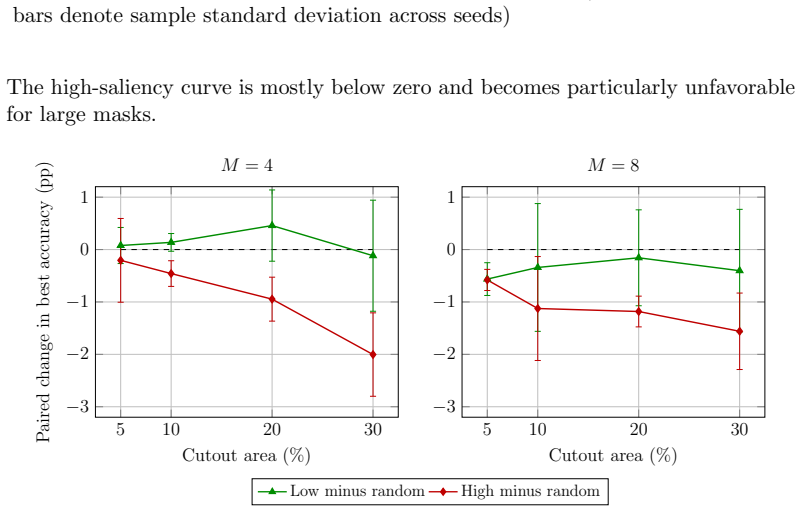
The paper's central claim is that HiResCAM-guided cutout does not improve grayscale malware family classification in the tested controlled setting. On RawMal-TF, the no-cutout ResNet18 baseline attains the highest mean best validation accuracy, $72.83\% \pm 0.16\%$; the best cutout condition is random cutout with $M=4$ and $30\%$ area at $71.55\% \pm 0.45\%$, and the best low-saliency condition is $71.43\% \pm 1.12\%$. Low-saliency cutout is seed-sensitive relative to matched random cutout, ranging from $-0.56$ to $+0.46$ percentage points across the eight area and $M$ cells, while high-saliency cutout is negative in most cells, with paired deficits from $-0.21$ to $-2.00$ percentage points. On CIFAR-100 the pattern reverses: low-saliency cutout with $M=4$ and $10\%$ area reaches $63.51\% \pm 0.36\%$ versus $62.65\% \pm 0.57\%$ for no cutout, and low-saliency placement protects large-mask performance, while high-saliency cutout is consistently harmful. The conclusion is that the value of saliency-guided cutout depends on the image domain, so malware-image saliency should not be equated with natural-image object saliency.
Load-bearing premise
The controlled comparison assumes that the CAM-guided and random cutout conditions differ only in where the square is placed, yet the paper specifies that CAM-guided masks are static across epochs and does not say whether the random control re-samples its window each epoch.
Editorial extensions
If this is right
- On grayscale RawMal-TF with ResNet18 and 100 epochs, adding cutout in any tested form lowers mean best validation accuracy, so the no-cutout baseline is the strongest setting in this controlled sweep.
- Low-saliency cutout is not reliably better than random cutout on malware: its paired advantage ranges from $-0.56$ to $+0.46$ percentage points and changes sign across seeds, while high-saliency cutout is generally worse by up to 2.00 percentage points.
- On CIFAR-100, low-saliency cutout improves peak validation accuracy over no cutout at small mask sizes and over random cutout for large masks, whereas high-saliency cutout is worse than random in every tested cell.
- The same implementation can produce a positive saliency-guided result, so the negative RawMal-TF outcome is a domain effect rather than a broken pipeline.
Reading between the lines
- A tighter random control that caches one static window per sample and augmentation index, exactly like the CAM-guided runs, would test whether the reported low-versus-random differences are inflated by mask diversity; the paper does not state whether the random condition re-samples each epoch.
- The teacher's HiResCAM is computed for its predicted class from the final convolutional layer, so using ground-truth labels or intermediate layers could change both low- and high-saliency rankings, an extension the paper leaves open.
- Aligning masks with executable structure, such as PE-section boundaries or byte ranges, rather than image-saliency squares, is the paper's own suggestion for future work and could separate the failure of square saliency from the failure of cutout itself.
Signed reviews
Editorial analysis
A structured set of objections, weighed in public.
Referee Report
Summary. This paper experimentally evaluates whether cutout regularization with regions selected by HiResCAM saliency improves image-based malware classification relative to no cutout and standard random cutout. Using ResNet18 with 100 epochs, seeds 42–44, cutout areas of 5%, 10%, 20%, and 30%, and M=4 and M=8 augmented copies, the authors compare four conditions (no cutout, random, low-saliency, high-saliency) on grayscale RawMal-TF images (17 families, 1,000 samples per family) and, for contrast, on CIFAR-100. The paper reports that on RawMal-TF the no-cutout baseline achieves the highest mean best validation accuracy (72.83%±0.16%) and that every cutout condition is lower; low-saliency cutout is seed-sensitive relative to matched random cutout, and high-saliency cutout is generally worse. On CIFAR-100, low-saliency cutout at 10% area improves over the no-cutout baseline (63.51% vs. 62.65%) while high-saliency cutout is consistently harmful. The authors conclude that the value of saliency-guided cutout is domain dependent and that malware images should not be treated as equivalent to natural images.
Significance. If the experimental comparison is sound, this paper provides a useful controlled negative result for CAM-guided cutout in malware classification and a contrasting positive result on CIFAR-100. The study's strengths include within-seed paired comparisons, multiple seeds and cutout areas, a teacher–student setup that avoids circularity (the teacher is trained without cutout and the student is trained on different augmented data), and explicit acknowledgment that three seeds make the statistics exploratory. The public repository and per-run metrics files support reproducibility. The main caveat is that the central matched comparison between saliency-guided and random cutout presumes that the two conditions differ only in how the cutout window is selected; if the random control re-samples masks each epoch while the CAM-guided masks are static, the measured differences conflate placement rule with mask diversity. This issue must be resolved before the secondary conclusions about low- versus high-saliency placement and the CIFAR-100 advantage over random cutout can be considered reliable.
major comments (1)
- [Section 3.3, Tables 3 and 4] The paper does not state whether the standard random cutout control also uses a static window per sample/copy index or re-samples a new window each epoch. Section 3.3 explicitly says that for CAM-guided cutout "the augmented copies are static: a sample index and augmentation index map to the same selected window in every epoch," but no corresponding statement is given for the random condition. If random cutout re-samples each epoch, then the random control enjoys greater mask diversity over the 100 training epochs, meaning the paired differences in Tables 3 and 4 (low-minus-random and high-minus-random) do not isolate the effect of saliency-based placement; they conflate the placement rule with temporal mask diversity. This directly affects the paper's secondary claims that low-saliency cutout is seed-sensitive relative to random on RawMal-TF, that high-saliency cutout is generally harmful, and that low-saliency cutout improves over random on CIFAR-100. The primary negative claim that no-cutout beats all cutout conditions is less affected, but the controlled comparison that motivates the study is compromised. The authors should state explicitly how the random control is implemented; if it is dynamic, they should either re-run with matched static masks or substantially temper these comparative conclusions.
minor comments (4)
- [Section 1, Introduction] In the concluding sentence of the introduction, "the field fo malware analysis" should read "the field of malware analysis."
- [Section 2.1] The sentence "a model becomes more stronger" contains a redundant comparative; it should be "a model becomes stronger."
- [Section 3.3] The description of candidate-window selection says that a "specified, copy-specific seed value" is used, but it does not clarify whether this seed is also epoch-specific or fixed across epochs. This is closely related to the major issue about static versus dynamic masks and should be clarified in the revision.
- [Section 5.5] The paper appropriately acknowledges that only validation metrics are available and that no held-out test set is reported. Given this limitation, the abstract and conclusions should perhaps more consistently use the phrase "validation accuracy" rather than "accuracy" to avoid any impression of test-set generalization, though the current phrasing is mostly careful.
Circularity Check
No circularity: the paper reports controlled experiments whose target outcomes are measured, not derived from their inputs.
full rationale
The paper is an empirical controlled study rather than a derivation, and its central claims are measured outcomes rather than consequences of construction. The teacher model is a no-cutout ResNet18 checkpoint trained on the original training images, and the student models are trained on cutout-augmented copies and evaluated on unmasked validation data, so the target result (whether saliency-guided cutout improves accuracy) is not an input to the method. The low-saliency and high-saliency conditions select masks from HiResCAM maps of the teacher's predicted class, while the random condition selects masks without saliency, and the paired comparisons in Tables 3 and 4 are computed within matched dataset, seed, area, and augmentation multiplicity settings. None of the reported accuracies are fitted parameters renamed as predictions, and no equation in the paper reduces the output to an input by definition. The references to RawMal-TF [2,3] and to the repository [9] supply the dataset, code, and prior transformation comparisons, but they do not carry the load of the conclusion that cutout fails to improve grayscale malware classification; that conclusion is stated as a negative experimental finding. The paper also explicitly limits its claims to validation metrics and acknowledges missing test-set and per-family metrics, which is the opposite of presenting a forced result as a derivation. The static-cache detail in Section 3.3 ('The augmented copies are static: a sample index and augmentation index map to the same selected window in every epoch') raises a possible experimental confound if the random control re-samples masks each epoch, because the random condition would then have greater mask diversity; however, that is a methodological concern about control equivalence, not a circularity in which the conclusion is equivalent to the input by construction. Accordingly, no circular step can be exhibited, and the appropriate score is 0.
Assumptions & free parameters
free parameters (2)
- candidate window percentile =
10%
- validation split fraction =
0.1
assumptions (4)
- domain assumption HiResCAM maps are faithful indicators of class evidence.
- domain assumption Validation accuracy is an adequate proxy for the regularization effect.
- domain assumption RawMal-TF grayscale images and CIFAR-100 are representative of their domains.
- domain assumption The no-cutout teacher checkpoint is a valid source of saliency for student cutout placement.
Cite this review
Pith. "Pith review of CAM-Guided Saliency Cutout and Image-Based Malware Classification." pith.science (2026). https://pith.science/paper/GDDPJJLG
@misc{pith2026260811634,
  author       = {Pith},
  title        = {Pith review of: CAM-Guided Saliency Cutout and Image-Based Malware Classification},
  year         = {2026},
  howpublished = {\url{https://pith.science/paper/GDDPJJLG}},
  note         = {Machine review of arXiv:2608.11634}
}
abstract
Dropout regularization is commonly used to reduce overfitting by removing parts of a neural network during training. For Convolutional Neural Networks (CNN), cutouts serve a somewhat analogous purpose. Cutouts can be implemented as data augmentation: the original training image is retained, and additional copies are created with regions removed. In this chapter, we test whether cutout placement can be improved by using High-Resolution Class Activation Mapping (HiResCAM). We compare four controlled training conditions: no cutout, standard random cutout, low-saliency cutout, and high-saliency cutout. We experiment using grayscale malware images from the RawMal-TF dataset (17 families with~1,000 samples per family), and for comparison to natural images, we experiment with the well-known CIFAR-100 dataset. All experiments are based on ResNet18 with~100 training epochs. For the cutout experiments, we test cutout areas of~5\%, 10\%, 20\%, and~30\%, and we consider~$M\in\{4,8}$ augmented copies per original training image. The RawMal-TF results are slightly worse for all three cutout cases (random, high and low saliency) as compared to no cutouts. In contrast, our CIFAR-100 experimental results improve slightly under low-saliency cutout. These results suggest that the value of saliency-guided cutout is domain dependent, and that malware images should not be treated as equivalent to natural images.
Figures


Figures from the paper (8 more)


Reference graph
Works this paper leans on
-
[1]
A comparison of selected image transformation techniques for malware classification
Rishit Agrawal, Kunal Bhatnagar, Andrew Do, Ronnit Rana, Martin Jureˇ cek, and Mark Stamp. A comparison of selected image transformation techniques for malware classification. In Roberto Di Pietro, Karen Renaud, and Paolo Mori, editors,Proceedings of the 12th International Conference on Information Systems Security and Privacy, volume 2 ofICISSP, pages 33...
2026
-
[2]
A Comparison of Selected Image Transformation Techniques for Malware Classification
Rishit Agrawal, Kunal Bhatnagar, Andrew Do, Ronnit Rana, and Mark Stamp. A comparison of selected image transformation techniques for malware classi- fication.https://arxiv.org/abs/2509.10838, 2025
work page Pith review arXiv 2025
-
[3]
RawMal-TF: Raw malware dataset labeled by type and family.https://arxiv.org/abs/2506.23909, 2025
David B´ alik, Martin Jureˇ cek, and Mark Stamp. RawMal-TF: Raw malware dataset labeled by type and family.https://arxiv.org/abs/2506.23909, 2025
arXiv 2025
-
[4]
Trans- fer learning for image-based malware classification
Niket Bhodia, Pratikkumar Prajapati, Fabio Di Troia, and Mark Stamp. Trans- fer learning for image-based malware classification. In Paolo Mori, Steven Fur- nell, and Olivier Camp, editors,Proceedings of the 5th International Conference on Information Systems Security and Privacy, ICISSP, pages 719–726, 2019
2019
-
[5]
Matteo Brosolo, Vinod P., and Mauro Conti. Through the static: Demystifying malware visualization via explainability.Journal of Information Security and Applications, 91:104063, 2025
work page 2025
-
[6]
Terrance DeVries and Graham W. Taylor. Improved regularization of convo- lutional neural networks with cutout.https://arxiv.org/abs/1708.04552, 2017
arXiv 2017
-
[7]
An image is worth 16x16 words: Transformers for image recognition at scale
Alexey Dosovitskiy, Lucas Beyer, Alexander Kolesnikov, Dirk Weissenborn, Xiaohua Zhai, Thomas Unterthiner, Mostafa Dehghani, Matthias Minderer, Georg Heigold, Sylvain Gelly, Jakob Uszkoreit, and Neil Houlsby. An image is worth 16x16 words: Transformers for image recognition at scale. InInterna- tional Conference on Learning Representations, ICLR, 2021
work page 2021
-
[8]
Rachel Lea Draelos and Lawrence Carin. Use HiResCAM instead of Grad- CAM for faithful explanations of convolutional neural networks.https:// arxiv.org/abs/2011.08891, 2020. 21
arXiv 2011
Show all 26 references
-
[9]
CAMRegularization, GitHub repository.https:// github.com/yasamanebrahimi-byte/CAMRegularization, 2026
Yasaman Ebrahimi. CAMRegularization, GitHub repository.https:// github.com/yasamanebrahimi-byte/CAMRegularization, 2026
2026
-
[10]
Computing and evaluating saliency maps for image classification: a tutorial.Journal of Electronic Imaging, 32(2):020801, 2023
Tristan Gomez and Harold Mouch` ere. Computing and evaluating saliency maps for image classification: a tutorial.Journal of Electronic Imaging, 32(2):020801, 2023
2023
-
[11]
Naofumi Hama, Masayoshi Mase, and Art B. Owen. Deletion and insertion tests in regression models.Journal of Machine Learning Research, 24:1–38, 2023
2023
-
[12]
Deep residual learning for image recognition
Kaiming He, Xiangyu Zhang, Shaoqing Ren, and Jian Sun. Deep residual learning for image recognition. InProceedings of the IEEE Conference on Computer Vision and Pattern Recognition, CVPR, pages 770–778, 2016
2016
-
[13]
Weinberger
Gao Huang, Zhuang Liu, Laurens Van Der Maaten, and Kilian Q. Weinberger. Densely connected convolutional networks. InProceedings of the IEEE Confer- ence on Computer Vision and Pattern Recognition, CVPR, pages 4700–4708, 2017
2017
-
[14]
Andreopoulos, and Mark Stamp
Mugdha Jain, William B. Andreopoulos, and Mark Stamp. Convolutional neu- ral networks and extreme learning machines for malware classification.Journal of Computer Virology and Hacking Techniques, 16(3):229–244, 2020
2020
-
[15]
Learning multiple layers of features from tiny images
Alex Krizhevsky. Learning multiple layers of features from tiny images. Tech- nical report, University of Toronto, 2009
2009
-
[16]
Swin transformer: Hierarchical vision transformer using shifted windows
Ze Liu, Yutong Lin, Yue Cao, Han Hu, Yixuan Wei, Zheng Zhang, Stephen Lin, and Baining Guo. Swin transformer: Hierarchical vision transformer using shifted windows. InProceedings of the IEEE/CVF International Conference on Computer Vision, ICCV, pages 10012–10022, 2021
2021
-
[17]
A convnet for the 2020s
Zhuang Liu, Hanzi Mao, Chao-Yuan Wu, Christoph Feichtenhofer, Trevor Dar- rell, and Saining Xie. A convnet for the 2020s. InProceedings of the IEEE/CVF Conference on Computer Vision and Pattern Recognition, CVPR, pages 11976– 11986, 2022
2022
-
[18]
Kimmell, Mahmoud Ab- delsalam, Sajad Khorsandroo, and Maanak Gupta
Harikha Manthena, Shaghayegh Shajarian, Jeffrey C. Kimmell, Mahmoud Ab- delsalam, Sajad Khorsandroo, and Maanak Gupta. Explainable artificial intel- ligence (XAI) for malware analysis: A survey of techniques, applications, and open challenges.IEEE Access, 13:61611–61640, 2025
2025
-
[19]
Malware images: Visualization and automatic classification
Lakshmanan Nataraj, Shankarapani Karthikeyan, George Jacob, and BS Man- junath. Malware images: Visualization and automatic classification. InPro- ceedings of the 8th International Symposium on Visualization for Cyber Secu- rity, pages 1–7, 2011
2011
-
[20]
Advancing mal- ware imagery classification with explainable deep learning: A state-of-the-art approach using SHAP, LIME and Grad-CAM.PLOS ONE, 20(5):e0318542, 2025
Sadia Nazim, Muhammad Mansoor Alam, Syed Safdar Rizvi, Jawahir Che Mustapha, Syed Shujaa Hussain, and Mazliham Mohd Suud. Advancing mal- ware imagery classification with explainable deep learning: A state-of-the-art approach using SHAP, LIME and Grad-CAM.PLOS ONE, 20(5):e03185...
2025
-
[21]
RISE: Randomized input sampling for explanation of black-box models
Vitali Petsiuk, Abir Das, and Kate Saenko. RISE: Randomized input sampling for explanation of black-box models. InBritish Machine Vision Conference, BMVC, page 151, 2018
2018
-
[22]
Selvaraju, Michael Cogswell, Abhishek Das, Ramakrishna Vedantam, Devi Parikh, and Dhruv Batra
Ramprasaath R. Selvaraju, Michael Cogswell, Abhishek Das, Ramakrishna Vedantam, Devi Parikh, and Dhruv Batra. Grad-CAM: Visual explanations from deep networks via gradient-based localization. In2017 IEEE International Conference on Computer Vision, ICCV, pages 618–626, 2017
2017
-
[23]
Hinton, Alex Krizhevsky, Ilya Sutskever, and Ruslan Salakhutdinov
Nitish Srivastava, Geoffrey E. Hinton, Alex Krizhevsky, Ilya Sutskever, and Ruslan Salakhutdinov. Dropout: A simple way to prevent neural networks from overfitting.Journal of Machine Learning Research, 15:1929–1958, 2014
1929
-
[24]
A selective survey of deep learning techniques and their ap- plication to malware analysis
Mark Stamp. A selective survey of deep learning techniques and their ap- plication to malware analysis. In Mark Stamp, Mamoun Alazab, and Andrii Shalaginov, editors,Malware Analysis Using Artificial Intelligence and Deep Learning, pages 3–51. Springer, 2021
2021
-
[25]
Efficientnet: Rethinking model scaling for con- volutional neural networks
Mingxing Tan and Quoc Le. Efficientnet: Rethinking model scaling for con- volutional neural networks. InInternational Conference on Machine Learning, ICML, pages 6105–6114, 2019
2019
-
[26]
Deep learning versus gist descriptors for image-based malware classifi- cation
Sravani Yajamanam, Vikash Raja Samuel Selvin, Fabio Di Troia, and Mark Stamp. Deep learning versus gist descriptors for image-based malware classifi- cation. In Paolo Mori, Steven Furnell, and Olivier Camp, editors,Proceedings of the 4th International Conference on Information...
2018
Reviewed August 16, 2026 · model on record in the stance chip above.
Discussion (0). Continue with ORCID to comment.