REVIEW 2 major objections 5 minor 23 references
REOPD: Reliability-Adaptive Reward Extrapolation for On-Policy Distillation
T0 review · 2 major / 5 minor · reviewed 2026-08-16 · deepseek-v4-flash
Pith's one-line read A single shared adaptive controller for on-policy distillation matches or beats per-domain tuned extrapolation coefficients across math, code, and multi-teacher settings.
desk verdict Clean, well-specified method proposal with a strong ablation, but the headline empirical claims are not yet supported by single-run, no-error-bar numbers. read the letter →
The pith
A machine-rendered reading of the paper's core claim, the machinery that carries it, and where it could break.
The reading
What carries the argument
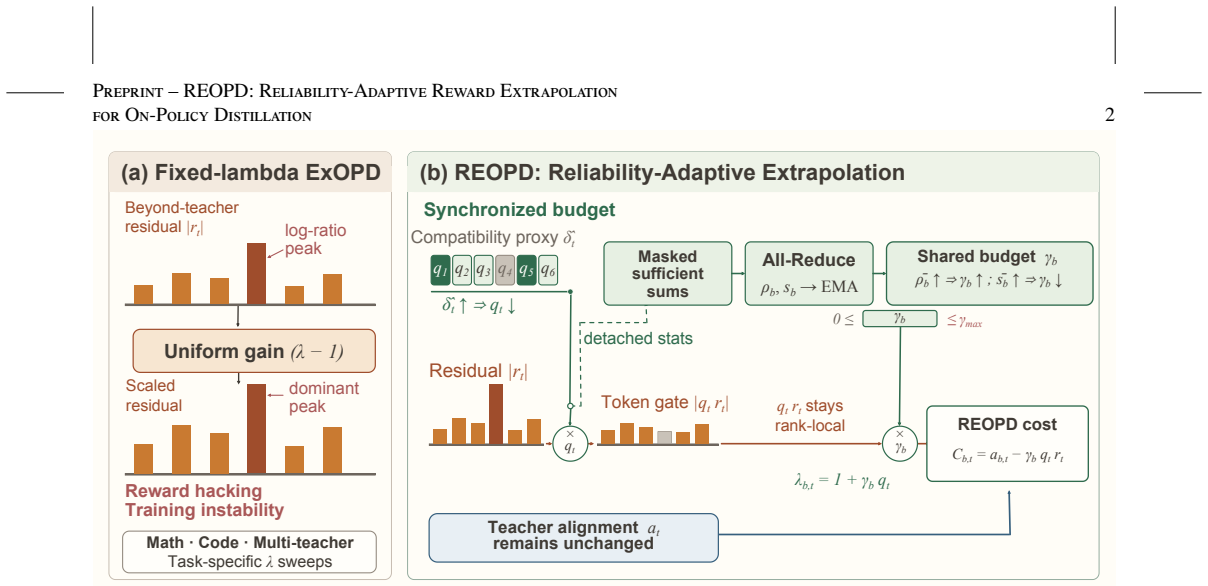
The load-bearing object is the token-wise effective coefficient $\lambda_{b,t}=1+\gamma_b q_t$, inserted into the distillation cost as $C_{b,t}=a_{b,t}-\gamma_b q_t r_{b,t}$. Here $a_t$ is the student–teacher alignment cost, $r_t$ is the teacher–reference log-ratio that defines the implicit reward, $q_t$ is a compatibility weight built from a stop-gradient student–teacher discrepancy proxy $\hat{\delta}_t$ (with $q_t=\exp(-\hat{\delta}_t/\tau)$, so agreement keeps $q_t$ near $1$ and disagreement attenuates the residual), and $\gamma_b$ is a shared micro-batch budget computed from the compatibility-weighted residual proportion $\rho_b$ and the reliable residual RMS $s_b$ after EMA smoothing, clipped to $[0,\gamma_{\max}]$. This object does the work of separating teacher alignment from extrapolation: it reduces to standard OPD at $\gamma=0$, to fixed-$\lambda$ ExOPD when $q=1$ and $\gamma=\lambda-1$, and it guarantees $1\le \lambda_{b,t}\le 1+\gamma_{\max}$ so no single token can receive unbounded extrapolation.
What would settle it
Take a training set where teacher outputs are systematically corrupted at the token level (for example, math solutions with deliberately inserted arithmetic slips), keep the student initialization and prompts identical, and compare REOPD against OPD and a verifier-gated baseline. If the tokens receiving the largest amplified residual are the corrupted tokens and accuracy drops relative to OPD, then the compatibility gate is not a sufficient safety signal.
Extended reading notes
Core claim
The central claim is that reward extrapolation in on-policy distillation fails not because extrapolation is dangerous, but because a single global coefficient applies the same gain to every token. REOPD establishes that the token-wise coefficient $\lambda_{b,t}=1+\gamma_b q_t$ resolves this by decomposing ExOPD's uniform residual multiplier into two adaptive parts: a token gate $q_t$ that preserves the residual when the student and teacher agree locally and suppresses it when they disagree, and a shared, bounded budget $\gamma_b$ that reflects how much compatible residual the current batch can support. The paper states that this construction preserves teacher alignment at all times, bounds the effective coefficient to $[1, 1+\gamma_{\max}]$, and reuses only the student, teacher, and reference log-probabilities already needed by G-OPD. Empirically, REOPD reports better or matching accuracy relative to G-OPD across single-teacher math, single-teacher code, and shared multi-teacher distillation, and its ablation shows that removing the token gate costs 4.27 points while removing the budget bound costs 0.50 points, identifying token-level filtering as the principal component.
Load-bearing premise
The load-bearing premise is that local student–teacher agreement marks the teacher's residual signal as safe to amplify, so if the student and teacher both agree on tokens that are nevertheless wrong, REOPD extrapolates confidently in wrong directions.
Editorial extensions
If this is right
- Fixed-coefficient ExOPD's per-domain $\lambda$ sweep can be replaced by online adaptation using only quantities already computed in OPD, eliminating a costly full-training tuning loop.
- Token-level compatibility, not the batch budget, is the main source of improvement, so residual filtering per token is the intervention that stabilizes reward extrapolation.
- A single shared adaptive controller works across routed domain teachers, so multi-teacher distillation does not need separate per-teacher coefficients.
- The added safety comes at no extra inference cost: no verifier, reward model, value model, or rollout beyond standard OPD is required.
- Because the effective coefficient is bounded by $1+\gamma_{\max}$, extreme teacher–reference log-ratio peaks cannot dominate the policy update beyond the explicit cap.
Reading between the lines
- Editorial inference: since $q_t$ measures compatibility rather than correctness, the method's safety depends on the teacher being mostly right; injecting a sparse, cheap correctness signal, such as verifier labels only where $q_t$ is high, could suppress confident joint errors without giving up the adaptive budget.
- Editorial inference: the logged dynamics show $\gamma_b$ saturating at its upper bound late in training, suggesting the controller's main work happens early; a simpler schedule that starts small and anneals to $\gamma_{\max}$ may reproduce much of REOPD's benefit in single-teacher settings.
- Editorial inference: the discrepancy proxy is computed per token on the sampled response, so a token with low $q_t$ because of an earlier student mistake is merely down-weighted, not corrected; combining REOPD with rollout truncation or rollback could produce alignment gains the current method leaves on the table.
- Editorial inference: the controller is tested only at one model scale and teacher family, so the strongest testable extension is running REOPD on larger student models and heterogeneous teacher families to see whether the shared budget remains stable.
Signed reviews
Editorial analysis
A structured set of objections, weighed in public.
Referee Report
Summary. The paper proposes REOPD, a reliability-adaptive extension of ExOPD for on-policy distillation. REOPD replaces the global extrapolation coefficient with a token-level compatibility weight q_t and a micro-batch-level adaptive budget γ_b, yielding an effective token-wise coefficient λ_{b,t}=1+γ_b q_t that preserves the standard teacher-alignment term while gating only the beyond-teacher residual. The method requires no verifier, reward model, value model, or extra rollout beyond standard OPD. The paper evaluates REOPD on single-teacher mathematics, single-teacher code, and mixed-domain multi-teacher distillation, reporting that REOPD outperforms OPD and the fixed λ=1.25 ExOPD baseline on mathematics and on both multi-teacher domains, while performing comparably on single-teacher code. A component ablation in the mathematics setting shows that removing the token-level gate lowers accuracy by 4.27 points, identifying token compatibility as the main active component.
Significance. If the empirical claims hold, the contribution is useful: the decomposition of teacher alignment from extrapolation control is conceptually clean, the special cases (γ_b=0 recovers OPD, q_t=1 and fixed γ_b recovers ExOPD) are well stated, and the ablation cleanly attributes the main effect to the token gate rather than to the batch controller. The method is not circular: q_t and γ_b are stop-gradient functions of already-computed log-probabilities, and B0 is calibrated on alignment RMS, not on evaluation accuracy. The main weakness is that the headline comparisons rest on small differences (0.19 to 1.38 percentage points) reported without repeated seeds, confidence intervals, or cluster-aware uncertainty. Because the evaluation pools many completions per problem, the effective sample size is much smaller than the reported number of completions, so the central 'outperforms/matching' claims are currently underdetermined. The paper acknowledges that q_t is a compatibility measure rather than a correctness estimator; that limitation is real but secondary relative to the missing uncertainty quantification.
major comments (2)
- [Secs. 4.1, 4.2, Table 1] The central empirical claim is not yet supported by the reported statistics. All main results come from a single step-50 checkpoint, no repeated seeds are reported for the main table, and the only seed mentioned (42) is used for ablations. The text says 'across repeated experiments' (Secs. 4.1 and 5), but no repeated experiments are shown. Pooling 3,840 mathematics completions from 120 problems, or 2,868 code completions from 717 tasks, treats responses to the same problem as independent, while the effective sampling unit is the problem. The reported differences of 0.19 to 1.38 percentage points can therefore easily be within cluster noise. Please provide variance-aware evidence: multiple seeds with means and standard deviations, or cluster bootstrap confidence intervals at the problem level, and state explicitly whether the REOPD advantages over OPD and ExOPD are statistically significant. Without this, the abstract's 'outperforms' and 'matching' statements are not supported.
- [Sec. 4.3] The comparison against the best fixed coefficient chosen from the same evaluation sweep is an oracle baseline, and the paper is transparent that this is not a post-hoc favorable baseline for REOPD. However, the four margins reported here are +0.19, −0.15, +0.03, and +0.42 percentage points, which fall within the uncertainty range described in the previous comment. The claim that REOPD 'reaches comparable or better performance than the task-specific best fixed coefficient' needs error bars or confidence intervals for both the REOPD runs and the swept ExOPD curves. Without such intervals, the reader cannot distinguish a genuine adaptation advantage from sampling noise.
minor comments (5)
- [Sec. 3.3, Eq. (6)] The phrase 'low-variance k 3 discrepancy proxy' is unclear: the symbol 'k' or 'k3' is never defined, and the equation as written only introduces x and δ. Please either define the term or remove it.
- [Sec. 4.1] The auto-calibration of B0 is described only verbally as a 'scaled moving average of the alignment RMS, κ RMS_b(a)' during the first K0 controller calls. Please provide the exact formula and initialization details, since B0 directly affects the magnitude of the extrapolation budget.
- [Table 1 and Sec. 4.2] The terminology is inconsistent: the abstract and Sec. 4.2 refer to 'G-OPD' as the comparison method, while Table 1 labels the corresponding rows 'OPD'. Please clarify whether G-OPD denotes the general framework and 'OPD' denotes the λ=1 instantiation, and use the terminology consistently throughout.
- [Figure 3] Panel (b) reports 'mean compatibility q_t and effective coefficient λ_{b,i,t}'; because the effective coefficient is token-wise and varies within a batch, please clarify over which tokens the mean is taken and whether the plotted quantity is the micro-batch average of λ or the average of γ_b times the average q_t.
- [Sec. 3.3 and Conclusion] The abstract and title use 'reliability' to describe the gating mechanism, but Sec. 3.3 correctly states that q_t measures local compatibility, not correctness. Since the paper explicitly acknowledges that the gate cannot detect cases where both student and teacher are wrong, please qualify the abstract's phrase 'reliable teacher-reference directions' to avoid overstating the semantic content of the gate.
Circularity Check
No significant circularity: REOPD's core coefficient is constructed from already-available log-probabilities, and the reported benchmark comparisons are measured against external evaluation sets rather than fitted to the claims.
full rationale
The derivation chain is self-contained. The token-level compatibility weight q_{b,i,t} is defined directly from the student, teacher, and reference log-probabilities via Eqs. (1)-(7), all of which are quantities already computed in the standard G-OPD pipeline, and both q and the micro-batch budget gamma_b are explicitly detached from the computation graph as stop-gradient control signals. The budget scale B0 is calibrated in automatic mode from a scaled moving average of alignment RMS, not from evaluation accuracy, so no benchmark target is fitted or renamed as a prediction. The final objective in Eq. (5) is a construction, not a derived empirical claim, and the paper's stated contributions are empirical comparisons on AIME, HMMT, HumanEval+, MBPP+, and LiveCodeBench against external baselines OPD and fixed-coefficient ExOPD. The acknowledged limitation that q measures local compatibility rather than correctness is a scope caveat, not a circular step, because the method never claims q is an independent correctness oracle. The skeptical concern that single-run, pooled-completion statistics may not support the reported margins is a statistical-evidence issue, not a reduction of the result to its inputs, and therefore does not raise the circularity score.
Assumptions & free parameters
free parameters (6)
- tau =
0.007
- gamma_max =
1
- B0 (budget scale) =
auto-calibrated with kappa=0.5 over the first 10 controller calls
- beta (EMA smoothing) =
0.95
- beta_gamma (budget smoothing) =
0.9
- warm-up schedule =
math: five controller calls at gamma=0.25; code and multi-teacher: none
assumptions (5)
- domain assumption The teacher-reference log-ratio r_t defines a valid dense implicit reward for on-policy distillation, as in G-OPD.
- ad hoc to paper The student-teacher discrepancy proxy delta_t is a valid gate for extrapolation reliability: large disagreement should suppress the extra residual.
- ad hoc to paper Batch statistics rho_b and s_b, after EMA smoothing, correctly indicate how much extrapolation a micro-batch can support.
- standard math exp(x) >= x + 1 for real x, which ensures delta_t >= 0 and q_t in (0,1].
- domain assumption The PPO-style surrogate with negative token cost as advantage is a valid policy update for this distillation objective.
Cite this review
Pith. "Pith review of REOPD: Reliability-Adaptive Reward Extrapolation for On-Policy Distillation." pith.science (2026). https://pith.science/paper/FE77OSEY
@misc{pith2026260811698,
  author       = {Pith},
  title        = {Pith review of: REOPD: Reliability-Adaptive Reward Extrapolation for On-Policy Distillation},
  year         = {2026},
  howpublished = {\url{https://pith.science/paper/FE77OSEY}},
  note         = {Machine review of arXiv:2608.11698}
}
abstract
On-policy distillation (OPD) trains a student on its own trajectories under dense token-level supervision from a teacher. Reward-extrapolation methods such as ExOPD amplify the teacher-reference log-likelihood ratio to move beyond direct imitation, but apply a single global coefficient $\lambda$ to every token. This can drive the student to fit extreme peaks in the implicit reward, causing reward hacking and unstable training, and the optimal $\lambda$ varies across domains, requiring costly sweeps. We propose REOPD, a reliability-adaptive reward extrapolation framework for OPD. REOPD combines a token-level compatibility weight with a batch-level adaptive budget, yielding a token-wise coefficient $\lambda_{b,t}=1+\gamma_b q_t$ that preserves teacher alignment while selectively extrapolating along reliable teacher-reference directions. It requires no verifier, reward model, value model, or extra rollout beyond standard OPD. REOPD outperforms G-OPD on single-teacher mathematics and on both domains in the multi-teacher setting, while matching G-OPD on single-teacher code, demonstrating effective fine-grained reliability adaptation across domains and teacher configurations.
Figures


Reference graph
Works this paper leans on
-
[1]
On-policy distillation of language mod- els: Learning from self-generated mistakes
Rishabh Agarwal, Nino Vieillard, Yongchao Zhou, Pi- otr Stanczyk, Sabela Ramos Garea, Matthieu Geist, and Olivier Bachem. On-policy distillation of language mod- els: Learning from self-generated mistakes. InThe Twelfth International Conference on Learning Representa- tions, 2024. URL https://openreview.net/forum? id=3zKtaqxLhW
work page 2024
-
[2]
Yaxuan Li, Yuxin Zuo, Bingxiang He, Jinqian Zhang, Chaojun Xiao, Cheng Qian, Tianyu Yu, Huan ang Gao, Wenkai Yang, Zhiyuan Liu, and Ning Ding. Rethink- ing on-policy distillation of large language models: Phe- nomenology, mechanism, and recipe.arXiv preprint arXiv:2604.13016, 2026. URL https://arxiv.org/ abs/2604.13016
arXiv 2026
-
[4]
Wenkai Yang, Weijie Liu, Ruobing Xie, Kai Yang, Saiy- ong Yang, and Yankai Lin. Learning beyond teacher: Generalized on-policy distillation with reward extrapo- lation.arXiv preprint arXiv:2602.12125, 2026. URL https://arxiv.org/abs/2602.12125
arXiv 2026
-
[5]
Distill- ing the knowledge in a neural network.arXiv preprint arXiv:1503.02531, 2015
Geoffrey Hinton, Oriol Vinyals, and JeffDean. Distill- ing the knowledge in a neural network.arXiv preprint arXiv:1503.02531, 2015. URL https://arxiv.org/ abs/1503.02531
arXiv 2015
-
[6]
Yoon Kim and Alexander M. Rush. Sequence-level knowl- edge distillation. InProceedings of the 2016 Conference on Empirical Methods in Natural Language Processing, pages 1317–1327, Austin, Texas, 2016. Association for Computational Linguistics. doi: 10.18653/v1/D16-1139. URLhttps://aclanthology.org/D16-1139/
-
[7]
MiniLLM: Knowledge distillation of large language mod- els
Yuxian Gu, Li Dong, Furu Wei, and Minlie Huang. MiniLLM: Knowledge distillation of large language mod- els. InThe Twelfth International Conference on Learn- ing Representations, 2024. URL https://openreview. net/forum?id=5h0qf7IBZZ
work page 2024
-
[8]
Model extrapolation expedites alignment
Chujie Zheng, Ziqi Wang, Heng Ji, Minlie Huang, and Nanyun Peng. Model extrapolation expedites alignment. InProceedings of the 63rd Annual Meeting of the Asso- ciation for Computational Linguistics (Volume 1: Long Papers), pages 1025–1041, Vienna, Austria, 2025. Asso- ciation for Computational Linguistics. doi: 10.18653/v1/ 2025.acl-long.51. URL https://a...
doi:10.18653/v1/ 2025
-
[9]
Xurong Xie, Zhucun Xue, Jiafu Wu, Jian Li, Yabiao Wang, Xiaobin Hu, Yong Liu, and Jiangning Zhang. LLM-oriented token-adaptive knowledge distillation.Pro- ceedings of the AAAI Conference on Artificial Intelli- gence, 40(40):34070–34078, 2026. doi: 10.1609/aaai. v40i40.40701. URL https://ojs.aaai.org/index. php/AAAI/article/view/40701
doi:10.1609/aaai 2026
Show all 23 references
-
[10]
ASKD: Reinforcement learning-style knowledge distillation with quality-adaptive skewness.Proceedings of the AAAI Conference on Ar- tificial Intelligence, 40(41):34781–34789, 2026
Mingjie Zhang, Xiaoling Zhou, Yuxiao Luo, Yiyu Liu, Shikun Zhang, and Wei Ye. ASKD: Reinforcement learning-style knowledge distillation with quality-adaptive skewness.Proceedings of the AAAI Conference on Ar- tificial Intelligence, 40(41):34781–34789, 2026. doi: 10.1609/aaai.v...
2026 doi
-
[11]
Prune-OPD: Efficient and reliable on-policy dis- tillation for long-horizon reasoning.arXiv preprint arXiv:2605.07804, 2026
Zhicheng Yang, Zhijiang Guo, Yifan Song, Minrui Xu, Yongxin Wang, Yiwei Wang, Xiaodan Liang, and Jing Tang. Prune-OPD: Efficient and reliable on-policy dis- tillation for long-horizon reasoning.arXiv preprint arXiv:2605.07804, 2026. URL https://arxiv.org/ abs/2605.07804
2026 arXiv
-
[12]
SCOPE: Signal-calibrated on-policy dis- tillation enhancement with dual-path adaptive weighting
Binbin Zheng, Xing Ma, Yiheng Liang, Jingqing Ruan, Xiaoliang Fu, Kepeng Lin, Benchang Zhu, Ke Zeng, and Xunliang Cai. SCOPE: Signal-calibrated on-policy dis- tillation enhancement with dual-path adaptive weighting. arXiv preprint arXiv:2604.10688, 2026. URL https: //arxiv.org...
2026 arXiv
-
[13]
SG-OPD: Sign-gated on- policy distillation via sign-consistency gating and phased teacher sampling.arXiv preprint arXiv:2606.09304, 2026
Haoran Xu, Hongyu Wang, Yifei Gao, Jiaze Li, Xiaofeng Zhang, and Xiaosong Yuan. SG-OPD: Sign-gated on- policy distillation via sign-consistency gating and phased teacher sampling.arXiv preprint arXiv:2606.09304, 2026. URLhttps://arxiv.org/abs/2606.09304
2026 arXiv
-
[14]
Reward-gated on-policy distillation
Mohammad Sadegh Akhondzadeh, Vijay Lingam, Atula Tejaswi, Chanakya Ekbote, Sujay Sanghavi, and Alek- sandar Bojchevski. Reward-gated on-policy distillation. arXiv preprint arXiv:2607.04037, 2026. URL https: //arxiv.org/abs/2607.04037
2026 arXiv
-
[15]
Proximal policy optimization algorithms.arXiv preprint arXiv:1707.06347, 2017
John Schulman, Filip Wolski, Prafulla Dhariwal, Alec Radford, and Oleg Klimov. Proximal policy optimization algorithms.arXiv preprint arXiv:1707.06347, 2017. URL https://arxiv.org/abs/1707.06347
2017 arXiv
-
[16]
Qwen3 Technical Re- port.arXiv preprint arXiv:2505.09388, 2025
An Yang, Anfeng Li, Baosong Yang, Beichen Zhang, Binyuan Hui, Bo Zheng, et al. Qwen3 Technical Re- port.arXiv preprint arXiv:2505.09388, 2025. URL https://arxiv.org/abs/2505.09388
2025 arXiv
-
[17]
DeepMath-103K: A large- scale, challenging, decontaminated, and verifiable math- ematical dataset for advancing reasoning.arXiv preprint arXiv:2504.11456, 2025
Zhiwei He, Tian Liang, Jiahao Xu, Qiuzhi Liu, Xingyu Chen, Yue Wang, Linfeng Song, Dian Yu, Zhenwen Liang, Wenxuan Wang, Zhuosheng Zhang, Rui Wang, Zhaopeng Tu, Haitao Mi, and Dong Yu. DeepMath-103K: A large- scale, challenging, decontaminated, and verifiable math- ematical da...
2025 arXiv
-
[18]
Advancing LLM reasoning generalists with preference trees.arXiv preprint Preprint– REOPD: Reliability-AdaptiveRew ardExtrapolation forOn-PolicyDistillation 9 arXiv:2404.02078, 2024
Lifan Yuan, Ganqu Cui, Hanbin Wang, Ning Ding, Xingyao Wang, Jia Deng, Boji Shan, Huimin Chen, Ruob- ing Xie, Yankai Lin, Zhenghao Liu, Bowen Zhou, Hao Peng, Zhiyuan Liu, and Maosong Sun. Advancing LLM reasoning generalists with preference trees.arXiv preprint Preprint– REOPD:...
2024 arXiv
-
[19]
Decoupled weight de- cay regularization
Ilya Loshchilov and Frank Hutter. Decoupled weight de- cay regularization. InInternational Conference on Learn- ing Representations, 2019. URL https://openreview. net/forum?id=Bkg6RiCqY7
2019
-
[20]
Evaluating large language models trained on code.arXiv preprint arXiv:2107.03374, 2021
Mark Chen, Jerry Tworek, Heewoo Jun, Qiming Yuan, Henrique Ponde de Oliveira Pinto, Jared Kaplan, et al. Evaluating large language models trained on code.arXiv preprint arXiv:2107.03374, 2021. URL https://arxiv. org/abs/2107.03374
2021 arXiv
-
[21]
Le, and Charles Sutton
Jacob Austin, Augustus Odena, Maxwell Nye, Maarten Bosma, Henryk Michalewski, David Dohan, Ellen Jiang, Carrie Cai, Michael Terry, Quoc V . Le, and Charles Sutton. Program synthesis with large language models.arXiv preprint arXiv:2108.07732, 2021. URL https://arxiv. org/abs/2108.07732
2021 arXiv
-
[22]
Is your code generated by ChatGPT really correct? rigorous evaluation of large language models for code generation.arXiv preprint arXiv:2305.01210, 2023
Jiawei Liu, Chunqiu Steven Xia, Yuyao Wang, and Ling- ming Zhang. Is your code generated by ChatGPT really correct? rigorous evaluation of large language models for code generation.arXiv preprint arXiv:2305.01210, 2023. URLhttps://arxiv.org/abs/2305.01210
2023 arXiv
-
[23]
LiveCodeBench: Holistic and contamination free evaluation of large language mod- els for code.arXiv preprint arXiv:2403.07974, 2024
Naman Jain, King Han, Alex Gu, Wen-Ding Li, Fanjia Yan, Tianjun Zhang, Sida Wang, Armando Solar-Lezama, Koushik Sen, and Ion Stoica. LiveCodeBench: Holistic and contamination free evaluation of large language mod- els for code.arXiv preprint arXiv:2403.07974, 2024. URL https:/...
2024 arXiv
-
[2026]
URLhttps://arxiv.org/abs/2604.14084
Reviewed August 16, 2026 · model on record in the stance chip above.
Discussion (0). Continue with ORCID to comment.