REVIEW 5 major objections 5 minor 25 references
When the API Speaks the Wrong Language: Revisiting Post-Training for Multilingual Tool Use
T0 review · 5 major / 5 minor · reviewed 2026-08-16 · deepseek-v4-flash
Pith's one-line read Careful supervised fine-tuning, not complex reinforcement learning, fixes multilingual API-call language errors.
desk verdict Useful failure-mode definition and a plausible SFT-vs-RL story, but the main comparison is unverifiable because the same GRPO/RM-3 configuration has different numbers in Tables 4, 5, 6, and 7. read the letter →
The pith
A machine-rendered reading of the paper's core claim, the machinery that carries it, and where it could break.
The reading
What carries the argument
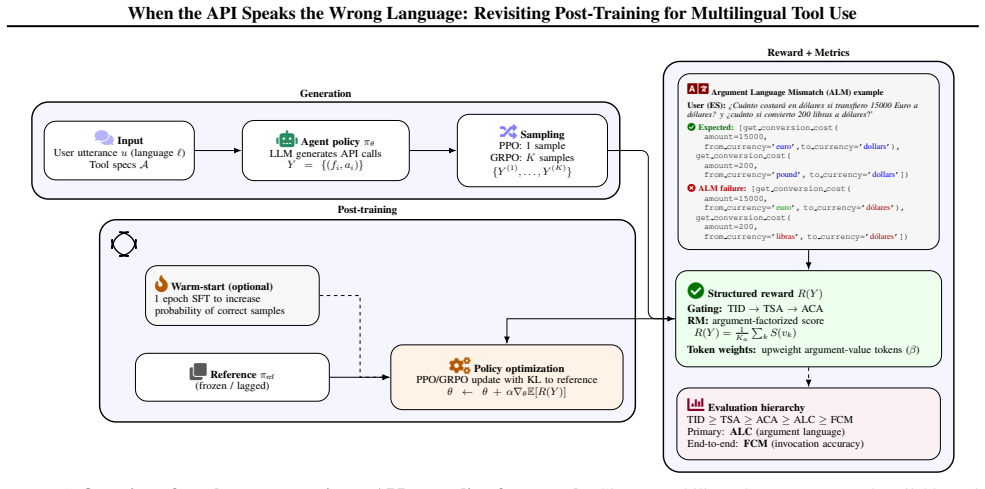
The paper's central named object is Argument Language Mismatch (ALM), a failure where the tool and argument names are correct but argument values are generated in a language inconsistent with the user's utterance. The machinery that carries the argument is a five-step hierarchical evaluation chain—Tool Invocation Detection, Tool Selection Accuracy, Argument Completion Accuracy, Argument Language Consistency, and Function Call Match—whose strict ordering FCM ≤ ALC ≤ ACA ≤ TSA ≤ TID lets the authors separate language errors from structural errors. On the training side, the load-bearing mechanism is RM-3, an argument-factorized reward that scores each argument value's language on a graded scale (exact match, minor variation, mismatch) and combines those scores with structural gates, giving the policy per-argument credit; combined with GRPO's group-relative advantage normalization, this reward design produces the paper's strongest RL results while remaining stable under token-level reward weighting. The benchmark itself is a translated, parallel version of a human-annotated function-calling dataset built with a rule-based protocol that translates user-derived values while preserving canonical identifiers and API names.
What would settle it
Take a random sample of the translated benchmark's 832 ALM-relevant turns, replace the automated judge's language-consistency scores with human annotations, and compare best-checkpoint SFT against GRPO; if the SFT advantage (e.g., 67.4 vs 55.3 FCM on Split-1) shrinks or reverses under human labels, the paper's central claim is an artifact of judge or translation bias.
Extended reading notes
Core claim
On the paper's own terms, the discovery is that Argument Language Mismatch is a generative conditioning failure, not a structural or intent failure, and that this kind of failure is largely learnable by imitation. The paper defines a strict metric hierarchy TID ≥ TSA ≥ ACA ≥ ALC ≥ FCM, isolating language consistency from tool selection and argument completion, and shows that SFT on 832 ALM-relevant turns from a translated function-calling benchmark lifts ALC and FCM far above the base model on both a high-API-overlap learnability split and a low-overlap generalization split. At best validation checkpoints on Split-1, SFT reaches 79.1 ALC and 67.4 FCM, exceeding GRPO (74.0 and 55.3) on both, and exceeding SFT+GRPO (79.3 and 61.3) on FCM. RL's remaining value appears in generalization: GRPO improves cross-lingual ALC consistently across Italian, Dutch, and French, whereas SFT's gains are uneven and include negative transfer on Dutch, and GRPO preserves English reasoning on MGSM while the best-checkpoint SFT model drops from 70.8 to 62.2. The paper concludes that even the strongest argument-factorized reward design, RM-3, improves RL only incrementally over a strong SFT baseline, and that careful supervised training and honest model selection should be the default for structured multilingual generation.
Load-bearing premise
The whole ranking rests on the assumption that translation and an automated language judge reproduce how real multilingual API calls fail; if translation artifacts or judge bias drive the ALC scores, the SFT-over-RL conclusion may not transfer to natural use.
Editorial extensions
If this is right
- Multilingual agent teams should treat a strong, validation-selected SFT model as the default and reserve RL for generalization or multi-objective needs, because best-checkpoint SFT already beats GRPO on end-to-end FCM in the learnability split.
- Language consistency should be scored separately from tool selection and argument completion; the hierarchy TID→TSA→ACA→ALC→FCM turns ALM from a hidden failure into a measurable diagnostic.
- If RL is used, argument-factorized rewards (RM-3) are the main driver of gains; sparse or stepwise rewards leave language consistency under-optimized, and token-level upweighting works under GRPO but destabilizes PPO.
- RL's honest advantage is generalization: GRPO transfers the 'match argument language to user locale' rule to unseen APIs and languages more consistently than SFT, and preserves general reasoning in English where the best-checkpoint SFT model loses 8.6 MGSM points.
Reading between the lines
- If the paper's account is right, the SFT-vs-RL ranking should extend to other surface-level conditioning problems in structured generation, such as localized date, number, and unit formats in code or SQL; a quick test would be applying the same metric hierarchy to a code-generation task with locale-dependent literals.
- The benchmark's translation protocol explicitly enforces utterance-value coherence, so natural multilingual tool-use data with code-switching or mixed-language inputs may behave differently; collecting such logs and re-running the comparison would show whether SFT's dominance survives realistic language mixing.
- Since the paper's ALM-aware prompt intervention already recovers part of the ALC gap (+7.5 points) without any training, a constrained-decoding or language-identifier-conditioned variant of SFT may close much of the remaining RL margin, which the paper does not test.
Signed reviews
Editorial analysis
A structured set of objections, weighed in public.
Referee Report
Summary. The paper formalizes Argument Language Mismatch (ALM), a failure mode in multilingual API calling where a model selects the correct tool but generates argument values in the wrong language. It constructs a multilingual extension of the Berkeley Function Calling benchmark and compares supervised fine-tuning (SFT) with PPO and GRPO under sparse, stepwise, and argument-factorized reward models. The central claim is that SFT is a strong baseline, achieving performance comparable to and sometimes exceeding RL, while RL provides only incremental gains concentrated in generalization and multi-objective trade-offs.
Significance. If validated, the paper would offer a useful formalization of ALM, a reproducible translated benchmark, and a cautionary result about the importance of strong SFT baselines in structured multilingual generation. The systematic comparison of reward granularity and the cross-lingual evaluation are valuable contributions. However, the significance is currently tempered by unresolved internal-reporting inconsistencies and by the absence of calibration or error bars for the primary metric, so the headline SFT-versus-RL comparison cannot be fully verified as written.
major comments (5)
- [Tables 4–7, Section 5.5–5.7] The same configuration (GRPO, RM-3 reward, Qwen2.5-14B, best validation checkpoint, Split-1) is reported as 74.0/55.3 ALC/FCM in Table 4 and Table 5, as 74.04/55.32 in Table 7, but as 81.2/66.9 in Table 6. Since the central claim in Section 5.3 that SFT (79.1/67.4) exceeds GRPO depends on the 74.0/55.3 numbers, the headline conclusion is not verifiable from the paper as written. Please reconcile these values and explicitly label the split and checkpoint-selection protocol for every table.
- [Section 6 and Appendix F] Section 6 states that 'SFT yields limited improvements in language consistency, whereas GRPO with argument-level rewards learns a transferable rule,' and Appendix F.7 concludes that 'outcome-driven optimization via argument-factorized reinforcement learning is necessary to achieve robust multilingual grounding.' These statements directly contradict the abstract, Section 5.2, and Section 7, which argue that SFT is a strong baseline and RL gains are incremental. Please resolve this contradiction or clearly distinguish the settings to which each statement applies.
- [Section 5.8, Table 8] The text says GRPO 'demonstrates stronger generalization than SFT' on cross-lingual transfer, but Table 8 shows SFT achieving a higher average ALC (57.88 vs. 57.72) and larger absolute improvements on Italian and French, with GRPO only better on Dutch. The claim as stated is not supported by the displayed numbers.
- [Section 2.3, Section 4.2, Appendix J] The primary evaluation metric ALC is computed via an LLM judge described in Appendix J, but the paper reports no calibration against human labels, no inter-annotator agreement, and no confidence intervals or standard deviations across training seeds. Since ALC is the basis for the main SFT-versus-RL comparison and for all reward models, please provide judge accuracy, human agreement, and error bars for the main tables.
- [Section 8.4, Appendix G] The paper acknowledges that the translated benchmark 'may introduce artifacts or reduce variability compared to naturally occurring multilingual data.' The translation prompt in Appendix G explicitly enforces utterance-value coherence and localizes argument values, which may make the task unusually learnable by SFT. Please add an analysis on natural (untranslated) multilingual API failures or explicitly scope the conclusions to translated benchmarks.
minor comments (5)
- [Section 3.2, Appendix A.3] Section 3.2 says the benchmark covers 'five languages' but lists only Spanish, French, Italian, and Dutch, while Appendix A.3 says 'five additional languages' including Hindi. Please correct the inconsistency.
- [Table 2] Table 2 contains stray 'High' and 'Low' labels that do not correspond to any column header; please remove them.
- [Equations (2) and (4)] The notation for ALCcont is inconsistent: Eq. (2) uses 1/(K*I) without defining K and I, while Eq. (4) uses 1/K. Please define the indexing or simplify the notation.
- [Tables 6 and 7] Tables 6 and 7 do not state which split they report; since Section 5.1 says results use Split-1 unless otherwise noted, please label each table explicitly.
- [Abstract and Introduction] The phrase 'visiting post-training strategies' in the Introduction appears to be a typo for 'revisiting'; please fix.
Circularity Check
No load-bearing circularity; one minor definitional entanglement where the RM-3 reward equals the reported ALC metric by construction, while the central SFT-versus-RL comparison remains an independent empirical result.
-
self definitional
[Section 4.2.3 (Eq. 4); Section 4.2.2 (ALC threshold); evaluation judge in Appendix J]
"RM-3 combines discrete structural gates with continuous argument-level rewards: ... ALCcont(Y) otherwise. ... The graded argument-level score is defined as: ALCcont(Y) = 1 K X i,k S(vi,k). ... A binary language-consistency score is obtained by thresholding this value: ALC= 1 if ALCcont≥1.8 (i.e., at least 90% of the maximum score 2.0), and ALC= 0 otherwise."
By construction, the RM-3 training reward for structurally correct outputs is exactly the continuous judge score ALCcont(Y) (Eq. 4), and the primary reported metric ALC is defined as that same judge score thresholded at 1.8 (Section 4.2.2), using the same LLM judge prompt in Appendix J. Under RM-3, the reward is, by definition, the graded precursor of the reported ALC metric, so claims that RM-3 yields the highest ALC and that GRPO with RM-3 improves ALC partially restate the training objective rather than an outcome measured independently of it.
full rationale
The paper contains no self-citations, so patterns 3, 4, and 5 do not apply: every cited basis (BFC benchmark, GRPO, PPO, RLHF, tool-use datasets) is external, and no load-bearing argument reduces to prior work of the present authors. The benchmark is an external dataset (BFC) that is translated rather than generated to fit the hypothesis, and the central claim is an empirical ranking between SFT and RL methods; checkpoints are selected on validation FCM, not on the reported test metrics, so the comparison is not a fitted parameter renamed as a prediction. Cross-lingual transfer is a genuine held-out evaluation (trained on Spanish, tested on Italian, Dutch, and French), so those results are not forced by construction. The one definitional entanglement, flagged as a step above, is that the RM-3 reward equals the continuous ALC metric built from the same LLM judge; per the reviewing rule, the paper's own limitation statement in Section 8.4 ('our study focuses on a translated benchmark, which may introduce artifacts or reduce variability compared to naturally occurring multilingual data') is weighed here: it is a construct-validity risk, not a circularity. Similarly, the unreconciled GRPO/RM-3 numbers across Tables 4, 5, 6, and 7 (74.0/55.3 vs. 81.2/66.9 vs. 74.04/55.32) and the absence of human calibration for the LLM judge are correctness and verifiability concerns, not cases of a derivation equating its output to its input by construction. The derivation chain is therefore substantially self-contained, and only a minor, openly stated metric-reward identity keeps the circularity score above zero.
Assumptions & free parameters
free parameters (7)
- RM-2 ALC binary threshold =
1.8
- RM-2 language scores =
2.0 / 1.5 / 1.0
- RM-3 language scores =
2.5 / 2.0 / 1.0
- Token reward weight beta =
1.5 and 3
- GRPO sampling configuration =
K=8, T=0.6, top-p=0.95
- ALM-turn selection criteria =
832 turns, 16.35%
- API overlap split thresholds =
17% and 6%
assumptions (4)
- domain assumption Language consistency with the user is a correctness requirement for API arguments unless the schema says otherwise.
- domain assumption An LLM judge reliably assigns language scores to argument values.
- domain assumption The LLM-based translation protocol preserves the distribution and difficulty of natural multilingual API calls.
- ad hoc to paper The selected ALM-relevant turns are representative for measuring ALM improvements.
invented entities (1)
-
Argument Language Mismatch and the ALC metric
Cite this review
Pith. "Pith review of When the API Speaks the Wrong Language: Revisiting Post-Training for Multilingual Tool Use." pith.science (2026). https://pith.science/paper/LDUSE6FL
@misc{pith2026260811715,
  author       = {Pith},
  title        = {Pith review of: When the API Speaks the Wrong Language: Revisiting Post-Training for Multilingual Tool Use},
  year         = {2026},
  howpublished = {\url{https://pith.science/paper/LDUSE6FL}},
  note         = {Machine review of arXiv:2608.11715}
}
read the original abstract
The reliability of Large Language Models (LLMs) for API calling degrades in multilingual settings. A common failure occurs when a model selects the correct tool but generates argument values in an inconsistent language, which we term Argument Language Mismatch (ALM). Although semantically correct, such outputs are operationally invalid and not captured by standard API-calling metrics. We revisit post-training strategies for mitigating ALM and find that, in our benchmark, supervised fine-tuning (SFT) provides a strong baseline, substantially improving argument language consistency and end-to-end function call accuracy. Under consistent model selection, SFT achieves performance comparable to, and sometimes exceeding more complex reinforcement learning (RL) approaches. We further examine whether RL with structured, argument-aware rewards offers additional benefits. While methods such as Group Relative Policy Optimization (GRPO) can improve language consistency and better preserve general reasoning ability, these gains are incremental and most pronounced in generalization and multi-objective trade-offs. Overall, our results suggest that much of the performance in multilingual API grounding can be achieved through careful supervised training, with RL providing targeted rather than fundamental improvements.
Figures


Reference graph
Works this paper leans on
-
[1]
Scale vs. Structural Richness APIGen provides the largest supervision signal (60,000 samples), but exhibits strictly single-turn structure with Turns/Dialog= 1.00. In contrast, BFC contains fewer total samples but demonstrates substantially higher structural variance: Turns/DialogBFC = 1.47 (max = 7). This difference increases contextual dependency and cr...
-
[2]
The long tail in BFC significantly increases combinatorial selection complexity
Tool Selection Difficulty BFC exposes the model to an average of Tools/TurnBFC = 3.99 (max = 37), compared to 1.00 in API-Bank and 4.85 (max 11) in ToolAlpaca. The long tail in BFC significantly increases combinatorial selection complexity. The probability of correct API selection under uniform choice decreases inversely with candidate set size, making BF...
-
[3]
This is the highest among human-annotated benchmarks
Argument-Level Complexity Argument entropy is measured via the average number of parameters per API: Args/APIBFC = 2.37 (max = 21). This is the highest among human-annotated benchmarks. Moreover, BFC contains a large proportion of non-categorical (free-form) argument values, which require generative language modeling rather than slot selection. Since ALM ...
-
[4]
Dialogue Structure and Context Propagation Unlike APIGen and ToolAlpaca, BFC contains multi-turn interactions with dependency chains across turns. Up to 7-turn dialogues require propagation of prior tool outputs, increasing grounding difficulty and exposing compounding error modes
-
[5]
Annotation Fidelity Datasets such as APIGen and Glaive FC are fully synthetic, introducing potential distributional artifacts from generative pipelines. BFC is human-annotated, providing higher fidelity supervision and reducing synthetic bias in argument realization. Summary.BFC occupies a distinct regime characterized by: • Moderate scale, • High structu...
-
[6]
Maintain identical structure, spacing, and formatting
-
[7]
Keep all numeric values, boolean values, and technical identifiers unchanged
-
[8]
Pay special attention to the placement of commas in the dictionary file
Show all 25 references
-
[9]
UTTERANCE-V ALUE COHERENCE: When translating utterances, ensure argument values remain consistent with what the user actually said in the translated utterance
-
[10]
FUNCTION DESCRIPTION COHERENCE: Read function descriptions carefully and ensure values match expected formats: - If description says ”City, State” format like ”Berkeley, CA”, include both city and state in values - If description specifies enum values, keep them as-is unless t...
-
[11]
LOCALIZATION INTELLIGENCE: Apply smart localization when function descriptions allow it: - User commands (”echo hi”→”echo hola” when user says ”di hola”) - Common objects and actions that users would naturally say in their language - Check function descriptions: if they accept...
-
[12]
Output ONLY the JSON - no explanations or comments
-
[13]
Preserve exact JSON structure and formatting
-
[14]
Keep all field names unchanged
-
[15]
Ensure utterance and values are coherent
-
[16]
For empty input, return empty string
-
[20]
Remember the format of the dictionary must not change
-
[21]
The formatting should not change at all
-
[22]
Strictly translate and transliterate the input text based on the above instructions and not interpret, modify, or answer any questions found in it
-
[23]
DO NOT generate any new headers
-
[24]
Inference Prompt for API Calling The following prompt is used during evaluation to generate structured API calls
DO NOT attempt to answer any questions in the text-only translate the given content H. Inference Prompt for API Calling The following prompt is used during evaluation to generate structured API calls. API Inference Template You are an API-calling assistant. You are given:
-
[25]
22 When the API Speaks the Wrong Language: Revisiting Post-Training for Multilingual Tool Use Your task: - Decide whether an API call is required
A list of available tools with function signatures. 22 When the API Speaks the Wrong Language: Revisiting Post-Training for Multilingual Tool Use Your task: - Decide whether an API call is required. - If required, generate the correct API call(s). - Populate all required argum...
-
[2022]
emnlp-main.340/
URL https://aclanthology.org/2022. emnlp-main.340/. 12 When the API Speaks the Wrong Language: Revisiting Post-Training for Multilingual Tool Use Xu, Z. et al. Is dpo superior to ppo for llm alignment? a comprehensive study.arXiv preprint arXiv:2404.10719, 2024. Yu, T., Zhang,...
2022 arXiv
-
[2023]
emnlp-main.187/
URL https://aclanthology.org/2023. emnlp-main.187/. Lin, Z., Madotto, A., Winata, G. I., Xu, P., Jiang, F., Hu, Y ., Shi, C., and Fung, P. Bitod: A bilingual multi-domain dataset for task-oriented dialogue modeling. InNeurIPS Datasets and Benchmarks Track, 2021. Liu, Z., Hoang...
2023 arXiv
-
[2025]
Conneau, A., Khandelwal, K., Goyal, N., Chaudhary, V ., Wenzek, G., Guzm´an, F., Grave, E., Ott, M., Zettlemoyer, L., and Stoyanov, V
URLhttps://proceedings.mlr.press/ v267/chu25c.html. Conneau, A., Khandelwal, K., Goyal, N., Chaudhary, V ., Wenzek, G., Guzm´an, F., Grave, E., Ott, M., Zettlemoyer, L., and Stoyanov, V . Unsupervised cross-lingual represen- tation learning at scale. InProceedings of the 58th ...
2020
Reviewed August 16, 2026 · model on record in the stance chip above.
Discussion (0). Continue with ORCID to comment.