REVIEW 3 major objections 5 minor 65 references
Advancing MLLM-based UAV Image Understanding and Reasoning: A Benchmark and a Training-Free Multi-Agent System
T0 review · 3 major / 5 minor · reviewed 2026-08-16 · deepseek-v4-flash
Pith's one-line read A training-free multi-agent system with a 32B open-source model reaches 77.0% accuracy on a new UAV question-answer benchmark, beating Gemini 3 Pro by 4.0%.
desk verdict A serious benchmark-plus-agent paper whose headline claim is plausible but can't be fully trusted until the benchmark and code are released. read the letter →
The pith
A machine-rendered reading of the paper's core claim, the machinery that carries it, and where it could break.
The reading
What carries the argument
The central object is UAV-MAS, a training-free multi-agent loop built on three interacting mechanisms. DSPE routes each query to a small set of aerial-specific tools through per-tool activation agents; CAIR wraps the ReAct loop, which interleaves reasoning and tool actions, with a perceptual verification agent that decides whether new evidence updates or preserves the current answer; DAAS scores each reasoning step, prunes a branch only when two consecutive scores fall below a difficulty-derived threshold, and selects the best path by average score. Together they convert a single MLLM call into a structured, self-verifying tool-use process, which is what the paper credits for the accuracy gains.
What would settle it
Have a different annotation team independently re-sample images from the same 13 public UAV datasets, build a held-out question set with the same 16 task templates, and run UAV-MAS-32B and Gemini 3 Pro on it; if the 4.0-point margin disappears or reverses, the original benchmark's sample selection rather than system capability produced the reported lead.
Extended reading notes
Core claim
On the paper's own terms, the discovery is that UAV aerial understanding fails in three identifiable ways: tools trained on ground-level images do not match aerial patterns, errors made by tools cascade through multi-step chains, and fixed linear reasoning does not adapt to query difficulty. After evaluating open- and closed-source MLLMs and agent systems on UAVQA-Bench, the paper proposes UAV-MAS, in which a Domain-Specific Perception Engine provides aerial-adapted tools such as zooming, description, depth estimation, semantic grounding, and de-hallucinated open-vocabulary detection; a Context-Aware Iterative Refinement module verifies each tool step and updates the accumulated answer state only when consistent; and a Difficulty-Aware Adaptive Search prunes low-confidence branches only after two consecutive low scores while selecting the final path by average node score. The reported result is 77.0% overall accuracy for the 32B configuration, surpassing Gemini 3 Pro by 4.0%, and 70.47% for the 8B configuration, an 8.7-point gain over its base model; the system also holds up on the independent CHOICE benchmark at 75.23%.
Load-bearing premise
UAVQA-Bench's 1,500 manually selected images and questions fairly represent UAV aerial understanding, so the 4.0-point lead over Gemini 3 Pro reflects real capability rather than benchmark selection.
Editorial extensions
If this is right
- A 32B open-source model can surpass a top closed-source model on a broad UAV QA benchmark when equipped with domain tools and verification, without fine-tuning.
- An 8B agent is enough to lift accuracy by 8.7 points on the same benchmark, suggesting small models benefit most from structured tool use.
- Difficulty-adaptive search beats brute-force repeated sampling: at similar accuracy, UAV-MAS uses 57.7% less time and fewer model and tool calls than majority vote at 3.
- The benchmark provides a single yardstick for comparing perception, counting, spatial reasoning, and grounding in overhead imagery.
Reading between the lines
- The three diagnosed failure modes are likely to appear in adjacent overhead-imagery settings such as satellite imagery, traffic cameras, and agricultural surveys, so the DSPE-CAIR-DAAS recipe may transfer to those domains with a different toolset.
- Because the benchmark was built by the same group that designed the system, an independent re-annotation or fresh-image sample is the decisive test of whether the 4.0-point margin reflects capability rather than benchmark selection.
- If the benchmark's closed-ended format were replaced with free-form answers, rankings could shift, since open-ended responses reward different reasoning behaviors than option selection.
- The per-tool activation agents and score agents could themselves be replaced by a learned router or a smaller distilled model, which would shrink latency while preserving most of the gain.
Signed reviews
Editorial analysis
A structured set of objections, weighed in public.
Referee Report
Summary. The paper introduces UAVQA-Bench, a 1,500-sample human-annotated benchmark for UAV aerial image understanding and reasoning covering 6 capability dimensions and 16 tasks in multiple-choice and visual grounding formats, drawn from 13 public UAV datasets. The authors evaluate a range of open- and closed-source MLLMs and agent-based systems, identify three failure modes (domain-toolset mismatch, error propagation, static reasoning), and propose UAV-MAS, a training-free multi-agent system with a Domain-Specific Perception Engine (DSPE), a Context-Aware Iterative Refinement module (CAIR), and a Difficulty-Aware Adaptive Search mechanism (DAAS). The central claim is that UAV-MAS with a 32B open-source MLLM achieves 77.0% overall accuracy on UAVQA-Bench, surpassing Gemini 3 Pro by 4.0%, and that the 8B variant improves by 8.7% over its base model. A cross-dataset experiment on the CHOICE benchmark reports generalization gains for the 8B system using only generic zooming and description tools.
Significance. If the central claim holds, the paper makes a meaningful contribution: it provides a broader UAV question-answering benchmark than existing options, and it demonstrates a training-free agent architecture that can make an open-source 32B MLLM competitive with a proprietary frontier model on a diverse aerial understanding suite. The proposed UAV-MAS is clearly described and modular, and the module-level and within-module ablations in Tables IV and V are a useful first analysis of where the gains come from. The cross-dataset CHOICE result (Table VII) is genuine independent evidence for the reasoning components, and the efficiency comparison in Table VI addresses an important practical concern. However, the headline result rests on a benchmark that is not released, for which no inter-annotator agreement or per-task sample sizes are reported, and whose design was itself motivated by failure-mode inspection on the same data; with single-run point estimates throughout, the significance of the stated accuracy gaps is not yet established.
major comments (3)
- [§III.A, Table III] The headline claim (abstract; Table III) that UAV-MAS-32B surpasses Gemini 3 Pro by 4.0% rests entirely on UAVQA-Bench, yet the benchmark is not released, is annotated by seven volunteers from the authors' own laboratory, and is not accompanied by any inter-annotator agreement statistic or per-task sample counts. Because the question templates (Appendix A) are fixed and known, the 1500 samples could over-represent task formats where the toolchain (detection, depth, zooming) is most beneficial; without a release, an external audit, or at minimum an IAA measure and per-task sample sizes, the 4.0% gap cannot be distinguished from benchmark-specific selection or template bias. I ask the authors to release the benchmark with annotation details, report IAA and per-task sizes, and discuss any potential template-driven biases in the composition statistics of Figure 3.
- [§IV, Tables IV–VI, Appendix B] The method was designed after evaluating failure modes on UAVQA-Bench itself (§IV states this explicitly), and the key hyperparameters — the S_init-to-τ mapping in §IV.C (τ=2,4,6), the depth D=5 and width W=min(3,|T_opt|) in Appendix B.A, and the sampling temperature of 0.7 — appear to be fixed values chosen for this same benchmark. All reported numbers are single-run point estimates with no standard deviation, error bars, or significance tests. This makes the claimed 7.4–8.7% gains over the base models and the 4.0% lead over Gemini 3 Pro vulnerable to overfitting to UAVQA-Bench. I request a hold-out tuning split or pre-registered hyperparameters, multiple seeds with variance reporting, and a sensitivity analysis over τ, D, and W to establish that the conclusions are not artifacts of these choices.
- [§V.D, Table VII] The CHOICE cross-dataset experiment is a real strength, but it provides only partial external validation: it tests the 8B model with generic zooming and description tools, not the full DSPE aerial toolkit, and it excludes Referring Expression Segmentation because of incompatible output formats, keeping only 440 compatible questions. Consequently, Table VII supports the generalizability of the CAIR/DAAS reasoning loop, but it does not directly validate the domain-specific toolset or the headline 32B-vs-Gemini-3-Pro comparison on UAVQA-Bench. The authors should state this limitation explicitly rather than implying full-system cross-dataset generalization, and ideally add a second external benchmark or a subset of CHOICE tasks with the complete DSPE toolkit to close the gap.
minor comments (5)
- [§IV.A] The de-hallucination filter in the Open-Vocabulary Detection tool uses an equidistant condition |c_{i+1}−2c_i+c_{i−1}|<δ, but the value of δ is never reported in the main text or the supplementary material; please specify it so the method is reproducible.
- [§IV.C] The S_init-to-τ mapping is described as 'fixed' but the boundaries [0,3], [4,8], [9,10] are discontinuous if S_init is real-valued; please clarify whether S_init is an integer score and, if so, state that explicitly.
- [§V.A, Table III] The 'Human Avg.' row reports the average of 10 participants but does not say how the participants were instructed, whether they used the same closed-ended protocol and image inputs as the models, or how much variance existed across participants; a brief protocol description and a standard deviation would be helpful.
- [Abstract and §V.D] The term 'training-free' is used for a system that relies on trained perception models such as Depth Anything 3 and open-vocabulary detectors; please clarify in the introduction or method that 'training-free' refers only to no fine-tuning of the MLLM/agent backbone, not to the absence of trained vision tools.
- [Throughout] There are inconsistent spacing artifacts in the UAV terminology (e.g., 'UA V-MAS' in the main text versus 'UAV-MAS' in tables and the supplementary); please harmonize the notation in the final camera-ready version.
Circularity Check
No circularity by construction; in-sample benchmark co-design is a validity risk, not a circular reduction.
full rationale
The paper's central claim is an empirical evaluation result, not a derivation constrained to equal its inputs. UAVQA-Bench is a newly constructed human-annotated benchmark, and UAV-MAS is a training-free agent system with fixed, explicitly stated components (DSPE, CAIR, DAAS). The DAAS threshold mapping is presented as a fixed three-level rule (S_init in [0,3],[4,8],[9,10] maps to tau = 2,4,6), not as a parameter fitted to the benchmark and then reported as a prediction. The statement that evaluating on UAVQA-Bench 'exposes three key failures' and that UAV-MAS was designed to address them does indicate in-sample adaptation, but no equation or construction makes the reported 77.0% accuracy equal to a fitted quantity; the accuracy is measured, not derived. Cross-dataset evaluation on CHOICE provides independent evidence that the method generalizes beyond UAVQA-Bench. No load-bearing self-citation, imported uniqueness theorem, or ansatz-by-citation is present. Accordingly, the appropriate finding is no significant circularity, and any concerns about benchmark representativeness or overfitting belong to correctness/validity risk rather than circularity.
Assumptions & free parameters
free parameters (6)
- DAAS pruning threshold mapping (tau) =
tau=2 for S_init in [0,3], tau=4 for [4,8], tau=6 for [9,10]
- Maximum search depth D =
5
- Search width W =
min(3, |T_opt|)
- Sampling temperature for MLLM calls =
0.7
- IoU threshold for visual grounding =
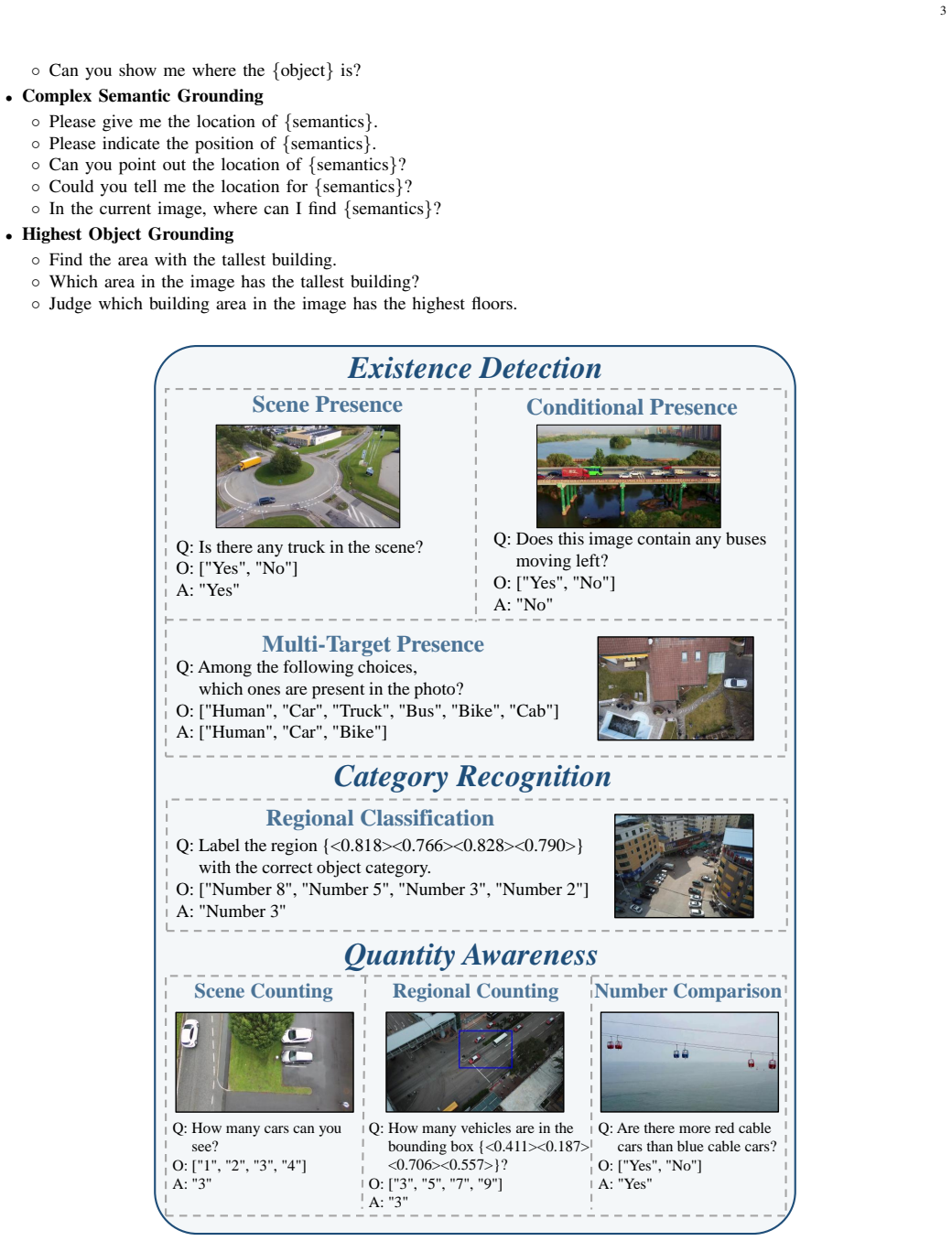
0.5
- De-hallucination filter delta =
not specified
assumptions (4)
- domain assumption Depth Anything 3 produces reliable relative depth maps for aerial imagery, allowing correct height and distance comparisons.
- domain assumption The MLLM-based existence verification and equidistant heuristic filter reliably separate real detections from hallucinated bounding boxes.
- domain assumption The Score Agent's self-reported confidence scores are meaningful for pruning and path selection in DAAS.
- domain assumption The Instruct and Thinking variants of Qwen3-VL share the same architecture and can be mixed without breaking the system.
Cite this review
Pith. "Pith review of Advancing MLLM-based UAV Image Understanding and Reasoning: A Benchmark and a Training-Free Multi-Agent System." pith.science (2026). https://pith.science/paper/ILHECK6T
@misc{pith2026260811738,
  author       = {Pith},
  title        = {Pith review of: Advancing MLLM-based UAV Image Understanding and Reasoning: A Benchmark and a Training-Free Multi-Agent System},
  year         = {2026},
  howpublished = {\url{https://pith.science/paper/ILHECK6T}},
  note         = {Machine review of arXiv:2608.11738}
}
read the original abstract
Multimodal Large Language Model (MLLM)-based UAV aerial image understanding and reasoning is essential for aerial intelligence yet poses distinct challenges arising from extreme scale variation, arbitrary camera orientations, and high object density. Despite growing interest, existing evaluations remain fragmented across individual datasets and narrow tasks, leaving a critical gap in unified assessment of UAV understanding and reasoning capabilities. To fill this gap, we construct UAVQA-Bench, a benchmark of 1,500 human-annotated QA pairs drawn from 13 public UAV datasets, covering 6 capability dimensions and 16 tasks in both multiple-choice and visual grounding formats. Systematic evaluation of a broad range of open-source and closed-source MLLMs as well as agent-based systems on UAVQA-Bench identifies three key failure modes: domain-toolset mismatch, unchecked error propagation, and static reasoning. Motivated by these findings, we propose UAV-MAS, a training-free multi-agent system for MLLM-based UAV aerial image understanding and reasoning, comprising a Domain-Specific Perception Engine (DSPE) that routes queries to task-appropriate visual tools, a Context-Aware Iterative Refinement module (CAIR) that validates intermediate reasoning to curb error accumulation, and a Difficulty-Aware Adaptive Search mechanism (DAAS) that adjusts search depth to question difficulty. UAV-MAS with a 32B open-source MLLM achieves 77.0% overall accuracy on UAVQA-Bench, surpassing Gemini 3 Pro by 4.0\%, while the 8B variant improves 8.7\% over its base model.
Figures


Figures from the paper (5 more)




Reference graph
Works this paper leans on
-
[1]
Uav-detr: efficient end-to-end object detection for unmanned aerial vehicle imagery,
H. Zhang, K. Liu, Z. Gan, and G.-N. Zhu, “Uav-detr: efficient end-to-end object detection for unmanned aerial vehicle imagery,”arXiv preprint arXiv:2501.01855, 2025
arXiv 2025
-
[2]
Self-supervised monocular depth estimation from oblique uav videos,
L. Madhuanand, F. Nex, and M. Y . Yang, “Self-supervised monocular depth estimation from oblique uav videos,”ISPRS journal of photogram- metry and remote sensing, vol. 176, pp. 1–14, 2021
work page 2021
-
[3]
Mmbench: Is your multi-modal model an all-around player?
Y . Liu, H. Duan, Y . Zhang, B. Li, S. Zhang, W. Zhao, Y . Yuan, J. Wang, C. He, Z. Liuet al., “Mmbench: Is your multi-modal model an all-around player?” inEuropean conference on computer vision. Springer, 2024, pp. 216–233
2024
-
[4]
RSVQA: Visual question answering for remote sensing data,
S. Lobry, D. Marcos, J. Murray, and D. Tuia, “RSVQA: Visual question answering for remote sensing data,”IEEE Transactions on Geoscience and Remote Sensing, vol. 58, no. 12, pp. 8555–8566, 2020
work page 2020
-
[5]
Vrsbench: A versatile vision-language benchmark dataset for remote sensing image understanding,
X. Li, J. Ding, and M. Elhoseiny, “Vrsbench: A versatile vision-language benchmark dataset for remote sensing image understanding,”Advances in Neural Information Processing Systems, vol. 37, pp. 3229–3242, 2024
2024
-
[6]
Xlrs-bench: Could your multimodal llms understand extremely large ultra-high-resolution remote sensing im- agery?
F. Wang, H. Wang, Z. Guo, D. Wang, Y . Wang, M. Chen, Q. Ma, L. Lan, W. Yang, J. Zhanget al., “Xlrs-bench: Could your multimodal llms understand extremely large ultra-high-resolution remote sensing im- agery?” inProceedings of the Computer Vision and Pattern Recognition Conference, 2025, pp. 14 325–14 336
2025
-
[7]
Visdrone-det2019: The vision meets drone object detection in image challenge results,
D. Du, P. Zhu, L. Wen, X. Bian, H. Lin, Q. Hu, T. Peng, J. Zheng, X. Wang, Y . Zhanget al., “Visdrone-det2019: The vision meets drone object detection in image challenge results,” inProceedings of the IEEE/CVF international conference on computer vision workshops, 2019, pp. 0–0
2019
-
[8]
The unmanned aerial vehicle benchmark: Object detection and tracking,
D. Du, Y . Qi, H. Yu, Y . Yang, K. Duan, G. Li, W. Zhang, Q. Huang, and Q. Tian, “The unmanned aerial vehicle benchmark: Object detection and tracking,” inProceedings of the European conference on computer vision (ECCV), 2018, pp. 370–386
2018
Show all 65 references
-
[9]
Urbanvideo-bench: Benchmarking vision-language models on embodied intelligence with video data in urban spaces,
B. Zhao, J. Fang, Z. Dai, Z. Wang, J. Zha, W. Zhang, C. Gao, Y . Wang, J. Cui, X. Chenet al., “Urbanvideo-bench: Benchmarking vision-language models on embodied intelligence with video data in urban spaces,”arXiv preprint arXiv:2503.06157, 2025
2025
-
[10]
Yolo26: An analysis of nms-free end to end framework for real-time object detection,
S. Chakrabarty, “Yolo26: An analysis of nms-free end to end framework for real-time object detection,”arXiv preprint arXiv:2601.12882, 2026. 12
2026
-
[11]
Dfir-detr: Frequency domain enhancement and dynamic feature aggregation for cross-scene small object detection,
B. Gao, J. Tong, X. Chen, H. Yu, and Z. Li, “Dfir-detr: Frequency domain enhancement and dynamic feature aggregation for cross-scene small object detection,”arXiv preprint arXiv:2512.07078, 2025
2025 arXiv
-
[12]
Uav-based intelligent traffic surveillance system: Real-time vehicle detection, classification, tracking, and behav- ioral analysis,
A. Khanpour, T. Wang, A. Vahidi-Shams, W. Ectors, F. Nakhaie, A. Taheri, and C. Claudel, “Uav-based intelligent traffic surveillance system: Real-time vehicle detection, classification, tracking, and behav- ioral analysis,”arXiv preprint arXiv:2509.04624, 2025
2025 arXiv
-
[13]
Global–local fusion with semantic information-guidance for accurate small object detection in UA V aerial images,
Y . Chen, Z. Ye, H. Sun, T. Gong, S. Xiong, and X. Lu, “Global–local fusion with semantic information-guidance for accurate small object detection in UA V aerial images,”IEEE Transactions on Geoscience and Remote Sensing, vol. 63, pp. 1–15, 2025, art. no. 4701115
2025
-
[14]
Detection-driven exposure-correction network for nighttime drone-view object detection,
Y . Xi, W. Jia, Q. Miao, J. Feng, J. Ren, and H. Luo, “Detection-driven exposure-correction network for nighttime drone-view object detection,” IEEE Transactions on Geoscience and Remote Sensing, vol. 62, pp. 1– 14, 2024, art. no. 5605014
2024
-
[15]
Wheatai v1. 0: An ai-powered high throughput wheat phenotyping platform,
M. Maimaitijiang, H. Ghimire, S. Thapa, M. M. Billah, S. Sehgal, M. Singh, S. Kaushal, K. Poudel, S. Subedi, U. U. R. Janjuaet al., “Wheatai v1. 0: An ai-powered high throughput wheat phenotyping platform,”arXiv preprint arXiv:2601.08863, 2026
2026
-
[16]
Maizestandcounting (masc): Auto- mated and accurate maize stand counting from uav imagery using image processing and deep learning,
D. E. Kharismawati and T. Kazic, “Maizestandcounting (masc): Auto- mated and accurate maize stand counting from uav imagery using image processing and deep learning,”arXiv preprint arXiv:2510.07580, 2025
2025
-
[17]
Panoptic segmentation of environmental uav images: Litter beach,
O. Youme, J. M. Dembele, E. C. Ezin, and C. Cambier, “Panoptic segmentation of environmental uav images: Litter beach,”arXiv preprint arXiv:2508.15985, 2025
2025 arXiv
-
[18]
Codrone: Autonomous drone navigation assisted by edge and cloud foundation models,
P. Chen, T. Ouyang, K. Luo, W. Hong, and X. Chen, “Codrone: Autonomous drone navigation assisted by edge and cloud foundation models,”IEEE Internet of Things Journal, 2025
2025
-
[19]
Generalization evaluation of deep stereo matching methods for uav-based forestry applications,
Y . Lin, B. Xue, M. Zhang, S. Schofield, and R. Green, “Generalization evaluation of deep stereo matching methods for uav-based forestry applications,”arXiv preprint arXiv:2512.03427, 2025
2025
-
[20]
Precise depth estimation by calculating affine transformation parameters,
X. Shi, T. Tang, J. Chen, S. Lv, and Y . Liu, “Precise depth estimation by calculating affine transformation parameters,”IEEE Transactions on Geoscience and Remote Sensing, vol. 62, pp. 1–15, 2024
2024
-
[21]
FLDet: Faster and lighter aerial object detector,
S. Wang, K. Liu, J. Huang, and X. Li, “FLDet: Faster and lighter aerial object detector,”IEEE Transactions on Circuits and Systems for Video Technology, vol. 35, no. 5, pp. 4450–4463, 2025
2025
-
[22]
TGCADNet: Text-guided context-aware detection via CLIP for small objects in UA V scenes,
F. Sun, D. Cheng, P. Zheng, T. Song, L. Chen, and Q. Kou, “TGCADNet: Text-guided context-aware detection via CLIP for small objects in UA V scenes,”IEEE Transactions on Circuits and Systems for Video Technology, vol. 36, no. 6, pp. 7846–7859, 2026
2026
-
[23]
Detect anything via next point prediction,
Q. Jiang, J. Huo, X. Chen, Y . Xiong, Z. Zeng, Y . Chen, T. Ren, J. Yu, and L. Zhang, “Detect anything via next point prediction,”arXiv preprint arXiv:2510.12798, 2025
2025
-
[24]
Visdrone-det2021: The vision meets drone object detection challenge results,
Y . Cao, Z. He, L. Wang, W. Wang, Y . Yuan, D. Zhang, J. Zhang, P. Zhu, L. Van Gool, J. Hanet al., “Visdrone-det2021: The vision meets drone object detection challenge results,” inProceedings of the IEEE/CVF International conference on computer vision, 2021, pp. 2847–2854
2021
-
[25]
Dota: A large-scale dataset for object detection in aerial images,
G.-S. Xia, X. Bai, J. Ding, Z. Zhu, S. Belongie, J. Luo, M. Datcu, M. Pelillo, and L. Zhang, “Dota: A large-scale dataset for object detection in aerial images,” inProceedings of the IEEE conference on computer vision and pattern recognition, 2018, pp. 3974–3983
2018
-
[26]
Uavscenes: A multi-modal dataset for uavs,
S. Wang, S. Li, Y . Zhang, S. Yu, S. Yuan, R. She, Q. Guo, J. Zheng, O. K. Howe, L. Chandraet al., “Uavscenes: A multi-modal dataset for uavs,”arXiv preprint arXiv:2507.22412, 2025
2025 arXiv
-
[27]
Dyfo: A training-free dynamic focus visual search for enhancing lmms in fine-grained visual understanding,
G. Li, J. Xu, Y . Zhao, and Y . Peng, “Dyfo: A training-free dynamic focus visual search for enhancing lmms in fine-grained visual understanding,” inProceedings of the Computer Vision and Pattern Recognition Confer- ence, 2025, pp. 9098–9108
2025
-
[28]
Pyvision: Agentic vision with dynamic tooling,
S. Zhao, H. Zhang, S. Lin, M. Li, Q. Wu, K. Zhang, and C. Wei, “Pyvision: Agentic vision with dynamic tooling,”arXiv preprint arXiv:2507.07998, 2025
2025 arXiv
-
[29]
Multi-agent constraint factorization reveals latent invariant solution structure,
C. Scofield, “Multi-agent constraint factorization reveals latent invariant solution structure,”arXiv preprint arXiv:2601.15077, 2026
2026
-
[30]
Mas-orchestra: Understanding and improv- ing multi-agent reasoning through holistic orchestration and controlled benchmarks,
Z. Ke, Y . Ming, A. Xu, R. Chin, X.-P. Nguyen, P. Jwalapuram, S. Yavuz, C. Xiong, and S. Joty, “Mas-orchestra: Understanding and improv- ing multi-agent reasoning through holistic orchestration and controlled benchmarks,”arXiv preprint arXiv:2601.14652, 2026
2026 arXiv
-
[31]
Agent identity uri scheme: Topology-independent naming and capability-based discovery for multi-agent systems,
R. R. Rodriguez Jr, “Agent identity uri scheme: Topology-independent naming and capability-based discovery for multi-agent systems,”arXiv preprint arXiv:2601.14567, 2026
2026 arXiv
-
[32]
Internvl3. 5: Advancing open-source multi- modal models in versatility, reasoning, and efficiency,
W. Wang, Z. Gao, L. Gu, H. Pu, L. Cui, X. Wei, Z. Liu, L. Jing, S. Ye, J. Shaoet al., “Internvl3. 5: Advancing open-source multi- modal models in versatility, reasoning, and efficiency,”arXiv preprint arXiv:2508.18265, 2025
2025 arXiv
-
[33]
Pa- per2rebuttal: A multi-agent framework for transparent author response assistance,
Q. Ma, C. Guo, Z. Tian, S. Wang, J. Xiao, Y . Yue, and Z. Zhang, “Pa- per2rebuttal: A multi-agent framework for transparent author response assistance,”arXiv preprint arXiv:2601.14171, 2026
2026 arXiv
-
[34]
The orchestration of multi- agent systems: Architectures, protocols, and enterprise adoption,
A. Adimulam, R. Gupta, and S. Kumar, “The orchestration of multi- agent systems: Architectures, protocols, and enterprise adoption,”arXiv preprint arXiv:2601.13671, 2026
2026
-
[35]
Motion-to-response content generation via multi-agent ai sys- tem with real-time safety verification,
H. Lee, “Motion-to-response content generation via multi-agent ai sys- tem with real-time safety verification,”arXiv preprint arXiv:2601.13589, 2026
2026
-
[36]
Agentgc: Evolutionary learning-based lossless compres- sion for genomics data with llm-driven multiple agent,
S. Hui, D. Yanfeng, H. Ma, C. Xu, K. Jin, L. Zu, C. Zhong, G. Wang, W. Caiet al., “Agentgc: Evolutionary learning-based lossless compres- sion for genomics data with llm-driven multiple agent,”arXiv preprint arXiv:2601.13559, 2026
2026
-
[37]
React: Synergizing reasoning and acting in language models,
S. Yao, J. Zhao, D. Yu, N. Du, I. Shafran, K. R. Narasimhan, and Y . Cao, “React: Synergizing reasoning and acting in language models,” inThe eleventh international conference on learning representations, 2022
2022
-
[38]
Au-air: A multi-modal unmanned aerial vehicle dataset for low altitude traffic surveillance,
I. Bozcan and E. Kayacan, “Au-air: A multi-modal unmanned aerial vehicle dataset for low altitude traffic surveillance,” in2020 IEEE International Conference on Robotics and Automation (ICRA). IEEE, 2020, pp. 8504–8510
2020
-
[39]
Webuav-3m: A benchmark for unveiling the power of million- scale deep uav tracking,
C. Zhang, G. Huang, L. Liu, S. Huang, Y . Yang, X. Wan, S. Ge, and D. Tao, “Webuav-3m: A benchmark for unveiling the power of million- scale deep uav tracking,”IEEE Transactions on Pattern Analysis and Machine Intelligence, vol. 45, no. 7, pp. 9186–9205, 2022
2022
-
[40]
Visdrone-det2019: The vision meets drone object detection in image challenge results,
D. Du, P. Zhu, L. Wen, X. Bian, H. Lin, Q. Hu, T. Peng, J. Zheng, X. Wang, Y . Zhanget al., “Visdrone-det2019: The vision meets drone object detection in image challenge results,” inProceedings of the IEEE/CVF international conference on computer vision workshops, 2019
2019
-
[41]
Semantic drone dataset,
U. Graz, “Semantic drone dataset,” 2019. [Online]. Available: http://dronedataset.icg.tugraz.at/
2019
-
[42]
Drone-based rgb-infrared cross- modality vehicle detection via uncertainty-aware learning,
Y . Sun, B. Cao, P. Zhu, and Q. Hu, “Drone-based rgb-infrared cross- modality vehicle detection via uncertainty-aware learning,”IEEE Trans- actions on Circuits and Systems for Video Technology, vol. 32, no. 10, pp. 6700–6713, 2022
2022
-
[43]
Vdd: Varied drone dataset for semantic segmentation,
W. Cai, K. Jin, J. Hou, C. Guo, L. Wu, and W. Yang, “Vdd: Varied drone dataset for semantic segmentation,”Journal of Visual Communication and Image Representation, vol. 109, p. 104429, 2025
2025
-
[44]
Large-scale structure from motion with semantic constraints of aerial images,
Y . Chen, Y . Wang, P. Lu, Y . Chen, and G. Wang, “Large-scale structure from motion with semantic constraints of aerial images,” inChinese Conference on Pattern Recognition and Computer Vision (PRCV). Springer, 2018, pp. 347–359
2018
-
[45]
Uavid: A semantic segmentation dataset for uav imagery,
Y . Lyu, G. V osselman, G.-S. Xia, A. Yilmaz, and M. Y . Yang, “Uavid: A semantic segmentation dataset for uav imagery,”ISPRS journal of photogrammetry and remote sensing, vol. 165, pp. 108–119, 2020
2020
-
[46]
Wilduav: Monocular uav dataset for depth estimation tasks,
H. Florea, V .-C. Miclea, and S. Nedevschi, “Wilduav: Monocular uav dataset for depth estimation tasks,” in2021 IEEE 17th International Conference on Intelligent Computer Communication and Processing (ICCP). IEEE, 2021, pp. 291–298
2021
-
[47]
Hazydet: Open-source benchmark for drone-view object detec- tion with depth-cues in hazy scenes,
C. Feng, Z. Chen, X. Li, C. Wang, J. Yang, M.-M. Cheng, Y . Dai, and Q. Fu, “Hazydet: Open-source benchmark for drone-view object detec- tion with depth-cues in hazy scenes,”arXiv preprint arXiv:2409.19833, 2024
2024 arXiv
-
[48]
Graph regularized flow attention network for video animal counting from drones,
P. Zhu, T. Peng, D. Du, H. Yu, L. Zhang, and Q. Hu, “Graph regularized flow attention network for video animal counting from drones,”IEEE Transactions on Image Processing, vol. 30, pp. 5339–5351, 2021
2021
-
[49]
A benchmark and simulator for uav tracking,
M. Mueller, N. Smith, and B. Ghanem, “A benchmark and simulator for uav tracking,” inEuropean conference on computer vision, vol. 7, 2016
2016
-
[50]
Depth anything 3: Recovering the visual space from any views,
H. Lin, S. Chen, J. H. Liew, D. Y . Chen, Z. Li, G. Shi, J. Feng, and B. Kang, “Depth anything 3: Recovering the visual space from any views,”arXiv preprint arXiv:2511.10647, 2025
2025 arXiv
-
[51]
Qwen3-vl technical report,
S. Bai, Y . Cai, R. Chen, K. Chen, X. Chen, Z. Cheng, L. Deng, W. Ding, C. Gao, C. Ge, W. Ge, Z. Guo, Q. Huang, J. Huang, F. Huang, B. Hui, S. Jiang, Z. Li, M. Li, M. Li, K. Li, Z. Lin, J. Lin, X. Liu, J. Liu, C. Liu, Y . Liu, D. Liu, S. Liu, D. Lu, R. Luo, C. Lv, R. Men, L. M...
2025 arXiv
-
[52]
Glm-4.5v and glm-4.1v-thinking: Towards versatile multimodal reasoning with scalable reinforcement learning,
V . Team, W. Hong, W. Yu, X. Gu, G. Wang, G. Gan, H. Tang, J. Cheng, J. Qi, J. Ji, L. Pan, S. Duan, W. Wang, Y . Wang, Y . Cheng, Z. He, Z. Su, Z. Yang, Z. Pan, A. Zeng, B. Wang, B. Chen, B. Shi, C. Pang, C. Zhang, D. Yin, F. Yang, G. Chen, J. Xu, J. Zhu, J. Chen, J. Chen, J. ...
2025 arXiv
-
[53]
Qwen3.5: Accelerating productivity with native multimodal agents,
Q. Team, “Qwen3.5: Accelerating productivity with native multimodal agents,” February 2026. [Online]. Available: https://qwen.ai/blog?id= qwen3.5
2026
-
[54]
Introducing gpt-5.2,
OpenAI, “Introducing gpt-5.2,” https://openai.com/index/ introducing-gpt-5-2/, 2025, accessed: 2026-01-28
2025
-
[55]
Gemini 3 pro and gemini 3 flash models,
Google DeepMind, “Gemini 3 pro and gemini 3 flash models,” https: //ai.google.dev/, 2025, accessed: 2026-01-15
2025
-
[56]
Qwen-agent: An agent framework based on qwen,
QwenLM, “Qwen-agent: An agent framework based on qwen,” https: //github.com/QwenLM/Qwen-Agent, 2024
2024
-
[57]
Choice: Benchmarking the remote sensing capabilities of large vision-language models,
X. An, J. Sun, Z. Gui, and W. He, “Choice: Benchmarking the remote sensing capabilities of large vision-language models,” in Advances in Neural Information Processing Systems, vol. 38, 2025. [Online]. Available: https://proceedings.neurips.cc/paper files/paper/ 2025/hash/befe2...
2025
-
[59]
Existence Detection (ED): •Scene Presence ◦Is any{object}present here? ◦Is any{object}visible in the image? ◦Is there any{object}in the scene? ◦Does this image contain any{object}? ◦Can you see any{object}in this picture? •Conditional Presence ◦Is any{object}present{condition}...
-
[60]
◦Classify the object in region{<x 1><y1><x2><y2>}
Category Recognition (CR): •Regional Classification ◦Identify the object found in{<x 1><y1><x2><y2>}. ◦Classify the object in region{<x 1><y1><x2><y2>}. ◦Which class does the object in{<x 1><y1><x2><y2>}belong to? ◦What is the category of the object located at{<x 1><y1><x2><y2...
-
[61]
◦Count all the{object}in this picture
Quantity Awareness (QA): •Scene Counting ◦Provide the quantity of{object}. ◦Count all the{object}in this picture. ◦How many{object}are in this image? ◦How many instances of{object}can you see? ◦Can you count the number of{object}present? •Regional Counting ◦Provide the quantit...
-
[62]
◦Which color does the{object}in{<x 1><y1><x2><y2>}have? ◦Identify the driving direction (relative to the camera) of the{object}in{<x 1><y1><x2><y2>}
Fine-grained Attribute Perception (FAP): •Regional Attribute Recognition ◦What color is the{object}in{<x 1><y1><x2><y2>}? ◦Identify the color of the{object}in{<x 1><y1><x2><y2>}. ◦Which color does the{object}in{<x 1><y1><x2><y2>}have? ◦Identify the driving direction (relative ...
-
[63]
Spatial Relationship Understanding (SRU): •Spatial Relation ◦Relative to the object in{<x 1><y1><x2><y2>}A, where is the object in{<x 1><y1><x2><y2>}B? ◦As seen by the object in{<x 1><y1><x2><y2>}A, in what direction is the object in{<x 1><y1><x2><y2>}B? ◦From the viewpoint of...
-
[64]
Yes", "No
Visual Grounding (VG): •Simple Object Grounding ◦Locate the{object}. ◦Point out the{object}. ◦Could you point out the{object}? ◦Draw the position of a/an{object}. 3 ◦Can you show me where the{object}is? •Complex Semantic Grounding ◦Please give me the location of{semantics}. ◦P...
-
[65]
Q”, “O”, and “A
Template Visualizations:In this section, we present additional examples from UA VQA-Bench. Figure 1 provides sample instances and visual prompts for the tasks of Existence Detection, Category Recognition, and Quantity Awareness. Figure 2 illustrates examples for Fine-grained A...
-
[2013]
He is currently a Professor with the College of Future In- formation Technology, Fudan University, Shanghai, China
He was a Research Scientist with the Institute for Infocomm Research, A*STAR, Singapore, from 2013 to 2017, and a Senior Scientist with the Huawei Singapore Research Center from 2017 to 2018. He is currently a Professor with the College of Future In- formation Technology, Fuda...
2013
Reviewed August 16, 2026 · model on record in the stance chip above.
Discussion (0). Continue with ORCID to comment.