REVIEW 3 major objections 5 minor 91 references
Learning with Bilevel-Minimax Optimization for Efficient and Reliable Transfer Attacks
T0 review · 3 major / 5 minor · reviewed 2026-08-16 · deepseek-v4-flash
Pith's one-line read A bilevel-minimax recipe lifts adversarial transfer by 23 points
desk verdict The empirical study is broad and the formulation is novel, but the stated IGA update for learning the initialization is algebraically invalid as written because the inner objective has no dependence on the initialization variable. read the letter →
The pith
A machine-rendered reading of the paper's core claim, the machinery that carries it, and where it could break.
The reading
What carries the argument
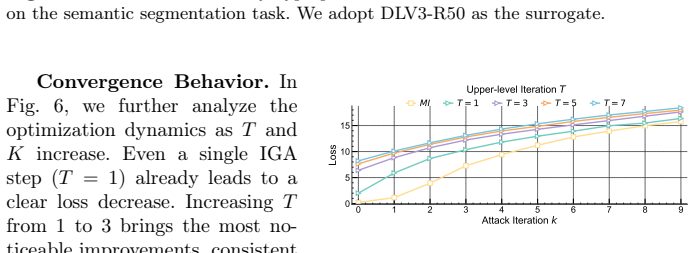
Two components carry the algorithm. First, the Soft Weight Modulator (SWM) performs single-step alternating updates of the perturbation and surrogate weights $\tilde{K}$ times inside the inner loop, using only one backward pass, so the surrogate is locally adapted to produce more universal gradients. Second, the Implicit Gradient Approximator (IGA) computes the outer hypergradient with respect to the initialization $\delta$ via the implicit function theorem, solving the linear system $\nabla^2_{\phi\phi} f\, h = \nabla_\phi F$ with a Fletcher-Reeves conjugate gradient method and a damping term $\rho I$ to ensure invertibility, avoiding unrolling of the inner trajectory. The theoretical analysis (Lemma 1, Lemma 2, Theorem 1) shows a descent inequality and an averaged stationarity bound with error terms from IGA and from the finite inner steps $\tilde{K}$, framing the solver as a stable regularized bilevel method.
What would settle it
On a small model pair, compute the true hypergradient by unrolling the inner trajectory and compare its inner product with the IGA approximation; if the average cosine similarity is not positive, or if the outer loss decreases only when the damping term dominates the Hessian, the implicit gradient is not capturing the true coupling. Alternatively, train BMAT with $\tilde{K}=1$ inner step and with $\tilde{K}=50$; if the learned initialization's transfer gain vanishes or reverses at the larger $\tilde{K}$, the method is overfitting to the finite-step dynamics.
Extended reading notes
Core claim
BMAT claims that replacing the vanilla single-level attack objective with a bilevel-minimax problem, in which the inner level solves min over perturbation $\phi$ and max over surrogate weights $\omega$, and the outer level optimizes the initialization $\delta$ via implicit differentiation, yields consistently more transferable adversarial examples. Concretely, the paper reports that BMAT, as a wrapper around nine base attackers, raises average attack success rate by 23.28% across 24 combinations on ImageNet over 10 victim models spanning CNNs, robust ensembles, and transformers, and on Cityscapes it reduces mIoU by up to roughly 2x, with a 46.4% relative mIoU drop on ADE20K. The claim is that the learned initialization encodes task-agnostic trajectory seeds while the inner minimax flattens the surrogate's loss landscape, jointly producing gradients that transfer across architectures without query access to the victim.
Load-bearing premise
The whole scheme assumes that the implicit-function-theorem hypergradient, computed after only a handful of non-convex inner steps and with a damping patch, is a genuine descent direction for the outer objective rather than an artifact of the finite-step trajectory.
Editorial extensions
If this is right
- If BMAT is correct, existing gradient-based transfer attacks (PGD, MI, SI, SGM, Ghost, etc.) can be upgraded by learning an initialization perturbation, with gains on both CNN and transformer victims.
- BMAT's gains persist under normalized backward-pass budgets, meaning the learned seed is more efficient than simply running more attack iterations.
- In a single-surrogate setting with no additional victim supervision, BMAT still improves average ASR by 30-58%, implying that the bilevel coupling itself, not the auxiliary pseudo-surrogate, drives transferability.
- The mechanism analysis shows SWM flattens the surrogate loss landscape and the learned initialization raises feature shift on held-out models, consistent with the claim that transferability comes from coordinated variable evolution.
Reading between the lines
- If the implicit-function hypergradient is reliable, the same bilevel-minimax recipe could apply to other black-box transfer settings like object detection or video models, where the inner minimax could adapt different surrogate components.
- The dependence on only $\tilde{K}$ finite inner steps suggests the learned initialization may be specialized to that exact inner step count; varying $\tilde{K}$ at test time could change effectiveness, a testable extension.
- The paper's framing implies that any improvement in surrogate adaptation, not just Bayesian weight sampling, could be plugged into the inner minimax to push cross-architecture transfer further, potentially making transfer attacks scale with surrogate diversity rather than attack iterations.
Signed reviews
Editorial analysis
A structured set of objections, weighed in public.
Referee Report
Summary. The manuscript proposes BMAT, a bilevel-minimax formulation for transfer-based adversarial attacks. The outer level is said to learn an initialization perturbation δ through an implicit-gradient approximator (IGA), while the inner level uses a soft-weight modulator (SWM) to jointly update the perturbation and surrogate parameters. The paper reports extensive classification and segmentation experiments with large ASR gains and mIoU reductions across many victims, plus stability-oriented lemmas and a theorem. The empirical breadth is substantial, and the experimental protocol is generally careful. However, the central algorithmic derivation is invalid as written: the inner objective f does not depend on δ, so the cross-Hessian used to update δ is identically zero and the described IGA update cannot move δ.
Significance. If the method worked as described, the reported gains would be meaningful for transfer attacks: the evaluation spans classification and segmentation, more than 30 victim models, multiple base attackers, and normalized computational budgets. The direct comparison with the closely related BETAK method and the extensive ablations are strengths, as is the stated intention to release code. However, the load-bearing IGA mechanism is algebraically vacuous in the stated formulation, and the theoretical statements are unproven and depend on undefined quantities. Consequently, the paper does not currently establish that BMAT learns an initialization or that the observed empirical gains arise from the described bilevel-minimax coupling.
major comments (3)
- [§3.2, Eqs. (3)–(7); Algorithm 1, line 11] The hypergradient update is not valid. The inner objective f in Eq. (3) is -L_s(\phi,S_\omega;D_i) - \tau R(S_\omega;D_i), which contains no δ; δ appears only as the initial condition \phi_0 = δ in Eq. (4). Hence the cross-Hessian \nabla^2_{\delta\phi} f in Eq. (6) is identically zero, and the update in Algorithm 1 line 11 cannot change δ. The implicit-function theorem does not apply here, because it requires the inner problem to depend on δ as a parameter; δ is not such a parameter. The finite-step response \phi^*(\delta) does depend on δ through the initial condition, but its derivative must be obtained by differentiating through the \tilde K SWM iterations, not from the stated IFT expression. This is a load-bearing error: the learned-initialization mechanism is the paper's central algorithmic contribution.
- [§3.2, 'Algorithm Analysis'; Lemmas 1–2; Theorem 1] The theoretical statements are not usable in their current form. Lemma 1 asserts a descent inequality involving \nabla_\delta F and a gradient norm, while Algorithm 1 updates δ with sign(·) and projection; no argument connects the two. Lemma 2 and Theorem 1 involve error terms \epsilon_IGA, \epsilon_\phi^{(\tilde K)}, \epsilon_\omega^{(\tilde K)} and constants L_\phi, L_\omega, G_F that are never defined, and no proofs are supplied in the manuscript or an appendix. Moreover, Lemma 2's bounds grow with \tilde K as (1+\beta^2 L_\phi^2)^{\tilde K}, which is the opposite of the convergence needed to replace the finite-step response by an implicit optimum. The claimed theoretical insights are therefore unverifiable and do not support the algorithm as described.
- [§3.2, Eq. (4) and the IGA paragraph] Even if the zero cross-Hessian issue were set aside, applying the implicit-function theorem at an 'approximate inner optimum' is not justified. Eq. (4) explicitly defines \phi^*(\delta) as a finite-step response rather than a stationary point of f, whereas Eq. (6) requires \nabla_\phi f(\phi^*(\delta)) = 0 in a neighborhood. No such condition is proved, and with only \tilde K inner steps the inner trajectory need not be near any stationary point. The damping term (\nabla^2_{\phi\phi} f + \rho I)^{-1} is introduced without derivation and cannot repair the missing δ-dependence of f.
minor comments (5)
- [§3.2, Eq. (5)] Please clarify how the SWM obtains both \nabla_\phi f and \nabla_\omega f in a single backward pass; standard backprop can provide gradients with respect to both groups of variables, but the memory and ordering assumptions should be stated explicitly.
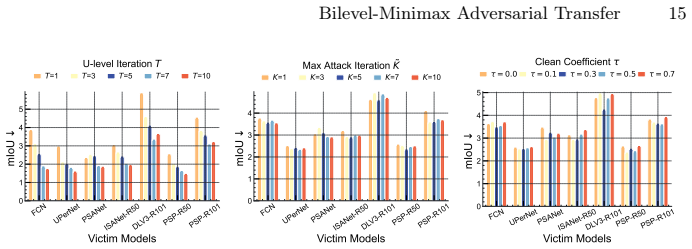
- [Figure 5] The hyperparameter ablation figure is not readable because the axis labels are shown as escaped '/uni000000...' sequences; the font encoding needs to be fixed.
- [§3.1, Eqs. (1) and (3)] The surrogate-loss notation is inconsistent: Eq. (1) writes L_s(\phi; S_\omega, D_i) while Eq. (3) writes L_s(\phi, S_\omega; D_i). Please use one convention throughout.
- [Algorithm 2] The conjugate-gradient iteration computes \eta_\nu as r_\nu^\top r_\nu / (p_\nu^\top (\nabla^2_{\phi\phi} f \cdot p_\nu)); if the denominator is near zero the iteration is undefined, and the later note about damping does not appear in the pseudocode. A safeguard or a reference to the damping variant should be added.
- [§4.2, Table 8 caption and text] The sentence 'BMAT improves ASR by +25.87% and +41.45% over PGD on average' should state whether these are absolute percentage-point gains or relative gains; the surrounding numbers suggest percentage points, but the wording is ambiguous.
Circularity Check
No significant circularity: evaluation is against held-out victims and the core derivation is not fitted to its success criteria; the IGA hypergradient issue is a correctness concern rather than a circularity.
full rationale
I walked the derivation chain from Eq. (1) through Algorithm 1. The inner minimax objective f(phi,omega) in Eq. (3) and the outer objective F(delta, phi*(delta)) in Eq. (4) are not fitted to the reported transfer metrics: phi*(delta) is evaluated on a pseudo-surrogate P, and all ASR/mIoU results are measured on held-out victim models not used for IP learning. The SWM co-update (Eq. 5) and the IGA linear solve (Alg. 2, Eq. 7) are algorithmic components whose outputs feed the IP update; they are not re-statements of the evaluation criteria. Self-citations exist (e.g., BETAK [51] and the authors' bilevel papers [44,45,49]), but they are not load-bearing: BETAK is benchmarked directly in Table 3, and the implicit-function-theorem citation in Eq. (6) points to a standard general result rather than a self-issued uniqueness theorem. I therefore find no case where a prediction or first-principles result reduces to its own input by construction. I do flag, as a correctness risk rather than circularity, that the displayed hypergradient in Eq. (6)/(7) is problematic: f in Eq. (3) has no explicit delta-dependence, so the cross-Hessian (nabla^2_{delta phi} f) is identically zero and Algorithm 1 line 11 would not move delta as written. This is an algebraic-validity / omitted-support issue that should be weighed in a technical review, but it is not an equivalence-of-prediction-to-input and therefore does not raise the circularity score.
Assumptions & free parameters
free parameters (6)
- tau (regularizer coefficient) =
0.1 or 0.5 (ablated in Fig. 5)
- T (outer IP iterations) =
2-3 in main results (Fig. 5, Tab. 8)
- K_tilde (inner SWM steps) =
5-10 in main results
- alpha, beta, gamma (step sizes) =
not reported
- rho (IGA damping) =
not reported
- zeta (CG tolerance) and N (CG max iterations) =
not reported
assumptions (4)
- domain assumption The inner minimax objective f(phi, omega) = -L_s(phi, S_omega) - tau R(S_omega) with max over omega produces surrogate weights whose gradients generalize across architectures.
- standard math The implicit function theorem applies to the inner minimax: the inner response phi*(delta) is differentiable and (H_phiphi f) is invertible.
- ad hoc to paper The finite-step inner response after K~ SWM iterations is close enough to the implicit optimum phi*(delta) for the implicit-function-based hypergradient to be a valid descent direction.
- domain assumption The pseudo-surrogate P (white-box surrogate, Bayesian version, or auxiliary Inception-v3) provides a transferable signal for learning the initialization delta.
Cite this review
Pith. "Pith review of Learning with Bilevel-Minimax Optimization for Efficient and Reliable Transfer Attacks." pith.science (2026). https://pith.science/paper/WED4OSS2
@misc{pith2026260811815,
  author       = {Pith},
  title        = {Pith review of: Learning with Bilevel-Minimax Optimization for Efficient and Reliable Transfer Attacks},
  year         = {2026},
  howpublished = {\url{https://pith.science/paper/WED4OSS2}},
  note         = {Machine review of arXiv:2608.11815}
}
read the original abstract
Transfer-based adversarial attacks craft adversarial examples using surrogate models to mislead black-box victim models. Beyond perturbation generation, transferability is fundamentally governed by the coupling of initialization, surrogate adaptation, and gradient dynamics. We revisit this challenge from a bilevel-minimax perspective and propose BMAT (Bilevel-Minimax Adversarial Transfer). The bilevel formulation captures the dependency between initialization and perturbation, while the inner minimax problem promotes surrogate robustness for cross-architecture generalization. Algorithmically, we develop an integrated bottom-up solver that combines a Soft Weight Modulator and an Implicit Gradient Approximator to enable ternary coupling among initialization, surrogate adaptation, and perturbation optimization. We further provide theoretical insights into the optimization dynamics of the proposed bilevel-minimax framework. Extensive experiments on classification and segmentation benchmarks show that BMAT outperforms more than 10 strong baselines across more than 30 victim models, improving both intra- and cross-architecture transfer and yielding up to a 2x reduction in mIoU. Code is available at https://github.com/callous-youth/BMAT.
Figures


Figures from the paper (3 more)

Reference graph
Works this paper leans on
-
[1]
In: Forty-first International Conference on Machine Learning (2024)
Agnihotri, S., Jung, S., Keuper, M.: Cospgd: an efficient white-box adversarial attack for pixel-wise prediction tasks. In: Forty-first International Conference on Machine Learning (2024)
2024
-
[2]
In: Proceedings of the AAAI Conference on Artificial Intelligence
Bai, F., Liu, R., Du, Y., Wen, Y., Yang, Y.: Rat: Adversarial attacks on deep rein- forcement agents for targeted behaviors. In: Proceedings of the AAAI Conference on Artificial Intelligence. vol. 39, pp. 15453–15461 (2025)
2025
-
[3]
In: Proceedings of the IEEE/CVF Conference on Computer Vision and Pattern Recognition
Cai, Z., Tan, Y., Asif, M.S.: Ensemble-based blackbox attacks on dense prediction. In: Proceedings of the IEEE/CVF Conference on Computer Vision and Pattern Recognition. pp. 4045–4055 (2023)
2023
-
[4]
In: Proceedings of the IEEE International Con- ference on Computer Vision Workshops
Cao, Y., Xu, J., Lin, S., Wei, F., Hu, H.: Gcnet: Non-local networks meet squeeze- excitation networks and beyond. In: Proceedings of the IEEE International Con- ference on Computer Vision Workshops. pp. 0–0 (2019)
2019
-
[5]
In: 2017 ieee symposium on security and privacy (sp)
Carlini, N., Wagner, D.: Towards evaluating the robustness of neural networks. In: 2017 ieee symposium on security and privacy (sp). pp. 39–57. Ieee (2017)
2017
-
[6]
arXiv preprint arXiv:2303.09105 (2023)
Chen, H., Zhang, Y., Dong, Y., Yang, X., Su, H., Zhu, J.: Rethinking model ensem- ble in transfer-based adversarial attacks. arXiv preprint arXiv:2303.09105 (2023)
arXiv 2023
-
[7]
In: Proceedings of the AAAI Conference on Artificial Intelligence
Chen, J., Feng, Z., Zeng, R., Pu, Y., Zhou, C., Jiang, Y., Gan, Y., Li, J., Ji, S.: En- hancing adversarial transferability with adversarial weight tuning. In: Proceedings of the AAAI Conference on Artificial Intelligence. vol. 39, pp. 2061–2069 (2025)
2025
-
[8]
arXiv preprint arXiv:1706.05587 (2017)
Chen, L.C., Papandreou, G., Schroff, F., Adam, H.: Rethinking atrous convolution for semantic image segmentation. arXiv preprint arXiv:1706.05587 (2017)
arXiv 2017
Show all 91 references
-
[9]
In: Proceedings of the IEEE/CVF international conference on com- puter vision
Chen, Z., Xie, L., Niu, J., Liu, X., Wei, L., Tian, Q.: Visformer: The vision-friendly transformer. In: Proceedings of the IEEE/CVF international conference on com- puter vision. pp. 589–598 (2021)
2021
-
[10]
Contributors, M.: Mmsegmentation: Openmmlab semantic segmentation toolbox and benchmark (2020)
2020
-
[11]
In: Proceedings of the IEEE conference on computer vision and pattern recognition
Cordts, M., Omran, M., Ramos, S., Rehfeld, T., Enzweiler, M., Benenson, R., Franke, U., Roth, S., Schiele, B.: The cityscapes dataset for semantic urban scene understanding. In: Proceedings of the IEEE conference on computer vision and pattern recognition. pp. 3213–3223 (2016)
2016
-
[12]
In: Proceedings of the IEEE conference on computer vision and pattern recognition
Dong, Y., Liao, F., Pang, T., Su, H., Zhu, J., Hu, X., Li, J.: Boosting adversarial attacks with momentum. In: Proceedings of the IEEE conference on computer vision and pattern recognition. pp. 9185–9193 (2018)
2018
-
[13]
In: Proceedings of the IEEE/CVF Conference on Computer Vision and Pattern Recognition
Dong, Y., Pang, T., Su, H., Zhu, J.: Evading defenses to transferable adversar- ial examples by translation-invariant attacks. In: Proceedings of the IEEE/CVF Conference on Computer Vision and Pattern Recognition. pp. 4312–4321 (2019)
2019
-
[14]
arXiv preprint arXiv:2010.11929 (2020)
Dosovitskiy, A., Beyer, L., Kolesnikov, A., Weissenborn, D., Zhai, X., Unterthiner, T., Dehghani, M., Minderer, M., Heigold, G., Gelly, S., et al.: An image is worth 16x16 words: Transformers for image recognition at scale. arXiv preprint arXiv:2010.11929 (2020)
2020 arXiv
-
[15]
arXiv preprint arXiv:1906.02398 (2019)
Du, J., Zhang, H., Zhou, J.T., Yang, Y., Feng, J.: Query-efficient meta attack to deep neural networks. arXiv preprint arXiv:1906.02398 (2019)
2019 arXiv
-
[16]
In: Proceedings of the IEEE/CVF Conference on Computer Vision and Pattern Recognition
Fan, X., Wang, X., Gao, J., Wang, J., Luo, Z., Liu, R.: Bi-level learning of task- specific decoders for joint registration and one-shot medical image segmentation. In: Proceedings of the IEEE/CVF Conference on Computer Vision and Pattern Recognition. pp. 11726–11735 (2024)
2024
-
[17]
In: Pro- ceedings of the AAAI Conference on Artificial Intelligence
Fang, S., Li, J., Lin, X., Ji, R.: Learning to learn transferable attack. In: Pro- ceedings of the AAAI Conference on Artificial Intelligence. vol. 36, pp. 571–579 (2022) Bilevel-Minimax Adversarial Transfer 17
2022
-
[18]
arXiv preprint arXiv:1806.04910 (2018)
Franceschi, L., Frasconi, P., Salzo, S., Grazzi, R., Pontil, M.: Bilevel pro- gramming for hyperparameter optimization and meta-learning. arXiv preprint arXiv:1806.04910 (2018)
2018 arXiv
-
[19]
The Visual Computer39(4), 1471–1484 (2023)
Gao, J., Liu, X., Liu, R., Fan, X.: Learning adaptive hyper-guidance via proxy- based bilevel optimization for image enhancement. The Visual Computer39(4), 1471–1484 (2023)
2023
-
[20]
In: Proceedings of the 32nd ACM International Conference on Multimedia
Gao, J., Liu, Y.: Enhancing images with coupled low-resolution and ultra-dark degradations: A tri-level learning framework. In: Proceedings of the 32nd ACM International Conference on Multimedia. pp. 8642–8651 (2024)
2024
-
[21]
arXiv preprint arXiv:2512.11453 (2025)
Gao, J., Liu, Y., Cheng, R., Tan, K.C.: Learning to evolve for optimization via stability-inducing neural unrolling. arXiv preprint arXiv:2512.11453 (2025)
2025
-
[22]
In: Proceedings of the 2026 International Conference on Multimedia Retrieval
Gao, J., Liu, Y., Cui, D., Zhao, Z.: Snoc: Subtle nested objective configuration for joint ultra-low-light enhancement and super-resolution. In: Proceedings of the 2026 International Conference on Multimedia Retrieval. pp. 2172–2181 (2026)
2026
-
[23]
Pattern Recognition 154, 110558 (2024)
Gao, J., Liu, Y., Yue, Z., Fan, X., Liu, R.: Collaborative brightening and ampli- fication of low-light imagery via bi-level adversarial learning. Pattern Recognition 154, 110558 (2024)
2024
-
[24]
IEEE transactions on neural networks and learning systems36(4), 7500–7513 (2024)
Gao, J., Yue, Z., Liu, Y., Xie, S., Fan, X., Liu, R.: A dual-stream-modulated learning framework for illuminating and super-resolving ultra-dark images. IEEE transactions on neural networks and learning systems36(4), 7500–7513 (2024)
2024
-
[25]
arXiv preprint arXiv:2310.17626 (2023)
Gu, J., Jia, X., de Jorge, P., Yu, W., Liu, X., Ma, A., Xun, Y., Hu, A., Khakzar, A., Li, Z., et al.: A survey on transferability of adversarial examples across deep neural networks. arXiv preprint arXiv:2310.17626 (2023)
2023 arXiv
-
[26]
In: European Conference on Computer Vision
Gu, J., Zhao, H., Tresp, V., Torr, P.H.: Segpgd: An effective and efficient adver- sarial attack for evaluating and boosting segmentation robustness. In: European Conference on Computer Vision. pp. 308–325. Springer (2022)
2022
-
[27]
Advances in neural information processing systems33, 85– 95 (2020)
Guo, Y., Li, Q., Chen, H.: Backpropagating linearly improves transferability of adversarial examples. Advances in neural information processing systems33, 85– 95 (2020)
2020
-
[28]
arXiv preprint arXiv:2307.16572 (2023)
He, M., Zhang, J., Yang, Z., He, M., Barnes, N., Dai, Y.: Transferable attack for semantic segmentation. arXiv preprint arXiv:2307.16572 (2023)
2023 arXiv
-
[29]
In: Proceedings of the IEEE conference on computer vision and pattern recognition
Hu, J., Shen, L., Sun, G.: Squeeze-and-excitation networks. In: Proceedings of the IEEE conference on computer vision and pattern recognition. pp. 7132–7141 (2018)
2018
-
[30]
In: Proc
Hu, Q., Wang, B., Yang, T.: A stochastic momentum method for min-max bilevel optimization. In: Proc. 13th Annu. Workshop Optim. Mach. Learn (2021)
2021
-
[31]
arXiv preprint arXiv:1907.12273 (2019)
Huang, L., Yuan, Y., Guo, J., Zhang, C., Chen, X., Wang, J.: Interlaced sparse self-attention for semantic segmentation. arXiv preprint arXiv:1907.12273 (2019)
2019 arXiv
-
[32]
arXiv preprint arXiv:1911.07140 (2019)
Huang, Z., Zhang, T.: Black-box adversarial attack with transferable model-based embedding. arXiv preprint arXiv:1911.07140 (2019)
2019 arXiv
-
[33]
In: International conference on machine learning
Ji, K., Yang, J., Liang, Y.: Bilevel optimization: Convergence analysis and en- hanced design. In: International conference on machine learning. pp. 4882–4892. PMLR (2021)
2021
-
[34]
In: Pro- ceedings of the 31st ACM International Conference on Multimedia
Jiao, X., Liu, Y., Gao, J., Chu, X., Fan, X., Liu, R.: Pearl: Preprocessing enhanced adversarial robust learning of image deraining for semantic segmentation. In: Pro- ceedings of the 31st ACM International Conference on Multimedia. pp. 8185–8194 (2023)
2023
-
[35]
In: 2020 IEEE/CVF Conference on Computer Vision and Pattern Recog- nition Workshops (CVPRW)
Klingner, M., Bär, A., Fingscheidt, T.: Improved noise and attack robustness for semantic segmentation by using multi-task training with self-supervised depth es- timation. In: 2020 IEEE/CVF Conference on Computer Vision and Pattern Recog- nition Workshops (CVPRW). pp. 1299–13...
2020
-
[36]
In: Artificial intelligence safety and security, pp
Kurakin, A., Goodfellow, I.J., Bengio, S.: Adversarial examples in the physical world. In: Artificial intelligence safety and security, pp. 99–112. Chapman and Hall/CRC (2018)
2018
-
[37]
In: The Eleventh International Conference on Learning Representations (2023)
Li, Q., Guo, Y., Zuo, W., Chen, H.: Making substitute models more bayesian can enhance transferability of adversarial examples. In: The Eleventh International Conference on Learning Representations (2023)
2023
-
[38]
In: International Conference on Machine Learning
Li, Y., Li, L., Wang, L., Zhang, T., Gong, B.: Automa: A bayesian automation for adversarial attacks. In: International Conference on Machine Learning. pp. 5799–
-
[39]
In: Proceedings of the AAAI Conference on Artificial Intelligence
Li, Y., Bai, S., Zhou, Y., Xie, C., Zhang, Z., Yuille, A.: Learning transferable adversarial examples via ghost networks. In: Proceedings of the AAAI Conference on Artificial Intelligence. vol. 34, pp. 11458–11465 (2020)
2020
-
[40]
IEEE Transactions on Information Forensics and Security (2025)
Li, Z., Li, Q., Ren, M., Ru, Y., Sun, Z.: Enhancing adversarial transferability with alignment network. IEEE Transactions on Information Forensics and Security (2025)
2025
-
[41]
Lin, J., Song, C., He, K., Wang, L., Hopcroft, J.E.: Nesterov accelerated gradient andscaleinvarianceforadversarialattacks.arXivpreprintarXiv:1908.06281(2019)
2019 arXiv
-
[42]
In: Proceedings of the European conference on computer vision (ECCV)
Liu, C., Zoph, B., Neumann, M., Shlens, J., Hua, W., Li, L.J., Fei-Fei, L., Yuille, A., Huang, J., Murphy, K.: Progressive neural architecture search. In: Proceedings of the European conference on computer vision (ECCV). pp. 19–34 (2018)
2018
-
[43]
arXiv preprint arXiv:2401.13205 (2024)
Liu, J., Lyu, X.: Boosting the transferability of adversarial examples via local mixup and adaptive step size. arXiv preprint arXiv:2401.13205 (2024)
2024 arXiv
-
[44]
IEEE Transactions on Pattern Analysis and Machine Intelligence46(7), 5026–5043 (2024)
Liu, R., Gao, J., Liu, X., Fan, X.: Learning with constraint learning: New perspec- tive, solution strategy and various applications. IEEE Transactions on Pattern Analysis and Machine Intelligence46(7), 5026–5043 (2024)
2024
-
[45]
IEEE Transactions on Pattern Analysis and Machine Intelligence44(12), 10045–10067 (2021)
Liu, R., Gao, J., Zhang, J., Meng, D., Lin, Z.: Investigating bi-level optimization for learning and vision from a unified perspective: A survey and beyond. IEEE Transactions on Pattern Analysis and Machine Intelligence44(12), 10045–10067 (2021)
2021
-
[46]
In: International Conference on Machine Learning
Liu, R., Liu, X., Yuan, X., Zeng, S., Zhang, J.: A value-function-based interior- point method for non-convex bi-level optimization. In: International Conference on Machine Learning. pp. 6882–6892. PMLR (2021)
2021
-
[47]
In: International Con- ference on Machine Learning
Liu, R., Liu, Y., Yao, W., Zeng, S., Zhang, J.: Averaged method of multipliers for bi-level optimization without lower-level strong convexity. In: International Con- ference on Machine Learning. pp. 21839–21866. PMLR (2023)
2023
-
[48]
Advances in Neural Information Processing Systems34, 8662–8675 (2021)
Liu, R., Liu, Y., Zeng, S., Zhang, J.: Towards gradient-based bilevel optimization with non-convex followers and beyond. Advances in Neural Information Processing Systems34, 8662–8675 (2021)
2021
-
[49]
IEEE Transactions on Pattern Analysis and Machine Intelligence (2025)
Liu, R., Liu, Y., Zeng, S., Zhang, J.: Augmenting iterative trajectory for bilevel optimization: Methodology, analysis and extensions. IEEE Transactions on Pattern Analysis and Machine Intelligence (2025)
2025
-
[50]
In: ICASSP 2026-2026 IEEE International Conference on Acoustics, Speech and Signal Processing (ICASSP)
Liu, Y., Gao, J.: Past as prior: Reweighted proxy guidance for stable adversar- ial training. In: ICASSP 2026-2026 IEEE International Conference on Acoustics, Speech and Signal Processing (ICASSP). pp. 3356–3360. IEEE (2026)
2026
-
[51]
In: Proceedings of the Thirty-Third International Joint Conference on Artificial Intelligence
Liu, Y., Gao, J., Liu, X., Jiao, X., Fan, X., Liu, R.: Advancing generalized trans- fer attack with initialization derived bilevel optimization and dynamic sequence truncation. In: Proceedings of the Thirty-Third International Joint Conference on Artificial Intelligence. pp. 1...
2024
-
[52]
Liu, Z., Lin, Y., Cao, Y., Hu, H., Wei, Y., Zhang, Z., Lin, S., Guo, B.: Swin transformer:Hierarchical visiontransformerusingshiftedwindows.In:Proceedings Bilevel-Minimax Adversarial Transfer 19 of the IEEE/CVF international conference on computer vision. pp. 10012–10022 (2021)
2021
-
[53]
In: European Conference on Computer Vision
Long, Y., Zhang, Q., Zeng, B., Gao, L., Liu, X., Zhang, J., Song, J.: Frequency domain model augmentation for adversarial attack. In: European Conference on Computer Vision. pp. 549–566. Springer (2022)
2022
-
[54]
arXiv preprint arXiv:2203.08725 (2022)
Lord, N.A., Mueller, R., Bertinetto, L.: Attacking deep networks with surrogate- based adversarial black-box methods is easy. arXiv preprint arXiv:2203.08725 (2022)
2022 arXiv
-
[55]
Advances in Neural Information Processing Systems32(2019)
MacDonald, J., Wäldchen, S., Hauch, S., Kutyniok, G.: Adversarial training and robustness for multiple perturbations. Advances in Neural Information Processing Systems32(2019)
2019
-
[56]
arXiv preprint arXiv:2007.00806 (2020)
Miller, C., Vosoughi, S.: Query-free adversarial transfer via undertrained surro- gates. arXiv preprint arXiv:2007.00806 (2020)
2020 arXiv
-
[57]
IEEE Transactions on Image Processing 31, 239–250 (2021)
Mu, P., Liu, Z., Liu, Y., Liu, R., Fan, X.: Triple-level model inferred collaborative network architecture for video deraining. IEEE Transactions on Image Processing 31, 239–250 (2021)
2021
-
[58]
In: European Conference on Computer Vision
Nakka, K.K., Salzmann, M.: Indirect local attacks for context-aware semantic seg- mentation networks. In: European Conference on Computer Vision. pp. 611–628. Springer (2020)
2020
-
[59]
Springer (2006)
Nocedal, J., Wright, S.J.: Numerical optimization. Springer (2006)
2006
-
[60]
Journal of Science Innovation and Technology Research (2025)
Ododo, F.R., Sadiq, R.R.: Adversarial attacks in cybersecurity: A machine learning perspective. Journal of Science Innovation and Technology Research (2025)
2025
-
[61]
arXiv preprint arXiv:1605.07277 (2016)
Papernot, N., McDaniel, P., Goodfellow, I.: Transferability in machine learning: from phenomena to black-box attacks using adversarial samples. arXiv preprint arXiv:1605.07277 (2016)
2016 arXiv
-
[62]
Symmetry13(5), 817 (2021)
Pedraza, A., Deniz, O., Bueno, G.: On the relationship between generalization and robustness to adversarial examples. Symmetry13(5), 817 (2021)
2021
-
[63]
Advances in neural information processing systems35, 29845–29858 (2022)
Qin, Z., Fan, Y., Liu, Y., Shen, L., Zhang, Y., Wang, J., Wu, B.: Boosting the trans- ferability of adversarial attacks with reverse adversarial perturbation. Advances in neural information processing systems35, 29845–29858 (2022)
2022
-
[64]
arXiv preprint arXiv:2210.04886 (2022)
Rebuffi, S.A., Croce, F., Gowal, S.: Revisiting adapters with adversarial training. arXiv preprint arXiv:2210.04886 (2022)
2022 arXiv
-
[65]
International journal of computer vision115(3), 211–252 (2015)
Russakovsky, O., Deng, J., Su, H., Krause, J., Satheesh, S., Ma, S., Huang, Z., Karpathy, A., Khosla, A., Bernstein, M., et al.: Imagenet large scale visual recog- nition challenge. International journal of computer vision115(3), 211–252 (2015)
2015
-
[66]
In: Proceedings of the IEEE conference on computer vision and pattern recognition
Sandler, M., Howard, A., Zhu, M., Zhmoginov, A., Chen, L.C.: Mobilenetv2: In- verted residuals and linear bottlenecks. In: Proceedings of the IEEE conference on computer vision and pattern recognition. pp. 4510–4520 (2018)
2018
-
[67]
IEEE transactions on pattern analysis and machine intelligence39(4), 640–651 (2017)
Shelhamer, E., Long, J., Darrell, T.: Fully convolutional networks for semantic seg- mentation. IEEE transactions on pattern analysis and machine intelligence39(4), 640–651 (2017)
2017
-
[68]
In: Proceedings of the AAAI conference on artificial intelligence
Szegedy, C., Ioffe, S., Vanhoucke, V., Alemi, A.: Inception-v4, inception-resnet and the impact of residual connections on learning. In: Proceedings of the AAAI conference on artificial intelligence. vol. 31 (2017)
2017
-
[69]
In: Proceedings of the IEEE conference on computer vision and pattern recognition
Szegedy, C., Vanhoucke, V., Ioffe, S., Shlens, J., Wojna, Z.: Rethinking the incep- tion architecture for computer vision. In: Proceedings of the IEEE conference on computer vision and pattern recognition. pp. 2818–2826 (2016)
2016
-
[70]
arXiv preprint arXiv:1705.07204 (2017) 20 Y
Tramèr, F., Kurakin, A., Papernot, N., Goodfellow, I., Boneh, D., Mc- Daniel, P.: Ensemble adversarial training: Attacks and defenses. arXiv preprint arXiv:1705.07204 (2017) 20 Y. Liu et al
2017 arXiv
-
[71]
IEEE Transactions on Neural Networks and Learning Systems (2025)
Wang, D., Yao, W., Jiang, T., Zheng, X., Wu, J.: Improving the transferability of adversarial examples by feature augmentation. IEEE Transactions on Neural Networks and Learning Systems (2025)
2025
-
[72]
Expert Systems with Applications255, 124757 (2024)
Wang, J., Chen, Z., Jiang, K., Yang, D., Hong, L., Guo, P., Guo, H., Zhang, W.: Boosting the transferability of adversarial attacks with global momentum initial- ization. Expert Systems with Applications255, 124757 (2024)
2024
-
[73]
In: Proceedings of the IEEE/CVF Conference on Computer Vision and Pattern Recognition
Wang, X., He, K.: Enhancing the transferability of adversarial attacks through variance tuning. In: Proceedings of the IEEE/CVF Conference on Computer Vision and Pattern Recognition. pp. 1924–1933 (2021)
2021
-
[74]
In: Proceedings of the IEEE/CVF International Conference on Computer Vision
Wang, X., He, X., Wang, J., He, K.: Admix: Enhancing the transferability of ad- versarial attacks. In: Proceedings of the IEEE/CVF International Conference on Computer Vision. pp. 16158–16167 (2021)
2021
-
[75]
In: Proceedings of the IEEE/CVF international conference on computer vision
Wang, Z., Guo, H., Zhang, Z., Liu, W., Qin, Z., Ren, K.: Feature importance-aware transferable adversarial attacks. In: Proceedings of the IEEE/CVF international conference on computer vision. pp. 7639–7648 (2021)
2021
-
[76]
arXiv preprint arXiv:2110.00476 (2021)
Wightman, R., Touvron, H., Jégou, H.: Resnet strikes back: An improved training procedure in timm. arXiv preprint arXiv:2110.00476 (2021)
2021 arXiv
-
[77]
In: Proceedings of the IEEE/CVF Conference on Computer Vision and Pattern Recognition
Wu, W., Su, Y., Chen, X., Zhao, S., King, I., Lyu, M.R., Tai, Y.W.: Boosting the transferability of adversarial samples via attention. In: Proceedings of the IEEE/CVF Conference on Computer Vision and Pattern Recognition. pp. 1161– 1170 (2020)
2020
-
[78]
In: Proceedings of the European Conference on Computer Vision (ECCV)
Xiao, T., Liu, Y., Zhou, B., Jiang, Y., Sun, J.: Unified perceptual parsing for scene understanding. In: Proceedings of the European Conference on Computer Vision (ECCV). pp. 418–434 (2018)
2018
-
[79]
Advances in Neural Information Processing Systems36, 1905– 1922 (2023)
Xiaosen, W., Tong, K., He, K.: Rethinking the backward propagation for adversar- ial transferability. Advances in Neural Information Processing Systems36, 1905– 1922 (2023)
2023
-
[80]
In: Proceedings of the IEEE/CVF conference on computer vision and pattern recognition
Xie, C., Zhang, Z., Zhou, Y., Bai, S., Wang, J., Ren, Z., Yuille, A.L.: Improving transferability of adversarial examples with input diversity. In: Proceedings of the IEEE/CVF conference on computer vision and pattern recognition. pp. 2730–2739 (2019)
2019
-
[81]
arXiv preprint arXiv:2105.15203 (2021)
Xie, E., Wang, W., Yu, Z., Anandkumar, A., Alvarez, J.M., Luo, P.: Segformer: Simple and efficient design for semantic segmentation with transformers. arXiv preprint arXiv:2105.15203 (2021)
2021 arXiv
-
[82]
In: International Conference on Learning Representations
Yao, W., Yin, H., Zeng, S., Zhang, J.: Overcoming lower-level constraints in bilevel optimization: A novel approach with regularized gap functions. In: International Conference on Learning Representations. vol. 2025, pp. 55516–55549 (2025)
2025
-
[83]
In: Proceedings of the AAAI Conference on Artificial Intelligence
Yin, J.L., Wang, W., Lin, W., Liu, X., et al.: Adversarial-inspired backdoor de- fense via bridging backdoor and adversarial attacks. In: Proceedings of the AAAI Conference on Artificial Intelligence. vol. 39, pp. 9508–9516 (2025)
2025
-
[84]
In: International Conference on Learning Representations
Yuan, J., Fangyuan, X., Nie, F., Li, X.: Riemannian optimization on relaxed indi- cator matrix manifold. In: International Conference on Learning Representations. vol. 2026, pp. 68665–68721 (2026)
2026
-
[85]
In: Proceedings of the IEEE/CVF International Conference on Computer Vision
Yuan, Z., Zhang, J., Jia, Y., Tan, C., Xue, T., Shan, S.: Meta gradient adversarial attack. In: Proceedings of the IEEE/CVF International Conference on Computer Vision. pp. 7748–7757 (2021)
2021
-
[86]
In: Proceedings of the AAAI Conference on Artificial Intelligence
Yue, Z., Gao, J., Su, Z.: Unveiling details in the dark: Simultaneous brightening and zooming for low-light image enhancement. In: Proceedings of the AAAI Conference on Artificial Intelligence. vol. 38, pp. 6899–6907 (2024) Bilevel-Minimax Adversarial Transfer 21
2024
-
[87]
In: International Conference on Machine Learning
Zhang, Y., Zhang, G., Khanduri, P., Hong, M., Chang, S., Liu, S.: Revisiting and advancing fast adversarial training through the lens of bi-level optimization. In: International Conference on Machine Learning. pp. 26693–26712. PMLR (2022)
2022
-
[88]
In: Proceedings of the European Conference on Computer Vision (ECCV)
Zhao, H., Zhang, Y., Liu, S., Shi, J., Change Loy, C., Lin, D., Jia, J.: Psanet: Point- wise spatial attention network for scene parsing. In: Proceedings of the European Conference on Computer Vision (ECCV). pp. 267–283 (2018)
2018
-
[89]
arXiv preprint arXiv:2012.15840 (2020)
Zheng, S., Lu, J., Zhao, H., Zhu, X., Luo, Z., Wang, Y., Fu, Y., Feng, J., Xiang, T., Torr, P.H., et al.: Rethinking semantic segmentation from a sequence-to-sequence perspective with transformers. arXiv preprint arXiv:2012.15840 (2020)
2020 arXiv
-
[90]
Zhou, B., Zhao, H., Puig, X., Fidler, S., Barriuso, A., Torralba, A.: Scene parsing throughade20kdataset.In:ProceedingsoftheIEEEconferenceoncomputervision and pattern recognition. pp. 633–641 (2017)
2017
-
[91]
IEEE Transactions on Image Processing31, 6487–6501 (2022)
Zhu, Y., Chen, Y., Li, X., Chen, K., He, Y., Tian, X., Zheng, B., Chen, Y., Huang, Q.: Toward understanding and boosting adversarial transferability from a distri- bution perspective. IEEE Transactions on Image Processing31, 6487–6501 (2022)
2022
Reviewed August 16, 2026 · model on record in the stance chip above.
Discussion (0). Continue with ORCID to comment.