REVIEW 3 major objections 3 minor 59 references
Squeezed quantum states and partner modes in the moving mirror model of black hole evaporation
T0 review · 3 major / 3 minor · reviewed 2026-08-16 · deepseek-v4-flash
Pith's one-line read The paper reformulates the moving mirror model using Rindler/Milne modes and shows that the radiation reaching an inertial observer is a squeezed version of Hawking and partner modes, so thermal-looking spectra can hide extra quantum…
desk verdict A solid reformulation of moving-mirror radiation as squeezed Rindler/Milne modes; the central spectrum/correlation results hold up, but the claimed uniqueness of the Hawking/partner split is basis-dependent and the Fermi-Dirac inversion claim is not actually demonstrated. read the letter →
The pith
A machine-rendered reading of the paper's core claim, the machinery that carries it, and where it could break.
The reading
What carries the argument
The load-bearing objects are the left-moving Rindler and Milne modes, defined on the two sides of the constant null line v0 = 1/κ at past null infinity: the Milne mode covers v < v0 and is identified as the Hawking mode, while the Rindler mode covers v > v0 and serves as its partner. The in-vacuum is a two-mode squeezed state in this Rindler/Milne basis, and reflection from the mirror maps those modes into the right-moving Minkowski out-modes through Bogoliubov coefficients that encode the mirror's entire history. Equations (46) and (66) are the central identities: they factor each observed spectrum into a Bose-Einstein factor for the Rindler/Milne mode times squeezing corrections, so the deviation from thermality is exactly the squeezing. The mechanism is that no squeezing reproduces the eternal-acceleration result, while finite-duration squeezing produces both spectrum deviations and the additional correlations Q_RR shown in Eqs. (53) and (69).
What would settle it
Take a mirror with trajectory (27) that accelerates for a finite time and then stops, and measure the number-correlation Q_RR(ω1,ω2) between two right-moving out-modes at future null infinity for ω1 ≠ ω2: the paper's Eqs. (53) or (69) predict a nonzero, history-dependent value, so finding Q_RR = 0 for all inequivalent frequencies, or finding an exactly Bose-Einstein spectrum for all finite stopping times, would falsify the squeezing mechanism.
Extended reading notes
Core claim
The paper establishes that the right-moving radiation collected at I+R is not the same object as the standard thermal Hawking modes: it is a two-mode squeezed image of the Milne (Hawking) modes, with Rindler (partner) modes entering too when the mirror stops accelerating. Equation (46) expresses the spectrum for the asymptotically null case as a Bose-Einstein population of the Milne mode multiplied by a history-dependent squeezing factor, and Eq. (66) decomposes the evaporating case into individually squeezed Rindler modes, individually squeezed Milne modes, and a mutual-squeezing cross term. Consequently, the exact Bose-Einstein spectrum and the absence of self-correlations are recovered only when there is no squeezing, whereas any finite-duration mirror history produces deviations and nonzero Q_RR(ω1,ω2) among the right-moving out-modes. The paper also shows that the squeezing operators cancel in the reduced density matrices, so the Rindler-Milne entanglement entropy is unchanged even though the out-basis correlations are contaminated by squeezing.
Load-bearing premise
The entire identification of the radiated quanta with squeezed Hawking and partner modes rests on treating the mirror's asymptote, or supposed asymptote, v0 = 1/κ as a physically meaningful dividing line, even though the paper itself notes in footnote 1 that v0 is mathematically arbitrary unless the trajectory actually has such an asymptote.
Editorial extensions
If this is right
- For a mirror that accelerates forever, the Bose-Einstein spectrum and vanishing self-correlations are recovered exactly because the Milne modes are not squeezed; any finite-duration mirror history breaks both.
- A nearly thermal spectrum at I+R does not imply uncorrelated Hawking quanta, since the mirror-induced squeezing makes Q_RR(ω1,ω2) nonzero among right-moving modes even where the spectrum is approximately Planckian.
- In an evaporating timelike-to-timelike mirror, the partner modes do not disappear; they arrive at I+R as squeezed Rindler modes mixed with squeezed Milne modes, so the observed radiation is a mixture of individual and mutual two-mode squeezings.
- Entanglement entropy between the Hawking and partner mode remains the standard Rindler-Milne value because the squeezing operators cancel in the reduced density matrices, but number-counting correlation measurements must account for squeezing before inferring entanglement.
- Statistical inversions of the spectrum, such as Bose-Einstein-like spectra becoming Fermi-Dirac-like, are attributed to the same mode-squeezing mechanism rather than to a change in particle statistics.
Reading between the lines
- If the mechanism is correct, the same logic should apply to any analog system with a finite interaction window: thermal-looking Hawking radiation is generically squeezed-thermal, and intensity-correlation measurements are a direct probe of the squeezing.
- The arbitrariness of v0 suggests that the Hawking/partner split is itself a choice of mode basis, so which mode is called the partner may depend on the observer's detector design; the basis-independent part of the physics is the existence of the extra correlations.
- A testable extension would be to derive the squeezing parameter from the mirror's acceleration profile and predict how Q_RR scales with acceleration duration; the paper's numerical results already show that longer acceleration gives stronger correlations.
- For a semitransparent mirror, transmitted modes will add further squeezing channels; the present perfect-reflector formulation is the clean zero-transmission limit on which that extension can be built.
Signed reviews
Editorial analysis
A structured set of objections, weighed in public.
Referee Report
Summary. The paper reformulates the (1+1)-dimensional moving-mirror model in terms of Rindler/Milne modes rather than Minkowski plane-wave in/out modes. For a mirror that asymptotes to a future null line (trajectory (27)), the authors show that the radiation received at future null infinity is a two-mode-squeezed version of the reflected Milne modes, with the frequency spectrum Eq. (46) deviating from the Bose-Einstein form and the correlation function Q_RR in Eq. (53) becoming nonzero. For a mirror that accelerates and then returns to rest (trajectory (55)), they argue that the radiation is a mixture of individually squeezed Milne and Rindler modes plus mutual squeezing, summarized by the spectrum formula Eq. (66) and the correlation formula Eq. (69). The paper's stated answers to its two questions are that the approximations needed for a Bose-Einstein spectrum correspond to the absence or weakness of mode squeezing, and that a natural notion of partner modes is obtained by partitioning the past null infinity at the (actual or 'supposed') asymptote v0=1/κ.
Significance. If the claims hold, the paper provides a useful interpretive and quantitative framework: it identifies the standard approximation leading to the Bose-Einstein spectrum as the limit in which the Rindler/Milne modes are unsqueezed, and it predicts additional Hanbury-Brown-Twiss-type correlations Q_RR≠0 that distinguish the exact moving-mirror radiation from the idealized thermal result. The explicit analytic Bogoliubov coefficients, the clean separation of thermal and squeezing contributions in Eqs. (46) and (66), and the numerical plots of spectra and correlations are genuine strengths. The main caveat is that the uniqueness of the 'Hawking' and 'partner' decomposition in the evaporating case is not established, because it rests on an arbitrary split at v0; the invariant content is the total spectrum and the total correlation, which are defined from Minkowski out-modes. A second caveat is that the correlation predictions for the asymptotically null case are affected by acknowledged but unregulated infrared divergences. The paper is a reasonable candidate for publication after these issues are addressed.
major comments (3)
- [VI.B, Eq. (65), footnote 1] The central interpretive claim of Section VI.B is that, for the timelike-to-timelike trajectory, the radiation at I+R is a combination of squeezed Milne (Hawking) modes, squeezed Rindler (partner) modes, and mutual squeezing. This claim depends on partitioning the in-region at v0=1/κ. Footnote 1 states that v0 is mathematically arbitrary and acquires physical meaning only when the trajectory has an asymptote or a 'would-be' null curve. For trajectory (62), the mirror decelerates at v*<v0 and never reaches v0, so v0 is an extrapolation of the accelerating segment, not an actual null line of the spacetime. A different split, say v0' in (v*,∞), is equally allowed by the Rindler/Milne decomposition and changes the coefficients {γI,δI,γII,δII} in Eq. (65) and the individual/mutual squeezing decomposition in Eq. (66). The total spectrum ⟨Nω⟩ and QRR(ω1,ω2) are invariant because they are defined directly from the Minkowski out-modes via Eq. (19), but the identification of which part of the radiation is 'Hawking' and which is 'partner' is basis-dependent. The authors should either prove a uniqueness claim for v0, or explicitly state that the Hawking/partner decomposition is a choice motivated by the would-be horizon, and spell out which physical conclusions are independent of that choice.
- [VII.A.1, Eqs. (53)-(54), Fig. 8] The paper acknowledges in Section VII.A.1 that both QRR(ω1,ω2) and QRL(ω1,−ω2) suffer from an infrared divergence due to the divergence of the Bogoliubov β-coefficient, but no regulator, cutoff, or limiting prescription is supplied, and Fig. 8 displays finite-looking curves. Since nonzero QRR is one of the two central quantitative predictions of the paper, this is not a purely cosmetic issue. The authors should state the regularization used (e.g., a detector bandwidth, an infrared cutoff, or a principal-value prescription), show that the plotted curves are insensitive to it, or identify the divergence-free content of Eqs. (53)-(54) that is robust. Without this, the correlation plots cannot be regarded as definite quantitative predictions.
- [VII.B, Eqs. (73)-(74)] In Section VII.B, the local squeezing operators do not cancel in the partial traces as written. For example, Tr_R[\hat f_I \hat f_{II} \hatρ_{LR} \hat f†_{II} \hat f†_I] = \hat f_I (Tr_R \hatρ_{LR}) \hat f†_I, not Tr_R \hatρ_{LR}; the cyclic trace identity applies to a full trace, not to a partial trace over one subsystem. The final conclusion that the von Neumann entropy is unchanged is nevertheless correct, because \hat f_I and \hat f_{II} are unitary, so the reduced states differ by local unitaries and have identical spectra. The displayed equalities in Eqs. (73)-(74) should therefore be revised to read 'equal up to local unitary transformations.'
minor comments (3)
- [Eq. (36)] The expression [δ(ω1−ω2)]² is not a well-defined distribution. It should be presented as the limit of a smeared correlation, or explicitly as a formal shorthand for a sharply peaked function with unit integral, to avoid a distributional ambiguity.
- [Section V.A, Eqs. (28)-(36)] The symbol ω is used for both the Minkowski out-frequency and the Rindler frequency in Eqs. (28)-(36). This is potentially confusing in Eqs. (34) and (36), where the two frequencies enter different factors. A short sentence distinguishing the two notations, or a distinct symbol, would improve readability.
- [Section II.A, footnote 1; Section VI.B] Footnote 1 correctly notes that v0 is mathematically arbitrary and only acquires physical meaning through an asymptote or a would-be null curve. Since the discussion in Section VI.B relies critically on this point, the caveat should be restated at the beginning of Section VI.B rather than only in a footnote in Section II.A.
Circularity Check
No circular derivation; minor self-citations and an acknowledged basis-choice ambiguity keep the score at 2.
full rationale
The core computations are self-contained: the Bogoliubov coefficients for trajectories (27) and (55) are evaluated directly from the ray-tracing functions (30) and (62), and the spectrum and correlation identities in Eqs. (46), (53), (66), and (69) follow from those coefficients together with the standard, externally established Rindler/Milne vacuum entanglement of Refs. [15,16]. No parameter is fitted to the target spectrum or correlation, and no formula is assumed from the authors' prior work as a substitute for calculation. The only caveat is the one the paper itself states in footnote 1: the split point v0 = 1/κ that separates Rindler (partner) modes from Milne (Hawking) modes is mathematically arbitrary and acquires physical meaning only when the trajectory has a real or would-be asymptote. In Sec. VI.B the paper explicitly calls v0 a 'supposed asymptote' for the timelike-to-timelike trajectory, so changing v0 would reshuffle the decomposition in Eq. (66) without changing the invariant total spectrum or the correlations in Eq. (69). That is a basis-choice and interpretation ambiguity, not a circular deduction: the exact results are valid for the stated choice and would be obtained by the same method for any other split. The mirror trajectories are taken from the authors' earlier papers, but they serve only as explicit input examples, not as load-bearing external theorems, so the self-citations are minor and non-circular.
Assumptions & free parameters
free parameters (2)
- κ =
κ (e.g., κ=1 in the figures)
- v* (or T*) =
v* = 0.7, 0.85 in the figures
assumptions (6)
- domain assumption The in-vacuum is the Minkowski vacuum |0;in⟩.
- domain assumption The mirror is a perfectly reflecting, point-like mirror with a prescribed trajectory.
- domain assumption The field is a massless scalar boson in 1+1 dimensions.
- standard math Rindler/Milne modes form complete bases on each side of a null line v0 and are entangled in the Minkowski vacuum.
- ad hoc to paper For the timelike-to-timelike trajectory, the 'supposed asymptote' v0 = 1/κ still yields a physically meaningful partition of I−_R into Rindler and Milne regions even though the mirror never reaches v0.
- domain assumption The correlation function Q(k1,k2) defined in Eq. (16) is a valid measure of quantum correlations relevant to Hawking radiation.
Cite this review
Pith. "Pith review of Squeezed quantum states and partner modes in the moving mirror model of black hole evaporation." pith.science (2026). https://pith.science/paper/7CCJSTRY
@misc{pith2026260811957,
  author       = {Pith},
  title        = {Pith review of: Squeezed quantum states and partner modes in the moving mirror model of black hole evaporation},
  year         = {2026},
  howpublished = {\url{https://pith.science/paper/7CCJSTRY}},
  note         = {Machine review of arXiv:2608.11957}
}
read the original abstract
The standard moving mirror model in (1+1)-dimensional spacetime is known to reproduce several quantum aspects of black hole evaporation. A perfectly reflecting, accelerating mirror can emit radiation whose frequency spectrum resembles that of Hawking radiation, although this correspondence holds only under certain approximations. Moreover, the standard in-out formulation does not provide a natural notion of the partner modes associated with the Hawking radiation. In this paper, we reformulate the moving mirror model in terms of Rindler/Milne modes. This formulation not only attributes the origin of the required approximations to mode squeezing effects but also naturally incorporates the notion of partner modes. Furthermore, as a consequence of these mode squeezing effects, the radiation received by an inertial observer at future null infinity exhibits additional nontrivial quantum correlations, even though its frequency spectrum approximately follows a Bose--Einstein or Fermi--Dirac distribution.
Figures


Figures from the paper (6 more)



Reference graph
Works this paper leans on
-
[1]
Two-mode squeezing of Milne modes By comparing Eqs. (38) and Eq. (39) to Eqs. (28) and (33), one immediately expects that the initial motion of the mirror shall affect the correlation between differentoutmodes. As we shall see in the next subsection V B 2, it not only alters the correlation between the right-moving Minkowski plane waveoutmode ˆbR ω and th...
-
[2]
Additional correlations Previously, we briefly mentioned the correlation between various modes in the moving mirror model with an asymp- totically null motion in terms of the Bogoliubov coefficients{α R ω,−ω′,βR ω,−ω′,αL −ω,−ω′,βL −ω,−ω′}that relate the right- moving Minkowski plane waveoutmode and the left-moving Minkowski plane waveinmode, and the left-...
-
[3]
The ray-tracing function for Eq
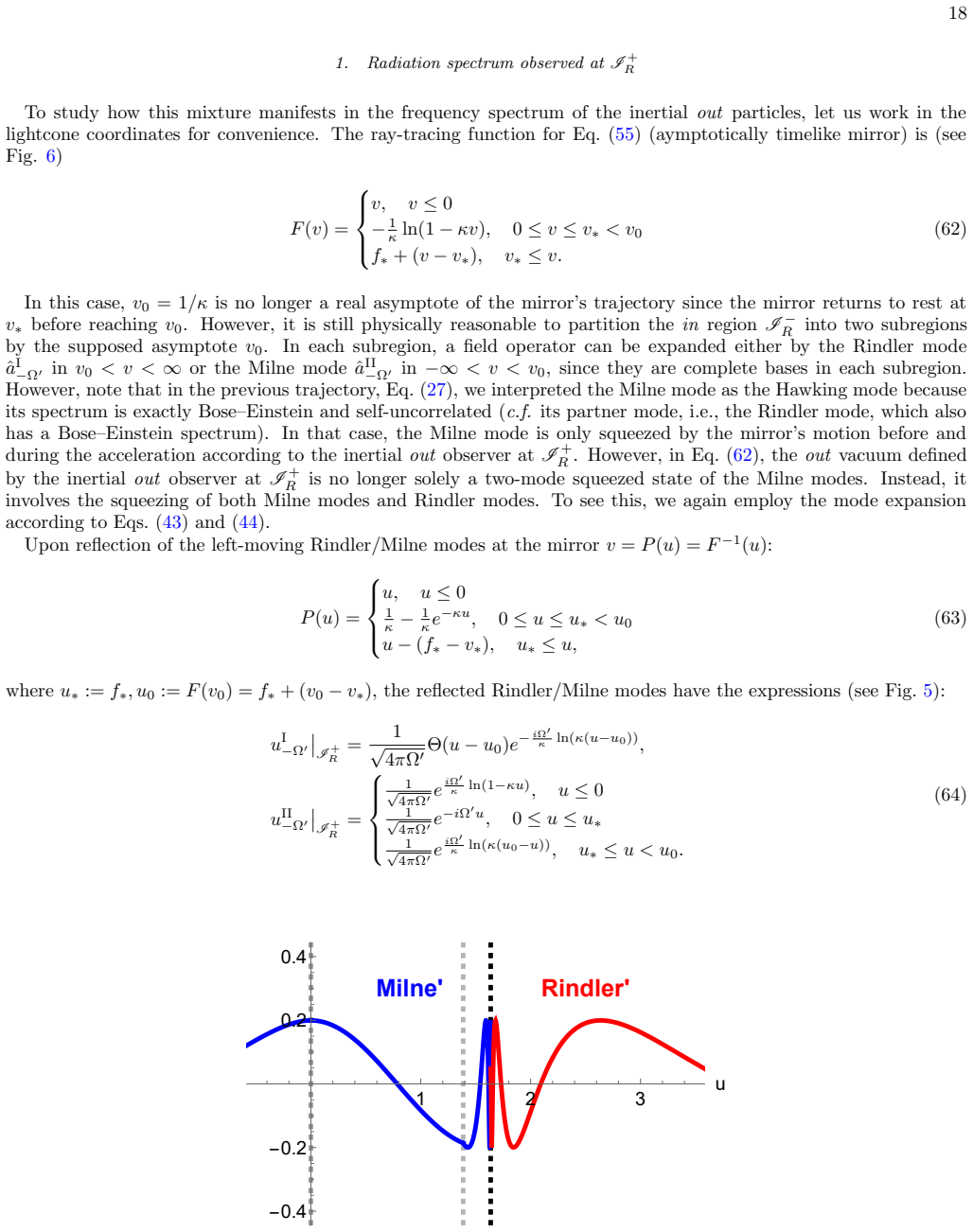
Radiation spectrum observed atI + R To study how this mixture manifests in the frequency spectrum of the inertialoutparticles, let us work in the lightcone coordinates for convenience. The ray-tracing function for Eq. (55) (aymptotically timelike mirror) is (see Fig. 6) F(v) = v, v≤0 − 1 κ ln(1−κv),0≤v≤v ∗ <v 0 f∗ + (v−v ∗), v ∗≤v. (62) In this ca...
-
[4]
Correlations measured atI + R The trajectory considered in this section is timelike both in the past and future, so the radiated particles can only propagate to the mirror’s right-hand side. In this case, the particles observed by an inertial observer atI + R consist of both squeezed Rindler and Milne modes. Therefore, the correlation between different mo...
-
[5]
Timelike to asymptotically null trajectory According to Eq. (38) for a timelike to asymptotically null trajectory, the spectrum|β R ω,−ω′|2 diverges atω= 0 whenω′̸= 0 due to the 1/ωbehavior (see the green dashed curve in Fig. 7a). However, the appearance of a divergence may not be a surprise. For example, in the Carlitz-Willey trajectory, the spectrum (28...
-
[6]
(58) is plotted as the blue and red curves in Fig
Timelike to timelike trajectory In the case of timelike to timelike trajectory (55), the spectrum|β R ω,−ω′|2 according to Eq. (58) is plotted as the blue and red curves in Fig. 7, which show that the spectra are finite everywhere in contrast to the green dashed curve in Fig. 7a, and the longer the mirror accelerates (largerv ∗ but stillv ∗ < v0), the mor...
-
[7]
S. W. Hawking, Particle creation by black holes, Commun. Math. Phys.43, 199 (1975)
1975
-
[8]
S. W. Hawking, Breakdown of predictability in gravitational collapse, Phys. Rev. D14, 2460 (1976)
1976
Show all 59 references
-
[9]
S. A. Fulling and P. C. W. Davies, Radiation from a moving mirror in two dimensional space-time: conformal anomaly, Proc. R. Soc. A348, 393 (1976)
1976
-
[10]
P. C. W. Davies and S. A. Fulling, Radiation from moving mirrors and from black holes, Proc. R. Soc. A356, 237 (1977)
1977
-
[11]
R. D. Carlitz and R. S. Willey, Reflections on moving mirrors, Phys. Rev. D36, 2327 (1987)
1987
-
[12]
Hotta and A
M. Hotta and A. Sugita, The fall of the black hole firewall: natural nonmaximal entanglement for the page curve, PTEP 2015, 123B04 (2015)
2015
-
[13]
Chen and D.-h
P. Chen and D.-h. Yeom, Entropy evolution of moving mirrors and the information loss problem, Phys. Rev. D96, 025016 (2017)
2017
-
[14]
M. R. R. Good, K. Yelshibekov, and Y. C. Ong, On horizonless temperature with an accelerating mirror, JHEP03, 013 (2017)
2017
-
[15]
Osawa, K.-N
Y. Osawa, K.-N. Lin, Y. Nambu, M. Hotta, and P. Chen, Final burst of the moving mirror is unrelated to the partner mode of analog hawking radiation, Phys. Rev. D110, 025023 (2024)
2024
-
[16]
K.-N. Lin, E. Ievlev, M. R. R. Good, and P. Chen, Classical acceleration temperature from evaporated black hole remnants and accelerated electron-mirror radiation, Eur. Phys. J. C84, 641 (2024), arXiv:2402.16137 [gr-qc]
2024 arXiv
-
[17]
B. S. DeWitt, Quantum field theory in curved spacetime, Phys. Rep.19, 295 (1975)
1975
-
[18]
Haro, Moving mirrors and the black-body spectrum, J
J. Haro, Moving mirrors and the black-body spectrum, J. Phys. A: Math. Gen.38, L307 (2005)
2005
-
[19]
M. R. R. Good,Quantized scalar fields under the influence of moving mirror and anisotropic curved spacetime, Ph.D. thesis, North Carolina U. (2011)
2011
-
[20]
M. R. R. Good, P. R. Anderson, and C. R. Evans, Time dependence of particle creation from accelerating mirrors, Phys. Rev. D88, 025023 (2013)
2013
-
[21]
W. G. Unruh, Notes on black-hole evaporation, Phys. Rev. D14, 870 (1976)
1976
-
[22]
R. M. Wald, Particle and energy cost of entanglement of hawking radiation with the final vacuum state, Phys. Rev. D 100, 065019 (2019)
2019
-
[23]
Engelhardt and A
N. Engelhardt and A. C. Wall, Quantum extremal surfaces: holographic entanglement entropy beyond the classical regime, JHEP01, 073 (2015)
2015
-
[24]
Almheiri, T
A. Almheiri, T. Hartman, J. Maldacena, E. Shaghoulian, and A. Tajdini, Replica wormholes and the entropy of hawking radiation, JHEP05, 013 (2020)
2020
-
[25]
Penington, S
G. Penington, S. H. Shenker, D. Stanford, and Z. Yang, Replica wormholes and the black hole interior, JHEP03, 205 (2022)
2022
-
[26]
P. Chen, M. Sasaki, D. H. Yeom, and J. Yoon, Resolving information loss paradox with euclidean path integral, Int. J. Mod. Phys. D31, 2242001 (2022)
2022
-
[27]
P. Chen, M. Sasaki, D. H. Yeom, and J. Yoon, Tunneling between multiple histories as a solution to the information loss paradox, Entropy25, 1663 (2023)
2023
-
[28]
M. R. Good, E. V. Linder, and F. Wilczek, Moving mirror model for quasithermal radiation fields, Phys. Rev. D101, 025012 (2020), arXiv:1909.01129 [gr-qc]
2020 arXiv
-
[29]
Ievlev and M
E. Ievlev and M. R. R. Good, Larmor Temperature, Casimir Dynamics, and Planck’s Law, MDPI Physics5, 797 (2023), arXiv:2211.00946 [gr-qc]
2023 arXiv
-
[30]
Fabbri and J
A. Fabbri and J. Navarro-Salas,Modeling black hole evaporation(World Scientific, 2005)
2005
-
[31]
R. H. Brown and R. Q. Twiss, Lxxiv. a new type of interferometer for use in radio astronomy, The London, Edinburgh, and Dublin Philosophical Magazine and Journal of Science45, 663 (1954)
1954
-
[32]
C. W. Gardiner and P. Zoller,Quantum Noise(Springer, New York, 2004)
2004
-
[33]
Tomonaga and Y
M. Tomonaga and Y. Nambu, Second-Order Coherence as an Indicator of Quantum Entanglement of Hawking Radiation in Moving-Mirror Models, Phys. Rev. D110, 105004 (2024), arXiv:2407.09218
2024 arXiv
-
[34]
Lin, C.-E
K.-N. Lin, C.-E. Chou, and P. Chen, Particle production by a relativistic semitransparent mirror in (1+3)D Minkowski spacetime, Phys. Rev. D103, 025014 (2021), arXiv:2008.12251 [gr-qc]. 27
2021 arXiv
-
[35]
Lin and P
K.-N. Lin and P. Chen, Particle production by a relativistic semitransparent mirror of finite size and thickness, Eur. Phys. J. C84, 53 (2024), arXiv:2107.09033 [gr-qc]
2024 arXiv
-
[36]
R. M. Wald,Quantum field theory in curved spacetime and black hole thermodynamics(University of Chicago press, 1994)
1994
-
[37]
Nicolaevici, Semitransparency effects in the moving mirror model for hawking radiation, Phys
N. Nicolaevici, Semitransparency effects in the moving mirror model for hawking radiation, Phys. Rev. D80, 125003 (2009)
2009
-
[38]
Hotta, R
M. Hotta, R. Sch¨ utzhold, and W. G. Unruh, Partner particles for moving mirror radiation and black hole evaporation, Phys. Rev. D91, 124060 (2015)
2015
-
[39]
Tomitsuka, K
T. Tomitsuka, K. Yamaguchi, and M. Hotta, Partner formula for an arbitrary moving mirror in 1 + 1 dimensions, Phys. Rev. D101, 024003 (2020)
2020
-
[40]
W. G. Unruh, Experimental black-hole evaporation?, Phys. Rev. Lett.46, 1351 (1981)
1981
-
[41]
L. J. Garay, J. R. Anglin, J. I. Cirac, and P. Zoller, Sonic analog of gravitational black holes in bose-einstein condensates, Phys. Rev. Lett.85, 4643 (2000)
2000
-
[42]
Hotta, Y
M. Hotta, Y. Nambu, Y. Sugiyama, K. Yamamoto, and G. Yusa, Expanding edges of quantum hall systems in a cosmology language: Hawking radiation from de sitter horizon in edge modes, Phys. Rev. D105, 105009 (2022)
2022
-
[43]
Bianchi and M
E. Bianchi and M. Smerlak, Entanglement entropy and negative energy in two dimensions, Phys. Rev. D90, 041904(R) (2014)
2014
-
[44]
Walker, Negative energy fluxes and moving mirrors in curved space, Classical and Quantum Gravity2, L37 (1985)
W. Walker, Negative energy fluxes and moving mirrors in curved space, Classical and Quantum Gravity2, L37 (1985)
1985
-
[45]
L. H. Ford and T. A. Roman, Energy flux correlations and moving mirrors, Phys. Rev. D70, 125008 (2004)
2004
-
[46]
M. R. R. Good and Y. C. Ong, Signatures of energy flux in particle production: a black hole birth cry and death gasp, JHEP07, 145 (2015)
2015
-
[47]
Bianchi and D
E. Bianchi and D. E. Paraizo, On Radiative Fluxes and Coulombic Charges in the Balance Law for Black Hole Evaporation, (2026), arXiv:2603.13120 [gr-qc]
2026
-
[48]
D. N. Page, Average entropy of a subsystem, Phys. Rev. Lett.71, 1291 (1993)
1993
-
[49]
D. N. Page, Information in black hole radiation, Phys. Rev. Lett.71, 3743 (1993)
1993
-
[50]
Osawa, Y
Y. Osawa, Y. Nambu, and R. Yoshimoto, Entanglement harvesting from quantum field: Insights via the partner formula, Phys. Rev. D113, 045023 (2026)
2026
-
[51]
Barton and A
G. Barton and A. Calogeracos, On the quantum electrodynamics of a dispersive mirror.: I. mass shifts, radiation, and radiative reaction, Annals of Physics238, 227 (1995)
1995
-
[52]
Haro and E
J. Haro and E. Elizalde, Black hole collapse simulated by vacuum fluctuations with a moving semitransparent mirror, Phys. Rev. D77, 045011 (2008)
2008
-
[53]
A. I. Nikishov and V. I. Ritus, Emission of scalar photons by an accelerated mirror in 1+ 1 space and its relation to the radiation from an electrical charge in classical electrodynamics, J. Exp. Theor. Phys.81, 615 (1995)
1995
-
[54]
M. R. R. Good, On spin-statistics and bogoliubov transformations in flat spacetime with acceleration conditions, Int. J. Mod. Phys. A28, 1350008 (2013)
2013
-
[55]
Chen and G
P. Chen and G. Mourou, Accelerating plasma mirrors to investigate black hole information loss paradox, Phys. Rev. Lett. 118, 045001 (2017), arXiv:1512.04064 [gr-qc]
2017 arXiv
-
[56]
Chen and G
P. Chen and G. Mourou, Trajectory of a flying plasma mirror traversing a target with density gradient, Phys. Plasmas27, 123106 (2020), arXiv:2004.10615 [physics.plasm-ph]
2020 arXiv
-
[57]
Chenet al.(AnaBHEL), AnaBHEL (Analog Black Hole Evaporation via Lasers) Experiment: Concept, Design, and Status, Photon.9, 1003 (2022)
P. Chenet al.(AnaBHEL), AnaBHEL (Analog Black Hole Evaporation via Lasers) Experiment: Concept, Design, and Status, Photon.9, 1003 (2022)
2022
-
[58]
Liu and P
Y.-K. Liu and P. Chen, Correction: Plasma wakefield: from accelerators to black holes, Rev. Mod. Plasma Phys.10, 8 (2026)
2026
-
[59]
Y.-K. Liu, P. Chen, and Y. Fang, Reflectivity and spectrum of relativistic flying plasma mirrors, Phys. Plasmas28, 103301 (2021)
2021
Reviewed August 16, 2026 · model on record in the stance chip above.
Discussion (0). Continue with ORCID to comment.