REVIEW 3 major objections 4 minor 66 references
Enhancing the power of a quantum heat engine via control of the system--reservoir coupling
T0 review · 3 major / 4 minor · reviewed 2026-08-16 · deepseek-v4-flash
Pith's one-line read This paper claims that a quantum Otto engine's power can be optimized by tuning the kinetic temperature of its atomic reservoir, which reshapes the heat transfer law while efficiency stays fixed.
desk verdict Solid experimental mechanism, but the cycle-closure step G_h=G_c is asserted without proof; the headline optimum is a model extrapolation, so the quantitative claims need a referee's attention while the qualitative insight is worth keeping. read the letter →
The pith
A machine-rendered reading of the paper's core claim, the machinery that carries it, and where it could break.
The reading
What carries the argument
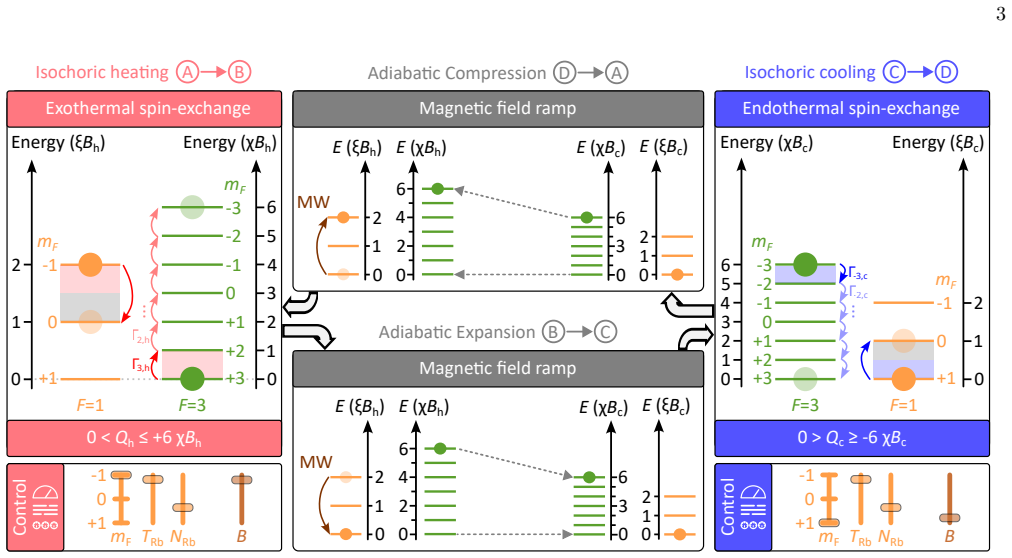
The load-bearing object is the triangular rate matrix $K_i(T_{\mathrm{Rb}},B_i)$ of the collisional master equation $\dot P=K_i P$, whose state-dependent rates $\Gamma_{m,i}=n(r,T_{\mathrm{Rb}})\,\langle\sigma_{m,i}(E_{\mathrm{col}},B_i)\,v_{\mathrm{col}}\rangle$ come from thermal averages over energy-dependent s-wave scattering cross sections. Because the matrix is triangular, its eigenvalues are just its diagonal entries, and the heat transferred in a stroke is a multi-exponential sum over those modes, summarized by the thermalization factor $G_i(t)=Q_i(t)/Q_{i,\infty}$. The physical asymmetry doing the work is the opposite energy scaling of exothermal versus endothermal cross sections: heating rates fall with $T_{\mathrm{Rb}}$ while cooling rates rise, which lets the reservoir temperature reallocate time between strokes and thereby shape the power–duration trade-off.
What would settle it
Measure the full seven-Zeeman-state population vector after one complete Otto cycle at the operating points of Figures 5 and 6 and compare it with the vector at the start of the cycle; if populations have drifted, the extracted work, power, and efficiency do not describe a true cyclic engine. A second test is to run the engine at $T_{\mathrm{Rb}}=1410$ nK and above to see whether the measured peak power occurs where the model predicts.
Extended reading notes
Core claim
The central discovery is that the heat transfer law of this engine is set at the microscopic level by energy-dependent s-wave spin-exchange scattering, and that this law can be reshaped by changing the kinetic temperature of the atomic reservoir. The rate matrices for the heating and cooling strokes are both triangular, with diagonal entries equal to the state-dependent rates $\Gamma_{m,i}(T_{\mathrm{Rb}},N_{\mathrm{Rb}},B_i)$, and heat evolves as a weighted sum of exponentials $Q_i(t)=\sum_k c_k d_k[\exp(\lambda_k t)-1]$ rather than as a single exponential. Exothermal cross sections decrease monotonically with collision energy while endothermal cross sections show threshold behaviour, so the heating rates fall and the cooling rates rise as $T_{\mathrm{Rb}}$ increases in the explored range; the paper exploits this asymmetry to control the relative duration of the two isochoric strokes. Imposing the cyclic-closure condition $G_h(\tau_h)=G_c(\tau_c)$ links the stroke durations, and the resulting total cycle duration is non-monotonic in $T_{\mathrm{Rb}}$, which yields a well-defined optimum at finite temperature. The paper also shows that replacing the multi-exponential dynamics with a single average rate overestimates maximum power by factors of 1.52–1.71 and underestimates the optimal cycle duration, so the usual phenomenological single-rate heat transfer law is questioned.
Load-bearing premise
The claim depends on assuming that matching how much heat is absorbed and released in the two strokes is enough to bring the seven-level working medium back to its starting configuration each cycle; equal heat amounts do not automatically return every population to its initial value when heating and cooling follow different rate structures, and the paper does not show a direct measurement of full state return.
Editorial extensions
If this is right
- Tuning the kinetic temperature of an atomic reservoir is a demonstrated control knob for the heat transfer law of a quantum engine, independent of modifying the system Hamiltonian.
- Power can be optimized at fixed efficiency: in the measured window the efficiency stays $\eta=0.489(2)$ while the maximum power changes with $T_{\mathrm{Rb}}$.
- The optimum is reached in the low-fluctuation regime with sub-Poissonian relative power fluctuations, so high power does not come at the cost of stability.
- Microscopic multi-exponential relaxation should replace single-exponential phenomenological laws when modelling such engines; the mono-exponential reference model overestimates power by 52–71% in this system.
- The mechanism is expected to transfer to other systems with multiple relaxation channels, including spin-bath and central-spin environments, where the relaxation spectrum rather than the bath temperature controls performance.
Reading between the lines
- Inference: the predicted optimum at $T_{\mathrm{Rb,opt}}=1410(5)$ nK sits above the highest measured temperature of 1140 nK, so a direct run at 1410 nK and higher would test whether the power peak is truly there rather than an extrapolation from the model.
- Inference: the same asymmetric-rate control could be exercised by other knobs that shift the relative heating-to-cooling rate ratio, such as magnetic field near Feshbach resonances, bath density, or choice of collision partner; the paper fixes magnetic fields and density.
- Inference: if the cyclic-closure assumption is verified by a full state-return measurement, the approach suggests a design principle, shaping a reservoir's relaxation-time spectrum is an engine resource, that could be tested in engineered solid-state or spin-bath platforms.
Signed reviews
Editorial analysis
A structured set of objections, weighed in public.
Referee Report
Summary. The paper reports an experimental quantum Otto engine in which seven Zeeman states of ultracold 133Cs atoms serve as the working medium and an ultracold 87Rb cloud serves as the reservoir. Heat exchange is mediated by inelastic s-wave spin-exchange collisions with energy-dependent cross sections, producing asymmetric heating and cooling dynamics. By tuning the Rb kinetic temperature, the authors control the relative durations of the isochoric strokes and thereby the total cycle time, and they report a power maximum at fixed efficiency, with a predicted optimal point T_Rb,opt = 1410(5) nK and P_max,opt/k_B = 28.0 nK/ms. The experimental population dynamics are compared with a parameter-free model based on coupled-channel scattering cross sections, plus a finite-Rb-lifetime correction with parameters fitted from separate lifetime measurements.
Significance. If the cycle-closure issue is resolved, this would be a valuable demonstration: direct microscopic control of a system-reservoir interaction is used to modify the heat transfer law and to optimize finite-time power at fixed efficiency. The strengths of the paper include time-resolved population measurements, a spin-dynamics model with no free parameters for the collision rates, cross sections from independent coupled-channel calculations, and a public data availability statement. The quantitative peak claim, however, depends on an unproven cyclic-closure condition and on model extrapolation beyond the measured temperature range, so the central numerical result is not yet established.
major comments (3)
- [Section IV, Eq. (13)] The statement that cyclic operation follows from equal thermalization factors G_h(τ_h)=G_c(τ_c) is not established and is in fact not a periodicity condition for the triangular rate matrices in Eqs. (7)-(8). Starting from e0, the state after heating is exp(K_h τ_h)e0, and after cooling it is exp(K_c τ_c)exp(K_h τ_h)e0; because all nonzero eigenvalues of K_c are negative and e0 is its unique fixed point, this product equals e0 only in the limit τ_c→∞. Equal thermalization factors fix only a scalar heat fraction, not the population vector, so the internal energy of the unreturned population is omitted from Eq. (13). At the reported optimum the thermalization factor is close to but below unity (Fig. 7(b)), so the omission is first order in 1-G. Please provide either a derivation of full state return or a direct measurement of the population vector after a complete cycle, and recompute |W|, P, and η from the actual return state; until then the extracted power and the optimum at T_Rb,opt=1410(5) nK are not established as cycle-averaged quantities.
- [Section III, Eqs. (11)-(13)] The identification Q_c,∞=-6χB_c is valid only if the cooling stroke starts from full population inversion. Because Q_c,∞=-Σ c_k d_k in Eq. (11) depends on the initial population vector, and the cooling stroke starts from the partially inverted state reached after finite τ_h, the normalization used in G_c overestimates the available heat whenever G_h<1. This is not a negligible correction in the regime shown in Fig. 7(b), where the thermalization factor is below unity at higher T_Rb. Please evaluate Q_c,∞ from the measured state at the start of cooling, or explicitly justify that the initial state for cooling is the full inversion within experimental uncertainty.
- [Section V and Fig. 7(c)] The headline optimum T_Rb,opt=1410(5) nK and P_max,opt/k_B=28.0 nK/ms are not direct measurements: the data are reported for T_Rb = 679, 858, and 1140 nK, and 1410 nK lies outside the measured range. The optimum therefore comes from numerical model extrapolation, including the finite-lifetime correction with parameters fitted in Appendix C. Please state explicitly that the optimum is a model prediction, and support the stated uncertainty either by measuring at or near T_Rb ≈ 1410 nK or by propagating the uncertainties of the fitted lifetime parameters into the predicted peak position and height.
minor comments (4)
- [Section III and Section V] The claim that the numerical model is parameter-free should be qualified: the bare collision model in Eq. (6) is parameter-free for the scattering rates, but the curves that include the finite Rb lifetime use five fitted parameters (T_Rb,ss, T_Rb,0, γ_ht, N_Rb,0, γ_ev) from Appendix C. Please state clearly which curves are purely parameter-free and which include the lifetime correction.
- [Section IV, Eq. (14)] The heat leak Q_l is introduced in Eq. (14) but never defined; please give its explicit expression or cite the derivation in Ref. [33] so that the efficiency formula can be checked directly.
- [Section V] The uncertainty quoted for T_Rb,opt = 1410(5) nK is not explained in the text; please report how this error bar is obtained (for example, from the covariance of the fitted model parameters or from bootstrap resampling of the measured data).
- [Figure 4] In Fig. 4(c) the cooling heat is magnified by a factor of 20, which makes the cooling dynamics difficult to assess at the same scale as the heating dynamics; a separate panel with identical axes would clarify the comparison.
Circularity Check
No load-bearing circularity: the power-optimum prediction rests on independently parameterized scattering rates and separate lifetime fits, not on fitting the engine data.
full rationale
The spin-dynamics model is self-contained with respect to the claimed engine improvement: Eq. (6) is solved with the rate matrices of Eqs. (7)-(8), whose rates (9)-(10) are obtained from coupled-channel scattering cross sections together with the Rb density and kinetic temperature. No parameter is fitted to the heat, power, or efficiency data of the engine. The only fitted quantities are the Rb-cloud lifetime parameters in Appendix C, which are determined from separate Rb-lifetime measurements and then inserted into the model as a correction; they are not adjusted to reproduce the measured power curve. The thermalization factor in Eq. (12) is a definition, and Eq. (13) follows from the first law together with the assumed cyclic closure condition G_h=G_c. That closure condition is a physical assumption and one might question whether equal thermalization fractions guarantee return of all seven populations for the triangular rate matrices, but that is a modeling-validity concern rather than a circular reduction: the predicted optimum T_Rb,opt=1410(5) nK is obtained by evaluating the independently parameterized model, not by inverting the measured power maximum. The self-citations, such as the master-equation reference [46] and the earlier engine papers [33,34], supply experimental methods and prior context, but the present work independently validates the dynamics against direct population measurements (Fig. 4) and against external scattering calculations, so those citations are not load-bearing. No predicted quantity is equivalent by construction to an input, and no fitted parameter is renamed as a prediction.
Assumptions & free parameters
free parameters (5)
- T_Rb,ss (Rb steady-state temperature)
- T_Rb,0 (Rb initial temperature in stroke)
- gamma_ht (Rb heating rate)
- N_Rb,0 (initial Rb atom number)
- gamma_ev (Rb loss rate)
assumptions (6)
- domain assumption The population dynamics obeys a Markovian master equation with state-dependent rates (Eq. 5).
- domain assumption The coupled-channel scattering cross sections provided by A. Guthmann accurately model the inelastic spin-exchange collisions.
- domain assumption Collision energies follow a Maxwell-Boltzmann distribution determined by the Rb kinetic temperature.
- domain assumption Adiabatic magnetic field ramps preserve Zeeman populations during work strokes.
- ad hoc to paper Cyclic operation follows from equal thermalization factors G_h(τ_h)=G_c(τ_c).
- standard math The first law applies with zero internal energy change over the cycle, W=Q_h-|Q_c|.
Cite this review
Pith. "Pith review of Enhancing the power of a quantum heat engine via control of the system--reservoir coupling." pith.science (2026). https://pith.science/paper/LOUWICZC
@misc{pith2026260812055,
  author       = {Pith},
  title        = {Pith review of: Enhancing the power of a quantum heat engine via control of the system--reservoir coupling},
  year         = {2026},
  howpublished = {\url{https://pith.science/paper/LOUWICZC}},
  note         = {Machine review of arXiv:2608.12055}
}
read the original abstract
The non-equilibrium properties of open quantum systems are determined by the microscopic laws governing energy exchange with their environment. In particular, an enhancement of the performance of quantum heat engines has been predicted by speeding up the dynamics through control of the system--bath interaction. However, direct microscopic control of heat transfer between the machine and the reservoir has remained elusive so far. Here, we experimentally demonstrate such control in a quantum Otto engine realized with ultracold Cs-133 atoms coupled to an atomic reservoir of ultracold Rb-87 atoms. Heat exchange between the two is mediated by inelastic s-wave collisions whose energy-dependent scattering cross sections lead to an asymmetric equilibration dynamics in the isochoric heating and cooling strokes. By tuning the kinetic temperature of the atomic reservoir, we modify the associated microscopic scattering rates, and thereby the heat transfer law, giving control over the time allocation within the engine cycle through control over the microscopic, multi-exponential relaxation dynamics. This enables power output optimization at fixed efficiency. Our results establish microscopic control of system-reservoir interactions as a tool for manipulating heat flow at the nanoscale and engineering the finite-time performance of quantum thermal machines.
Figures


Figures from the paper (4 more)


Reference graph
Works this paper leans on
-
[1]
F. L. Curzon and B. Ahlborn, Efficiency of a Carnot en- gine at maximum power output, Am. J. Phys.43, 22 (1975)
1975
-
[2]
B. Andresen, P. Salamon, and R. S. Berry, Thermody- namics in finite time, Phys. Today37, 62 (1984)
work page 1984
-
[3]
J. M. Gordon and M. Huleihil, On optimizing maximum- power heat engines, J. Appl. Phys.69, 1 (1991)
work page 1991
-
[4]
Andresen, Current trends in finite-time thermody- namics, Angew
B. Andresen, Current trends in finite-time thermody- namics, Angew. Chem. Int. Ed.50, 2690 (2011)
work page 2011
-
[5]
Kosloff, Quantum thermodynamics: A dynamical viewpoint, Entropy15, 2100 (2013)
R. Kosloff, Quantum thermodynamics: A dynamical viewpoint, Entropy15, 2100 (2013)
2013
-
[6]
Chen, The maximum power output and maximum ef- ficiency of an irreversible carnot heat engine, J
J. Chen, The maximum power output and maximum ef- ficiency of an irreversible carnot heat engine, J. Phys. D: Appl. Phys27, 1144 (1994)
work page 1994
-
[7]
Van den Broeck, Thermodynamic efficiency at maxi- mum power, Phys
C. Van den Broeck, Thermodynamic efficiency at maxi- mum power, Phys. Rev. Lett.95, 190602 (2005)
work page 2005
-
[8]
Schmiedl and U
T. Schmiedl and U. Seifert, Efficiency at maximum power: An analytically solvable model for stochastic heat engines, EPL81, 20003 (2008)
2008
Show all 66 references
-
[9]
Esposito, K
M. Esposito, K. Lindenberg, and C. Van den Broeck, Universality of efficiency at maximum power, Phys. Rev. Lett.102, 130602 (2009)
2009
-
[10]
Esposito, R
M. Esposito, R. Kawai, K. Lindenberg, and C. Van den Broeck, Efficiency at maximum power of low-dissipation Carnot engines, Phys. Rev. Lett.105, 150603 (2010)
2010
-
[11]
R. S. Whitney, Most efficient quantum thermoelectric at finite power output, Phys. Rev. Lett.112, 130601 (2014)
2014
-
[12]
Torrontegui, S
E. Torrontegui, S. Ib´ a˜ nez, S. Mart´ ınez-Garaot, M. Mod- ugno, A. del Campo, D. Gu´ ery-Odelin, A. Ruschhaupt, X. Chen, and J. G. Muga, Shortcuts to adiabaticity, Adv. At. Mol. Opt. Phys.62, 117 (2013)
2013
-
[13]
Gu´ ery-Odelin, A
D. Gu´ ery-Odelin, A. Ruschhaupt, A. Kiely, E. Tor- rontegui, S. Mart´ ınez-Garaot, and J. G. Muga, Short- cuts to adiabaticity: Concepts, methods, and applica- tions, Rev. Mod. Phys.91, 045001 (2019)
2019
-
[14]
W. Hou, W. Yao, X. Zhao, K. Rehan, Y. Li, Y. Li, E. Lutz, Y. Lin, and J. Du, Combining energy efficiency and quantum advantage in cyclic machines, Nat. Com- mun.16, 5127 (2025)
2025
-
[15]
I. A. Mart´ ınez, A. Petrosyan, D. Gu´ ery-Odelin, E. Trizac, and S. Ciliberto, Engineered swift equilibration of a Brownian particle, Nat. Phys.12, 843 (2016)
2016
-
[16]
Raynal, T
D. Raynal, T. de Guillebon, D. Gu´ ery-Odelin, E. Trizac, J.-S. Lauret, and L. Rondin, Shortcuts to equilibrium with a levitated particle in the underdamped regime, Phys. Rev. Lett.131, 087101 (2023)
2023
-
[17]
R. Dann, A. Tobalina, and R. Kosloff, Shortcut to equi- libration of an open quantum system, Phys. Rev. Lett. 122, 250402 (2019)
2019
-
[18]
Pancotti, M
N. Pancotti, M. Scandi, M. T. Mitchison, and M. Perarnau-Llobet, Speed-ups to isothermality: En- hanced quantum thermal machines through control of the system-bath coupling, Phys. Rev. X10, 031015 (2020)
2020
-
[19]
J. M. Gordon, Observations on efficiency of heat en- gines operating at maximum power, Am. J. Phys.58, 370 (1990)
1990
-
[20]
Chen and Z
L. Chen and Z. Yan, The effect of heat-transfer law on the performance of a two-heat-reservoir endoreversible cycle, J. Chem. Phys.90, 3740 (1994)
1994
-
[21]
Feldmann, E
T. Feldmann, E. Geva, R. Kosloff, and P. Salamon, Heat engines in finite time governed by master equations, Am. J. Phys.64, 485 (1996)
1996
-
[22]
Deffner, Efficiency of harmonic quantum otto engines at maximal power, Entropy20, 875 (2018)
S. Deffner, Efficiency of harmonic quantum otto engines at maximal power, Entropy20, 875 (2018)
2018
-
[23]
Roßnagel, S
J. Roßnagel, S. T. Dawkins, K. N. Tolazzi, O. Abah, E. Lutz, F. Schmidt-Kaler, and K. Singer, A single-atom heat engine, Science352, 325 (2016)
2016
-
[24]
von Lindenfels, O
D. von Lindenfels, O. Gr¨ ab, C. T. Schmiegelow, V. Kaushal, J. Schulz, M. T. Mitchison, J. Goold, F. Schmidt-Kaler, and U. G. Poschinger, Spin heat en- gine coupled to a harmonic-oscillator flywheel, Phys. Rev. Lett.123, 080602 (2019)
2019
-
[25]
Van Horne, D
N. Van Horne, D. Yum, T. Dutta, P. H¨ anggi, J. Gong, D. Poletti, and M. Mukherjee, Single-atom energy- conversion device with a quantum load, npj Quantum Inf.6, 37 (2020)
2020
-
[26]
Volosheniuk, R
S. Volosheniuk, R. Conte, E. Pyurbeeva, T. Baum, M. Vilas-Varela, S. Ferna´ andez, D. Pen˜ na, H. S. J. van der Zant, and P. Gehring, A single-molecule quantum heat engine, Nano Lett.26, 984 (2025)
2025
-
[27]
J. P. S. Peterson, T. B. Batalh˜ ao, M. Herrera, A. M. Souza, R. S. Sarthour, I. S. Oliveira, and R. M. Serra, Experimental characterization of a spin quantum heat engine, Phys. Rev. Lett.123, 240601 (2019)
2019
-
[28]
R. J. de Assis, T. M. de Mendon¸ ca, C. J. Villas-Boas, A. M. de Souza, R. S. Sarthour, I. S. Oliveira, and N. G. de Almeida, Efficiency of a quantum Otto heat engine operating under a reservoir at effective negative temper- atures, Phys. Rev. Lett.122, 240602 (2019)
2019
-
[29]
Josefsson, A
M. Josefsson, A. Svilans, A. M. Burke, E. A. Hoffmann, S. Fahlvik, C. Thelander, M. Leijnse, and H. Linke, A quantum-dot heat engine operating close to the ther- modynamic efficiency limits, Nat. Nanotechnol.13, 920 (2018)
2018
-
[30]
Klatzow, J
J. Klatzow, J. N. Becker, P. M. Ledingham, C. Weinzetl, K. T. Kaczmarek, D. J. Saunders, J. Nunn, I. A. Walms- ley, R. Uzdin, and E. Poem, Experimental demonstration of quantum effects in the operation of microscopic heat engines, Phys. Rev. Lett.122, 110601 (2019)
2019
-
[31]
M. Kwon, T. Denzler, R. Maier, V. Vorobyov, D. Dasari, E. Lutz, and J. Wrachtrup, Converting co- herence into work with a fully quantum engine (2025), arXiv:2511.06096
2025
-
[32]
Brantut, C
J.-P. Brantut, C. Grenier, J. Meineke, D. Stadler, D. Krinner, C. Kollath, T. Esslinger, and A. Georges, A thermoelectric heat engine with ultracold atoms, Science 342, 713 (2013)
2013
-
[33]
Bouton, J
Q. Bouton, J. Nettersheim, S. Burgardt, D. Adam, E. Lutz, and A. Widera, A quantum heat engine driven by atomic collisions, Nat. Commun.12, 2063 (2021)
2021
-
[34]
Nettersheim, S
J. Nettersheim, S. Burgardt, Q. Bouton, D. Adam, E. Lutz, and A. Widera, Power of a quasispin quantum otto engine at negative effective spin temperature, PRX Quantum3, 040334 (2022)
2022
-
[35]
J. Kim, S. Oh, D. Yang, J. Kim, M. Lee, and K. An, A photonic quantum engine driven by superradiance, Nat. Photonics16, 707 (2022)
2022
-
[36]
J. Koch, K. Menon, E. Cuestas, S. Barbosa, E. Lutz, T. Fogarty, T. Busch, and A. Widera, A quantum engine in the BEC–BCS crossover, Nature621, 723 (2023)
2023
-
[37]
Dubi and M
Y. Dubi and M. Di Ventra, Colloquium: Heat flow and thermoelectricity in atomic and molecular junctions, 16 Rev. Mod. Phys.83, 131 (2011)
2011
-
[38]
N. Li, J. Ren, L. Wang, G. Zhang, P. H¨ anggi, and B. Li, Colloquium: Phononics: Manipulating heat flow with electronic analogs and beyond, Rev. Mod. Phys.84, 1045 (2012)
2012
-
[39]
J. P. Pekola and B. Karimi, Colloquium: Quantum heat transport in condensed matter systems, Rev. Mod. Phys. 93, 041001 (2021)
2021
-
[40]
Ciccarello, S
F. Ciccarello, S. Lorenzo, V. Giovannetti, and G. M. Palma, Quantum collision models: Open system dynam- ics from repeated interactions, Phys. Rep.954, 1 (2022)
2022
-
[41]
N. V. Prokof’ev and P. C. E. Stamp, Theory of the spin bath, Rep. Prog. Phys.63, 669 (2000)
2000
-
[42]
P. M. Harrington, E. J. Mueller, and K. W. Murch, Engi- neered dissipation for quantum information science, Nat. Rev. Phys.4, 660 (2022)
2022
-
[43]
Kosloff and Y
R. Kosloff and Y. Rezek, The quantum harmonic Otto cycle, Entropy19, 136 (2017)
2017
-
[44]
Cohen-Tannoudji and D
C. Cohen-Tannoudji and D. Guery-Odelin, Advances in Atomic Physics (World Scientific, 2011)
2011
-
[45]
Values and uncertainties are intentionally quoted with excess precision to provide reproducible input parameters for numerical simulations
-
[46]
Schmidt, D
F. Schmidt, D. Mayer, Q. Bouton, D. Adam, T. Lausch, N. Spethmann, and A. Widera, Quantum spin dy- namics of individual neutral impurities coupled to a Bose-Einstein condensate, Phys. Rev. Lett.121, 130403 (2018)
2018
-
[47]
Cannoni, Relativisticσv rel in the calculation of relics abundances: A closer look, Phys
M. Cannoni, Relativisticσv rel in the calculation of relics abundances: A closer look, Phys. Rev. D89, 103533 (2014)
2014
-
[48]
Pietzonka and U
P. Pietzonka and U. Seifert, Universal trade-off between power, efficiency, and constancy in steady-state heat en- gines, Phys. Rev. Lett.120, 190602 (2018)
2018
-
[49]
Holubec and A
V. Holubec and A. Ryabov, Cycling tames power fluctu- ations near optimum efficiency, Physical Rev. Lett.121, 120601 (2018)
2018
-
[50]
Denzler and E
T. Denzler and E. Lutz, Power fluctuations in a finite- time quantum Carnot engine, Phys. Rev. Res.3, L032041 (2021)
2021
-
[51]
Benenti, G
G. Benenti, G. Casati, K. Saito, and R. S. Whitney, Fun- damental aspects of steady-state conversion of heat to work at the nanoscale, Phys. Rep.694, 1 (2017)
2017
-
[52]
N. M. Myers, O. Abah, and S. Deffner, Quantum ther- modynamic devices: From theoretical proposals to ex- perimental reality, AVS Quantum Sci.4, 027101 (2022)
2022
-
[53]
Arrachea, Energy dynamics, heat production and heat–work conversion with qubits: toward the develop- ment of quantum machines, Rep
L. Arrachea, Energy dynamics, heat production and heat–work conversion with qubits: toward the develop- ment of quantum machines, Rep. Prog. Phys.86, 036501 (2023)
2023
-
[54]
L. M. Cangemi, C. Bhadra, and A. Levy, Quantum en- gines and refrigerators, Phys. Rep.1087, 1 (2024)
2024
-
[55]
Ziman and V
M. Ziman and V. Buˇ zek, All (qubit) decoherences: Complete characterization and physical implementation, Phys. Rev. A72, 022110 (2005)
2005
-
[56]
Scarani, M
V. Scarani, M. Ziman, P. ˇStelmachoviˇ c, N. Gisin, and V. Buˇ zek, Thermalizing quantum machines: Dissipation and entanglement, Phys. Rev. Lett.88, 097905 (2002)
2002
-
[57]
Karevski and T
D. Karevski and T. Platini, Quantum nonequilibrium steady states induced by repeated interactions, Phys. Rev. Lett.102, 207207 (2009)
2009
-
[58]
Manzano, F
G. Manzano, F. Plastina, and R. Zambrini, Optimal work extraction and thermodynamics of quantum measure- ments and correlations, Phys. Rev. Lett.121, 120602 (2018)
2018
-
[59]
C ¸ akmak and O
B. C ¸ akmak and O. E. M¨ ustecaplıo˘ glu, Spin quantum heat engines with shortcuts to adiabaticity, Phys. Rev. E99, 032108 (2019)
2019
-
[60]
Watanabe, B
G. Watanabe, B. P. Venkatesh, P. Talkner, and A. del Campo, Quantum performance of thermal machines over many cycles, Phys. Rev. Lett.118, 050601 (2017)
2017
-
[61]
P. W. Anderson, A mathematical model for the narrow- ing of spectral lines by exchange or motion, J. Phys. Soc. Jpn.9, 316 (1954)
1954
-
[62]
Yang, W.-L
W. Yang, W.-L. Ma, and R.-B. Liu, Quantum many-body theory for electron spin decoherence in nanoscale nuclear spin baths, Rep. Prog. Phys.80, 016001 (2017)
2017
-
[63]
Schmidt, D
F. Schmidt, D. Mayer, M. Hohmann, T. Lausch, F. Kin- dermann, and A. Widera, Precision measurement of the 87Rb tune-out wavelength in the hyperfine ground state f= 1 at 790 nm, Phys. Rev. A93, 022507 (2016)
2016
-
[64]
Weber, J
T. Weber, J. Herbig, M. Mark, H.-C. N¨ agerl, and R. Grimm, Three-body recombination at large scatter- ing lengths in an ultracold atomic gas, Phys. Rev. Lett. 91, 123201 (2003)
2003
-
[65]
M. E. Gehm, K. M. O’Hara, T. A. Savard, and J. E. Thomas, Dynamics of noise-induced heating in atom traps, Phys. Rev. A58, 3914 (1998)
1998
-
[66]
Grimm, M
R. Grimm, M. Weidem¨ uller, and Y. B. Ovchin- nikov, Optical dipole traps for neutral atoms (1999), arXiv:physics/9902072
1999 arXiv
Reviewed August 16, 2026 · model on record in the stance chip above.
Discussion (0). Continue with ORCID to comment.