REVIEW 5 major objections 5 minor 26 references
Learning Loco-Manipulation From SMPC Demonstrations With Sparse Offline-to-Online RL
T0 review · 5 major / 5 minor · reviewed 2026-08-16 · deepseek-v4-flash
Pith's one-line read Sparse rewards plus offline SMPC demonstrations can teach whole-body loco-manipulation, and the learned policies can outperform their MPC teacher.
desk verdict Solid empirical pipeline paper with genuine ablations; the 'surpass teacher' claim is overstated because the comparison is against dataset statistics rather than a fresh SMPC expert under the same evaluation protocol. read the letter →
The pith
A machine-rendered reading of the paper's core claim, the machinery that carries it, and where it could break.
The reading
What carries the argument
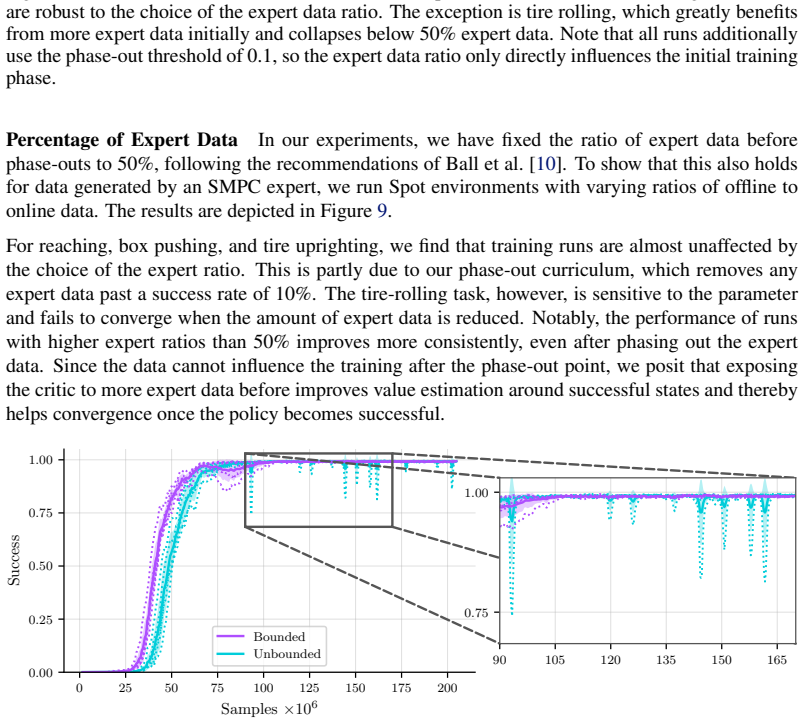
The architecture is hierarchical: a high-level task policy outputs delta commands for desired base velocity, arm joint positions, torso height, and torso pitch, and a frozen low-level whole-body controller (trained with the ReLIC method) tracks these commands while maintaining balance. The offline-to-online training mechanism mixes SMPC expert transitions into the replay buffer at a 50% ratio, then phases them out once the policy reaches a 10% success rate, moving to pure online learning. Two stabilization techniques carry the training: bounded critic networks, constrained to the theoretical Q-value limits of the sparse reward, and an action parameterization that explicitly caps desired accelerations and speeds. SMPC data collection itself uses spline-sampled action trajectories, warm-starting, and massively parallel tiled environments to generate millions of samples per hour.
What would settle it
Run the deployed sparse-reward policy on hardware or in simulation while recording commanded versus actual base velocity and arm joint positions for the frozen low-level controller; if the tracking error pushes the torso beyond the crash limits or prevents task completion over many episodes, the hierarchical claim collapses. A simpler test would be to train the same pipeline with offline data from a different optimal-control expert: if learning fails despite equivalent coverage, the specific role of SMPC data in solving exploration is not established.
Extended reading notes
Core claim
The central claim is that a strictly sparse task reward, combined with offline expert transitions from SMPC, is sufficient to train hardware-deployable loco-manipulation policies. The reward is $r=0$ at the goal, $r=-1$ otherwise, and $r=-2/(1-\gamma)$ on crash, with $\gamma=0.99$, so the agent must discover task success through exploration rather than shaped guidance. The paper argues that SMPC-generated offline data solves the exploration problem, allowing a modified FastTD3 agent to learn from sparse rewards alone. The learned policies are then shown to finish tasks faster and more consistently than the SMPC expert that produced the demonstrations, and they transfer to real hardware on both an arm-equipped quadruped and a humanoid.
Load-bearing premise
The load-bearing premise is that the frozen low-level whole-body controller can track the high-level policy's delta commands accurately enough to preserve balance and execute the task, even when those commands lie outside the controller's original training distribution—and the paper reports no tracking-error or stability-margin analysis for such out-of-distribution commands.
Editorial extensions
If this is right
- New loco-manipulation skills can be acquired by tuning SMPC costs interactively in simulation and generating offline data, rather than manually shaping dense RL rewards, which the paper identifies as the main bottleneck in scaling RL to complex tasks.
- Because the high-level policy is trained on true task objectives, the learned behaviors can be faster and more consistent than the expert demonstrations they were seeded with, as shown across all five tasks.
- The same offline-to-online pipeline transfers across different embodiments, since the relative action parameterization and frozen low-level controller are shared between data collection and deployment.
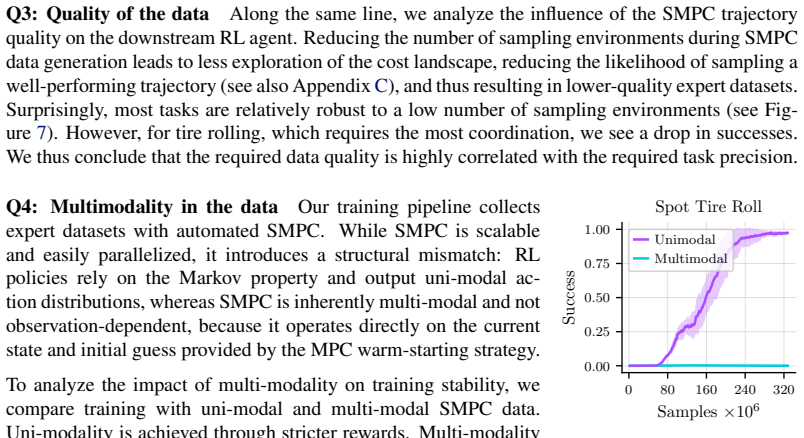
- Data quality and multimodality are decisive: uni-modal demonstration data is required for successful learning, and dataset size requirements scale with task complexity, with the hardest task needing four million samples.
- The framework eliminates the need for human demonstrations or teleoperation for non-anthropomorphic robots, since SMPC can be applied directly to any morphology.
Reading between the lines
- If this claim generalizes, the practical bottleneck for learning loco-manipulation shifts from reward design to the tracking fidelity of the low-level stabilization controller and to controlling the behavioral mode of offline data.
- The same seeding mechanism could likely work with other parallelizable optimal control experts beyond SMPC, since the paper's argument centers on coverage and quality of demonstrations rather than on the specific sampling method.
- The bounded-critic technique, grounded in the known minimum and maximum returns of the sparse reward, may transfer to other sparse-reward tasks as a way to stabilize off-policy training with fewer tuned hyperparameters.
- The paper's stated limitation that learned policies remain tied to the dataset's distribution suggests a testable extension: unfreezing the low-level controller late in online training could unlock strategies that diverge more fundamentally from the SMPC trajectories.
Signed reviews
Editorial analysis
A structured set of objections, weighed in public.
Referee Report
Summary. This paper proposes a hierarchical offline-to-online RL framework for loco-manipulation. A sampling-based model predictive controller (SMPC) is run in simulation to generate large expert datasets; a modified FastTD3 agent is then trained with a purely sparse reward (Eq. 1) while initially mixing expert transitions into the replay buffer and phasing them out after a success-rate threshold. The high-level policy outputs delta commands for base velocity, arm joints, torso height, and pitch, which are tracked by a frozen ReLIC low-level controller. The method is evaluated on five tasks across an arm-equipped Spot and a G1 humanoid in simulation and on hardware, with ablations on dataset size, data quality, expert data fraction, phase-out threshold, bounded critics, and multimodality. The paper claims that the resulting policies are tuning-free and surpass the SMPC teacher in task completion time.
Significance. If substantiated, the framework would provide a practical way to avoid manual reward shaping for whole-body loco-manipulation and to combine the sample efficiency of model-based control with the runtime speed and domain-randomization robustness of learned policies. The manuscript has genuine strengths: five-seed training curves, ablations that isolate dataset size, data quality, expert ratio, phase-out threshold, and bounded critics, a no-SMPC-data baseline that fails as expected, and real deployments on two morphologies. The 'surpass teacher' result and the hardware-deployability claim are, however, currently supported only by indirect or anecdotal evidence, so the significance is conditional on the requested additions.
major comments (5)
- [§4 Q1; Figure 5; Algorithm 1; Table 2] The claim that learned policies 'surpass the original optimal control teacher' is not established by the reported comparison. Figure 5 compares average task duration of the RL policy with statistics computed over the complete 4M-sample SMPC dataset used for training. That dataset is generated by Algorithm 1, a stochastic sampling-based planner with K=256 samples per tile, a 50-step horizon, N_c=10 spline control points, and random perturbations around a warm start. These are locally elite samples from a deliberately throughput-limited stochastic optimizer, not the output of a converged optimal controller. The paper does not run a fresh SMPC expert under the same evaluation protocol (same initial state distribution, warm-starting, and cost function) to establish the teacher's actual performance. Because the sparse reward directly penalizes time-to-goal, faster RL durations are expected and do not by themselves show 'more optimal behaviors that strictly align with true task objectives.' Please add a fair teacher baseline and, ideally, report safety margins, energy, and command aggressiveness alongside duration.
- [§3.1; §6] The hierarchical architecture's central assumption is that the frozen ReLIC low-level controller can track the high-level policy's delta commands ([∆v_cmd, ∆q_arm_cmd, ∆h_cmd, ∆p_cmd]) with sufficient accuracy to maintain balance while executing new, faster behaviors. The paper reports no tracking-error analysis, no comparison of the commanded distribution with the low-level policy's training distribution, and no stability margins for out-of-distribution commands. Since the 'surpass teacher' result and all hardware deployments depend on this tracking assumption, please provide quantitative tracking errors over the range of commands produced by the learned policies and verify that balance is maintained at the achieved task durations.
- [§3.3; Appendix C] The SMPC expert is the core data source of the paper, but its dense cost functions are never specified. The text states that 'complete algorithmic details are provided in Appendix C,' yet Appendix C contains only Algorithm 1 and the hyperparameter table; the actual cost terms and weights, including the 'stricter rewards' used to enforce unimodality in Q4, are missing. Without these cost definitions, the offline dataset generation is not reproducible and the central comparison cannot be reconstructed. Please include explicit per-task cost functions and the modality-filtering cost terms.
- [Abstract; §1 Contribution; §3.3] The 'tuning-free' framing is stronger than what the pipeline actually provides. The paper still requires manual selection of the SMPC dense cost weights (Section 3.3), the expert-data fraction (Figure 9), the phase-out threshold (Figure 11), and the domain-randomization ranges (Appendix B). The accurate claim is that the RL policy itself is trained on a purely sparse reward, with no manual RL reward shaping; the broader 'eliminating the need for manual tuning' statement should be qualified to avoid overclaiming.
- [§4, 'Real-world deployment'] The hardware validation is reported only qualitatively ('reliably deployed,' videos in supplementary material). For the sim-to-real claim to be assessable, please report quantitative deployment results: number of trials per task, success counts, task durations, and any observed failures. Without these, the robustness of the framework on physical hardware is anecdotal.
minor comments (5)
- [Figure 5] Add error bars or a table of standard deviations; the text reports 11-45% reductions, but the figure itself does not show these statistics.
- [Equation (1)] Define the crash condition (torso height/tilt limits) in the main text immediately below the equation, since the reward depends on it.
- [Table 1] The symbol τ is used both for the Polyak factor and for the learning rates; rename one of these to avoid confusion.
- [Algorithm 1] Define the notation s_ckpt, s_full, s_Ne, and R_τ near the pseudocode; currently these are only implicit in the surrounding text.
- [Section 6] Reconcile the limitation that 'behavioral optimality remains local' with the introduction's claim that policies 'strictly align with true task objectives'; this framing tension should be acknowledged earlier.
Circularity Check
No significant circularity: the SMPC-to-RL pipeline is empirical and the central comparisons are independent of the training inputs.
full rationale
The paper's central claim is empirical: bootstrapping a sparse-reward TD3 agent with SMPC-generated offline data yields policies that match or exceed the data-generating controller. The claimed 'surpass' result in Q1/Figure 5 is not circular because the learned policy is evaluated in 50k fresh simulated episodes and compared with statistics over the complete 4M-sample SMPC dataset; the policy could have failed to beat the teacher, and in fact the ablations show that without SMPC data the sparse-reward learner fails entirely (Figure 4). The sparse reward is not defined in terms of the SMPC trajectories; it is a task-completion reward independent of the data-generation mechanism. The only self-citation is the frozen ReLIC low-level controller [4], which is prior published work used as a component rather than a result derived here; citing it as a tracking module is not a circular justification of the paper's contribution. A possible objection that the SMPC baseline is a stochastic, throughput-limited expert rather than a converged optimal controller is a baseline-fairness/correctness concern, not a circularity: it does not make the RL result equivalent to its inputs by construction. Accordingly, no circular step is identified.
Assumptions & free parameters
free parameters (4)
- SMPC dense cost weights =
not reported
- Expert data fraction in replay buffer =
0.5
- Phase-out threshold =
0.1
- Domain randomization ranges =
not reported
assumptions (5)
- domain assumption The frozen low-level ReLIC controller tracks high-level delta commands while maintaining stability
- domain assumption Simulation with MuJoCo Warp and domain randomization faithfully represents real-world dynamics for these tasks
- domain assumption The sparse reward (Eq. 1) correctly encodes task success and cannot be achieved through unintended behaviors
- domain assumption SMPC-generated trajectories provide enough coverage of successful states for critic and actor updates to bootstrap
- standard math Standard TD3/FastTD3 convergence assumptions apply to the mixed offline-online buffer
Cite this review
Pith. "Pith review of Learning Loco-Manipulation From SMPC Demonstrations With Sparse Offline-to-Online RL." pith.science (2026). https://pith.science/paper/YEWQ7M7W
@misc{pith2026260812063,
  author       = {Pith},
  title        = {Pith review of: Learning Loco-Manipulation From SMPC Demonstrations With Sparse Offline-to-Online RL},
  year         = {2026},
  howpublished = {\url{https://pith.science/paper/YEWQ7M7W}},
  note         = {Machine review of arXiv:2608.12063}
}
read the original abstract
Integrating locomotion and manipulation is essential for robot autonomy, but scaling standard Reinforcement Learning (RL) to complex tasks is severely bottlenecked by the slow, manual process of dense reward shaping. To bypass this limitation, we leverage Sample-based Model Predictive Control (SMPC) entirely in simulation as an automated, rapidly tunable expert to generate massive offline datasets. Because this data solves the fundamental exploration problem, we can train an off-policy RL agent using purely sparse task rewards, drastically reducing the time required to learn new skills and eliminating the need for manual tuning. Integrating this high-level agent with a low-level dynamic stability controller yields more optimal behaviors that strictly align with true task objectives, ultimately allowing the learned policies to surpass the original optimal control teacher. We validate the robustness of this sim-to-real framework by successfully deploying complex loco-manipulation skills across different morphologies, including an arm-equipped Spot quadruped and a G1 humanoid.
Figures


Figures from the paper (8 more)




Reference graph
Works this paper leans on
-
[1]
S. Zhao, Y . Ze, Y . Wang, C. K. Liu, P. Abbeel, G. Shi, and R. Duan. Resmimic: From gen- eral motion tracking to humanoid whole-body loco-manipulation via residual learning.arXiv preprint arXiv:2510.05070, 2025
arXiv 2025
-
[2]
J. Dao, H. Duan, and A. Fern. Sim-to-real learning for humanoid box loco-manipulation. In2024 IEEE International Conference on Robotics and Automation (ICRA), pages 16930– 16936. IEEE, 2024
2024
-
[3]
F. Liu, Z. Gu, Y . Cai, Z. Zhou, H. Jung, J. Jang, S. Zhao, S. Ha, Y . Chen, D. Xu, et al. Opt2skill: Imitating dynamically-feasible whole-body trajectories for versatile humanoid loco- manipulation.IEEE Robotics and Automation Letters, 2025
work page 2025
-
[4]
X. Zhu, Y . Chen, L. Sun, F. Niroui, S. L. Cleac’h, J. Wang, and K. Fang. Versatile loco- manipulation through flexible interlimb coordination. In9th Annual Conference on Robot Learning, 2025. URLhttps://openreview.net/forum?id=Spg25qkV81
work page 2025
-
[5]
L. Bruderm ¨uller, B. Hung, X. Zhu, J. Wang, N. Hawes, P. Culbertson, and S. Le Cleac’h. Generative models from and for sampling-based mpc: A bootstrapped approach for adaptive contact-rich manipulation.IEEE Robotics and Automation Letters, 11(3):3478–3485, 2026. doi:10.1109/LRA.2026.3655193
- [6]
-
[7]
R. S. Sambhus, K. K. Mehta, A. M. Sadeghi, B. M. Imran, J. Kim, T. Chunawala, V . Pas- tore, S. Vijayan, and K. A. Hamed. A nonlinear mpc framework for loco-manipulation of quadrupedal robots with non-negligible manipulator dynamics.IEEE Robotics and Automa- tion Letters, 2026
work page 2026
-
[8]
A. Rigo, M. Hu, S. K. Gupta, and Q. Nguyen. Hierarchical optimization-based control for whole-body loco-manipulation of heavy objects. In2024 IEEE International Conference on Robotics and Automation (ICRA), pages 15322–15328. IEEE, 2024
2024
Show all 26 references
-
[9]
A. Rigo, Y . Chen, S. K. Gupta, and Q. Nguyen. Contact optimization for non-prehensile loco-manipulation via hierarchical model predictive control.arXiv preprint arXiv:2210.03442, 2022
2022 arXiv
-
[10]
P. J. Ball, L. Smith, I. Kostrikov, and S. Levine. Efficient online reinforcement learning with offline data. InInternational Conference on Machine Learning, pages 1577–1594. PMLR, 2023
2023
-
[11]
Y . Seo, C. Sferrazza, H. Geng, M. Nauman, Z.-H. Yin, and P. Abbeel. Fasttd3: Simple, fast, and capable reinforcement learning for humanoid control.arXiv preprint arXiv:2505.22642, 2025
2025 arXiv
-
[12]
A. Nair, B. McGrew, M. Andrychowicz, W. Zaremba, and P. Abbeel. Overcoming exploration in reinforcement learning with demonstrations. In2018 IEEE international conference on robotics and automation (ICRA), pages 6292–6299. IEEE, 2018. 10
2018
-
[13]
H. Hu, S. Mirchandani, and D. Sadigh. Imitation bootstrapped reinforcement learning.arXiv preprint arXiv:2311.02198, 2023
2023 arXiv
-
[14]
Vecerik, T
M. Vecerik, T. Hester, J. Scholz, F. Wang, O. Pietquin, B. Piot, N. Heess, T. Roth¨orl, T. Lampe, and M. Riedmiller. Leveraging demonstrations for deep reinforcement learning on robotics problems with sparse rewards.arXiv preprint arXiv:1707.08817, 2017
2017 arXiv
-
[15]
Pinto, A
L. Pinto, A. Mandalika, B. Hou, and S. Srinivasa. Sample-efficient learning of nonpre- hensile manipulation policies via physics-based informed state distributions.arXiv preprint arXiv:1810.10654, 2018
2018 arXiv
-
[16]
Khandate, T
G. Khandate, T. L. Saidi, S. Shang, E. T. Chang, Y . Liu, S. Dennis, J. Adams, and M. Ciocarlie. R×r: Rapid exploration for reinforcement learning via sampling-based reset distributions and imitation pre-training.Autonomous Robots, 48(7):17, 2024
2024
-
[17]
Bruedigam, A
J. Bruedigam, A. A. Abbas, M. Sorokin, K. Fang, B. Hung, M. Guru, S. G. Sosnowski, J. Wang, S. Hirche, and S. L. Cleac’h. Jacta: A versatile planner for learning dexterous and whole- body manipulation. In8th Annual Conference on Robot Learning, 2024. URLhttps:// openreview.net...
2024
-
[18]
Fujimoto, H
S. Fujimoto, H. van Hoof, and D. Meger. Addressing function approximation error in actor- critic methods. In J. Dy and A. Krause, editors,Proceedings of the 35th International Con- ference on Machine Learning, volume 80 ofProceedings of Machine Learning Research, pages 1587–15...
2018
-
[19]
Todorov, T
E. Todorov, T. Erez, and Y . Tassa. Mujoco: A physics engine for model-based control. In 2012 IEEE/RSJ International Conference on Intelligent Robots and Systems, pages 5026–
2012
-
[20]
Zakka, Q
K. Zakka, Q. Liao, B. Yi, L. L. Lay, K. Sreenath, and P. Abbeel. mjlab: A lightweight framework for gpu-accelerated robot learning, 2026. URLhttps://arxiv.org/abs/2601. 22074
2026
-
[21]
H. V . Hasselt, Y . Doron, F. Strub, M. Hessel, N. Sonnerat, and J. Modayil. Deep re- inforcement learning and the deadly triad.ArXiv, abs/1812.02648, 2018. URLhttps: //api.semanticscholar.org/CorpusID:54446702
2018 arXiv
-
[22]
Bhatt, D
A. Bhatt, D. Palenicek, B. Belousov, M. Argus, A. Amiranashvili, T. Brox, and J. Peters. Crossq: Batch normalization in deep reinforcement learning for greater sample efficiency and simplicity. InThe Twelfth International Conference on Learning Representations, 2024. URL https...
2024
-
[23]
Howell, N
T. Howell, N. Gileadi, S. Tunyasuvunakool, K. Zakka, T. Erez, and Y . Tassa. Predictive sam- pling: Real-time behaviour synthesis with mujoco, 2022. URLhttps://arxiv.org/abs/ 2212.00541
2022 arXiv
-
[24]
Williams, A
G. Williams, A. Aldrich, and E. A. Theodorou. Model predictive path integral control: From theory to parallel computation.Journal of Guidance Control and Dynamics, 40:344–357,
-
[2017]
11 A Extended Ablations In this section, we perform further ablations on our experiments
URLhttps://api.semanticscholar.org/CorpusID:64010044. 11 A Extended Ablations In this section, we perform further ablations on our experiments. All configurations are averaged over five seeds, with the shaded areas denoting the standard deviation. 0 25 50 Samples×106 0.0 0.5 1...
-
[5033]
doi:10.1109/IROS.2012.6386109
IEEE, 2012. doi:10.1109/IROS.2012.6386109
2012
Reviewed August 16, 2026 · model on record in the stance chip above.
Discussion (0). Continue with ORCID to comment.