REVIEW 1 major objections 6 minor 165 references
LIGO Detector Characterization in the Second and Third Parts of the Fourth Observing Run
T0 review · 1 major / 6 minor · reviewed 2026-08-16 · deepseek-v4-flash
Pith's one-line read LIGO's detector-characterization program, not the detectors alone, is what made the fourth observing run's hundreds of confident gravitational-wave detections possible.
desk verdict Solid, honest DetChar archive for O4b/O4c; the carried-over iDQ calibration is the one soft spot worth a referee comment. read the letter →
The pith
A machine-rendered reading of the paper's core claim, the machinery that carries it, and where it could break.
The reading
What carries the argument
The load-bearing mechanism is the DetChar operational pipeline, a closed loop of monitoring, diagnosis, mitigation, and data-quality labeling. Its main components are the Omicron Q-transform glitch finder, the Data Quality Report (DQR) with per-task false-alarm thresholds calibrated on O4a, the iDQ statistical timeseries that quantifies auxiliary-channel evidence of transient noise and down-ranks PyCBC candidates during flagged time, safe-channel lists from photon-calibrator injections, and the lines and notch lists for persistent and wandering spectral artifacts. Together these convert raw strain into a vetted, analysis-ready dataset, and the paper argues that this pipeline is what allowed hundreds of detections to be made confidently.
What would settle it
Recompute the offline iDQ false-alarm probabilities for the two-week O4c stretch shown in Figure 21 (June 24–July 8, 2025) using a calibration refit to post-O4b auxiliary data; if the fraction of livetime flagged (reported as 0.08%) or the trigger-rate enhancement in the shortest-duration bin (reported as roughly 174 times the mean) changes beyond statistical tolerance, the paper's assumption that iDQ carried over unchanged from O4a is falsified.
Extended reading notes
Core claim
The central claim is that detector characterization—not just detector sensitivity—determined the scientific output of O4. With a program of routine hardware injections to certify 'safe' auxiliary channels, automated and human event validation, and data-quality products such as iDQ, lines lists, and notch lists, the collaboration was able to identify hundreds of confident CBC detections, mitigate the glitches that would otherwise bias parameter estimation, and suppress correlated and non-stationary noise for burst, continuous-wave, and stochastic searches. The paper records improvements such as the reduction of LHO's glitch rate, including a 50% drop in blip-glitch rate relative to O3, and LLO's recovery from scattered-light noise after cage-baffle and HAM-1 ISI installations. It also reports that, of 114 O4b public alerts, nine were retracted, with the retractions motivated mostly by search-pipeline concerns and only a minority by data quality, and that 25 unretracted events required glitch subtraction.
Load-bearing premise
The paper's load-bearing assumption is that the iDQ glitch flag, calibrated and configured in O4a, remained valid after the major hardware changes of O4b and O4c; if auxiliary-channel noise statistics drifted, the false-alarm probabilities that down-rank candidates would no longer mean what they did.
Editorial extensions
If this is right
- If DetChar is as central as claimed, future observing runs with longer duration and more events will require even more automated data-quality tools, because the manual validation workload scales with event rate.
- The success of per-task DQR thresholds calibrated on O4a suggests that recalibrating data-quality flags on accumulated data will improve true-alarm rates without inflating deadtime.
- The iDQ down-ranking scheme, which concentrates on the shortest-duration templates most easily mimicked by glitches, shows that glitch mitigation can be targeted rather than blanket, preserving sensitivity for clean triggers.
- Following the guidance that glitches far from a signal do not bias inference, the noise-mitigation team reduced subtraction in O4c, indicating that future runs can reserve subtraction for glitches that actually overlap the signal.
- The documented hardware changes that reduced noise—cage baffles, HAM-1 ISI installation, NPRO replacement, and upgraded earthquake-mode control—provide a concrete template for prioritizing commissioning investments at future observatories.
Reading between the lines
- If the iDQ calibration actually drifted after the O4b/O4c hardware changes, the unchanged-configuration assumption would understate the false-alarm probability uncertainty; a recalibration study on post-O4b auxiliary data would settle this and could either confirm the paper's implicit transferability claim or reveal a bias in down-ranking.
- The paper's account suggests that many noise sources are environmental and site-specific, so a similar detector-characterization program at future ground-based gravitational-wave observatories would need to re-derive safe channels, lines lists, and thresholds from scratch rather than carry them over unchanged.
- The unexplained 12-hour BNS-range drops and 30-minute oscillations at LLO, if eventually traced to thermal lensing or mechanical coupling at the end stations, would make temperature stabilization a standard commissioning lever, extending beyond what this paper establishes.
Signed reviews
Editorial analysis
A structured set of objections, weighed in public.
Referee Report
Summary. This paper reports LIGO detector characterization (DetChar) activities for the second and third parts of the fourth observing run (O4b and O4c). It documents hardware and configuration changes at LHO and LLO between the end of O4a and the end of O4c, including the OFI repair, two PSL NPRO replacements, HAM-1 ISI installations, LLO cage baffles, EQ-mode modifications, and LEMI recalibrations. It presents detector performance metrics such as BNS range, duty cycle, glitch rates, and earthquake lock survival; it describes instrumental investigations of glitches, spectral lines and combs, scattered light, electronics-ground noise, and BNS range oscillations; and it reviews event validation, the Data Quality Report, and the data quality products supplied to CBC, burst, continuous-wave, and stochastic searches. The central claim is that DetChar efforts enabled the confident detection of hundreds of compact binary coalescences during O4. The paper is candid about unresolved causal mechanisms in several investigations, appropriately labeling findings as not conclusively established.
Significance. If the operational record is accurate, the paper is a valuable reference for the LVK collaboration and for future observing runs. Its strengths include explicit caveats on non-confirmed causal interventions, the consistent use of the uncleaned strain channel for cross-period glitch-rate comparisons, detailed citations to aLOG entries and technical documents, and quantitative performance benchmarks such as the LLO maximum BNS range of 171.5 Mpc and the low LHO O4c glitch rate. Because the paper is a descriptive run summary rather than a derivation, the circularity burden is low; the main risk is traceability and calibration stability of statistical data quality products across hardware changes. If the identified calibration-transfer issue is either demonstrated to be benign or properly caveated, the paper meets the standard for publication in its field.
major comments (1)
- [5.2.1 (with Sections 2.3–2.5, 4.1, 4.2)] The load-bearing point that needs work is the transfer of iDQ calibration from O4a to O4b/O4c. Section 5.2.1 states that iDQ's configuration and calibration were unchanged from O4a and that PyCBC Live applies the hard cut FAP(t)<10^{-4} within ±1 s, while the offline PyCBC search folds the logL>=5 flag into its ranking statistic. Sections 2.3–2.5 document substantial hardware changes during O4b/O4c: the LHO OFI polarizer and wedge replacement, two PSL NPRO swaps, HAM-1 ISI installations at both sites, and LLO cage baffles. These changes could plausibly alter the auxiliary-channel statistics from which OVL assigns iDQ false-alarm probabilities, which would change the meaning of a given FAP value. Figure 21 shows that the O4c offline flag is strongly enriched in short-duration triggers, but enrichment is a relative statement and does not validate the absolute FAP scale on which the low-latency hard cut depends. The same concern applies to the per-task DQR thresholds introduced in Section 4.1, which were calibrated using O4a statistics and then used in O4b/O4c, and to the extension of DQR tasks to Virgo in Section 4.2. Please either provide quantitative evidence that the FAP calibrations remained stable (for example, comparisons of predicted vs. observed glitch rates in flagged epochs for each part of O4) or state explicitly that the absolute calibration was not revalidated and discuss the consequences for the low-latency hard cut and the offline down-weighting.
minor comments (6)
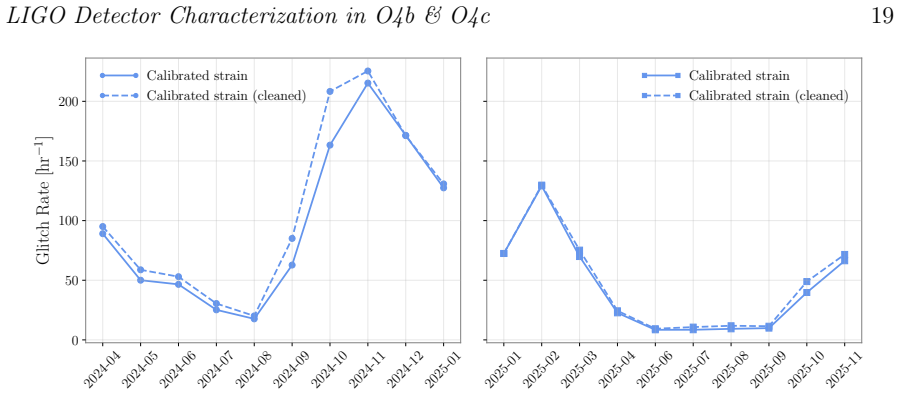
- [3.1] The claim that the LHO O4c glitch rate is the lowest observed in the advanced-detector era would be easier to verify if the paper included historical rates for O1–O3 or a citation to a comparison table; Figure 10 only shows O4a, O4b, and O4c.
- [4.4] Please report the number of retractions attributed to search-pipeline concerns versus data quality explicitly; the text currently says 'the majority' and lists four data-quality-related retractions, which is less precise than the rest of the paper.
- [Table 2] The column labeled 'Lock Probability' appears to report the fraction of earthquakes during which lock was maintained; consider renaming it for consistency with the text and stating whether the O4b-to-O4c differences are statistically significant.
- [5.3.2] The statement that without gating the non-stationarity cuts would remove approximately 27% of segments would benefit from a one-sentence description of how this counterfactual was estimated.
- [4.2] The sentence about KAGRA data, 'and hence it was not used for validation of candidates,' is slightly confusing; consider rewording to clarify that KAGRA data were ingested and processed by DQR tasks but not used in candidate validation or parameter estimation.
- [Throughout] Please correct minor typos: 'severly' (Section 2.4.2), 'aquisition' (Section 2.3.3), 'targetted' (Section 3.2.2), 'perfrom' (Section 4.3), 'denoates' (Figure 16 caption), and 'attmept' (reference [94]).
Circularity Check
No significant circularity: the paper is an operational report whose headline quantities are measurements, not fits relabeled as predictions, and its few carry-over assumptions are traceability concerns rather than self-referential derivations.
full rationale
The paper's load-bearing claims are empirical measurements: BNS ranges, glitch rates, line counts, retraction counts, and the O4c glitch-rate record are all direct descriptions of detector performance rather than outputs of a derivation that re-imports its own inputs. The iDQ configuration and calibration being 'unchanged from O4a' is an operational carry-forward assumption, not a circular derivation; Figure 21 supplies an independent enrichment check of the offline flag's utility, even though it does not revalidate the absolute FAP scale after hardware changes. Similarly, the DQR per-task thresholds calibrated on O4a statistics are described as an improvement, but the paper does not show those same O4a data being used as the confirmation of the improvement, so no fitted-input-called-prediction step is exhibited. References to prior LIGO detector-characterization papers and in-preparation items are continuity citations, not load-bearing uniqueness theorems or ansatz-smuggling devices. The absence of proof for the iDQ calibration transfer is a legitimate traceability and robustness concern, but it is not a circularity: no equation in the paper reduces to itself, and no prediction is definitionally equivalent to a fitted parameter.
Assumptions & free parameters
free parameters (3)
- DQR per-task statistical thresholds =
not stated numerically
- Strict-notch StdRatio factor =
1.5
- Non-stationarity cut threshold on |Delta sigma| =
not stated
assumptions (4)
- domain assumption The LIGO strain data are 'typically Gaussian and stationary' apart from the characterized artifacts.
- domain assumption Photon-calibrator sine-Gaussian injections into h(t) are an adequate proxy for testing whether auxiliary channels can respond to real signals; a channel with no response is declared 'safe' for veto development.
- domain assumption The earthquake identification criterion (coincident 30-100 mHz vertical ground motion peaks in two or more buildings at a site) captures the population of lock-threatening earthquakes.
- domain assumption The iDQ configuration and calibration remain valid in O4b and O4c, unchanged from O4a, despite major hardware changes to the detectors.
Cite this review
Pith. "Pith review of LIGO Detector Characterization in the Second and Third Parts of the Fourth Observing Run." pith.science (2026). https://pith.science/paper/GFC2QLBV
@misc{pith2026260812193,
  author       = {Pith},
  title        = {Pith review of: LIGO Detector Characterization in the Second and Third Parts of the Fourth Observing Run},
  year         = {2026},
  howpublished = {\url{https://pith.science/paper/GFC2QLBV}},
  note         = {Machine review of arXiv:2608.12193}
}
read the original abstract
LIGO detector characterization efforts enabled the confident detection of gravitational waves from hundreds of compact binary coalescences during the fourth observing run. Reliable production of high quality detector data and rapid noise mitigation efforts allow the extraction of the most in-depth knowledge of gravitational wave sources and their progenitors. In this paper we describe LIGO detector characterization activities during the second and third parts of O4-O4b and O4c. We summarize changes in detector configuration and performance at the LIGO Hanford and LIGO Livingston Observatories between the end of the first part of O4a and the end of O4c, including upgrades made during the commissioning break preceding O4b and during repairs performed in O4c. We describe instrumental investigations carried out at both sites designed to understand and subsequently mitigate the effect on detector sensitivity of transient glitches, narrowband spectral lines, and vibration-driven noise, among other data quality concerns. We then review the tools and procedures used to validate gravitational wave candidates and the data quality products thus supplied to searches for gravitational waves from compact binary coalescences and unmodeled transients, continuous gravitational waves, and the stochastic gravitational wave background. The efforts of the detector characterization group are essential for maintaining and improving the sensitivity and reliability of the LIGO detectors especially as observing runs lengthen and more events are detected. We conclude with prospects for LIGO detector characterization activities in future observing runs.
Figures


Figures from the paper (20 more)




Reference graph
Works this paper leans on
-
[1]
Abbott B Pet al2016 GW150914: First results from the search for binary black hole coalescence with Advanced LIGOPhys. Rev. D93122003 (PreprintarXiv:1602.03839)
-
[2]
Abbott B Pet al(LIGO-Virgo Collaboration) 2019 GWTC-1: A Gravitational-Wave Transient Catalog of Compact Binary Mergers Observed by LIGO and Virgo during the First and Second Observing RunsPhys. Rev. X9031040 (PreprintarXiv:1811.12907)
arXiv 2019
-
[3]
Abbott Ret al(LIGO-Virgo Collaboration) 2021 GWTC-2: Compact Binary Coalescences Observed by LIGO and Virgo during the First Half of the Third Observing RunPhys. Rev. X 11021053 (PreprintarXiv:2010.14527)
arXiv 2021
-
[4]
Abbott Ret al2023 GWTC-3: Compact Binary Coalescences Observed by LIGO and Virgo during the Second Part of the Third Observing RunPhys. Rev. X13041039 (PreprintarXiv: 2111.03606)
-
[5]
Abac Aet al(LIGO-Virgo-KAGRA Collaboration) 2025 GWTC-4.0: Updating the Gravitational- Wave Transient Catalog with Observations from the First Part of the Fourth LIGO-Virgo- KAGRA Observing Run (PreprintarXiv:2508.18082)
arXiv 2025
-
[6]
Abac Aet al(LIGO-Virgo-KAGRA Collaboration) 2026 GWTC-5.0: Observations from the Second Part of the Fourth LIGO-Virgo-KAGRA Observing Run and Updates to the Gravitational-Wave Transient Catalog (PreprintarXiv:2605.27225)
arXiv 2026
-
[7]
Acernese Fet al2015 Advanced Virgo: a second-generation interferometric gravitational wave detectorClassical Quantum Gravity32024001 (PreprintarXiv:1408.3978)
-
[8]
Astron.335–40 (PreprintarXiv:1811.08079)
Kagra Collaboration 2019 KAGRA: 2.5 generation interferometric gravitational wave detector Nat. Astron.335–40 (PreprintarXiv:1811.08079)
arXiv 2019
Show all 165 references
-
[9]
Soni Set al2025 LIGO Detector Characterization in the first half of the fourth Observing run Classical Quantum Gravity42085016 (PreprintarXiv:2409.02831)
-
[10]
Acernese Fet al2023 Virgo detector characterization and data quality: results from the O3 run Classical Quantum Gravity40185006 (PreprintarXiv:2210.15633)
-
[11]
Akutsu Tet al2021 Overview of KAGRA: Calibration, detector characterization, physical environmental monitors, and the geophysics interferometerProgress of Theoretical and Experimental Physics202105A102 (PreprintarXiv:2009.09305)
2009
-
[12]
Davis D and Capote E 2025 Guiding interferometer improvements with the frequency-dependent inspiral rangePhys. Rev. D111122005 (PreprintarXiv:2502.07253)
2025 arXiv
-
[13]
Goetz Eet al2026 Narrow spectral artifact investigation and mitigation in LIGO data from the fourth LIGO-Virgo-KAGRA observing run (PreprintarXiv:2606.05959)
-
[14]
Davis Det al2021 LIGO detector characterization in the second and third observing runsClassical Quantum Gravity38135014 (PreprintarXiv:2101.11673) LIGO Detector Characterization in O4b & O4c44
-
[15]
Nuttall L K 2018 Characterizing transient noise in the LIGO detectorsPhilos. Trans. R. Soc. London, Ser. A37620170286 (PreprintarXiv:1804.07592)
2018 arXiv
-
[16]
Abbott B P and other 2016 Characterization of transient noise in Advanced LIGO relevant to gravitational wave signal GW150914Classical Quantum Gravity33134001 (PreprintarXiv: 1602.03844)
2016 arXiv
-
[17]
Zevin Met al2017 Gravity Spy: integrating advanced LIGO detector characterization, machine learning, and citizen scienceClassical Quantum Gravity34064003 (PreprintarXiv:1611.04596)
-
[18]
Glanzer Jet al2023 Data quality up to the third observing run of advanced LIGO: Gravity Spy glitch classificationsClassical Quantum Gravity40065004 (PreprintarXiv:2208.12849)
-
[19]
Payne E, Hourihane S, Golomb J, Udall R, Davis D and Chatziioannou K 2022 Curious case of GW200129: Interplay between spin-precession inference and data-quality issuesPhys. Rev. D 106104017 (PreprintarXiv:2206.11932)
2022 arXiv
-
[20]
Lecoeuche Y, McIver J, Knee A M, Udall R, Rink K, Hourihane S, Miller S J, Chatziioannou K, Massinger T and Davis D 2026 Coalescing Compact Binary Parameter Estimation with Gravitational Waves in the Presence of non-Gaussian Transient Noise (PreprintarXiv: 2604.07668)
2026 arXiv
-
[21]
Udall R, Bini S, Chatziioannou K, Davis D, Hourihane S, Lecoeuche Y, McIver J and Miller S 2026 Inferring the spins of merging black holes in the presence of data-quality issuesPhys. Rev. D113042005 (PreprintarXiv:2510.05029)
2026
-
[22]
Karki Set al2016 The Advanced LIGO photon calibratorsRev. Sci. Instrum.87114503 (Preprint arXiv:1608.05055)
-
[23]
Essick R, Mo G and Katsavounidis E 2021 A coincidence null test for Poisson-distributed events Phys. Rev. D103042003 (PreprintarXiv:2011.13787)
2021 arXiv
-
[24]
Pem central URLhttps://pem.ligo.org/
-
[25]
Ganapathy Det al2023 Broadband Quantum Enhancement of the LIGO Detectors with Frequency-Dependent SqueezingPhys. Rev. X13041021
-
[26]
Schwartz Eet al2020 Improving the robustness of the advanced LIGO detectors to earthquakes Classical Quantum Gravity37235007 (PreprintarXiv:2007.12847)
2007 arXiv
-
[27]
caltech.edu/aLOG/index.php?callRep=85740
Capote E and Warner J Trying High Bandwidth control for earthquakehttps://alog.ligo-wa. caltech.edu/aLOG/index.php?callRep=85740
-
[28]
Pham H Start testing EQ control with ASC cut-offhttps://alog.ligo-la.caltech.edu/aLOG/ index.php?callRep=78473
-
[29]
Capote Eet al2025 Advanced LIGO detector performance in the fourth observing runPhys. Rev. D111062002 (PreprintarXiv:2411.14607)
-
[30]
Matichard Fet al2015 Seismic isolation of Advanced LIGO: Review of strategy, instrumentation and performanceClassical Quantum Gravity32185003 (PreprintarXiv:1502.06300)
-
[31]
Nguyen P, Schofield R M S, Effler Aet al2021 Environmental noise in advanced LIGO detectors Classical Quantum Gravity38145001 (PreprintarXiv:2101.09935)
-
[32]
Janssens K, Lawrence J, Effler A, Schofield R M S, Lalleman M, Betzwieser J, Christensen N, Coughlin M W, Driggers J C, Helmling-Cornell A Fet al2025 Coherent injection of magnetic noise and its impact on gravitational-wave searchesPhys. Rev. D112102003 (PreprintarXiv: 2505.11903)
-
[33]
Venikoudis S, De Lillo F, Janssens K, Suresh J and Bruno G 2025 Impact of correlated magnetic noise on directional stochastic gravitational-wave background searchesPhys. Rev. D111 082005 (PreprintarXiv:2411.11746)
2025
-
[34]
Abac A Get al(LIGO-Virgo-KAGRA Collaboration) 2025 Upper Limits on the Isotropic Gravitational-Wave Background from the first part of LIGO, Virgo, and KAGRA’s fourth Observing Run (PreprintarXiv:2508.20721)
2025 arXiv
-
[35]
edu/aLOG/index.php?callRep=84924
Pham K, Schofield R and Campos C May 15 LEMI calibrationhttps://alog.ligo-wa.caltech. edu/aLOG/index.php?callRep=84924
-
[36]
Effler A, Pham K, Guidry T, MacDonald T and Connolly G Vault Tests for LEMI magnetometers LIGO Detector Characterization in O4b & O4c45 calibrationhttps://alog.ligo-la.caltech.edu/aLOG/index.php?callRep=79137
-
[37]
php?callRep=78903
Bossilkov V Greater angular offload to L1https://alog.ligo-la.caltech.edu/aLOG/index. php?callRep=78903
-
[38]
Bossilkov V Summary of Commissioning Changeshttps://alog.ligo-la.caltech.edu/aLOG/ index.php?callRep=78942
-
[39]
Driggers Jet alIFO very unhappy, something likely wrong with alignment, AS C needs strange offsetshttps://alog.ligo-wa.caltech.edu/aLOG/index.php?callRep=77368
-
[40]
edu/aLOG/index.php?callRep=77392
Dwyer Set alwe suspect that something in OFI has changedhttps://alog.ligo-wa.caltech. edu/aLOG/index.php?callRep=77392
-
[41]
ligo-wa.caltech.edu/aLOG/index.php?callRep=77427
Dwyer S Summary of alogs related to changes in our output arm this weekhttps://alog. ligo-wa.caltech.edu/aLOG/index.php?callRep=77427
-
[42]
Sanchez A, Kijbunchoo N and Xu V Re-aligning SQZ to current AS alignment 4.5dB, required big ZM moveshttps://alog.ligo-wa.caltech.edu/aLOG/index.php?callRep=77400
-
[43]
Kawabe K, Dwyer S, Crouch R and Abouelfettouh I DARM offset causing locklosses again https://alog.ligo-wa.caltech.edu/aLOG/index.php?callRep=79082
-
[44]
ligo-wa.caltech.edu/aLOG/index.php?callRep=79101
Dwyer S some symptoms that seem similar to April 22nd/23rd output changehttps://alog. ligo-wa.caltech.edu/aLOG/index.php?callRep=79101
-
[45]
Kawabe K and Dwyer S KTP wedge chipped, back up spare installed and ready to go to chamber https://alog.ligo-wa.caltech.edu/aLOG/index.php?callRep=79326
-
[46]
Dwyer S, Kawabe K, Driggers J and Compton C FS Assmembly Reinstalled in OFIhttps: //alog.ligo-wa.caltech.edu/aLOG/index.php?callRep=79363
-
[47]
caltech.edu/aLOG/index.php?callRep=79690
Gray C, Patane O, Short R and Dwyer S H1 Back To Observing!!!https://alog.ligo-wa. caltech.edu/aLOG/index.php?callRep=79690
-
[48]
Oberling J, Short R, Dwyer S, Sanchez A, Xu V, Capote C and Compton C Overview of PSL Story so farhttps://alog.ligo-wa.caltech.edu/aLOG/index.php?callRep=81193
-
[49]
Driggers J Comment to: Test setup of spare NPRO does not seem to see glitches; beginning process to swap to spare NPROhttps://alog.ligo-wa.caltech.edu/aLOG/index.php? callRep=80837
-
[50]
caltech.edu/aLOG/index.php?callRep=80908
Short R and Oberling J PSL NPRO Swap: It Lives! (WP 12155)https://alog.ligo-wa. caltech.edu/aLOG/index.php?callRep=80908
-
[51]
Compton C Comparison of PSL glitches before locklosses tagged: glitches dramatically changed after NPRO swaphttps://alog.ligo-wa.caltech.edu/aLOG/index.php?callRep=81386
-
[52]
caltech.edu/aLOG/index.php?callRep=81107
Xu V and Oberling J PSL NPRO Crystal Temperature Tuninghttps://alog.ligo-wa. caltech.edu/aLOG/index.php?callRep=81107
-
[53]
ligo-wa.caltech.edu/aLOG/index.php?callRep=81409
Oberling J and Short R PSL NPRO Swap: Here We Go Again (WP 12210)https://alog. ligo-wa.caltech.edu/aLOG/index.php?callRep=81409
-
[54]
Robinet F, Arnaud N, Leroy N, Lundgren A, Macleod D and McIver J 2020 Omicron: A tool to characterize transient noise in gravitational-wave detectorsSoftwareX12100620 (Preprint arXiv:2007.11374)
2020 arXiv
-
[55]
Brown J C 1991 Calculation of a constant Q spectral transformJ. Acoust. Soc. Am.89425–434
1991
-
[56]
Davis D, Massinger T, Lundgren A, Driggers J C, Urban A L and Nuttall L 2019 Improving the sensitivity of Advanced LIGO using noise subtractionClassical Quantum Gravity36055011 (PreprintarXiv:1809.05348)
2019 arXiv
-
[57]
Dartez L, Dwyer S and Vajente, G New DARM offloading reduces non-stationarity by reducing ESD drive RMS.https://alog.ligo-wa.caltech.edu/aLOG/index.php?callRep=74939
-
[58]
Cabero Met al2019 Blip glitches in Advanced LIGO dataClassical Quantum Gravity36155010 (PreprintarXiv:1901.05093)
1901 arXiv
-
[59]
Nandi D, Effler A, Soni S, Aira Ferreira T, Schofield R, Pham H, O’Hanlon T, Frolov V V and Gonz´ alez G 2026 Scattered light noise at LIGO Livingston Observatory during O4 (Preprint arXiv:2605.14143)
2026 arXiv
-
[60]
ligo-la.caltech.edu/aLOG/index.php?callRep=69626
Ferreira T and Gonzalez G Significant discrepancy between the spectrograms from LIGO Detector Characterization in O4b & O4c46 GDS CALIB STRAIN and GDS CALIB STRAIN CLEAN/NOLINEShttps://alog. ligo-la.caltech.edu/aLOG/index.php?callRep=69626
-
[61]
php?callRep=69850
Ferreira T and Gonzalez G Omicron at GDS CALIB STRAIN and GDS CALIB STRAIN NOLINEShttps://alog.ligo-la.caltech.edu/aLOG/index. php?callRep=69850
-
[62]
Soni Set al2021 Reducing scattered light in LIGO’s third observing runClassical Quantum Gravity38025016 (PreprintarXiv:2007.14876)
2007 arXiv
-
[63]
Schofield R CER ACs and main HVAC likely couple to DARM in input arm, possibly through MCA2 bafflehttps://alog.ligo-wa.caltech.edu/aLOG/index.php?callRep=74175
-
[64]
Schofield R Confirmation from laser vibrometry and beating shakers: the MC baffle by HAM3 has been producing noise in DARM and the one by HAM2 produces noise when 18 Hz vibration is increased by about 5; also, suggestions for mitigation during the January break https://alog.li...
-
[65]
Schofield R Evaluation of stray light work done during the break: desired reductions in vibration coupling attained for EX cryobaffle, and for input arm - after adjustment of ITMY CP yaw https://alog.ligo-wa.caltech.edu/aLOG/index.php?callRep=76969
-
[66]
caltech.edu/aLOG/index.php?callRep=79546
Connolly G Hunting 30-40 Hz peaks with portable accelerometerhttps://alog.ligo-wa. caltech.edu/aLOG/index.php?callRep=79546
-
[67]
caltech.edu/aLOG/index.php?callRep=80182
Callos S and Schofield R 24-30 Hz Range Noise in DARM Identificationhttps://alog.ligo-wa. caltech.edu/aLOG/index.php?callRep=80182
-
[68]
Connolly G Identification of 30-40 Hz peaks in DARMhttps://alog.ligo-wa.caltech.edu/ aLOG/index.php?callRep=80655
-
[69]
caltech.edu/aLOG/index.php?callRep=82986
Schofield R, McCarthy R, Guidry T, Connolly G, Mannix B and Olson J 35 Hz peak in DARM greatly reduced by changing the frequency of the OSB HVAC drive.https://alog.ligo-wa. caltech.edu/aLOG/index.php?callRep=82986
-
[70]
Callos S and Schofield R 20-40 Hz HVAC Noisehttps://alog.ligo-wa.caltech.edu/aLOG/ index.php?callRep=86257
-
[71]
M´ erou J, Calafat A, Effler A, Dwyer S, Schofield R and Driggers J Witness channels of the set of near-30Hz and near-100Hz combs at LHOhttps://alog.ligo-wa.caltech.edu/aLOG/ index.php?callRep=87414
-
[72]
Aasi Jet al(LIGO Scientific Collaboration) 2015 Advanced LIGOClassical Quantum Gravity 32074001 (PreprintarXiv:1411.4547)
2015 arXiv
-
[73]
Lockerbie N A, Carbone L, Shapiro B, Tokmakov K V, Bell A and Strain K A 2011 First results from the ‘Violin-Mode’ tests on an advanced LIGO suspension at MITClassical Quantum Gravity28245001
2011
-
[74]
Starkman T Effect of violin mode amplitude on narrow lines near the violin modeshttps: //alog.ligo-wa.caltech.edu/aLOG/index.php?callRep=71501
-
[75]
Starkman T Asymmetry in narrow line contamination in bands around violin mode frequencies https://alog.ligo-wa.caltech.edu/aLOG/index.php?callRep=71800
-
[76]
Goetz Eet alO3 lines and combs in found in self-gated C01 datahttps://dcc.ligo.org/ LIGO-T2100200/public
-
[77]
org/LIGO-T2400204/public
Goetz Eet alO4a lines and combs in found in self-gated C00 cleaned datahttps://dcc.ligo. org/LIGO-T2400204/public
-
[78]
Neunzert A CAL AWG LINES extra calibration lines create many narrow artifacts below 100 Hz https://alog.ligo-wa.caltech.edu/aLOG/index.php?callRep=71964
-
[79]
Neunzert A, Goetz E, Knee A, Collier T and Marceau A Deeper study of a 2023 test shows calibration lines + violin modes = more line contamination than previously understood https://alog.ligo-wa.caltech.edu/aLOG/index.php?callRep=79825
2023
-
[80]
Neunzert A Relationship between violin mode height and narrow spectral artifact contamination, revisitedhttps://alog.ligo-wa.caltech.edu/aLOG/index.php?callRep=82320
-
[81]
Goetz E, Knee A and Neunzert A O4a lines statistics and most problematic artifactshttps: LIGO Detector Characterization in O4b & O4c47 //alog.ligo-wa.caltech.edu/aLOG/index.php?callRep=79579
-
[82]
Calafat A, M´ erou J, Dwyer S, Schofield R and Driggers J Intermodulation lines andβestimation in H1:OMC-DCPD SUM OUT DQhttps://alog.ligo-wa.caltech.edu/aLOG/index.php? callRep=87923
-
[83]
edu/aLOG/index.php?callRep=67075
Schofield R and Dwyer S Update on grounding noise studieshttps://alog.ligo-wa.caltech. edu/aLOG/index.php?callRep=67075
-
[84]
Effler A PEM Injection Statushttps://alog.ligo-la.caltech.edu/aLOG/index.php? callRep=64609
-
[85]
Effler A Commissioning tests todayhttps://alog.ligo-la.caltech.edu/aLOG/index.php? callRep=67149
-
[86]
php?callRep=72118
Schofield R ETMX bias that minimizes grounding noise coupling hasnt changed much since January, and PEM injections at 60Whttps://alog.ligo-wa.caltech.edu/aLOG/index. php?callRep=72118
-
[87]
Schofield R, Dwyer S and Compton C ETMX bias sweep gives significantly different minimum in electronics ground noise coupling after charge change: from 150 V to new value of 58 V (1.5 bias offset)https://alog.ligo-wa.caltech.edu/aLOG/index.php?callRep=78194
-
[88]
caltech.edu/aLOG/index.php?callRep=78734
Schofield R Slow changes of ITMY ESD bias during observationhttps://alog.ligo-wa. caltech.edu/aLOG/index.php?callRep=78734
-
[89]
Schofield R Slow bias changes during observation completed; New ESD bias settings: ITMX 0V, ITMY -40V (-4.0 in offset window)https://alog.ligo-wa.caltech.edu/aLOG/index.php? callRep=78925
-
[90]
Helmling-Cornell A F, Nguyen P, Schofield R M S and Frey R 2024 Automated evaluation of environmental coupling for Advanced LIGO gravitational wave detectionsClassical Quantum Gravity41145003 (PreprintarXiv:2312.00735)
2024 arXiv
-
[91]
Berger B Ket al2023 Searching for the causes of anomalous Advanced LIGO noiseAppl. Phys. Lett.122184101
-
[92]
Effler A, Schofield R M S, Frolov V V, Gonz´ alez G, Kawabe K, Smith J R, Birch J and McCarthy R 2015 Environmental influences on the LIGO gravitational wave detectors during the 6th science runClassical Quantum Gravity32035017 (PreprintarXiv:1409.5160)
2015 arXiv
-
[93]
Short R, Glanzer J, Helmling-Cornell A, Effler A and Schofield R PEM injections successfully completed - will inform HVAC experimentshttps://alog.ligo-wa.caltech.edu/aLOG/ index.php?callRep=69745
-
[94]
Cahillane C Comment to: Another failed attmept to switch OMC ASC to dither alignment https://alog.ligo-wa.caltech.edu/aLOG/index.php?callRep=64609
-
[95]
php?callRep=89929
Callos S, Connolly G, Schofield R, Short R and Campos C PEM November 2025 Injection Coupling Analysis Completehttps://alog.ligo-wa.caltech.edu/aLOG/index. php?callRep=89929
2025
-
[96]
Washimi T, Yokozawa T, Tanaka T, Itoh Y, Kume J and Yokoyama J 2021 Method for environmental noise estimation via injection tests for ground-based gravitational wave detectors Classical Quantum Gravity38125005 (PreprintarXiv:2012.09294)
2021 arXiv
-
[97]
php?callRep=78693
Pham H, O’Hanlon T and Effler A BS HEPI injections imply large amount of scattered light in the vertex, from ITM elliptical baffleshttps://alog.ligo-la.caltech.edu/aLOG/index. php?callRep=78693
-
[98]
Nandi D and Ferreira T Comparing the rate of scattered light glitches pre and post vent https://alog.ligo-la.caltech.edu/aLOG/index.php?callRep=78226
-
[99]
Nandi D 2025 aLIGO LLO Logbookhttps://alog.ligo-la.caltech.edu/aLOG/index.php? callRep=75579
2025
-
[100]
Pham H 2024 aLIGO LLO Logbookhttps://alog.ligo-la.caltech.edu/aLOG/index.php? callRep=72674
2024
-
[101]
O’Hanlon T and Effler E EX Manifold Wrapped to try and affect 30 min oscillationshttps: //alog.ligo-la.caltech.edu/aLOG/index.php?callRep=73481 LIGO Detector Characterization in O4b & O4c48
-
[102]
edu/aLOG/index.php?callRep=73288
Frolov V and Effler E EX tapping tests and microseism drivehttps://alog.ligo-la.caltech. edu/aLOG/index.php?callRep=73288
-
[103]
Berger B Wandering lines in PEM VMON channels at EX line up with BNS range oscillations https://alog.ligo-la.caltech.edu/aLOG/index.php?callRep=80232
-
[104]
Berger B Time variation of wandering lines in PEM EX VMON ESDPOWER channelshttps: //alog.ligo-la.caltech.edu/aLOG/index.php?callRep=80556
-
[105]
Walker M, Agnew A F, Bidler J, Lundgren A, Macedo A, Macleod D, Massinger T J, Patane O and Smith J R 2018 Identifying correlations between LIGO’s astronomical range and auxiliary sensors using lasso regressionClassical Quantum Gravity35225002 (PreprintarXiv: 1807.02592)
2018 arXiv
-
[106]
Mullavey A Unlocking ALS end-station PLLshttps://alog.ligo-la.caltech.edu/aLOG/ index.php?callRep=75125
-
[107]
Grant G and Glanzer JInvestigations of Binary Neutron Star Range Oscillations at LIGO Livingstonhttps://dcc.ligo.org/LIGO-T2500220/public
-
[108]
caltech.edu/aLOG/index.php?callRep=72583
Kabagoz B and Effler A Low range, sqz on off test: It’s not the squeezerhttps://alog.ligo-la. caltech.edu/aLOG/index.php?callRep=72583
-
[109]
edu/aLOG/index.php?callRep=72819
Glanzer J Comment to: Excess noise during range oscillationhttps://alog.ligo-la.caltech. edu/aLOG/index.php?callRep=72819
-
[110]
caltech.edu/aLOG/index.php?callRep=78194
Glanzer J Comment to: BRUCO comparision for range oscillationshttps://alog.ligo-la. caltech.edu/aLOG/index.php?callRep=78194
-
[111]
ligo-la.caltech.edu/aLOG/index.php?callRep=73009
Glanzer J Potential correlation between long duration range drops and CS temphttps://alog. ligo-la.caltech.edu/aLOG/index.php?callRep=73009
-
[112]
Brooks A Environmental coupling to the ITMs due to temperature excursions even with stabilized lab temperaturehttps://alog.ligo-la.caltech.edu/aLOG/index.php?callRep=74834
-
[113]
caltech.edu/aLOG/index.php?callRep=78104
Iwaguchi S Comparison before and after changing AHU settingshttps://alog.ligo-la. caltech.edu/aLOG/index.php?callRep=78104
-
[114]
Iwaguchi S AHU behavior and LVEA temperature after change of AHU1 settinghttps: //alog.ligo-la.caltech.edu/aLOG/index.php?callRep=78563
-
[115]
php?callRep=78617
O’Hanlon T LVEA HVAC Controls Changehttps://alog.ligo-la.caltech.edu/aLOG/index. php?callRep=78617
-
[116]
Kandhasamy S 2024 Wandering lines in h(t) around 580 Hz and other related lineshttps: //alog.ligo-la.caltech.edu/aLOG/index.php?callRep=70869
2024
-
[117]
Macleod D, Goetz E, Ota I, Isi M, Massinger T, Davis D, Pitkin M, Altin P and Nitz A 2024 gwpy/gwsumm: 2.2.6 URLhttps://doi.org/10.5281/zenodo.10999143
2024 doi
-
[118]
Comput.1827–34 ISSN 2213-1337 URLhttps: //www.sciencedirect.com/science/article/pii/S2213133716301196
Areeda J, Smith J, Lundgren A, Maros E, Macleod D and Zweizig J 2017 LigoDV-web: Providing easy, secure and universal access to a large distributed scientific data store for the LIGO scientific collaborationAstron. Comput.1827–34 ISSN 2213-1337 URLhttps: //www.sciencedirect.co...
2017
-
[119]
Fisher R P, Hemming G, Bizouard M A, Brown D A, Couvares P F, Robinet F and Verkindt D 2021 DQSEGDB: A time-interval database for storing gravitational wave observatory metadata SoftwareX14100677 (PreprintarXiv:2008.11316)
2021 arXiv
-
[120]
Vajente G 2023 BruCo: Brute-force coherence noise analsysis URLhttps://git.ligo.org/ gabriele-vajente/bruco
2023
-
[121]
Smith J R, Abbott T, Hirose E, Leroy N, MacLeod D, McIver J, Saulson P and Shawhan P 2011 A hierarchical method for vetoing noise transients in gravitational-wave detectorsClassical Quantum Gravity28235005 (PreprintarXiv:1107.2948)
2011 arXiv
-
[122]
Isogai T, LIGO Scientific Collaboration and Virgo Collaboration 2010 Used percentage veto for LIGO and virgo binary inspiral searchesJ. Phys. Conf. Ser.(J. Phys. Conf. Ser.vol 243) (IOP) p 012005
2010
-
[123]
Essick R, Godwin P, Hanna C, Blackburn L and Katsavounidis E 2020 iDQ: Statistical Inference of Non-Gaussian Noise with Auxiliary Degrees of Freedom in Gravitational-Wave Detectors LIGO Detector Characterization in O4b & O4c49 (PreprintarXiv:2005.12761)
2020 arXiv
-
[124]
Davis D, Trevor M, Mozzon S and Nuttall L K 2022 Incorporating information from LIGO data quality streams into the PyCBC search for gravitational wavesPhys. Rev. D106102006 (PreprintarXiv:2204.03091)
2022 arXiv
-
[125]
Talukder D 2017 LIGO Channel Activity Monitor URLhttps://github.com/dipongkar/ ligocam
2017
-
[126]
Goetz E, Neunzert A and Suyamprakasam S 2025 Fscan URLhttps://doi.org/10.5281/ zenodo.18776397
2025
-
[127]
thesis Minnesota U
Meyers P M 2018Cross-correlation searches for persistent gravitational waves with Advanced LIGO and noise studies for current and future ground-based gravitational-wave detectorsPh.D. thesis Minnesota U
-
[128]
Hernandez G and E T 2023Stochmon: A LIGO Data Analysis ToolTech. Rep. T1400205 LSC URLhttps://dcc.ligo.org/LIGO-T1400205/public
-
[129]
Usman S A, Nitz A H, Harry I W, Biwer C M, Brown D A, Cabero M, Capano C D, Canton T D, Dent T, Fairhurst Set al2016 The pycbc search for gravitational waves from compact binary coalescenceClassical Quantum Gravity33215004
-
[130]
Messick C, Blackburn K, Brady P, Brockill P, Cannon K, Cariou R, Caudill S, Chamberlin S J, Creighton J D, Everett Ret al2017 Analysis framework for the prompt discovery of compact binary mergers in gravitational-wave dataPhys. Rev. D95042001
-
[131]
Aubin F, Brighenti F, Chierici R, Estevez D, Greco G, Guidi G M, Juste V, Marion F, Mours B, Nitoglia Eet al2021 The mbta pipeline for detecting compact binary coalescences in the third ligo–virgo observing runClassical Quantum Gravity38095004
-
[132]
Luan J, Hooper S, Wen L and Chen Y 2012 Towards low-latency real-time detection of gravitational waves from compact binary coalescences in the era of advanced detectorsPhys. Rev. D85102002 (PreprintarXiv:1108.3174)
2012 arXiv
-
[133]
Hooper S, Chung S K, Luan J, Blair D, Chen Y and Wen L 2012 Summed parallel infinite impulse response filters for low-latency detection of chirping gravitational wavesPhys. Rev. D 86024012 (PreprintarXiv:1108.3186)
2012 arXiv
-
[134]
Marx E, Benoit W, Gunny A, Omer R, Chatterjee D, Venterea R C, Wills L, Saleem M, Moreno E, Raikman Ret al2025 Machine-learning pipeline for real-time detection of gravitational waves from compact binary coalescencesPhys. Rev. D111042010
-
[135]
Skliris V, Norman M R and Sutton P J 2024 Toward real-time detection of unmodeled gravitational wave transients using convolutional neural networksPhys. Rev. D110104034
2024
-
[136]
Mishra T, O’Brien B, Szczepa´ nczyk M, Vedovato G, Bhaumik S, Gayathri V, Prodi G, Salemi F, Milotti E, Bartos Iet al2022 Search for binary black hole mergers in the third observing run of advanced ligo-virgo using coherent waveburst enhanced with machine learningPhys. Rev. D ...
-
[137]
Cornish N J, Littenberg T B, B´ ecsy B, Chatziioannou K, Clark J A, Ghonge S and Millhouse M 2021 BayesWave analysis pipeline in the era of gravitational wave observationsPhys. Rev. D 103044006 (PreprintarXiv:2011.09494)
2021 arXiv
-
[138]
Di Renzo F, Fidecaro F, Razzano M and Sorrentino N 2024 BRiSTOL – a Band-limited RMS Stationarity Test Tool for Gravitational Wave Data (PreprintarXiv:2401.15392)
2024 arXiv
-
[139]
Vazsonyi L and Davis D 2023 Identifying glitches near gravitational-wave signals from compact binary coalescences using the Q-transformClassical Quantum Gravity40035008 (Preprint arXiv:2208.12338)
2023 arXiv
-
[140]
Mozzon S, Nuttall L K, Lundgren A, Dent T, Kumar S and Nitz A H 2020 Dynamic normalization for compact binary coalescence searches in non-stationary noiseClassical Quantum Gravity37 215014 (PreprintarXiv:2002.09407)
2020
-
[141]
Macas R and Lundgren A 2023 Sensitive test of non-Gaussianity in gravitational-wave detector dataPhys. Rev. D108063016 (PreprintarXiv:2306.09019)
2023 arXiv
-
[142]
´Alvarez-L´ opez S, Liyanage A, Ding J, Ng R and McIver J 2024 GSpyNetTree: a signal-vs- LIGO Detector Characterization in O4b & O4c50 glitch classifier for gravitational-wave event candidatesClassical Quantum Gravity41085007 (PreprintarXiv:2304.09977)
2024 arXiv
-
[143]
´Alvarez-L´ opez S, Chan M L, Herbst F S, Raghunathan D, Ahuja A, Liyanage A, Ding J, Garcia- Varela A, Ng R and McIver J 2026 GSpyNetTree-O4: an event validation tool used in the fourth LIGO-Virgo-KAGRA observing run (PreprintarXiv:2607.25208)
2026 arXiv
-
[144]
Davis Det al2026 Rapid data quality investigations of gravitational-wave events with the Data Quality Report Builder toolkitarXiv e-printsarXiv:2605.16183 (PreprintarXiv:2605.16183)
-
[145]
Acernese F, Agathos M, Ain A, Albanesi S, Allocca A, Amato A, Andrade T, Andres N, Andr´ es- Carcasona M, Andri´ c Tet al2023 Virgo detector characterization and data quality: tools Classical Quantum Gravity40185005
-
[146]
Hourihane S and Chatziioannou K 2025 Glitches far from transient gravitational-wave events do not bias inferencePhys. Rev. D112084006 (PreprintarXiv:2506.21869)
2025
-
[147]
Cornish N J and Littenberg T B 2015 Bayeswave: Bayesian inference for gravitational wave bursts and instrument glitchesClassical Quantum Gravity32135012 (PreprintarXiv:1410.3835)
2015 arXiv
-
[148]
Ashton, G et al 2024 CBCFlowhttps://cbc.docs.ligo.org/projects/cbcflow/index.html
2024
-
[149]
Ligo Scientific Collaboration, VIRGO Collaboration and Kagra Collaboration 2025 LIGO/Virgo/KAGRA S250108ha: Retraction of GW compact binary merger candidateGRB Coordinates Network388561
2025
-
[150]
Ligo Scientific Collaboration, VIRGO Collaboration and Kagra Collaboration 2024 LIGO/Virgo/KAGRA S240420aw: Retraction of GW compact binary merger candidateGRB Coordinates Network361901
2024
-
[151]
Ligo Scientific Collaboration, VIRGO Collaboration and Kagra Collaboration 2024 LIGO/Virgo/KAGRA S241104a: Retraction of GW compact binary merger candidateGRB Coordinates Network380701
2024
-
[152]
Ligo Scientific Collaboration, VIRGO Collaboration and Kagra Collaboration 2024 LIGO/Virgo/KAGRA S240624cd: Retraction of GW unmodeled transient candidateGRB Coordinates Network367471
2024
-
[153]
thesis University of Oregon
Helmling-Cornell A 2025Noise Mitigation in Searches for Gravitational Waves from Compact Binaries and Cosmic StringsPh.D. thesis University of Oregon
-
[154]
Arnaud N 2023 LIGO and Virgo detector characterization and data quality: Contributions to the O3 run and preparation for O4Nucl. Instrum. Methods Phys. Res. A1048167945
2023
-
[155]
Abac Aet al2026 Open Data from LIGO, Virgo, and KAGRA through the Second Part of the Fourth Observing Run (PreprintarXiv:2605.27090)
-
[156]
Evans Met al2015 Observation of Parametric Instability in Advanced LIGOPhys. Rev. Lett. 114161102 (PreprintarXiv:1502.06058)
-
[157]
Essick R, Blackburn L and Katsavounidis E 2013 Optimizing vetoes for gravitational-wave transient searchesClassical Quantum Gravity30155010 (PreprintarXiv:1303.7159)
2013 arXiv
-
[158]
J.923254 (PreprintarXiv:2008.07494)
Dal Canton T, Nitz A H, Gadre B, Cabourn Davies G S, Villa-Ortega V, Dent T, Harry I and Xiao L 2021 Real-time Search for Compact Binary Mergers in Advanced LIGO and Virgo’s Third Observing Run Using PyCBC LiveAstrophys. J.923254 (PreprintarXiv:2008.07494)
2021 arXiv
-
[159]
Trevor M, Cabourn Davies G S, Dal Canton T, Dent T, Harry I, Hoang S and Tolley A 2026 PyCBC Live Search for Compact Binary Mergers in Advanced LIGO and Virgo’s Fourth Observing Run (PreprintarXiv:2606.07679)
2026 arXiv
-
[160]
Drago Met al2021 coherent WaveBurst, a pipeline for unmodeled gravitational-wave data analysisSoftwareX14100678 (PreprintarXiv:2006.12604)
2006 arXiv
-
[161]
Macquet A, Bizouard M A, Christensen N and Coughlin M 2021 Long-duration transient gravitational-wave search pipelinePhys. Rev. D104102005 (PreprintarXiv:2108.10588)
2021 arXiv
-
[162]
ligo-la.caltech.edu/aLOG/index.php?callRep=64377
Lundgren A Electrical glitches remain at EY after ESD transitioned to EXhttps://alog. ligo-la.caltech.edu/aLOG/index.php?callRep=64377
-
[163]
Davis D, Neunzert A, Goetz E, Riles K, Wette K and Lalleman M Self-gating of O4a h(t) for use in continuous-wave searcheshttps://dcc.ligo.org/LIGO-T2400003/public LIGO Detector Characterization in O4b & O4c51
-
[164]
J.95225 (PreprintarXiv:2303.15696)
Renzini A Iet al2023 pygwb: A Python-based Library for Gravitational-wave Background SearchesAstrophys. J.95225 (PreprintarXiv:2303.15696)
-
[165]
Abac Aet alIn preparation
Reviewed August 16, 2026 · model on record in the stance chip above.
Discussion (0). Continue with ORCID to comment.