REVIEW 5 major objections 6 minor 5 references
A Hierarchical Energy-Based Model for Multimodal Cognition
T0 review · 5 major / 6 minor · reviewed 2026-08-14 · deepseek-v4-flash
Pith's one-line read This paper claims that a hierarchical, energy-based hub-and-spoke architecture, with per-modality diffusion-based predictive-coding pipelines converging on an amodal hub, provides a mechanistic account of attention, perceptual…
desk verdict A clear, ambitious theoretical proposal that deserves a serious referee but not acceptance on its current evidence: the claimed 'recoveries' of surprisal and ERP components are mostly definitional or analogical, pending implementation and quantitative tests. read the letter →
The pith
A machine-rendered reading of the paper's core claim, the machinery that carries it, and where it could break.
The reading
What carries the argument
The central object is the hub-and-spoke energy landscape: per-modality predictive-coding pipelines (visual objects, scene, phonemes/characters, words) converge on a shared amodal hub state, modeled on the anterior temporal lobe. The load-bearing identity is the predictive-coding energy $E_{pc} = \frac{1}{2}\epsilon_s^\top \Pi_s \epsilon_s + \frac{1}{2}\epsilon_z^\top \Pi_z \epsilon_z$, where $\epsilon_s$ is the sensory prediction error, $\epsilon_z$ is the prior/state error, and $\Pi_s, \Pi_z$ are precision matrices whose reduction implements attentional suppression. Predictions are generated by a diffusion-based energy model that stochastically anneals a candidate next state to low energy, with an energy function conditioned jointly on the local latent state and the current shared hub state. This machinery carries the argument: precision reduction gives attention and inattentional blindness, warm-started annealing over a two-well landscape gives bistability with non-memoryless dwell times, and the two error terms map onto surprisal, N400, and trajectory-reorientation costs in language.
What would settle it
Fit the model's two energy terms, summed level-1 character cross-entropy and level-2 word-latent prior mismatch, as separate predictors of N400 amplitude in existing ERP datasets: if one term alone accounts for the effect, the claimed two-level decomposition of the N400 fails.
Extended reading notes
Core claim
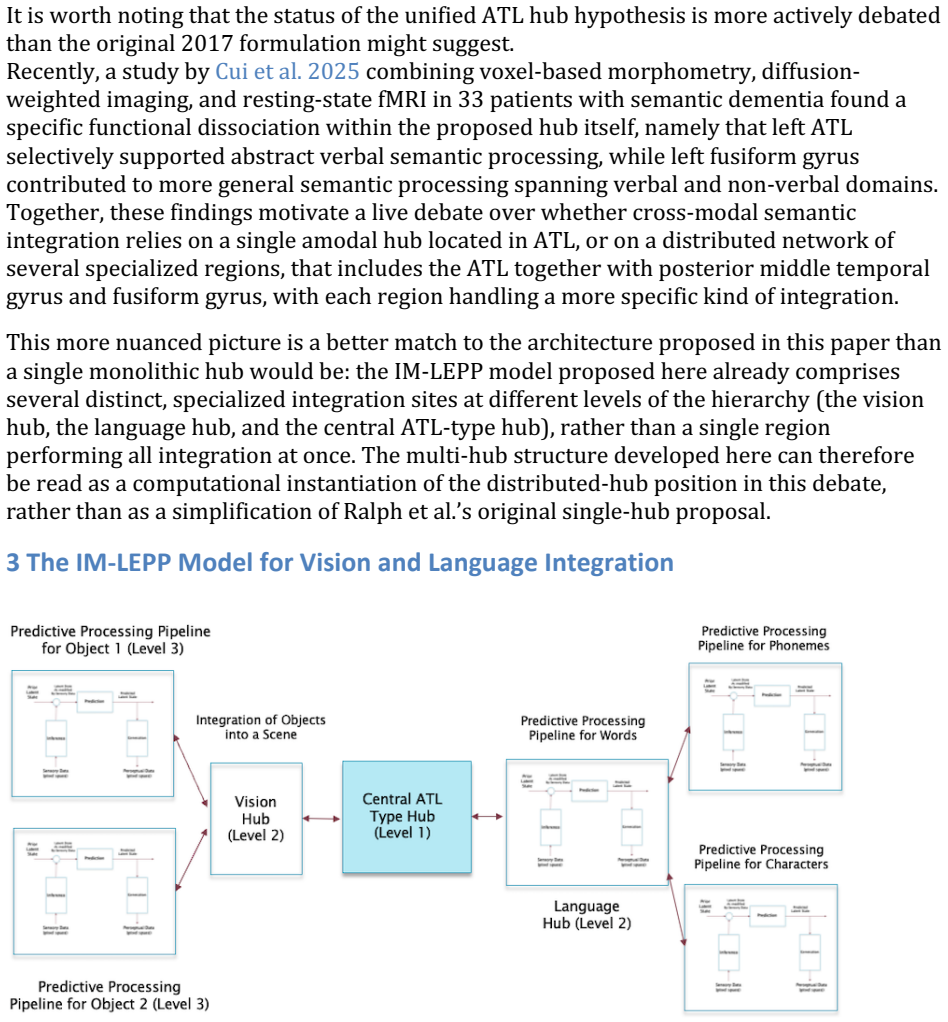
The discovery claimed is that the binding problem in the brain, the integration of separate sensory streams into a single experience, can be solved by a hub-and-spoke hierarchy of energy-minimizing predictive-coding pipelines. In IM-LEPP, each object, scene, and word has its own pipeline, and their latent states are integrated at a vision hub and then at a central amodal hub; that central state is fed back into each pipeline as a conditioning variable in the diffusion-based prediction energy, so every prediction reflects the full multimodal context while preserving each modality's identity. The same precision-weighting machinery that implements attention also shapes the energy landscape: reducing precision on an unattended pipeline suppresses its contribution, producing inattentional blindness, while a genuinely ambiguous stimulus creates a two-well landscape whose stochastic annealing produces Necker-cube switching. In language, the two-level pipeline makes surprisal fall out of character-level cross-entropy, maps level-1 cross-entropy onto lexical-access and level-2 prior-mismatch onto integration accounts of the N400, and explains garden-path reanalysis as an escape from a locally wrong interpretation triggered by new evidence. The paper further claims this architecture is fundamentally different from transformer models because it actively maintains a persistent latent state with momentum, whereas transformers recompute fresh from context at each step.
Load-bearing premise
The load-bearing premise is that a single shared hub state can be fed back to condition every modality's prediction without destroying modality identity, so that the brain's semantic integration can be modeled as energy minimization in hub-and-spoke latent spaces.
Editorial extensions
If this is right
- If IM-LEPP is correct, attention is precision-weighting: an unattended object's pipeline is suppressed by lowering its sensory precision, which directly explains inattentional blindness and change blindness.
- Necker-cube bistability follows from stochastic escape over a fixed, two-well energy landscape, predicting gamma-distributed dominance durations and longer dwells for ecologically preferred interpretations.
- Surprisal emerges from character-level cross-entropy, so reading time costs are neural settling time in the lowest-level predictive-coding pipeline.
- The N400 decomposes into two architecture-level terms (lexical access vs. discourse integration), and the P600 indexes garden-path escape-and-resettle; each is testable against ERP data.
- Language acquisition is data-efficient because words map onto an already-grounded hub; hearing a familiar word with attention withdrawn should drive mental imagery via the same open-loop generative mechanism as vision.
Reading between the lines
- If the hub-and-spoke design holds, the same architecture should accommodate additional spokes (action/praxis, non-linguistic sound) without redesign, making it a candidate unified substrate for embodied semantic cognition.
- The model predicts that true multimodal binding requires a single amodal hub with top-down conditioning, not just early input fusion; this suggests architecture-level targets for testing multimodal LLMs against human brain data.
- The N400 decomposition implies that lesioning the hub (as in semantic dementia) should differentially affect the integration term but not the lexical-access term, a prediction that could be tested in patient ERP studies.
- The warm-started annealing account of Necker switching implies that any intervention that changes the energy barrier (e.g., depth cues) should change dwell times exponentially, which existing psychophysics could reanalyze without new experiments.
Signed reviews
Editorial analysis
A structured set of objections, weighed in public.
Referee Report
Summary. This paper proposes IM-LEPP, a hierarchical energy-based model of multimodal cognition that extends the author's earlier LEPP framework to integrate vision and language. The architecture is a hub-and-spoke design in which per-modality predictive-coding pipelines (visual objects and scenes, phonemes/characters and words) converge on a central amodal hub modeled on the anterior temporal lobe, with each level conditioned by, rather than overwritten by, the hub state. The paper claims that this architecture provides a mechanistic account of inattentional blindness, change blindness, and Necker-cube bistability, and that its mathematical structure recovers or motivates surprisal theory, the N400/P600 ERP components, garden-path reanalysis, and a falsifiable contrast with transformer language models. It also discusses data-efficient word learning, an outline of semantic/episodic memory, and positions the model relative to predictive coding, the free-energy principle, JEPA, and Hierarchical Temporal Memory. The manuscript contains no trained implementations or simulations; the mathematical derivations are limited to the standard predictive-coding energy, and the psycholinguistic 'recoveries' are qualitative identifications with terms of that energy.
Significance. If the central claims were established, IM-LEPP would offer a valuable unifying framework connecting energy-based predictive processing, multimodal integration, and a wide range of psycholinguistic and attentional phenomena. The paper is strong in its breadth of engagement with existing literature (e.g., Heeger, tPC, JEPA, HTM), its explicit specification of the architecture and update equations, and its concrete, falsifiable predictions in Section 9 (e.g., the diffusion-predictor residual test, the N400 decomposition, dwell-time distribution shape, and memory write-gating criteria). The authors also deserve credit for being transparent about the lack of a working implementation and for explicitly stating that trained dynamics are needed to test whether the proposed behaviors emerge rather than being read into the architecture by construction.
major comments (5)
- [Section 5.4 (and Section 5.1, equation for E_char^(1))] The claim that the model's mathematical structure 'recovers' surprisal theory is circular: the character-level predictive-coding energy E_char^(1) = −Σ T_i log y_i + ½ ε_z^T Π_z ε_z reduces, at its optimum, to −log y_true, which is exactly the categorical cross-entropy (surprisal) of the observed character. This is true by construction for any softmax classifier and does not follow from the diffusion-based prediction module or from any other architectural principle unique to IM-LEPP. The paper should either reframe this as 'the model uses surprisal as its training objective by construction' or provide an independent derivation that does not presuppose the cross-entropy form.
- [Section 5.4 (reading-time link)] The step that a large predictive-coding energy value makes 'the predictive coding energy pipeline take longer to settle down for each character, and thus for the entire word, which maps naturally onto longer reading times' is asserted without any derivation from the model's dynamics. In gradient descent or Langevin sampling, convergence time depends on the curvature of the loss landscape, learning rates, and the noise schedule, not on the scalar energy value at the optimum. A high-surprisal word can in principle converge as quickly as a low-surprisal word. Without an analysis of the update dynamics (or a simulation), the energy-to-processing-time link is an extra assumption, not a consequence of the architecture, and therefore cannot be claimed as a recovery of surprisal effects.
- [Section 9 versus Abstract, Section 4, and Section 5.4] Section 9 explicitly states that 'a trained implementation... is a prerequisite for much of the experimental program' and that it is needed to test whether the qualitative behaviors 'actually emerge from trained dynamics rather than being read into the architecture by construction.' This directly undercuts the abstract's assertion that the architecture 'gives a mechanistic account' of inattentional blindness and Necker-cube bistability, and the similar claims in Sections 4 and 5.4. As written, those sections provide verbal narratives that map existing phenomena onto architectural components, but no simulation, quantitative derivation, or data fitting demonstrates that the proposed mechanisms produce the phenomena. The authors should either provide a proof-of-concept simulation for at least one phenomenon or systematically soften 'mechanistic account' and 'recovers' to 'is consistent with' or 'motivates' throughout.
- [Section 4.1 (Necker cube)] The Necker-cube analysis invokes a double-well energy landscape, a Kramers escape rate, and a warm-start argument, but the barrier height ΔE and the noise schedule are free parameters and no quantitative predictions are derived from the model's own parameters. The claim that the model 'explains' bistable perception is therefore not supported: the non-memoryless dwell-time distribution and the asymmetry prediction are attributed to generic properties of Langevin dynamics in a double well, not to anything specific to IM-LEPP. To substantiate the mechanistic claim, the authors would need to either simulate the proposed diffusion process and fit its dwell-time statistics or provide a formal connection from the model's energy functions and precision parameters to the observed gamma-like distributions.
- [Section 5.4 (N400/P600 mapping)] The identification of the level-1 summed cross-entropy term with the lexical-access side of the N400 and the level-2 prior-mismatch term with the integration side, with P600 as the signature of 'escape-and-resettle,' is a post-hoc assignment of two energy terms to two ERP components. No functional model is given for how energy values translate into EEG amplitudes or latencies, and no quantitative comparison with ERP data is reported. This is a plausible interpretive suggestion, but it does not constitute a recovery of the N400/P600 effects from the architecture; the authors should present it as a hypothesis to be tested rather than as a result of the model.
minor comments (6)
- [Abstract] The abstract ends with 'to test its central claims Key Words:...' which appears to be a formatting error; the key-words header should be separated from the preceding sentence with proper punctuation.
- [Section 2] There is a duplicated word in 'on the the ATL area of the brain' (under the description of Ralph et al.'s model).
- [Throughout] The article repeatedly uses 'an hierarchical,' 'an latent,' 'an energy based,' and similar constructions where 'a' is the correct article; a careful proofread for articles and hyphenation is needed.
- [Section 5.5] In the sentence 'maps onto the predictive-coding energy in the IM-LEPP model by using the energy equation,' the phrase 'the energy equation' is preceded by a duplicated 'the' in the original text; also the equation number itself is not cited, which makes it hard for the reader to locate.
- [Notation, Sections 3-5] The notation z_t, zz_t, zzz_t, xx_t, yy_m, and E_p/E_char is heavily overloaded and the subscripts are inconsistently typeset (e.g., u_t^(t+1) = zzz_t). A notation table or a figure with a clear legend would greatly improve readability.
- [References] The LEPP model (reference [70], 'Varma, 2026') is a self-published blog-style source; since the entire paper builds on this model, the authors should either provide an archival reference (arXiv/DOI) or include a self-contained summary of the LEPP energy and diffusion dynamics in an appendix, so that the reader can verify the core assumptions.
Circularity Check
The 'recovery' of surprisal in §5.4 is definitional: the character-level energy is cross-entropy by construction, and the energy-to-settling-time link needed for reading-time predictions is asserted, not derived.
-
self definitional
[Section 5.4, Surprisal Theory paragraph, using the emission energy defined in Section 5.1]
"Assuming that the ground truth for the i-th character is given in 1-hot form by t=(t_1,…,t_K), the previous section showed that the predictive coding pipeline for the i-th character is driven by the minimization of the energy term −Σ_j t_j log y_j which reduces to the definition of surprisal −log y_true."
In §5.1 the energy E_char^(1) = −Σ_i T_i log y_i + ½ ε_z^T Π_z ε_z is the model's chosen emission loss, with y = softmax(z^(1)). The first term is exactly the standard categorical cross-entropy (negative log-likelihood) used to train the classifier. Surprisal theory is then 'recovered' by observing that word surprisal decomposes via the chain rule into character-level negative log-likelihoods, i.e., into the same cross-entropy term already built into the energy. That is a restatement of the training objective, not a derived consequence of the architecture.
full rationale
The paper is a conceptual architecture proposal with no fitted parameters or trained implementation, so the main circularity risk is not statistical forcing but definitional reduction. The clearest instance is the advertised recovery of surprisal theory in §5.4: the character-level predictive-coding energy introduced in §5.1 is cross-entropy by construction, and the paper's chain-rule decomposition simply rewrites -log p(word|context) as a sum of character-level -log y_true terms. The model therefore 'predicts' surprisal because surprisal was put into the loss. The N400/P600 and garden-path discussions are mappings or 'natural candidate' assignments rather than derivations; they are unsupported or analogical, but not circular. The paper's own §9 caveat that trained dynamics may be 'read into the architecture by construction' shows awareness of the broader risk, but does not undo the specific definitional surprisal step. Self-citations to the earlier LEPP paper supply the diffusion/energy machinery as prior architectural premises; they are load-bearing but not in the same way as the loss-identity step, since the psycholinguistic 'recoveries' are not derived from the earlier paper's equations. Overall, one centrally advertised 'recovery' reduces by construction to the model's loss function, while the rest of the paper retains independent (if speculative) architectural content, giving a partial circularity score of 6.
Assumptions & free parameters
free parameters (4)
- Precision matrices Π_s and Π_z in predictive coding energy =
None specified
- Word-boundary detection threshold =
None specified
- Diffusion noise schedule and annealing parameters for E_p =
None specified
- Energy barrier height ΔE for Necker cube switching =
None specified
assumptions (7)
- standard math Bayesian predictive coding update with gradient descent on cross-entropy plus prior energy (section 5.1)
- standard math Kramers escape rate formula for bistable switching, rate ∝ exp(-ΔE/kT) (section 4.1)
- standard math Divisive normalization can approximate softmax (Heeger, 2017) (section 5.3)
- domain assumption Hub-and-spoke semantic cognition framework of Lambon Ralph et al. 2017, with an amodal ATL hub integrating modality-specific spokes (section 2)
- domain assumption Object file theory and per-object visual pipelines, with one predictive coding pipeline per attended object (section 4)
- ad hoc to paper The diffusion-based temporal prediction module from the author's prior LEPP paper can be transplanted to word-level and hub-conditioned prediction (sections 3 and 5)
- ad hoc to paper A central hub state can condition every spoke's prediction while preserving spoke identity (sections 3, Figures 3, 6, 7)
invented entities (3)
-
Central amodal hub state zzz_t
-
Level 2 vision hub and language hub states zz_t
-
Artificial amygdala
Cite this review
Pith. "Pith review of A Hierarchical Energy-Based Model for Multimodal Cognition." pith.science (2026). https://pith.science/paper/EFEMMCFL
@misc{pith2026260812398,
  author       = {Pith},
  title        = {Pith review of: A Hierarchical Energy-Based Model for Multimodal Cognition},
  year         = {2026},
  howpublished = {\url{https://pith.science/paper/EFEMMCFL}},
  note         = {Machine review of arXiv:2608.12398}
}
read the original abstract
We propose IM-LEPP (Integrated Multimodal Latent Energy-based Predictive Processing), a hierarchical, energy-based model of multimodal cognition that extends a previously proposed single-modality model (LEPP) to integrate vision and language. Following the view that generative neural networks are effective theories of cognitive dynamics, analogous to how statistical mechanics relates to thermodynamics, IM-LEPP models cognition as latent states flowing through learned energy landscapes rather than as an account of neural circuitry. The architecture is a hub-and-spoke hierarchy, grounded in the controlled semantic cognition framework of Lambon Ralph et al., in which predictive-coding pipelines for visual objects, scenes, and linguistic units converge on a shared amodal hub modeled on the anterior temporal lobe. Each pipeline's own prediction is conditioned by, rather than overwritten by, the current hub state, preserving pipeline-specific identity while letting every prediction reflect the full multimodal context. We show this architecture gives a mechanistic account of attentional phenomena such as inattentional blindness and Necker-cube bistability, and that its structure recovers or motivates independently established findings in psycholinguistics, including surprisal theory, the N400/P600 ERP components, and garden-path reanalysis, alongside a falsifiable contrast with transformer language models on trajectory-sensitivity in next-word prediction. We also discuss data-efficient language acquisition relative to LLMs, outline a semantic/episodic memory subsystem, situate the model against predictive coding, the free-energy principle, JEPA, and Hierarchical Temporal Memory, and propose concrete experimental predictions to test its central claims Key Words: predictive processing; predictive coding; energy-based models; diffusion models; effective theory; computational neuroscience.
Figures


Figures from the paper (11 more)


Reference graph
Works this paper leans on
-
[9]
Chang, E. F., Rieger, J. W., Johnson, K., Berger, M. S., Barbaro, N. M., & Knight, R. T. (2010). Categorical speech representation in human superior temporal gyrus. Nature Neuroscience, 13(11), 1428–1432. https://www.nature.com/articles/nn.2641 10. Clark, A. (2013). Whatever next? Predictive brains, situated agents, and the future of cognitive science. Be...
arXiv 2010
-
[21]
Ghio, M. et al. (2024). Sampling with Flows, Diffusion, and Autoregressive Neural Networks from a Spin-Glass Perspective. arXiv:2308.14085. https://arxiv.org/abs/2308.14085 22. Hale, J. (2001). A probabilistic Earley parser as a psycholinguistic model. Proceedings of NAACL 2001. https://dl.acm.org/doi/10.3115/1073336.1073357 23. Hawkins, J., Lewis, M., Kl...
work page Pith review arXiv 2024
-
[33]
Kahneman, D., Treisman, A., & Gibbs, B. J. (1992). The reviewing of object files: Object-specific integration of information. Cognitive Psychology, 24(2), 175–219. http://wexler.free.fr/library/files/kahneman%20(1992)%20the%20reviewing%20of%20object%20files.%20object-specific%20integration%20of%20information.pdf 34. Kanwisher, N., McDermott, J., & Chun, M...
-
[45]
Lewis, R. L., & Vasishth, S. (2005). An activation-based model of sentence processing as skilled memory retrieval. Cognitive Science, 29(3), 375–419. https://tallinzen.net/media/readings/lewis_vasishth_2005.pdf 46. Liberman, A. M., Harris, K. S., Hoffman, H. S., & Griffith, B. C. (1957). The discrimination of speech sounds within and across phoneme bounda...
arXiv 2005
-
[57]
Osterhout, L., & Holcomb, P. J. (1992). Event-related brain potentials elicited by syntactic anomaly. Journal of Memory and Language, 31(6), 785–806. https://faculty.washington.edu/losterho/Osterhout%26Holcomb1992.pdf 58. Potter, M. C. (1976). Short-term conceptual memory for pictures. Journal of Experimental Psychology: Human Learning and Memory, 2(5), 5...
Reviewed August 14, 2026 · model on record in the stance chip above.
Discussion (0). Continue with ORCID to comment.