REVIEW 3 major objections 6 minor 34 references
PseudoMapLabeler: Confidence-Aware Pseudo-Label Generation for Semi-Supervised Online Mapping
T0 review · 3 major / 6 minor · reviewed 2026-08-16 · deepseek-v4-flash
Pith's one-line read The paper claims that a confidence-aware spatial-clipping pipeline can turn noisy teacher predictions on unlabeled driving data into pseudo-labels strong enough to lift semi-supervised online HD map construction by 6.1 mAP.
desk verdict A clever segment-level pseudo-label refinement idea, but the headline mAP gain is compromised by temperature tuning on the evaluation set. read the letter →
The pith
A machine-rendered reading of the paper's core claim, the machinery that carries it, and where it could break.
The reading
What carries the argument
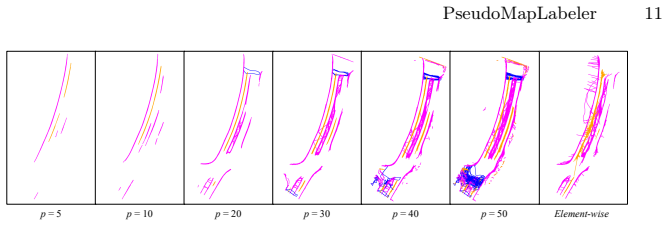
The load-bearing object is the Beta-distribution confidence map together with percentile-based spatial clipping. For each 0.5 m BEV cell and semantic class, the map updates Beta shape parameters $\alpha$ and $\beta$ from the number of times the cell was observed and the sum of calibrated prediction confidences, so a cell's posterior mean confidence, $\text{conf}(x,y,c) = \alpha/(\alpha+\beta)$, rises with repeated high-confidence detections and is damped by a weak prior biased toward absence ($p_0=0.2$, $\kappa=2.0$). Confidence values are sampled along accumulated polylines, and only contiguous runs above the class threshold $\tau_c = \operatorname{Percentile}(\{c_i\}, 100-p)$ survive, with polygons kept only if all points pass. This object carries the argument by deciding which partial geometry is trustworthy enough to re-inject as a prior into the teacher's prior-conditioned decoder.
What would settle it
Compare the precision of clipped high-confidence segments with the discarded low-confidence segments on the pseudo-unlabeled set, whose labels are available for evaluation; if top-percentile segments are not substantially more accurate than the discarded tail, the confidence map is not separating signal from noise and the 6.1 mAP gain must come from elsewhere, such as the extra pretraining data regardless of quality. A targeted control would also corrupt ego poses during temporal accumulation and check whether the mAP gain collapses, which would reveal dependence on localization accuracy.
Extended reading notes
Core claim
On its own terms, the paper's discovery is that confidence-aware spatial clipping turns noisy temporally accumulated predictions into map priors good enough to bootstrap a better pseudo-label generator. The teacher is first trained only on the labeled subset; its per-frame predictions are calibrated by temperature scaling, accumulated in a scene-local frame, and summarized by a Beta-distribution confidence map per 0.5 m bird's-eye-view cell. Rather than thresholding whole elements, the method clips each polyline to continuous runs of points whose confidence exceeds a class-specific percentile threshold, and uses the result as a prior for a second teacher pass over the unlabeled data. Those refined predictions, used as pseudo-labels, pre-train a student from scratch before fine-tuning on the labeled subset. The paper reports +6.1 mAP over the labeled-only baseline and +2.8 mAP over whole-element filtering, with the largest per-class gain on pedestrian crossings.
Load-bearing premise
The method assumes that the teacher's predictions on unlabeled data, noisy as they are from only 16.5% labeled training, contain enough reliable signal that confidence-based clipping keeps the correct segments and trims the wrong ones; if the teacher is confidently wrong, the clipping step preserves those errors as pseudo-labels.
Editorial extensions
If this is right
- With 16.5% labeled data, a student trained on pseudo-labels from spatial clipping and fine-tuned on labeled data reaches 27.6 mAP on the nuScenes validation set versus 21.5 mAP for the labeled-only baseline.
- Spatial clipping beats element-level filtering by 2.8 mAP for UPPM and 1.4 mAP for MapTR, showing that retaining partial reliable segments is better than all-or-nothing element decisions.
- The same pseudo-labeled dataset transfers to a different architecture, giving a MapTR student a 5.0 mAP gain, which supports the claim that the refinement-and-pseudo-labeling pipeline is model-agnostic.
- Pseudo-label quality peaks around percentile p=20–30 on the pseudo-unlabeled set, with rasterized Dice/IoU favoring p=30 while the mAP difference from p=20 is within noise.
- The roughly 10 mAP gap between refined pseudo-labels and the ground-truth-prior upper bound marks headroom attributable to limited teacher quality at 16.5% labeled data.
Reading between the lines
- If the gain is driven by confidence separation rather than simply more pretraining data, the same pipeline should transfer to lane-detection or BEV segmentation outputs that can be rasterized onto the same confidence grid.
- Because the method depends on accurate ego poses during temporal accumulation, localization noise is a hidden hyperparameter; a controlled pose-jitter study would show whether the 6.1 mAP gain degrades faster than single-frame baselines.
- The gap to the ground-truth-prior ceiling points to teacher quality as the next bottleneck, so an iterative self-training loop that retrains the teacher on its own high-confidence pseudo-labels is the natural next step.
Signed reviews
Editorial analysis
A structured set of objections, weighed in public.
Referee Report
Summary. The manuscript proposes PseudoMapLabeler (PML), a teacher-student semi-supervised learning framework for online vectorized HD mapping. A Uni-PrevPredMap (UPPM) teacher is trained on only 16.5% of the StreamMapNet geosplit training set. Its predictions on the remaining 83.5% are accumulated in scene-local coordinates, converted into per-class Beta-distribution confidence maps using temperature-scaled scores, and spatially clipped via percentile thresholds to produce refined map priors. The teacher is then re-applied with these priors to generate pseudo-labels, which are used to train a student UPPM or MapTR from scratch before fine-tuning on the labeled subset. On the nuScenes validation set, the paper reports +6.1 mAP over a temporal-prior-enabled UPPM baseline and +5.0 mAP for a MapTR student. The paper also ablates the percentile threshold and compares spatial clipping with element-wise filtering.
Significance. If the reported gains hold under a clean evaluation protocol, PML would be a useful contribution to an underexplored problem: semi-supervised learning for online vectorized HD mapping. The paper takes several steps in the right direction: it uses the geographically disjoint StreamMapNet split to prevent spatial leakage, it compares against a strong temporal-prior-enabled UPPM baseline rather than a naive single-frame model, it includes a second architecture (MapTR) to support model-agnosticism, and it makes the pseudo-unlabeled set and its ground truth available for diagnostic evaluation. The spatial-clipping idea, which preserves partial high-confidence segments instead of discarding whole elements, is reasonable and potentially valuable. However, the current evidence is weakened by two protocol issues in the experimental design: the temperature used in pseudo-label generation is calibrated on the same validation set used for final evaluation, and the percentile threshold is selected using ground truth labels from the pseudo-unlabeled set. In addition, the results are presented without variance estimates.
major comments (3)
- [Section 4.2, Eq. (3), Eq. (4), Eq. (8), Table 2] The temperature parameter T* is optimized on the nuScenes validation set via Eq. (3) and then used in Eq. (4) through the calibrated scores scalib, which determine the Beta confidence maps, the percentile thresholds of Eq. (8), and ultimately the pseudo-labels that train the student. The final mAP in Table 2 is measured on the same validation set. The paper's argument that temperature scaling preserves per-element confidence ranking does not cover the downstream aggregation: the sums in Eq. (4) combine varying numbers of observations per grid cell and can reorder across T, and the percentile thresholds in Eq. (8) shift with T. The student's training signal is therefore a function of validation-set labels, making the reported +6.1 mAP a tuned-on-validation result rather than an unbiased estimate. I ask the authors to calibrate T on a split disjoint from the final evaluation set (for example, a held-out portion of the labeled training data or a separate split of the pseudo-unlabeled set) and re-report Table 2, or to demonstrate explicitly that the results are insensitive to T over a plausible range.
- [Section 4.2, Table 1] The percentile p=30 used for the final student is selected by evaluating pseudo-label quality on the pseudo-unlabeled set using its ground truth labels (Table 1). In a genuine SSL scenario, the unlabeled set would not have labels; using those labels to choose p means the training signal is selected with information that the method would not have access to in deployment. This is distinct from evaluating a fixed pipeline on a held-out set. The current protocol also creates an internal tension, since mAP peaks at p=20 while Dice/IoU peaks at p=30 and the justification is post hoc. I recommend selecting p without DU labels (e.g., by cross-validation on DL or by a fixed confidence heuristic) and reporting how much Table 2 changes across p=20, p=30, and p=40.
- [Table 2] All results in Table 2 appear to be from single training runs; no standard deviations, number of seeds, or significance tests are reported. The headline improvements (+6.1 mAP over the UPPM baseline, +2.8 mAP over element filtering, and +5.0 mAP for MapTR) are moderate in size and could be within run-to-run variation for models of this complexity. Please report mean and standard deviation over at least three runs (or otherwise establish reproducibility), since the central empirical claim depends on these differences being reliable.
minor comments (6)
- [Section 3.4] The displayed formula for the accumulated map elements is garbled in the manuscript ('M acc = Snf rm(scene) i=1 Mscene i'); please define n_frames(scene) explicitly and write the union operation cleanly.
- [Section 3.7] The text says the teacher is initially trained without any map priors, yet the baseline is described as having temporal priors enabled. Please clarify the distinction between the model's internal temporal priors (its own past predictions) and the proposed refined map priors, so the reader can see exactly what is being ablated.
- [Table 1] The GT Prior row reports values in parentheses without explanation; please add a footnote stating whether these are computed with ground-truth priors during the second pass and why they are parenthesized.
- [Section 4.2] The statement that the pseudo-unlabeled set contains ground truth labels 'used only for evaluation purposes' is inconsistent with the use of those labels to select p in Table 1; please rephrase once the protocol is fixed.
- [Throughout] The term 'map priors' is used both for the proposed refined priors and for the prior-fusion mechanisms in related work (NMP, P-MapNet); consider using a distinct term such as 'refined pseudo-priors' to reduce ambiguity.
- [Equations] There are minor typographical inconsistencies in the equations, such as missing boldface for vectors in Eq. (1) and inconsistent placement of subscripts and superscripts; a careful proofread would improve readability.
Circularity Check
Validation-set temperature calibration leaks into pseudo-label generation, so the reported +6.1 mAP improvement is partly tuned on the evaluation labels rather than a clean SSL generalization estimate.
-
fitted input called prediction
[Section 4.2 (Probability Calibration), Eq. (3)-(4); Table 2]
"The temperature parameter T is optimized on a held-out validation set by minimizing the negative log-likelihood of binary cross-entropy (NLL-BCE): ... In our experiments, we use the nuScenes validation set for this optimization. ... Since temperature scaling preserves the relative ordering of confidence scores, using the validation set for calibration does not compromise the fairness of mAP evaluation, which depends only on prediction ranking rather than absolute values."
T* is fitted to validation-set ground truth via Eq. (3). It then enters Eq. (4) through s_calib_m, changing the Beta-map parameters alpha and hence conf(x,y,c); the percentile thresholds tau_c of Eq. (8) and the spatial clipping that produces M_prior and the pseudo-labels D_U all depend on conf. The student trained on these pseudo-labels is evaluated on the same validation split in Table 2. The stated defense addresses per-element ranking for a fixed teacher, but conf is a sum of temperature-scaled scores over varying observations, and such sums can reorder across T, altering thresholds and clipped segments. The +6.1 mAP is therefore partially tuned on the evaluation labels, not a fully independent measurement.
full rationale
The paper's core derivation chain is otherwise self-contained: it is an empirical teacher-student pipeline whose pseudo-labels come from the teacher's own predictions on 581 training scenes, and the percentile p is selected using ground-truth labels on those training scenes, not the validation split. The spatial-clipping contribution and the cross-architecture MapTR result rest on independent measurements. Self-citations in the reference list (D2HDMap, road-manual paper) are related-work citations only and are not load-bearing. The one concrete circular element is the temperature calibration on the nuScenes validation set, because that same set is the evaluation set for Table 2, and T* directly shapes the confidence map that creates pseudo-labels. While the effect is not a by-construction equality between input and output, it is a fitted parameter on the target data that influences the reported gain, so the headline claim is not a clean generalization estimate. The estimate is partially circular in an evaluation sense, but the main framework retains independent empirical content.
Assumptions & free parameters
free parameters (5)
- p0 (prior detection probability) =
0.2
- kappa (prior strength) =
2.0
- grid resolution delta =
0.5 m
- percentile threshold p =
30
- temperature T* =
0.696
assumptions (4)
- domain assumption Teacher predictions on unlabeled data contain enough signal for confidence-based refinement
- domain assumption Temporal accumulation with provided ego-poses yields aligned predictions
- standard math Beta-binomial conjugate update gives a valid per-cell reliability estimate
- domain assumption The pseudo-unlabeled set's ground truth can be used to select p without biasing validation results
Cite this review
Pith. "Pith review of PseudoMapLabeler: Confidence-Aware Pseudo-Label Generation for Semi-Supervised Online Mapping." pith.science (2026). https://pith.science/paper/7NMSMF6B
@misc{pith2026260812600,
  author       = {Pith},
  title        = {Pith review of: PseudoMapLabeler: Confidence-Aware Pseudo-Label Generation for Semi-Supervised Online Mapping},
  year         = {2026},
  howpublished = {\url{https://pith.science/paper/7NMSMF6B}},
  note         = {Machine review of arXiv:2608.12600}
}
read the original abstract
A critical challenge in deploying online HD map construction systems to real-world scenarios is the scarcity of labeled training data, which limits model generalization in diverse environments. To address this limitation, we propose a teacher-student semi-supervised learning (SSL) framework that generates high-quality pseudo-labels from unlabeled data through confidence-aware map refinement. Our approach first trains a teacher model on limited labeled data, then leverages Beta-distribution-based confidence maps to assess the reliability of predicted map elements across temporal observations. Unlike conventional filtering methods that discard entire elements, we introduce a spatial clipping technique that selectively preserves high-confidence regions while removing unreliable segments. The refined map elements serve as map priors that improve the teacher model's prediction accuracy on unlabeled data in a second pass. These enhanced predictions become pseudo-labels for training a student model from scratch, followed by fine-tuning on the original labeled data. Experimental results on the nuScenes dataset demonstrate that our teacher-student framework with refined pseudo-labels improves performance by +6.1 mAP under a low-label regime compared to training on labeled data alone, offering a practical solution to the labeled data scarcity problem in online HD map construction.
Figures


Figures from the paper (1 more)

Reference graph
Works this paper leans on
-
[1]
In: 2020 Inter- national joint conference on neural networks (IJCNN)
Arazo, E., Ortego, D., Albert, P., O’Connor, N.E., McGuinness, K.: Pseudo- labeling and confirmation bias in deep semi-supervised learning. In: 2020 Inter- national joint conference on neural networks (IJCNN). pp. 1–8. IEEE (2020) 2, 4
work page 2020
-
[2]
In: Proceedings of the IEEE/CVF conference on computer vision and pattern recognition
Caesar, H., Bankiti, V., Lang, A.H., Vora, S., Liong, V.E., Xu, Q., Krishnan, A., Pan, Y., Baldan, G., Beijbom, O.: nuscenes: A multimodal dataset for autonomous driving. In: Proceedings of the IEEE/CVF conference on computer vision and pattern recognition. pp. 11621–11631 (2020) 1, 3, 10
work page 2020
-
[3]
In: European Conference on Computer Vision (ECCV)
Chen, J., Wu, Y., Tan, J., Ma, H., Furukawa, Y.: Maptracker: Tracking with strided memory fusion for consistent vector hd mapping. In: European Conference on Computer Vision (ECCV). pp. 90–107 (2024) 3
work page 2024
-
[4]
arXiv preprint arXiv:2304.09807 (2023) 4
Chen, S., Zhang, Y., Liao, B., Xie, J., Cheng, T., Sui, W., Zhang, Q., Huang, C., Liu, W., Wang, X.: Vma: Divide-and-conquer vectorized map annotation system for large-scale driving scene. arXiv preprint arXiv:2304.09807 (2023) 4
arXiv 2023
-
[5]
arXiv preprint arXiv:1708.04552 (2017) 4
DeVries, T., Taylor, G.W.: Improved regularization of convolutional neural net- works with cutout. arXiv preprint arXiv:1708.04552 (2017) 4
arXiv 2017
-
[6]
IEEE Open Journal of Intelligent Transportation Systems4, 527–550 (2023) 1
Elghazaly, G., Frank, R., Harvey, S., Safko, S.: High-definition maps: Comprehen- sive survey, challenges, and future perspectives. IEEE Open Journal of Intelligent Transportation Systems4, 527–550 (2023) 1
work page 2023
-
[7]
In: International conference on machine learning
Guo, C., Pleiss, G., Sun, Y., Weinberger, K.Q.: On calibration of modern neural networks. In: International conference on machine learning. pp. 1321–1330. PMLR (2017) 7
work page 2017
-
[8]
In: 2024 IEEE/RSJ International Con- ference on Intelligent Robots and Systems (IROS)
Ishikawa, H., Iida, T., Konishi, Y., Aoki, Y.: Pct: Perspective cue training frame- work for multi-camera bev segmentation. In: 2024 IEEE/RSJ International Con- ference on Intelligent Robots and Systems (IROS). pp. 13253–13260. IEEE (2024) 4
work page 2024
Show all 34 references
-
[9]
IEEE Robotics and Automation Letters (2024) 3
Jiang, Z., Zhu, Z., Li, P., Gao, H.a., Yuan, T., Shi, Y., Zhao, H., Zhao, H.: P- mapnet: Far-seeing map generator enhanced by both sdmap and hdmap priors. IEEE Robotics and Automation Letters (2024) 3
2024
-
[10]
arXiv preprint arXiv:2408.07221 (2024) 4
Kage, P., Rothenberger, J.C., Andreadis, P., Diochnos, D.I.: A review of pseudo- labeling for computer vision. arXiv preprint arXiv:2408.07221 (2024) 4
2024
-
[11]
In: ICML Workshop on Challenges in Representation Learning (2013) 4
Lee, D.H.: Pseudo-label: The simple and efficient semi-supervised learning method for deep neural networks. In: ICML Workshop on Challenges in Representation Learning (2013) 4
2013
-
[12]
In: 2022 International Conference on Robotics and Automation (ICRA)
Li, Q., Wang, Y., Wang, Y., Zhao, H.: Hdmapnet: An online hd map construc- tion and evaluation framework. In: 2022 International Conference on Robotics and Automation (ICRA). pp. 4628–4634 (2022) 3
2022
-
[13]
In: European Conference on Computer Vision (ECCV)
Li, Z., Wang, W., Li, H., Xie, E., Sima, C., Lu, T., Qiao, Y., Dai, J.: Bevformer: Learning bird’s-eye-view representation from multi-camera images via spatiotem- poral transformers. In: European Conference on Computer Vision (ECCV). pp. 1–18 (2022) 3
2022
-
[14]
In: International Conference on Learning Representations (ICLR) (2023) 3, 13, 14
Liao, B., Chen, S., Wang, X., Cheng, T., Zhang, Q., Liu, W., Huang, C.: Maptr: Structured modeling and learning for online vectorized hd map construction. In: International Conference on Learning Representations (ICLR) (2023) 3, 13, 14
2023
-
[15]
International Journal of Computer Vision133(3), 1352–1374 (2025) 3 16 C
Liao, B., Chen, S., Zhang, Y., Jiang, B., Zhang, Q., Liu, W., Huang, C., Wang, X.: Maptrv2: An end-to-end framework for online vectorized hd map construction. International Journal of Computer Vision133(3), 1352–1374 (2025) 3 16 C. Tsuchiya et al
2025
-
[16]
In: Proceedings of the IEEE/CVF Conference on Computer Vision and Pattern Recognition
Lilja, A., Fu, J., Stenborg, E., Hammarstrand, L.: Localization is all you evaluate: Data leakage in online mapping datasets and how to fix it. In: Proceedings of the IEEE/CVF Conference on Computer Vision and Pattern Recognition. pp. 22150– 22159 (2024) 10
2024
-
[17]
In: Proceedings of the Computer Vision and Pattern Recogni- tion Conference
Lilja, A., Wallin, E., Fu, J., Hammarstrand, L.: Exploring semi-supervised learning for online mapping. In: Proceedings of the Computer Vision and Pattern Recogni- tion Conference. pp. 2477–2487 (2025) 4
2025
-
[18]
In: International Conference on Machine Learning
Liu, Y., Yuan, T., Wang, Y., Wang, Y., Zhao, H.: Vectormapnet: End-to-end vec- torized hd map learning. In: International Conference on Machine Learning. pp. 22352–22369 (2023) 3
2023
-
[19]
In: Proceedings of the IEEE/CVF international conference on computer vision
Liu, Y., Yan, J., Jia, F., Li, S., Gao, A., Wang, T., Zhang, X.: Petrv2: A unified framework for 3d perception from multi-camera images. In: Proceedings of the IEEE/CVF international conference on computer vision. pp. 3262–3272 (2023) 3
2023
-
[20]
In: Proceedings of the IEEE/CVF International Conference on Computer Vision
Löwens, C., Funke, T., Xie, J., Condurache, A.P.: Pseudomaptrainer: Learning online mapping without hd maps. In: Proceedings of the IEEE/CVF International Conference on Computer Vision. pp. 5263–5272 (2025) 4
2025
-
[21]
IEEE Transactions on Intelligent Vehicles9(7), 5173–5185 (2024) 4
Mei, R., Sui, W., Zhang, J., Qin, X., Wang, G., Peng, T., Chen, T., Yang, C.: Rome: Towards large scale road surface reconstruction via mesh representation. IEEE Transactions on Intelligent Vehicles9(7), 5173–5185 (2024) 4
2024
-
[22]
In: 2025 IEEE/RSJ International Conference on Intelligent Robots and Systems (IROS)
Monninger, T., Zhang, Z., Mo, Z., Anwar, M.Z., Staab, S., Ding, S.: Mapdiffusion: Generative diffusion for vectorized online hd map construction and uncertainty estimation in autonomous driving. In: 2025 IEEE/RSJ International Conference on Intelligent Robots and Systems (IROS...
2025
-
[23]
arXiv preprint arXiv:2504.06647 (2025) 3, 4, 5, 6, 9, 10, 13
Peng, N., Zhou, X., Wang, M., Chen, G., Xu, W.: Uni-prevpredmap: Extending prevpredmap to a unified framework of prior-informed modeling for online vector- ized hd map construction. arXiv preprint arXiv:2504.06647 (2025) 3, 4, 5, 6, 9, 10, 13
2025
-
[24]
In: 2025 IEEE/CVF Winter Conference on Applications of Computer Vision (WACV)
Peng, N., Zhou, X., Wang, M., Yang, X., Chen, S., Chen, G.: Prevpredmap: Ex- ploring temporal modeling with previous predictions for online vectorized hd map construction. In: 2025 IEEE/CVF Winter Conference on Applications of Computer Vision (WACV). pp. 8134–8143. IEEE (2025) 3, 6
2025
-
[25]
arXiv preprint arXiv:2210.10426 (2022) 2
Scherer, S., Schön, R., Lienhart, R.: Pseudo-label noise suppression techniques for semi-supervised semantic segmentation. arXiv preprint arXiv:2210.10426 (2022) 2
2022 arXiv
-
[26]
In: 2026 IEEE Intelligent Vehicles Symposium (IV)
Shon,S.,Tsuchiya,C.,Bhanderi,D.,Ilstrup,D.,Cheng,H.,Ostafew,C.:D2hdmap: Non-visible driveline map prior for online vectorized hd map prediction. In: 2026 IEEE Intelligent Vehicles Symposium (IV). pp. 1156–1162 (2026).https://doi. org/10.1109/IV66570.2026.116239074
2026
-
[27]
arXiv preprint arXiv:2510.15266 (2025) 2
Sun,X.,Wang,R.,Wang,Q.,Wu,Y.,Jia,X.,Meng,D.:Semi-supervisedregression with heteroscedastic pseudo-labels. arXiv preprint arXiv:2510.15266 (2025) 2
2025
-
[28]
In: Advances in Neural Information Processing Systems (NeurIPS)
Tarvainen, A., Valpola, H.: Mean teachers are better role models: Weight-averaged consistency targets improve semi-supervised deep learning results. In: Advances in Neural Information Processing Systems (NeurIPS). pp. 1195–1204 (2017) 4
2017
-
[29]
Tumu, A., Christensen, H.I., Vazquez-Chanlatte, M., Tsuchiya, C., Bhanderi, D.: Using language and road manuals to inform map reconstruction for autonomous driving (2025),https://arxiv.org/abs/2506.103173
2025 arXiv
-
[30]
arXiv preprint arXiv:2301.00493 (2023) 1, 3 PseudoMapLabeler 17
Wilson, B., Qi, W., Agarwal, T., Lambert, J., Singh, J., Khandelwal, S., Pan, B., Kumar, R., Hartnett, A., Pontes, J.K., et al.: Argoverse 2: Next generation datasets for self-driving perception and forecasting. arXiv preprint arXiv:2301.00493 (2023) 1, 3 PseudoMapLabeler 17
2023 arXiv
-
[31]
In: Proceedings of the IEEE/CVF Conference on Computer Vision and Pattern Recognition
Xiong, X., Liu, Y., Yuan, T., Wang, Y., Wang, Y., Zhao, H.: Neural map prior for autonomous driving. In: Proceedings of the IEEE/CVF Conference on Computer Vision and Pattern Recognition. pp. 17535–17544 (2023) 3
2023
-
[32]
In: Proceedings of the IEEE/CVF conference on computer vision and pattern recognition
Yang, L., Qi, L., Feng, L., Zhang, W., Shi, Y.: Revisiting weak-to-strong consis- tency in semi-supervised semantic segmentation. In: Proceedings of the IEEE/CVF conference on computer vision and pattern recognition. pp. 7236–7246 (2023) 4
2023
-
[33]
In: IEEE/CVF Winter Conference on Applications of Computer Vision (WACV)
Yuan, T., Liu, Y., Wang, Y., Wang, Y., Zhao, H.: Streammapnet: Streaming map- ping network for vectorized online hd map construction. In: IEEE/CVF Winter Conference on Applications of Computer Vision (WACV). pp. 7356–7365 (2024) 3, 10, 11
2024
-
[34]
In: European Conference on Computer Vision
Zhang, X., Liu, G., Liu, Z., Xu, N., Liu, Y., Zhao, J.: Enhancing vectorized map perception with historical rasterized maps. In: European Conference on Computer Vision. pp. 422–439. Springer (2024) 4
2024
Reviewed August 16, 2026 · model on record in the stance chip above.
Discussion (0). Continue with ORCID to comment.