REVIEW 3 major objections 4 minor 45 references
CW-BASS v2: Saturation-Aware Pseudo-Label Selection for Semi-Supervised Segmentation under Foundation-Model Teachers
T0 review · 3 major / 4 minor · reviewed 2026-08-15 · deepseek-v4-flash
Pith's one-line read One held-out reliability statistic decides whether a segmentation teacher earns strict or adaptive pseudo-label filtering.
desk verdict Solid negative result on adaptive thresholds for saturated DINOv2 teachers, but the 'never worse' gate is validated post-hoc on validation splits, not on the 9-image calibration slice the deployment actually uses. read the letter →
The pith
A machine-rendered reading of the paper's core claim, the machinery that carries it, and where it could break.
The reading
What carries the argument
The load-bearing object is the saturation gate: a one-pass comparison of pi_kept = Pr[correct | c >= 0.95], the reliability of the teacher's confident set estimated on a held-out calibration slice, against the operating threshold tau = 0.95 itself. If pi_kept >= tau, the teacher's confident set earns the confidence it demands and the method deploys strict thresholding; otherwise it falls back to a self-adaptive floor tau_floor = s * c_bar_t * (mu_k / max_j mu_j) that scales with the teacher's mean confidence and, by Theorem 1, pins retention to a fixed quantile bounded away from 1, whereas the bare dynamic threshold, by Corollary 1, collapses to full retention as confidence saturates. Two supporting results carry the argument: Proposition 1, that the held-out per-class noise estimator is unbiased where any in-batch estimator is downward-biased (on ADE20K the in-batch read is 98.4% against 89.3% held out), and the measured failure chain of confidence saturation, dynamic-range collapse, mask flooding, and early-peak-then-decline confirmation bias.
What would settle it
Run the gate live at epoch 0 on several seeds of the Pascal 1/8 teacher using only the calibration slice: if any draw of pi_kept crosses below 0.95 while the true reliability is about 98%, the deployed gate would wrongly engage the floor variant, which the paper itself measures at 82.32 against strict's 87.40, a directly observable misfire that would falsify the deployment claim even if the post-hoc criterion is correct.
Extended reading notes
Core claim
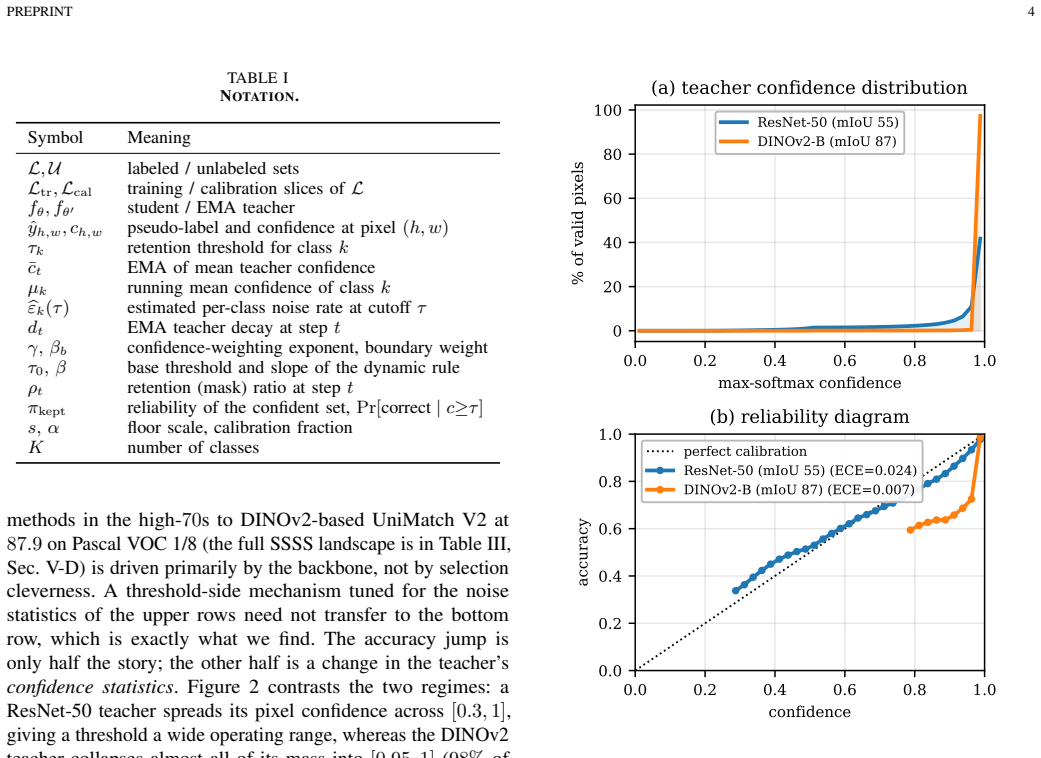
On the paper's own terms, the central discovery is a regime inversion with a measured mechanism. ResNet-era adaptive thresholding rules, dynamic global thresholds, per-class curricula, soft confidence weights, were built for teachers whose confidence spread widely and whose uncertain pixels were often still correct. A DINOv2 teacher collapses that spread: 98% of Pascal pixels have confidence at least 0.95, so any cutoff that adapts downward sits beneath the saturated mass, admits nearly every pixel including almost all teacher errors, and drives retention to 1. The original CW-BASS dynamic threshold is algebraically capped near 0.34, so it degenerates to a constant and the mask floods. The paper claims that strict fixed thresholding at tau = 0.95 is therefore the right rule on reliable saturated teachers, and that the single statistic that separates regimes is pi_kept, the probability that a pixel above the cutoff is correct, estimated on labels the student never trains on. Where pi_kept >= tau the gate selects strict, reproducing the UniMatch V2 operating point (Pascal VOC 1/8 at 87.4 against its reported 87.9, Cityscapes within 0.5); where pi_kept is about 89% (ADE20K) it selects a self-adaptive floor that provably pins retention away from 1, which edges ahead of strict by 1.5 mIoU on a single seed. The paper is explicit that this affirmative win is single-seed and that the gate's boundary is calibrated, not tuned to mIoU.
Load-bearing premise
The gate as deployed must read pi_kept from the live calibration slice, which on Pascal VOC 1/8 is only about 9 images, too few, by the paper's own admission, to separate 98% from 89% with confidence, whereas the across-teacher demonstration measures pi_kept on the 200-image validation split of a converged teacher, so the criterion is validated but the live system is never measured.
Editorial extensions
If this is right
- On the saturated, reliable Pascal VOC and Cityscapes teachers the gate selects strict, so CW-BASS v2 deploys none of its own adaptive machinery there: it reproduces the UniMatch V2 operating point (87.4 versus 87.9 at 1/8; within 0.5 on Cityscapes) and claims to be never worse than the strict state of the art at every DINOv2 scale tested.
- On the one confidently unreliable teacher (ADE20K, pi_kept about 89%), the gate selects the floor, which reaches 50.58 mIoU against 49.10 for strict, the regime where adaptive filtering earns its keep, although the +1.5 magnitude is a single seed.
- A generation of adaptive selection rules (FreeMatch, SoftMatch, per-class risk minimisation) fails the same measured way on saturated teachers: an early peak within epochs 4 to 20, then a decline, with the per-class evaluation model itself shedding 6.14 mIoU.
- The four practitioner checks distilled from the analysis, measure pi_kept, match the batch, report trajectories, and check the best-versus-final gap on the EMA teacher, turn the mechanism into a cheap pre-flight before adopting any threshold rule.
- The held-out calibration costs under 1% wall-clock overhead and accuracy is flat in the calibration fraction alpha, so the gate is nearly free once a labeled slice exists.
Reading between the lines
- My inference: the gate's boundary is a calibration claim about a teacher, not about DINOv2 specifically, so the same pi_kept-versus-tau test is a plausible pre-check for CLIP- or SAM-style teachers, but the paper's own scope statement says this is untested and six teachers can only bracket the boundary, not pin it.
- My inference: the paper's admitted weakness, that a roughly 9-image calibration slice on Pascal 1/8 cannot resolve 98% from 89%, points to a testable fix it leaves implicit, accumulating pi_kept across early epochs, using the unlabeled pool for the estimate, or deferring the gate decision until the teacher has converged, which is when the paper's own validation measures it.
- My inference: the in-batch optimism gap (98.4% versus 89.3%) is a general warning for self-training beyond segmentation, any method that reads confidence statistics off its own training pixels inherits a self-confirming bias that grows as the student memorises the labeled set.
Signed reviews
Editorial analysis
A structured set of objections, weighed in public.
Referee Report
Summary. This paper proposes CW-BASS v2, a saturation-aware pseudo-label selection rule for semi-supervised semantic segmentation under DINOv2 teachers. The method measures the reliability of the teacher's confident set, pi_kept = Pr[correct | c >= 0.95], on held-out labels and gates between strict thresholding at tau = 0.95 and a self-adaptive confidence floor. In a controlled Pascal VOC 1/8 comparison at matched batch size 16, the strict UniMatch V2 recipe beats five adaptive threshold rules, and only strict reaches the UniMatch V2 operating point; the paper attributes this to confidence saturation, dynamic-range collapse, mask flooding, and early-peak-then-decline. Across six DINOv2 S/B teachers, the gate makes the correct strict-versus-floor call, selecting strict on Pascal VOC and Cityscapes and the floor on ADE20K, with a +1.5 mIoU gain over strict on ADE20K (single seed). The paper is explicit that the cross-teacher gate demonstration is a post-hoc validation on validation splits of converged teachers, that the calibration slice is only about 9 images on Pascal 1/8, and that the ADE20K affirmation is single-seed.
Significance. The controlled three-seed Pascal comparison and the matched-batch trajectory analysis are valuable and unusually candid: the paper reports strict's seed variance, best-versus-final EMA degradation, batch-size confounds, and the failure of its own adaptive floor on a saturated teacher. If the deployment version of the gate can be validated, the paper would be a useful contribution, because it explains when adaptive thresholding fails at foundation-model strength and proposes a decision rule rather than another fixed heuristic. The paper's strengths include falsifiable mechanism statements (Corollary 1; Theorem 1 framed as an empirical-stability claim), measured confound components, and released code and scripts for reproducing tables and figures.
major comments (3)
- [Sec. IV-C; Sec. VII-A(iii)] The deployment claim rests on measuring pi_kept on the calibration slice L_cal, but on Pascal 1/8 L_cal is only about 9 images (alpha = 0.05 of 183), a number the paper itself says is 'too few to separate 98% from 89% with confidence.' The cross-teacher demonstration instead measures pi_kept on the 200-image validation split of converged teachers. The paper asserts that the separation (98% vs 89%) is 'far wider than the slice-size noise,' but it provides no variance, bias, or early-training measurement of the live L_cal-based estimator. Please add an experiment or bootstrap analysis showing that a gate run on L_cal-size slices, ideally at training epochs comparable to when the gate would fire, separates the reliable and unreliable regimes; without this, the headline claim that the deployed method is 'never worse' than strict is not established.
- [Abstract and Contribution 1; Sec. VII-A(ii)] The claim that the method is 'never worse' than strict is stronger than the evidence. The only regime in which the gate selects the floor is ADE20K, where the +1.5 mIoU gain over strict is single-seed and, as the paper states, within plausible seed noise; strict's own seed range on Pascal is 84.09-87.40. The sign of the floor-vs-strict gap reproduces at DINOv2-S and DINOv2-B, but the headline 'never worse' requires either multiple seeds of the decisive ADE20K cell or a restricted claim such as 'the gate makes the correct call on the teachers tested, and the floor is competitive rather than proven better.'
- [Sec. V-A, item 1; Sec. VI-A; Sec. VII-A(v)] The strict arm is the full UniMatch V2 recipe (two independent strong views and plain cross-entropy), while the adaptive arms use the CW-BASS v2 scaffold (one strong view plus feature perturbation, confidence-weighted cross-entropy, and a boundary term). The measured components of this confound account for only about 1.2 mIoU, but the dual-strong-view difference is not ablated at all, so the causal statement that the threshold rule itself causes the 3-5 mIoU gap is not fully supported. A drop-in strict-threshold arm inside the CW-BASS v2 loop, even at reduced scale, would make the strict-versus-adaptive comparison single-factor and is the most valuable missing experiment for the paper's causal reading.
minor comments (4)
- [Sec. V-B] In the computational-overhead paragraph, '~104-image unlabeled pool' should read '~10^4-image unlabeled pool', since the Pascal unlabeled pool is on the order of ten thousand images; the printed form '104' is ambiguous.
- [Figure 2(b)] The reliability-diagram comparison contrasts a converged DINOv2 teacher with a partially trained ResNet-50 teacher; the paper flags this confound in the text, but the caption should state it directly because the ECE contrast is easy to over-read.
- [Sec. IV-A] The paper deliberately attaches no confidence interval to the calibration estimator, which is reasonable given spatial correlation, but the statement that the gate's separation is 'far wider than the slice-size noise' would be more convincing if accompanied by a bootstrap estimate of pi_kept's standard error on L_cal-size samples.
- [Table VI] In the Cityscapes-S row the floor (81.16) is below strict (81.51), so the text saying all adaptive rules 'tie' strict on Cityscapes should be worded as 'within 0.5' or 'spread at most 0.7' to avoid overstating the tie.
Circularity Check
No construction-level circularity; the gate boundary is a pre-existing threshold and Theorem 1 rests on a stated, falsifiable assumption, though post-hoc gate validation and self-citation limit independence.
full rationale
Walking the derivation chain, I find no step where a predicted quantity is identical by construction to an input or where a fitted parameter is renamed as a prediction. The gate (Eq. 10) compares pi_kept = Pr[correct | c >= 0.95] to the pre-existing operating threshold tau = 0.95, which the paper explicitly states is 'not a value tuned on mIoU' (Sec. IV-C). This is a calibration self-consistency criterion, not a fit. Theorem 1 follows from the explicitly stated, falsifiable Assumption 1, and the paper candidly says 'Once Assumption 1 is granted the factors cancel and the result is elementary; the substance is entirely whether the assumption holds', so the bounded-retention claim is a conditional derivation with an empirical check, not a tautological prediction. Proposition 1 is a standard de-biasing argument using a calibration slice L_cal disjoint from the supervised gradient; its unbiasedness is conditional on the teacher and selected count, as stated. The main independence-limiting features are flagged rather than hidden: the six-teacher 'blind' gate call is 'a post-hoc validation, not a live deployment' (Sec. IV-C), measured on 200-image validation splits from converged teachers rather than on the ~9-image L_cal a live run would use, and Sec. VII-A says 'we have therefore validated the criterion, not measured the live system'. This is a real limitation on the deployment claim, and the paper even contains an internal tension between 'too few to separate 98% from 89% with confidence' (Sec. IV-C) and 'the separation it exploits ... is far wider than the slice-size noise' (Sec. IV-C), but that is a correctness/evidential problem, not circularity. The CW-BASS scaffold is self-cited, but the collapse analysis is re-derived from Equation (4) and checked by a parameter sweep (Table XV), so the self-citation is not load-bearing for the central gate result. Accordingly, there is no construction-level circularity; the score of 2 reflects the minor self-citation and the post-hoc, same-teacher validation that temper the 'blind' and 'never worse' claims without making the derivation equivalent to its inputs.
Assumptions & free parameters
free parameters (8)
- floor scale s =
0.95
- calibration fraction alpha =
0.05
- base threshold tau0 =
0.6
- sigmoid slope beta =
0.5
- lower clamp tau_min =
0.3
- confidence weighting exponent gamma =
1
- boundary weight beta_b =
0.5
- floor momentum m =
0.99
assumptions (4)
- domain assumption Assumption 1: confidence of unlabeled pixels follows a scale-family distribution c = c_bar_t * V_k with time-invariant relative confidence V_k.
- domain assumption Calibration pixels are drawn from the same population as unlabeled pixels and are independent of the student optimization because they never contribute gradients.
- domain assumption DINOv2 teachers are representative of foundation-model teachers for the gate.
- standard math Welch t-test and standard probability calculations are used to compare three-seed means.
Cite this review
Pith. "Pith review of CW-BASS v2: Saturation-Aware Pseudo-Label Selection for Semi-Supervised Segmentation under Foundation-Model Teachers." pith.science (2026). https://pith.science/paper/SICPNIKT
@misc{pith2026260812773,
  author       = {Pith},
  title        = {Pith review of: CW-BASS v2: Saturation-Aware Pseudo-Label Selection for Semi-Supervised Segmentation under Foundation-Model Teachers},
  year         = {2026},
  howpublished = {\url{https://pith.science/paper/SICPNIKT}},
  note         = {Machine review of arXiv:2608.12773}
}
read the original abstract
Semi-supervised semantic segmentation has long turned on one question, which pseudo-labels to trust, and a generation of selection rules, dynamic thresholds, per-class curricula, soft confidence weights, answered it for the noisy, under-confident ResNet teachers of their day. Self-supervised foundation encoders change the regime: with a DINOv2 teacher, confidence saturates, so the filtering that helped a weak teacher can hurt a strong one. We propose CW-BASS v2, a saturation-aware pseudo-label selection method that reads the teacher's confidence regime rather than committing to one rule. It pairs held-out calibration, an unbiased per-class noise estimate, with a self-adaptive confidence floor that provably bounds retention away from 1, and combines them in a one-pass gate: measure the reliability of the teacher's confident set, pi_kept = Pr[correct | c >= tau], on a held-out slice, and filter strictly when it meets the confidence demanded (pi_kept >= tau), falling back to the adaptive floor otherwise. The boundary is the pre-existing operating threshold, not a value tuned to mIoU, and across six DINOv2 teachers it makes the correct strict-vs-floor call blind. CW-BASS v2 thus recovers the UniMatch V2 operating point on the saturated benchmarks by selecting strict (Pascal VOC 1/8 87.4 against its reported 87.9; Cityscapes within 0.5), and improves on it where the confident set is unreliable (pi_kept ~ 89%, ADE20K), where the floor edges ahead (+1.5 mIoU, single seed). The gate is principled because the failure it avoids is measured, not assumed: on a reliable, saturated teacher the confidence distribution's dynamic range collapses (98% of Pascal pixels >= 0.95), so an adaptive cutoff floods the retention mask and self-training decays into confirmation bias.
Figures


Figures from the paper (8 more)


Reference graph
Works this paper leans on
-
[1]
Semi-supervised semantic segmentation needs strong, varied perturbations,
X. Chen, Y . Yuan, G. Zeng, and J. Wang, “Semi-supervised semantic segmentation needs strong, varied perturbations,” inCVPR, 2021
work page 2021
-
[2]
Fixmatch: Simplifying semi-supervised learning with consistency and confidence,
K. Sohn, D. Berthelot, N. Carlini, Z. Zhang, H. Zhang, C. A. Raffel, A. S. Rawat, O. Shavitet al., “Fixmatch: Simplifying semi-supervised learning with consistency and confidence,” inNeurIPS, 2020
work page 2020
-
[3]
Revisiting weak-to- strong consistency in semi-supervised semantic segmentation,
L. Yang, L. Qi, L. Feng, W. Zhang, and Y . Shi, “Revisiting weak-to- strong consistency in semi-supervised semantic segmentation,” inCVPR, 2023
2023
-
[4]
Pseudo-label: The simple and efficient semi-supervised learning method for deep neural networks,
D.-H. Lee, “Pseudo-label: The simple and efficient semi-supervised learning method for deep neural networks,” inICML Workshop on Challenges in Representation Learning, 2013
work page 2013
-
[5]
Encoder- decoder with atrous separable convolution for semantic image segmenta- tion,
L.-C. Chen, Y . Zhu, G. Papandreou, F. Schroff, and H. Adam, “Encoder- decoder with atrous separable convolution for semantic image segmenta- tion,”ECCV, 2018
work page 2018
-
[6]
Flexmatch: Boosting semi-supervised learning with curriculum pseudo labeling,
B. Zhang, Y . Wang, W. Hou, H. Wu, J. Wang, M. Okumura, and T. Shinozaki, “Flexmatch: Boosting semi-supervised learning with curriculum pseudo labeling,” inNeurIPS, 2021
work page 2021
-
[7]
Freematch: Self-adaptive thresholding for semi-supervised learning,
Y . Wang, H. Chen, Q. Heng, W. Hou, Y . Fan, Z. Wu, J. Wang, M. Savvides, T. Shinozaki, B. Rajet al., “Freematch: Self-adaptive thresholding for semi-supervised learning,” inICLR, 2023
work page 2023
-
[8]
Softmatch: Addressing the quantity-quality tradeoff in semi-supervised learning,
H. Chen, R. Tao, Y . Fan, Y . Wang, J. Wang, B. Schiele, X. Xie, B. Raj, and M. Savvides, “Softmatch: Addressing the quantity-quality tradeoff in semi-supervised learning,” inICLR, 2023
work page 2023
Show all 45 references
-
[9]
Semi-supervised semantic segmentation using unreliable pseudo-labels,
Y . Wang, H. Wang, Y . Shen, J. Fei, W. Li, G. Jin, L. Wu, R. Zhao, and X. Le, “Semi-supervised semantic segmentation using unreliable pseudo-labels,” inCVPR, 2022
2022
-
[10]
Re-distributing biased pseudo labels for semi-supervised semantic segmentation: A baseline investigation,
R. He, J. Yang, and X. Qi, “Re-distributing biased pseudo labels for semi-supervised semantic segmentation: A baseline investigation,” in CVPR, 2022
2022
-
[11]
Semi-supervised semantic segmentation via adaptive equalization learning,
H. Hu, F. Wei, H. Hu, Q. Ye, J. Cui, and L. Wang, “Semi-supervised semantic segmentation via adaptive equalization learning,” inNeurIPS, 2021
2021
-
[12]
CW-BASS: Confidence- weighted boundary-aware learning for semi-supervised semantic seg- mentation,
E. Tarubinga, J. Kalafatovich, and S.-W. Lee, “CW-BASS: Confidence- weighted boundary-aware learning for semi-supervised semantic seg- mentation,” in2025 International Joint Conference on Neural Networks (IJCNN). IEEE, 2025, pp. 1–8
2025
-
[13]
Dinov2: Learning robust visual features without supervision,
M. Oquab, T. Darcet, T. Moutakanni, H. V . V o, M. Szafraniecet al., “Dinov2: Learning robust visual features without supervision,”TMLR, 2024
2024
-
[14]
Vision transformers for dense prediction,
R. Ranftl, A. Bochkovskiy, and V . Koltun, “Vision transformers for dense prediction,” inICCV, 2021
2021
-
[15]
UniMatch V2: Pushing the limit of semi-supervised semantic segmentation,
L. Yang, L. Qi, L. Feng, W. Zhang, and Y . Shi, “UniMatch V2: Pushing the limit of semi-supervised semantic segmentation,”IEEE Transactions on Pattern Analysis and Machine Intelligence (TPAMI), 2025
2025
-
[16]
Feedback-driven pseudo-label reliability assessment: Redefining thresholding for semi-supervised semantic segmentation,
N. Ghamsarian, S. Nasirihaghighi, K. Schoeffmann, and R. Sznit- man, “Feedback-driven pseudo-label reliability assessment: Redefining thresholding for semi-supervised semantic segmentation,”arXiv preprint arXiv:2505.07691, 2025
2025 arXiv
-
[17]
Pseudo-labeling and confirmation bias in deep semi-supervised learning,
E. Arazo, D. Ortego, P. Albert, N. E. O’Connor, and K. McGuinness, “Pseudo-labeling and confirmation bias in deep semi-supervised learning,” inInternational Joint Conference on Neural Networks (IJCNN), 2020
2020
-
[18]
Fine-tuning can distort pretrained features and underperform out-of-distribution,
A. Kumar, A. Raghunathan, R. Jones, T. Ma, and P. Liang, “Fine-tuning can distort pretrained features and underperform out-of-distribution,” in International Conference on Learning Representations (ICLR), 2022
2022
-
[19]
Mean teachers are better role models: Weight-averaged consistency targets improve semi-supervised deep learning results,
A. Tarvainen and H. Valpola, “Mean teachers are better role models: Weight-averaged consistency targets improve semi-supervised deep learning results,” inNeurIPS, 2017
2017
-
[20]
Perturbed and strict mean teachers for semi-supervised semantic seg- mentation,
Y . Liu, Y . Tian, Y . Chen, F. Liu, V . Belagiannis, and G. Carneiro, “Perturbed and strict mean teachers for semi-supervised semantic seg- mentation,” inCVPR, 2022
2022
-
[21]
St++: Make self-training work better for semi-supervised semantic segmentation,
L. Yang, W. Zhuo, L. Qi, Y . Shi, and Y . Gao, “St++: Make self-training work better for semi-supervised semantic segmentation,” inCVPR, 2022
2022
-
[22]
Augseg: Maximizing the utility of unlabeled data for semi-supervised semantic segmentation,
Z. Zhao, S. Yang, H. Xing, S. Xu, Y . Yang, and Y . Zhang, “Augseg: Maximizing the utility of unlabeled data for semi-supervised semantic segmentation,” inCVPR, 2023
2023
-
[23]
Allspark: Reborn labeled features from unlabeled in transformer for semi-supervised semantic segmentation,
H. Yang, M. Li, Y . Zhuge, and H. Lu, “Allspark: Reborn labeled features from unlabeled in transformer for semi-supervised semantic segmentation,” inCVPR, 2024
2024
-
[24]
CorrMatch: Label propagation via correlation matching for semi-supervised semantic segmentation,
Z. Sun, F. Yang, Q. Huet al., “CorrMatch: Label propagation via correlation matching for semi-supervised semantic segmentation,” in CVPR, 2024
2024
-
[25]
Dash: Semi-supervised learning with dynamic thresholding,
Y . Xu, L. Shang, J. Ye, Q. Qian, Y .-F. Li, B. Sun, H. Li, and R. Jin, “Dash: Semi-supervised learning with dynamic thresholding,” inICML, 2021
2021
-
[26]
CAFS: Class adaptive framework for semi-supervised semantic segmentation,
J. Ju, H. Noh, Y . Wang, M. Seo, and D.-G. Choi, “CAFS: Class adaptive framework for semi-supervised semantic segmentation,”arXiv preprint arXiv:2303.11606, 2023
2023 arXiv
-
[27]
FARCLUSS: Fuzzy adaptive rebalancing and contrastive uncertainty learning for semi- supervised semantic segmentation,
E. Tarubinga, J. Kalafatovich, and S.-W. Lee, “FARCLUSS: Fuzzy adaptive rebalancing and contrastive uncertainty learning for semi- supervised semantic segmentation,”Neural Networks, 2026, art. 109494; arXiv:2506.11142
2026 arXiv
-
[28]
Realistic evaluation of deep semi-supervised learning algorithms,
A. Oliver, A. Odena, C. Raffel, E. D. Cubuk, and I. J. Goodfellow, “Realistic evaluation of deep semi-supervised learning algorithms,” in Advances in Neural Information Processing Systems (NeurIPS), 2018
2018
-
[29]
Rethinking semi-supervised segmentation beyond accuracy: Reliability and robustness,
S. Landgrafet al., “Rethinking semi-supervised segmentation beyond accuracy: Reliability and robustness,” inGerman Conference on Pattern Recognition (GCPR), 2025, arXiv:2506.05917
2025 arXiv
-
[30]
SemiVL: Semi-supervised semantic segmentation with vision-language guidance,
L. Hoyer, D. Dai, H. Wang, and L. Van Gool, “SemiVL: Semi-supervised semantic segmentation with vision-language guidance,” inECCV, 2024
2024
-
[31]
Learning with noisy labels,
N. Natarajan, I. S. Dhillon, P. K. Ravikumar, and A. Tewari, “Learning with noisy labels,” inNeurIPS, 2013
2013
-
[32]
Confident learning: Estimating uncertainty in dataset labels,
C. G. Northcutt, L. Jiang, and I. L. Chuang, “Confident learning: Estimating uncertainty in dataset labels,”Journal of Artificial Intelligence Research, vol. 70, pp. 1373–1411, 2021
2021
-
[33]
On calibration of modern neural networks,
C. Guo, G. Pleiss, Y . Sun, and K. Q. Weinberger, “On calibration of modern neural networks,” inProceedings of the 34th International Conference on Machine Learning (ICML), ser. Proceedings of Machine Learning Research, vol. 70. PMLR, 2017, pp. 1321–1330
2017
-
[34]
Beta calibration: A well-founded and easily implemented improvement on logistic calibration for binary classifiers,
M. Kull, T. Silva Filho, and P. Flach, “Beta calibration: A well-founded and easily implemented improvement on logistic calibration for binary classifiers,” inAISTATS, 2017
2017
-
[35]
Beyond temperature scaling: Obtaining well-calibrated multiclass probabilities with Dirichlet calibration,
M. Kull, M. Perello Nieto, M. Kängsepp, T. Silva Filho, H. Song, and P. Flach, “Beyond temperature scaling: Obtaining well-calibrated multiclass probabilities with Dirichlet calibration,” inAdvances in Neural Information Processing Systems (NeurIPS), vol. 32, 2019
2019
-
[36]
Improving calibration for long- tailed recognition,
Z. Zhong, J. Cui, S. Liu, and J. Jia, “Improving calibration for long- tailed recognition,” inIEEE Conference on Computer Vision and Pattern Recognition (CVPR), 2021
2021
-
[37]
Theoretical analysis of self- training with deep networks on unlabeled data,
C. Wei, K. Shen, Y . Chen, and T. Ma, “Theoretical analysis of self- training with deep networks on unlabeled data,” inICLR, 2021
2021
-
[38]
Learning imbal- anced datasets with label-distribution-aware margin loss,
K. Cao, C. Wei, A. Gaidon, N. Arechiga, and T. Ma, “Learning imbal- anced datasets with label-distribution-aware margin loss,” inNeurIPS, 2019
2019
-
[39]
Seesaw loss for long-tailed instance segmentation,
J. Wang, W. Zhang, Y . Zang, Y . Cao, J. Pang, T. Gong, K. Chen, Z. Liu, C. C. Loy, and D. Lin, “Seesaw loss for long-tailed instance segmentation,” inCVPR, 2021
2021
-
[40]
CReST: A class-rebalancing self-training framework for imbalanced semi-supervised learning,
C. Wei, K. Sohn, C. Mellina, A. Yuille, and F. Yang, “CReST: A class-rebalancing self-training framework for imbalanced semi-supervised learning,” inCVPR, 2021
2021
-
[41]
Class-imbalanced semi-supervised learning with adaptive thresholding,
L.-Z. Guo and Y .-F. Li, “Class-imbalanced semi-supervised learning with adaptive thresholding,” inProceedings of the 39th International Conference on Machine Learning (ICML), ser. Proceedings of Machine Learning Research, vol. 162. PMLR, 2022, pp. 8082–8094
2022
-
[42]
Towards the uncharted: Density-descending feature perturbation for semi-supervised semantic segmentation,
X. Wang, H. Bai, L. Yu, Y . Zhao, and J. Xiao, “Towards the uncharted: Density-descending feature perturbation for semi-supervised semantic segmentation,” inCVPR, 2024
2024
-
[43]
Revisiting and maximizing temporal knowledge in semi-supervised semantic segmentation,
W. Shin, H. J. Park, J. S. Kim, and S. W. Han, “Revisiting and maximizing temporal knowledge in semi-supervised semantic segmentation,”arXiv preprint arXiv:2405.20610, 2024
2024
-
[44]
Beyond pixels: Semi- supervised semantic segmentation with a multi-scale patch-based multi- label classifier,
P. Howlader, S. Das, H. Le, and D. Samaras, “Beyond pixels: Semi- supervised semantic segmentation with a multi-scale patch-based multi- label classifier,” inECCV, 2024
2024
-
[45]
PixCon: Clean-positive contrastive learning for foundation- model semi-supervised segmentation,
E. Tarubinga, “PixCon: Clean-positive contrastive learning for foundation- model semi-supervised segmentation,”arXiv preprint arXiv:2607.03068, 2026. APPENDIX Two analyses that Sec. VI summarises in the main text are reported here in full: a threshold-parameter sweep ruling ou...
2026 arXiv
Reviewed August 15, 2026 · model on record in the stance chip above.
Discussion (0). Continue with ORCID to comment.