REVIEW 3 major objections 4 minor 46 references
CRAFT: LLM-Based Iterative Refinement for Temporal Reasoning over Clinical Narratives
T0 review · 3 major / 4 minor · reviewed 2026-08-15 · deepseek-v4-flash
Pith's one-line read A generator-verifier loop with a five-point rubric improves exact-match symptom-timeline reconstruction on 3,166 vaccine adverse-event reports.
desk verdict MedTempo is a solid new benchmark, but the paper's 'consistently improves' claim rests on small, untested EM gaps and is undercut by the authors' own Claude ablation. read the letter →
The pith
A machine-rendered reading of the paper's core claim, the machinery that carries it, and where it could break.
The reading
What carries the argument
The load-bearing mechanism is the time-bucket trajectory representation together with the generator-verifier loop. Each report $r$ is mapped to a prediction $B(r) = (B_1,\dots,B_K)$: a JSON list of non-empty buckets in which every finding from the provided symptom list appears exactly once and buckets run from earliest to latest. The generator $g$ maps the symptom list, free-text narrative, and any prior feedback to a candidate timeline; the verifier $v$ first runs FormatTool, a deterministic normalizer that repairs raw output into the bucket schema without touching temporal content, then scores the candidate on a five-point additive rubric and emits either ACCEPT or REVISE with feedback. The full-regeneration variant rewrites the timeline from the complete task prompt each round, which the ablation shows is safer than an edit-conditioned variant under sustained feedback. The loop converts temporal ordering from a single-shot generation problem into a constrained iterative structured-prediction problem with a fixed acceptance threshold $\theta = 3$ and budget $T_{\max} = 4$.
What would settle it
Take a random sample of MedTempo-T reports and have annotators build gold timelines directly from the narratives without ever seeing the GPT-4o mini draft; compare the blind gold labels to the released labels on bucket composition and pairwise order. If agreement is far below the reported 93% inter-annotator rate, or if CRAFT's gains shrink when evaluated against blind labels, the central claim is not independent of the drafting model. A sharper test is to restrict evaluation to the 9% of reports whose draft labels were corrected: if CRAFT does not improve there, the loop mostly echoes the drafting model's biases rather than reasoning about time.
Extended reading notes
Core claim
The central discovery is that a fully automated generator-verifier refinement loop beats two alternative baselines at reconstructing ordered symptom timelines from anchor-sparse narratives, and it beats a single unverified pass for three of the four models tested. CRAFT-Full pairs a generator that regenerates the entire timeline from full task context at each iteration with a verifier that awards one point for each of five criteria: valid JSON in earliest-to-latest order, unmentioned symptoms placed as "none" in the final group, each symptom appearing exactly once, symptoms grouped only when they occur around the same time, and group order following the temporal cues in the text. A score of at least 3 accepts the candidate; otherwise the verifier returns specific corrective feedback and the loop repeats, up to four iterations. Across Claude Sonnet 4.5, GPT-4.1, Llama-3.3-70B, and MedGemma-27B, CRAFT-Full achieves the highest exact-match score in every model block relative to the baselines, and the ablations attribute most of the gain to the verifier, with full-context regeneration outperforming edit-conditioned refinement. The paper also reports that for Claude, whose first pass is already near gold, the fixed threshold can reject a correct output and make the loop slightly underperform a single unverified pass.
Load-bearing premise
The load-bearing premises are that MedTempo's gold timelines genuinely reflect the order symptoms appeared and that the provided symptom lists are complete and correctly coded; the riskier one is the gold timelines, because they were drafted by GPT-4o mini and then human-reviewed, so if the reviewers anchored on the draft the benchmark target inherits the drafting model's temporal biases and the measured gains are partly circular.
Editorial extensions
If this is right
- Exact-match timeline reconstruction becomes achievable from a single report plus a symptom list, without requiring timestamps or multi-visit records.
- For capable models, a longer refinement budget pays off: GPT-4.1's exact match grows from 26.90 at iteration 1 to 35.61 at iteration 4, while weaker models accept within one or two iterations and gain little.
- The ablations show most of the gain comes from the verifier and from regenerating with full context, so improvements in feedback quality are likely more valuable than switching to local-edit refinement.
- The stable model ranking across configurations and vaccine types makes MedTempo a usable standardized benchmark for comparing future temporal-reasoning methods.
- The reserved non-temporal reports set up a separable next task, deciding whether a report contains temporal progression, that would let a future pipeline apply CRAFT selectively.
Reading between the lines
- A per-backbone acceptance threshold is the obvious untested lever: the paper's own case study shows a fixed $\theta = 3$ can reject or under-reward a near-correct Claude output and drive oscillation, so adapting the threshold to the model would likely recover the lost points.
- Because the gold labels were drafted by GPT-4o mini and then human-reviewed, a blind re-annotation of a random sample, with annotators seeing only the narrative, would test whether MedTempo's target is independent of the drafting model family; the paper does not report such a check.
- The same bucket-list representation and rubric loop could port to other anchor-sparse timeline tasks, such as inferring symptom progression from electronic-health-record narratives, with the verifier rubric re-specified for each new setting.
- If the verifier's rubric is the main driver of gains, investing in better verifier criteria may matter more than scaling the generator.
Signed reviews
Editorial analysis
A structured set of objections, weighed in public.
Referee Report
Summary. This paper introduces CRAFT, a generator-verifier LLM framework for reconstructing stage-wise symptom timelines from single clinical narratives with weak temporal anchoring, and MedTempo, a benchmark of 5,347 VAERS narratives of which 3,166 have expert-validated temporal stage annotations. CRAFT iterates between a generator that proposes or edits a bucket-based timeline and a verifier that scores it with a 0-5 rubric, returning targeted feedback until an acceptance threshold or iteration cap is reached. The authors evaluate five configurations (CRAFT-Full, PIVOT, GUIDE, CRAFT-G, and CRAFT without verifier) on four LLM backbones using exact match, LCCS, and Kendall's tau-b, and report that CRAFT-Full attains the highest EM in every model block, with ablations attributing gains to the verifier and to full regeneration. They also report vaccine-stratified results and two case studies showing how verifier feedback corrects grouping errors and how a miscalibrated verifier can cause oscillation.
Significance. If the empirical claims are supported, the paper makes three useful contributions: it defines a clean, under-addressed task (structured trajectory reconstruction from anchor-sparse single reports), it releases a relatively large expert-validated benchmark with clear exclusion rules and 93% inter-annotator agreement, and it provides a systematic comparison of generator and verifier design choices across four model tiers. The ablation design is thoughtful, the three evaluation metrics are appropriate for bucket-sequence prediction, and the dataset construction is generally careful, including adjudication and reporting of acceptance, correction, and exclusion rates. The main reservations concern the statistical support for the headline claim, the uniform hyperparameter choice applied to all backbones, and the possibility that the gold standard inherits biases from the LLM that drafted the initial timelines; these issues are addressable but currently prevent the central conclusion from being fully established.
major comments (3)
- [Section 6.1, Table 5.1] The headline claim that CRAFT-Full 'consistently improves temporal ordering accuracy' and is 'the strongest configuration' rests on EM margins of +1.0, +0.8, +0.7, and +0.1 over PIVOT and +1.6, +2.0, +1.5, and +0.7 over GUIDE, with the smallest margin corresponding to roughly three changed reports among 3,166. No confidence intervals or paired significance tests (McNemar, bootstrap, permutation) are reported anywhere in Section 6 or the appendix, so these differences are currently indistinguishable from sampling noise. Please add paired significance testing or, failing that, restrict the conclusion to a directional observation for the particular models and configurations tested.
- [Appendix A.2 with Section 6.4 and Table 6.1] The loop hyperparameters T_max=4 and theta=3 were selected on a 100-instance dev set using GPT-4.1 alone and applied uniformly to all backbones. The paper's own results show this choice is miscalibrated for Claude Sonnet 4.5, where CRAFT-Full (EM 37.14) falls below CRAFT without verifier (EM 37.83), and Appendix A.5 documents an oscillation caused by the same threshold behavior under GUIDE. Because the central claim is that CRAFT-Full is strongest across model tiers, the paper must either calibrate per model with a non-test selection protocol or report a sensitivity analysis over theta and T_max showing that the conclusion is robust; otherwise the 'strongest configuration' claim is only supported for GPT-4.1.
- [Section 3.3 and Figure 4.1(a)] Gold timelines were initialized by GPT-4o mini and then reviewed by two annotators, with 80% of drafts accepted unchanged; Figure 4.1(a) instead labels the pre-annotation model as GPT-4.1. If the human reviewers anchored on the model draft, the benchmark inherits GPT-4o mini's temporal ordering biases, which would favor LLM-based systems of the same family and make the benchmark less reliable as an independent gold standard. The authors should report a human-only reannotation of a random subset (with agreement against the current gold) or otherwise quantify anchoring, and they should correct the model-name inconsistency.
minor comments (4)
- [Section 3.3, Table 3.1] The statement that '80% of LLM annotations were accepted without change' is useful, but the paper does not report the distribution of the 9% corrected cases by error type; a small breakdown (e.g., grouping versus ordering corrections) would help assess the anchoring risk.
- [Table 5.1] The row label 'CRAFT G' should be 'CRAFT-G' to match Section 5.2 and the rest of the paper.
- [Section 5.3] The paper says deterministic decoding is used; please state the temperature and sampling settings explicitly for the proprietary APIs and note whether API-side nondeterminism was checked.
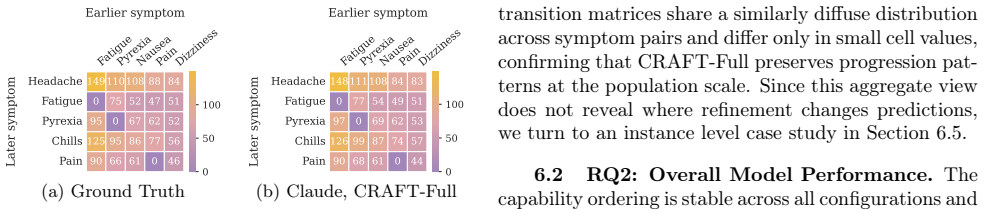
- [Figures 6.1 and A.1] The heatmaps would be easier to read with a defined color scale and explicit zero handling; the current captions describe counts but the color mapping is not explained.
Circularity Check
No circularity: CRAFT's EM gains and MedTempo scores are empirical; no fitted parameter is renamed as a prediction.
full rationale
The paper's central claim—that CRAFT-Full improves temporal ordering accuracy over the PIVOT and GUIDE baselines—is an empirical, externally evaluated result, not a derivation from its own inputs. The gold-standard timelines in MedTempo were produced by a three-phase human-in-the-loop protocol (GPT-4o mini draft, two human annotators, adjudication, Section 3.3), and no model output or predicted timeline is used to define the gold labels. The only tuned quantities, Tmax=4 and theta=3, are selected on a 100-instance development sample with GPT-4.1 (Appendix A.2) and then applied uniformly; this is standard hyperparameter selection rather than fitting a parameter to the evaluation data and renaming it a prediction. The verifier's rubric scores structural properties (valid JSON, all symptoms used once, ordering, grouping), and acceptance is a thresholded score, not a directly fitted target. There is no self-citation chain: the cited iterative-refinement work (Self-Refine, Hein et al.) is external prior work, and no uniqueness theorem or author-imposed ansatz is invoked to force the framework. The GPT-4o-mini pre-annotation could raise a benchmark-validity concern about human anchoring, but that is a data-construction and evaluation-bias issue, not a circular derivation: the paper's pipeline does not use the gold labels to construct the generator, verifier, or predictions. Under the required standard of exhibiting a concrete reduction of a claimed result to its own fitted input or self-citation, no circular step is present.
Assumptions & free parameters
free parameters (4)
- max_iterations T_max =
4
- verifier acceptance threshold theta =
3
- verifier rubric weights =
1 point per criterion, 5 criteria
- data filtering cutoffs =
symptom count > 3; words > 10; words >= 30 retained unconditionally
assumptions (4)
- domain assumption The VAERS narratives contain sufficient temporal evidence to reconstruct the true symptom order, and the 3,166 reports selected as MedTempo-T are exactly those with temporal progression.
- domain assumption The MedDRA symptom list F(r) paired with each report is complete and correct, so the ordering task is well-defined on a fixed finding set.
- ad hoc to paper Gold timelines derived from a GPT-4o mini draft plus human review and adjudication are valid ground truth.
- domain assumption LLM outputs under deterministic decoding are deterministic enough for reproducible comparison across the four backbones.
Cite this review
Pith. "Pith review of CRAFT: LLM-Based Iterative Refinement for Temporal Reasoning over Clinical Narratives." pith.science (2026). https://pith.science/paper/J3P5BNXK
@misc{pith2026260812779,
  author       = {Pith},
  title        = {Pith review of: CRAFT: LLM-Based Iterative Refinement for Temporal Reasoning over Clinical Narratives},
  year         = {2026},
  howpublished = {\url{https://pith.science/paper/J3P5BNXK}},
  note         = {Machine review of arXiv:2608.12779}
}
read the original abstract
Understanding the temporal progression of symptoms in clinical narratives is critical for disease monitoring, safety surveillance, and causality assessment. Clinical narratives, however, rarely provide explicit temporal anchors. Current approaches to temporal information reasoning focus predominantly on pairwise relation classification across multi-visit and timestamp-rich records, leaving the reconstruction of structured symptom trajectories from individual anchor-sparse reports largely unaddressed. We propose CRAFT, an LLM framework that pairs a generator with a constraint-based verifier to iteratively produce and refine stage-wise symptom timelines through targeted feedback. We conduct evaluation on MedTempo, a new benchmark of 5,347 vaccine adverse-event narratives spanning three COVID-19 vaccine types, with expert-validated temporal stage annotations for 3,166 reports. Experiments across four LLM backbones demonstrate that CRAFT consistently improves temporal ordering accuracy, with ablation analysis isolating the contribution of generator and verifier components across model capability levels.
Figures


Figures from the paper (4 more)



Reference graph
Works this paper leans on
-
[1]
Algorithms on Strings, Trees, and Sequences: Computer Science and Computational Biology , author =. 1997 , publisher =
work page 1997
-
[2]
Transformers: State-of-the-Art Natural Language Processing , author =. Proceedings of the 2020 Conference on Empirical Methods in Natural Language Processing: System Demonstrations , month = oct, year =. doi:10.18653/v1/2020.emnlp-demos.6 , pages =
-
[3]
Dettmers, Tim and Pagnoni, Artidoro and Holtzman, Ari and Zettlemoyer, Luke , booktitle =
-
[4]
and Bethard, Steven and Finan, Sean and Palmer, Martha and Pradhan, Sameer and de Groen, Piet C
Styler IV, William F. and Bethard, Steven and Finan, Sean and Palmer, Martha and Pradhan, Sameer and de Groen, Piet C. and Erickson, Brad and Miller, Timothy and Lin, Chen and Savova, Guergana and Pustejovsky, James , title =. Transactions of the Association for Computational Linguistics , volume =
-
[5]
Fifth International Workshop on Computational Semantics (IWCS-5) , year =
Pustejovsky, James and Casta. Fifth International Workshop on Computational Semantics (IWCS-5) , year =
-
[6]
Proceedings of the Fourth International Workshop on Semantic Evaluations (SemEval-2007) , year =
Verhagen, Marc and Gaizauskas, Robert and Schilder, Frank and Hepple, Mark and Pustejovsky, James , title =. Proceedings of the Fourth International Workshop on Semantic Evaluations (SemEval-2007) , year =
work page 2007
-
[7]
Evaluating Temporal Relations in Clinical Text: 2012
Sun, Weiyi and Rumshisky, Anna and Uzuner,. Evaluating Temporal Relations in Clinical Text: 2012. Journal of the American Medical Informatics Association , volume =
work page 2012
-
[8]
Proceedings of the 11th International Workshop on Semantic Evaluation (SemEval-2017) , year =
Bethard, Steven and Savova, Guergana and Palmer, Martha and Pustejovsky, James , title =. Proceedings of the 11th International Workshop on Semantic Evaluation (SemEval-2017) , year =
work page 2017
Show all 46 references
-
[9]
PLOS ONE , volume =
Li, Yiming and Li, Jianfu and He, Jianping and Tao, Cui , title =. PLOS ONE , volume =
-
[10]
Drug Safety , year =
Sessa, Maurizio and others , title =. Drug Safety , year =
-
[11]
2025 , howpublished =
OpenAI , title =. 2025 , howpublished =
2025
-
[12]
2025 , howpublished =
Anthropic , title =. 2025 , howpublished =
2025
-
[13]
2024 , howpublished =
2024
-
[14]
2507.05201 , archivePrefix =
Sellergren, Andrew and Kazemzadeh, Sahar and Jaroensri, Tiam and Kiraly, Atilla and others , year =. 2507.05201 , archivePrefix =
-
[15]
Biometrika , volume=
The treatment of ties in ranking problems , author=. Biometrika , volume=. 1945 , publisher=
1945
-
[16]
Proceedings of the 2016 conference on empirical methods in natural language processing , pages=
Squad: 100,000+ questions for machine comprehension of text , author=. Proceedings of the 2016 conference on empirical methods in natural language processing , pages=
2016
-
[17]
Proceedings of the 2018 Conference on Empirical Methods in Natural Language Processing , year =
Temporal Information Extraction by Predicting Relative Time-lines , author =. Proceedings of the 2018 Conference on Empirical Methods in Natural Language Processing , year =. doi:10.18653/v1/D18-1155 , url =
2018 doi
-
[18]
2023 , address =
Alsayyahi, Sarah and Batista-Navarro, Riza , booktitle =. 2023 , address =. doi:10.18653/v1/2023.emnlp-main.1016 , url =
2023 doi
- [19]
-
[20]
Journal of Biomedical Informatics , volume =
Review of Temporal Reasoning in the Clinical Domain for Timeline Extraction: Where we are and where we need to be , author =. Journal of Biomedical Informatics , volume =. 2021 , doi =
2021
-
[21]
Journal of Biomedical Informatics , volume =
Extraction of temporal relations from clinical free text: A systematic review of current approaches , author =. Journal of Biomedical Informatics , volume =. 2020 , doi =
2020
-
[22]
Journal of Biomedical Informatics , volume =
Towards generating a patient’s timeline: Extracting temporal relationships from clinical notes , author =. Journal of Biomedical Informatics , volume =. 2013 , doi =
2013
-
[23]
Journal of the American Medical Informatics Association , volume =
The Evaluation of a Temporal Reasoning System in Processing Clinical Discharge Summaries , author =. Journal of the American Medical Informatics Association , volume =. 2008 , doi =
2008
-
[24]
AMIA Annual Symposium Proceedings , year =
A Systematic Temporal Extraction Pipeline for Medical Concepts in Clinical Notes , author =. AMIA Annual Symposium Proceedings , year =
-
[25]
JAMIA Open , volume =
Using large language models for temporal relation extraction from pediatric clinical reports , author =. JAMIA Open , volume =. 2025 , doi =
2025
-
[26]
npj Digital Medicine , volume =
TIMER: temporal instruction modeling and evaluation for longitudinal clinical records , author =. npj Digital Medicine , volume =. 2025 , doi =
2025
- [27]
-
[28]
Proceedings of the 22nd Workshop on Biomedical Natural Language Processing and BioNLP Shared Tasks , month = jul, year =
End-to-end clinical temporal information extraction with multi-head attention , author =. Proceedings of the 22nd Workshop on Biomedical Natural Language Processing and BioNLP Shared Tasks , month = jul, year =. doi:10.18653/v1/2023.bionlp-1.4 , pages =
-
[29]
Evaluating
Andrew, Judith Jeyafreeda and Vincent, Marc and Burgun, Anita and Garcelon, Nicolas , editor =. Evaluating. Proceedings of the First Workshop on Patient-Oriented Language Processing (CL4Health) @ LREC-COLING 2024 , month = may, year =
2024
- [30]
- [31]
-
[32]
AMIA Joint Summits on Translational Science proceedings
Extracting Relative Timelines from Medical Case Reports using Large Language Models , author =. AMIA Joint Summits on Translational Science proceedings. AMIA Joint Summits on Translational Science , year =
-
[33]
2018 , month = nov, url =
Extracting Clinical Event Timelines: Temporal Information Extraction and Temporal Relation Inference , author =. 2018 , month = nov, url =
2018
-
[34]
Vaccine Adverse Event Reporting System , howpublished =
-
[35]
VAERS Data Disclaimer , author =
-
[36]
VAERS Privacy Policy , author =
-
[37]
The Vaccine Adverse Event Reporting System (VAERS) , author =
-
[38]
Submitting and Accessing VAERS Data (Access and Use) , author =
-
[39]
Vaccine Adverse Event Reporting System (VAERS): Questions and Answers , author =
-
[40]
VAERS Data Use Guide , author =
-
[41]
2023 , eprint=
Self-Refine: Iterative Refinement with Self-Feedback , author=. 2023 , eprint=
2023
-
[42]
DCT -Centered Temporal Relation Extraction
Wang, Liang and Li, Peifeng and Xu, Sheng. DCT -Centered Temporal Relation Extraction. Proceedings of the 29th International Conference on Computational Linguistics. 2022
2022
-
[43]
Inducing Temporal Relations from Time Anchor Annotation
Cheng, Fei and Miyao, Yusuke. Inducing Temporal Relations from Time Anchor Annotation. Proceedings of the 2018 Conference of the North A merican Chapter of the Association for Computational Linguistics: Human Language Technologies, Volume 1 (Long Papers). 2018. doi:10.18653/v1...
2018 doi
-
[44]
NPJ Digital Medicine , volume=
Iterative refinement and goal articulation to optimize large language models for clinical information extraction , author=. NPJ Digital Medicine , volume=. 2025 , publisher=
2025
-
[45]
Drug Safety , volume=
The medical dictionary for regulatory activities (MedDRA) , author=. Drug Safety , volume=. 1999 , publisher=. doi:10.2165/00002018-199920020-00002 , PMID=
1999 doi
-
[46]
AMIA annual symposium proceedings , volume=
Towards temporal relation discovery from the clinical narrative , author=. AMIA annual symposium proceedings , volume=
Reviewed August 15, 2026 · model on record in the stance chip above.
Discussion (0). Continue with ORCID to comment.