REVIEW 3 major objections 5 minor 68 references
A Minkowski-core black hole with cosmological constant and electric charge
T0 review · 3 major / 5 minor · reviewed 2026-08-15 · deepseek-v4-flash
Pith's one-line read Adding electric charge and a cosmological constant to the Minkowski-core black hole leaves its singularity-free center intact and puts the AdS phase transition under the control of the regularization parameter.
desk verdict A new charged (A)dS Minkowski-core solution family with a real entropy-limit error and an unverified matter-coupling assumption; worth refereeing after fixes. read the letter →
The pith
A machine-rendered reading of the paper's core claim, the machinery that carries it, and where it could break.
The reading
What carries the argument
The load-bearing object is the covariant effective Hamiltonian constraint in the form of Eq. (9), built from an effective mass function $M_{\rm eff}$ and a structure function $\mu$ (a phase-space function encoding the deformed closure of the constraint algebra), subject to the covariance equations (10)–(11). An inverse reconstruction procedure converts a prescribed static spherically symmetric metric into such an $M_{\rm eff}$ and $H^G_{\rm eff}$, making that metric the unique static vacuum solution of the theory. The paper then appends the classical spherically reduced Maxwell Hamiltonian and the cosmological-constant term to this constraint, Eq. (20), and solves the resulting equations of motion in two gauges. This machinery transfers the regularization out of the matter sector and into the gravitational Hamiltonian itself, while the covariance equations are what guarantee the resulting metric is diffeomorphism-invariant and therefore gauge independent.
What would settle it
Compute the Poisson bracket $\{H^T_{\rm eff}[N_1], H^T_{\rm eff}[N_2]\}$ for the total constraint of Eq. (20), with the Maxwell and $\Lambda$ terms included. If the result is not $H^T_x[\mu E^1 (N_1 \partial_x N_2 - N_2 \partial_x N_1)/(E^2)^2]$ with the same structure function $\mu$ as the vacuum theory, then the gauge-independence claim for the metric (21) fails; this is a direct algebraic check using only the paper's Eqs. (7), (16), and (19).
Extended reading notes
Core claim
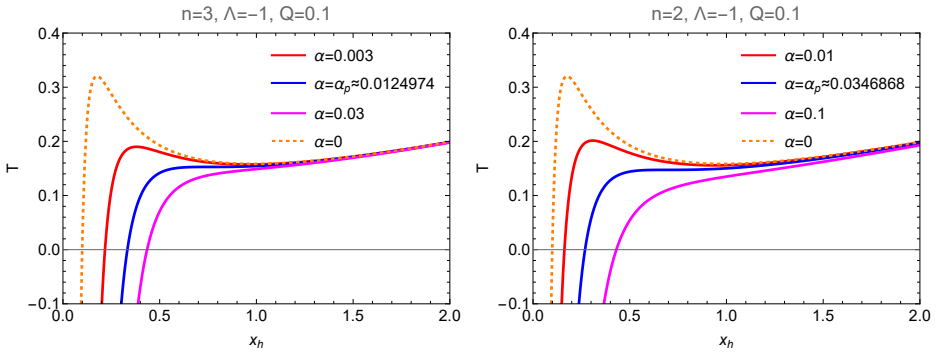
The central claim is that the spacetime with $f(x) = 1 - 2m e^{-\alpha x^{-n}}/x + Q^2 e^{-\alpha x^{-n}}/x^2 - (\Lambda/3)x^2 e^{-\alpha x^{-n}}$ is the static, spherically symmetric charged (A)dS extension of the Minkowski-core black hole inside a generally covariant effective Hamiltonian theory. Solving the equations of motion in the Schwarzschild gauge and in the Painlevé–Gullstrand gauge (a coordinate choice with a nonzero shift vector) produces line elements that differ only by a coordinate transformation, which the authors take as proof of gauge independence. The regularity statement is quantitative: as $x \to 0$ the metric function tends to 1 and the Kretschmann scalar vanishes exponentially fast, while at spatial infinity it tends to $8\Lambda^2/3$; the horizon structure (two horizons, one degenerate extremal horizon, or none) mirrors the Reissner–Nordström–AdS pattern with the inner region regularized. For AdS, the first law gains a new conjugate pair $(\Phi_\alpha, \alpha)$, and the entropy obtained from $S = \int dM/T$ deviates from the Bekenstein–Hawking area law, acquiring a logarithmic correction for $n=2$; for $\alpha$ below a critical value the free energy develops a swallowtail loop, the signature of a first-order phase transition, which disappears once $\alpha$ exceeds that value.
Load-bearing premise
Everything rests on the assumption that adding the ordinary electric and cosmological-constant terms to the modified gravitational Hamiltonian preserves the self-consistency of the theory's constraints; if that closure fails, the claimed spacetime would not be a generally covariant solution of the theory.
Editorial extensions
If this is right
- The charged and (A)dS-extended Minkowski-core solution is gauge independent, so physical predictions computed from the Schwarzschild form or from the Painlevé–Gullstrand form refer to the same spacetime.
- In the limit $\alpha \to 0$, the metric, temperature, entropy, and first law reduce exactly to the Reissner–Nordström–AdS ones, restoring the area-law entropy and giving a clean benchmark from which all regularization effects are measured.
- For $\Lambda < 0$ and $\alpha$ below a critical value $\alpha_p$, the black hole undergoes a first-order phase transition, signalled by two turning points in the temperature, two divergences in the heat capacity, and a swallowtail loop in the free energy; above $\alpha_p$ the transition disappears and a single stable phase remains.
- Neither electric charge nor the cosmological constant spoils the Minkowski core: the metric approaches flat Minkowski geometry at the center and the Kretschmann scalar vanishes there for generic parameter values.
- The entropy deviates from the Bekenstein–Hawking area law, and for $n=2$ it acquires a logarithmic correction, placing this model alongside quantum-gravity entropy calculations.
Reading between the lines
- The inverse-construction route is metric-driven, so the same recipe should produce charged (A)dS extensions of other regular metrics such as the Hayward, Bardeen, or Frolov families, each with its own critical parameter; the paper flags this as future work but gives no reason beyond solvability of the reconstruction equation why it should fail.
- Because the regularization factor $e^{-\alpha x^{-n}}$ decays exponentially away from the center, this model is observationally distinguishable from Reissner–Nordström–AdS mainly at small radius, through ringdown echoes or photon-ring images, while large-radius thermodynamics converge to the benchmark.
- The entropy result being independent of $Q$ and $\Lambda$ suggests, if it holds up, that the regularization changes only the geometric sector of the microstate counting; this is a sharper statement than the paper's own conclusion that the entropy simply deviates from the area law.
- The paper acknowledges that the covariance equations do not fix a unique effective Hamiltonian, so other reconstructions could share the same metric and thermodynamics but differ in the dynamical response to perturbations; observational tests beyond the static solution would then probe the choice of reconstruction, not just the geometry.
Signed reviews
Editorial analysis
A structured set of objections, weighed in public.
Referee Report
Summary. This paper applies the covariant effective-Hamiltonian framework of Ref. [53] to the Minkowski-core regular black hole. It reconstructs, by inverse engineering, a gravitational Hamiltonian constraint (14) whose unique static vacuum solution is the metric (12). It then adds a cosmological constant term (16) and a spherically reduced Maxwell term (19) to form the total constraint (20), solves the resulting equations of motion in Schwarzschild and Painlevé–Gullstrand gauges, and presents the charged (A)dS metric (21). The paper shows the Kretschmann scalar tends to zero at the center and to 8Λ²/3 at infinity, analyzes the horizon structure, and, for AdS, derives the mass, temperature, entropy, heat capacity, and free energy, reporting a first-order phase transition below a critical value of the regularization parameter α.
Significance. If the two load-bearing points identified below are resolved, this would be a useful concrete example of a regular black hole with electric charge and cosmological constant within a generally covariant effective Hamiltonian framework. The vacuum-sector derivation is transparent and self-contained: the reconstruction in Appendix A, the explicit constraint (14), the two-gauge solution with the coordinate transformation (24), and the complete Kretschmann expression in Appendix C are all presented in detail. The charged extension is a definite, falsifiable prediction of the framework rather than an input. However, the covariance of the matter-coupled constraint is asserted but not verified, and the entropy normalization prevents the claimed α→0 recovery of the area law for Q>0. These issues affect the central claims of the abstract and conclusions, so the manuscript requires substantive revision.
major comments (3)
- [II B, Eq. (20)] The total Hamiltonian constraint H_T^eff is obtained by simply adding the classical Λ and Maxwell terms (16) and (19) to the reconstructed H_G^eff. The covariance proof in Sec. II A applies to the vacuum constraint H_G^eff only; no computation is presented showing that {H_T^eff[N1], H_T^eff[N2]} closes in the form (7) with the same structure function μ and the effective metric (8). Since H_Λ and H_EM depend only on E1 and E2, their cross-brackets with H_G^eff are nontrivial and must be checked explicitly. Without this check, the statement that (21) and (23) are two gauges of one generally covariant theory, and hence that (21) is the gauge-independent charged extension, is an assumption rather than a derived result. Please compute the total bracket and either show it equals H_x[μE1/E2^2(N1N2'-N2N1')] or state the restrictions on M_eff and μ under which matter coupling preserves the deformed algebra.
- [III, Eqs. (28)–(37)] The statement that the entropy is independent of Λ and Q, and the claim that α→0 restores the area law, are not supported by the adopted definition. From Eqs. (29) and (34) one obtains dM/dx = 2πx e^{αx^{-n}} T, so Eq. (36) gives S(x_h)=∫_{x0}^{x_h} 2πx e^{αx^{-n}} dx. The lower limit x0 is defined by T(x0)=0 and therefore depends on Q and Λ, so S0 in Eq. (36), and hence S itself, depend on these parameters. In the limit α→0 this yields S=π(x_h^2-x0^2) with x0>0 for Q>0 (for example, Λ=-1, Q=0.1 gives x0≈0.1), not S=πx_h^2. The O(α^0) term in Eq. (37) is explicitly A/4-πx0^2, which contradicts the conclusions' claim that the area-law entropy is restored. To recover the Bekenstein–Hawking entropy one must fix the integration constant differently, e.g., by taking the lower limit x=0 rather than the zero of T.
- [III, Eq. (37)] The small-α expansion is performed with x0 treated as a fixed constant, but x0 is determined by T(x0)=0 and hence shifts with α. The endpoint contribution -2πx0 e^{αx0^{-n}} dx0/dα is therefore missing from the first-order expansion. If the lower limit is intended to be an α-independent integration constant, this should be stated explicitly and distinguished from the T=0 definition used in Eq. (36).
minor comments (5)
- [II B] There is a typo in the first sentence: 'Frist' should be 'First'.
- [III, Eq. (35)] The notation ∂²T/∂²x_h should be ∂²T/∂x_h².
- [Fig. 6 caption] The caption appears to assign the same parameter n=2 to both panels, but the critical values α_p≈0.0124974 and α_p≈0.0346868 correspond, as in Figs. 4 and 5, to n=3 and n=2, respectively; the caption should be corrected.
- [III, after Eq. (36)] The sentence 'only the positive-temperature branch is thermodynamically relevant' is presented without justification. Since the entropy is defined by integrating from T=0, the choice of lower limit is not the standard area-law normalization, and this choice affects the free energy (40); a brief justification or a discussion of the alternative normalization would improve the paper.
- [III, Eq. (37)] The expansion contains a denominator n−2; for 1≤n<2 the leading correction changes sign, and the paper does not comment on this range. A sentence noting the behavior for n<2 would be helpful.
Circularity Check
No significant circularity: the vacuum Hamiltonian is explicitly reverse-engineered, the charged (A)dS metric follows from solving the coupled equations of motion, and the cited reconstruction method is independent published work.
full rationale
The paper plainly labels the vacuum-sector derivation an inverse construction (Sec. II B, App. A: 'Given a static, spherically symmetric metric, the method reconstructs an effective Hamiltonian constraint ... such that the prescribed metric is the unique static vacuum solution'), so that the Minkowski-core metric solves H_G^eff by design, not as a hidden prediction. The new claims—charged (A)dS metric (21), PG form (23), gauge equivalence (24), Kretschmann limits (26), and the thermodynamics of Sec. III—are obtained by adding independent Maxwell and cosmological-constant terms (16)–(19) to H_G^eff and solving the resulting equations of motion in Appendix B, with integration constants fixed by the classical limit (c1=-2M, c2=1/√3; C1=-2m, C2=1). No parameter is fitted to reproduce the target metric after the reconstruction. The dependence on Ref. [53] is a citation to a peer-reviewed, general reconstruction procedure by one of the present authors; it does not smuggle in the target result, and the paper acknowledges the residual freedom of R and the integration constants. The main weakness—that covariance of the total constraint after adding matter is asserted rather than demonstrated (no explicit check that {H_T,H_T} closes with the same structure function μ)—is an unverified assumption and a correctness risk, not a circular step. Hence no circularity is found.
Assumptions & free parameters
free parameters (4)
- alpha
- n
- z =
0
- x0 =
determined by T(x0)=0
assumptions (6)
- domain assumption Covariance equations (10)-(11) and the general form (9) of H_G_eff from Refs. [48,49] are valid.
- domain assumption The inverse reconstruction of Ref. [53] with integration constants R=0 and Xi=0 yields the unique static vacuum solution matching the target metric.
- ad hoc to paper Adding classical matter Hamiltonians, the Lambda term (16) and Maxwell term (19), to H_G_eff preserves the first-class constraint algebra with the same structure function mu.
- standard math The spherically symmetric reduced phase space (K_I, E_I) with Poisson brackets (1) is an adequate description.
- domain assumption The seed Minkowski-core metric (12) with z=0 is a physically acceptable starting point.
- domain assumption The thermodynamic first law dM = T dS + V dP + Phi_Q dQ + Phi_alpha dalpha is assumed to hold for the effective solution.
Cite this review
Pith. "Pith review of A Minkowski-core black hole with cosmological constant and electric charge." pith.science (2026). https://pith.science/paper/EF4PTR67
@misc{pith2026260812800,
  author       = {Pith},
  title        = {Pith review of: A Minkowski-core black hole with cosmological constant and electric charge},
  year         = {2026},
  howpublished = {\url{https://pith.science/paper/EF4PTR67}},
  note         = {Machine review of arXiv:2608.12800}
}
read the original abstract
Within a covariant effective Hamiltonian framework, we employ an inverse construction to derive the gravitational Hamiltonian constraint for a Minkowski-core regular black hole without invoking exotic matter. We then extend the constraint by coupling it to a spherically reduced Maxwell field and including a cosmological constant. The resulting charged anti-de Sitter (AdS) and de Sitter (dS) solution is gauge independent and reduces to the Reissner--Nordstr\"om--AdS (RN-AdS) black hole when the regularization parameter vanishes. Electric charge and a cosmological constant preserve the Minkowski core: the metric approaches the Minkowski geometry at the center, the Kretschmann scalar vanishes there, and the spacetime exhibits a multi-horizon structure. Focusing on AdS backgrounds, we investigate the black hole thermodynamics. For a regularization parameter below a critical value, the model exhibits a phase transition with consistent signatures across these thermodynamic quantities, demonstrating that Minkowski-core regularization can preserve center regularity while modifying the AdS thermodynamic phase structure relative to the RN-AdS benchmark.
Figures


Figures from the paper (3 more)


Reference graph
Works this paper leans on
-
[53]
Covariant Dynamics from Static Spherically Symmetric Geometries,
C. Zhang and Z. Cao, “Covariant Dynamics from Static Spherically Symmetric Geometries,” Phys. Rev. Lett.135no. 26, (2025) 261401,arXiv:2506.09540 [gr-qc]
arXiv 2025
-
[1]
Structures of classical GR 5
-
[2]
Hamiltonian constraint and matter coupling for the Minkowski-core black hole 8 C
Extensions to effective model 6 B. Hamiltonian constraint and matter coupling for the Minkowski-core black hole 8 C. Curvature invariants and regularity of the extended model 12 III. Black hole thermodynamics14 IV. Conclusions18 Acknowledgments19 A. Method of Construct the Hamiltonian constraint19 B. Equations of motion21 C. Kretschmann scalar and reality...
-
[3]
In this case, the spacetime is based on a 4-dimensional manifoldM×Σ with Σ ∼= M1×S 2
Structures of classical GR Let us start with the spherically symmetric sector of GR. In this case, the spacetime is based on a 4-dimensional manifoldM×Σ with Σ ∼= M1×S 2. HereM 1 denotes the 1-dimensional manifold corresponding to the radial direction, andS 2 is the 2-sphere. Let (x,θ,ϕ)∈M 1×S 2 be the adapted coordinates. In classical GR, the phase space...
-
[4]
This model can be regarded as a modified theory of gravity formulated in the Hamiltonian framework
Extensions to effective model We now turn to the effective model introduced in [48, 49]. This model can be regarded as a modified theory of gravity formulated in the Hamiltonian framework. It is effective in the sense that the Hamiltonian constraint is modified from its classical expression, referred to as HG eff, while the phase-space structure, as well ...
-
[5]
Observation of Gravitational Waves from a Binary Black Hole Merger,
SubstitutingE 1 =x 2,E 2 from (B2),N x = 0, andNfrom (B4) into the general metric (8) then yields the Schwarzschild- gauge line element (21) of Sec. II B. We next solve the same constraints in the PG gaugeE1(x) =x 2 andE 2(x) =x. Imposing HT x = 0 andH T eff = 0 gives K2(x) = e αx−n 2 q −Q2 + Λx4 3 +C 1x x ,(B5) K1(x) = x−n−2e αx−n 2 [αn(3Q 2−Λx 4−3C 1x) ...
arXiv 2016
-
[7]
The Singularities of gravitational collapse and cosmology,
S. W. Hawking and R. Penrose, “The Singularities of gravitational collapse and cosmology,” Proc. Roy. Soc. Lond. A314(1970) 529–548
1970
-
[8]
The large scale structure of space-time,
S. W. Hawking and G. F. R. Ellis, “The large scale structure of space-time,” 2023. https://api.semanticscholar.org/CorpusID:121949888
work page 2023
Show all 68 references
-
[9]
Singularity Theorems and Their Consequences,
J. M. M. Senovilla, “Singularity Theorems and Their Consequences,” Gen. Rel. Grav.30 (1998) 701,arXiv:1801.04912 [gr-qc]
1998 arXiv
-
[10]
Nonsingular general relativistic gravitational collapse,
J. Bardeen, “Nonsingular general relativistic gravitational collapse,”
-
[11]
Formation and evaporation of regular black holes,
S. A. Hayward, “Formation and evaporation of regular black holes,” Phys. Rev. Lett.96 (2006) 031103,arXiv:gr-qc/0506126
2006 arXiv
-
[12]
Notes on nonsingular models of black holes,
V. P. Frolov, “Notes on nonsingular models of black holes,” Phys. Rev. D94no. 10, (2016) 24 104056,arXiv:1609.01758 [gr-qc]
2016 arXiv
-
[13]
Construction of Regular Black Holes in General Relativity,
Z.-Y. Fan and X. Wang, “Construction of Regular Black Holes in General Relativity,” Phys. Rev. D94no. 12, (2016) 124027,arXiv:1610.02636 [gr-qc]
2016 arXiv
-
[14]
Regular Black Holes: A Short Topic Review,
C. Lan, H. Yang, Y. Guo, and Y.-G. Miao, “Regular Black Holes: A Short Topic Review,” Int. J. Theor. Phys.62no. 9, (2023) 202,arXiv:2303.11696 [gr-qc]
2023 arXiv
-
[15]
Echoes from the Minkowski-core spacetime,
D. Zhang, Q. Tan, G. Fu, H. Gong, J.-P. Wu, and Q. Pan, “Echoes from the Minkowski-core spacetime,” Sci. China Phys. Mech. Astron.69no. 5, (2026) 250412,arXiv:2509.23215 [gr-qc]
2026
-
[16]
Quasinormal modes and ringdown waveforms of a Frolov black hole,
Z. Song, H. Gong, H.-L. Li, G. Fu, L.-G. Zhu, and J.-P. Wu, “Quasinormal modes and ringdown waveforms of a Frolov black hole,” Commun. Theor. Phys.76no. 10, (2024) 105401,arXiv:2406.04787 [gr-qc]
2024 arXiv
-
[17]
Quasinormal modes of a d-dimensional regular black hole featuring an integrable singularity,
Z. Dong, D. Zhang, G. Fu, and J.-P. Wu, “Quasinormal modes of a d-dimensional regular black hole featuring an integrable singularity,” Eur. Phys. J. C85no. 2, (2025) 215, arXiv:2412.20457 [gr-qc]
2025 arXiv
-
[18]
Quasinormal modes of a regular black hole with sub-Planckian curvature,
D. Zhang, H. Gong, G. Fu, J.-P. Wu, and Q. Pan, “Quasinormal modes of a regular black hole with sub-Planckian curvature,” Eur. Phys. J. C84no. 6, (2024) 564, arXiv:2402.15085 [gr-qc]
2024 arXiv
-
[19]
Thermodynamics of the Bardeen Black Hole in Anti-de Sitter Space,
C. Li, C. Fang, M. He, J. Ding, and J. Deng, “Thermodynamics of the Bardeen Black Hole in Anti-de Sitter Space,” Mod. Phys. Lett. A34no. 40, (2019) 1950336,arXiv:1812.02567 [hep-th]
2019 arXiv
-
[20]
A new black hole coupled with nonlinear electrodynamics surrounded by quintessence: Thermodynamics, geodesics, and Regge–Wheeler potential,
A. Al-Badawi and F. Ahmed, “A new black hole coupled with nonlinear electrodynamics surrounded by quintessence: Thermodynamics, geodesics, and Regge–Wheeler potential,” Chin. J. Phys.94(2025) 185–203,arXiv:2503.00765 [gr-qc]
2025 arXiv
-
[21]
Thermodynamics and phase transition of Bardeen–AdS-class black holes,
S.-P. Wu and S.-W. Wei, “Thermodynamics and phase transition of Bardeen–AdS-class black holes,” Class. Quant. Grav.42no. 7, (2025) 075015,arXiv:2407.19702 [gr-qc]
2025 arXiv
-
[22]
Shadow of rotating regular black holes,
A. Abdujabbarov, M. Amir, B. Ahmedov, and S. G. Ghosh, “Shadow of rotating regular black holes,” Phys. Rev. D93no. 10, (2016) 104004,arXiv:1604.03809 [gr-qc]
2016 arXiv
-
[23]
Observational appearances of an inner extremal regular black hole illuminated by various accretion flows,
D. Zhang, G. Fu, X.-J. Wang, Q. Pan, X.-M. Kuang, and J.-P. Wu, “Observational appearances of an inner extremal regular black hole illuminated by various accretion flows,” Eur. Phys. J. C85no. 9, (2025) 1051,arXiv:2412.20450 [gr-qc]
2025 arXiv
-
[24]
Probing Quantum Gravity effects with 25 Extreme Mass Ratio Inspirals around Rotating Hayward Black Holes,
D. Zhang, C. Zhang, Q. Pan, G. Fu, and J.-P. Wu, “Probing Quantum Gravity effects with 25 Extreme Mass Ratio Inspirals around Rotating Hayward Black Holes,”arXiv:2602.07436 [gr-qc]
-
[25]
Gravitational waveforms from periodic orbits around a novel regular black hole,
H. Gong, S. Long, X.-J. Wang, Z. Xia, J.-P. Wu, and Q. Pan, “Gravitational waveforms from periodic orbits around a novel regular black hole,”arXiv:2509.23318 [gr-qc]
-
[26]
The Bardeen model as a nonlinear magnetic monopole,
E. Ayon-Beato and A. Garcia, “The Bardeen model as a nonlinear magnetic monopole,” Phys. Lett. B493(2000) 149–152,arXiv:gr-qc/0009077
2000 arXiv
-
[27]
Nonlinear electrodynamics, regular black holes and wormholes,
K. A. Bronnikov, “Nonlinear electrodynamics, regular black holes and wormholes,” Int. J. Mod. Phys. D27no. 06, (2018) 1841005,arXiv:1711.00087 [gr-qc]
2018 arXiv
-
[28]
Regular multihorizon black holes in modified gravity with nonlinear electrodynamics,
S. Nojiri and S. D. Odintsov, “Regular multihorizon black holes in modified gravity with nonlinear electrodynamics,” Phys. Rev. D96no. 10, (2017) 104008,arXiv:1708.05226 [hep-th]
2017 arXiv
-
[29]
Regular black holes and their singular families,
H. Huang and X.-P. Rao, “Regular black holes and their singular families,” Phys. Rev. D 111no. 10, (2025) 104040,arXiv:2503.13133 [gr-qc]
2025 arXiv
-
[30]
Can we distinguish whether black holes have singularities or not through echoes and light rings?,
X.-P. Rao and H. Huang, “Can we distinguish whether black holes have singularities or not through echoes and light rings?,”arXiv:2505.11073 [gr-qc]
-
[31]
Introduction to Modern Canonical Quantum General Relativity,
T. Thiemann, “Introduction to Modern Canonical Quantum General Relativity,” arXiv:gr-qc/0110034
-
[32]
Loop quantum gravity,
C. Rovelli, “Loop quantum gravity,” Living Rev. Rel.1(1998) 1,arXiv:gr-qc/9710008
1998 arXiv
-
[33]
Background independent quantum gravity: A Status report,
A. Ashtekar and J. Lewandowski, “Background independent quantum gravity: A Status report,” Class. Quant. Grav.21(2004) R53,arXiv:gr-qc/0404018
2004 arXiv
-
[34]
Fundamental structure of loop quantum gravity,
M. Han, W. Huang, and Y. Ma, “Fundamental structure of loop quantum gravity,” Int. J. Mod. Phys. D16(2007) 1397–1474,arXiv:gr-qc/0509064
2007 arXiv
-
[35]
Loop Quantum Cosmology: A Status Report,
A. Ashtekar and P. Singh, “Loop Quantum Cosmology: A Status Report,” Class. Quant. Grav.28(2011) 213001,arXiv:1108.0893 [gr-qc]
2011 arXiv
-
[36]
Absence of singularity in loop quantum cosmology,
M. Bojowald, “Absence of singularity in loop quantum cosmology,” Phys. Rev. Lett.86 (2001) 5227–5230,arXiv:gr-qc/0102069
2001 arXiv
-
[37]
Quantum Transfiguration of Kruskal Black Holes,
A. Ashtekar, J. Olmedo, and P. Singh, “Quantum Transfiguration of Kruskal Black Holes,” Phys. Rev. Lett.121no. 24, (2018) 241301,arXiv:1806.00648 [gr-qc]
2018 arXiv
-
[38]
An effective model for the quantum Schwarzschild black hole,
A. Alonso-Bardaji, D. Brizuela, and R. Vera, “An effective model for the quantum Schwarzschild black hole,” Phys. Lett. B829(2022) 137075,arXiv:2112.12110 [gr-qc]
2022 arXiv
-
[39]
Loop Quantum Black Hole,
X. Zhang, “Loop Quantum Black Hole,” Universe9no. 7, (2023) 313,arXiv:2308.10184 26 [gr-qc]
2023 arXiv
-
[40]
Black Holes in Loop Quantum Gravity,
A. Perez, “Black Holes in Loop Quantum Gravity,” Rept. Prog. Phys.80no. 12, (2017) 126901,arXiv:1703.09149 [gr-qc]
2017 arXiv
-
[41]
Quantum Oppenheimer-Snyder and Swiss Cheese Models,
J. Lewandowski, Y. Ma, J. Yang, and C. Zhang, “Quantum Oppenheimer-Snyder and Swiss Cheese Models,” Phys. Rev. Lett.130no. 10, (2023) 101501,arXiv:2210.02253 [gr-qc]
2023 arXiv
-
[42]
Semiclassical loop quantum black hole,
L. Modesto, “Semiclassical loop quantum black hole,” Int. J. Theor. Phys.49(2010) 1649–1683,arXiv:0811.2196 [gr-qc]
2010 arXiv
-
[43]
Reduced phase space quantization of black holes: Path integrals and effective dynamics,
C. Zhang, “Reduced phase space quantization of black holes: Path integrals and effective dynamics,” Phys. Rev. D104no. 12, (2021) 126003,arXiv:2106.08202 [gr-qc]
2021 arXiv
-
[44]
Fate of quantum black holes,
V. Husain, J. G. Kelly, R. Santacruz, and E. Wilson-Ewing, “Fate of quantum black holes,” Phys. Rev. D106no. 2, (2022) 024014,arXiv:2203.04238 [gr-qc]
2022 arXiv
-
[45]
Phenomenological dynamics of loop quantum cosmology in Kantowski-Sachs spacetime,
D.-W. Chiou, “Phenomenological dynamics of loop quantum cosmology in Kantowski-Sachs spacetime,” Phys. Rev. D78(2008) 044019,arXiv:0803.3659 [gr-qc]
2008 arXiv
-
[46]
Covariance in models of loop quantum gravity: Spherical symmetry,
M. Bojowald, S. Brahma, and J. D. Reyes, “Covariance in models of loop quantum gravity: Spherical symmetry,” Phys. Rev. D92no. 4, (2015) 045043,arXiv:1507.00329 [gr-qc]
2015 arXiv
-
[47]
Nonsingular spherically symmetric black-hole model with holonomy corrections,
A. Alonso-Bardaji, D. Brizuela, and R. Vera, “Nonsingular spherically symmetric black-hole model with holonomy corrections,” Phys. Rev. D106no. 2, (2022) 024035, arXiv:2205.02098 [gr-qc]
2022 arXiv
-
[48]
Black holes and covariance in effective quantum gravity,
C. Zhang, J. Lewandowski, Y. Ma, and J. Yang, “Black holes and covariance in effective quantum gravity,” Phys. Rev. D111no. 8, (2025) L081504,arXiv:2407.10168 [gr-qc]
2025
-
[49]
Black holes and covariance in effective quantum gravity: A solution without Cauchy horizons,
C. Zhang, J. Lewandowski, Y. Ma, and J. Yang, “Black holes and covariance in effective quantum gravity: A solution without Cauchy horizons,” Phys. Rev. D112no. 4, (2025) 044054,arXiv:2412.02487 [gr-qc]
2025
-
[50]
Black holes in effective loop quantum gravity: Covariant holonomy modifications,
I. H. Belfaqih, M. Bojowald, S. Brahma, and E. I. Duque, “Black holes in effective loop quantum gravity: Covariant holonomy modifications,” Phys. Rev. D112no. 4, (2025) 046022,arXiv:2407.12087 [gr-qc]
2025 arXiv
-
[51]
Singularity resolution by holonomy corrections: Spherical charged black holes in cosmological backgrounds,
A. Alonso-Bardaji, D. Brizuela, and R. Vera, “Singularity resolution by holonomy corrections: Spherical charged black holes in cosmological backgrounds,” Phys. Rev. D107 no. 6, (2023) 064067,arXiv:2302.10619 [gr-qc]
2023 arXiv
-
[52]
Quantum geometry and effective dynamics of Janis-Newman-Winicour singularities,
C. Zhang and X. Zhang, “Quantum geometry and effective dynamics of Janis-Newman-Winicour singularities,” Phys. Rev. D101no. 8, (2020) 086002, 27 arXiv:1912.07278 [gr-qc]
2020 arXiv
-
[54]
Regular black holes with sub-Planckian curvature,
Y. Ling and M.-H. Wu, “Regular black holes with sub-Planckian curvature,” Class. Quant. Grav.40no. 7, (2023) 075009,arXiv:2109.05974 [gr-qc]
2023 arXiv
-
[55]
Accretion disk for regular black holes with sub-Planckian curvature,
W. Zeng, Y. Ling, Q.-Q. Jiang, and G.-P. Li, “Accretion disk for regular black holes with sub-Planckian curvature,” Phys. Rev. D108no. 10, (2023) 104072,arXiv:2308.00976 [gr-qc]
2023 arXiv
-
[56]
Singularities and the Finale of Black Hole Evaporation,
L. Xiang, Y. Ling, and Y. G. Shen, “Singularities and the Finale of Black Hole Evaporation,” Int. J. Mod. Phys. D22(2013) 1342016,arXiv:1305.3851 [gr-qc]
2013 arXiv
-
[57]
Quantum symmetry reduction for diffeomorphism invariant theories of connections,
M. Bojowald and H. A. Kastrup, “Quantum symmetry reduction for diffeomorphism invariant theories of connections,” Class. Quant. Grav.17(2000) 3009–3043, arXiv:hep-th/9907042
2000 arXiv
-
[58]
Spherically symmetric quantum geometry: Hamiltonian constraint,
M. Bojowald and R. Swiderski, “Spherically symmetric quantum geometry: Hamiltonian constraint,” Class. Quant. Grav.23(2006) 2129–2154,arXiv:gr-qc/0511108
2006 arXiv
-
[59]
Loop quantization of spherically symmetric midi-superspaces,
M. Campiglia, R. Gambini, and J. Pullin, “Loop quantization of spherically symmetric midi-superspaces,” Class. Quant. Grav.24(2007) 3649–3672,arXiv:gr-qc/0703135
2007 arXiv
-
[60]
Spherically symmetric Einstein-Maxwell theory and loop quantum gravity corrections,
R. Tibrewala, “Spherically symmetric Einstein-Maxwell theory and loop quantum gravity corrections,” Class. Quant. Grav.29(2012) 235012,arXiv:1207.2585 [gr-qc]
2012 arXiv
-
[61]
Covariant effective spacetimes of spherically symmetric electrovacuum with a cosmological constant,
J. Yang, C. Zhang, and Y. Ma, “Covariant effective spacetimes of spherically symmetric electrovacuum with a cosmological constant,” Phys. Rev. D112no. 6, (2025) 064049, arXiv:2503.15157 [gr-qc]
2025
-
[62]
The Four laws of black hole mechanics,
J. M. Bardeen, B. Carter, and S. W. Hawking, “The Four laws of black hole mechanics,” Commun. Math. Phys.31(1973) 161–170
1973
-
[63]
Black holes and entropy,
J. D. Bekenstein, “Black holes and entropy,” Phys. Rev. D7(1973) 2333–2346
1973
-
[64]
Entropy and black-hole thermodynamics,
R. M. Wald, “Entropy and black-hole thermodynamics,” Phys. Rev. D20(1979) 1271–1282
1979
-
[65]
First law and Smarr formula of black hole mechanics in nonlinear gauge theories,
Y. Zhang and S. Gao, “First law and Smarr formula of black hole mechanics in nonlinear gauge theories,” Class. Quant. Grav.35no. 14, (2018) 145007,arXiv:1610.01237 [gr-qc]
2018 arXiv
-
[66]
Charged Simpson-Visser AdS Black Holes: Geodesic Structure and Thermodynamic Properties,
F. Ahmed, A. Al-Badawi, and M. Fathi, “Charged Simpson-Visser AdS Black Holes: Geodesic Structure and Thermodynamic Properties,”arXiv:2601.10469 [gr-qc]
-
[67]
Logarithmic correction to the Bekenstein-Hawking entropy,
R. K. Kaul and P. Majumdar, “Logarithmic correction to the Bekenstein-Hawking entropy,” 28 Phys. Rev. Lett.84(2000) 5255–5257,arXiv:gr-qc/0002040
2000 arXiv
-
[68]
Logarithmic corrections to black hole entropy from the Cardy formula,
S. Carlip, “Logarithmic corrections to black hole entropy from the Cardy formula,” Class. Quant. Grav.17(2000) 4175–4186,arXiv:gr-qc/0005017
2000 arXiv
-
[69]
Counting black hole microscopic states in loop quantum gravity,
A. Ghosh and P. Mitra, “Counting black hole microscopic states in loop quantum gravity,” Phys. Rev. D74(2006) 064026,arXiv:hep-th/0605125. 29
2006 arXiv
Reviewed August 15, 2026 · model on record in the stance chip above.
Discussion (0). Continue with ORCID to comment.