REVIEW 3 major objections 5 minor 56 references
Decomposition of Evidence, Contradiction, and Fragility in Perturbation Responses
T0 review · 3 major / 5 minor · reviewed 2026-08-15 · deepseek-v4-flash
Pith's one-line read The paper claims that perturbation response magnitude alone is ambiguous, and that DECAF resolves the ambiguity by routing each stage response into endpoint-aligned evidence, endpoint-opposed contradiction, or endpoint-null fragility…
desk verdict DECAF is a cheap, endpoint-relative response decomposition with serious controlled validation; the ImageNet-9 role-agreement headline is confounded by shared endpoint information and needs reframing. read the letter →
The pith
A machine-rendered reading of the paper's core claim, the machinery that carries it, and where it could break.
The reading
What carries the argument
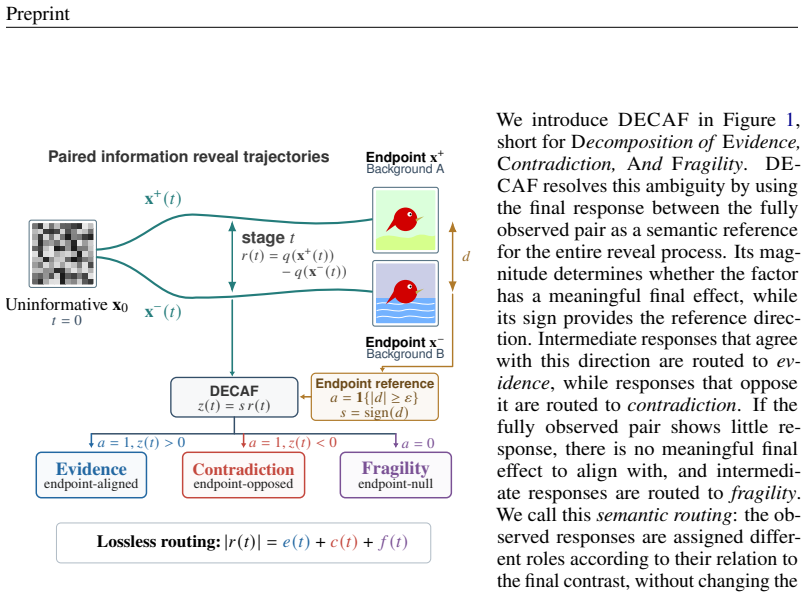
The central object is the paired reveal together with the endpoint-relative routing rule. A paired reveal starts both inputs at a common uninformative state and produces matched trajectories $(x^+(t),x^-(t))$, so the signed response $r(t)=q(x^+(t))-q(x^-(t))$ is observed as information becomes available; the fully observed contrast $d=r(1)$ is then used only as a gate and orientation. Routing $(e,c,f)=(a(sr)_+, a(sr)_-, (1-a)|r|)$ preserves ordinary magnitude exactly, and Theorem 1 proves this is the unique triple satisfying conservation, endpoint gating, and directional support. The mechanism works because it separates the trajectory's relation to the endpoint from its size: aligned and opposed mass are distinguished only on active pairs, while endpoint-null trajectory sensitivity is quarantined as fragility. No gradients, parameters, or internal states are needed, so the decomposition applies to any black-box score.
What would settle it
Re-run the ImageNet-9 magnitude-matched audit with behavioral indicators constructed entirely from held-out corruption families that are never part of the DECAF reveal path and never share the endpoint contrast $d$; if the largest-component role agreement drops toward the magnitude-only level while ordinary magnitude is still matched, the claimed independence would be falsified. A second decisive test: build a synthetic model where the endpoint contrast is chosen at random independently of intermediate responses; DECAF would then route responses into $E$ and $C$ purely by orientation, and role agreement with externally defined behavior should fall to chance if the components carry no independent information.
Extended reading notes
Core claim
On the paper's own terms, DECAF assigns observable semantic roles to paired perturbation responses. Given a factual input and a counterfactual input, the final contrast $d=r(1)$ determines a gate $a=\mathbf{1}_{|d|\ge\epsilon}$ and an orientation $s=\operatorname{sign}(d)$; each intermediate signed response is routed as $(e,c,f)=(a(sr)_+, a(sr)_-, (1-a)|r|)$. Evidence is response mass aligned with the final effect, contradiction is mass that opposes it, and fragility is response on pairs whose final effect is negligible under the chosen threshold. Theorem 1 shows this routing is the unique splitting satisfying conservation, endpoint gating, and directional support; Theorem 2 shows the profile strictly refines ordinary magnitude, with the same $\mathrm{Abs}=m$ arising from $(m,0,0)$, $(0,m,0)$, or $(0,0,m)$. The paper further claims the components track independently measured model behavior: on controlled 3D Shapes tasks the evidence margin correlates 0.936 with shortcut-reversal vulnerability, contradiction tracks the pairwise label-swap rate with 0.961, and fragility tracks endpoint-null prediction-change rate; on ImageNet-9, after matching ordinary magnitude within 5%, the largest DECAF component matches an independently defined behavioral indicator in 96.4% of comparisons versus 35.0% for magnitude alone.
Load-bearing premise
The load-bearing premise is that the behavioral indicators used to validate DECAF are genuinely independent of DECAF's construction: on ImageNet-9 the evidence and contradiction labels are defined from the same endpoint contrast DECAF uses for gating and orientation, so the agreed role may partly reflect shared endpoint information.
Editorial extensions
If this is right
- If $\mathrm{Abs}$ is replaced by $(E,C,F)$, any decision rule based on ordinary magnitude is still implementable, while the reverse is impossible in general; magnitude-matched comparisons can therefore reveal semantic differences that magnitude alone erases.
- When the evaluation target repeats the same intervention that defines the endpoint, endpoint-only magnitude already carries most attribution signal; short DECAF trajectories add their clearest value when rankings must transfer to a different intervention.
- Changing only the reveal path from blend to nested-patch raises ordinary response by about 80% without increasing evidence, so path-sensitivity is concentrated in fragility and contradiction rather than in the endpoint-aligned component.
- On forward-only attribution benchmarks, short DECAF trajectories outperform the tested general-purpose gradient or sampling baselines, and on a 1B-scale DINOv2 model a short trajectory matches IG-32 with 4.75× lower wall time and 2.36× lower peak memory.
- The decomposition provides an observable endpoint-relative semantics, not a claim about latent causes of trajectory responses; fragility marks response on endpoint-null pairs without diagnosing off-manifold artifacts, boundary uncertainty, or calibration effects.
Reading between the lines
- Editorial inference: because the gate and orientation are derived from the same endpoint contrast used to define the ImageNet-9 evidence and contradiction labels, part of the 96.4% role-agreement may reflect endpoint information shared between predictor and label; a cleaner test would define all behavioral indicators from held-out perturbations that never enter the DECAF path.
- Editorial inference: the contradiction channel gives model and data auditors a numeric handle on effect reversal versus attenuation, something ordinary magnitude and signed net response cannot separate; this could be used to compare models on whether a learned effect is genuinely reversed under context shift.
- Editorial inference: because fragility is path-relative by construction, the decomposition suggests a diagnostic practice of reporting $(E,C,F)$ under several reveal paths rather than a single number, using the path-stability of $E$ and $C$ as an indicator of robust reliance.
- Editorial inference: the method's forward-only, gradient-free nature means it could be lifted to models with discrete outputs or remote score APIs; a testable extension would verify whether the components still track behavioral measures when $q$ is a margin or logit rather than a probability.
Signed reviews
Editorial analysis
A structured set of objections, weighed in public.
Referee Report
Summary. The paper proposes DECAF, a post-hoc decomposition of paired perturbation responses into evidence E, contradiction C, and fragility F. The decomposition routes the signed stage response r(t) by its relation to the final contrast d = q(x+)-q(x-): aligned mass to E, opposed mass to C, and endpoint-null response to F, with conservation Abs = E+C+F. The authors prove uniqueness under endpoint-relative axioms (Theorem 1), show that the decomposition strictly refines magnitude (Theorem 2), and validate the components in controlled 3D Shapes and Covertype experiments, on ImageNet-9, and on external attribution benchmarks. The headline empirical claim is that after matching ordinary response magnitude, the largest DECAF component agrees with an independently observed behavior in 96.4% of ImageNet-9 cases versus 35.0% for magnitude alone.
Significance. The theoretical results are elementary and largely definitional, but the paper is appropriately modest about this: Theorem 1 is a uniqueness statement within an explicitly endpoint-relative semantics, and the paper's value lies in the behavioral validation. The controlled 3D Shapes and Covertype studies are genuinely careful: they use held-out behavioral targets defined without DECAF, they treat the model or training trajectory as the statistical unit, and they report bootstrap intervals. The correlations between C and label-swap rate (0.961) and between F and endpoint-null prediction change (0.974) are strong evidence that the components carry the intended semantics in settings where the ground truth is controlled. The forward-only, black-box-friendly implementation and the honest discussion of endpoint-versus-trajectory value (Section 7 and Appendix H) are also strengths. The main open question is whether the ImageNet-9 headline result is contaminated by endpoint information shared between the behavioral labels and the DECAF orientation.
major comments (3)
- [Section 6.2 / Appendix F.4] The headline 96.4% versus 35.0% role-agreement does not yet rule out an endpoint confound. The behavioral indicators YE and YC are defined directly from endpoint predictions in Appendix F.4: YE marks a same-to-random background replacement that changes the predicted class or drops true-class probability by at least 0.20, and YC marks a switch to the new background's class under Same-Next. DECAF orients E and C with the same endpoint contrast d = q(x+)-q(x-) (Section 3), and the matched-pair construction in Section 6.2 controls Abs = E+C+F, not |d|. Section 6.1 reports AUROC 0.960 for endpoint magnitude on the evidence behavior, so endpoint information nearly saturates that label. I therefore cannot accept the 96.4% figure as evidence for trajectory semantics until |d| is controlled. Please repeat the matched-pair analysis with |d| additionally matched (for example, within 5% or within narrow strata), and report the role-agreement accuracy of an endpoint-only rule that uses sign(d) and |d|. If the gap persists under this control, the confound is resolved.
- [Section 6.2 / Appendix F.5] The role-agreement metric needs a chance baseline under the overlap rule. Because YE, YC, and YF are allowed to overlap and credit is divided among tied largest coordinates, a case with multiple active behaviors can be scored correct regardless of which DECAF coordinate is largest. The reported 0.964 could overstate semantic agreement if many matched cases have two or three active indicators. Please report the distribution of active-indicator counts among the 8,289 matched comparisons, the expected agreement of a random role assignment under the same overlap and tie rule, and, ideally, the agreement restricted to cases with exactly one active indicator.
- [Section 7 / Table 5] The trajectory gain over endpoint-only M is negative on ImageNet-1k for DECAF-3 and DECAF-5 and only +0.007 for DECAF-9, as shown in Table 5 and Appendix H.3. The paper discusses this limitation clearly, but the abstract's phrase 'short forward-only DECAF trajectories outperform the tested general-purpose attribution baselines' should be qualified in the abstract itself, since the endpoint-only reference also outperforms those baselines on ImageNet-1k and since the trajectory gain is negative for two of the three DECAF variants on that benchmark.
minor comments (5)
- [Section 5 (Proposition 1 paragraph)] The sentence 'The controlled experiment in Section 5.See Appendix B for the proof' is missing a predicate or a period; it should be rewritten as a complete sentence.
- [Title block] The title block contains 'OFEVIDENCE' and 'ANDFRAGILITY' without spaces; the typography should be fixed.
- [Appendix F.7] The sentence 'Figure 10 contains the panel moved from the main text' is an editing artifact and should be replaced with a normal reference to the figure.
- [References] The two Covert et al. entries (2021a and 2021b) have identical titles and should either be merged or distinguished with a note, since they appear to be the same work.
- [Tables 1 and 11] Table 1 reports model calls per image for ImageNet-9, while Table 11 reports rows per image for ImageNet-1k; the main text should state explicitly that the difference arises from the number of factors (one background pair versus sixteen patches) to avoid apparent inconsistency.
Circularity Check
ImageNet-9 role-agreement is partly self-definitional: YE/YC labels and DECAF's E/C share the same endpoint contrast d, and Abs matching does not control M=|d|; the controlled validations are independent.
-
self definitional
[Section 6.2 and Appendix F.4; DECAF routing in Section 3, Eq. (1)]
"Evidence behavior. Set YE = 1 when Mixed-Same is classified correctly and replacing its background with Mixed-Rand either changes the predicted class or lowers the true-class probability by at least 0.20. ... Contradiction behavior. Set YC = 1 when changing only the background makes the model switch from the foreground class to the class associated with the new Mixed-Next background. / a=1{|d|≥ε}, s=sign(d) ... (e(t),c(t),f(t))=(az+(t), az−(t),(1−a)|r(t)|)."
The behavioral labels are endpoint prediction-change events computed from q(x+) and q(x-), and DECAF's gate and orientation are computed from the same endpoint contrast d=q(x+)-q(x-). On the active branch, E and C are just the sign-split of the endpoint-oriented response sr(t), so the 'largest component' is endpoint-aligned by construction. Section 6.2 matches Abs=E+C+F (relative difference at most 5%) but does not match M=|d|, and Section 6.1 reports that endpoint magnitude M alone reaches AUROC 0.960 for the evidence behavior. The 96.4% role-agreement can therefore be carried by the shared endpoint contrast rather than by trajectory semantics; the claimed 'independently measured behavior' is only partially independent of the DECAF construction.
full rationale
The core routing is explicitly endpoint-relative, and Theorems 1 and 2 are direct consequences of the stated axioms (conservation, endpoint gating, directional support); they are self-consistent definitional results rather than hidden empirical predictions. The controlled 3D Shapes and Covertype validations use behaviors measured from training interventions and held-out prediction changes that do not share DECAF's d, so those component meanings are independently supported. The circularity concern is concentrated in the ImageNet-9 audit: YE and YC are defined from the same endpoint scores that set sign(d) and the active gate, and the Section 6.2 matching controls Abs but not M=|d|. The paper itself acknowledges that endpoint magnitude nearly saturates the evidence label (AUROC 0.960). This makes the headline 96.4% versus 35.0% partially confounded by the shared endpoint contrast, although the decomposition is not fitted to the labels and no self-citation chain carries the argument. Score 5 reflects one partially self-definitional validation step alongside otherwise independent controlled evidence.
Assumptions & free parameters
free parameters (1)
- Endpoint threshold epsilon =
0.02 default, with 0.01 and 0.05 sensitivity checks.
assumptions (4)
- ad hoc to paper Operational axioms of Theorem 1: conservation (e+c+f=|r|), endpoint gating (f=0 when active, e=c=0 when null), and directional support (c=0 when sr>=0, e=0 when sr<=0).
- domain assumption The final endpoint contrast d provides a meaningful semantic reference for the entire reveal trajectory.
- domain assumption The chosen interpolation, Gaussian blur blend and nested-patch reveal, is a meaningful progressive reveal of information.
- domain assumption The model returns a stable real-valued score q; hard labels are formally sufficient but less informative.
invented entities (1)
-
DECAF response roles E, C, and F
independent evidence
Cite this review
Pith. "Pith review of Decomposition of Evidence, Contradiction, and Fragility in Perturbation Responses." pith.science (2026). https://pith.science/paper/XATRTH6W
@misc{pith2026260812935,
  author       = {Pith},
  title        = {Pith review of: Decomposition of Evidence, Contradiction, and Fragility in Perturbation Responses},
  year         = {2026},
  howpublished = {\url{https://pith.science/paper/XATRTH6W}},
  note         = {Machine review of arXiv:2608.12935}
}
read the original abstract
Perturbation methods explain model decisions by measuring prediction changes under altered inputs, but response magnitude tells us only how much a model reacts, not what that reaction means. The same magnitude can support the final factual-counterfactual difference, oppose it, or arise strongly along the perturbation path yet vanish at the endpoint. We therefore track how the contrast develops as paired inputs are progressively revealed, using the final contrast to interpret the trajectory. We introduce DECAF (Decomposition of Evidence, Contradiction, And Fragility), which routes aligned, opposed, and endpoint-null responses into evidence E, contradiction C, and fragility F. The decomposition preserves ordinary magnitude exactly, Abs = E + C + F, and is unique under endpoint-relative axioms. Across controlled vision and tabular settings, the three components track independently measured behavior. In a 72-model ImageNet-9 audit, we compare cases with nearly identical response magnitude but different independently measured behaviors. The largest DECAF component agrees with an observed behavior in 96.4% of cases, compared with 35.0% for magnitude alone. Changing only the reveal path increases total response by nearly 80%, yet evidence barely changes while fragility grows by more than 4x. On FunnyBirds and ImageNet-1k, short forward-only DECAF trajectories outperform the tested general-purpose attribution baselines. On a 1B-scale DINOv2 model, a short trajectory matches a strong gradient-based baseline with 4.75x lower wall time and 2.36x lower peak memory.
Figures


Figures from the paper (8 more)


Reference graph
Works this paper leans on
-
[1]
The Annals of Mathematical Statistics , volume=
Equivalent Comparisons of Experiments , author=. The Annals of Mathematical Statistics , volume=
-
[2]
Advances in Neural Information Processing Systems , volume=
Sanity Checks for Saliency Maps , author=. Advances in Neural Information Processing Systems , volume=
-
[3]
PLOS ONE , volume=
On Pixel-Wise Explanations for Non-Linear Classifier Decisions by Layer-Wise Relevance Propagation , author=. PLOS ONE , volume=
-
[4]
arXiv preprint arXiv:1804.03599 , year=
Understanding Disentangling in -VAE , author=. arXiv preprint arXiv:1804.03599 , year=
-
[5]
International Conference on Learning Representations , year=
Explaining Image Classifiers by Counterfactual Generation , author=. International Conference on Learning Representations , year=
-
[6]
Proceedings of the 36th International Conference on Machine Learning , pages=
Neural Network Attributions: A Causal Perspective , author=. Proceedings of the 36th International Conference on Machine Learning , pages=
-
[7]
Journal of Machine Learning Research , volume=
Explaining by Removing: A Unified Framework for Model Explanation , author=. Journal of Machine Learning Research , volume=
-
[8]
Advances in Neural Information Processing Systems , volume=
Explanations Can Be Manipulated and Geometry Is to Blame , author=. Advances in Neural Information Processing Systems , volume=
Show all 56 references
-
[9]
arXiv preprint arXiv:1702.08608 , year=
Towards a Rigorous Science of Interpretable Machine Learning , author=. arXiv preprint arXiv:1702.08608 , year=
-
[10]
Proceedings of the IEEE International Conference on Computer Vision , pages=
Interpretable Explanations of Black Boxes by Meaningful Perturbation , author=. Proceedings of the IEEE International Conference on Computer Vision , pages=
-
[11]
Proceedings of the IEEE International Conference on Computer Vision , pages=
Understanding Deep Networks via Extremal Perturbations and Smooth Masks , author=. Proceedings of the IEEE International Conference on Computer Vision , pages=
-
[12]
International Conference on Learning Representations , year=
Shapley Explainability on the Data Manifold , author=. International Conference on Learning Representations , year=
-
[13]
Nature Machine Intelligence , volume=
Shortcut Learning in Deep Neural Networks , author=. Nature Machine Intelligence , volume=
-
[14]
Proceedings of the AAAI Conference on Artificial Intelligence , volume=
Interpretation of Neural Networks Is Fragile , author=. Proceedings of the AAAI Conference on Artificial Intelligence , volume=
-
[15]
Proceedings of the 36th International Conference on Machine Learning , pages=
Counterfactual Visual Explanations , author=. Proceedings of the 36th International Conference on Machine Learning , pages=
-
[16]
arXiv preprint arXiv:1907.07165 , year=
Explaining Classifiers with Causal Concept Effect , author=. arXiv preprint arXiv:1907.07165 , year=
1907 arXiv
-
[17]
Advances in Neural Information Processing Systems , volume=
A Benchmark for Interpretability Methods in Deep Neural Networks , author=. Advances in Neural Information Processing Systems , volume=
-
[18]
Proceedings of the 58th Annual Meeting of the Association for Computational Linguistics , pages=
Towards Faithfully Interpretable NLP Systems: How Should We Define and Evaluate Faithfulness? , author=. Proceedings of the 58th Annual Meeting of the Association for Computational Linguistics , pages=
-
[19]
Proceedings of the Twenty Third International Conference on Artificial Intelligence and Statistics , pages=
Feature Relevance Quantification in Explainable AI: A Causal Problem , author=. Proceedings of the Twenty Third International Conference on Artificial Intelligence and Statistics , pages=
-
[20]
Proceedings of the IEEE/CVF Conference on Computer Vision and Pattern Recognition , pages=
Guided Integrated Gradients: An Adaptive Path Method for Removing Noise , author=. Proceedings of the IEEE/CVF Conference on Computer Vision and Pattern Recognition , pages=
-
[21]
Proceedings of the 35th International Conference on Machine Learning , pages=
Interpretability Beyond Feature Attribution: Quantitative Testing with Concept Activation Vectors , author=. Proceedings of the 35th International Conference on Machine Learning , pages=
-
[22]
Proceedings of the 37th International Conference on Machine Learning , pages=
Concept Bottleneck Models , author=. Proceedings of the 37th International Conference on Machine Learning , pages=
-
[23]
Communications of the ACM , volume=
The Mythos of Model Interpretability , author=. Communications of the ACM , volume=
-
[24]
Advances in Neural Information Processing Systems , volume=
A Unified Approach to Interpreting Model Predictions , author=. Advances in Neural Information Processing Systems , volume=
-
[25]
Proceedings of the British Machine Vision Conference , year=
RISE: Randomized Input Sampling for Explanation of Black-Box Models , author=. Proceedings of the British Machine Vision Conference , year=
-
[26]
Proceedings of the ACM SIGKDD International Conference on Knowledge Discovery and Data Mining , pages=
Why Should I Trust You?: Explaining the Predictions of Any Classifier , author=. Proceedings of the ACM SIGKDD International Conference on Knowledge Discovery and Data Mining , pages=
-
[27]
Proceedings of the 39th International Conference on Machine Learning , pages=
A Consistent and Efficient Evaluation Strategy for Attribution Methods , author=. Proceedings of the 39th International Conference on Machine Learning , pages=
-
[28]
International Conference on Learning Representations , year=
Distributionally Robust Neural Networks for Group Shifts: On the Importance of Regularization for Worst-Case Generalization , author=. International Conference on Learning Representations , year=
-
[29]
Advances in Neural Information Processing Systems , volume=
CXPlain: Causal Explanations for Model Interpretation under Uncertainty , author=. Advances in Neural Information Processing Systems , volume=
-
[30]
Proceedings of the IEEE International Conference on Computer Vision , pages=
Grad-CAM: Visual Explanations from Deep Networks via Gradient-Based Localization , author=. Proceedings of the IEEE International Conference on Computer Vision , pages=
-
[31]
Proceedings of the 34th International Conference on Machine Learning , pages=
Learning Important Features Through Propagating Activation Differences , author=. Proceedings of the 34th International Conference on Machine Learning , pages=
-
[32]
International Conference on Learning Representations Workshop , year=
Deep Inside Convolutional Networks: Visualising Image Classification Models and Saliency Maps , author=. International Conference on Learning Representations Workshop , year=
-
[33]
Proceedings of the AAAI/ACM Conference on AI, Ethics, and Society , pages=
Fooling LIME and SHAP: Adversarial Attacks on Post Hoc Explanation Methods , author=. Proceedings of the AAAI/ACM Conference on AI, Ethics, and Society , pages=
-
[34]
arXiv preprint arXiv:1706.03825 , year=
SmoothGrad: Removing Noise by Adding Noise , author=. arXiv preprint arXiv:1706.03825 , year=
-
[35]
Distill , volume=
Visualizing the Impact of Feature Attribution Baselines , author=. Distill , volume=
-
[36]
Proceedings of the 34th International Conference on Machine Learning , pages=
Axiomatic Attribution for Deep Networks , author=. Proceedings of the 34th International Conference on Machine Learning , pages=
-
[37]
International Conference on Learning Representations , year=
Noise or Signal: The Role of Image Backgrounds in Object Recognition , author=. International Conference on Learning Representations , year=
-
[38]
Proceedings of the IEEE/CVF Conference on Computer Vision and Pattern Recognition , pages=
Attribution in Scale and Space , author=. Proceedings of the IEEE/CVF Conference on Computer Vision and Pattern Recognition , pages=
-
[39]
Advances in Neural Information Processing Systems , volume=
On the (In)fidelity and Sensitivity of Explanations , author=. Advances in Neural Information Processing Systems , volume=
-
[40]
European Conference on Computer Vision , pages=
Visualizing and Understanding Convolutional Networks , author=. European Conference on Computer Vision , pages=
-
[41]
International Conference on Learning Representations , year=
Towards Better Understanding of Gradient-Based Attribution Methods for Deep Neural Networks , author=. International Conference on Learning Representations , year=
-
[42]
Proceedings of the 2023 ACM Conference on Fairness, Accountability, and Transparency , year=
Saliency Cards: A Framework to Characterize and Compare Saliency Methods , author=. Proceedings of the 2023 ACM Conference on Fairness, Accountability, and Transparency , year=
2023
-
[43]
Advances in Neural Information Processing Systems , volume=
Explanations Based on the Missing: Towards Contrastive Explanations with Pertinent Negatives , author=. Advances in Neural Information Processing Systems , volume=
-
[44]
International Conference on Learning Representations , year=
FastSHAP: Real-Time Shapley Value Estimation , author=. International Conference on Learning Representations , year=
-
[45]
Proceedings of the 26th International Conference on Artificial Intelligence and Statistics , series=
Don't Be Fooled: Label Leakage in Explanation Methods and the Importance of Their Quantitative Evaluation , author=. Proceedings of the 26th International Conference on Artificial Intelligence and Statistics , series=
-
[46]
Explainable AI: Interpreting, Explaining and Visualizing Deep Learning , pages=
The (Un)reliability of Saliency Methods , author=. Explainable AI: Interpreting, Explaining and Visualizing Deep Learning , pages=
-
[47]
Proceedings of the 40th International Conference on Machine Learning , series=
Explainability as Statistical Inference , author=. Proceedings of the 40th International Conference on Machine Learning , series=
-
[48]
Advances in Neural Information Processing Systems , volume=
Full-Gradient Representation for Neural Network Visualization , author=. Advances in Neural Information Processing Systems , volume=
-
[49]
Advances in Neural Information Processing Systems , volume =
Explanations Based on the Missing: Towards Contrastive Explanations with Pertinent Negatives , author =. Advances in Neural Information Processing Systems , volume =
-
[50]
Journal of Machine Learning Research , volume =
Explaining by Removing: A Unified Framework for Model Explanation , author =. Journal of Machine Learning Research , volume =
-
[51]
Proceedings of the IEEE/CVF International Conference on Computer Vision (ICCV) , pages =
FunnyBirds: A Synthetic Vision Dataset for a Part-Based Analysis of Explainable AI Methods , author =. Proceedings of the IEEE/CVF International Conference on Computer Vision (ICCV) , pages =
-
[52]
Advances in Neural Information Processing Systems , volume =
Benchmarking the Attribution Quality of Vision Models , author =. Advances in Neural Information Processing Systems , volume =
-
[53]
1998 , howpublished =
Blackard, Jock , title =. 1998 , howpublished =
1998
-
[54]
Proceedings of The 28th International Conference on Artificial Intelligence and Statistics , pages =
Distributional Counterfactual Explanations With Optimal Transport , author =. Proceedings of The 28th International Conference on Artificial Intelligence and Statistics , pages =. 2025 , editor =
2025
-
[55]
International Conference on Learning Representations , volume=
Joint Distribution--Informed Shapley Values for Sparse Counterfactual Explanations , author=. International Conference on Learning Representations , volume=
-
[56]
arXiv preprint arXiv:2603.16436 , year=
DISCOVER: A Solver for Distributional Counterfactual Explanations , author=. arXiv preprint arXiv:2603.16436 , year=
Reviewed August 15, 2026 · model on record in the stance chip above.
Discussion (0). Continue with ORCID to comment.