REVIEW 5 major objections 3 minor 46 references
Operationalizing Cyber Threat Intelligence with GraphRAG
T0 review · 5 major / 3 minor · reviewed 2026-08-15 · deepseek-v4-flash
Pith's one-line read Feeding a cyberattack report into a knowledge-graph retriever instead of a vector-similarity retriever produces hunting plans whose detections survive adversary infrastructure rotation, with 100% survival versus 29% on the deep-dive report.
desk verdict A seriously built pipeline and a genuinely new durability metric, but the headline 100%-vs-29% result is not established because the judge scores contradict the paper's own rubric ceilings. read the letter →
The pith
A machine-rendered reading of the paper's core claim, the machinery that carries it, and where it could break.
The reading
What carries the argument
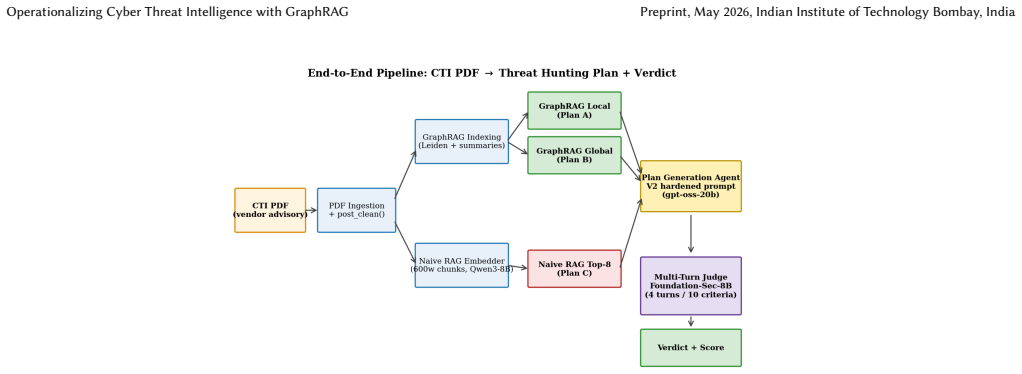
The load-bearing mechanism is GraphRAG Local Search over a report-derived knowledge graph: at indexing time entities (actor, malware, technique, vulnerability, domain, ip, file, sector) and their relationships are extracted and clustered into communities, and at query time the seed entities for a hunting question pull in their relationship neighbourhood, the text units describing those relationships, and the community summary that names a behavioural chain. That multi-entity neighbourhood is what lets the generator verbalise a TTP-level detection such as Outlook spawning mshta.exe then powershell.exe followed by a beacon, instead of latching onto the loudest single indicators. Naive RAG, by contrast, retrieves the top-8 cosine-similar text chunks, which for network-first CTI prose are usually the chunks naming network observables, anchoring the plan at L4 with an L1–L3 tail. The Pyramid of Pain framework supplies the evaluation axis: seven levels ordered by the adversary's cost to evade, from hashes and IPs up to TTPs.
What would settle it
Run the deep-dive APT28 plans against simulated or recorded endpoint and network telemetry with every IP, domain, and file hash rotated, and count how many detections actually fire; if the Naive RAG plan fires on a comparable share of its detections, or the GraphRAG plan loses significant detections, the reported 100% versus 29% gap would not be a property of the retrieval back-ends.
Extended reading notes
Core claim
The central claim is that retrieval architecture, not the language model or the prompt, determines the Pyramid-of-Pain resilience of an automatically generated threat hunting plan. Holding the generation model and the hardened generation prompt fixed and varying only the retrieval step, the paper reports that GraphRAG Local Search produces plans whose detections cluster at L5–L7 (host artefacts, tool fingerprints, TTPs) and survive a complete rotation of campaign IOCs at 100%, while Naive RAG produces plans that cluster at L4 with a long L1–L3 fragile tail and retain only 29% of detections under the same rotation. The paper also finds that the wording of the generation prompt moves total quality far more than the retrieval back-end does, but that only graph retrieval lifts the plan into the durable top of the pyramid. The intended upshot is that knowledge-graph-aware retrieval is the architecturally correct foundation for turning vendor reports into SOC-deployable hunting plans.
Load-bearing premise
The entire survival comparison rests on trusting the language-model judge's counts of which detections would still fire after IOC rotation, because no detection query was ever run against real or simulated telemetry and the counting procedure's reliability is not established.
Editorial extensions
If this is right
- Detection plans generated through graph-based retrieval should keep firing after public indicators go stale, extending operational life from hours to weeks or longer.
- SOCs deploying automated CTI-to-detection pipelines should make graph-based Local Search the primary retrieval back-end and keep Global Search behind an output-length fallback, since sparse reports silently degrade it.
- Because the hardened prompt moved every plan by tens of points, the contract imposed on the generator matters at least as much as retrieval; comparing retrieval architectures without such a contract will understate or mask architectural differences.
- The evidence suggests the GraphRAG-versus-Naive gap is not about total plan quality but about composition: near-equal grand totals hide a systematic difference in which detections remain after rotation, so SOCs should evaluate on durability, not aggregate scores.
Reading between the lines
- Extending beyond the paper: if the survival gap reproduces under real telemetry, graph-retrieval benefits may appear for other security text-to-artefact tasks, such as YARA or Sigma rule generation, where the durable signal is relational rather than lexical.
- Extending beyond the paper: rotating tool names, registry paths, and network artefacts in addition to IOCs would test whether L5–L7 detections truly persist; the paper's mechanism predicts GraphRAG plans should survive a broader rotation while Naive RAG plans degrade further.
- Extending beyond the paper: holding the prompt fixed and varying only retrieval neighbourhood size would isolate whether detection durability tracks the number of retrieved relationships, separating graph structure from retrieval coverage.
- Extending beyond the paper: because the prompt change moved total scores far more than the retrieval change, RAG comparisons in security that do not control prompt strictness may misattribute quality gains to the retrieval architecture.
Signed reviews
Editorial analysis
A structured set of objections, weighed in public.
Referee Report
Summary. This paper compares Microsoft GraphRAG (Local and Global Search) with Naive vector RAG for converting CTI reports into threat-hunting plans, using a locally hosted generation model and an LLM-as-Judge with a ten-criterion rubric. The central claim is that GraphRAG produces plans that are more durable under IOC rotation: a deep-dive on an APT28 report reports 100% survival of GraphRAG detections versus 29% for Naive RAG, and a nine-report breadth experiment is said to confirm a consistent Pyramid-of-Pain advantage for GraphRAG even where grand totals are close. The paper also reports a large V1-to-V2 prompt effect and characterizes two pipeline failure modes.
Significance. If the durability result were sound, it would be a useful contribution to CTI operationalization: much prior work measures extraction accuracy or rule validity rather than resilience to IOC rotation. The paper is also commendably explicit about its failure modes and about the strong effect of the generation prompt. However, the central measurement is not currently credible: the rubric defined in the paper contradicts the reported scores, and the survival counts are undocumented and are not validated against telemetry. As written, the headline 100%-versus-29% gap is as likely to be an artifact of the evaluation instrument as a property of the retrieval architecture.
major comments (5)
- [§5.3, Table 6, Table 7] The rubric in §5.3 states that detection_durability and ioc_resistance are capped at ≤3 when fewer than 30% of detections survive full IOC rotation. Table 7 reports that Plan C (Naive RAG) has 4/14 surviving detections, i.e., 29%, yet Table 6 awards Plan C 8/10 on detection_durability and 9/10 on ioc_resistance. Applying the stated caps lowers Plan C's Tier 2 score from 31 to at most 20 and its grand total from 78 to at most 67, which changes the reported 'close' deep-dive comparison. This is a load-bearing internal inconsistency in the headline evidence, and the manuscript cannot be correct as written.
- [§6.4, Table 7, §5.3] The survival counts that drive RQ2 are not accompanied by any documented counting procedure. The text does not state who classified each detection as surviving, what defines a detection for enumeration, how 'would still fire' was determined under complete IOC rotation, or whether the six-step judge procedure described in §5.3 produced Table 7. No detection query is executed against real or simulated logs, so the word 'firing' in the abstract and §6.4 overstates what was measured. An LLM's opinion that a detection 'would still fire' needs validation against at least a documented adversarial simulation or human expert counting before it can support the paper's central claim.
- [§A, §6.2, §6.4] The V2 generation prompt (Appendix A, rules 3 and 5) requires every detection to carry a self-assigned Pyramid tag and instructs the model that L1–L3 detections expire while L4–L7 survive, and it forces Section 2 to be labelled 'Primary' and Section 3 to be labelled 'Fragile'. The survival measurement is therefore entangled with the prompt contract: the judge may simply be reading durability labels that the generation model was required to write, rather than independently assessing whether the detection logic survives rotation. No ablation or human validation is reported that separates retrieval-architecture effects from prompt-mandated self-labeling.
- [§5.3, §6.1] The rubric's floors, ceilings, and the 30%/60% thresholds were calibrated on pilot runs of the same APT28 advisory that is then used as the headline deep-dive (§5.3, §6.1). This makes the evaluation instrument dependent on the test instance. A conclusion based on a rubric fitted to that instance needs a holdout or sensitivity analysis before the reported 100%-versus-29% number can be interpreted as evidence about the retrieval architecture.
- [§5.4, Table 8] The breadth experiment's win counts are computed from best-of-runs maxima over two runs and over Plans A and B for GraphRAG, while many cells are 16/100 silent-failure floors or 0/100 judge parsing failures. As reported, the 'approximately tied' grand-total comparison is not a comparison between two fixed pipelines, and the claimed Tier 2 advantage for GraphRAG on the breadth set is not established with this aggregation. Per-run and per-plan scores with failure-aware aggregation and sensitivity analysis should be reported.
minor comments (3)
- [§5.1, Table 3] The text says the corpus is drawn from four vendors (CrowdStrike, Cyble, EclecticIQ, Mandiant) plus one open-source advisory, but Table 3 lists only reports from CrowdStrike, Cyble, and EclecticIQ; the text and table should be reconciled.
- [§6.4, Abstract] The term 'firing' should be replaced with language that matches the actual measurement, such as 'judged as likely to fire', unless detection queries are actually executed against telemetry.
- [§7.3] The limitations section acknowledges the single-judge-run issue, but the paper would benefit from reporting multiple judge runs or at least a variance estimate, since the deep-dive and breadth conclusions rest entirely on this one judge's scores.
Circularity Check
Headline IOC-rotation 'firing' rate reduces to self-assigned Pyramid tags under a prompt that defines durability as the tag, and the rubric was calibrated on the same APT28 report used as the headline deep-dive.
-
self definitional
[Appendix A rule (3); Section 5.3 counting procedure; Section 6.4 / Table 7]
"The prompt also tells the model that L1–L3 detections expire within forty-eight hours of report publication while L4–L7 detections survive adversary infrastructure rotation, giving the model the operational context for its own tagging."
The paper's headline claim (Section 6.4, Table 7) is that GraphRAG plans 'kept firing' at 100% after IOC rotation while Naive RAG kept firing at 29%. No detection query is executed; survival is a classification made under the judge's six-step procedure (Section 5.3), which starts by listing each detection's Pyramid level and then counts 'how many would still fire'. The V2 generation prompt explicitly instructs the model that L1–L3 detections 'expire within forty-eight hours' while L4–L7 detections 'survive adversary infrastructure rotation', and Table 4 scores ioc_resistance partly on the plan's 'labelling'. The measured survival count therefore reduces, by construction, to the self-assigned Pyramid tags and rotation-resilience prose that the prompt forces both pipelines to produce.
-
fitted input called prediction
[Section 5.3 (Pilot V1 runs on APT28 advisory; floors/ceilings calibrated); Section 6.2–6.4 deep-dive]
"Pilot V1 runs on the APT28 advisory showed the collapse mode these floors prevent: the judge scored specificity 0/10 despite four campaign-specific IOCs being cited verbatim, because two prose-only queries elsewhere pulled the holistic impression down."
The rubric floors, ceilings, and 30%/60% thresholds were 'calibrated symmetrically' on pilot V1 runs of the very APT28 advisory later used as the deep-dive (Section 5.3 vs Tables 5–7). Section 5.3 says the floors were added because 'Pilot V1 runs on the APT28 advisory showed the collapse mode these floors prevent', and Section 6.2 then presents the same APT28 report as the headline evidence. This is in-sample evaluation: the rubric and the V2 prompt were tuned on the report that is later used to demonstrate pipeline superiority. The Tier 2 discrimination, including the 30% ceiling that would cap Plan C at ≤3 if 29% survival were applied, is partly forced by that calibration rather than discovered out of sample.
full rationale
The derivation is not circular in the self-citation sense: GraphRAG [15] and the judge model [23] are external systems, and no load-bearing argument reduces to a citation by the present authors. The circularity is in the measurement and evaluation design. Section 6.4's 'would still fire' count is not an executed detection; it is a judge classification, and the V2 prompt (Appendix A, rule 3) explicitly instructs the model that L1–L3 detections 'expire within forty-eight hours' while L4–L7 detections 'survive adversary infrastructure rotation'. The judge's counting procedure (Section 5.3) begins with the plan's self-assigned Pyramid levels, so the headline 100% vs 29% survival comparison reduces by construction to the tag distributions the generation model produced under a prompt that encodes the durability mapping. Additionally, the rubric's floors, ceilings, and 30%/60% thresholds were calibrated on pilot runs of the same APT28 advisory that is then used for the deep-dive (Section 5.3 vs Tables 5–7), making Tables 5–7 an in-sample demonstration rather than an out-of-sample test. The paper's own numbers are internally inconsistent in a way that reinforces this: Table 6 gives Plan C detection_durability 8/10 and ioc_resistance 9/10, while Table 7 reports 29% survival and Section 5.3 caps both criteria at ≤3 when fewer than 30% survive; the survival counts and rubric scores therefore cannot both be outputs of the stated procedure. Section 7.3 candidly notes the small grand-total margin and judge failures, but those caveats do not repair the self-referential measurement. None of this makes the architectural hypothesis false — the shared prompt means any GraphRAG tag-distribution advantage could still stem from retrieval — but the paper's headline durability metric is not independently measured, and the deep-dive is calibrated on the report it claims to predict. Score 7.
Assumptions & free parameters
free parameters (3)
- Retrieval hyperparameters (chunk size, chunk overlap, top-K, community level) =
600 words / 80 words / 8 / 2
- Rubric ceilings and floors (30% survival cap, 60% pyramid-level threshold, per-criterion floors/ceilings) =
30%, 60%, 0-10 floor/ceiling values
- Tie-breaker rule (higher Tier 2 wins even if Tier 1 lower) =
60/40 tier split
assumptions (4)
- domain assumption The Pyramid of Pain ordering of detection durability is correct (L1-L3 fragile, L4-L7 durable).
- domain assumption The Foundation-Sec-8B LLM judge, with the authors' rubric, produces valid scores of detection quality and durability without external validation.
- domain assumption Rotating all IPs, domains, and file hashes is the correct and sufficient operational test of plan durability.
- domain assumption The reports in the nine-report corpus are representative of CTI reports SOC teams consume.
Cite this review
Pith. "Pith review of Operationalizing Cyber Threat Intelligence with GraphRAG." pith.science (2026). https://pith.science/paper/UIN47PQG
@misc{pith2026260813050,
  author       = {Pith},
  title        = {Pith review of: Operationalizing Cyber Threat Intelligence with GraphRAG},
  year         = {2026},
  howpublished = {\url{https://pith.science/paper/UIN47PQG}},
  note         = {Machine review of arXiv:2608.13050}
}
read the original abstract
When a security researcher publishes a report on a cyberattack, detection engineers are supposed to turn it into working detection rules. In practice, most automated attempts at this only extract the simplest clues from the report --- bad IP addresses, domain names, and file hashes --- and turn them into block lists. This is a weak strategy, because attackers can change these simple clues within hours or days, so the resulting detections stop working almost as soon as they are deployed. Security teams describe this idea with the Pyramid of Pain. This project asks whether feeding a report into a knowledge-graph retrieval system, Microsoft GraphRAG, rather than a standard vector-similarity retrieval system (Naive RAG), produces detection plans that rely more on these durable, top-of-pyramid clues. Both systems are given the same report, the same generation instructions, and the same language model to write the final plan; only the retrieval step differs. In a detailed case study of one APT28 report, the GraphRAG plan kept firing at 100\% of its detections after every IP address, domain, and file hash in the report was rotated, while the Naive RAG plan kept firing at only 29\%. Repeating the comparison across nine real CTI reports from four vendors confirms the same pattern: GraphRAG plans consistently reach higher, harder-to-evade levels of the pyramid, even when the two systems end up close on total score. The results support treating knowledge-graph-aware retrieval as the architecturally correct foundation for automatically generating SOC-deployable hunting plans, while showing that the wording of the generation prompt matters almost as much as the retrieval back-end itself.
Figures


Figures from the paper (1 more)

Reference graph
Works this paper leans on
-
[1]
Ehsan Aghaei, Sarthak Jain, Prashanth Arun, and Arjun Sambamoorthy. 2025. SecureBERT 2.0.arXiv preprint arXiv:2510.00240(2025)
arXiv 2025
-
[2]
Ehsan Aghaei, Xi Niu, Waseem Shadid, and Ehab Al-Shaer. 2022. Secure- BERT: A Domain-Specific Language Model for Cybersecurity.arXiv preprint arXiv:2204.02685(2022)
arXiv 2022
-
[3]
Md Tanvirul Alam, Dipkamal Bhusal, Youngja Park, and Nidhi Rastogi. 2022. Looking Beyond IoCs: Automatically Extracting Attack Patterns from External CTI.arXiv preprint arXiv:2211.01753(2022)
work page Pith review arXiv 2022
-
[4]
Asad Ali and Min-Chun Peng. 2024. TTPMapper: Accurate Mapping of TTPs from Unstructured CTI Reports. In2024 IEEE International Conference on Future Machine Learning and Data Science (FMLDS). 558–563
work page 2024
-
[5]
Anna Bertiger, Bobby Filar, Aryan Luthra, Stefano Meschiari, Aiden Mitchell, Sam Scholten, and Vivek Sharath. 2025. Evaluating LLM Generated Detection Rules in Cybersecurity. InConference on Applied Machine Learning in Information Security (CAMLIS). arXiv preprint arXiv:2509.16749
work page Pith review arXiv 2025
-
[6]
David J. Bianco. 2013. The Pyramid of Pain. https://www.attackiq.com/glossary/ pyramid-of-pain-2/
work page 2013
-
[7]
Marvin Büchel, Tommaso Paladini, Stefano Longari, Michele Carminati, Stefano Zanero, Hodaya Binyamini, Gal Engelberg, Dan Klein, Giancarlo Guizzardi, Marco Caselli, Andrea Continella, Maarten van Steen, Andreas Peter, and Thijs van Ede
- [8]
Show all 46 references
-
[9]
K. S. Chandrakala, T. Murali Mohan, Praveena Mallampalli, and T. V. Satyasheela
-
[10]
Yutong Cheng, Osama Bajaber, Saimon Amanuel Tsegai, Dawn Song, and Peng Gao. 2024. CTINexus: Automatic Cyber Threat Intelligence Knowledge Graph Construction Using Large Language Models.arXiv preprint arXiv:2410.21060 (2024)
2024 arXiv
-
[11]
Alankrit Chona, Igor Kozlov, and Ambuj Kumar. 2026. Cyber Defense Bench- mark: Agentic Threat Hunting Evaluation for LLMs in SecOps.arXiv preprint arXiv:2604.19533(2026)
2026 arXiv
-
[12]
CrowdStrike Intelligence. 2025. CSA-211140: LABYRINTH CHOLLIMA Targets Cryptocurrency Sector with TxRLoader. CrowdStrike Falcon Intelligence
2025
-
[13]
CrowdStrike Intelligence. 2026. CSA-260004: Zimbra Local File-Inclusion Vulner- ability Probing and Testing Observed In-The-Wild. CrowdStrike Falcon Intelli- gence
2026
-
[14]
CrowdStrike Intelligence. 2026. CSA-260255: Fancy Bear Continues LayeredMesh Campaign — Exploits CVE-2026-21509 to Deploy MiniPostal FrameLoader and Custom Covenant Grunt Stager. CrowdStrike Falcon Intelligence
2026
-
[15]
Darren Edge, Ha Trinh, Newman Cheng, Joshua Bradley, Alex Chao, Apurva Mody, Steven Truitt, Dasha Metropolitansky, Robert Osazuwa Ness, and Jonathan Larson. 2025. From Local to Global: A Graph RAG Approach to Query-Focused Summarization.arXiv preprint arXiv:2404.16130v2(Feb. 2025)
2025 arXiv
-
[16]
Foundation AI Team, Cisco. 2025. Foundation-Sec-8B: A Cybersecurity- Specialised Language Model. Hugging Face Model Card
2025
-
[17]
Ali Habibzadeh, Farid Feyzi, and Reza Ebrahimi Atani. 2025. Large Language Models for Security Operations Centers: A Comprehensive Survey.arXiv preprint arXiv:2509.10858(2025)
2025 arXiv
-
[18]
Dzenan Hamzic, Florian Skopik, Max Landauer, Markus Wurzenberger, and Andreas Rauber. 2026. Beyond RAG for Cyber Threat Intelligence: A Systematic Evaluation of Graph-Based and Agentic Retrieval.arXiv preprint arXiv:2604.11419 (2026)
2026 arXiv
-
[19]
Rossi, Subhabrata Mukherjee, Xianfeng Tang, Qi He, Zhigang Hua, Bo Long, Tong Zhao, Neil Shah, Amin Javari, Yinglong Xia, and Jiliang Tang
Haoyu Han, Yu Wang, Harry Shomer, Kai Guo, Jiayuan Ding, Yongjia Lei, Ma- hantesh Halappanavar, Ryan A. Rossi, Subhabrata Mukherjee, Xianfeng Tang, Qi He, Zhigang Hua, Bo Long, Tong Zhao, Neil Shah, Amin Javari, Yinglong Xia, and Jiliang Tang. 2025. Retrieval-Augmented Generat...
2025 arXiv
-
[20]
Vasanth Iyer, Leonardo Bobadilla, and S. S. Iyengar. 2026. CyberLLM-FINDS 2025: Instruction-Tuned Fine-tuning of Domain-Specific LLMs with Retrieval- Augmented Generation and Graph Integration for MITRE Evaluation.arXiv preprint arXiv:2601.06779v1(Jan. 2026)
2026
-
[21]
Beomjin Jin, Yejin Do, Seyoung Jin, Jungho Oh, Seungwoo Yoo, Chaejin Lim, Elisa Bertino, and Hyoungshick Kim. 2025. CTIGen: A LLM-based Framework for Automated CTI Report Generation.SSRN preprint 6596521, submitted to Elsevier (2025)
2025
-
[22]
Jeff Johnson, Matthijs Douze, and Hervé Jégou. 2021. Billion-Scale Similarity Search with GPUs.IEEE Transactions on Big Data7, 3 (2021), 535–547
2021
-
[23]
Paul Kassianik et al. 2025. Llama-3.1-FoundationAI-SecurityLLM-Base-8B Tech- nical Report.arXiv preprint arXiv:2504.21039(2025)
2025 arXiv
-
[24]
Hyoung Rok Kim, Donghyeon Lee, Insup Lee, Soohan Lee, and Sangjin Lee
-
[25]
Ardian, Elmar Kiesling, and Andreas Ekelhart
Kabul Kurniawan, Rayhan F. Ardian, Elmar Kiesling, and Andreas Ekelhart. 2025. AgCyRAG: An Agentic Knowledge Graph Based RAG Framework for Automated Security Analysis. InProceedings of the 2nd International Workshop on Reasoning and Analysis over Graphs and Knowledge Graphs (R...
2025
-
[26]
Kabul Kurniawan, Elmar Kiesling, and Andreas Ekelhart. 2024. CyKG-RAG: Towards Knowledge-Graph Enhanced Retrieval Augmented Generation for Cy- bersecurity. InProceedings of the 1st International Workshop on Reasoning and Analysis over Graphs and Knowledge Graphs (RAGE-KG) at I...
2024
-
[27]
Multi-Step LLM Pipeline for Enhancing TTP Extraction in Cyber Threat Intelligence.IEEE Access13 (2025), 179696–179710
2025
-
[28]
Zhenyuan Li, Jun Zeng, Yan Chen, and Zhenkai Liang. 2022. AttacKG: Construct- ing Technique Knowledge Graph from Cyber Threat Intelligence Reports. In Proceedings of the 27th European Symposium on Research in Computer Security (ESORICS). 589–609
2022
-
[29]
Yuqiao Meng, Luoxi Tang, Feiyang Yu, Xi Li, Guanhua Yan, Ping Yang, and Zhaohan Xi. 2025. Benchmarking LLM-Assisted Blue Teaming via Standardized Threat Hunting.arXiv preprint arXiv:2509.23571(2025)
2025 arXiv
-
[30]
Patrick Lewis, Ethan Perez, Aleksandra Piktus, Fabio Petroni, Vladimir Karpukhin, Naman Goyal, Heinrich Küttler, Mike Lewis, Wen-tau Yih, Tim Rocktäschel, Sebastian Riedel, and Douwe Kiela. 2020. Retrieval-Augmented Generation for Knowledge-Intensive NLP Tasks. InAdvances in N...
2020
-
[31]
MITRE Corporation. 2023. MITRE ATT&CK: Adversarial Tactics, Techniques, and Common Knowledge. https://attack.mitre.org/
2023
-
[32]
OASIS Open. 2021. STIX Version 2.1. OASIS Standard
2021
-
[33]
Shaswata Mitra, Subash Neupane, Martin Duclos, Sudip Mittal, Aritran Piplai, Md Rayhanur Rahman, Edward Zieglar, and Shahram Rahimi. 2025. FALCON: Transforming Cyber Threat Intelligence into Deployable IDS Rules with Self- Reflection.arXiv preprint arXiv:2508.18684(2025)
2025 arXiv
-
[34]
Qwen Team. 2025. Qwen3-Embedding-8B: 4096-Dimensional Multilingual Em- beddings. Hugging Face Model Card
2025
-
[35]
Clemens Sauerwein and Alexander Pfohl. 2022. Towards Automated Classifica- tion of Attackers’ TTPs by Combining NLP with ML Techniques.arXiv preprint arXiv:2207.08478(2022)
2022 arXiv
-
[36]
OpenAI. 2025. gpt-oss-20b: An Open-Weight 20B Language Model. Model Card
2025
-
[37]
V. A. Traag, L. Waltman, and N. J. van Eck. 2019. From Louvain to Leiden: Guaranteeing Well-Connected Communities.Scientific Reports9 (2019), 5233
2019
-
[38]
Ming Xu, Hongtai Wang, Jiahao Liu, Xinfeng Li, Zhengmin Yu, Weili Han, Hoon Wei Lim, Jin Song Dong, and Jiaheng Zhang. 2024. ThreatPilot: Attack- Driven Threat Intelligence Extraction.arXiv preprint arXiv:2412.10872(2024)
2024
-
[39]
Yuval Schwartz, Lavi Benshimol, Dudu Mimran, Yuval Elovici, and Asaf Shabtai
-
[40]
Cohen, Ruslan Salakhutdinov, and Christopher D
Zhilin Yang, Peng Qi, Saizheng Zhang, Yoshua Bengio, William W. Cohen, Ruslan Salakhutdinov, and Christopher D. Manning. 2018. HotpotQA: A Dataset for Diverse, Explainable Multi-hop Question Answering. InProceedings of the 2018 Conference on Empirical Methods in Natural Langua...
2018
-
[41]
Yongheng Zhang, Tingwen Du, Yunshan Ma, Xiang Wang, Yi Xie, Guozheng Yang, Yuliang Lu, and Ee-Chien Chang. 2024. AttacKG+: Boosting Attack Knowledge Graph Construction with Large Language Models.arXiv preprint arXiv:2405.04753 (2024)
2024 arXiv
-
[42]
Xing, Hao Zhang, Joseph E
Lianmin Zheng, Wei-Lin Chiang, Ying Sheng, Siyuan Zhuang, Zhanghao Wu, Yonghao Zhuang, Zi Lin, Zhuohan Li, Dacheng Li, Eric P. Xing, Hao Zhang, Joseph E. Gonzalez, and Ion Stoica. 2023. Judging LLM-as-a-Judge with MT- Bench and Chatbot Arena. InAdvances in Neural Information P...
2023
-
[43]
Xiuzhang Yang, Ruijie Zhong, Yuling Chen, Guojun Peng, Di Yao, Chaofan Chen, Chenyang Wang, Dongni Zhang, Yilin Zhou, and Zixuan Yang. 2026. CTI-Thinker: An LLM-Driven System for CTI Knowledge Graph Construction and Attack Reasoning.Cybersecurity9 (2026), 106. doi:10.1186/s424...
2026 doi
-
[2024]
LLMCloudHunter: Harnessing LLMs for Automated Extraction of Detection Rules from Cloud-Based CTI.arXiv preprint arXiv:2407.05194(2024)
2024 arXiv
-
[2025]
InProceedings of the 34th USENIX Security Symposium
SoK: Automated TTP Extraction from CTI Reports — Are We There Yet?. InProceedings of the 34th USENIX Security Symposium. 4621
-
[2026]
InProceedings of the 4th International Conference on Intelligent Data Communication Technologies and Internet of Things (IDCIoT)
CT-RAG: A Deep Retrieval-Augmented Generation Framework for Auto- mated Cyber Threat Intelligence and Severity Assessment. InProceedings of the 4th International Conference on Intelligent Data Communication Technologies and Internet of Things (IDCIoT). IEEE, 717–723
Reviewed August 15, 2026 · model on record in the stance chip above.
Discussion (0). Continue with ORCID to comment.