REVIEW 4 major objections 5 minor 21 references
ProbSplat: Efficient Probabilistic Hardware for Gaussian Splatting in 3D Scene Reconstruction
T0 review · 4 major / 5 minor · reviewed 2026-08-15 · deepseek-v4-flash
Pith's one-line read A 6T floating-gate inverter column can be programmed to store and evaluate a Gaussian component, making Gaussian splatting likelihood run at 18 pJ per inference.
desk verdict A plausible, honestly-reported extension of the 6T FG inverter array to program mean and variance, but the headline PSNR and energy claims are projections, not hardware measurements. read the letter →
The pith
A machine-rendered reading of the paper's core claim, the machinery that carries it, and where it could break.
The reading
What carries the argument
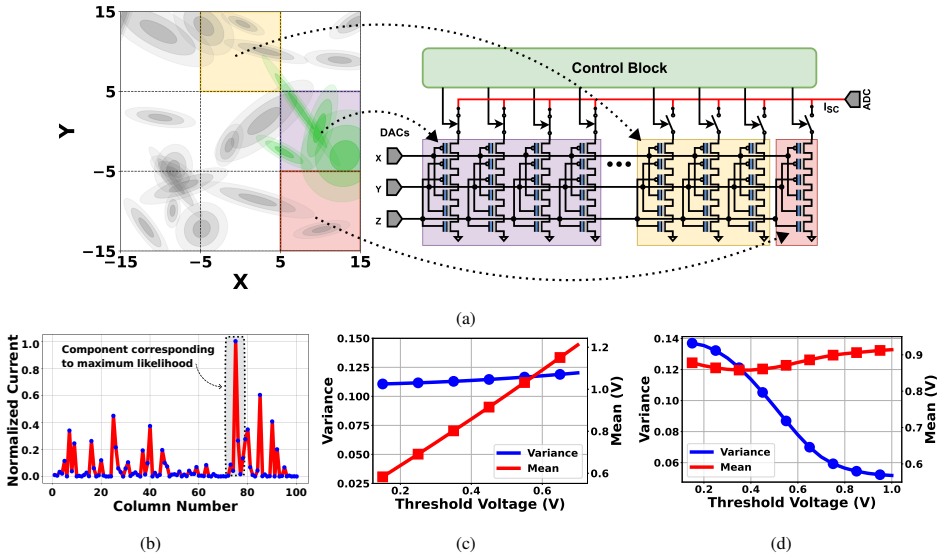
The central object is the 6T floating-gate inverter column: six transistors whose floating-gate threshold voltages $V_{Tn}$ and $|V_{Tp}|$ are programmed to store a Gaussian component, and whose short-circuit current $I_{SC}$ evaluates that component's likelihood at the input voltage $V_z$. The key identity is the orthogonality of programming directions in the $(V_{Tn}, |V_{Tp}|)$ plane: shifting $V_{Tn}$ up by an amount and $|V_{Tp}|$ down by the same amount moves the mean, while shifting both by the same amount broadens or narrows the current spread and hence the variance. A pull-up to pull-down width ratio of $W_p = 3W_n$ minimizes the residual coupling between the two controls. This mechanism carries the argument because it replaces digital log-likelihood computation with an analog current that is already the stored-and-computed Gaussian value.
What would settle it
Simulate or fabricate the 180-nm 6T floating-gate array, measure the actual $I_{SC}$ curves across the full programmed mean and variance range, and render a test scene using those measured currents instead of idealized Gaussian kernels; if the PSNR falls clearly below 21.99 dB or mean/variance deviations exceed roughly 2.4 percent, the independent-programmability and fidelity claims fail.
Extended reading notes
Core claim
The paper's discovery is a voltage-programming rule that makes a 6T floating-gate inverter column a faithful, independently tunable Gaussian-like element rather than a fixed-shape kernel. If $V_{Tn}$ and $|V_{Tp}|$ are treated as two programming axes, then moving the threshold voltages along a line of slope $-1$ changes only the mean, while moving them along a line of slope $+1$ changes only the variance; the contour lines of mean and variance in this plane are orthogonal, so the two parameters decouple. The short-circuit current $I_{SC}$ of each column then behaves as the component's likelihood current, and parallel columns sum a Gaussian mixture in the analog domain. ProbSplat applies this to 3D Gaussian splatting by mapping each scene Gaussian's mean and diagonal covariance to one inverter column, gating whole scene cells with digital control logic, and reading the mixture likelihood through a logarithmic ADC. Simulated in 180-nm CMOS at 1.8 V and 50 MHz, the design reports mean-variance independence with under 2.4 percent deviation, 18 pJ per 4-bit log-likelihood inference, 202.57 pJ per 8-bit inference with 500 mixture functions, and a rendered-scene PSNR of 21.99 dB.
Load-bearing premise
The load-bearing premise is that a real scene's Gaussians can be squeezed into the hardware's narrow, diagonal-covariance threshold-voltage range and that the analog column current tracks the intended Gaussian closely enough that render quality computed from the re-parameterized Gaussians is what the hardware would actually produce.
Editorial extensions
If this is right
- If the 6T column behaves as simulated, Gaussian splatting likelihood evaluation drops to 18 pJ at 4-bit precision, with the inverter columns contributing only 5.67 pJ and the logarithmic ADC dominating at 8-bit precision.
- Scene reconstruction using hardware-constrained diagonal-covariance Gaussians reaches 21.99 dB PSNR at int8 precision, and raising the opacity threshold from 0.005 to 0.25 reduces the number of required 6T columns by 3.49x with only a modest PSNR penalty.
- Because each scene cell is gated by 2-bit-per-axis digital control, only Gaussians near the queried position dissipate switching power, making energy scale with scene locality rather than full mixture size.
- Mean and variance can be programmed independently across each column, so a scene's Gaussian components can have different spreads, not just the fixed variance of the earlier mean-only inverter design.
Reading between the lines
- Pith inference: because the mean and variance contours are orthogonal, the same threshold-voltage plane could in principle program other parametric kernels, such as Laplace or asymmetric shapes, by choosing nonlinear programming paths, extending the architecture beyond Gaussian mixtures.
- Pith inference: the paper's fidelity check re-parameterizes the splatting Gaussians into the hardware's allowable mean and variance range; an end-to-end simulation that feeds actual $I_{SC}$ curves through the ADC would test how much analog non-ideality changes the 21.99 dB figure.
- Pith inference: the energy comparison projects reference ADC and DAC designs to 180 nm and 1.8 V under ideal scaling; a fabricated ProbSplat prototype would be the decisive test of whether the 18 pJ and 202.57 pJ figures survive real peripheral overheads.
Signed reviews
Editorial analysis
A structured set of objections, weighed in public.
Referee Report
Summary. The manuscript proposes ProbSplat, a compute-in-memory architecture based on 6T floating-gate inverter columns that programs both the mean and the variance of Gaussian mixture components by setting transistor threshold voltages. It reports TSMC 180nm SPICE simulations showing mean and variance programming with less than 2.4% deviation, and it projects energy per log-likelihood inference of 17.99 pJ at 4-bit precision and 202.57 pJ at 8-bit precision for a 500-column array. The architecture is applied to 3D Gaussian splatting using the train scene dataset, and the paper reports a rendering quality of 21.99 dB PSNR at 8-bit precision.
Significance. If the claims hold, the ability to program Gaussian means and variances independently in a standard floating-gate CMOS inverter array is a useful extension of the authors' prior HMGM work and could enable low-power probabilistic computing for edge 3D vision and robotics. The paper includes SPICE-level simulations, Monte Carlo sampling, explicit energy-modeling assumptions, and a real-scene rendering experiment, which are strengths. However, the headline fidelity and energy results are projections: the PSNR is computed from ideal Gaussian kernels in software rather than from the simulated analog column currents, and the energy numbers rely on ideal scaling of external ADC/DAC designs. The central independence claim also needs reconciliation with the mean drift shown in Fig. 5(b). These issues are load-bearing for the main claims but appear addressable in revision.
major comments (4)
- [Section IV, Fig. 6] The 21.99 dB PSNR figure is computed from a software Gaussian-splatting renderer in which the means and covariances are constrained to the 6T FG inverter programming range, but the simulated ISC(Vz) curves, including their non-Gaussian shape and the peak-current variation with variance noted in Section III, do not enter the rendering. Consequently, the fidelity claim is not yet a claim about the hardware's actual analog behavior. Please recompute the rendering using the simulated column currents or provide a validated analytical model of ISC(Vz), and report a goodness-of-fit metric between ISC(Vz) and the Gaussian kernel used in the renderer.
- [Section IV, Table I and Abstract] The energy figures of 17.99 pJ and 202.57 pJ are obtained by ideal scaling of reference ADC and DAC designs, not from simulation or measurement of the proposed system, but the abstract presents them as consumption numbers. In addition, the DAC reference [19] is a NAND-flash memory paper, not a 10-bit DAC, so the 3-DAC energy estimate is not supported. Please relabel all energy numbers as projections, supply the correct DAC reference, justify the exponential bit-scaling assumption for the log-ADC, and state the simulation basis for the 5.67 pJ inverter-column energy.
- [Section III, Fig. 5(b) and Fig. 2 caption] The claimed mean-variance independence with 2.17-2.37% deviation appears inconsistent with Fig. 5(b), where sweeping VTn = |VTp| along the variance-programming axis shifts the peak location of ISC by roughly 0.25 V (from about 0.70 V to 0.95 V) for Wp = 3*Wn. This is a substantial fraction of the stated 0-0.9 V mean mapping range and exceeds the reported percentage. Please define the exact deviation metric used for the 2.37%/2.17% figures, specify the usable programming range over which the claim holds, and either demonstrate independence over that range or qualify the claim accordingly.
- [Section IV and Section II] The comparison with a conventional digital implementation is not a controlled baseline: the 477 pJ figure is derived from a WFST speech-recognizer design and standard-cell library projections [20,21], not from a GMM or Gaussian-splatting processor, and the comparison uses different component counts (30 vs. 500 mixtures) and different workload assumptions. Please either remove the comparison or provide a matched baseline with the same task, technology, precision, and number of components.
minor comments (5)
- [Abstract and Section II] The circuit outputs currents proportional to Gaussian kernel values; calling this 'log-likelihood inference' is imprecise. Please clarify that a log-ADC converts the summed current to a log-likelihood, or use 'likelihood evaluation' where appropriate.
- [Section III, Fig. 4] The variables Vx and Vy in the caption of Fig. 4 are not defined in the text. Please define them and describe the programming procedure for setting the floating-gate voltages.
- [Section III] The statement 'In applications like gaussian splatting, the variances are typically low' should be justified or qualified, since 3D Gaussian splatting scenes can require a wide range of covariance values.
- [Section IV] Please specify how the 6T FG inverter constraints (diagonal covariance, limited variance range, mean range) are imposed on the trained Gaussian splat parameters, and whether the Gaussians are re-fit or simply clipped to the hardware range.
- [Fig. 7(a)] The claim that the mean and variance contours are orthogonal should be supported by a quantitative measure, since the simulations in Fig. 5(b) show a non-negligible cross-coupling.
Circularity Check
No significant circularity: the independent mean/variance programming, energy estimates, and rendering fidelities are forward simulations or externally referenced, not reductions to the paper's own inputs.
full rationale
The paper's central claim is a new hardware capability: independent programming of Gaussian mean and variance by deterministic threshold-voltage shifts on a 6T floating-gate inverter array. This is derived from circuit equations and verified by SPICE simulations (Figs. 4 and 5), not by assuming the conclusion. The energy figures use external ADC/DAC references with stated ideal scaling assumptions, and the PSNR results in Fig. 6 are obtained by rendering the train scene with Gaussian parameters constrained to the inverter programming range; this is a forward simulation, not a fit of hardware outputs back into the inputs. The main caveat, noted in Section IV, is that the rendered PSNR does not use the simulated ISC(Vz) curves themselves, so the hardware's non-ideal analog kernel shape is not end-to-end validated; however, that is a validation gap, not circularity. Self-citations to prior work [15] and [17] provide the starting architecture and comparator, but the new variance-control mechanism is independently simulated and does not reduce to those citations.
Assumptions & free parameters
free parameters (3)
- Wp:Wn ratio =
3
- Default threshold voltage V_TH =
0.45 V
- Energy scaling exponents =
2 for node, 2 for VDD, 2 for precision bit difference
assumptions (3)
- domain assumption The short-circuit current of a CMOS inverter as a function of input voltage is approximately Gaussian, with peak location controlled by transistor threshold voltages.
- domain assumption Floating-gate MOSFET threshold voltages can be programmed deterministically to desired values.
- ad hoc to paper Energy scaling Energy ∝ (node/ref)^2, (VDD/ref)^2, and 2^(precision difference) holds for the peripherals.
Cite this review
Pith. "Pith review of ProbSplat: Efficient Probabilistic Hardware for Gaussian Splatting in 3D Scene Reconstruction." pith.science (2026). https://pith.science/paper/WVPMGIWY
@misc{pith2026260813143,
  author       = {Pith},
  title        = {Pith review of: ProbSplat: Efficient Probabilistic Hardware for Gaussian Splatting in 3D Scene Reconstruction},
  year         = {2026},
  howpublished = {\url{https://pith.science/paper/WVPMGIWY}},
  note         = {Machine review of arXiv:2608.13143}
}
read the original abstract
This paper presents ProbSplat, a Compute-in-Memory (CIM)-inspired architecture based on programmable and energy efficient floating-gate inverter columns for probabilistic computing. Improving upon our prior work, ProbSplat programs and stores both means and variances of Gaussian mixture components, and evaluates log-likelihood for gaussian splatting during scene reconstruction with high energy efficiency, suitable for robotics and augmented/virtual reality (AR/VR) at the edge. Our proposed scheme enables independent control of both mean and variance via deterministic adjustment of floating-gate MOSFET threshold voltages, increasing the fidelity of hardware to program probability distributions. The design is simulated in 180nm CMOS on 1.8 V at 50 MHz and achieves mean-variance independence with <2.4% deviation during 3-D Gaussian mixture modeling. Compared to conventional digital implementations, ProbSplat significantly reduces compute complexity, memory footprint, and power consumption. The scalable framework consumes 18pJ energy per log-likelihood inference with 4-bit precision while operating for 500 mixture functions in a 3-D GMM. Scene reconstruction with ProbSplat's characteristics gave satisfactory fidelity of 21.99 PSNR (dB) at 8-bit precision.
Figures


Figures from the paper (4 more)


Reference graph
Works this paper leans on
-
[19]
A 1tb 4b/cell 64-stacked-wl 3d nand flash memory with 12mb/s program throughput,
S. Lee, C. Kim, M. Kim, S.-m. Joe, J. Jang, S. Kim, K. Lee, J. Kim, J. Park, H.-J. Leeet al., “A 1tb 4b/cell 64-stacked-wl 3d nand flash memory with 12mb/s program throughput,” in2018 IEEE International Solid-State Circuits Conference-(ISSCC). IEEE, 2018, pp. 340–342
2018
-
[1]
Probabilistic numerics and uncertainty in computations,
P. Hennig, M. A. Osborne, and M. Girolami, “Probabilistic numerics and uncertainty in computations,”Proceedings of the Royal Society A: Mathematical, Physical and Engineering Sciences, vol. 471, no. 2179, p. 20150142, 2015
work page 2015
-
[2]
Probabilistic photonic computing for ai,
F. Br ¨uckerhoff-Pl¨uckelmann, A. P. Ovvyan, A. Varri, H. Borras, B. Klein, L. Meyer, C. D. Wright, H. Bhaskaran, G. S. Syed, A. Sebas- tianet al., “Probabilistic photonic computing for ai,”Nature Computa- tional Science, pp. 1–11, 2025
work page 2025
-
[3]
Probabilistic machine learning and artificial intelli- gence,
Z. Ghahramani, “Probabilistic machine learning and artificial intelli- gence,”Nature, vol. 521, no. 7553, pp. 452–459, 2015
work page 2015
-
[4]
Probabilistic terrain mapping for mobile robots with uncertain localization,
P. Fankhauser, M. Bloesch, and M. Hutter, “Probabilistic terrain mapping for mobile robots with uncertain localization,”IEEE Robotics and Automation Letters, vol. 3, no. 4, pp. 3019–3026, 2018
2018
-
[5]
4d gaussian splatting for real-time dynamic scene rendering,
G. Wu, T. Yi, J. Fang, L. Xie, X. Zhang, W. Wei, W. Liu, Q. Tian, and X. Wang, “4d gaussian splatting for real-time dynamic scene rendering,” inProceedings of the IEEE/CVF conference on computer vision and pattern recognition, 2024, pp. 20 310–20 320
2024
-
[6]
A review and comparative study on probabilistic object detection in autonomous driv- ing,
D. Feng, A. Harakeh, S. L. Waslander, and K. Dietmayer, “A review and comparative study on probabilistic object detection in autonomous driv- ing,”IEEE Transactions on Intelligent Transportation Systems, vol. 23, no. 8, pp. 9961–9980, 2022
2022
-
[7]
Temporal clustering of surgical activities in robot-assisted surgery,
A. Zia, C. Zhang, X. Xiong, and A. M. Jarc, “Temporal clustering of surgical activities in robot-assisted surgery,”International journal of computer assisted radiology and surgery, vol. 12, no. 7, pp. 1171–1178, 2017
work page 2017
Show all 21 references
-
[8]
pixelsplat: 3d gaussian splats from image pairs for scalable generalizable 3d recon- struction,
D. Charatan, S. L. Li, A. Tagliasacchi, and V . Sitzmann, “pixelsplat: 3d gaussian splats from image pairs for scalable generalizable 3d recon- struction,” inProceedings of the IEEE/CVF Conference on Computer Vision and Pattern Recognition (CVPR), June 2024, pp. 19 457–19 467
2024
-
[9]
Gaussian splatting slam,
H. Matsuki, R. Murai, P. H. Kelly, and A. J. Davison, “Gaussian splatting slam,” inProceedings of the IEEE/CVF Conference on Computer Vision and Pattern Recognition (CVPR), June 2024, pp. 18 039–18 048
2024
-
[10]
Mobile robot localization: A review of probabilistic map-based techniques,
S. M. Malagon-Soldara, M. Toledano-Ayala, G. Soto-Zarazua, R. V . Carrillo-Serrano, and E. A. Rivas-Araiza, “Mobile robot localization: A review of probabilistic map-based techniques,”IAES International Journal of Robotics and Automation, vol. 4, no. 1, p. 73, 2015
2015
-
[11]
Colmap- free 3d gaussian splatting,
Y . Fu, S. Liu, A. Kulkarni, J. Kautz, A. A. Efros, and X. Wang, “Colmap- free 3d gaussian splatting,” inProceedings of the IEEE/CVF Conference on Computer Vision and Pattern Recognition, 2024, pp. 20 796–20 805
2024
-
[12]
Learning mixtures of gaussians,
S. Dasgupta, “Learning mixtures of gaussians,” in40th Annual Sympo- sium on F oundations of Computer Science (Cat. No.99CB37039), 1999, pp. 634–644
1999
-
[13]
Memory devices and applications for in-memory computing,
A. Sebastian, M. Le Gallo, R. Khaddam-Aljameh, and E. Eleftheriou, “Memory devices and applications for in-memory computing,”Nature Nanotechnology, vol. 15, no. 7, pp. 529–544, Jul 2020. [Online]. Available: https://doi.org/10.1038/s41565-020-0655-z
2020 doi
-
[14]
In-memory computing: Advances and prospects,
N. Verma, H. Jia, H. Valavi, Y . Tang, M. Ozatay, L.-Y . Chen, B. Zhang, and P. Deaville, “In-memory computing: Advances and prospects,”IEEE Solid-State Circuits Magazine, vol. 11, no. 3, pp. 43–55, 2019
2019
-
[15]
Ultralow-power localization of insect-scale drones: Interplay of probabilistic filtering and compute-in-memory,
P. Shukla, A. Muralidhar, N. Iliev, T. Tulabandhula, S. B. Fuller, and A. R. Trivedi, “Ultralow-power localization of insect-scale drones: Interplay of probabilistic filtering and compute-in-memory,”IEEE Trans- actions on V ery Large Scale Integration (VLSI) Systems, vol. 30, ...
2022
-
[16]
3d gaussian splatting for real-time radiance field rendering,
B. Kerbl, G. Kopanas, T. Leimk ¨uhler, and G. Drettakis, “3d gaussian splatting for real-time radiance field rendering,” 2023. [Online]. Available: https://arxiv.org/abs/2308.04079
2023 arXiv
-
[17]
Highly parallel and ultra-low-power probabilistic reasoning with programmable gaussian-like memory transistors,
C. Lee, L. Rahimifard, J. Choi, J.-i. Park, C. Lee, D. Kumar, P. Shukla, S. M. Lee, A. R. Trivedi, H. Yoo, and S. G. Im, “Highly parallel and ultra-low-power probabilistic reasoning with programmable gaussian-like memory transistors,”Nature Communications, vol. 15, no. 1, p. 2...
2024
-
[18]
A 2.5 mw 80 db dr 36 db sndr 22 ms/s logarithmic pipeline adc,
J. Lee, J. Kang, S. Park, J.-s. Seo, J. Anders, J. Guilherme, and M. P. Flynn, “A 2.5 mw 80 db dr 36 db sndr 22 ms/s logarithmic pipeline adc,” IEEE Journal of Solid-State Circuits, vol. 44, no. 10, pp. 2755–2765, 2009
2009
-
[20]
A 6 mw, 5,000-word real- time speech recognizer using wfst models,
M. Price, J. Glass, and A. P. Chandrakasan, “A 6 mw, 5,000-word real- time speech recognizer using wfst models,”IEEE Journal of Solid-State Circuits, vol. 50, no. 1, pp. 102–112, 2015
2015
-
[21]
Performance comparisons between 7-nm finfet and conventional bulk cmos standard cell libraries,
Q. Xie, X. Lin, Y . Wang, S. Chen, M. J. Dousti, and M. Pedram, “Performance comparisons between 7-nm finfet and conventional bulk cmos standard cell libraries,”IEEE Transactions on Circuits and Systems II: Express Briefs, vol. 62, no. 8, pp. 761–765, 2015. 5
2015
Reviewed August 15, 2026 · model on record in the stance chip above.
Discussion (0). Continue with ORCID to comment.