Machine Learning · arXiv:2608.27020 v1 · submitted 27 Aug 2026 · 2 references
Representation Measurements Under Function-Preserving Reparameterizations
The paper says
“Hidden coordinates are not uniquely determined by a language model's input–output function, so representation-derived measurements should be invariant to function-preserving changes of basis.”
more of the abstract
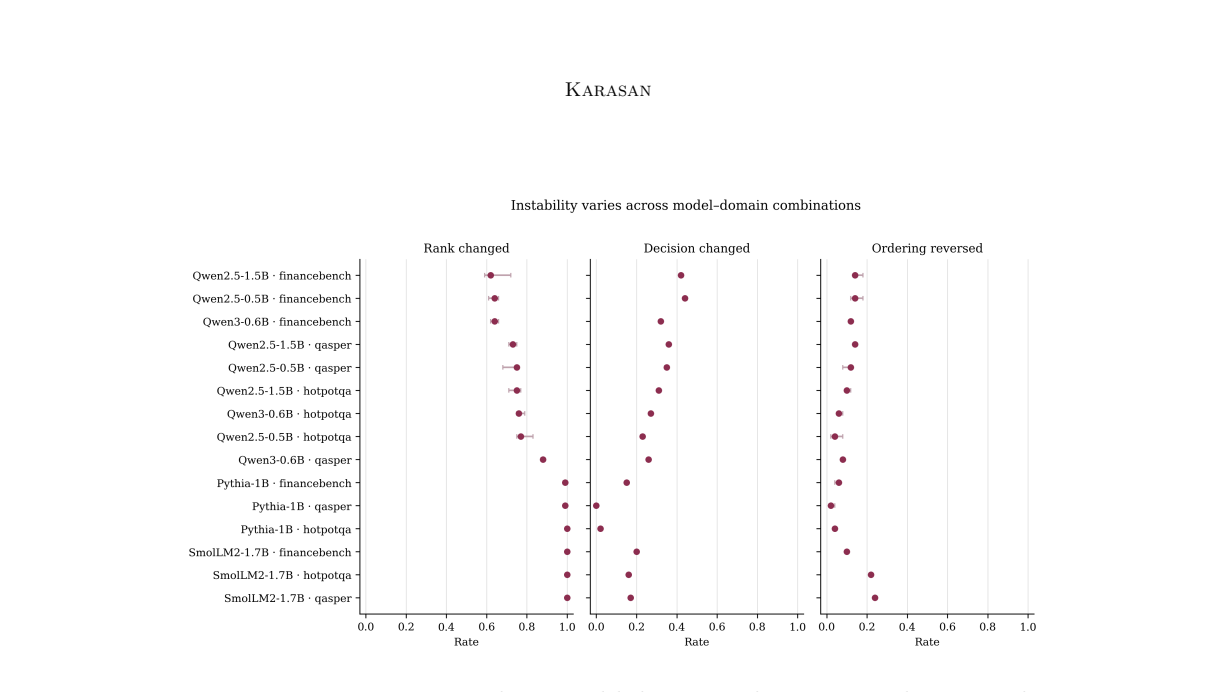
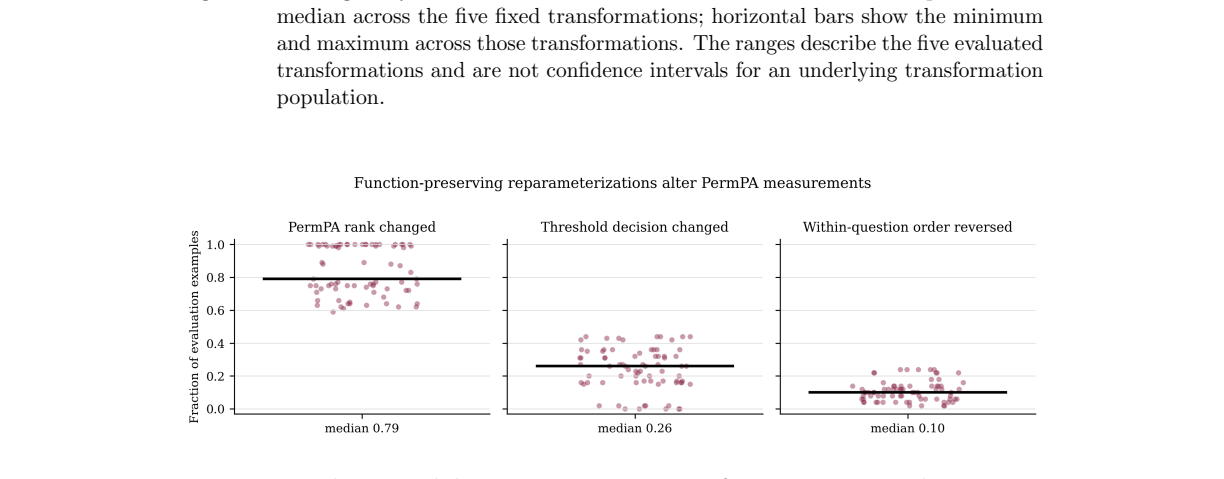
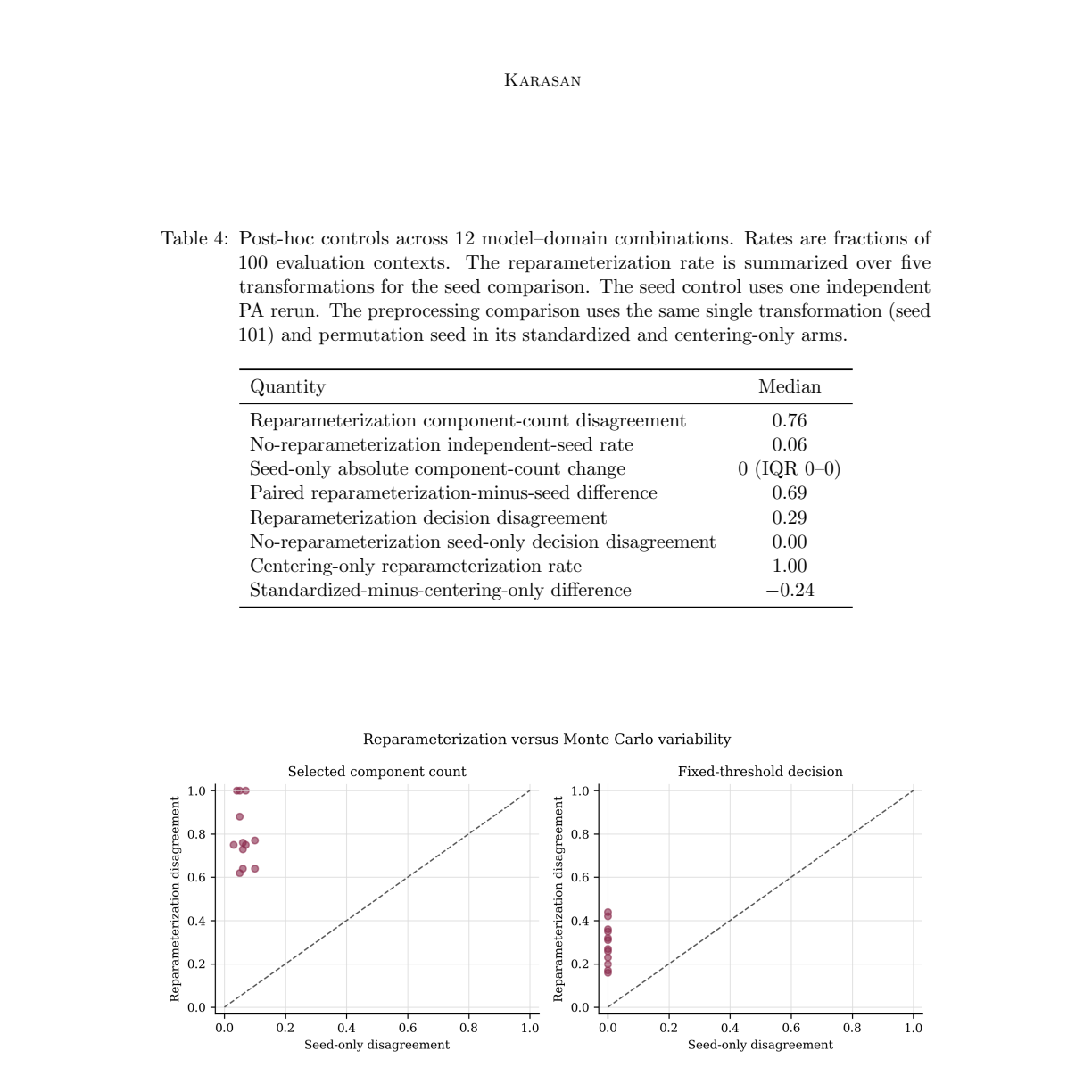
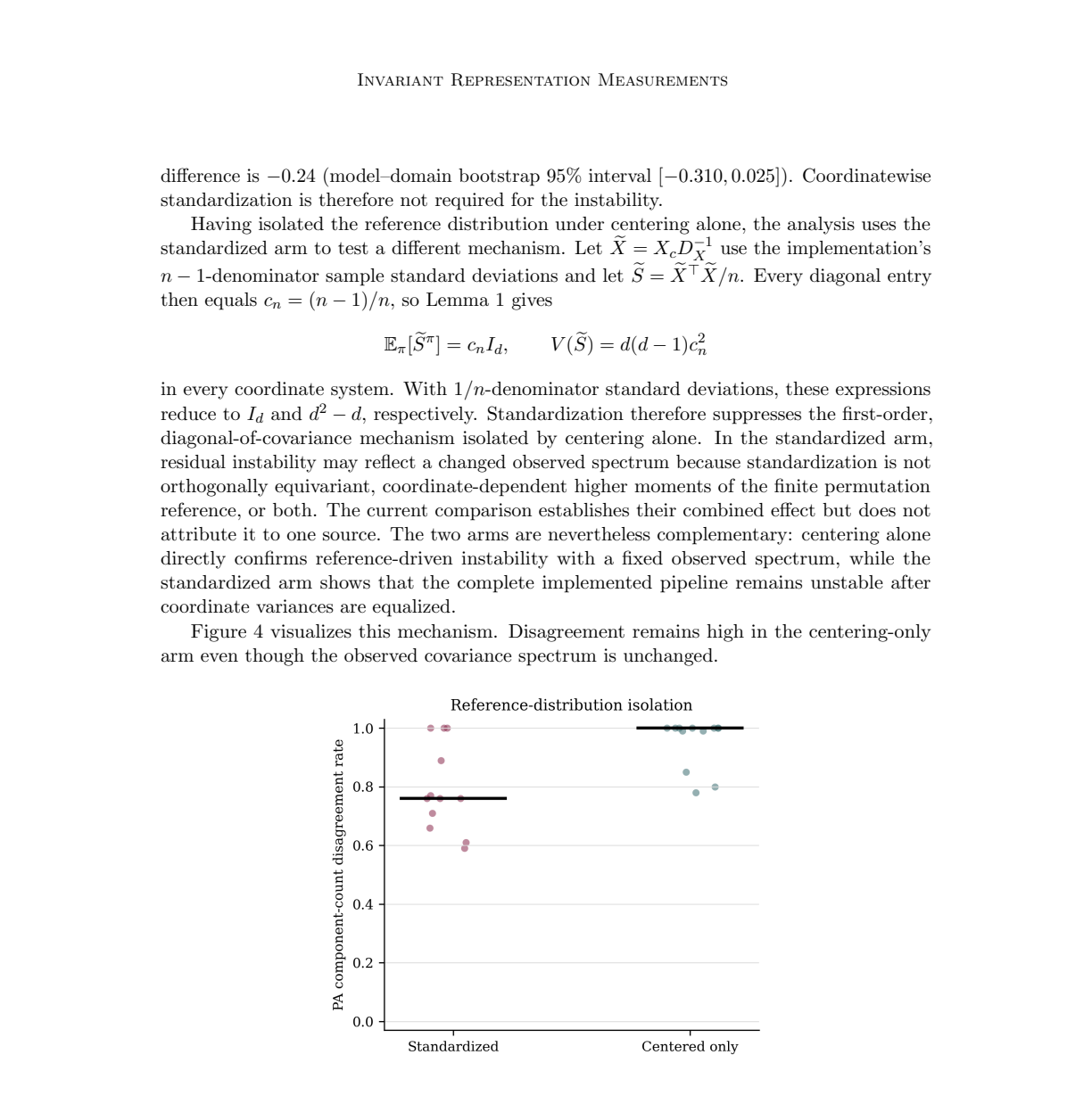
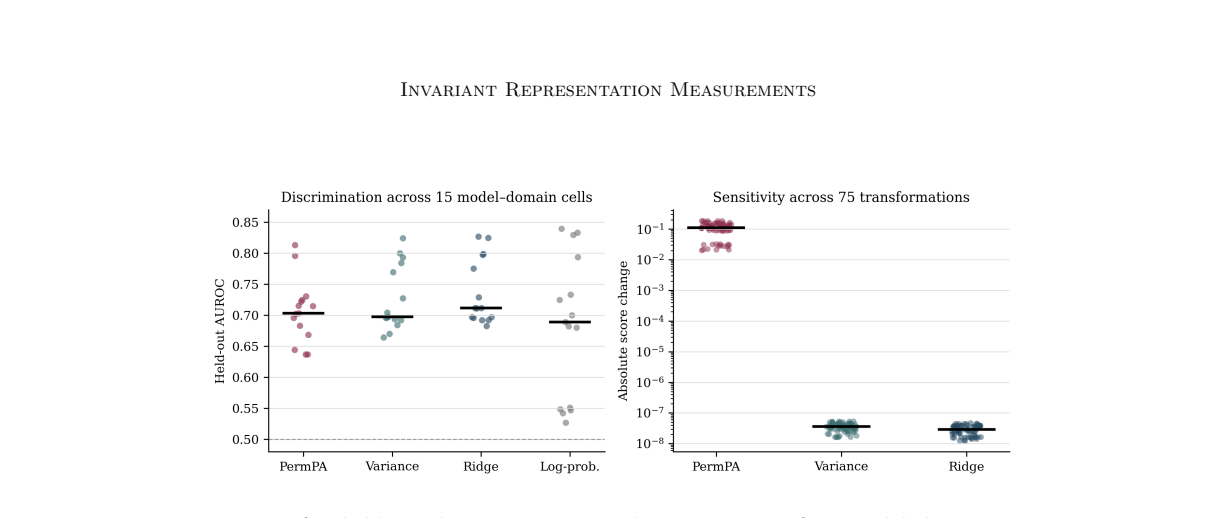
This study shows that column-permutation parallel analysis violates function-preserving reparameterization invariance because its reference distribution and selected component count can change while the model function and observed covariance spectrum remain fixed. More generally, a data-internal reference procedure cannot simultaneously preserve every coordinate marginal, remain orthogonally equivariant, and remove cross-coordinate covariance. Empirically, across five models, three retrieval domains, and 75 transformations, median component-count disagreement is 0.79 and median fixed-threshold decision disagreement is 0.26. A centering-only control isolates the reference-driven effect, with 1,141 of 1,200 component counts changing despite an unchanged observed spectrum, whereas independent parallel analysis seeds change none of the corresponding decisions. By contrast, orthogonally invariant comparator scores remain numerically stable with similar held-out discrimination. Together, these results show that parallel analysis-derived component counts and decisions can reflect hidden-coordinate choice rather than a well-defined property of the model.
from the abstract
Pith says
Machine review · deepseek-v4-flash · 9 Sep 2026 · what was read was not recorded · not checked by a person
It can be wrong. Challenge this review or reply to it.
Holds up. A clean demonstration that column-permutation parallel analysis is not invariant under coordinate changes that preserve the model function—theoretically grounded, empirically careful, and worth engaging with. This line is wrong
7 minor
How often objections from reviews like this one are right: not yet measured
Not checked: figures, code, what the 2 references say.
7 minor objections
The paper says, at Abstract and §4.1
Pith says: minor objection 1 of 7
The abstract's '75 transformations' conflates the 25 distinct model-transformation matrices with the 75 model-domain-transformation comparisons, which Section 4.1 distinguishes precisely; please align the abstract's wording with the main text.
The paper says, at §3, invariance definition
Pith says: minor objection 2 of 7
The invariance criterion is stated for a deterministic statistic T, but finite-replicate PA is randomized; the matched-seed convention introduced in Section 4.1 operationalizes equality across orientations for the implementation, and a sentence formalizing this convention in Section 3 would close the gap between the ideal-PA theory and the reported numbers.
show 5 more
The paper says, at §3, transformation class
Pith says: minor objection 3 of 7
The claim that any R in O(d) is admissible for the RMSNorm models rests on absorbing R into adjacent weight matrices; since this claim defines the admissible class used throughout, a one-line sketch of the absorption algebra (or a short appendix note) would allow readers to verify it without consulting QuaRot and SpinQuant.
The paper says, at §4.5, Figure 6
Pith says: minor objection 4 of 7
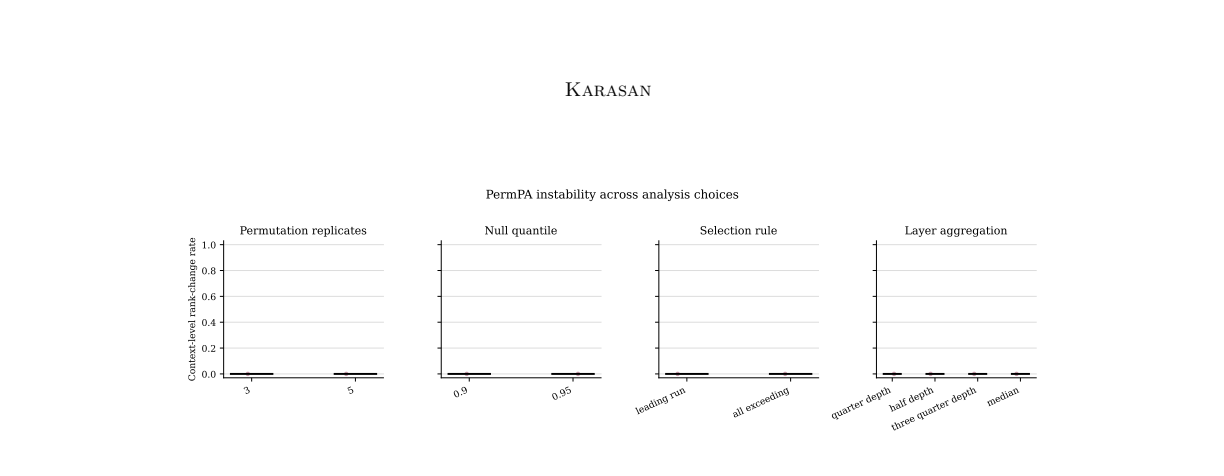
The quantile panel of Figure 6 appears to show tick marks only at 0.9 and 0.95, while Table 6 reports three quantile levels (0.90, 0.95, 0.99); please ensure all three levels are displayed or annotate the axis accordingly.
The paper says, at §7
Pith says: minor objection 5 of 7
The protocol file name 'missing controls protocol.json' is an unfortunate label for the post-hoc control analyses, since it could be read as implying that the main protocol lacked necessary controls; a name such as 'post_hoc_controls_protocol.json' would convey the same provenance information without the misleading connotation.
The paper says, at §4.2, decision thresholds
Pith says: minor objection 6 of 7
Decision disagreement is reported under thresholds fixed on the original coordinates and not recalibrated after reparameterization; a sentence clarifying that per-orientation recalibration is a different estimand, and that the component-count endpoint does not depend on this choice, would preempt a natural reader question.
The paper says, at §7
Pith says: minor objection 7 of 7
The phrase 'can be found here 1' in the Data Availability section appears to carry a dangling footnote or URL marker; the repository link should be presented in standard form.
What would settle it
Reproduce the construction of Theorem 2 numerically: define X_loc and X_mix as specified, compute the ideal PA component count (consecutive-from-largest, strict exceedance, ideal permutation quantiles via exhaustive enumeration if n is small or via the analytic bound), and verify that the count changes from 0 to 1 as predicted. This test isolates the theoretical mechanism from any numerical or implementation-specific effects.
from the skeptic's reading
How the review went
4 readings by deepseek-v4-flash · 9 Sep 2026
- Reader holds up
- Skeptic disagrees
- Editor wrote the verdict above
- Referee accept: 7 minor
Not run on this paper: the simulated authors' defence.
Pith did not check this review's objections against the paper.
The review in full
The review in brief, machine-written
Thanks for pointing me to this paper. My take: this is a solid, principled piece that identifies a real measurement problem and deals with it honestly. What's new: the paper shows that a widely used dimensionality estimator (column-permutation PA) can give different answers under orthogonal reparameterizations that leave the model's input-output function unchanged. This is not a trivial point—PA-based component counts and downstream classification decisions can reflect the arbitrary coordinate system rather than the model itself.
The theoretical analysis is clean. Lemma 1 and Lemma 2 pin down the mechanism: the permutation reference depends on the covariance diagonal, which changes under rotation even though the spectrum is invariant. Theorem 1 and Theorem 2 give orbit-wide range guarantees and concrete count changes. Theorem 3 is a broader impossibility result about marginal-preserving equivariant references that is interesting in its own right.
The empirical design is careful: pre-specified splits, calibration/evaluation separation, centering-only control, seed control, and robustness checks across 72 PA settings. The evidence supports the claim that the instability is larger than random seed noise and not due to preprocessing artifacts. The invariant comparators remove the sensitivity without losing discrimination, though they are presented as baselines rather than optimal solutions.
Weak spots are mainly scope-related. The experiments use small models (≤1.7B parameters). The conservative bound in Theorem 1 certifies only 15% of contexts, but the authors are upfront about this. The paper is transparent about its limitations, which is commendable.
Who this is for: anyone using parallel analysis on neural representations, or anyone concerned with measurement validity in representation analysis. It should interest the interpretability, retrieval, and representation learning communities.
My recommendation: send to peer review without hesitation. The paper is well-structured, the math is sound, and the empirical work is controlled. I would cite it in my own work if I were writing about representation measurement.
The strongest objection
The central claim that column-permutation parallel analysis is not invariant under function-preserving reparameterizations is supported by two independent theoretical constructions (Theorems 1 and 2) that hold in exact arithmetic, independent of numerical precision or the specific empirical transformations used. The empirical results are consistent with these proofs and provide additional concrete demonstration, but the core argument does not depend on unverified numerical assumptions. The reader's identified weakest assumption—numerical precision of transformations—does not threaten the theoretical validity of the claim. The paper's logic is internally consistent, the proofs are sound, and the limitations are transparently discussed. No hidden assumption or oversight appears to undermine the main conclusion.
The reader identified numerical precision as the weakest assumption, but the central theoretical claim does not rely on numerical realizability—the proofs assume exact reparameterization. Even if all empirical implementations had finite precision, Theorems 1 and 2 establish non-invariance in principle. The empirical experiments are auxiliary and carefully controlled. Thus the load-bearing concern is about a non-essential assumption, and the core argument remains sound. No adjustment to the reader's ACCEPT verdict is warranted.
The referee's report
If the results hold, PA-derived component counts and decisions should not be treated as well-defined properties of a fixed model without checking reparameterization invariance, a point with direct bearing on dimensionality estimation in LLM research and retrieval-context scoring. The paper's strengths are substantial: complete elementary proofs for all main results in Appendix B; two independent exact-arithmetic constructions (Theorems 1 and 2), so the central impossibility claim does not depend on numerical precision or on the finite verification set; a clean centering-only control isolating the reference mechanism with an exactly invariant observed spectrum; matched-seed protocols; pre-specified protocols separated from post-hoc controls; and explicit, honest treatment of the conservative certificate rate. The Gram-based invariant comparators are constructive alternatives, not merely a critique. The reported limitations (five small models, three domains, one-seed controls, one-transformation robustness grid) are transparently acknowledged in Section 5.
Pith's reading of the paper (a machine's summary, not the authors')
The paper shows that a widely used method for selecting the number of meaningful components in language-model representations—column-permutation parallel analysis—gives different answers after an orthogonal change of basis that leaves the model's input-output behavior unchanged. Because hidden representations are not uniquely determined by the model function, any measurement that depends on the coordinate system may reflect arbitrary algorithmic choices rather than a property of the model. The paper proves that no data-internal reference procedure can simultaneously preserve coordinate marginals, be orthogonally equivariant, and remove cross-coordinate covariance. Empirically, across five models and three retrieval domains, median component-count disagreement under such transformations is 0.79, and median fixed-threshold decision disagreement is 0.26, while orthogonally invariant comparator scores remain numerically stable and retain comparable discrimination. The results imply that representation-derived statistics should be tested for invariance before being interpreted as model-level quantities.
What carries the argument. The central machinery is the contrast between the orthogonal invariance of the observed covariance spectrum and the coordinate dependence of the column-permutation reference distribution. Lemma 1 shows that the expected permutation-reference covariance equals the diagonal of the sample covariance matrix, which changes under orthogonal transformation even though the eigenvalues do not. The Schur-Horn theorem then provides extremal diagonals over the orthogonal orbit, and Lemma 2 bounds finite-sample fluctuations to link diagonal changes to changes in parallel analysis thresholds. Theorem 3 uses the Cramér-Wold theorem and orthogonal equivariance to show that any marginal-preserving data-internal reference must reproduce the full empirical row measure, precluding covariance removal.
Core claim. The central claim is that column-permutation parallel analysis violates function-preserving reparameterization invariance: its reference distribution and selected component count can change under orthogonal transformations of hidden representations that preserve the model's input-output function and the observed covariance spectrum. The paper proves this theoretically through a chain of results: the expected permutation-reference covariance equals the diagonal of the sample covariance matrix (which rotates with the basis); the observed eigenvalue spectrum is unchanged; and the Schur–Horn theorem gives extremal diagonals over the orthogonal orbit, leading to a lower bound on the range of component counts. A separate construction within the LayerNorm-compatible subgroup shows an explicit count change. The paper also proves a general impossibility: any data-internal reference procedure that preserves every coordinate marginal and is orthogonally equivariant must reproduce the full empirical row measure, and therefore cannot alter cross-coordinate covariance. Empirically, the effects propagate through standardization and decision thresholds, and are not explained by seed variability or preprocessing.
The premise it rests on. The paper assumes that function-preserving orthogonal transformations can be realized numerically with sufficient precision (verified for 25 transformations with log-probability error below 1e-4), and that the results extend to any orthogonal transformation compatible with the architecture, not just the finite set tested.
If the paper is right (Pith's inferences, not the authors')
Researchers using parallel analysis on language-model representations must check whether their conclusions are stable under architecture-compatible orthogonal transformations.
The measurement-validity criterion introduced here—invariance under function-preserving reparameterizations—provides a general test for any statistic interpreted as a property of a model function.
The instability of parallel analysis propagates to downstream decisions, such as classifying whether a retrieved context contains sufficient evidence, which may change in a substantial fraction of cases.
Orthogonally invariant comparator scores (based on Gram matrices) remove this source of variability without observed loss in discrimination, offering a drop-in replacement for representation-based retrieval scoring.
The theoretical impossibility result (Theorem 3) applies to any data-internal reference procedure that aims to preserve marginals, be equivariant under orthogonal transformations, and alter cross-coordinate dependence, suggesting fundamental limitations for such approaches.
The paper's results imply that any representation-derived statistic that is not orthogonally invariant—including factor counts from other methods like Kaiser's rule or Velicer's MAP—should be similarly suspect unless proven otherwise.
The instability under function-preserving transformations suggests that comparative studies of language model representations across different random seeds or training runs may conflate architecture-driven properties with basis-dependent noise, if the measurement is not invariant.
A practical takeaway for practitioners: when reporting a component count from internal representations, also report the range of counts obtained over random orthogonal transformations of the hidden coordinates, as a sensitivity check.
The theoretical bound in Theorem 1 is conservative but often inconclusive; improving the bound could provide a more sensitive certificate for whether a given representation matrix is at risk of instability.
Check this review
Pith stored no record of this review's passes and took no fingerprint of it. Reviews made by code from 13 Nov 2026 on carry both.
How often reviews like this one are right
Reviews like this one: written by deepseek-v4-flash, where what was read was not recorded.
How often objections from reviews like this one are right: not yet measured
Reviews by people
This review was written by a machine. No person has reviewed this paper on Pith yet. A scientist listed on Pith can review it for a fee, and their review is published here whatever it concludes.
The paper
Abstract
Hidden coordinates are not uniquely determined by a language model's input–output function, so representation-derived measurements should be invariant to function-preserving changes of basis. This study shows that column-permutation parallel analysis violates function-preserving reparameterization invariance because its reference distribution and selected component count can change while the model function and observed covariance spectrum remain fixed. More generally, a data-internal reference procedure cannot simultaneously preserve every coordinate marginal, remain orthogonally equivariant, and remove cross-coordinate covariance. Empirically, across five models, three retrieval domains, and 75 transformations, median component-count disagreement is 0.79 and median fixed-threshold decision disagreement is 0.26. A centering-only control isolates the reference-driven effect, with 1,141 of 1,200 component counts changing despite an unchanged observed spectrum, whereas independent parallel analysis seeds change none of the corresponding decisions. By contrast, orthogonally invariant comparator scores remain numerically stable with similar held-out discrimination. Together, these results show that parallel analysis-derived component counts and decisions can reflect hidden-coordinate choice rather than a well-defined property of the model.
The paper's own sentences, arranged, kept beside the review and separate from it. Each label is drawn from a closed vocabulary; the number beside it is the probability the classifier gave that label. No sentence in this record was written by a model.
abstract compiled · 2026-09-23
The authors' main claim, as the classifier picked it out 1.00
“Together, these results show that parallel analysis-derived component counts and decisions can reflect hidden-coordinate choice rather than a well-defined property of the model.”
How the main claim is stated: asserted 0.89
What the abstract itself states, as probabilities: claims first 0.04 · states limitation 0.27 · human participants 0.04 · controlled comparison 0.93 · randomized assignment 0.02 · states quantitative result 0.99 · compares with prior results 0.91 · mentions code or data availability 0.02
The abstract, sentence by sentence
This table labels the abstract only (arXiv listing abstract v1). The number is the probability the classifier gave the label.
| Sentence | Role | The authors' own work | States the main conclusion | Strength |
|---|---|---|---|---|
| Hidden coordinates are not uniquely determined by a language model's input--output function, so representation-derived measurements should be invariant to function-preserving changes of basis. | background 0.99 | 0.06 | 0.19 | asserted 1.00 |
| This study shows that column-permutation parallel analysis violates function-preserving reparameterization invariance because its reference distribution and selected component count can change while the model function and observed covariance spectrum remain fixed. | result 0.89 | 0.91 | 0.23 | asserted 1.00 |
| More generally, a data-internal reference procedure cannot simultaneously preserve every coordinate marginal, remain orthogonally equivariant, and remove cross-coordinate covariance. | result 0.53 | 0.55 | 0.15 | asserted 0.99 |
| Empirically, across five models, three retrieval domains, and 75 transformations, median component-count disagreement is 0.79 and median fixed-threshold decision disagreement is 0.26. | result 1.00 | 0.96 | 0.07 | asserted 1.00 |
| A centering-only control isolates the reference-driven effect, with 1,141 of 1,200 component counts changing despite an unchanged observed spectrum, whereas independent parallel analysis seeds change none of the corresponding decisions. | result 0.94 | 0.95 | 0.07 | asserted 1.00 |
| By contrast, orthogonally invariant comparator scores remain numerically stable with similar held-out discrimination. | result 1.00 | 0.83 | 0.05 | asserted 1.00 |
| Together, these results show that parallel analysis-derived component counts and decisions can reflect hidden-coordinate choice rather than a well-defined property of the model. | interpretation 1.00 | 0.91 | 0.89 | asserted 0.89 |
What kind of paper the classifier reports this is: empirical study 0.78 · evidence from observation or experiment 0.63
What was examined, and what was not
Sources read
- arXiv listing abstract v1
Not examined
- full text
- figures and tables
- references and citing sentences
- relations to other papers
Levels run
- P abstract
Not run
- S sections
- T body sentences
- C citations
- R cross-paper relations
How the labels were made
Compiled by classifier-1.13.0 via TypeSafe API, question bank abstract-p1-20260923, 2026-09-23: 1 request, 5,686 input tokens.
Every quoted sentence on this record is the authors'. Every label is from Pith's closed vocabulary, with the probability shown beside it. This record as JSON
Figures (6)
Figures are the authors', reproduced from the paper.
References (2)
- [2022] URL https://proceedings.neurips.cc/paper_files/paper/2022/hash/ 4df3510ad02a86d69dc32388d91606f8-Abstract-Conference.html. Lucas Hayne, Heejung Jung, and R. McKell Carter. Does representation similarity capture function similarity?Transactions on Machine Learning Research, 202... on Pithdoi:10.1007/s11749-017-0571-1
- [2743] Association for Computational Linguistics, 2019. doi: 10.18653/v1/D19-1275. John L. Horn. A rationale and test for the number of factors in factor analysis.Psychometrika, 30(2):179–185, 1965. doi: 10.1007/BF02289447. Pranab Islam, Anand Kannappan, Douwe Kiela, Rebecca Qian, Ni... on Pithdoi:10.18653/v1/d19-1275
Cited by 1 Pith paper
Reviewed papers on Pith that cite this one. The full citation record
How the literature uses it
What this paper does with the arXiv papers it cites
What it cites · 3 sentences without a confident label
Uses data or values from 1 paper
-
To vary the form of retrieved evidence, FinanceBench, QASPER, and HotpotQA are used [ref] .
FinanceBench: A New Benchmark for Financial Question Answering · Study Design · 0.96
Challenges and discussion
Disagree with the review, or know something it missed? Leave a comment, or challenge this review formally: a challenge becomes a permanent entry in this paper's record, and its decision is published here.
Come back by email
A short list of the week's newly reviewed papers. Nothing is sent until you confirm from your inbox, and every email has a link that stops it. No account.
No comments yet.
Sign in to comment