Robotics · arXiv:2608.27221 v2 · submitted 27 Aug 2026
Tensegrity Continuum Robots Enable Task-Adaptive Morphologies for Cooperative Behaviors
The paper says
“Robots that can change their morphologies and behaviors for different tasks and environments hold great promise for adaptable, multifunctional systems.”
more of the abstract
Modular reconfigurable robots (MRRs) can achieve such functionalities by docking and rearranging individual units, but most rely on rigid modules that lack structural compliance, resulting in limited capabilities. Continuum robots offer compliance through flexible backbones, yet they cannot self-reconfigure into task-adaptive multi-robot configurations. Here, we introduce an MRR that unifies the advantages of both architectures by combining a tensegrity-based compliant body with claw-based connection mechanisms. Each robot can manipulate and locomote independently, and multiple robots can self-reconfigure into different morphologies (e.g., chains, loops, branches) for cooperative manipulation and locomotion. We demonstrate the robots' capability across diverse tasks and environments, including coordinated object manipulation and transport, multimodal locomotion, and loco-manipulation in real-world scenarios. These results lay a foundation for adaptable and multifunctional robotic collectives, with broad potential applications in manufacturing, space exploration, and search-and-rescue operations.
from the abstract
Pith says
Machine review · deepseek-v4-flash · 9 Sep 2026 · of version 1 of the paper; version 2 is newer · what was read was not recorded · not checked by a person
It can be wrong. Challenge this review or reply to it.
The passes disagreed. Reader: holds up. Skeptic: holds up only with conditions. Referee: major revision.
Solid hardware paper with real engineering value, but the 'first to combine compliance with reconfiguration' claim is contradicted by the paper's own reference 33 and needs a careful rewrite. This line is wrong
2 major objections · 5 minor
How often objections from reviews like this one are right: not yet measured
Not checked: figures, code, what the references say.
The paper says, at Abstract and Introduction (page 1–2)
The review did not quote this passage.
Pith says: Objection 1 of 2 · major
The paper repeatedly states that continuum robots 'cannot self-reconfigure into task-adaptive multi-robot configurations' (Abstract) and are 'largely unexplored' for modular reconfiguration (Introduction). However, Reference [33] (Cai et al. 2025) explicitly describes a 'Modular Self-Reconfigurable Continuum Robot'—a continuum robot with self-reconfiguration intended for loco-manipulation.
more of objection 1
This direct contradiction undermines the paper's motivation and its claim of being the first to unify continuum compliance with modular reconfigurability. The authors must acknowledge this prior work, explain what specific limitations it leaves (e.g., differences in backbone construction, coordination modalities, or task scope), and clearly state what TeCoBot adds beyond [33]. Without such clarification, the novelty claim is unsupported.
The paper says, at Introduction (page 2, paragraph 2)
The review did not quote this passage.
Pith says: Objection 2 of 2 · major
The statement 'most existing continuum robots function as standalone systems rather than self-contained modules that can dock, detach, and reassemble' is vague. Reference [33] directly disproves the implication that NO continuum robot achieves self-reconfiguration. Please revise to give a precise comparison: what aspect of reconfigurability or compliance does TeCoBot provide that [33] does not? Provide explicit criteria (e.g., tensegrity-specific compliance, docking versatility, range of morphologies).
5 minor objections
The paper says, at Figure 3 caption (page 7–8)
Pith says: minor objection 1 of 5
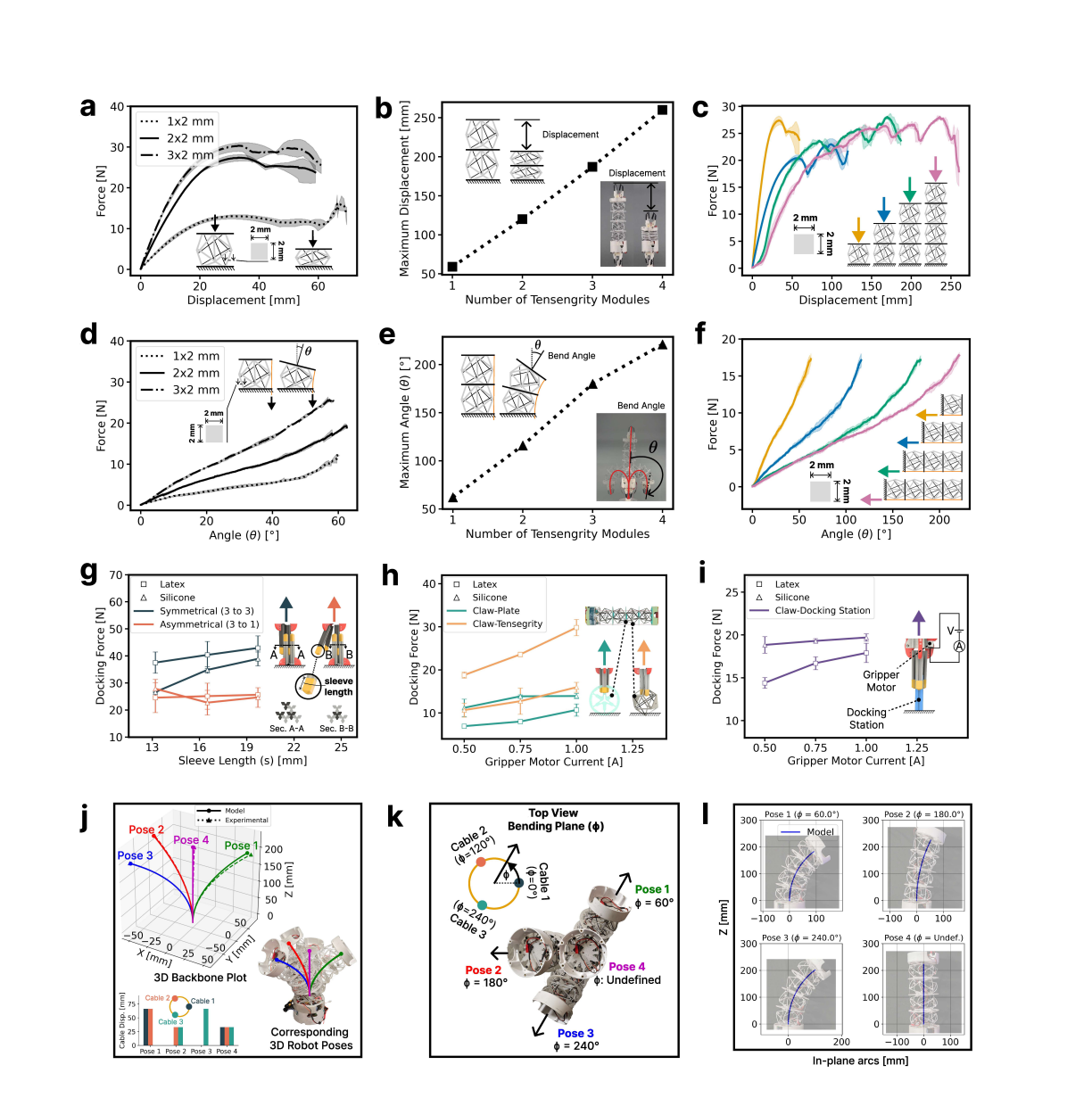
The caption for panels (j)–(l) says 'Quantitative validation results... are presented in Supplementary Materials.' It would help the reader to summarize the key error metrics (e.g., 0.8–3.0%) in the caption itself, as is done in the main text.
The paper says, at Methods (page 15, Claw and Roller Wheel Design)
Pith says: minor objection 2 of 5
Two actuation options (smart servo or geared DC motor) are mentioned for the claw, but the main text and figures should clarify which option is used in each experiment. For instance, the docking characterization uses a smart servo, while the locomotion demonstrations use a geared DC motor. Add a brief note to avoid confusion.
show 3 more
The paper says, at Results (page 8, last paragraph)
Pith says: minor objection 3 of 5
The sentence 'The claws are modular and can be swapped to match task requirements' could be misinterpreted as hot-swappable during operation. Clarify that swapping is a manual procedure (or specify if it is automated).
The paper says, at Figure 6 caption (page 12–13)
Pith says: minor objection 4 of 5
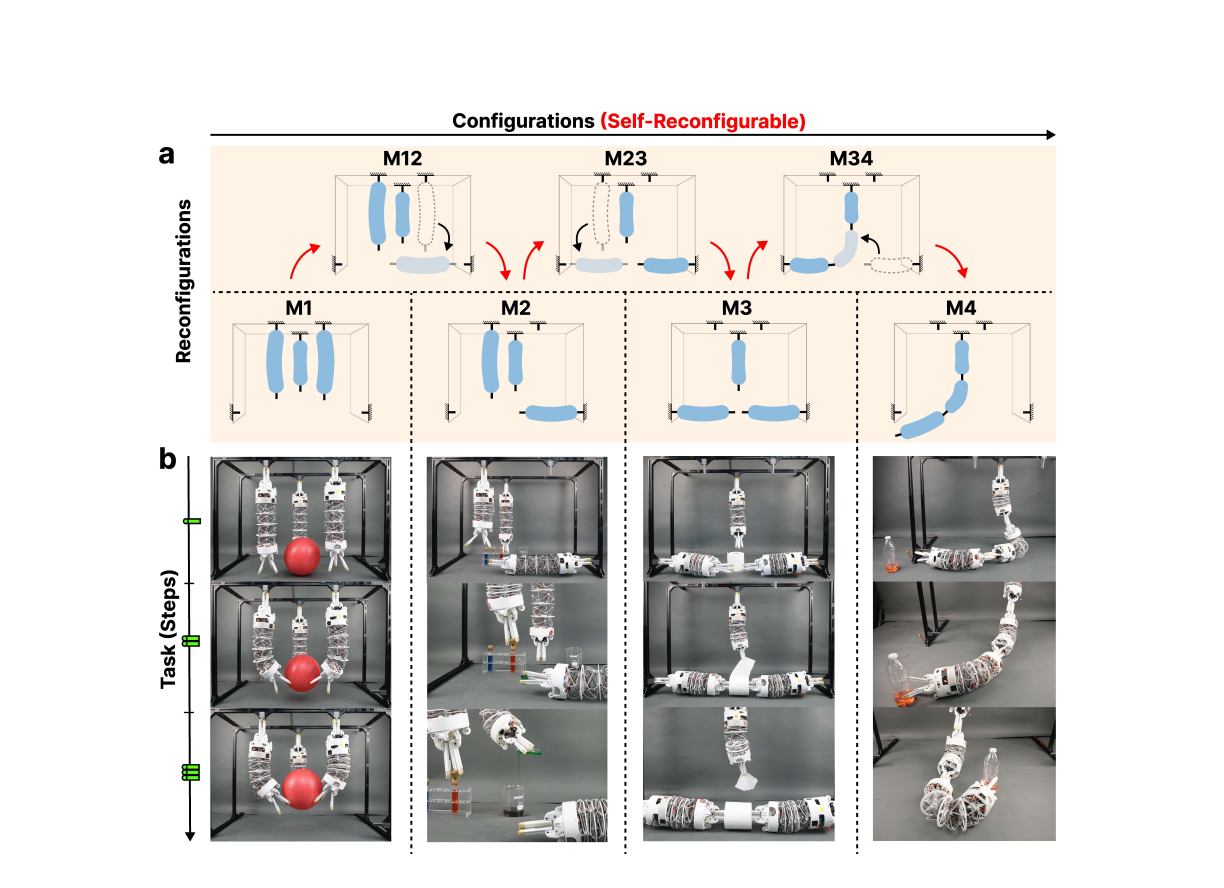
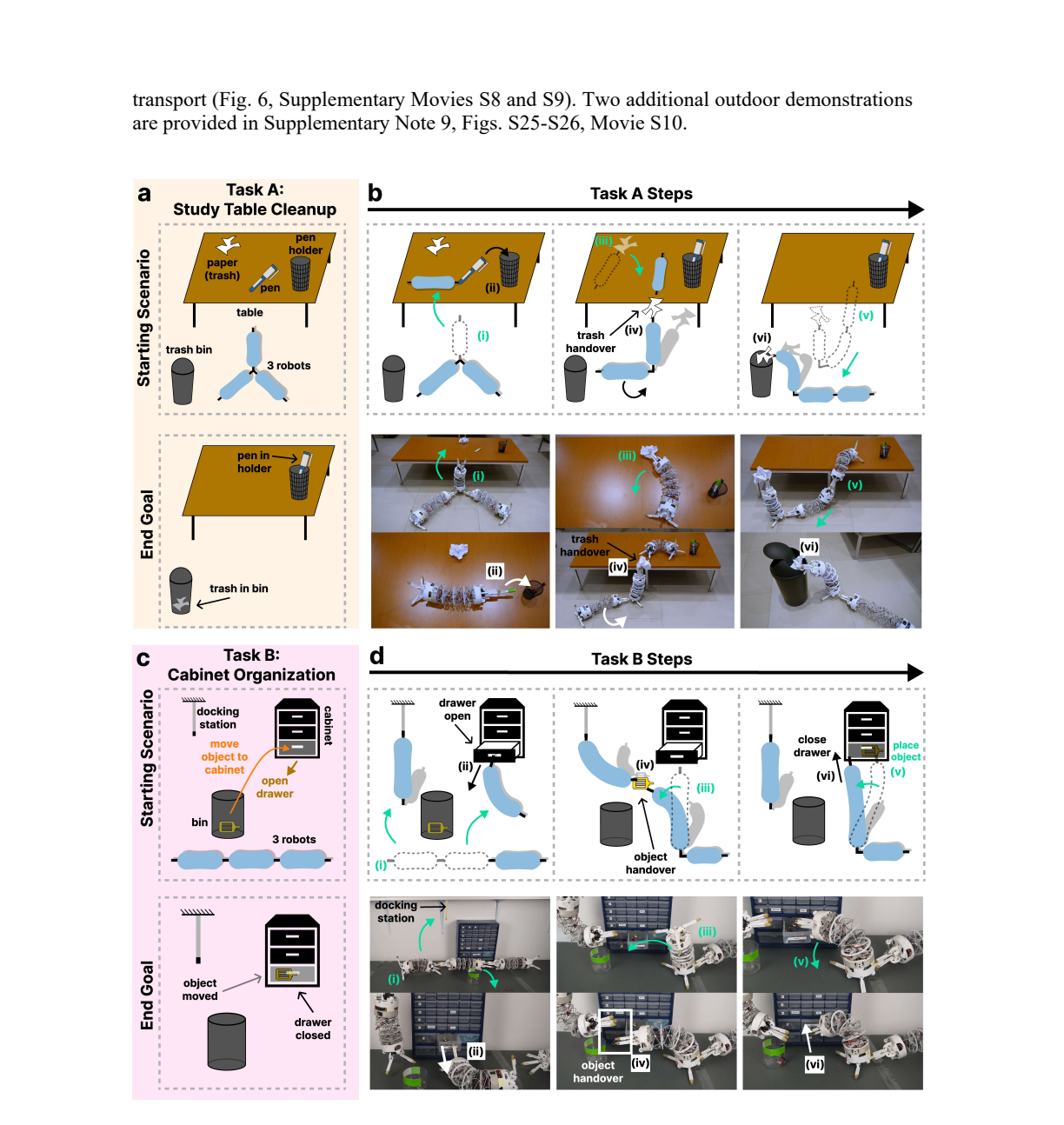
The caption is very long; consider moving part of the step description to the main text or supplement. Some phrases like 'shadows are applied only to robot bodies to indicate three-dimensional posture' are more appropriate for a figure note than a caption.
The paper says, at Supplementary Note 11 (Autonomous Docking)
Pith says: minor objection 5 of 5
The closed-loop docking uses a Raspberry Pi 5 and a Pi camera placed inside the top module. State whether this modification changes the robot's weight or center of mass, and whether it affects the locomotion or manipulation performance reported earlier.
What would settle it
Read Cai et al. (2025, IEEE RA-L 10, 1976–1983) and classify its backbone (continuum or discrete), self-reconfiguration capability (teleoperated or autonomous), and cooperative behaviors. If it uses a continuum backbone and demonstrates self-reconfiguration (docking/undocking) and cooperative tasks, then the paper’s claim that continuum robots “cannot self-reconfigure” is false, and the novelty claim must be revised to emphasize the tensegrity-specific design. If the prior system is not a true continuum robot or does not enable cooperative reconfiguration, the concern is mitigated.
from the skeptic's reading
How the review went
4 readings by deepseek-v4-flash · 9 Sep 2026
- Reader holds up
- Skeptic disagrees: says it holds up only with conditions The novelty claim is undercut by the paper's own reference 33 (Cai et al. 2025), which describes a modular self-reconfigurable continuum robot, contradicting the assertion that continuum robots cannot self-reconfigure.
- Editor wrote the verdict above
- Referee major revision: 2 major objections, 5 minor
Not run on this paper: the simulated authors' defence.
Pith did not check this review's objections against the paper.
The review in full
The review in brief, machine-written
The core of this paper is a well-engineered modular tensegrity platform. TeCoBot stacks icosahedral tensegrity modules into a compliant continuum body, adds claws at both ends, and uses those claws for both grasping and docking. The demonstrated range of single-robot and multi-robot behaviors — bending, rolling, pipe climbing, cooperative manipulation, reconfiguration into loops and chains — is genuinely impressive, and the systematic characterization (tendon size effects, docking forces across materials, constant-curvature model validation with tip errors under 3% of backbone length) is exactly the kind of evidence this field needs. Repeated trials, error bars, open code, and CAD-on-request all suggest reproducible work. Credit is due for that.
Now the soft spots, in proportion. The biggest one is the novelty claim. The Introduction states flatly that continuum robots "cannot self-reconfigure into task-adaptive multi-robot configurations," yet reference 33 is a 2025 RA-L paper titled "Modular Self-Reconfigurable Continuum Robot for General Purpose Loco-Manipulation." You cannot cite that paper elsewhere in the MRR capability list and then assert continuum robots cannot self-reconfigure. If Cai et al. already demonstrated a modular, self-reconfigurable continuum robot, TeCoBot's contribution is not unification of those properties; it is a specific instantiation with a tensegrity backbone, claw docking, and a broader demonstration portfolio. That is still a real contribution, but the Introduction needs to either soften the absolute claim or explicitly differentiate the mechanisms and capabilities. Right now the authors leave the contradiction sitting on the page.
Two smaller concerns. The constant-curvature model is validated only for the tested actuation patterns and light loads; the paper admits it may degrade under asymmetric multi-robot docking forces, and that limitation is fine as long as it is stated, which it is only implicitly. Also, most multi-robot reconfiguration is teleoperated. The autonomous docking section partially addresses this, but the broad "self-reconfigure" framing overstates what is currently autonomous. These are minor relative to the engineering achievement.
Overall, the reader's ACCEPT verdict holds up. The stress-test concern about reference 33 is real and should be fixed in revision, but it does not sink the paper — the hardware and experimental work stand on their own. This deserves serious peer review, and I would bring it to a reading group focused on modular or continuum robots.
The strongest objection
The paper’s Introduction states: “Continuum robots offer compliance through flexible backbones, yet they cannot self-reconfigure into task-adaptive multi-robot configurations.” This absolute claim is directly contradicted by Reference 33 (Cai et al. 2025, IEEE RA-L), which presents a “Modular Self-Reconfigurable Continuum Robot for General Purpose Loco-Manipulation.” If a continuum robot with self-reconfiguration already exists, then TeCoBot’s central contribution—unifying continuum compliance with modular reconfigurability—is not a first but an incremental improvement. The paper acknowledges this reference elsewhere (e.g., in the context of loco-manipulation) but fails to reconcile it with the gap statement. This inconsistency weakens the fundamental motivation and the novelty claim. The central claim’s “first” modifier becomes unsupported unless the paper explicitly distinguishes its approach (e.g., tensegrity backbone, specific claw design) from prior work, which it does not do in the Introduction. The burden is on the paper to show that prior continuum robots with modular reconfiguration are qualitatively different; the current text does not meet that burden.
The reader identified the constant-curvature kinematic model as the weakest assumption, but that concern is about model accuracy under load, which is secondary to the fundamental novelty claim. The more load-bearing issue is whether the central claim of ‘first unification’ is an accurate description given prior art. The paper’s own references include a direct counterexample (Cai et al. 2025) that appears to achieve similar capabilities. If that prior work indeed describes a continuum robot with modular reconfiguration, the paper’s contribution is diminished. The stress-tester’s job is to identify the single most load-bearing concern; this one challenges the very premise of novelty. The paper should address this by explicitly comparing its design to prior modular continuum robots and justifying the ‘first’ claim. Therefore, the verdict should be Conditional: accept only after the authors adjust the novelty claim to be precise about the tensegrity-based backbone and clarify how it differs from existing self-reconfigurable continuum robots.
The referee's report
If the claims hold, TeCoBot represents an interesting integration of tensegrity-based continuum compliance with modular reconfigurability, expanding the capability space of modular robots for contact-rich tasks. The demonstrations (e.g., cooperative manipulation, duct climbing, pipe rolling) are visually compelling and cover a diverse set of tasks. The open-source code and design resources would benefit the community. However, the strength of the novelty claim is undermined by a contradiction with the authors' own reference [33], which describes a modular self-reconfigurable continuum robot for loco-manipulation. The paper's central assertion that continuum robots 'cannot self-reconfigure' is not reconciled with this prior work, and the specific technical differentiators (tensegrity backbone, dual claw design) are not explicitly distinguished from [33] in the Introduction or Discussion.
Pith's reading of the paper (a machine's summary, not the authors')
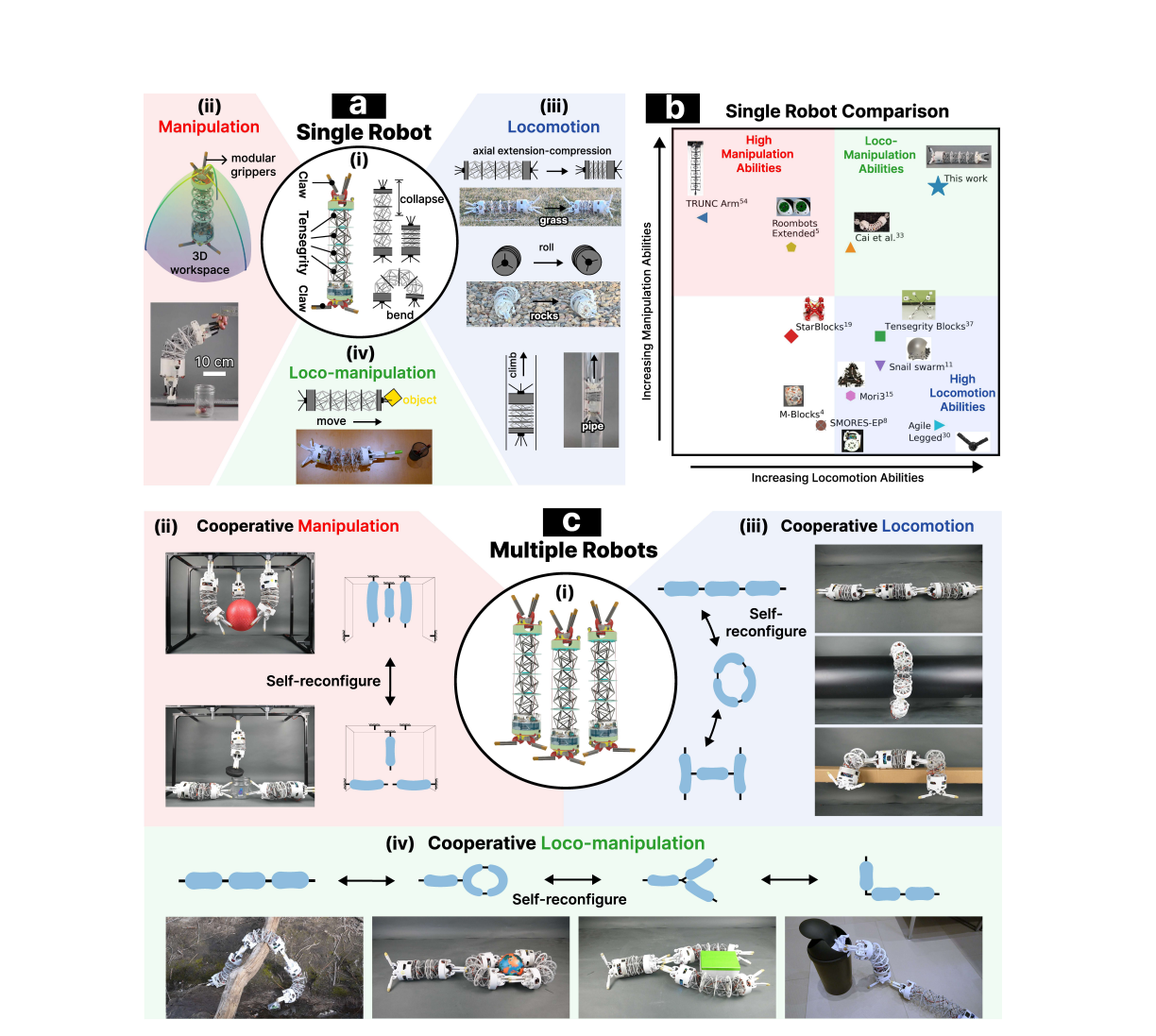
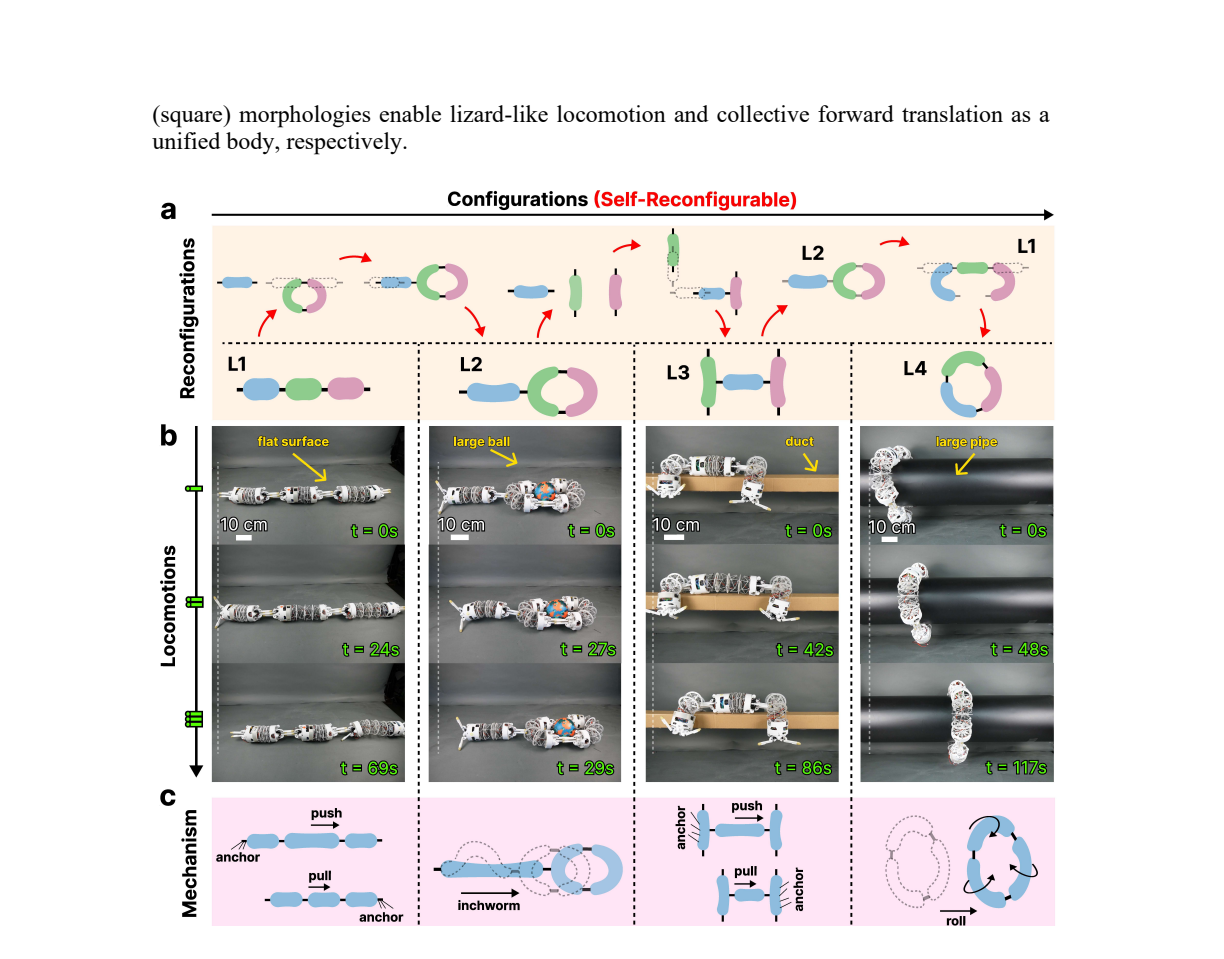
TeCoBot is a modular reconfigurable robot whose body is a compliant continuum made of stacked tensegrity modules — rigid carbon-fiber rods held in tension by stretchable tendon lattices, able to bend in any direction and to collapse and extend along its length. Claws at both ends let a single unit grasp objects and, more importantly, dock with other TeCoBots, in claw-to-claw or claw-to-body connections. The paper's central claim is that this pairing fills a gap neither architecture covers alone: rigid modular robots can rearrange but cannot conform to objects or terrain, while continuum robots can conform but cannot reassemble into new multi-robot shapes. On hardware, the authors show a single TeCoBot manipulating, rolling, crawling, and climbing, and groups of three self-reconfiguring into chains, loops, H-shapes, and branches that lift a 200 mm ball, open jars, traverse ducts, roll around pipes, and complete two multi-step indoor tasks (table cleanup and cabinet organization). If the claim holds, the payoff is a design route to robot collectives whose shape and behavior are chosen per task from the same compliant units.
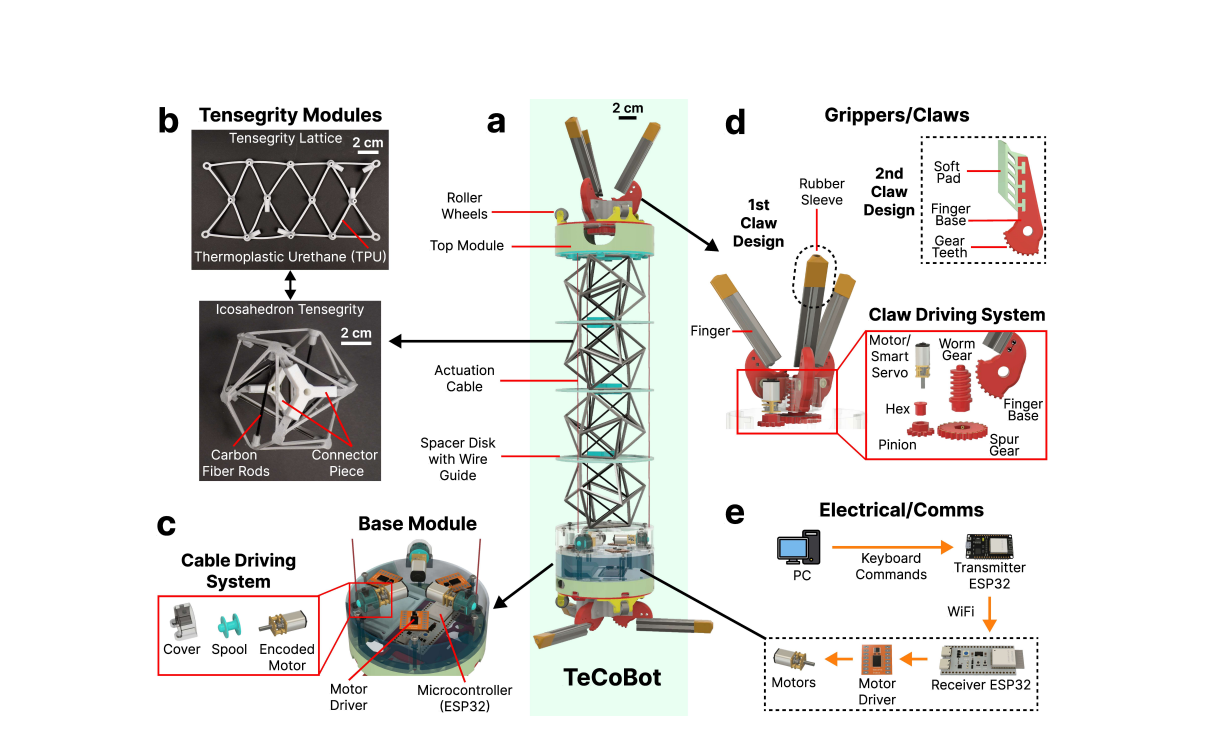
What carries the argument. The central mechanism is the stacked icosahedral tensegrity module: six rigid carbon-fiber rods assembled with a continuous, 3D-printed stretchable TPU tendon lattice into an icosahedron that deforms by bending and collapse and returns to shape through tendon tension. Four modules joined by connector pieces and spacer disks, actuated by three cables spaced $120^\circ$ apart, form a compliant continuum backbone whose deformation is described by a constant-curvature kinematic model — the model converts cable displacements into a predicted backbone arc, validated to within 0.8-3.0% of backbone length. The complementary mechanism is the claw connector at each end: a motor-driven worm-gear gripper that self-locks when powered off, doubling as a manipulation hand and a docking interface with measured connection forces up to roughly 43 N. The division of labor between the two is the argument: tensegrity supplies local compliance (conforming to objects, absorbing docking misalignment, keeping actuation force independent of module count), and the claws supply global reconfigurability (chains, loops, and branches), so that every multi-robot morphology inherits both properties.
Core claim. The central discovery is that a tensegrity backbone can give a modular robot the compliance of a continuum arm without sacrificing docking-based reconfiguration. Four icosahedral tensegrity modules, each built from six carbon-fiber rods and a continuous 3D-printed TPU tendon lattice, are stacked into a body that bends omnidirectionally under three cables spaced $120^\circ$ apart and collapses axially by up to 260 mm. The same claws that grasp objects serve as connection interfaces, and because docked modules remain deformable, any assembly of TeCoBots is itself a continuum structure: the paper demonstrates serial chains that reach and transport objects, loops with a trailing robot that inchworm, H-shaped assemblies that push-pull through ducts, closed loops that roll around pipes, and branched configurations that work together in multi-step manipulation. Measured collapsing and bending forces stay nearly constant as modules are added (about 23-28 N and 16-18 N, respectively), so larger deformations are obtained by stacking without heavier actuation, while a constant-curvature kinematic model predicts backbone shape from cable displacements with tip errors of 0.8-3.0% of backbone length. Open-loop and camera-guided closed-loop autonomous docking both succeeded on the platform, indicating that the reconfigurations themselves are not inherently teleoperation-dependent.
The premise it rests on. The load-bearing premise is that each tensegrity module bends as a circular arc of constant curvature, a shape assumption validated on unloaded single robots (tip errors of 0.8-3.0% of backbone length) but untested for heavily loaded or asymmetrically docked multi-robot assemblies.
If the paper is right (Pith's inferences, not the authors')
A single TeCoBot can pick-and-place objects and switch among six locomotion modes (axial extension-compression, inchworm, crawling, rolling, turning, pipe climbing), so a compliant modular unit need not be task-specialized: the same body is a hand, a rover, and a connector.
Because measured actuation force stays nearly constant as modules are stacked, a designer can extend reach or collapse range by adding modules without upsizing motors — a scaling rule the paper measures across one to four modules.
Docked assemblies remain deformable, so chains, loops, and branches can themselves bend, roll, and climb; morphology becomes a task-level choice rather than a fixed hardware constraint.
Autonomous docking worked both open-loop and with camera-based fiducial feedback, so the cooperative behaviors do not in principle require teleoperation.
Since the connector is also the manipulator, every robot in a docked assembly is a potential arm and every assembly a potential mobile base; that combination plausibly multiplies the task repertoire with robot count, a scaling the paper's four demonstration morphologies only begin to sample.
The force-independence result suggests a scaling test the paper does not run: a stack of many more than four modules should yield a much longer single-robot reach at roughly unchanged actuation effort, bounded in practice by self-weight and cable routing rather than by motor sizing.
The tensegrity body's tolerance for docking misalignment suggests docking might be completed by feel — sensing contact through motor current — which would extend the demonstrated vision-guided autonomous docking to dark or occluded settings.
Check this review
Pith stored no record of this review's passes and took no fingerprint of it. Reviews made by code from 13 Nov 2026 on carry both.
How often reviews like this one are right
Reviews like this one: written by deepseek-v4-flash, where what was read was not recorded.
How often objections from reviews like this one are right: not yet measured
Reviews by people
This review was written by a machine. No person has reviewed this paper on Pith yet. A scientist listed on Pith can review it for a fee, and their review is published here whatever it concludes.
The paper
Abstract
Robots that can change their morphologies and behaviors for different tasks and environments hold great promise for adaptable, multifunctional systems. Modular reconfigurable robots (MRRs) can achieve such functionalities by docking and rearranging individual units, but most rely on rigid modules that lack structural compliance, resulting in limited capabilities. Continuum robots offer compliance through flexible backbones, yet they cannot self-reconfigure into task-adaptive multi-robot configurations. Here, we introduce an MRR that unifies the advantages of both architectures by combining a tensegrity-based compliant body with claw-based connection mechanisms. Each robot can manipulate and locomote independently, and multiple robots can self-reconfigure into different morphologies (e.g., chains, loops, branches) for cooperative manipulation and locomotion. We demonstrate the robots' capability across diverse tasks and environments, including coordinated object manipulation and transport, multimodal locomotion, and loco-manipulation in real-world scenarios. These results lay a foundation for adaptable and multifunctional robotic collectives, with broad potential applications in manufacturing, space exploration, and search-and-rescue operations.
The paper's own sentences, arranged, kept beside the review and separate from it. Each label is drawn from a closed vocabulary; the number beside it is the probability the classifier gave that label. No sentence in this record was written by a model.
abstract compiled · 2026-09-23
The authors' main claim, as the classifier picked it out 0.82
“These results lay a foundation for adaptable and multifunctional robotic collectives, with broad potential applications in manufacturing, space exploration, and search-and-rescue operations.”
How the main claim is stated: hedged possibility 0.56
What the abstract itself states, as probabilities: claims first 0.14 · states limitation 0.10 · human participants 0.03 · controlled comparison 0.04 · randomized assignment 0.01 · states quantitative result 0.04 · compares with prior results 0.69 · mentions code or data availability 0.02
The abstract, sentence by sentence
This table labels the abstract only (arXiv listing abstract v1). The number is the probability the classifier gave the label.
| Sentence | Role | The authors' own work | States the main conclusion | Strength |
|---|---|---|---|---|
| Robots that can change their morphologies and behaviors for different tasks and environments hold great promise for adaptable, multifunctional systems. | background 1.00 | 0.04 | 0.06 | asserted 0.54 |
| Modular reconfigurable robots (MRRs) can achieve such functionalities by docking and rearranging individual units, but most rely on rigid modules that lack structural compliance, resulting in limited capabilities. | background 0.62 | 0.05 | 0.02 | asserted 0.99 |
| Continuum robots offer compliance through flexible backbones, yet they cannot self-reconfigure into task-adaptive multi-robot configurations. | gap 0.79 | 0.05 | 0.03 | asserted 1.00 |
| Here, we introduce an MRR that unifies the advantages of both architectures by combining a tensegrity-based compliant body with claw-based connection mechanisms. | contribution 0.99 | 0.87 | 0.11 | asserted 1.00 |
| Each robot can manipulate and locomote independently, and multiple robots can self-reconfigure into different morphologies (e.g., chains, loops, branches) for cooperative manipulation and locomotion. | contribution 0.73 | 0.68 | 0.25 | asserted 1.00 |
| We demonstrate the robots' capability across diverse tasks and environments, including coordinated object manipulation and transport, multimodal locomotion, and loco-manipulation in real-world scenarios. | result 0.87 | 0.95 | 0.15 | asserted 1.00 |
| These results lay a foundation for adaptable and multifunctional robotic collectives, with broad potential applications in manufacturing, space exploration, and search-and-rescue operations. | interpretation 0.98 | 0.28 | 0.59 | hedged possibility 0.56 |
What kind of paper the classifier reports this is: method or tool 0.99 · evidence from observation or experiment 1.00
What was examined, and what was not
Sources read
- arXiv listing abstract v1
Not examined
- full text
- figures and tables
- references and citing sentences
- relations to other papers
Levels run
- P abstract
Not run
- S sections
- T body sentences
- C citations
- R cross-paper relations
How the labels were made
Compiled by classifier-1.13.0 via TypeSafe API, question bank abstract-p1-20260923, 2026-09-23: 1 request, 5,698 input tokens.
Every quoted sentence on this record is the authors'. Every label is from Pith's closed vocabulary, with the probability shown beside it. This record as JSON
Figures (6)
Figures are the authors', reproduced from the paper.
Challenges and discussion
Disagree with the review, or know something it missed? Leave a comment, or challenge this review formally: a challenge becomes a permanent entry in this paper's record, and its decision is published here.
Come back by email
A short list of the week's newly reviewed papers. Nothing is sent until you confirm from your inbox, and every email has a link that stops it. No account.
No comments yet.
Sign in to comment