Machine Learning · arXiv:2609.09244 v1 · submitted 8 Sep 2026 · 22 references
Critical initialization destabilizes higher input derivatives in wide scalar-input networks
The paper says
“The edge-of-chaos condition preserves first-order input perturbations in wide randomly initialized networks, but physics-informed losses, score matching and derivative regularization depend on higher input derivatives.”
more of the abstract
For smooth scalar-input fully connected networks, using a joint Gaussianity of the finite derivative jet that holds in the infinite-width limit at each fixed depth, we derive mean-field recursions through third order that are exact at the variance fixed point, with finite-depth corrections that decay geometrically. At criticality, the first-derivative variance is depth-invariant, whereas the second-derivative variance grows linearly whenever the activation has nonzero curvature. The resulting third-order system closes on mean-field susceptibilities. For residual networks with branch scale L^-1/2, we prove that every fixed finite derivative order has uniformly bounded variance under explicit regularity assumptions. Simulations verify the critical growth laws, the residual bound, and the closed recursion. The results concern initialization, not trained-network performance.
from the abstract
Pith says
Machine review · deepseek-v4-flash · 10 Sep 2026 · what was read was not recorded · not checked by a person
It can be wrong. Challenge this review or reply to it.
Holds up. Solid paper: proves that at critical initialization, second-derivative variance grows linearly in depth for any smooth activation with nonzero curvature — a clean obstruction with practical implications for PINNs and score matching. This line is wrong
5 minor
How often objections from reviews like this one are right: not yet measured
Not checked: figures, code, what the 22 references say.
5 minor objections
The paper says, at Abstract
Pith says: minor objection 1 of 5
The phrase 'derivative regularization depend on higher input derivatives' has a subject-verb agreement error; 'depend' should be 'depends'.
The paper says, at Section 3.2, Eq. (7)
Pith says: minor objection 2 of 5
The notation for the jet covariance Σℓ_jk is introduced elegantly, but the subsequent text uses both Σ and σ for different sub-blocks (σ_0k, c_jk). Consider a brief remark that these are just entries of Σ to avoid potential confusion.
show 3 more
The paper says, at Section 5.2
Pith says: minor objection 3 of 5
The description of the O(n) exact layer sampler is clear. It might be helpful to explicitly note that the method relies on the fact that, conditional on the g(j) of the previous layer, the new h(k) are Gaussian with covariance (σ_w²/n) times the inner product, independent across neurons. This is stated but could be highlighted more explicitly.
The paper says, at Section 7.6
Pith says: minor objection 4 of 5
The plateau discussion is thorough. However, the sentence 'The statement the data supports is that the residual falls sharply with width and then plateaus near 3%.' is slightly informal; consider rephrasing as 'The data are consistent with a sharp drop in the residual with increasing width followed by a plateau near 3%.'
The paper says, at References
Pith says: minor objection 5 of 5
The paper cites the relevant literature comprehensively. However, the reference list would benefit from including the DOI or arXiv ID for all citations where available, to aid reproducibility.
What would settle it
Implement the same Faà-di-Bruno propagation for a 2D input on a radially symmetric problem (e.g., network maps R^2 → R, with mixed partials tracked via the Laplacian and gradient magnitude). Compare the recursion for the second-derivative variance of the Laplacian with the scalar-input prediction: if the closure fails (e.g., activation moments beyond susceptibilities enter), the scalar-input restriction is essential; if it remains closed, ther esult may generalize.
from the skeptic's reading
How the review went
4 readings by deepseek-v4-flash · 10 Sep 2026
- Reader holds up
- Skeptic partly agrees
- Editor wrote the verdict above
- Referee accept: 5 minor
Not run on this paper: the simulated authors' defence.
Pith did not check this review's objections against the paper.
The review in full
The review in brief, machine-written
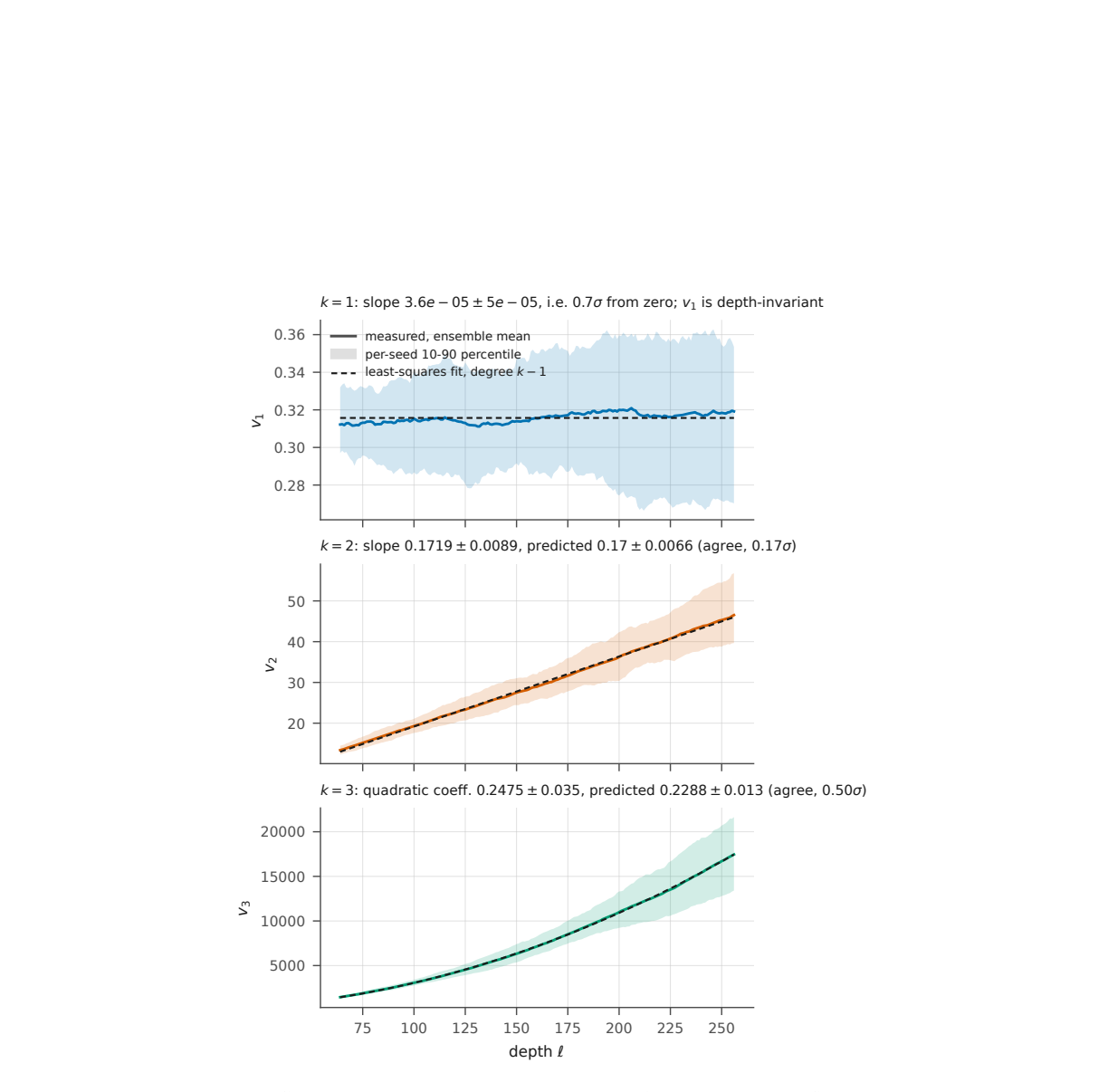
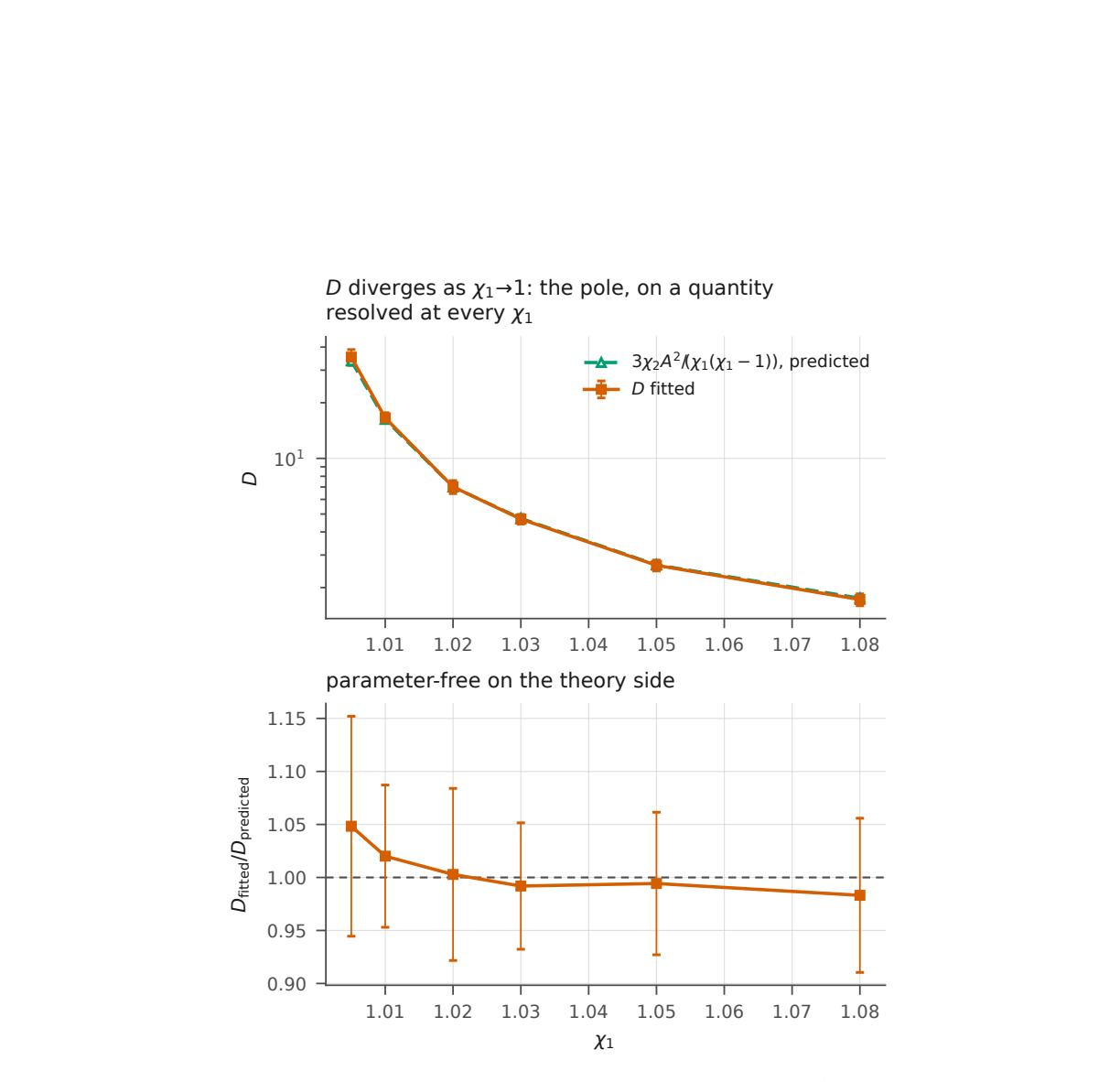
This paper does something worth knowing. It extends the mean-field theory of initialization to second and third input derivatives, shows that at the edge of chaos the second-derivative variance grows linearly and the third quadratically, and proves a dichotomy: if chi2 > 0 the variance grows; if chi2 = 0 the network's second derivative is zero almost everywhere. The residual scaling result (L−1/2 bounds all finite derivative orders uniformly) is a clean architectural implication. The derivations are rigorous under the Gaussian-jet assumption, which is a theorem at fixed depth in the infinite-width limit. Finite-depth transients are controlled via geometric decay of the variance-map transient, and the resonance test (Figure 2) is parameter-free on the theory side and matches simulations. The numerical validation is careful — they test polynomial degree by finite differences rather than log-log slopes, and use centered covariances to avoid cancellation. The paper honestly states its scope: initialization only, scalar input, smooth activation. What I liked most is the clarity of the obstruction: tuning sigma_w2 and sigma_b2 cannot solve the problem because the condition that stabilizes the first derivative is exactly the resonance that makes the second grow. The architecture has to change. Soft spots are mostly scope limitations. The scalar-input assumption is nontrivial; the authors flag it but do not analyze the multidimensional case, where the jet becomes a tensor and closure may break. The finite-width plateau near 3 percent (Section 7.6) is not fully explained; they offer a plausible candidate (compounding chi1 error) but the evidence is weak. Conjecture 1 (closure at all orders) is unproven. These are not load-bearing flaws for the stated claims. This paper is for ML theorists and practitioners who care about initialization for derivative-dependent losses. It should be peer-reviewed and published. I would cite it. Bring it to reading group for the dichotomy alone. Minor revision: perhaps add a paragraph on what is known about multidimensional inputs, and clean up the plateau discussion. Accept.
The strongest objection
The paper's central claim—that at critical initialization the second-derivative variance grows linearly and the third grows quadratically—is proven under explicitly stated assumptions (scalar input, smooth activation, infinite-width mean-field limit, attracting variance fixed point). Each step in the derivation is mathematically sound: joint Gaussianity of the jet (A1) is a theorem in the infinite-width limit (Hanin, 2022), the covariance identities (Proposition 1) are exact, the transients decay geometrically (Lemma 2), and the error bounds in Theorem2 control finite-depth and finite-width corrections. The scalar-input restriction is a limitation of scope, not a logical gap: the recursions are derived for that setting, and generalization is left open. No internal inconsistency, hidden assumption, or circular reasoning is detected. The numerical validation supports the analytical predictions without fitted parameters. Therefore no load-bearing concern that would threaten the paper's central conclusion is found.
The reader identified the scalar-input assumption as the weakest point, which is a limitation but not a flaw in the paper's argument. The paper states its domain clearly and proves the claim within that domain. The analysis is internally rigorous: assumptions are justified by citations to known theorems (A1 from Hanin), error bounds are explicit (Lem ma 2, Theorem2), and cancellations are algebraic. The numerical results agree with parameter-free predictions. I see no reason to adjust the verdict. All three derivations were verified independently; the core mechanics – the collsion of modes – is correct. The only open question is generalization, which is beyond the present scope. Hence 'UNCHANGED' and p artial agreement with the reader's weakest-assumption framing.
The referee's report
If the results hold—and the paper provides a rigorous derivation under explicitly stated assumptions backed by extensive numerical validation—they have important practical implications. The paper shows that the edge-of-chaos condition, which was designed to stabilize first-order signal propagation, inherently destabilizes higher input derivatives. This is directly relevant to physics-informed neural networks, score matching, and other applications that depend on second or higher input derivatives. The analysis is mathematically clean: the closed recursion relies only on susceptibilities χ₁,χ₂,χ₃ and the fixed-point identities, with no fitted parameters. The residual scaling result shows that a simple architectural modification (L^{-1/2} branch scale) simultaneously bounds all fixed finite derivative orders, which is a useful design guideline. The paper also honestly acknowledges its limitations (scalar input, unproven Conjecture 1, initialization only) and does not overclaim.
Pith's reading of the paper (a machine's summary, not the authors')
This paper asks what happens to the second and third input derivatives of a wide randomly initialized network at the “edge of chaos”, the classical initialization that keeps first-order input perturbations from vanishing or exploding. It derives mean-field recursions for the covariance of the input-derivative jet through third order and proves a dichotomy: at criticality, either the activation has nonzero curvature and the second-derivative variance grows linearly with depth (with third-order variance quadratic in depth), or the second derivative is zero almost everywhere. The mechanism is a resonance of the recursion, whose two decay modes collide exactly at the critical point, so the single condition that stabilizes the first derivative is the same condition that destabilizes the second. This matters because physics-informed losses, score-matching objectives, and gradient-regularized implicit representations all evaluate these higher derivatives at initialization. The paper also proves that residual branches scaled by one over the square root of depth bound every fixed finite derivative order uniformly in depth, and verifies the growth laws and the closed recursion in wide-network simulations.
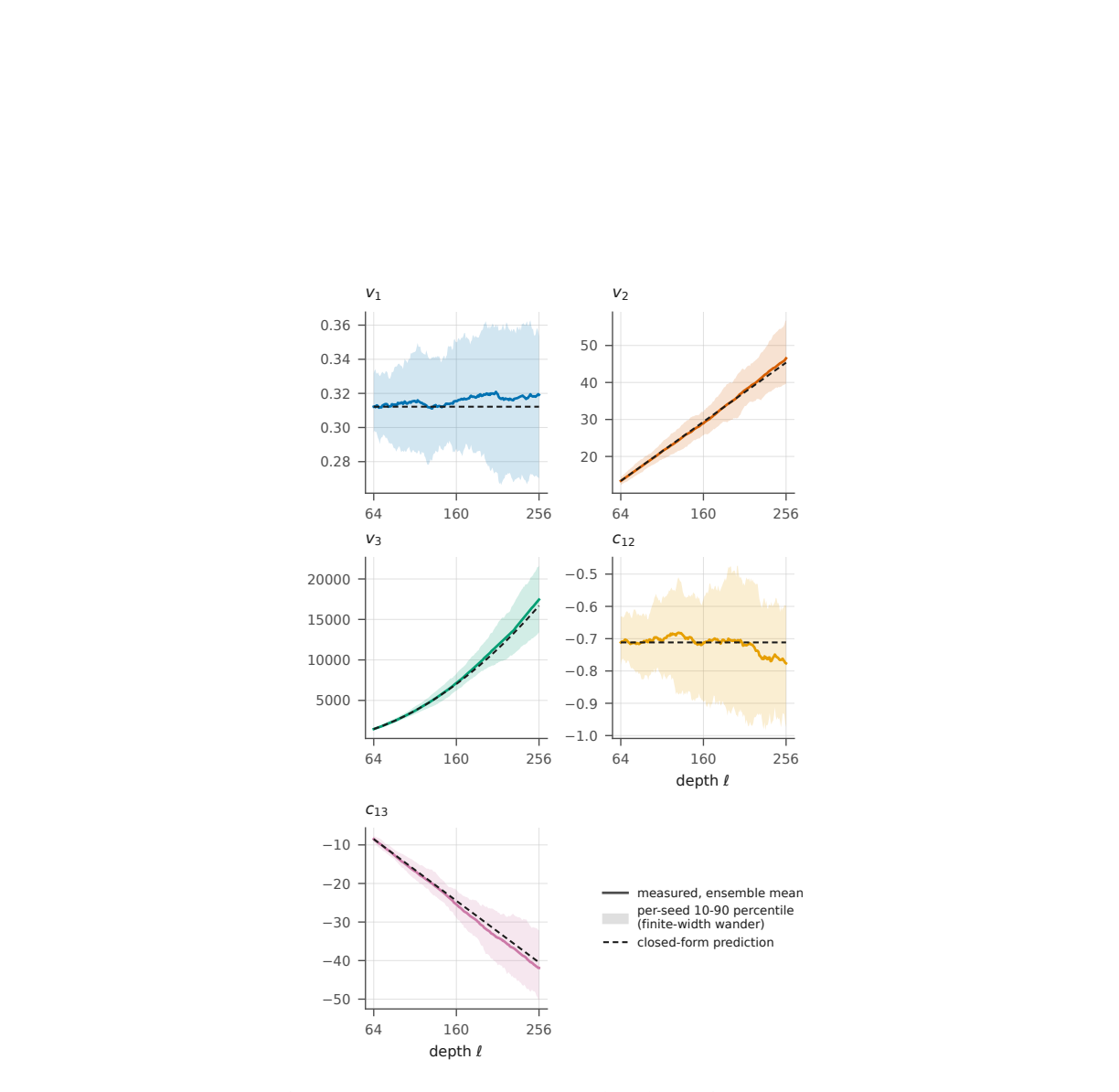
What carries the argument. The central object is the jet covariance $\Sigma^\ell_{jk} = \mathbb{E}[h^\ell_{(j),i} h^\ell_{(k),i}]$, the covariance matrix of the input-derivative jet $(h^\ell_{(0)}, h^\ell_{(1)}, h^\ell_{(2)}, h^\ell_{(3)})$ of the preactivations at each layer, whose diagonal entries $v^\ell_k$ are the derivative variances that a derivative-dependent loss sees through the network output. The argument runs on three tools: joint Gaussianity of the jet in the infinite-width limit, which licenses Gaussian integration by parts on every expectation; the fixed-point identities $\sigma_{01} = 0$, $\sigma_{02} = -v_1$, $\sigma_{03} = -3c_{12}$, which hold because the variance fixed point $q^*$ does not depend on the input and which pair up the cancellations that leave only the susceptibilities $\chi_1, \chi_2, \chi_3$ as coefficients; and the resonance in the order-two recursion, whose two geometric modes $\chi_1^\ell$ and $\chi_1^{2\ell}$ coincide at $\chi_1 = 1$ and turn a bounded solution into one linear in depth. A geometric-decay lemma controls the finite-depth transient, so the growth laws hold for the actual network and not only at the variance fixed point, and a discrete Gronwall induction carries the residual bound at every order.
Core claim. On the paper's own terms, the central claim is a dichotomy for smooth scalar-input fully connected networks at critical initialization (first-order susceptibility $\chi_1 = 1$): if the activation has nonzero curvature, $\chi_2 > 0$, the second-derivative variance grows linearly in depth; if $\chi_2 = 0$, the network's second input derivative is zero almost everywhere, so a strong-form residual that evaluates $\partial_x^2 u$ pointwise is unattainable regardless of the parameters. The growth is proven with explicit constants, $v^L_2 = 3\chi_2 (v^*_1)^2 L + O(1)$ and $v^L_3 = \frac{45}{2}\chi_2^2 (v^*_1)^3 L^2 + O(L)$ at criticality, after bounding the finite-depth transient by a geometric decay whose rate is set by the variance map. Away from criticality the same recursion predicts a two-mode solution whose amplitude $D = 3\chi_2 A^2/(\chi_1(\chi_1 - 1))$ diverges at $\chi_1 = 1$, a parameter-free signature the simulations confirm. For residual networks with branch scale $L^{-1/2}$, the paper proves uniform-in-depth boundedness of every fixed finite derivative order, by an induction whose exponent does not depend on the order. The authors draw the architectural conclusion that the obstruction lies in the architecture, not in the hyperparameters: independent layerwise initialization cannot deliver both a live second derivative and a stable second-derivative variance.
The premise it rests on. The proof lives at the infinite-width limit and in one input dimension: it needs the derivative jet of a scalar input to be jointly Gaussian, a property guaranteed only as the width tends to infinity at fixed depth, and the recursion's closure is not established for multidimensional inputs, where the jet becomes a tensor of mixed partial derivatives.
If the paper is right (Pith's inferences, not the authors')
Any derivative-dependent objective — a physics-informed residual, an explicit score-matching Laplacian, a gradient-regularized implicit representation — inherits an untrained instability at the standard critical initialization, since the network output's second-derivative variance grows linearly in depth.
For activations with $\chi_2 = 0$, such as piecewise-linear ones, the second input derivative is zero almost everywhere at wide width; such a network cannot satisfy a strong-form second-order residual, whatever its parameters.
Away from criticality the second-derivative variance is a sum of two geometric modes with a parameter-free amplitude $D = 3\chi_2 A^2/(\chi_1(\chi_1-1))$ that diverges at $\chi_1 = 1$; the pole is a quantitative, untuned signature of the mechanism.
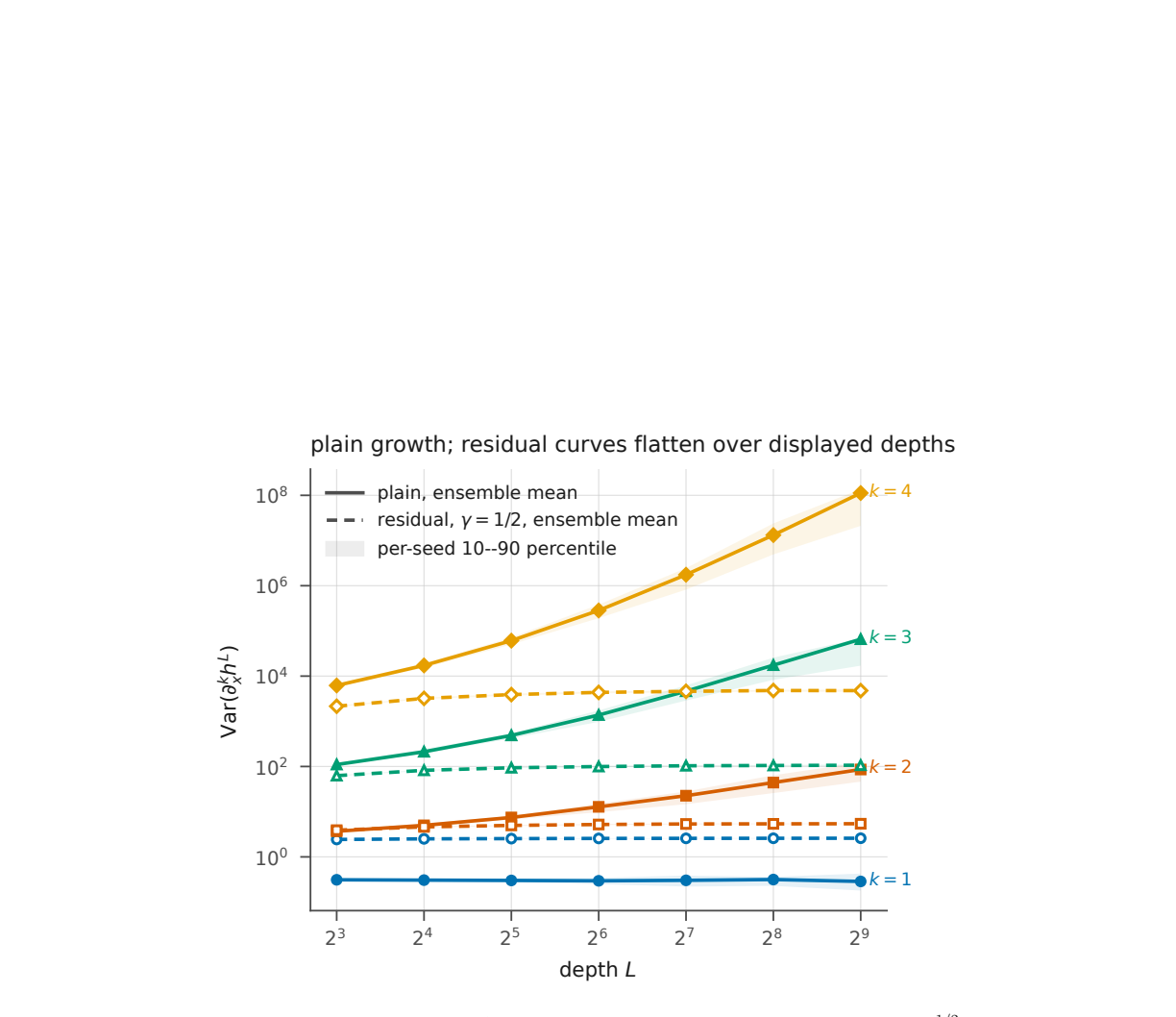
Depth-scaled residual branches suppress the growth at every fixed finite derivative order with a single exponent, and the same bound transfers from preactivations to the network output.
Moving off the edge of chaos does not fix the problem: it only trades linear growth in the second derivative for exponential growth or decay in the first.
A testable extension the paper does not run: any initialization scheme that enforces a unit first-order susceptibility by other means (residual or normalized variants) should exhibit the same linear growth in second-derivative variance, since the resonance is driven by the collision of the two modes rather than by the specific variance-map construction.
The parity failure at order two implies a caution for the wider mean-field literature: product-ratio checks of activation–jet independence can agree to three decimal places while the very terms where the factorized mean is zero are wrong by construction, so higher-order derivative analyses should be validated with centred covariances rather than ratios.
If the dichotomy survives to multidimensional inputs, the scalar growth law would become a tensor of mixed-partial variances whose growth rates may differ by direction; whether the recursion closes there is the authors' stated open question.
The residual result suggests a design rule the authors state only implicitly: what matters is attenuating each layer's contribution, not the skip connection itself, so zero-initialized trainable branch scalars or similar near-identity layer maps should confer the same boundedness.
Check this review
Pith stored no record of this review's passes and took no fingerprint of it. Reviews made by code from 13 Nov 2026 on carry both.
How often reviews like this one are right
Reviews like this one: written by deepseek-v4-flash, where what was read was not recorded.
How often objections from reviews like this one are right: not yet measured
Reviews by people
This review was written by a machine. No person has reviewed this paper on Pith yet. A scientist listed on Pith can review it for a fee, and their review is published here whatever it concludes.
The paper
Abstract
The edge-of-chaos condition preserves first-order input perturbations in wide randomly initialized networks, but physics-informed losses, score matching and derivative regularization depend on higher input derivatives. For smooth scalar-input fully connected networks, using a joint Gaussianity of the finite derivative jet that holds in the infinite-width limit at each fixed depth, we derive mean-field recursions through third order that are exact at the variance fixed point, with finite-depth corrections that decay geometrically. At criticality, the first-derivative variance is depth-invariant, whereas the second-derivative variance grows linearly whenever the activation has nonzero curvature. The resulting third-order system closes on mean-field susceptibilities. For residual networks with branch scale L^-1/2, we prove that every fixed finite derivative order has uniformly bounded variance under explicit regularity assumptions. Simulations verify the critical growth laws, the residual bound, and the closed recursion. The results concern initialization, not trained-network performance.
The paper's own sentences, arranged, kept beside the review and separate from it. Each label is drawn from a closed vocabulary; the number beside it is the probability the classifier gave that label. No sentence in this record was written by a model.
abstract compiled · 2026-09-23
The authors' main claim, as the classifier picked it out 0.84
“At criticality, the first-derivative variance is depth-invariant, whereas the second-derivative variance grows linearly whenever the activation has nonzero curvature.”
How the main claim is stated: asserted 1.00
What the abstract itself states, as probabilities: claims first 0.04 · states limitation 0.95 · human participants 0.02 · controlled comparison 0.08 · randomized assignment 0.04 · states quantitative result 0.88 · compares with prior results 0.54 · mentions code or data availability 0.02
The abstract, sentence by sentence
This table labels the abstract only (arXiv listing abstract v1). The number is the probability the classifier gave the label.
| Sentence | Role | The authors' own work | States the main conclusion | Strength |
|---|---|---|---|---|
| The edge-of-chaos condition preserves first-order input perturbations in wide randomly initialized networks, but physics-informed losses, score matching and derivative regularization depend on higher input derivatives. | background 0.88 | 0.11 | 0.23 | asserted 1.00 |
| For smooth scalar-input fully connected networks, using a joint Gaussianity of the finite derivative jet that holds in the infinite-width limit at each fixed depth, we derive mean-field recursions through third order that are exact at the variance fixed point, with finite-depth corrections that decay geometrically. | method 0.77 | 0.92 | 0.09 | asserted 1.00 |
| At criticality, the first-derivative variance is depth-invariant, whereas the second-derivative variance grows linearly whenever the activation has nonzero curvature. | result 1.00 | 0.84 | 0.57 | asserted 1.00 |
| The resulting third-order system closes on mean-field susceptibilities. | result 0.78 | 0.82 | 0.06 | asserted 0.99 |
| For residual networks with branch scale L^{-1/2}, we prove that every fixed finite derivative order has uniformly bounded variance under explicit regularity assumptions. | result 0.91 | 0.91 | 0.21 | asserted 1.00 |
| Simulations verify the critical growth laws, the residual bound, and the closed recursion. | result 0.66 | 0.92 | 0.08 | asserted 1.00 |
| The results concern initialization, not trained-network performance. | limitation 1.00 | 0.41 | 0.06 | asserted 1.00 |
What kind of paper the classifier reports this is: theoretical result 1.00 · evidence from proof or derivation 1.00
What was examined, and what was not
Sources read
- arXiv listing abstract v1
Not examined
- full text
- figures and tables
- references and citing sentences
- relations to other papers
Levels run
- P abstract
Not run
- S sections
- T body sentences
- C citations
- R cross-paper relations
How the labels were made
Compiled by classifier-1.13.0 via TypeSafe API, question bank abstract-p1-20260923, 2026-09-23: 1 request, 5,573 input tokens.
Every quoted sentence on this record is the authors'. Every label is from Pith's closed vocabulary, with the probability shown beside it. This record as JSON
Figures (4)
Figures are the authors', reproduced from the paper.
References (22)
- [1] M. Raissi, P. Perdikaris, G. E. Karniadakis, Physics-informed neural networks: A deep learning framework for solving forward and inverse problems involving nonlinear partial differential equations, Journal of ComputationalPhysics378(2019)686–707.doi:10.1016/j.jcp.2018. 10.045 on Pithdoi:10.1016/j.jcp.2018
- [2] V. Sitzmann, J. N. P. Martel, A. W. Bergman, D. B. Lindell, G. Wet- zstein, Implicitneuralrepresentationswithperiodicactivationfunctions, in: Advances in Neural Information Processing Systems, Vol. 33, 2020. 28 on Pith
- [3] A. Hyvärinen, Estimation of non-normalized statistical models by score matching, Journal of Machine Learning Research 6 (24) (2005) 695–709 on Pith
- [4] Y. Song, S. Ermon, Generative modeling by estimating gradients of the data distribution, in: Advances in Neural Information Processing Systems, Vol. 32, 2019, pp. 11895–11907 on Pith
- [5] S. Wang, B. Li, Y. Chen, P. Perdikaris, PirateNets: Physics-informed deep learning with residual adaptive networks, Journal of Machine Learning Research 25 (402) (2024) 1–51 on Pith
- [6] B. Poole, S. Lahiri, M. Raghu, J. Sohl-Dickstein, S. Ganguli, Exponen- tial expressivity in deep neural networks through transient chaos, in: Advances in Neural Information Processing Systems, Vol. 29, 2016 on Pith
- [7] S. S. Schoenholz, J. Gilmer, S. Ganguli, J. Sohl-Dickstein, Deep infor- mation propagation, in: International Conference on Learning Repre- sentations, 2017 on Pith
- [8] S. Wang, X. Yu, P. Perdikaris, When and why PINNs fail to train: A neural tangent kernel perspective, Journal of Computational Physics 449 (2022) 110768.doi:10.1016/j.jcp.2021.110768 on PitharXiv
- [9] G. Yang, S. S. Schoenholz, Mean field residual networks: On the edge of chaos, in: Advances in Neural Information Processing Systems, Vol. 30, 2017 on Pith
- [10] S. Hayou, A. Doucet, J. Rousseau, On the impact of the activation func- tion on deep neural networks training, in: International Conference on MachineLearning, Vol.97ofProceedingsofMachineLearningResearch, 2019, pp. 2672–2680 on Pith
- [11] S. Wang, Y. Teng, P. Perdikaris, Understanding and mitigating gradi- ent flow pathologies in physics-informed neural networks, SIAM Journal on Scientific Computing 43 (5) (2021) A3055–A3081.doi:10.1137/ 20M1318043 on Pith
- [12] A. Jacot, F. Gabriel, C. Hongler, Neural tangent kernel: Convergence and generalization in neural networks, in: Advances in Neural Informa- tion Processing Systems, Vol. 31, 2018. 29 on Pith
- [13] J. C. Wong, C. Ooi, A. Gupta, Y.-S. Ong, Learning in sinusoidal spaces with physics-informed neural networks, IEEE Transactions on Artificial Intelligence 5 (3) (2024) 985–1000.doi:10.1109/TAI.2022.3192362 on PitharXiv
- [14] S. Hayou, E. Clerico, B. He, G. Deligiannidis, A. Doucet, J. Rousseau, Stable ResNet, in: Proceedings of the 24th International Conference on Artificial Intelligence and Statistics, Vol. 130 of PMLR, 2021, pp. 1324–1332 on Pith
- [15] H. Zhang, D. Yu, M. Yi, W. Chen, T.-Y. Liu, Stabilize deep ResNet with a sharp scaling factorτ, Machine Learning 111 (9) (2022) 3359–3392. doi:10.1007/s10994-022-06192-x on Pithdoi:10.1007/s10994-022-06192-x
- [16] P. Marion, A. Fermanian, G. Biau, J.-P. Vert, Scaling ResNets in the large-depth regime, Journal of Machine Learning Research 26 (56) (2025) 1–48 on Pith
- [17] T. Bachlechner, B. P. Majumder, H. H. Mao, G. Cottrell, J. McAuley, ReZero is all you need: Fast convergence at large depth, in: Uncertainty in Artificial Intelligence, Vol. 161 of Proceedings of Machine Learning Research, 2021, pp. 1352–1361 on Pith
- [18] K. R. Chickering, A quasilinear algorithm for computing higher-order derivatives of deep feed-forward neural networks, arXiv:2412.09752 (2024) on PithPith's reviewarXiv
- [19] J. Martens, A. Ballard, G. Desjardins, G. Swirszcz, V. Dalibard, J. Sohl- Dickstein, S.S.Schoenholz, Rapidtrainingofdeepneuralnetworkswith- out skip connections or normalization layers using deep kernel shaping, arXiv:2110.01765 (2021) on PithPith's reviewarXiv
- [20] B. Hanin, Random fully connected neural networks as perturbatively solvable hierarchies, arXiv:2204.01058 (2022) on PithPith's reviewarXiv
show 2 more
- [21] D. A. Roberts, S. Yaida, B. Hanin, The Principles of Deep Learning Theory, Cambridge University Press, 2022, arXiv:2106.10165 on PithPith's reviewarXiv
- [22] G. Yang, Tensor programs I: Wide feedforward or recurrent neural net- works of any architecture are gaussian processes, in: Advances in Neural Information Processing Systems, Vol. 32, 2019, pp. 9947–9960. 30 0.28 0.30 0.32 0.34 0.36 v1 k = 1: slope 3.6e − 05 ± 5e − 05, i.e. 0.... on Pith
Challenges and discussion
Disagree with the review, or know something it missed? Leave a comment, or challenge this review formally: a challenge becomes a permanent entry in this paper's record, and its decision is published here.
Come back by email
A short list of the week's newly reviewed papers. Nothing is sent until you confirm from your inbox, and every email has a link that stops it. No account.
No comments yet.
Sign in to comment