Differential Geometry · arXiv:2609.14581 v1 · submitted 13 Sep 2026 · 30 references
Boundary flexibility for curvature conditions
The paper says
“We prove a general boundary gluing principle for families of Riemannian metrics with pointwise curvature restrictions on manifolds with possibly non-compact boundary.”
more of the abstract
This includes, as special cases, the classical gluing theorems by Perelman for metrics with positive Ricci curvature and convex singularities and by Gromov-Lawson and Bär-Hanke for metrics with positive scalar curvature and mean convex singularities. Using the language of algebraic curvature cones, our theorem implies and unifies many more previous gluing results. We also prove a boundary deformation principle that enables us to compare spaces of metrics with interior curvature restrictions and different boundary conditions. Our construction is based on the local flexibility lemma for open partial differential relations, as well as explicit 1-jet deformations of metrics along the boundary.
from the abstract
Pith says
Machine review · deepseek-v4-flash · 15 Sep 2026 · what was read was not recorded · not checked by a person
It can be wrong. Challenge this review or reply to it.
Holds up. A well-crafted unification of gluing theorems for Perelman- and Gromov-Lawson-type curvature conditions; the proofs are careful and the framework is genuinely new, though the assumptions are necessarily strong. This line is wrong
3 major objections · 5 minor
How often objections from reviews like this one are right: not yet measured
Not checked: figures, code, what the 30 references say.
The paper says, at §1 (Introduction)
The review did not quote this passage.
Pith says: Objection 1 of 3 · major
The sentence 'Perelman’s original gluing theorem clearly follows from surjectivity in the π₀‑statement of Theorem A for the case where C = C_{ric>0}' is correct because C_{R>0} ⊂ C_{ric>0}, so Theorem A applies. However, the phrase 'clearly follows' is optimistic: the reader must verify that Perelman’s condition II_{g1} + II_{g2} ≥ 0 is exactly the boundary condition in Theorem A (which is II_{g1} + II_{g2} ≥ 0), and that the cone C_{ric>0} does contain C_{R>0}.
more of objection 1
A brief justification would improve clarity.
The paper says, at §3.2, Lemma 3.15 and Lemma 4.1
The review did not quote this passage.
Pith says: Objection 2 of 3 · major
The statements of Lemma 3.15 and Lemma 4.1 are technically similar but differ in the radius of the perpendicular ball (B⊥_{ρ√Λ} vs B⊥_{ρ·Λ}) and in the conclusion about C(σ+ε) vs C(σ). This reflects the difference between Perelman and GL flexibility.
more of objection 2
The proofs are sketched, but they rely on the compactness arguments and the construction of Λ₀ via covers and partitions of unity. Given the central role of these lemmas, a more explicit explanation of how the function Λ₀ is built globally (especially how the constants for different α are patched) would help the reader.
The paper says, at §4, Theorem 4.5
The review did not quote this passage.
Pith says: Objection 3 of 3 · major
The theorem asserts that R_{C(σ)}(M₁∪_∂M M₂) → R_{C(σ)}^{GL}(M₁⊔M₂) is a weak homotopy equivalence. The proof refers to the same scheme as Theorem 3.21, but the family k(ξ) = −II_{g₂}⊔II_{g₂} used in the deformation must satisfy the boundary condition ι*(II_g − k)⃝∧b⊥ ∈ C(0). This is equivalent to ι*(II_{g₁}+II_{g₂})⃝∧b⊥ ∈ C(0), which is exactly the definition of R^{GL}. The verification that the deformation steps (Theorem 4.3) apply is only sketched; a slightly more detailed justification would increase confidence.
5 minor objections
The paper says, at §1, Table 1
Pith says: minor objection 1 of 5
In the row for PIC, the boundary condition is listed as '2-convex' with contributors Schlichting [28] and Chow [12], but the preceding rows for PIC2 and PIC1 also list 'convex'. The table would benefit from a note clarifying which curvature conditions are covered by which theorem (A or B) and how the boundary terms are interpreted.
The paper says, at §2.4, Corollary 2.13
Pith says: minor objection 2 of 5
The corollary states that for any compact K ⊂ C_B(Rⁿ) and r>0 there exists a>0 such that ... The dependency of a on K is not made explicit. Since K is the image of a family of curvature tensors under isometries, the statement is correct, but adding a remark that a depends on the modulus of continuity of the family would be helpful.
show 3 more
The paper says, at §3.2, Eq. (10)
Pith says: minor objection 3 of 5
The expression for II_t is derived as II_t = Λt·g₀(ξ) + h(ξ). Later, in Eq. (17), the formula for II_{γ_t} includes a term with ˙χ_δ. The transition from the Λ‑normal form to the deformed metric is clear, but the notation '≲' is used without a precise bound; specifying that the implicit constant depends only on the data on U^3_α would improve rigour.
The paper says, at §4, line after Remark 2.7
Pith says: minor objection 4 of 5
The text says 'In this paper, one important instance of the Kulkarni-Nomizu product is the algebraic curvature tensor b⃝∧b⊥'. The definition of b⊥ is given in §2.1, but its extension to a symmetric (0,2)-tensor on Rⁿ is immediate. A brief note that b⊥ is identified with the pullback of the standard inner product under the orthogonal projection onto the e₁‑direction would be useful.
The paper says, at References
Pith says: minor objection 5 of 5
Reference [15] (the author’s master’s thesis) is a dissertation; the link is given but is not permanent. If possible, provide the DOI or a stable URL. Similarly, reference [28] is a PhD thesis; a persistent identifier would be appreciated.
What would settle it
Independently re-derive the key estimate in Lemma 3.15 for a concrete Perelman flexible family (e.g., C = C_{ric>0}) with a nontrivial compact family of metrics, verifying that the constants Λ_0, ρ, δ_0 can be chosen uniformly and that the conclusion (idt⊕j)*R_g + B^⊥_{ρ√Λ} ⊂ C(σ+ε) holds for the claimed range of parameters.
from the skeptic's reading
How the review went
4 readings by deepseek-v4-flash · 15 Sep 2026
- Reader holds up
- Skeptic agrees
- Editor wrote the verdict above
- Referee minor revision: 3 major objections, 5 minor
Not run on this paper: the simulated authors' defence.
Pith did not check this review's objections against the paper.
The review in full
The review in brief, machine-written
Hi [Colleague],
The headline: This paper is a serious piece of work that unifies and extends the homotopical gluing results of Bär-Hanke to a wide class of curvature conditions, using the language of algebraic curvature cones. It is well-written and the proofs are detailed.
What is new: The paper proves weak homotopy equivalences for spaces of metrics with Perelman-type and Gromov-Lawson-type boundary conditions (Theorems A and B), and a boundary deformation principle (Theorem C). This brings together gluing theorems for positive Ricci curvature, positive scalar curvature, positive sectional curvature, intermediate Ricci curvatures, etc., under one roof. That is a genuine advance for the field.
What it does well: The author carefully constructs the framework, works with continuous families of metrics, deals with non-compact boundaries, and provides explicit curvature estimates. The reliance on Bär-Hanke's local flexibility lemma is legitimate—it is used as a black box, which is fine. The paper also shows that many previously separate results are special cases.
Soft spots: The assumptions are strong: the curvature cone must contain either the cone of positive curvature operators (for Perelman type) or the specific tensor b⃝ ∧ b⊥ (for Gromov-Lawson type). This is necessary for the technique, but it means the results do not apply to some natural curvature conditions (e.g., those that do not satisfy these inclusion properties). The paper acknowledges this. Another remark: the proofs are heavy, but that is typical for this kind of work.
Overall, this is a well-crafted paper that will be a standard reference for gluing theorems in Riemannian geometry. It deserves a careful referee and publication in a top journal. I would bring it to a reading group and would cite it.
Best.
The strongest objection
After a careful review of the arguments, I find no logical flaw or unsupported leap that undermines the central claims. The proofs are technically detailed and the assumptions are explicitly stated and justified. The reliance on Bär-Hanke's local flexibility lemma is a legitimate foundation; the constructions are consistent and the homotopical conclusions follow from the established deformation principles. The paper presents a rigorous unification and generalization of known gluing theorems, and the reasoning appears sound.
The reader identified the reliance on the boundary condition II_g1+II_g2 ≥ 0 and the assumption that the cone contains the cone of positive curvature operators as the weakest assumptions. These are indeed strong and exclude some natural curvature conditions, but the paper clearly states them and shows that many important examples satisfy them. I find no hidden gap or circularity in the proof that would weaken the central claim. The paper builds on the Bär-Hanke machinery in a careful manner, and all technical steps appear consistent. Therefore, the reader's verdict of ACCEPT is well-founded, and no adjustment is needed.
The referee's report
If the results are correct, this paper provides a systematic and highly general framework for gluing Riemannian metrics under a wide class of pointwise curvature constraints, extending far beyond the original Perelman and Gromov–Lawson settings. The homotopical statements (weak homotopy equivalences) are substantially stronger than mere existence results and open the door to further investigations of spaces of metrics with curvature bounds. The unification of many previously scattered gluing theorems into two main typologies (Perelman type and Gromov–Lawson type) is a valuable conceptual contribution. The paper is technically detailed, with careful lemmas and explicit estimates, and the dependence on Bär–Hanke’s local flexibility lemma is a legitimate foundation.
Pith's reading of the paper (a machine's summary, not the authors')
This paper establishes a general principle for gluing Riemannian metrics across a common boundary while preserving pointwise curvature restrictions. It shows that for a continuous family of curvature conditions that is either Perelman flexible or Gromov-Lawson flexible, the space of metrics on the glued manifold is weakly homotopy equivalent to the space of metrics on the disjoint union that satisfy a corresponding boundary condition. This unifies classical gluing theorems by Perelman (positive Ricci curvature) and Gromov-Lawson (positive scalar curvature) and extends them to a wide range of curvature conditions expressed through algebraic curvature cones. The results also include a boundary deformation principle that allows the second fundamental form to be adjusted while respecting the curvature constraint, enabling comparison of metrics with different boundary conditions.
What carries the argument. The key machinery is the notion of flexible families of algebraic curvature cones (Perelman flexible and Gromov-Lawson flexible), combined with the local flexibility lemma for open partial differential relations due to Bär-Hanke. The proof constructs explicit 1-jet deformations of metrics along the boundary using a two-stage gluing scheme, uniformisation of geodesic collar neighbourhoods, and a quantitative version of the Gram-Schmidt algorithm to control nearly isometric isomorphisms.
Core claim. The central claim is that for a Perelman flexible or Gromov-Lawson flexible continuous family of curvature conditions C, the inclusion of the space of metrics on the glued manifold M1 ∪∂M M2 into the space of metrics on M1 ⊔ M2 with the appropriate boundary condition (II_g1+II_g2 non-negative in the Perelman sense, or satisfying the Gromov-Lawson condition) is a weak homotopy equivalence. This is stated in Theorems A and B (Theorems 3.21 and 4.5). The boundary deformation principle (Theorem C) further shows that on a single manifold one can deform the second fundamental form arbitrarily (up to a Gromov-Lawson type condition) while staying within the curvature condition, allowing systematic comparison of spaces of metrics with different boundary conditions.
The premise it rests on. The load-bearing premise is that for Perelman type gluing, the curvature cone C must contain the cone of positive curvature operators, and the sum of second fundamental forms II_g1+II_g2 must be positive semidefinite; for Gromov-Lawson type, the cone must contain the algebraic curvature tensor b⃝∧b⊥, and the boundary condition is expressed in terms of the Kulkarni-Nomizu product of II_g1+II_g2 with b⊥.
If the paper is right (Pith's inferences, not the authors')
The classical gluing theorems of Perelman (positive Ricci curvature) and Gromov-Lawson (positive scalar curvature) are recovered as special cases of a unified framework.
Many previously separate gluing results (e.g., for positive sectional curvature, positive curvature operator, PIC, positive k-th intermediate Ricci curvature, positive m-intermediate curvature) are now corollaries of Theorems A and B.
The deformation principle (Theorem C) implies that spaces of doubling metrics, metrics with totally geodesic boundary, and metrics with convex boundary are all weakly homotopy equivalent to the space of metrics that satisfy the Gromov-Lawson boundary condition.
The results apply to manifolds with possibly non-compact boundaries, extending earlier work that handled only compact boundaries.
The homotopical formulation suggests that the topology of the space of metrics satisfying a curvature condition and a boundary condition is largely independent of the boundary condition as long as it lies within the flexible range.
The unification via algebraic curvature cones connects gluing problems to Ricci flow invariant curvature conditions (Wilking's construction C(S)), potentially linking abstract Ricci flow theory to concrete geometric constructions.
The quantitative control from the Gram-Schmidt argument may be adaptable to other problems where nearly isometric maps need to be approximated uniformly.
The paper leaves open the question of whether the flexibility conditions (containing C_R>0 or b⃝∧b⊥) are necessary or can be weakened for specific cones; characterising exactly which cones admit such gluing would be a natural extension.
Check this review
Pith stored no record of this review's passes and took no fingerprint of it. Reviews made by code from 13 Nov 2026 on carry both.
How often reviews like this one are right
Reviews like this one: written by deepseek-v4-flash, where what was read was not recorded.
How often objections from reviews like this one are right: not yet measured
Reviews by people
This review was written by a machine. No person has reviewed this paper on Pith yet. A scientist listed on Pith can review it for a fee, and their review is published here whatever it concludes.
The paper
Abstract
We prove a general boundary gluing principle for families of Riemannian metrics with pointwise curvature restrictions on manifolds with possibly non-compact boundary. This includes, as special cases, the classical gluing theorems by Perelman for metrics with positive Ricci curvature and convex singularities and by Gromov-Lawson and Bär-Hanke for metrics with positive scalar curvature and mean convex singularities. Using the language of algebraic curvature cones, our theorem implies and unifies many more previous gluing results. We also prove a boundary deformation principle that enables us to compare spaces of metrics with interior curvature restrictions and different boundary conditions. Our construction is based on the local flexibility lemma for open partial differential relations, as well as explicit 1-jet deformations of metrics along the boundary.
The paper's own sentences, arranged, kept beside the review and separate from it. Each label is drawn from a closed vocabulary; the number beside it is the probability the classifier gave that label. No sentence in this record was written by a model.
abstract compiled · 2026-09-23
The authors' main claim, as the classifier picked it out 1.00
“We prove a general boundary gluing principle for families of Riemannian metrics with pointwise curvature restrictions on manifolds with possibly non-compact boundary.”
How the main claim is stated: asserted 1.00
What the abstract itself states, as probabilities: claims first 0.05 · states limitation 0.11 · human participants 0.01 · controlled comparison 0.02 · randomized assignment 0.01 · states quantitative result 0.03 · compares with prior results 0.94 · mentions code or data availability 0.02
The abstract, sentence by sentence
This table labels the abstract only (arXiv listing abstract v1). The number is the probability the classifier gave the label.
| Sentence | Role | The authors' own work | States the main conclusion | Strength |
|---|---|---|---|---|
| We prove a general boundary gluing principle for families of Riemannian metrics with pointwise curvature restrictions on manifolds with possibly non-compact boundary. | contribution 0.79 | 0.96 | 0.88 | asserted 1.00 |
| This includes, as special cases, the classical gluing theorems by Perelman for metrics with positive Ricci curvature and convex singularities and by Gromov-Lawson and B\"ar-Hanke for metrics with positive scalar curvature and mean convex singularities. | interpretation 0.70 | 0.18 | 0.09 | asserted 1.00 |
| Using the language of algebraic curvature cones, our theorem implies and unifies many more previous gluing results. | interpretation 0.97 | 0.85 | 0.20 | asserted 0.99 |
| We also prove a boundary deformation principle that enables us to compare spaces of metrics with interior curvature restrictions and different boundary conditions. | contribution 0.87 | 0.96 | 0.11 | asserted 1.00 |
| Our construction is based on the local flexibility lemma for open partial differential relations, as well as explicit 1-jet deformations of metrics along the boundary. | method 1.00 | 0.89 | 0.05 | asserted 1.00 |
What kind of paper the classifier reports this is: theoretical result 1.00 · evidence from proof or derivation 1.00
What was examined, and what was not
Sources read
- arXiv listing abstract v1
Not examined
- full text
- figures and tables
- references and citing sentences
- relations to other papers
Levels run
- P abstract
Not run
- S sections
- T body sentences
- C citations
- R cross-paper relations
How the labels were made
Compiled by classifier-1.13.0 via TypeSafe API, question bank abstract-p1-20260923, 2026-09-23: 1 request, 4,304 input tokens.
Every quoted sentence on this record is the authors'. Every label is from Pith's closed vocabulary, with the probability shown beside it. This record as JSON
Figures (1)
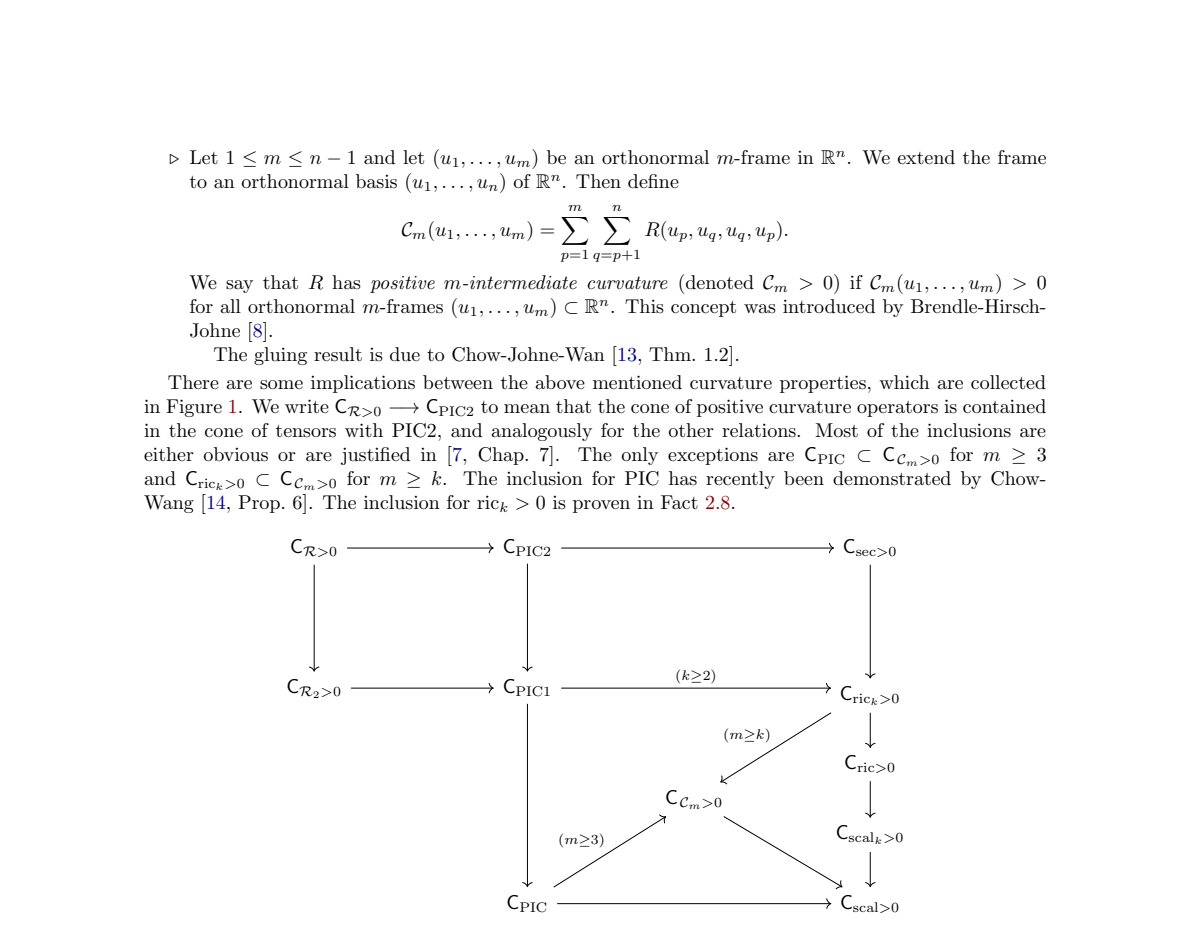
Figures are the authors', reproduced from the paper.
References (30)
- [1] Almeida, S.: Minimal hypersurfaces of a positive scalar curvature manifold.Math. Z.190(1985), 73–82 on Pith
- [2] B¨ ar, C.; Gauduchon, P.; Moroianu, A.: Generalized cylinders in semi-Riemannian and Spin geometry.Math. Z.249 (2005), 545–580 on Pith
- [3] B¨ ar, C.; Hanke, B.: Local flexibility for open partial differential relations.Comm. Pure Appl. Math.75(2022), 1377–1415 on Pith
- [4] : Boundary conditions for scalar curvature. Perspectives in Scalar Curvature. Vol. 2., World Sci. Publ., Hack- ensack, NJ, 325–377, 2023 on Pith
- [5] Besse, A. L.:Einstein manifolds. Ergebnisse der Mathematik und ihrer Grenzgebiete (3), vol. 10. Springer-Verlag, Berlin, 1987 on Pith
- [6] Botvinnik, B.; Walsh, M. G.; Wraith, D. J.: Homotopy groups of the observer moduli space of Ricci positive metrics. Geom. Topol.23(2019), 3003–3040 on Pith
- [7] Brendle, S.:Ricci Flow and the Sphere Theorem. Graduate Studies in Mathematics, vol. 111. American Mathematical Society, Providence, RI, 2010 on Pith
- [8] Brendle, S.; Hirsch, S.; Johne, F.: A generalization of Geroch’s conjecture.Comm. Pure Appl. Math77(2024), 441–456 on Pith
- [9] Brendle, S.; Marques, F. C.; Neves, A.: Deformations of the hemisphere that increase scalar curvature.Invent. Math.185(2011), 175–197 on Pith
- [10] Bridson, M. R.; Haefliger, A.:Metric Spaces of Non-Positive Curvature. Grundlehren der mathematischen Wis- senschaften, vol. 319. Springer Berlin, Heidelberg, 1999 on Pith
- [11] Burago, D.; Burago, Y.; Ivanov, S.:A course in metric geometry. Graduate Studies in Mathematics, vol. 33. American Mathematical Society, Providence, RI, 2001 on Pith
- [12] Chow, T.-K. A.: Positivity of Curvature on Manifolds with Boundary.Int. Math. Res. Notices2022(2022), 11401– 11426 on Pith
- [13] Chow, T.-K. A.; Johne, F.; Wan, J.: Preserving Positive Intermediate Curvature.J. Geom. Anal.33, 366(2023) on Pith
- [14] Chow, T.-K. A.; Wang, Y.: Minimal Two-Spheres and Manifolds with Positive Isotropic Curvature (2026). Preprint available onhttps://arxiv.org/abs/2609.06910 on PithPith's reviewarXiv
- [15] Frerichs, H.: Skalarkr¨ ummung auf Mannigfaltigkeiten mit nicht-kompaktem Rand (2022), available athttps:// nbn-resolving.de/urn:nbn:de:bvb:384-opus4-1081965 on Pith
- [16] : Scalar curvature deformations with non-compact boundaries (2025). Preprint available onhttps://arxiv. org/abs/2403.03941 on PithPith's reviewarXiv
- [17] Gromov, M.; Lawson, H. B.: Spin and scalar curvature in the presence of a fundamental group. I.Ann. of Math. (2) 111(1980), 209–230 on Pith
- [18] Gururaja, H. A.; Maity, S.; Seshadri, H.: On Wilking’s criterion for the Ricci flow.Math. Z.274(2013), 471–481 on Pith
- [19] Hirsch, M. W.:Differential topology. Graduate Texts in Mathematics, vol. 33. Springer New York, NY, 1976 on Pith
- [20] Hoelzel, S.: Surgery stable curvature conditions.Math. Ann.365(2016), 13–47 on Pith
show 10 more
- [21] Kosovskii, N. N.: Gluing of Riemannian manifolds of curvature at leastκ.St. Petersbg. Math. J.14(2003), 467–478, translation fromAlgebra Anal.14(2002), 140–157 on Pith
- [22] Micallef, M. J.; Moore, J. D.: Minimal two-spheres and the topology of manifolds with positive curvature on totally isotropic two-planes.Ann. of Math. (2)127(1988), 199–227 on Pith
- [23] Perelman, G.: Construction of Manifolds of Positive Ricci Curvature with Big Volume and Large Betti Numbers. Comparison Geometry, MSRI Publications30(1997), 157–163 on Pith
- [24] Reiser, P.; Wraith, D. J.: A generalization of the Perelman gluing theorem and applications (2024). Preprint available onhttps://arxiv.org/abs/2308.06996 on PithPith's reviewarXiv
- [25] Seeley, R. T.: Extension ofC ∞ functions defined in a half space.Proc. Amer. Math. Soc.15(1964), 625–626 on Pith
- [26] Sha, J.-P.:p-convex Riemannian manifolds.Invent. Math.83(1986), 437–447 on Pith
- [27] Schlichting, A.: Gluing Riemannian manifolds with curvature operators at leastκ(2012). Preprint available onhttps: //arxiv.org/abs/1210.2957 on PithPith's reviewarXiv
- [28] : Smoothing singularities of Riemannian metrics while preserving lower curvature bounds (2014), Ph.D. thesis, available athttp://dx.doi.org/10.25673/4040 on Pithdoi:10.25673/4040
- [29] Wilking, B.: A Lie algebraic approach to Ricci flow invariant curvature conditions and Harnack inequalities.J. Reine Angew. Math.679(2013), 223–247 on Pith
- [30] Wolfson, J.: Manifolds withk-positive Ricci curvature. Variational problems in differential geometry. London Math. Soc. Lecture Note Ser., Vol. 394., Cambridge Univ. Press, Cambridge, 182–201, 2011. Universit¨at Augsburg, Institut f ¨ur Mathematik, 86135 Augsburg, Germany Emai... on Pith
Challenges and discussion
Disagree with the review, or know something it missed? Leave a comment, or challenge this review formally: a challenge becomes a permanent entry in this paper's record, and its decision is published here.
Come back by email
A short list of the week's newly reviewed papers. Nothing is sent until you confirm from your inbox, and every email has a link that stops it. No account.
No comments yet.
Sign in to comment