Optics · arXiv:2609.15974 v1 · submitted 14 Sep 2026 · 77 references
Critical quantum metrology in the output of an optical parametric oscillator
The paper says
“Many quantum sensors infer parameters from continuously emitted fields, yet in the presence of unmonitored loss, it is difficult to determine how much critical enhancement survives in the accessible output.”
more of the abstract
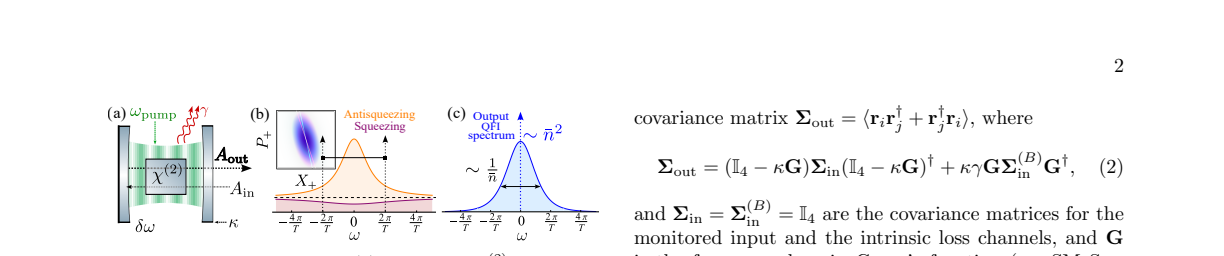
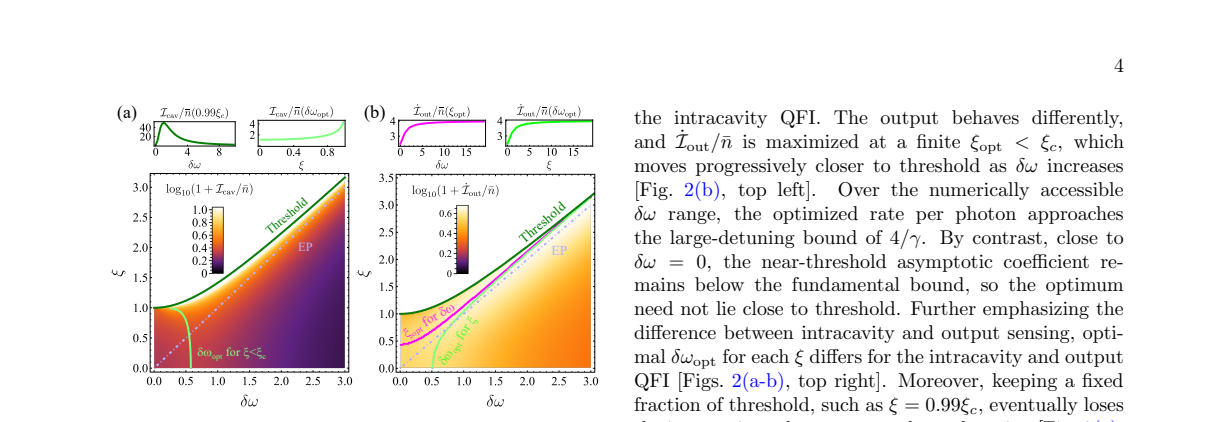
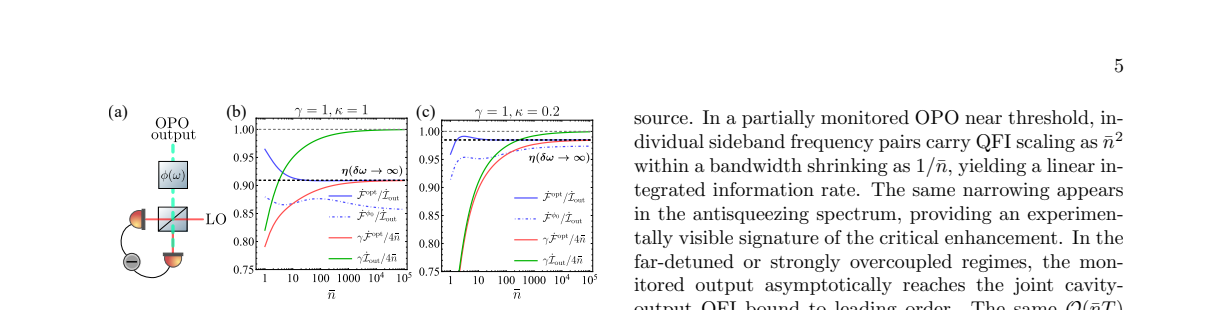
In this work, we calculate the full frequency-resolved output quantum Fisher information (QFI) of a stationary vacuum-seeded optical parametric oscillator for cavity-detuning estimation. We show that, for any fixed nonzero unmonitored loss, the QFI of correlated sideband pairs grows quadratically with the mean intracavity photon number near threshold, but only within a spectral window that narrows inversely with that number; consequently, the spectrum-integrated output QFI rate scales asymptotically only linearly. We identify a far-detuned, near-threshold regime in which the monitored output alone asymptotically approaches the loss-imposed upper bound on the joint cavity-output QFI. We further determine the operating points that maximize the output QFI rate per intracavity photon and introduce a frequency-resolved homodyne strategy that maximizes the Fisher information obtainable from a single record. Our results establish an operational connection between critical enhancement and metrological information accessible in the output field, while providing concrete guidance for the design and readout of dissipative parametric sensors.
from the abstract
Pith says
Machine review · deepseek-v4-flash · 15 Sep 2026 · what was read was not recorded · not checked by a person
It can be wrong. Challenge this review or reply to it.
Holds up. Resolves the central question of how much critical enhancement survives in the accessible OPO output under loss; the answer is linear in photon number, and the paper is analytically thorough. This line is wrong
1 minor
How often objections from reviews like this one are right: not yet measured
Not checked: figures, code, what the 77 references say.
1 minor objection
The paper says, at main text, near Eq. (3)
Pith says: minor objection 1 of 1
The paper notes in the paragraph after Eq. (6) that the continuum integral requires T ≫ 2π/Δω_QFI ~ n̄. Placing an explicit statement of this condition immediately after Eq. (3) would help readers appreciate that the asymptotic scaling rests on a specific order of limits (T→∞ before n̄→∞).
What would settle it
Independently verify the asymptotic scaling ˙Iout ∼ C_n n̄ for γ>0 using the replica-based Gaussian continuous-measurement formalism of Albarelli & Genoni (arXiv:2602.23304), which does not rely on the frequency-domain factorization; compute ˙Iout for a set of n̄ values at fixed γ,κ,δω and confirm agreement with Eq. (6) to within numerical precision.
from the skeptic's reading
How the review went
4 readings by deepseek-v4-flash · 15 Sep 2026
- Reader holds up
- Skeptic agrees
- Editor wrote the verdict above
- Referee accept: 1 minor
Not run on this paper: the simulated authors' defence.
Pith did not check this review's objections against the paper.
The review in full
The review in brief, machine-written
This paper does exactly what the field needed: it gives the first full analytical characterization of the frequency-resolved output QFI for an OPO with arbitrary coupling and loss, and shows that the integrated steady-state information rate is linear in intracavity photon number for any fixed nonzero unmonitored loss. The quadratic scaling of individual sideband pairs is real, but it comes with a spectral narrowing that cancels it in the integral. That demystifies a lot of overheated claims about super-Heisenberg scaling from criticality. The authors also identify the far-detuned and strongly overcoupled regimes where the monitored output alone asymptotically saturates the fundamental bound from adaptive metrology. The homodyne efficiency analysis is a nice practical touch, showing where a single photocurrent record can approach the QFI and where it cannot.
The derivations are rigorous, the input-output formalism is applied cleanly, and the results are cross-checked against the Demkowicz-Dobrzanski et al. bound. The supplementary material is thorough. The paper is self-contained and the assumptions are clearly stated, including the order of limits (T→∞ before n̄→∞) needed for the continuum treatment. That is the softest spot: resolving the critically enhanced bandwidth requires T ≫ n̄, which is physically demanding but not a flaw—the authors flag it and treat it honestly. The fully monitored (γ=0) case is included as a contrast, though it is not experimentally relevant; the cubic scaling there is similarly bounded by the need to resolve the narrowing window, and the paper says so.
This is a serious piece of work. The central argument holds up, the math is sound, and the conclusions are consistent with fundamental constraints. It advances the field by providing a clear operational picture of what criticality actually buys you in a practical output-monitoring scenario.
For whom? Anyone working on parametric sensors, critical metrology, or continuous Gaussian quantum metrology. The paper deserves a rigorous peer review and, assuming the finite-time conditions are properly scoped, should be published.
The strongest objection
The paper's central claim is derived under clearly stated assumptions, and the derivations are mathematically self-consistent. The most delicate step is the order of limits (T→∞ before n̄→∞), which the authors acknowledge is necessary to replace discrete frequency bins by a continuum. This condition is physically demanding (T≫n̄), but it is an asymptotic requirement and does not invalidate the result. The authors also construct explicit protocols (homodyne detection) that approach the QFI, and they correctly note that the scaling does not exceed standard quantum limits. I find no internal inconsistency or missing step that would undermine the main conclusion. The paper is thorough and the supplementary material provides full derivations.
The paper is well-constructed; the derivations are explicit and rely on standard Gaussian-state QFI and input-output theory. The only potential concern—the order of limits—is transparently discussed and does not undermine the asymptotic results. The authors correctly identify that the continuum integral requires T/̄n→∞, a condition that is physically demanding but theoretically valid. The reader's analysis captures this as the weakest assumption. No additional concerns justify a change in verdict.
The referee's report
The paper provides the first fully analytical characterization of critical metrology in the output of a dissipative parametric sensor under inaccessible loss. Its main results—the linear integrated QFI rate for γ > 0, the identification of regimes that saturate the fundamental bound, and the concrete homodyne readout—are significant for the design of practical quantum sensors that rely on continuously monitored fields. The derivations are mathematically rigorous, cross-checked against adaptive-metrology bounds, and supplemented with detailed calculations. The work bridges critical enhancement and experimentally accessible information, offering clear guidance for operating and reading out parametric sensors.
Pith's reading of the paper (a machine's summary, not the authors')
The paper studies how much critical quantum Fisher information (QFI) survives in the emitted field of an optical parametric oscillator (OPO) when some light is lost to unmonitored channels. The authors derive the full frequency-resolved output QFI for cavity-detuning estimation and discover that, for any fixed nonzero loss, the QFI of correlated sideband pairs grows quadratically with the mean intracavity photon number near threshold, but this enhancement is confined to a spectral window that narrows inversely with that number. Consequently, the spectrum-integrated output QFI rate scales only linearly with the mean intracavity photon number, a fundamental limit imposed by the loss. The work identifies far-detuned and strongly overcoupled regimes in which the monitored output alone asymptotically saturates the loss-imposed upper bound on the joint cavity–output QFI, and proposes a homodyne readout that approaches this bound with near-unity efficiency in the far-detuned limit. This matters because it clarifies the practical metrological capability of dissipative parametric sensors, showing that critical dynamics concentrate information into narrow spectral features but that the accessible information rate is ultimately bounded by loss.
What carries the argument. The central object is the frequency-resolved quantum Fisher information (QFI) density I_pair(ω)/2π for each correlated sideband pair of the stationary OPO output. The argument is carried by exact Gaussian-state QFI formulas applied to the two-mode covariance matrix Σ_out(ω) derived from input–output theory, together with asymptotic analysis of the critical limit ξ → ξ_c. The crucial identity is the pole structure of the Green's function, which yields near threshold a narrow Lorentzian-like peak of width Δω_QFI ∼ ϵ/Γ ∼ $ξ_c^{2}$/(2Γ n̄) in the QFI spectrum; integrating over ω converts the quadratic height into a linear dependence on n̄. The fundamental bound 4n̄T/γ is derived from the adaptive-metrology theorem of Demkowicz-Dobrzański et al., applied to the unmonitored loss channel.
Core claim. For any fixed nonzero unmonitored loss rate γ>0, the spectrum-integrated quantum Fisher information (QFI) rate at the output of a stationary vacuum-seeded optical parametric oscillator (OPO) for detuning estimation scales asymptotically as ˙I_out ∼ C_n n̄, where n̄ is the mean intracavity photon number and C_n = 4(κΓ/4 + $δω^{2}$)/(γ($Γ^{2}$/4 + $δω^{2}$)). Although the QFI of each correlated sideband pair near zero frequency grows as n̄^2, the spectral window carrying this enhancement narrows as 1/n̄, so the integrated rate becomes linear — not quadratic or cubic — in n̄. By contrast, when the OPO is fully monitored (γ=0) the integrated rate scales as n̄^3, but this does not exceed Heisenberg scaling in the total number of emitted photons. The paper further shows that in the far-detuned limit (δω ≫ Γ) or the strongly overcoupled limit (κ ≫ γ), the monitored output asymptotically attains the fundamental upper bound of 4n̄T/γ imposed by the unmonitored loss, meaning that under these conditions the output field alone contains essentially all available metrological information. Finally, the authors identify operating points that maximize the output QFI rate per intracavity photon and introduce a frequency-resolved homodyne measurement strategy whose classical Fisher information can approach the QFI in the far-detuned weak-outcoupling regime.
The premise it rests on. The derivation assumes the measurement time T is taken to infinity before the near-threshold limit n̄ → ∞, so that the continuum frequency integral is valid; this requires T ≫ 2π/Δω_QFI ∼ n̄, which may be violated in a finite-time experiment with large n̄.
If the paper is right (Pith's inferences, not the authors')
Any practical dissipative parametric sensor that estimates a parameter from the emitted field will be limited to a linear QFI rate in the mean photon number unless the unmonitored loss can be made arbitrarily small.
The spectral narrowing of the QFI peak near threshold provides an experimentally observable signature — the antisqueezing spectrum also exhibits a peak that grows as n̄² and narrows as 1/n̄ — that can be used to verify the critical enhancement.
Optimal operating points for output-based sensing differ from those maximizing intracavity QFI, squeezing, or antisqueezing; sweeping detuning and pump strength is required to maximize the information rate per photon.
A single frequency-resolved homodyne record can extract nearly all of the output QFI in the far-detuned regime with weak outcoupling, making the proposed readout scheme practical for approaching the fundamental bound.
The results extend directly to other parametrically driven bosonic sensors (Josephson parametric amplifiers, Kerr resonators, optomechanical systems), since the OPO model captures their essential dissipative critical dynamics.
The linear scaling ˙I_out ∝ n̄ implies that the steady-state information rate per emitted photon, I_out/N_out, is bounded by 4/γ regardless of how close to threshold the system is operated, so critical slowing down does not improve the ultimate photon efficiency.
The fact that the output alone saturates the joint bound in the far-detuned regime suggests that in such a regime one can ignore the cavity state for metrological purposes, simplifying experimental design: only the output field needs to be recorded and processed.
The homodyne efficiency η approaching unity in the far-detuned weak-outcoupling limit suggests a possible route to practical quantum-enhanced sensing with current technology, where the main challenge is maintaining the near-threshold condition while simultaneously achieving large detuning and small output coupling.
The sequential limit (T→∞ before n̄→∞) used to derive the continuum integral may not be realizable in finite-time experiments; for moderately large n̄ and finite T the actual QFI could be slightly higher or lower than the asymptotic formula, motivating a finite-T analysis.
Check this review
Pith stored no record of this review's passes and took no fingerprint of it. Reviews made by code from 13 Nov 2026 on carry both.
How often reviews like this one are right
Reviews like this one: written by deepseek-v4-flash, where what was read was not recorded.
How often objections from reviews like this one are right: not yet measured
Reviews by people
This review was written by a machine. No person has reviewed this paper on Pith yet. A scientist listed on Pith can review it for a fee, and their review is published here whatever it concludes.
How Pith checks papers · The full audit of this paper · Review history (2 versions)
The paper
Abstract
Many quantum sensors infer parameters from continuously emitted fields, yet in the presence of unmonitored loss, it is difficult to determine how much critical enhancement survives in the accessible output. In this work, we calculate the full frequency-resolved output quantum Fisher information (QFI) of a stationary vacuum-seeded optical parametric oscillator for cavity-detuning estimation. We show that, for any fixed nonzero unmonitored loss, the QFI of correlated sideband pairs grows quadratically with the mean intracavity photon number near threshold, but only within a spectral window that narrows inversely with that number; consequently, the spectrum-integrated output QFI rate scales asymptotically only linearly. We identify a far-detuned, near-threshold regime in which the monitored output alone asymptotically approaches the loss-imposed upper bound on the joint cavity-output QFI. We further determine the operating points that maximize the output QFI rate per intracavity photon and introduce a frequency-resolved homodyne strategy that maximizes the Fisher information obtainable from a single record. Our results establish an operational connection between critical enhancement and metrological information accessible in the output field, while providing concrete guidance for the design and readout of dissipative parametric sensors.
The paper's own sentences, arranged, kept beside the review and separate from it. Each label is drawn from a closed vocabulary; the number beside it is the probability the classifier gave that label. No sentence in this record was written by a model.
abstract compiled · 2026-09-23
The authors' main claim, as the classifier picked it out 0.83
“Our results establish an operational connection between critical enhancement and metrological information accessible in the output field, while providing concrete guidance for the design and readout of dissipative parametric sensors.”
How the main claim is stated: asserted 1.00
What the abstract itself states, as probabilities: claims first 0.04 · states limitation 0.66 · human participants 0.01 · controlled comparison 0.06 · randomized assignment 0.01 · states quantitative result 0.84 · compares with prior results 0.34 · mentions code or data availability 0.02
The abstract, sentence by sentence
This table labels the abstract only (arXiv listing abstract v1). The number is the probability the classifier gave the label.
| Sentence | Role | The authors' own work | States the main conclusion | Strength |
|---|---|---|---|---|
| Many quantum sensors infer parameters from continuously emitted fields, yet in the presence of unmonitored loss, it is difficult to determine how much critical enhancement survives in the accessible output. | background 0.63 | 0.04 | 0.04 | asserted 0.95 |
| In this work, we calculate the full frequency-resolved output quantum Fisher information (QFI) of a stationary vacuum-seeded optical parametric oscillator for cavity-detuning estimation. | contribution 0.94 | 0.96 | 0.05 | asserted 0.97 |
| We show that, for any fixed nonzero unmonitored loss, the QFI of correlated sideband pairs grows quadratically with the mean intracavity photon number near threshold, but only within a spectral window that narrows inversely with that number; consequently, the spectrum-integrated output QFI rate scales asymptotically only linearly. | result 1.00 | 0.94 | 0.51 | asserted 1.00 |
| We identify a far-detuned, near-threshold regime in which the monitored output alone asymptotically approaches the loss-imposed upper bound on the joint cavity-output QFI. | result 0.97 | 0.95 | 0.25 | asserted 1.00 |
| We further determine the operating points that maximize the output QFI rate per intracavity photon and introduce a frequency-resolved homodyne strategy that maximizes the Fisher information obtainable from a single record. | contribution 0.88 | 0.96 | 0.11 | asserted 1.00 |
| Our results establish an operational connection between critical enhancement and metrological information accessible in the output field, while providing concrete guidance for the design and readout of dissipative parametric sensors. | interpretation 0.99 | 0.81 | 0.77 | asserted 1.00 |
What kind of paper the classifier reports this is: theoretical result 1.00 · evidence from proof or derivation 1.00
What was examined, and what was not
Sources read
- arXiv listing abstract v1
Not examined
- full text
- figures and tables
- references and citing sentences
- relations to other papers
Levels run
- P abstract
Not run
- S sections
- T body sentences
- C citations
- R cross-paper relations
How the labels were made
Compiled by classifier-1.13.0 via TypeSafe API, question bank abstract-p1-20260923, 2026-09-23: 1 request, 5,172 input tokens.
Every quoted sentence on this record is the authors'. Every label is from Pith's closed vocabulary, with the probability shown beside it. This record as JSON
Figures (3)
Figures are the authors', reproduced from the paper.
References (77)
- [1] J. Aasi, J. Abadie, B. Abbott, R. Abbott, T. Abbott, M. Abernathy, C. Adams, T. Adams, P. Addesso, R. Ad- hikari,et al., “Enhanced sensitivity of the LIGO gravi- tational wave detector by using squeezed states of light,” Nat. Photonics7, 613 (2013) on Pith
- [2] for each±ω. Near-threshold, the fraction of output QFI extracted by phase-optimized homodyne detection,η= ˙Fopt/ ˙Iout, with ˙Fopt defined analogously to Eq. (3), approaches η∼ 1 2 + 1 π arctan δω/ξcp κ/γ ! + (δω/ξc) p κ/γ π(δω2/ξ2c +κ/γ) ,(10) andηincreases monotonically with... on Pith
- [3] C. M. Caves, “Quantum-mechanical noise in an interfer- ometer,” Phys. Rev. D23, 1693 (1981) on Pith
- [4] The LIGO Scientific Collaboration, “A gravitational wave observatory operating beyond the quantum shot- noise limit,” Nat. Phys.7, 962 (2011). 6 on Pith
- [5] M. Aspelmeyer, T. J. Kippenberg, and F. Marquardt, “Cavity optomechanics,” Rev. Mod. Phys.86, 1391 (2014) on Pith
- [6] C. L. Degen, F. Reinhard, and P. Cappellaro, “Quantum sensing,” Rev. Mod. Phys.89, 035002 (2017) on Pith
- [7] V. Giovannetti, S. Lloyd, and L. Maccone, “Advances in quantum metrology,” Nat. Photonics5, 222 (2011) on Pith
- [8] S. Midha and S. Gopalakrishnan, “Metrology of open quantum systems from emitted radiation,” Phys. Rev. A112, L060601 (2025) on Pith
- [9] K. Yokomizo, A. A. Clerk, and Y. Ashida, “Asymptotic scaling of precision limits in continuous gaussian quan- tum metrology,” (2026), arXiv:2601.13554 on PithPith's reviewarXiv
- [10] D. Yang, S. F. Huelga, and M. B. Plenio, “Efficient in- formation retrieval for sensing via continuous measure- ment,” Phys. Rev. X13, 031012 (2023) on Pith
- [11] K. Macieszczak, M. Gut ¸˘ a, I. Lesanovsky, and J. P. Gar- rahan, “Dynamical phase transitions as a resource for quantum enhanced metrology,” Phys. Rev. A93, 022103 (2016) on Pith
- [12] S. Gammelmark and K. Mølmer, “Fisher information and the quantum Cram´ er-Rao sensitivity limit of continuous measurements,” Phys. Rev. Lett.112, 170401 (2014) on Pith
- [13] F. Albarelli and M. G. Genoni, “Efficient evaluation of fundamental sensitivity limits and full counting statistics for continuously monitored Gaussian quantum systems,” (2026), arXiv:2602.23304 on PithPith's reviewarXiv
- [14] D. Yang, M. Ketkar, K. Audenaert, S. F. Huelga, and M. B. Plenio, “Quantum Cram´ er-Rao precision limit of noisy continuous sensing,” Phys. Rev. Lett.136, 070802 (2026) on Pith
- [15] A. Khan, F. Albarelli, and A. Datta, “Tensor network approach to sensing quantum light-matter interactions,” PRX Quantum6, 040343 (2025) on Pith
- [16] A. Vivas-Via˜ na and C. S´ anchez Mu˜ noz, “Quantum metrology through spectral measurements in quantum optics,” PRX Quantum7, 010346 (2026) on Pith
- [17] J. Wiersig, “Enhancing the sensitivity of frequency and energy splitting detection by using exceptional points: application to microcavity sensors for single-particle de- tection,” Phys. Rev. Lett.112, 203901 (2014) on Pith
- [18] J. Wiersig, “Sensors operating at exceptional points: General theory,” Phys. Rev. A93, 033809 (2016) on Pith
- [19] W. Chen, S ¸. Kaya ¨Ozdemir, G. Zhao, J. Wiersig, and L. Yang, “Exceptional points enhance sensing in an op- tical microcavity,” Nature548, 192 (2017) on Pith
- [20] H. Hodaei, A. U. Hassan, S. Wittek, H. Garcia-Gracia, R. El-Ganainy, D. N. Christodoulides, and M. Kha- javikhan, “Enhanced sensitivity at higher-order excep- tional points,” Nature548, 187 (2017) on Pith
show 57 more
- [21] R. Gaiba and M. G. A. Paris, “Squeezed vacuum as a uni- versal quantum probe,” Phys. Lett. A373, 934 (2009) on Pith
- [22] O. Pinel, J. Fade, D. Braun, P. Jian, N. Treps, and C. Fabre, “Ultimate sensitivity of precision measure- ments with intense Gaussian quantum light: A multi- modal approach,” Phys. Rev. A85, 010101 (2012) on Pith
- [23] O. Pinel, P. Jian, N. Treps, C. Fabre, and D. Braun, “Quantum parameter estimation using general single- mode Gaussian states,” Phys. Rev. A88, 040102 (2013) on Pith
- [24] Z. Jiang, “Quantum Fisher information for states in ex- ponential form,” Phys. Rev. A89, 032128 (2014) on Pith
- [25] D. ˇSafr´ anek, A. R. Lee, and I. Fuentes, “Quantum pa- rameter estimation using multi-mode Gaussian states,” New J. Phys.17, 073016 (2015) on Pith
- [26] D. ˇSafr´ anek, “Estimation of Gaussian quantum states,” J. Phys. A: Math. Theor.52, 035304 (2019) on Pith
- [27] J. Wiersig and S. Rotter, “Fundamental limits of non- Hermitian sensing from quantum Fisher information,” Rep. Prog. Phys.89, 067501 (2026) on Pith
- [28] A. Roy, S. Jahani, Q. Guo, A. Dutt, S. Fan, M.-A. Miri, and A. Marandi, “Nondissipative non-Hermitian dynam- ics and exceptional points in coupled optical parametric oscillators,” Optica8, 415 (2021) on Pith
- [29] C. Wang, D. Hu, S. Zorzetti, A. Grassellino, A. Roma- nenko, and Z. Zhang, “Squeezing-enhanced sensing at an exceptional point,” Phys. Rev. Lett.136, 250801 (2026) on Pith
- [30] C.-H. Liu, F. Li, S. Du, J. Wen, L. Yang, and C. Zhang, “Scaling of quantum Fisher information for quantum ex- ceptional point sensors,” (2024), arXiv:2404.03803 on PithPith's reviewarXiv
- [31] W. Langbein, “No exceptional precision of exceptional- point sensors,” Phys. Rev. A98, 023805 (2018) on Pith
- [32] H. Wang, Y.-H. Lai, Z. Yuan, M.-G. Suh, and K. Vahala, “Petermann-factor sensitivity limit near an exceptional point in a Brillouin ring laser gyroscope,” Nat. Commun. 11, 1610 (2020) on Pith
- [33] C. Chen, L. Jin, and R.-B. Liu, “Sensitivity of parameter estimation near the exceptional point of a non-Hermitian system,” New J. Phys.21, 083002 (2019) on Pith
- [34] H.-K. Lau and A. A. Clerk, “Fundamental limits and non-reciprocal approaches in non-Hermitian quantum sensing,” Nat. Commun.9, 4320 (2018) on Pith
- [35] L. Garbe, M. Bina, A. Keller, M. G. A. Paris, and S. Felicetti, “Critical quantum metrology with a finite- component quantum phase transition,” Phys. Rev. Lett. 124, 120504 (2020) on Pith
- [36] Y. Chu, S. Zhang, B. Yu, and J. Cai, “Dynamic frame- work for criticality-enhanced quantum sensing,” Phys. Rev. Lett.126, 010502 (2021) on Pith
- [37] G. Mihailescu, U. Alushi, R. Di Candia, S. Felicetti, and K. Gietka, “Critical quantum sensing: A tutorial on parameter estimation near quantum phase transitions,” PRX Quantum7, 020201 (2026) on Pith
- [38] P. Zanardi, M. G. A. Paris, and L. Campos Venuti, “Quantum criticality as a resource for quantum estima- tion,” Phys. Rev. A78, 042105 (2008) on Pith
- [39] F. Minganti, A. Biella, N. Bartolo, and C. Ciuti, “Spec- tral theory of Liouvillians for dissipative phase transi- tions,” Phys. Rev. A98, 042118 (2018) on Pith
- [40] M. Zhang, W. Sweeney, C. W. Hsu, L. Yang, A. Stone, and L. Jiang, “Quantum noise theory of exceptional point amplifying sensors,” Phys. Rev. Lett.123, 180501 (2019) on Pith
- [41] D. Anderson, M. Shah, and L. Fan, “Clarification of the exceptional-point contribution to photonic sensing,” Phys. Rev. Appl.19, 034059 (2023) on Pith
- [42] K. Gietka, F. Metz, T. Keller, and J. Li, “Adiabatic critical quantum metrology cannot reach the Heisenberg limit even when shortcuts to adiabaticity are applied,” Quantum5, 489 (2021) on Pith
- [43] M. M. Rams, P. Sierant, O. Dutta, P. Horodecki, and J. Zakrzewski, “At the limits of criticality-based quan- tum metrology: Apparent super-Heisenberg scaling re- visited,” Phys. Rev. X8, 021022 (2018) on Pith
- [44] U. Alushi, W. G´ orecki, S. Felicetti, and R. Di Candia, “Optimality and noise resilience of critical quantum sens- ing,” Phys. Rev. Lett.133, 040801 (2024) on Pith
- [45] R. Di Candia, F. Minganti, K. Petrovnin, G. S. Paraoanu, and S. Felicetti, “Critical parametric quantum sensing,” 7 npj Quantum Inf.9, 23 (2023) on Pith
- [46] K. Chen, J.-H. L¨ u, X. Zhu, H.-L. Zhang, W. Ning, Z.-B. Yang, and S.-B. Zheng, “Critical sensing with a single bosonic mode without boson-boson interactions,” Adv. Quantum Technol.7, 2400105 (2024) on Pith
- [47] G. Beaulieu, F. Minganti, S. Frasca, M. Scigliuzzo, S. Fe- licetti, R. Di Candia, and P. Scarlino, “Criticality- enhanced quantum sensing with a parametric supercon- ducting resonator,” PRX Quantum6, 020301 (2025) on Pith
- [48] T. Ilias, D. Yang, S. F. Huelga, and M. B. Plenio, “Criticality-enhanced quantum sensing via continuous measurement,” PRX Quantum3, 010354 (2022) on Pith
- [49] W. G´ orecki, S. Felicetti, L. Maccone, and R. Di Can- dia, “Time correlations from steady-state expectation values,” Phys. Rev. Lett.137, 090401 (2026) on Pith
- [50] W. G´ orecki, F. Albarelli, S. Felicetti, R. Di Candia, and L. Maccone, “Interplay between time and energy in bosonic noisy quantum metrology,” PRX Quantum6, 020351 (2025) on Pith
- [51] Z. Y. Ou and X. Li, “Quantum SU(1,1) interferome- ters: Basic principles and applications,” APL Photonics 5, 080902 (2020) on Pith
- [52] W. Wustmann and V. Shumeiko, “Parametric resonance in tunable superconducting cavities,” Phys. Rev. B87, 184501 (2013) on Pith
- [53] J. Guo, Q. He, and M. Fadel, “Quantum metrology with a squeezed Kerr oscillator,” Phys. Rev. A109, 052604 (2024) on Pith
- [54] B. Levitan, A. Metelmann, and A. A. Clerk, “Optome- chanics with two-phonon driving,” New J. Phys.18, 093014 (2016) on Pith
- [55] C. W. Gardiner and M. J. Collett, “Input and output in damped quantum systems: Quantum stochastic differen- tial equations and the master equation,” Phys. Rev. A 31, 3761 (1985) on Pith
- [56] Y.-X. Wang and A. A. Clerk, “Non-Hermitian dynamics without dissipation in quantum systems,” Phys. Rev. A 99, 063834 (2019) on Pith
- [57] A. I. Lvovsky, “Squeezed light,” inPhotonics: Scientific Foundations, Technology and Applications, Vol. 1, edited by D. L. Andrews (John Wiley & Sons, 2015) pp. 121– 163 on Pith
- [58] A. A. Clerk, M. H. Devoret, S. M. Girvin, F. Marquardt, and R. J. Schoelkopf, “Introduction to quantum noise, measurement, and amplification,” Rev. Mod. Phys.82, 1155 (2010) on Pith
- [59] A. Serafini,Quantum Continuous Variables: A Primer of Theoretical Methods, 2nd ed. (CRC Press, 2023) on Pith
- [60] A. Gatti, T. Corti, and E. Brambilla, “Squeezing and Einstein-Podolsky-Rosen correlation in the mirrorless op- tical parametric oscillator,” Phys. Rev. A96, 013820 (2017) on Pith
- [61] R. Demkowicz-Dobrza´ nski, J. Czajkowski, and P. Sekatski, “Adaptive quantum metrology under general Markovian noise,” Phys. Rev. X7, 041009 (2017) on Pith
- [62] A. Monras, “Phase space formalism for quantum estima- tion of gaussian states,” (2013), arXiv:1303.3682 on PithPith's reviewarXiv
- [63] C. Oh, C. Lee, C. Rockstuhl, H. Jeong, J. Kim, H. Nha, and S.-Y. Lee, “Optimal gaussian measurements for phase estimation in single-mode gaussian metrology,” npj Quantum Inf.5, 10 (2019). Supplemental Material for ”Critical quantum metrology in the output of an optical paramet... on Pith
- [64] Partially Monitored,γ̸= 0 6 on Pith
- [65] Fully Monitored,γ= 0 7 on Pith
- [66] Fundamental Metrological Bound on the Steady-State Output QFI Rate 8 C. Quantum Fisher Information at the Output of a Passive Sensor 9 IV. Output Squeezing and Homodyne Fisher Information 10 A. Output Squeezing Spectrum 10 B. Wigner Function 11 C. Homodyne Detection 12 on Pith
- [67] Photocurrent Measurement 12 on Pith
- [68] Supermode Representation 13 on Pith
- [69] Classical Fisher Information Scaling with Photon Number 14 References 15 I. OUTPUT COV ARIANCE MA TRIX OF A SINGLE-MODE OPTICAL P ARAMETRIC OSCILLA TOR A. F ully Monitored,γ= 0 We first consider an optical parametric oscillator (OPO) where the only dissipation arises from coup... on Pith
- [70] Partially Monitored,γ̸= 0 We now analyze the near-threshold asymptotic scaling of the output QFI rate for ¯n→∞, with the steady-state limitT→∞taken first as described in II C. Recall the main text definitions ξ2 c = Γ2 4 +δω 2, ϵ=ξ 2 c−ξ 2,Λ γ =δω 2(2γ+κ) + κΓ2 4 , Q(ω) =ω 2Γ2... on Pith
- [71] Fully Monitored,γ= 0 For zero intrinsic loss,γ= 0 and Γ =κ. We then have Λ 0 =κξ 2 c, andκξ 2 cω2Γ2 + Λ0(ϵ−ω 2)2 =κξ 2 cQ(ω), so the pair QFI reduces to Ipair(ω) = 16κ2ξ4 c Q(ω)2,(S41) Ipair(0) = 16κ2ξ4 c ϵ4 ∼ 256κ2¯n4 ξ4c ,(S42) where againI pair(0) = limω→0+Ipair(ω). The cro... on Pith
- [72] Fundamental Metrological Bound on the Steady-State Output QFI Rate Following the analysis in Refs. [S6, S7] we apply the adaptive metrological bound of Ref. [S8] to our partially monitored OPO. For a quantum stateρdescribed by the Lindblad equation dρ dt =−iδω[H,ρ] + JX j=1 Lj... on Pith
- [73] Photocurrent Measurement For homodyne detection with LO phaseϕ/2, the Fourier component of the photocurrent is the Fourier transform of the time-domain homodyne quadrature [S4], Iϕ(ω)∼ e−iϕ 2Aout(ω) +eiϕ 2A† out(ω) ,(S71) u1 = Re(Iϕ) =X + cosϕ 2 +P + sinϕ 2 =Q +,ϕ 2 ,(S72) u2 ... on Pith
- [74] Supermode Representation Since the two photocurrent contributions are identical, the full sideband-pair CFI can be optimized using only the + supermode. Definingu= (u 1,u 2)T = cos ϕ 2,sin ϕ 2 T , the CFI is Fpair(ω,ϕ) = 1 2 uTΣ′ +u uTΣ+u 2 + 1 2 uTJTΣ′ −Ju uTJTΣ−Ju 2 = uTΣ′ +... on Pith
- [75] First branch refers to optimal quadrature angle for central frequencies, while second branch refers to optimal quadrature angle solution for outer frequencies. Evaluating the CFI at the first and second branches gives CFI 1 and CFI 2. In both cases, when Λ for the initially do... on Pith
- [76] and optimal quadrature angleϕ opt = 2 atan2(u2,u 1). Forγ= 0, detΣ + = 1, soα 1 +α 2 = Tr(Σ−1 + Σ′ +) =∂ δω ln detΣ+ = 0, and henceα 1 =−α 2≡α. Using Eq. (S23) gives Ipair = 2I+ = 1 2 Tr[Σ−1 + Σ′ +Σ−1 + Σ′ +] =α 2,(S80) Thus, in the fully monitored OPO, measuring the optimal f... on Pith
- [77] Classical Fisher Information Scaling with Photon Number We consider how the classical Fisher information scales as threshold is approached. Optimized homodyne detection at eachωextractsF opt pair(ω) = max(α2 1,α 2 2), whereα 1,2 are the eigenvalues ofK=Σ −1/2 + Σ′ +Σ−1/2 + . I... on Pith
Challenges and discussion
Disagree with the review, or know something it missed? Leave a comment, or challenge this review formally: a challenge becomes a permanent entry in this paper's record, and its decision is published here.
Come back by email
A short list of the week's newly reviewed papers. Nothing is sent until you confirm from your inbox, and every email has a link that stops it. No account.
No comments yet.
Sign in to comment