Multiagent Systems · arXiv:2609.19183 v1 · submitted 15 Sep 2026 · 18 references
Message capacity and claim wording set the transition points of collective truth-finding in language-model networks
The paper says
“Whether human or large language model (LLM), an agent in a discussion reads only a few of the others' contributions, bounded by cognition, context, or cost.”
more of the abstract
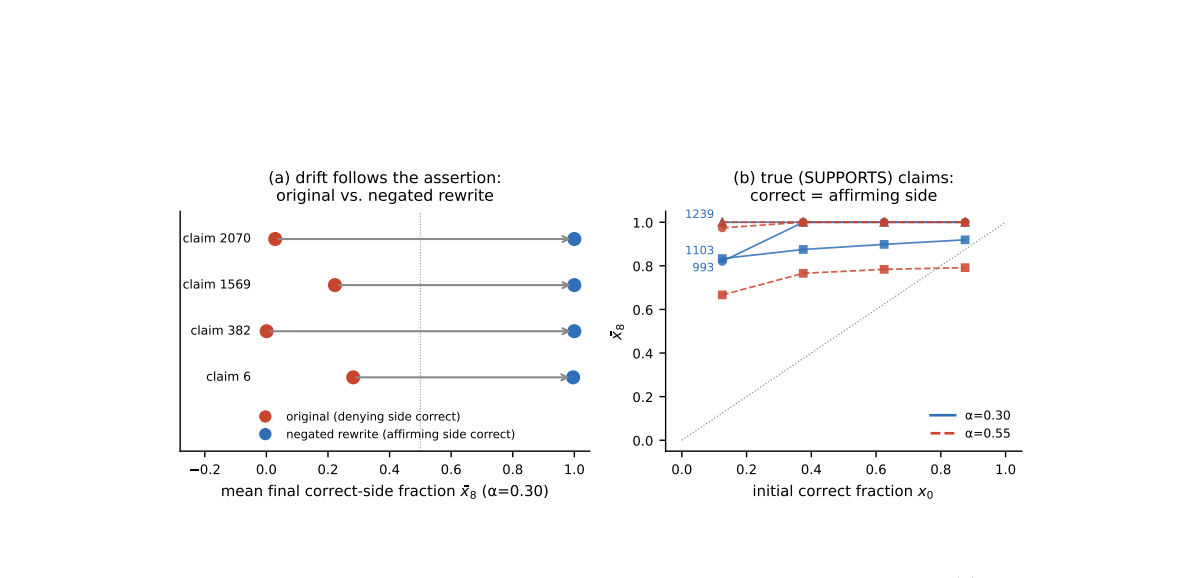
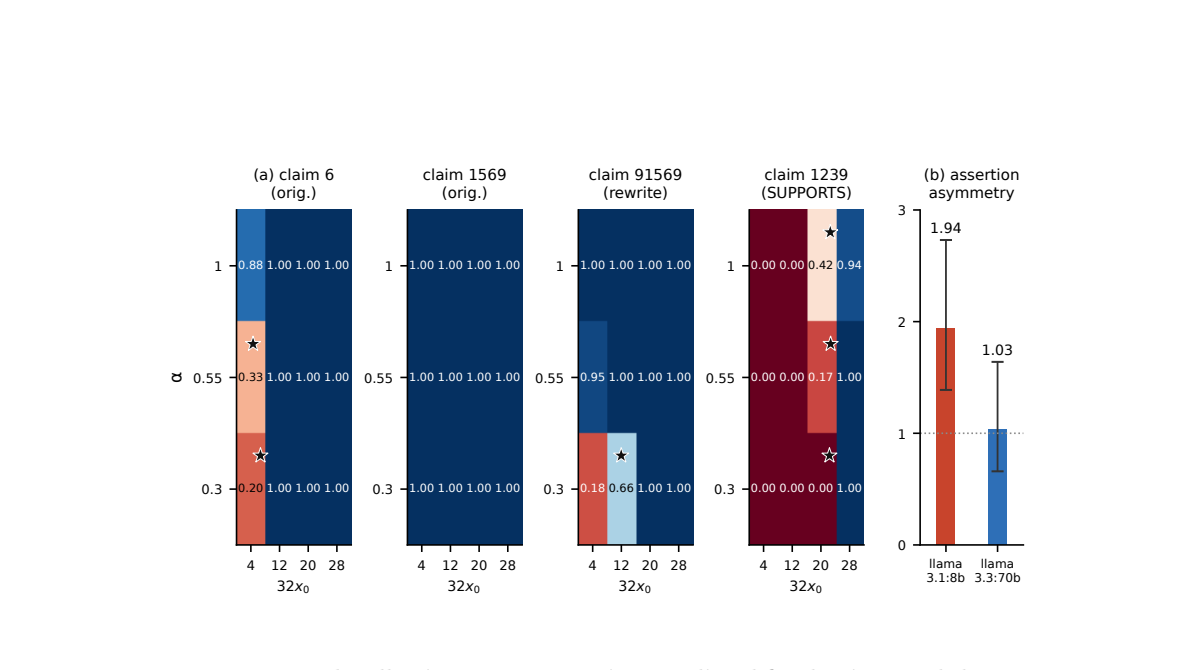
LLM collectives can settle on a wrong consensus even when a majority starts out correct; we ask how far that reading bound alone decides the outcome. We model the bound with one number, the message capacity, which sets how many of the others' messages an agent reads, and generate the communication network from it. Over 31,824 randomized queries, we found that an 8-billion-parameter model's judgment of a claim effectively reduces to a logistic function of a weighted sum of its inbox, the update rule of a stochastic binary neuron with divisively normalized weights. From these weights and the network's degree statistics alone, the wrong consensus should become unreachable from any start once agents read, on average, fewer than 6.4 of their 31 sources. In 1,414 episodes with assigned starts the prediction failed: the correct side won in fewer than 50% of episodes from every start, and in only 28-45% when 75% of agents started correct. The failure traces to the field, the threshold that a claim's wording sets for the agent's answer before any message is read: the experimental claims' fields lay below the calibration mean, and with each claim's own field the same weights reproduce the outcomes. Reversing the wording showed that the threshold follows what a claim asserts, not whether it is true. On a second 8B model the pipeline predicts claim-dependent bistability; transition points appeared where computed, and an eight-claim calibration matched in 15 of 16 conditions. At 70B the assertion bias is not detected. Thus a collective's fate is largely set by two single-agent measurements: the threshold a claim's wording sets, and the message capacity that sets the transition point.
from the abstract
Pith says
Machine review · deepseek-v4-flash · 18 Sep 2026 · what was read was not recorded · not checked by a person
It can be wrong. Challenge this review or reply to it.
Holds up, with conditions. A careful, honest paper that builds a plausible pipeline from single-agent measurements to collective transition points, but the main pre-registered prediction fails and the load-bearing approximation lacks a general error bound. This line is wrong
3 major objections · 6 minor
How often objections from reviews like this one are right: not yet measured
Not checked: figures, code, what the 18 references say.
The paper says, at Section 4.2; Eq. (2) and surrounding text
The review did not quote this passage.
Pith says: Objection 1 of 3 · major
The heterogeneous mean-field independence assumption (Eq. (2) treats each of an agent's k inputs as correct independently with probability x. The paper quantifies the approximation cost as an RMS difference of 0.04 in the eight-round final fraction (Section 4.2). However, this does not bound the error in the location of the transition point near the fold, where a small perturbation in the map F can shift the unstable fixed point by epsilon/(F'(x*)-1, which diverges at the fold.
more of objection 1
The qwen3:8b validation is reassuring, but the paper draws a general conclusion about capacity setting transition points without a bound on how this error scales with N, α, or network topology. Please provide an analysis of how the independence approximation error propagates to the predicted α* or to the transition point (unstable fixed point) as a function of system size and degree heterogeneity.
The paper says, at Section 4.4 and Section 3.2 (discrimination arm)
The review did not quote this passage.
Pith says: Objection 2 of 3 · major
The discrimination arm (variant B) was designed to separate the constant coupling rule from the divisive normalization rule. Section 4.4 states that the data favor the normalized rule but do not reject the constant one. Nevertheless, the paper uses divisive normalization (with γ=0.9) for all subsequent predictions (qwen, polarity experiment, etc.).
more of objection 2
This choice is critical because the predicted α* differs substantially between the two rules (e.g., variant B: α*=0.47 constant vs. 1.28 divisive). Please justify why divisive normalization is used throughout despite the inconclusive discrimination and show that the main qwen3:8b results are robust to using constant weights.
The paper says, at Section 4.2 (horizon effect) and the pre-registered criterion
The review did not quote this passage.
Pith says: Objection 3 of 3 · major
The paper acknowledges that the fold of the mean-field map is an infinite-time statement, and that near the fold the eight-round surrogate displaces the threshold by about 0.2 in α (Section 4.2). This horizon effect contributed to the failure of the pre-registered prediction.
more of objection 3
However, the pre-registered criterion (20% wrong-consensus rate from low x0) was set without accounting for this displacement. Please discuss how future predictions can incorporate finite-horizon surrogates into the criterion, and re-analyze the llama3.1:8b failure to separate the contributions of field transport and horizon effect more quantitatively.
6 minor objections
The paper says, at Abstract and Section 1
Pith says: minor objection 1 of 6
The abstract states 'the wrong consensus should become unreachable . . . once agents read fewer than 6.4 of their31 sources' as a prediction that failed. This is confusing because it is the pre-registered prediction; consider rephrasing to clarify that the blind prediction failed and why.
The paper says, at Section 2.2, Eq. (2)
Pith says: minor objection 2 of 6
It would be helpful to explicitly state the heterogeneous mean-field assumption in the main text, not just in the Methods, because it is load-bearing for the derivation.
show 4 more
The paper says, at Figure 3 caption
Pith says: minor objection 3 of 6
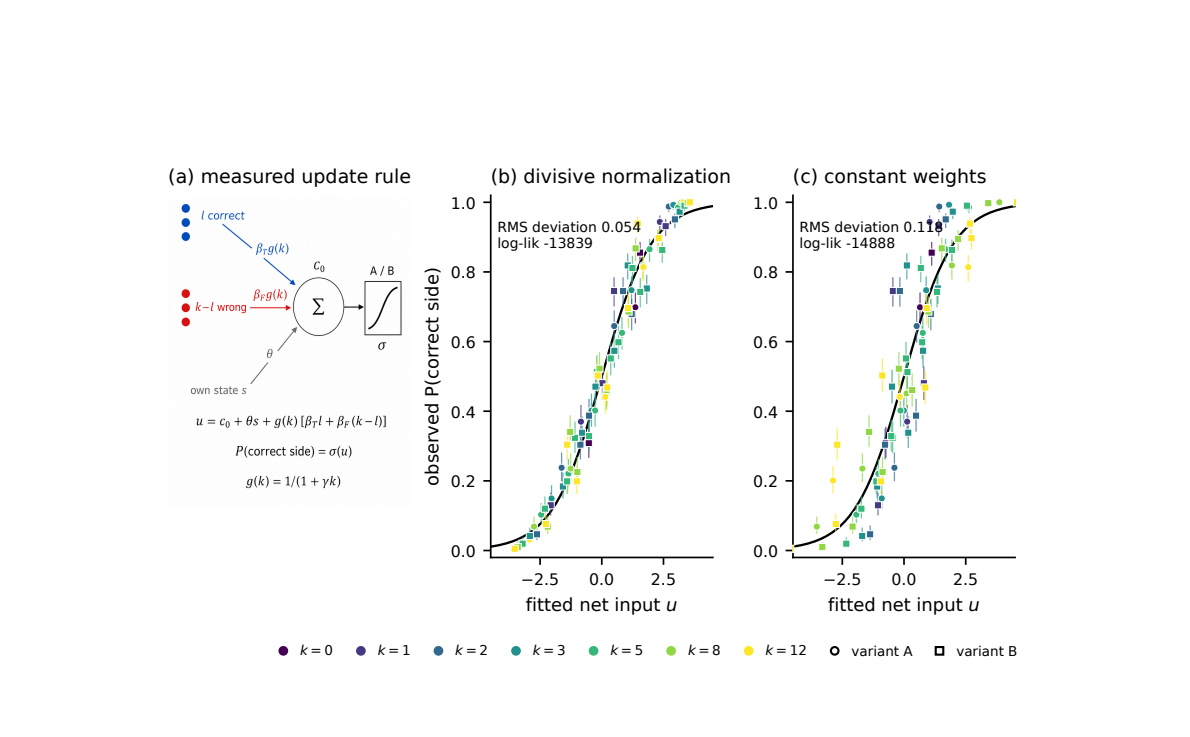
The caption describes 'divisive normalization (b)' and 'constant weights (c)' but does not state the γ value used (γ=0.9). Please include that information.
The paper says, at Section 4.5
Pith says: minor objection 4 of 6
The polarity experiment is compelling, but the claim that 'the assertion-referenced outcome is thus the same' could be misinterpreted. Clarify that the correct-side refernce changes between original and rewrite, so the assertion bias flips the consensus.
The paper says, at References
Pith says: minor objection 5 of 6
Several references are to arXiv preprints without permanent identifiers beyond the arXiv number; consider updating to published versions where available.
The paper says, at Pre-registration timeline (Methods, last paragraph)
Pith says: minor objection 6 of 6
The use of local timestamps rather than a third-party registry is acknowledged. Given the importance of separating prediction from outcome, please discuss the risk of selective reporting and why local registration is sufficient here (e.g., all data retained).
What would settle it
Use the logged qwen3:8b per-claim response functions, graph ensemble, seeds, and message banks. For every (claim, alpha) cell, compute (i) the Eq. (2) mean-field unstable fixed point; (ii) a long-horizon (e.g., 100-round) surrogate rollout on the realized fixed networks, giving finite-N basin boundaries; (iii) the eight-round surrogate crossing; and (iv) control rollouts in which each receiver's in-edges are redrawn every round, or independently resampled from P_alpha,N(k), destroying sender correlations. If the difference between (ii) and (i) exceeds the 0.04 RMS reported for final fractions, or if (iv) shifts the crossing by more than the observed 0.04 mean absolute transition-point error, then the independence assumption is load-bearing and the general claim must be restricted to the tested topology.
from the skeptic's reading
How the review went
4 readings by deepseek-v4-flash · 18 Sep 2026
- Reader holds up, with conditions
- Skeptic agrees
- Editor wrote the verdict above
- Referee major revision: 3 major objections, 6 minor
Not run on this paper: the simulated authors' defence.
Pith did not check this review's objections against the paper.
The review in full
The review in brief, machine-written
This paper does something genuinely new: it builds a closed-form theory of collective truth-finding in LLM networks from two single-agent measurements — the threshold a claim's wording sets and the message capacity — and tests it with pre-registered predictions. The machinery is clean: a crowding-generated network, a measured logistic response with divisive normalization, and a mean-field map whose fold gives the critical capacity. The paper is also refreshingly honest about failure. The main prediction for llama3.1:8b was wrong, and the authors trace it cleanly to field transport (the claim-specific threshold didn't transfer from calibration to experimental claims). The subsequent validation on qwen3:8b, with transition points matching in 15 of 16 cells, gives real weight to the pipeline.
The soft spots are real but bounded. The mean-field independence assumption (each input treated as independent) is load-bearing, and its error is measured only as a 0.04 RMS in final fraction, not directly in the transition point. Near the fold, small perturbations can amplify arbitrarily. The stress test flags this, and it's a legitimate concern, though the qwen validation suggests it's benign at N=32 on this graph ensemble. The finite-horizon issue (eight rounds versus infinite time) also complicates the comparison. And the scope is narrow: two 8B models, one network topology, a specific claim set. The paper's central claim — that capacity sets where the transition point sits and wording sets the phase — is supported but comes with caveats that limit its universality.
Who should read this: anyone working on LLM multi-agent systems, opinion dynamics, or collective intelligence. It's a serious empirical and theoretical contribution that advances beyond curve-fitting. The authors deserve credit for testing their own predictions transparently.
Recommendation: This paper deserves peer review. It should be refereed with attention to the mean-field approximation's domain of validity and the generalizability of the polarity effect. Accepting it would be a signal that the community values honest, self-critical empirical work.
The strongest objection
Section 2.2, Eq. (2), assumes each of an agent's k inputs is correct independently with probability x. The actual protocol violates this: the network is fixed within an episode, a receiver reads the same senders every round, and sender stances are correlated through the shared graph (Methods). The paper acknowledges the approximation and estimates its cost in Section 4.2 as an RMS difference of 0.04 in the eight-round final fraction when the mean-field map is replaced by surrogate rollouts on realized graphs. That number does not bound the error in the quantity the headline claims to predict. Transition points are unstable fixed points x* of Eq. (2); a perturbation epsilon in the map shifts x* by roughly epsilon/(F'(x*)-1), which diverges at the fold defining alpha*. So a small final-fraction error can become a large transition-point error in exactly the regime where the wrong-consensus basin disappears. The qwen3:8b validation is genuinely supportive, and the 0.04 RMS suggests the approximation is benign in the tested 32-agent regime. But the paper draws a general conclusion about capacity setting transition points from a single graph ensemble at one system size, and it offers no bound on how the independence error scales with N, alpha, or neighborhood structure. The llama3.1:8b failure additionally shows that finite-horizon effects can displace the fold by about 0.2 in alpha, so the successful qwen comparisons of infinite-time fixed points to eight-round 50% crossings mix two uncontrolled approximations. This is the load-bearing soft spot: the central quantitative predictions inherit an assumption whose error is measured only indirectly, in a different observable, on a single topology.
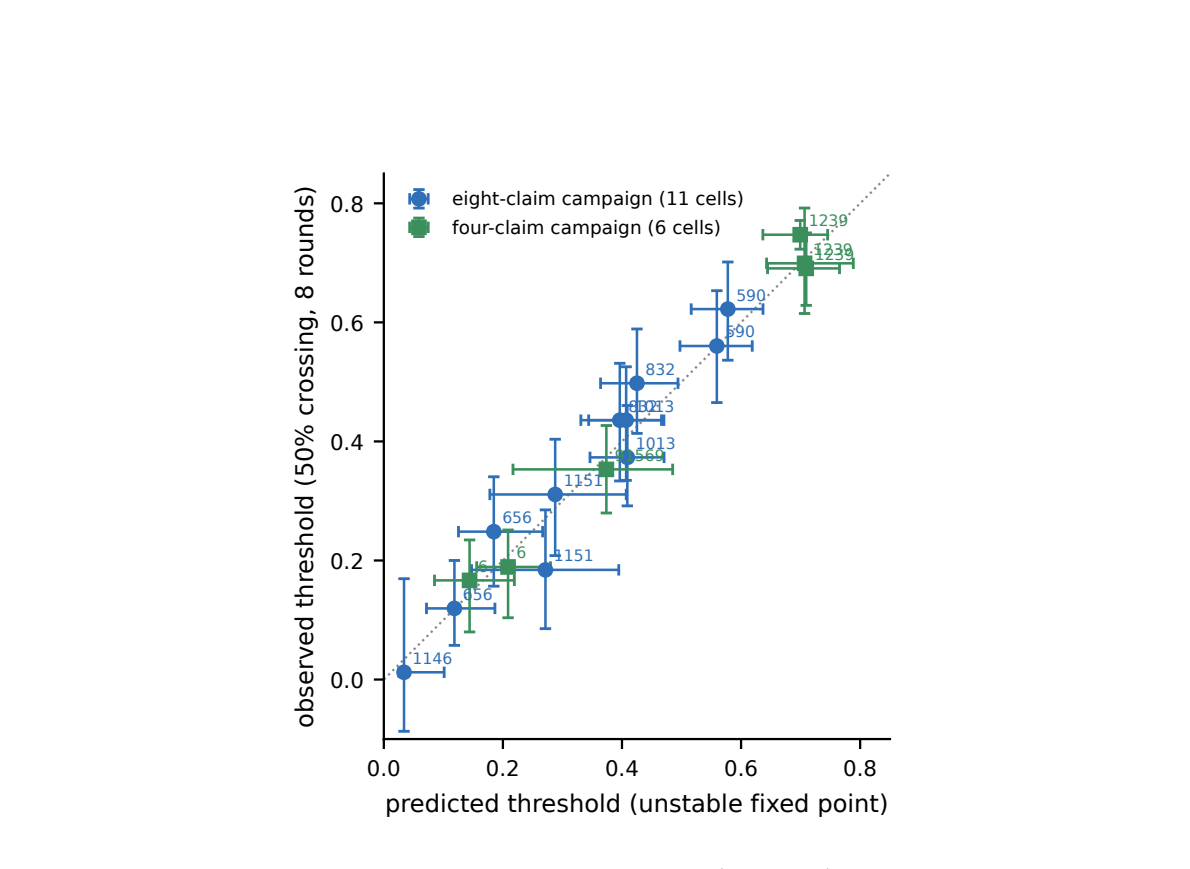
The reader's weakest assumption is also the most load-bearing one for the paper's central claim that two single-agent measurements set collective transition points. I agree with the reader's identification of Section 2.2, Eq. (2), and with the observation that the reported 0.04 RMS error is not a general bound. My stress-test pass sharpens the concern: the 0.04 figure is measured on eight-round final fractions, while the predicted quantities are unstable fixed points and a fold in alpha. Because the root-finding condition is G(x)-x=0, an error in G is divided by G'(x)-1, which diverges at the fold; hence the measured approximation error in one observable does not transfer to the predicted observable without additional argument. The qwen3:8b campaign deserves credit as real evidence: single-agent data preceded collectives, predicted thresholds fell inside bootstrap intervals in eleven bistable cells, and the claim-permutation rank correlation r_s=0.96 is an appropriate exchangeable-unit test. That agreement makes the independence error empirically small in the tested regime, but it does not bound it elsewhere. The llama3.1:8b horizon analysis strengthens the need for a separate check: near the fold, finite-horizon effects alone displaced the inferred capacity by roughly 0.2 in alpha, so the qwen comparisons of infinite-time mean-field fixed points to eight-round crossings cannot be taken as a clean measurement of the independence error. The proposed concrete test separates the two by comparing mean-field fixed points with long and short surrogates and with correlation-destroying rewiring controls on the same graphs. If the differences stay below the observed 0.04 threshold accuracy, the concern is retired; if not, the title's general claim needs qualification. This is a correctable weakness, not a fatal one, so the reader's CONDITIONAL verdict stands unchanged.
The referee's report
If the central claim holds, it provides a tool to assess LLM collectives before they run, using only single-agent measurements. The qwen3:8b validation—15/16 cell matches and a rank correlation of 0.96 between predicted and observed transition points—is strong out-of-sample evidence. The honest failure analysis on llama3.1:8b and the clean separation of the polarity channel are also valuable. The paper connects statistical mechanics, network science, and LLM behavior in a novel way. The main limitations are the reliance on the heterogeneous mean-field independence assumption (whose error near the fold is not bounded) and the inconclusive discrimination arm for the attenuation form. Overall, this is a significant contribution with potential impact on the design and evaluation of multi-agent LLM systems.
Pith's reading of the paper (a machine's summary, not the authors')
The paper asks how much of a language-model group's final answer is fixed before anyone speaks, by two quantities that can be measured on a single agent in isolation. The first is a reading budget: each agent is shown only some of the others' messages, and the paper turns that bound into one number, the message capacity $\alpha$, which also generates the communication network. The second is the field $h$, the log-odds that the agent answers on the correct side when it has read nothing at all — a threshold set by how a claim is worded, not by whether it is true. Feeding a measured single-agent response rule into the network's degree statistics yields a one-dimensional map whose fold gives the capacity at which a wrong consensus becomes unreachable. If that holds, a group's vulnerability to a wrong consensus can be assessed, and its reading budget chosen, before any debate is run.
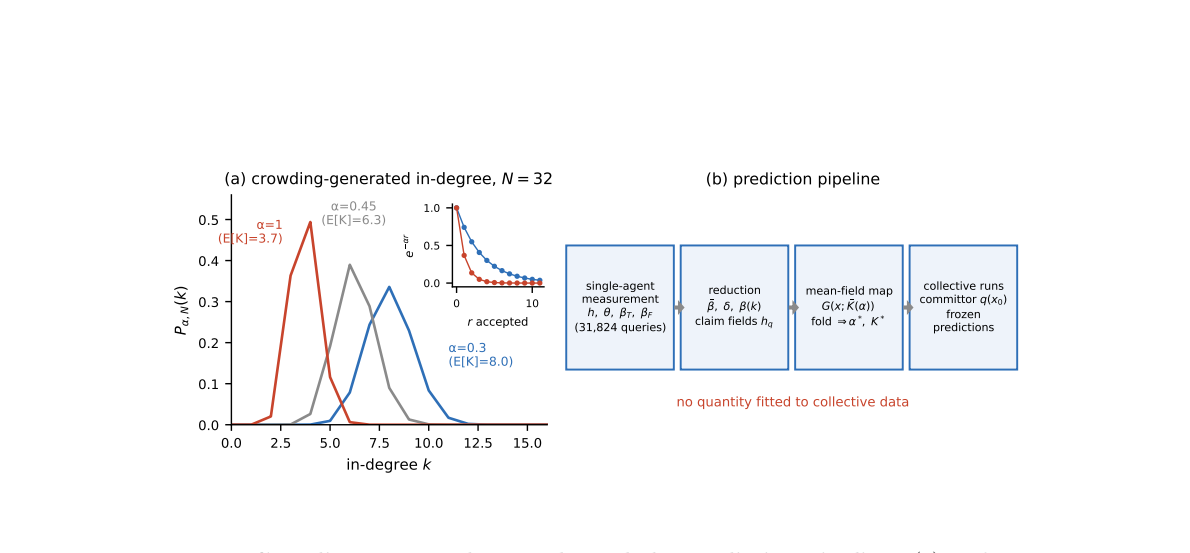
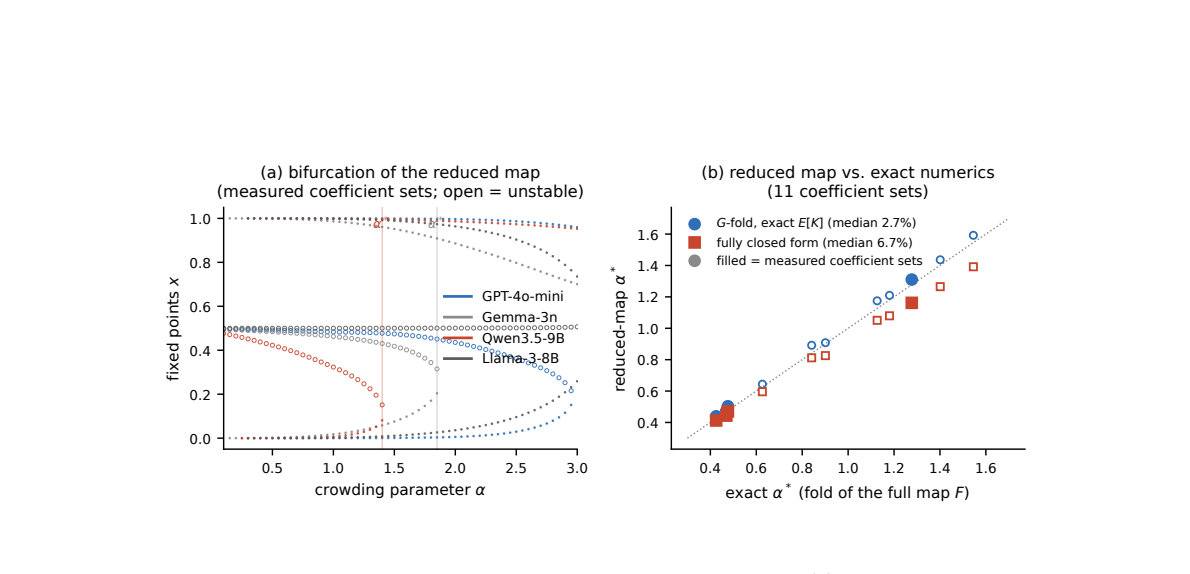
What carries the argument. The load-bearing objects are the message capacity $\alpha$ and the field $h$. $\alpha$ is the crowding parameter of a network-generation process: an agent that has already accepted $r$ sources accepts the next with probability $e^{-\alpha r}$, giving a mean in-degree $\bar{K}(\alpha) = \ln(1+\alpha(N-1))/\alpha$ with a closed-form degree distribution — larger $\alpha$ means fewer messages read. The field $h = c_0 + \theta/2$ is the unit's threshold with its sign reversed: the log-odds of the correct side with an empty inbox, which shifts the logistic response left or right while the message weights set its steepness. The pair enters a mean-field map $F(x)$ that carries the correct-side fraction of one round to the expected fraction of the next; its stable fixed points are the consensus states a collective can settle into, and the unstable point between them is the transition point separating the two basins. The critical capacity $\alpha^*$ is the value at which the unstable point merges with the wrong-consensus point and vanishes, a fold (saddle-node bifurcation) of the map. A reduced closed form $G(x;K)$ reproduces that fold to a median error of 2.7% against exact numerics, so the critical capacity can be read off a single equation.
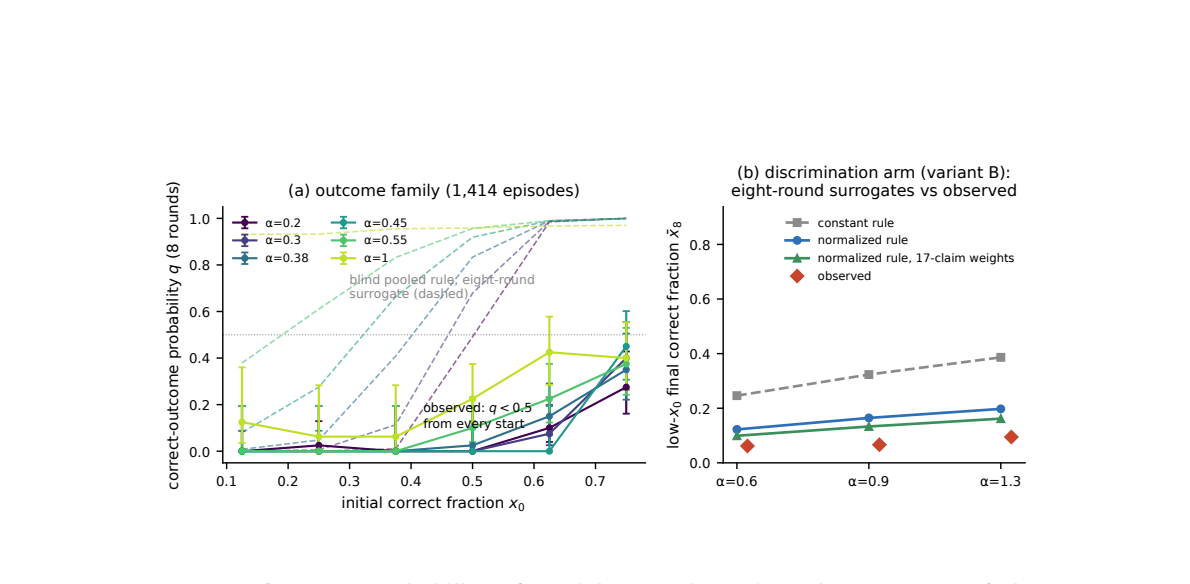
Core claim. Across 31,824 single-shot queries, an 8-billion-parameter model's judgment of a climate claim is well described as a stochastic binary neuron: the probability of siding with the correct answer is a logistic function of a weighted sum of its inbox, one weight for correct-side messages and one for wrong-side messages, both shrinking with inbox size as $\beta/(1+\gamma k)$. Pushed through a mean-field map whose fixed points are the possible consensus states, those measured coefficients predicted — before any collective ran — that the wrong-consensus basin disappears once agents read fewer than about 6.4 of their 31 sources ($\alpha^* = 0.435$). The prediction failed over 1,414 collective episodes: the correct side won from every starting fraction in fewer than half of them. The failure traced to the field, not the weights: the fields measured on the calibration claims did not carry over to the experimental claims, and with each claim's own field the unchanged weights reproduced the outcomes. Reversing a claim's wording reversed which side the collectives converged on, showing the threshold follows what a claim asserts rather than whether it is true. On a second 8B model the pipeline predicted claim-dependent bistability, and the predicted transition points matched observed ones in 15 of 16 conditions, rank-correlated at $r_s = 0.96$.
The premise it rests on. The mean-field step assumes each of an agent's $k$ inputs is on the correct side independently with probability $x$, even though in the experiment every receiver reads the same senders every round and those senders' states are correlated through the shared graph; the paper measures the cost of this approximation at a 0.04 root-mean-square difference in the final fraction on the tested networks but does not bound it in general.
If the paper is right (Pith's inferences, not the authors')
Capacity matters only up to the fold: above the computed $\alpha^*$ a small correct minority propagates, while below it a wrong consensus can trap even a large correct majority, as happened when 24 of 32 agents started correct and the correct side still won in only 28–45% of episodes.
A claim's field must be measured on the claims that will actually be debated; the message weights transfer between claim sets and the field does not, which is the specific failure that overturned the pre-registered prediction.
An eight-round experiment must be compared against an eight-round surrogate rather than the infinite-time fold, because near the fold the map relaxes slowly — a horizon effect that displaces the tested capacity by about 0.2 in $\alpha$.
Prompt scaffold is a design variable: adding one line stating the agent's own current answer raises the persistence term from absent to about 1.9 and moves the predicted fold from roughly 0.47 to 1.28 depending on the coupling rule, which makes the two variants experimentally distinguishable.
Verified versus predicted: the transition point in the initial fraction appeared at computed positions (15 of 16 cells on the second model, 10 of 10 polarity cells on the first), but the disappearance of the wrong basin as capacity rises — the fold in $\alpha$ itself — was never observed and remains a prediction.
If the field is a stable per-claim property of a reader rather than of a debate, then a question bank can be graded cheaply: which claims a given model will argue to the wrong side is readable from single-shot queries before any joint task is set.
The polarity channel looks like a claim-level relative of sycophancy — agreement with an assertion rather than with a stated user opinion — and the abliteration probe plus the absent channel at 70B suggest it is tied to instruction tuning and scale, testable in the base model by the log-probability readout the paper says it needs.
The theory's inputs are behavioural rather than machine-specific (threshold, per-message weights, load attenuation, intake bound), so the same measurement program could in principle place a human committee on the computed curve, though the paper is explicit that none of those human quantities is measured.
The mean-field independence step is the approximation most likely to move the predicted fold in real deployments with clustered, assortative, or recency-ordered routing, where sender correlations are stronger than in the uniformly random graphs tested here.
Check this review
Pith stored no record of this review's passes and took no fingerprint of it. Reviews made by code from 13 Nov 2026 on carry both.
How often reviews like this one are right
Reviews like this one: written by deepseek-v4-flash, where what was read was not recorded.
How often objections from reviews like this one are right: not yet measured
Reviews by people
This review was written by a machine. No person has reviewed this paper on Pith yet. A scientist listed on Pith can review it for a fee, and their review is published here whatever it concludes.
The paper
Abstract
Whether human or large language model (LLM), an agent in a discussion reads only a few of the others' contributions, bounded by cognition, context, or cost. LLM collectives can settle on a wrong consensus even when a majority starts out correct; we ask how far that reading bound alone decides the outcome. We model the bound with one number, the message capacity, which sets how many of the others' messages an agent reads, and generate the communication network from it. Over 31,824 randomized queries, we found that an 8-billion-parameter model's judgment of a claim effectively reduces to a logistic function of a weighted sum of its inbox, the update rule of a stochastic binary neuron with divisively normalized weights. From these weights and the network's degree statistics alone, the wrong consensus should become unreachable from any start once agents read, on average, fewer than 6.4 of their 31 sources. In 1,414 episodes with assigned starts the prediction failed: the correct side won in fewer than 50% of episodes from every start, and in only 28-45% when 75% of agents started correct. The failure traces to the field, the threshold that a claim's wording sets for the agent's answer before any message is read: the experimental claims' fields lay below the calibration mean, and with each claim's own field the same weights reproduce the outcomes. Reversing the wording showed that the threshold follows what a claim asserts, not whether it is true. On a second 8B model the pipeline predicts claim-dependent bistability; transition points appeared where computed, and an eight-claim calibration matched in 15 of 16 conditions. At 70B the assertion bias is not detected. Thus a collective's fate is largely set by two single-agent measurements: the threshold a claim's wording sets, and the message capacity that sets the transition point.
The paper's own sentences, arranged, kept beside the review and separate from it. Each label is drawn from a closed vocabulary; the number beside it is the probability the classifier gave that label. No sentence in this record was written by a model.
abstract compiled · 2026-09-23
The authors' main claim, as the classifier picked it out 1.00
“Thus a collective's fate is largely set by two single-agent measurements: the threshold a claim's wording sets, and the message capacity that sets the transition point.”
How the main claim is stated: asserted 0.91
What the abstract itself states, as probabilities: claims first 0.04 · states limitation 0.85 · human participants 0.04 · controlled comparison 0.28 · randomized assignment 0.42 · states quantitative result 0.98 · compares with prior results 0.21 · mentions code or data availability 0.03
The abstract, sentence by sentence
This table labels the abstract only (arXiv listing abstract v1). The number is the probability the classifier gave the label.
| Sentence | Role | The authors' own work | States the main conclusion | Strength |
|---|---|---|---|---|
| Whether human or large language model (LLM), an agent in a discussion reads only a few of the others' contributions, bounded by cognition, context, or cost. | background 1.00 | 0.06 | 0.02 | asserted 0.99 |
| LLM collectives can settle on a wrong consensus even when a majority starts out correct; we ask how far that reading bound alone decides the outcome. | gap 0.67 | 0.22 | 0.05 | asserted 0.88 |
| We model the bound with one number, the message capacity, which sets how many of the others' messages an agent reads, and generate the communication network from it. | method 0.99 | 0.93 | 0.04 | asserted 0.99 |
| Over 31,824 randomized queries, we found that an 8-billion-parameter model's judgment of a claim effectively reduces to a logistic function of a weighted sum of its inbox, the update rule of a stochastic binary neuron with divisively normalized weights. | result 0.98 | 0.96 | 0.05 | asserted 1.00 |
| From these weights and the network's degree statistics alone, the wrong consensus should become unreachable from any start once agents read, on average, fewer than 6.4 of their 31 sources. | result 0.79 | 0.85 | 0.10 | asserted 0.52 |
| In 1,414 episodes with assigned starts the prediction failed: the correct side won in fewer than 50% of episodes from every start, and in only 28-45% when 75% of agents started correct. | result 0.99 | 0.95 | 0.05 | asserted 1.00 |
| The failure traces to the field, the threshold that a claim's wording sets for the agent's answer before any message is read: the experimental claims' fields lay below the calibration mean, and with each claim's own field the same weights reproduce the outcomes. | interpretation 0.63 | 0.93 | 0.15 | asserted 1.00 |
| Reversing the wording showed that the threshold follows what a claim asserts, not whether it is true. | result 0.81 | 0.93 | 0.06 | asserted 1.00 |
| On a second 8B model the pipeline predicts claim-dependent bistability; transition points appeared where computed, and an eight-claim calibration matched in 15 of 16 conditions. | result 1.00 | 0.94 | 0.09 | asserted 0.96 |
| At 70B the assertion bias is not detected. | result 0.95 | 0.86 | 0.03 | asserted 1.00 |
| Thus a collective's fate is largely set by two single-agent measurements: the threshold a claim's wording sets, and the message capacity that sets the transition point. | interpretation 0.94 | 0.88 | 0.93 | asserted 0.91 |
What kind of paper the classifier reports this is: simulation study 0.71 · evidence from simulation or computation 0.71
What was examined, and what was not
Sources read
- arXiv listing abstract v1
Not examined
- full text
- figures and tables
- references and citing sentences
- relations to other papers
Levels run
- P abstract
Not run
- S sections
- T body sentences
- C citations
- R cross-paper relations
How the labels were made
Compiled by classifier-1.13.0 via TypeSafe API, question bank abstract-p1-20260923, 2026-09-23: 1 request, 8,456 input tokens.
Every quoted sentence on this record is the authors'. Every label is from Pith's closed vocabulary, with the probability shown beside it. This record as JSON
Figures (7)
Figures are the authors', reproduced from the paper.
References (18)
- [1] Andy Arditi, Oscar Obeso, Aaquib Syed, Daniel Paleka, Nina Panickssery, Wes Gurnee, and Neel Nanda. Refusal in language models is mediated by a single direction. InAdvances in Neural Information Processing Systems 37 (NeurIPS 2024), on Pith
- [8] doi: 10.1073/pnas.2531697123. Ariel Flint Ashery, Luca Maria Aiello, and Andrea Baronchelli. Emergent social conventions and collective bias in LLM populations.Science Advances, 11(20):eadu9368, on Pithdoi:10.1073/pnas.2531697123
- [10] 1126/sciadv.aea6091. arXiv:2409.02822. Cristiano De Nobili, Vijayasri Iyer, Alessandro Codello, and Raffaella Burioni. Microscopic dynamics of consensus formation in multi-agent LLM naming games. arXiv:2608.02178, on PithPith's reviewarXiv
- [11] 1038/s41598-026-47213-2. Nathan O. Hodas and Kristina Lerman. How visibility and divided attention constrain so- cial contagion. InProc. 2012 ASE/IEEE International Conference on Social Computing (SocialCom), on Pith
- [12] Yibo Hu and Jiaming Qu. Social pressure breaks majority voting in LLM safety panels. arXiv:2608.04415, on PithPith's reviewarXiv
- [13] arXiv:2310.13548. Tadahiro Taniguchi, Shiro Takagi, Jun Otsuka, Yusuke Hayashi, and Hiro Taiyo Hamada. Collective predictive coding as model of science: Formalizing scientific activities towards generative science.Royal Society Open Science, 12:241678, on PithPith's reviewarXiv
- [14] arXiv:2409.00102. Anne M. Treisman. Selective attention in man.British Medical Bulletin, 20(1):12–16, on PithPith's reviewarXiv
- [16] 96 0.969 0.667 1.000 0.031 discrimination arm B 300 0.917 0.633 0.875 0.062 true claims (A-1) 288 0.976 0.758 1.000 — negated rewrites (A-2) 192 1.000 0.995 1.000 — qwen3:8b, eight claims 256 0.996 0.992 1.000 0.000 qwen3:8b, four claims 480 0.996 0.967 1.000 0.000 28 S5.2 Out... on Pith
- [17] 5,984/5,984 1.243 [1.051, 1.471] base llama3.1:8b-text-q4 K M (6f98b5a6e4b7) 294/5,984 (2.10) not evaluable Table S3: Per-message assertion asymmetry (claim-fixed-effect logistic regression; claim- clustered bootstrap intervals). The instruct control reproduces the Stage-1 val... on Pith
- [18] is the fraction of episodes withx 8≥0.6, a finite-horizon quantity that we compare with the infinite-time fixed points only through surrogate rollouts. Observed thresholds are the 50% crossings of a logistic fit of the correct outcome onx 0 with a weak ridge penalty (0.002) so... on Pith
- [1953] doi: 10.1121/1.1907229. Yun-Shiuan Chuang, Agam Goyal, Nikunj Harlalka, Siddharth Suresh, Robert Hawkins, Sijia Yang, Dhavan Shah, Junjie Hu, and Timothy T. Rogers. Simulating opinion dynamics with networks of LLM-based agents. InFindings of NAACL 2024, on Pithdoi:10.1121/1.1907229
- [1964] doi: 10.1093/oxfordjournals.bmb.a070274. 22 Supplementary Information Supplementary Information for “Message capacity and claim wording set the transition points of collective truth-finding in language-model networks”. Section numbers, figures, and tables are prefixed with S; ... on Pithdoi:10.1093/oxfordjournals.bmb.a070274
- [1997] doi: 10.1038/36846. Mrinank Sharma, Meg Tong, Tomasz Korbak, David Duvenaud, Amanda Askell, Samuel R. Bowman, et al. Towards understanding sycophancy in language models. InInternational Conference on Learning Representations (ICLR 2024), on Pithdoi:10.1038/36846
- [2012] doi: 10.1038/nrn3136. E. Colin Cherry. Some experiments on the recognition of speech, with one and with two ears. Journal of the Acoustical Society of America, 25(5):975–979, on Pithdoi:10.1038/nrn3136
- [2020] Batu El, Jinhee Paeng, Fatih Dinc, Shiye Su, Mete Erdogan, Aneesh Pappu, Haotian Ye, Wanjia Zhao, Surya Ganguli, and James Zou. Physics of Agents: Statistical mechanics predicts collective behavior of AI agents. arXiv:2608.16578, 2026a. Batu El, Jinhee Paeng, Fatih Dinc, Shiye... on PithPith's reviewarXiv
- [2024] arXiv:2406.11717. Matteo Carandini and David J. Heeger. Normalization as a canonical neural computation. Nature Reviews Neuroscience, 13:51–62, on PithPith's reviewarXiv
- [2025] doi: 10.1126/sciadv.adu9368. Makoto Fukushima. Analytically tractable model of synaptic crowding explains emergent small-world structure and network dynamics.Scientific Reports, 16:11748, on Pithdoi:10.1126/sciadv.adu9368
- [2026] Thomas Diggelmann, Jordan Boyd-Graber, Jannis Bulian, Massimiliano Ciaramita, and Markus Leippold. CLIMATE-FEVER: A dataset for verification of real-world climate claims. InTackling Climate Change with Machine Learning workshop at NeurIPS 2020, on Pith
Cited by 1 Pith paper
Reviewed papers on Pith that cite this one. The full citation record
Challenges and discussion
Disagree with the review, or know something it missed? Leave a comment, or challenge this review formally: a challenge becomes a permanent entry in this paper's record, and its decision is published here.
Come back by email
A short list of the week's newly reviewed papers. Nothing is sent until you confirm from your inbox, and every email has a link that stops it. No account.
No comments yet.
Sign in to comment