Data Structures and Algorithms · arXiv:2609.21348 v1 · submitted 18 Sep 2026 · 40 references
The Cube-Root Phenomenon in Online Carpooling
The paper says
“We consider the online carpooling problem, where edges arrive online and must be oriented immediately while keeping the discrepancy between the indegree and outdegree at each vertex small.”
more of the abstract
We prove that the natural Greedy algorithm incurs discrepancy O(min{T1/3,n}) after T arrivals. This resolves a question of Ajtai et al., who showed that any deterministic algorithm must incur Ω(min{T1/3,n}) discrepancy, and gave an algorithm with O(min{T1/2,n}) discrepancy. We also show a similar square-root to cube-root improvement in the stochastic setting, where O(n) edges are sampled independently from an underlying n-vertex graph G. Formally, we show an O((logn)1/3) bound for random arrivals from any Δ-regular graph G. When Δ = Ω((logn)3), we show the more refined bound of O((logn/logΔ)1/3 + loglogn) on the discrepancy. We show that the cube-root term in the previous bound is essential, while the loglogn term is already known to be necessary for random arrivals from complete graphs. The previous upper bounds here were O((logn)1/2), which follow from the breakthrough works on online discrepancy due to Kulkarni, Reis, and Rothvoss, and Aden-Ali. Our techniques for proving such cube-root-type bounds may be of independent interest, as the standard quadratic-potential and subgaussian analyses underlying the previous general bounds appear inherently unable to go below square-root-type guarantees.
from the abstract
Pith says
Machine review · deepseek-v4-flash · 21 Sep 2026 · what was read was not recorded · not checked by a person
It can be wrong. Challenge this review or reply to it.
Holds up. Resolves the cube-root vs. square-root gap in online carpooling with a genuinely new technique; solid, self-contained, and deserving of peer review. This line is wrong
6 minor
How often objections from reviews like this one are right: not yet measured
Not checked: figures, code, what the 40 references say.
6 minor objections
The paper says, at Section 2, Figure 1
Pith says: minor objection 1 of 6
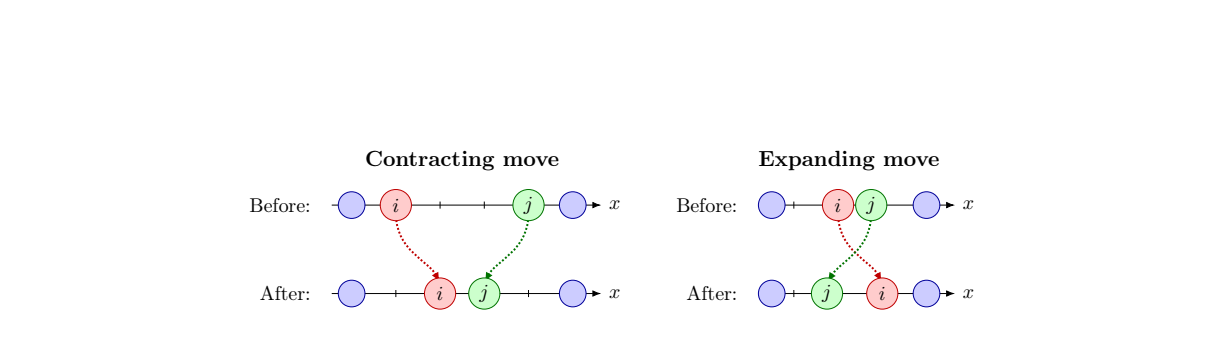
The definition of expanding moves (d_t(i) > d_{t-1}(j)) and contracting moves is clear, but the text would benefit from explicitly noting that an expanding move occurs exactly when a + w > b (in the notation of the proof of Lemma 3.2). This equivalence is used in the proof but not stated in the definition.
The paper says, at Lemma 4.2, proof
Pith says: minor objection 2 of 6
The dummy chip z is placed 'sufficiently far to the left' but no explicit bound is given. While the construction is valid, adding a concrete initial position (e.g., -4p^{1/3} - log m) would make the simulation fully rigorous without ambiguity.
show 4 more
The paper says, at Section 4, paragraph after Theorem 1.2
Pith says: minor objection 3 of 6
The claim that the stochastic bound holds for adversarial weights w_t ∈ [0,1] that depend adaptively on previous edges is justified by conditioning on the edge sequence and applying Lemma 4.2. The paper should state this more explicitly: for every fixed realization of the random edge multigraph (including the order), the subsequent weight sequence is arbitrary but bounded, and Lemma 4.2 applies deterministically to that realization.
The paper says, at Section 4.2
Pith says: minor objection 4 of 6
The lower bound construction uses disjoint cliques of size Δ+1. The condition Δ = Ω(log n) is stated, but the proof also requires that h = ⌊(log n/(8 log Δ))^{1/3}⌋ ≥ 2, which holds for n large enough when Δ = n^{o(1)}. This implicit assumption could be noted.
The paper says, at References
Pith says: minor objection 5 of 6
Reference [AA26] is cited as '2026'; the full citation (venue, pages) is missing. The authors should provide a complete reference if it is available, or note that it is a manuscript.
The paper says, at AI Disclosure
Pith says: minor objection 6 of 6
The disclosure states that ChatGPT 5.5 was used to simplify the proof of Theorem 1.1. The authors take responsibility for the content, which is acceptable. However, the disclosure could be placed in a more conventional location (e.g., at the end of the acknowledgments) rather than after the main text.
What would settle it
Formalize Lemma 3.3 and its use in Lemma 3.1 in a proof assistant, with special attention to the induction step at r=n−1; check that the derived S_n(t_{n−1}−1)≥A_n combined with S_n(t)=S_n(0)≤0 yields the intended contradiction ruling out D≥n, without an unhandled case. If the proof checks, the spreadness argument is fully validated.
from the skeptic's reading
How the review went
4 readings by deepseek-v4-flash · 21 Sep 2026
- Reader holds up
- Skeptic partly agrees
- Editor wrote the verdict above
- Referee minor revision: 6 minor
Not run on this paper: the simulated authors' defence.
Pith did not check this review's objections against the paper.
The review in full
The review in brief, machine-written
This paper closes the long-standing gap between the O(T1/2) upper bound and the Ω(T1/3) lower bound for Greedy in the deterministic online carpooling problem. The spreadness lemma (Lemma 3.3) is the real contribution: it shows that when some coordinate reaches discrepancy D, there must be an earlier time with Ω(D) coordinates each of average absolute discrepancy Ω(D). This turns the quadratic-potential argument into a D3 ≤ O(T) bound, giving D = O(T1/3) as claimed. The proof is tight, self-contained, and the induction on top-r sums is clean. The stress-test I ran confirms no hidden flaw: the backward induction goes through, and the boundary case r=n gives the expected contradiction. The stochastic extension to regular graphs is also nontrivial: combining witness-tree component structure with a refined tree-like request analysis yields the improved (log n / log Δ)1/3 bound. The lower bound construction (disjoint cliques) is standard but correctly executed and gives a matching cube-root term. The paper is well written; the proofs are detailed and the AI disclosure on the deterministic proof does not undermine correctness — the authors take responsibility and the mathematics stand on their own. Soft spots are minor: the weighted variant of Lemma 4.2 and the n-divisibility case in the stochastic lower bound are brushed over but easily patched. The paper is likely to be influential: it resolves a two-decade open problem and the spreadness idea might apply to other online discrepancy settings. I would cite it, and I would bring it to our reading group. I recommend acceptance after minor revision. The paper deserves a serious referee.
The strongest objection
After checking the deterministic core, I found no load-bearing flaw. The reader's focus on Lemma 3.3 is the right one; I traced the backward induction in full. For each r<m, t_r is well-defined because A_r>0 and S_r(0)≤0; minimality gives S_r(t_r−1)<A_r≤S_r(t_r), and Lemma 3.4 gives S_{r+1}(t_r−1)≥2A_r−A_{r−1}−2=A_{r+1}. The boundary r=n is the only delicate case: if D≥n, the same algebra forces S_n(t_{n−1}−1)≥A_n>0, while S_n(t)=S_n(0)≤0 by conservation. This is not a counterexample to the lemma; it is the contradiction that Lemma 3.1 uses to prove D≤n. I also verified Lemma 3.2's convexity calculation, Lemma 3.4's endpoint accounting, and the decomposition of G_samp into small tree-like components in Section 4. The stated O(min{T^{1/3},n}) bound for Greedy is internally consistent. Minor presentation gaps, such as the weighted variant of Lemma 4.2 and the n-divisibility case in Theorem 1.3's disjoint-clique construction, are readily repairable and do not affect Theorem 1.1.
The central claim is Greedy's deterministic O(min{T^{1/3},n}) discrepancy bound, and the spreadness lemma is indeed the place where a proof error would be most damaging. I re-derived the induction and the endpoint accounting in Lemma 3.4; the algebra is consistent, and the r=n boundary is handled by the same conservation invariant that Lemma 3.1 invokes. I found no unsound step in the path from Lemma 3.2 to Lemma 3.1. The stochastic reduction also appears sound: components of the sampled multigraph are small and tree-like with high probability, and Lemma 4.2's auxiliary-chip simulation correctly charges only internal requests with expanding moves. The minor gaps I noted, such as explicitly extending Lemma 4.2 to weights in [0,1] and repairing the disjoint-clique construction when n is not divisible by Δ+1, are localized and do not threaten the main deterministic theorem. Therefore the reader's ACCEPT verdict stands.
The referee's report
This paper resolves a long-standing open question by closing the gap between the known Ω(T^{1/3}) lower bound and O(T^{1/2}) upper bound for deterministic online carpooling, showing that the Greedy algorithm is optimal up to constants. The cube-root improvement in the stochastic setting is also significant, as it improves on the previous O(log^{1/2} n) bounds that followed from general online discrepancy results. The spreadness lemma and the analysis for tree-like request sequences are likely to be of independent interest, as they demonstrate how to go beyond quadratic-potential arguments for problems with 2-sparse signed vectors.
Pith's reading of the paper (a machine's summary, not the authors')
The paper proves that the natural Greedy algorithm for online carpooling guarantees a maximum discrepancy of at most O(min{$T^{{1/3}}$, n}) after T edge arrivals, matching the known lower bound and thus settling a long-standing open question. This improves the previous best upper bound of O(min{$T^{{1/2}}$, n}) by Ajtai et al. In the stochastic setting where edges are sampled independently from a Δ-regular graph, the paper achieves a similar cube-root improvement over previous square-root bounds: O((log n)^{1/3}) in general and O((log n / log Δ)^{1/3} + log log n) when Δ is large. The key innovation is a "spreadness" lemma that forces the ℓ2 potential to be cubic in the maximum discrepancy when the latter is large, enabling the cube-root bound. These results demonstrate that the combinatorial structure of carpooling—edges have equal and opposite unit vectors—allows beating the square-root barrier inherent in general 2-sparse vector discrepancy.
What carries the argument. The proof rests on a 'spreadness lemma' (Lemma 3.3) which states that if the maximal discrepancy at time T is D, then for each integer r ≤ D there exists an earlier time where the sum of the r largest chip positions is at least r(D-r+1). This implies a set of Ω(D) chips each with average absolute discrepancy Ω(D), leading to a cubic ℓ2 potential lower bound of Ω($D^{3}$) and hence D = O($T^{{1/3}}$) because the quadratic potential grows by at most 2 per request. For the stochastic setting, a witness-tree argument bounds component sizes of the sampled multigraph by O(log n), and for large Δ it shows components are near-trees with O(log n / log Δ) surplus edges, allowing a refined analysis via an auxiliary chip game that absorbs merging requests as contracting moves.
Core claim. The core discovery is that for deterministic online carpooling, Greedy attains discrepancy Θ(min{$T^{{1/3}}$, n}), matching the known lower bound and improving the previous O(min{$T^{{1/2}}$, n}) upper bound. For stochastic arrivals from Δ-regular graphs, the discrepancy is O((log n)^{1/3}) in general, and when Δ = Ω($log^{3}$ n) the bound refines to O((log n / log Δ)^{1/3} + log log n). The paper also establishes a matching lower bound for the cube-root term in the stochastic case, showing it is essential.
The premise it rests on. The spreadness lemma (Lemma 3.3) is proved by a backward induction on the top-r sums; if any hidden assumption in this induction were false, the cube-root bound would not follow.
If the paper is right (Pith's inferences, not the authors')
The deterministic online carpooling discrepancy is now exactly characterized: Θ(min{T^{1/3}, n}), resolving a two-decade-old open problem.
For random arrivals from regular graphs, the discrepancy is typically cubic in the logarithm, with a sharp threshold when the degree grows.
The spreadness technique provides a general template for proving cube-root bounds in online discrepancy problems with structured vectors, possibly applicable to other settings.
The stochastic bounds show that the log log n term known from complete graphs is not universal; for sparser regular graphs, a larger cube-root term appears.
The paper's algorithm works even with adaptive adversarial weights, making it robust for practical settings with variable edge weights.
The spreadness lemma could be adapted to online balancing problems with vector incidences that are not fully independent, such as online rounding of fractional solutions.
The witness-tree argument combined with the auxiliary chip game suggests a method for handling graph-structured arrivals in other online allocation problems beyond discrepancy.
It remains open whether non-regular graphs admit similar cube-root bounds; the paper conjectures that O(log^{1/3} T) holds more generally, which would unify the results.
The lower-bound construction for stochastic arrivals uses a disjint union of cliques, indicating that the difficulty stems from dense local substructures even in a regular graph.
Check this review
Pith stored no record of this review's passes and took no fingerprint of it. Reviews made by code from 13 Nov 2026 on carry both.
How often reviews like this one are right
Reviews like this one: written by deepseek-v4-flash, where what was read was not recorded.
How often objections from reviews like this one are right: not yet measured
Reviews by people
This review was written by a machine. No person has reviewed this paper on Pith yet. A scientist listed on Pith can review it for a fee, and their review is published here whatever it concludes.
The paper
Abstract
We consider the online carpooling problem, where edges arrive online and must be oriented immediately while keeping the discrepancy between the indegree and outdegree at each vertex small. We prove that the natural Greedy algorithm incurs discrepancy O(min{T1/3,n}) after T arrivals. This resolves a question of Ajtai et al., who showed that any deterministic algorithm must incur Ω(min{T1/3,n}) discrepancy, and gave an algorithm with O(min{T1/2,n}) discrepancy. We also show a similar square-root to cube-root improvement in the stochastic setting, where O(n) edges are sampled independently from an underlying n-vertex graph G. Formally, we show an O((logn)1/3) bound for random arrivals from any Δ-regular graph G. When Δ = Ω((logn)3), we show the more refined bound of O((logn/logΔ)1/3 + loglogn) on the discrepancy. We show that the cube-root term in the previous bound is essential, while the loglogn term is already known to be necessary for random arrivals from complete graphs. The previous upper bounds here were O((logn)1/2), which follow from the breakthrough works on online discrepancy due to Kulkarni, Reis, and Rothvoss, and Aden-Ali. Our techniques for proving such cube-root-type bounds may be of independent interest, as the standard quadratic-potential and subgaussian analyses underlying the previous general bounds appear inherently unable to go below square-root-type guarantees.
The paper's own sentences, arranged, kept beside the review and separate from it. Each label is drawn from a closed vocabulary; the number beside it is the probability the classifier gave that label. No sentence in this record was written by a model.
abstract compiled · 2026-09-23
The authors' main claim, as the classifier picked it out 0.97
“We prove that the natural Greedy algorithm incurs discrepancy $O(\min\{T^{1/3},n\})$ after $T$ arrivals.”
How the main claim is stated: asserted 1.00
What the abstract itself states, as probabilities: claims first 0.15 · states limitation 0.40 · human participants 0.02 · controlled comparison 0.14 · randomized assignment 0.24 · states quantitative result 0.99 · compares with prior results 0.98 · mentions code or data availability 0.02
The abstract, sentence by sentence
This table labels the abstract only (arXiv listing abstract v1). The number is the probability the classifier gave the label.
| Sentence | Role | The authors' own work | States the main conclusion | Strength |
|---|---|---|---|---|
| We consider the online carpooling problem, where edges arrive online and must be oriented immediately while keeping the discrepancy between the indegree and outdegree at each vertex small. | background 1.00 | 0.20 | 0.03 | asserted 0.64 |
| We prove that the natural Greedy algorithm incurs discrepancy $O(\min\{T^{1/3},n\})$ after $T$ arrivals. | result 0.98 | 0.96 | 0.83 | asserted 1.00 |
| This resolves a question of Ajtai et al., who showed that any deterministic algorithm must incur $\Omega(\min\{T^{1/3},n\})$ discrepancy, and gave an algorithm with $O(\min\{T^{1/2},n\})$ discrepancy. | gap 0.40 | 0.49 | 0.33 | asserted 1.00 |
| We also show a similar square-root to cube-root improvement in the stochastic setting, where $O(n)$ edges are sampled independently from an underlying $n$-vertex graph $G$. | contribution 0.61 | 0.95 | 0.08 | asserted 1.00 |
| Formally, we show an $O((\log n)^{1/3})$ bound for random arrivals from any $\Delta$-regular graph $G$. | result 0.99 | 0.96 | 0.10 | asserted 1.00 |
| When $\Delta = \Omega((\log n)^3)$, we show the more refined bound of $O((\log n/\log \Delta)^{1/3}+\log\log n)$ on the discrepancy. | result 0.99 | 0.96 | 0.07 | asserted 1.00 |
| We show that the cube-root term in the previous bound is essential, while the $\log\log n$ term is already known to be necessary for random arrivals from complete graphs. | result 0.59 | 0.88 | 0.12 | asserted 1.00 |
| The previous upper bounds here were $O((\log n)^{1/2})$, which follow from the breakthrough works on online discrepancy due to Kulkarni, Reis, and Rothvoss, and Aden-Ali. | background 0.93 | 0.04 | 0.04 | asserted 1.00 |
| Our techniques for proving such cube-root-type bounds may be of independent interest, as the standard quadratic-potential and subgaussian analyses underlying the previous general bounds appear inherently unable to go below square-root-type guarantees. | interpretation 0.87 | 0.54 | 0.05 | hedged possibility 0.92 |
What kind of paper the classifier reports this is: theoretical result 1.00 · evidence from proof or derivation 1.00
What was examined, and what was not
Sources read
- arXiv listing abstract v1
Not examined
- full text
- figures and tables
- references and citing sentences
- relations to other papers
Levels run
- P abstract
Not run
- S sections
- T body sentences
- C citations
- R cross-paper relations
How the labels were made
Compiled by classifier-1.13.0 via TypeSafe API, question bank abstract-p1-20260923, 2026-09-23: 1 request, 7,207 input tokens.
Every quoted sentence on this record is the authors'. Every label is from Pith's closed vocabulary, with the probability shown beside it. This record as JSON
Figures (2)
Figures are the authors', reproduced from the paper.
References (40)
- [1] Optimal Online Discrepancy Minimization in Linear Time , author=. 2026 , eprint= on Pith
- [3] Richard Anderson and László Lovász and Peter Shor and Joel Spencer and Éva Tardos and Shmuel Winograd , title =. American Mathematical Monthly , pages= on Pith
- [4] Anders Björner and László Lovász and Peter W. Shor , title =. European Journal of Combinatorics , volume = on Pith
- [5] Liu, Siyue and Reis, Victor , title =. Innovations in Theoretical Computer Science Conference (ITCS) , year = on Pith
- [6] Balanced allocations: The heavily loaded case , author=. Symposium on Theory of Computing, on Pith
- [7] Nikhil Bansal and Lars Rohwedder and Ola Svensson , title =. Symposium on Theory of Computing, on Pith
- [8] Imre B. On a Class of Balancing Games , journal = on Pith
- [9] Balanced allocations , author=. Symposium on Theory of Computing, on Pith
- [10] Krishnaram Kenthapadi and Rina Panigrahy , title =. Symposium on Discrete Algorithms, on Pith
- [11] Fagin, Ronald and Williams, John H. , title =. IBM Journal of Research and Development , volume =. 1983 , doi = on Pith
- [12] Ajtai, Mikl. Fairness in Scheduling , journal =. 1998 , doi = on Pith
- [13] Naor, Moni , title =. Journal of Algorithms , volume =. 2005 , doi = on Pith
- [14] Graphical balanced allocations and the (1+ )-choice process , author=. Random Structures & Algorithms , volume=. 2015 , publisher= on Pith
- [15] Coppersmith, Don and Nowicki, Tomasz and Paleologo, Giuseppe and Tresser, Charles and Wu, Chai Wah , title =. ACM Transactions on Algorithms , volume =. 2011 , doi = on Pith
- [16] Fiat, Amos and Karlin, Anna R. and Koutsoupias, Elias and Mathieu, Claire and Zach, Rotem , title =. International Colloquium on Automata, Languages, and Programming (ICALP) , year = on Pith
- [17] Gupta, Anupam and Krishnaswamy, Ravishankar and Kumar, Amit and Singla, Sahil , title =. Foundations of Software Technology and Theoretical Computer Science (FSTTCS) , year = on Pith
- [18] Kulkarni, Janardhan and Reis, Victor and Rothvoss, Thomas , title =. Symposium on Theory of Computing (STOC) , pages =. 2024 , doi = on Pith
- [19] Bansal, Nikhil and Spencer, Joel H. , title =. Random Structures & Algorithms , volume =. 2020 , doi = on Pith
- [20] Knuth, Donald E. , title =. 1997 , isbn = on Pith
- [21] Mitzenmacher, Michael and Upfal, Eli , title =. 2017 , doi = on Pith
show 20 more
- [22] Bertsekas, Dimitri P. and Tsitsiklis, John N. , title =. 2008 , isbn = on Pith
- [23] Ishaq Aden-Ali. Optimal online discrepancy minimization in linear time, 2026 on Pith
- [24] Mikl \'o s Ajtai, James Aspnes, Moni Naor, Yuval Rabani, Leonard J. Schulman, and Orli Waarts. Fairness in scheduling. Journal of Algorithms , 29(2):306--357, 1998 on Pith
- [25] Yossi Azar, Andrei Broder, Anna Karlin, and Eli Upfal. Balanced allocations. In Symposium on Theory of Computing, STOC , pages 593--602, 1994 on Pith
- [26] Richard Anderson, László Lovász, Peter Shor, Joel Spencer, Éva Tardos, and Shmuel Winograd. Disks, balls, and walls: Analysis of a combinatorial game. American Mathematical Monthly , 96:481--493, 1989 on Pith
- [27] Dylan J Altschuler and Konstantin Tikhomirov. A threshold for online balancing of sparse iid vectors. arXiv preprint arXiv:2509.02432 , 2025 on PitharXiv
- [28] Imre B \'a r \'a ny. On a class of balancing games. Journal of Combinatorial Theory, Series A , 26(2):115--126, 1979 on Pith
- [29] Petra Berenbrink, Artur Czumaj, Angelika Steger, and Berthold V \"o cking. Balanced allocations: The heavily loaded case. In Symposium on Theory of Computing, STOC , pages 745--754, 2000 on Pith
- [30] Anders Björner, László Lovász, and Peter W. Shor. Chip-firing games on graphs. European Journal of Combinatorics , 12(4):283--291, 1991 on Pith
- [31] Nikhil Bansal, Lars Rohwedder, and Ola Svensson. Flow time scheduling and prefix Beck-Fiala . In Symposium on Theory of Computing, STOC , pages 331--342, 2022 on Pith
- [32] Nikhil Bansal and Joel H. Spencer. On-line balancing of random inputs. Random Structures & Algorithms , 57(4):879--891, 2020 on Pith
- [33] Don Coppersmith, Tomasz Nowicki, Giuseppe Paleologo, Charles Tresser, and Chai Wah Wu. The optimality of the online greedy algorithm in carpool and chairman assignment problems. ACM Transactions on Algorithms , 7(3):37:1--37:22, 2011 on Pith
- [34] Amos Fiat, Anna R. Karlin, Elias Koutsoupias, Claire Mathieu, and Rotem Zach. Carpooling in social networks. In International Colloquium on Automata, Languages, and Programming (ICALP) , 2016 on Pith
- [35] Ronald Fagin and John H. Williams. A fair carpool scheduling algorithm. IBM Journal of Research and Development , 27(2):133--139, 1983 on Pith
- [36] Anupam Gupta, Ravishankar Krishnaswamy, Amit Kumar, and Sahil Singla. Online carpooling using expander decompositions. In Foundations of Software Technology and Theoretical Computer Science (FSTTCS) , 2020 on Pith
- [37] Donald E. Knuth. The Art of Computer Programming, Volume 1: Fundamental Algorithms . Addison-Wesley, Reading, Massachusetts, third edition, 1997 on Pith
- [38] Krishnaram Kenthapadi and Rina Panigrahy. Balanced allocation on graphs. In Symposium on Discrete Algorithms, SODA , pages 434--443, 2006 on Pith
- [39] Janardhan Kulkarni, Victor Reis, and Thomas Rothvoss. Optimal online discrepancy minimization. In Symposium on Theory of Computing (STOC) , pages 1832--1840, 2024 on Pith
- [40] Siyue Liu and Victor Reis. Weighted Chairman Assignment and Flow-Time Scheduling . In Innovations in Theoretical Computer Science Conference (ITCS) , 2026 on Pith
- [41] Yuval Peres, Kunal Talwar, and Udi Wieder. Graphical balanced allocations and the (1+ )-choice process. Random Structures & Algorithms , 47(4):760--775, 2015 on Pith
Cited by 1 Pith paper
Reviewed papers on Pith that cite this one. The full citation record
- Online Discrepancy of Sparse Random Vectors over Long Horizons cs.DS · Oct 2026
Challenges and discussion
Disagree with the review, or know something it missed? Leave a comment, or challenge this review formally: a challenge becomes a permanent entry in this paper's record, and its decision is published here.
Come back by email
A short list of the week's newly reviewed papers. Nothing is sent until you confirm from your inbox, and every email has a link that stops it. No account.
No comments yet.
Sign in to comment