Differential Geometry · arXiv:2609.21518 v1 · submitted 18 Sep 2026 · 57 references
The metric extension problem under positive and negative curvature conditions
The paper says
“We first prove that every smooth boundary metric on a compact manifold extends to a metric with any prescribed positive lower bound for Ricci curvature, whereas extensions under stronger positive \(k^{\mathrmth}\)-intermediate Ricci curvature conditions may fail due to local obstructions.”
more of the abstract
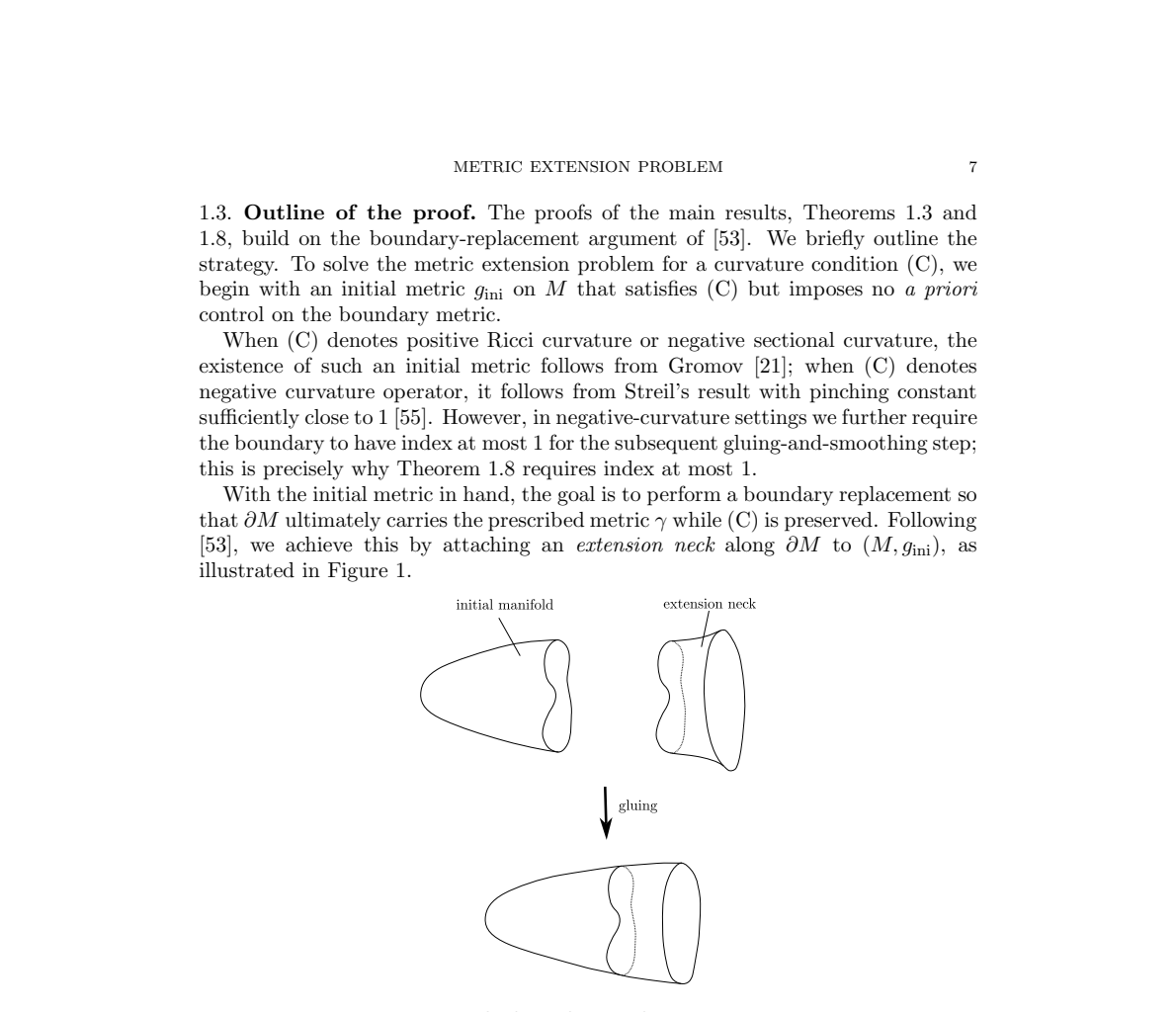
For negative sectional curvature, we identify a global obstruction to extension. We then consider the class of compact manifolds defined by the existence of a metric with negative sectional curvature and boundary index at most one. On every manifold in this class, we prove that any smooth boundary metric extends to a metric with negative sectional curvature and strictly convex umbilical boundary. We further show that every such initial metric admits a complete asymptotically hyperbolic isometric extension with the same curvature condition and any prescribed conformal infinity. This class of manifolds is closed under boundary connected sums. As a geometric application of these extension results, every smooth metric on \(\mathbb S^n\) admits a strictly convex isometric embedding into \(\mathbb R^n+1\) equipped with a complete metric of negative sectional curvature. The proofs combine neck constructions with corner smoothing for upper curvature bounds.
from the abstract
Pith says
Machine review · deepseek-v4-flash · 21 Sep 2026 · what was read was not recorded · not checked by a person
It can be wrong. Challenge this review or reply to it.
The passes disagreed. Reader: holds up. Skeptic: holds up only with conditions. Referee: major revision.
Strong positive Ricci result; negative-curvature corner smoothing has a computation issue that needs attention. This line is wrong
2 major objections · 4 minor
How often objections from reviews like this one are right: not yet measured
Not checked: figures, code, what the 57 references say.
The paper says, at §3.2, Theorem 3.4 (curvature-operator case)
The review did not quote this passage.
Pith says: Objection 1 of 2 · major
The derivation of inequality (3.17) is not fully justified. The expression for F(t) = (A_t ∧ A_t)(ϕ,ϕ) is given as Σ (α_ij)^2 ( (δ+t)/δ + 2λ_i )((δ+t)/δ + 2λ_j ), but the computation of A_t in the chosen diagonalization appears to lead to a different expression.
more of objection 1
Specifically, using I I_-(v_i,v_j) = λ_i δ_ij and -(I I_+ + I I_-)(v_i,v_j) = δ_ij, one obtains I I_+(v_i,v_j) = -(1+λ_i)δ_ij. Then A_t(v_i,v_i) = [(-δ+t)/δ]·(-(1+λ_i)) + [(δ-t)/δ]·λ_i = (δ-t)/δ (1+2λ_i), not (δ+t)/δ + 2λ_i. The claimed formulas for F''(t) and F'(-δ) rely on the given expression; if the expression is incorrect, the subsequent inequality (A_t ∧ A_t)(ϕ,ϕ) ≥ 4(I I_- ∧ I I_-)(ϕ,ϕ) and the overall curvature-operator bound for the C¹-interpolated metric are unsupported. Since Theorems 1.8, 1.11, 1.12, and 1.13 (in their curvature-operator versions) depend on this step, the authors should provide a corrected derivation with all coefficients explicitly verified, or explain why the given expression is correct under a different normalization.
The paper says, at §3.2, Theorem 3.4 (curvature-operator case)
The review did not quote this passage.
Pith says: Objection 2 of 2 · major
Continuing from the above: the 2-convexity assumption (iii) is used to ensure F'(-δ) ≥ 0, but if the expression for F(t) changes, the condition may need to be re-evaluated. The authors should check whether the eigenvalue relation λ_i + λ_j ≥ 0 remains sufficient, or whether a stronger condition is required.
4 minor objections
The paper says, at §5.2, Lemma 5.5
Pith says: minor objection 1 of 4
The statement says 'A has positive index of inertia at least m-1 at every point', but the proof uses the assumption 0 < a_2 ≤ ... ≤ a_m and chooses L large. The condition 'positive index at least m-1' means at most one non-positive eigenvalue; this is correctly used. However, the term 'convex' in the conclusion should be '2-convex' for clarity.
The paper says, at §3.2, Theorem 3.4 proof
Pith says: minor objection 2 of 4
In the C¹-interpolation substep, the definition of A_t involves I I_+ and I I_- with signs that depend on the orientation of the normal. It would be helpful to explicitly state the sign convention for the second fundamental forms on each side of the corner, as is done for the glued metric.
show 2 more
The paper says, at §2.2.2, Lemma 2.4
Pith says: minor objection 3 of 4
The constant Λ in (2.19) is said to bound R^{γ_t} ≤ Λ, but R^{γ_t} is a curvature operator, not a scalar. The notation 'R^{γ_t} ≤ Λ' should mean Rm^{γ_t} ≤ Λ γ_t ∧ γ_t pointwise. This is clear from context but could be stated explicitly.
The paper says, at §4.1, Lemma 4.2
Pith says: minor objection 4 of 4
The construction of the isotopy via Gromov's C¹-fibration theorem is sketched in a few sentences. While sufficient for experts, a more detailed reference or a brief explanation of how the path-lifting lemma applies to the pullback map P_{\bar g} would improve readability.
What would settle it
Independently compute F(t) and its derivatives from the explicit form of At with the eigenvalue decomposition given in the paper. Verify whether F''(t) can be made ≥ 0 using only the 2-convexity condition λ_i + λ_j ≥ 0, and whether F'(−δ) ≥ 0 follows without additional assumptions. If the correct calculation does not guarantee the inequality (At ∧ At)(ϕ,ϕ) ≥ 4(I I− ∧ I I−)(ϕ,ϕ), then the corner-smoothing lemma for the curvature-operator case is unproven, and the negative-curvature extension theorems require re-examination.
from the skeptic's reading
How the review went
4 readings by deepseek-v4-flash · 21 Sep 2026
- Reader holds up
- Skeptic partly agrees: says it holds up only with conditions The corner-smoothing proof (Theorem 3.4) for the curvature-operator case contains a computation that appears incorrect, potentially invalidating the negative-curvature extension results.
- Editor wrote the verdict above
- Referee major revision: 2 major objections, 4 minor
Not run on this paper: the simulated authors' defence.
Pith did not check this review's objections against the paper.
The review in full
The review in brief, machine-written
This paper has two main parts: the positive Ricci curvature extension (Theorem 1.3) and the negative curvature extension results (Theorems 1.8, 1.11, 1.12, 1.13). The positive part is clean and complete—a natural extension of the scalar curvature case, and it looks right. The intermediate Ricci obstruction theorems (1.5, 1.6) are a nice addition.
The negative-curvature side is more ambitious and technically involved. The neck constructions (Lemmas 2.2 and 2.4) are sound. The issue is in the corner-smoothing theorem (Theorem 3.4) for the curvature-operator case. The algebraic argument for the inequality (At ∧ At)(ϕ,ϕ) ≥ 4(I I− ∧ I I−)(ϕ,ϕ) appears to have a computation error. The expression given for F(t) = (At ∧ At)(ϕ,ϕ) after equation (3.17) doesn't match a direct diagonalization using the stated definitions. The claimed form of F''(t) and the conclusion that F(t) ≥ F(−δ) are not justified by the manuscript's formulas. This step is load-bearing for the negative curvature operator smoothing, and through it for Theorems 1.8, 1.11, 1.12, 1.13. The sectional-curvature version of Theorem 3.4 may be fine (it uses a simpler linear-algebraic reduction), but the curvature-operator case is the one that needs checking.
This doesn't sink the whole paper—the positive Ricci results are independent and solid—but the negative-curvature claims are currently incomplete. The authors should be given the opportunity to fix or clarify this computation in revision.
For a referee: the paper is worth engaging seriously. The positive Ricci extension alone is a significant contribution. The negative-curvature part has the right structure and would be important if the corner-smoothing argument holds up. Recommend requesting a careful verification of the algebra in the curvature-operator case of Theorem 3.4, and of the derivations that depend on it.
The strongest objection
The proof of Theorem 3.4 (curvature-operator case) aims to show that for the cubic interpolation metric g_δ, the inequality (At ∧ At)(ϕ,ϕ) ≥ 4 (I I− ∧ I I−)(ϕ,ϕ) holds for all bivectors ϕ. The derivation defines F(t) = (At ∧ At)(ϕ,ϕ) and writes F(t) = ∑ α_ij^2 ( (δ+t)/δ + 2λ_i ) ( (δ+t)/δ + 2λ_j ) (line after equation (3.17) in the manuscript). However, a direct computation using the definition of At and the diagonalization with respect to −(I I+ + I I−) gives F(t) = ∑ α_ij^2 (1 + t/δ + (2t/δ)λ_i)(1 + t/δ + (2t/δ)λ_j). The factor multiplying λ_i involves t/δ, not a constant 1. Consequently, the claimed formulas F''(t) ≡ (2/δ²)∑ α_ij^2 and F'(−δ) = (2/δ)∑ (λ_i + λ_j)α_ij^2 are not justified—the second derivative also depends on (1+2λ_i)(1+2λ_j). The argument that F(t) ≥ F(−δ) and therefore the desired inequality follows is thus unsupported. Since this step is essential for the C¹ interpolation in the corner smoothing, and Theorems 1.8, 1.11, 1.12, and 1.13 all rely on Theorem 3.4, this constitutes a serious weakness in the paper's central claims.
The reader's verdict accepts the paper as is, with HIGH confidence, and identifies only the index condition as the weakest assumption. While the index condition is indeed critical, the stress-test reveals a more fundamental internal concern: a specific algebraic computation in the proof of Theorem 3.4 appears to contain a mistake. If this mistake is genuine, the corner-smoothing construction under upper curvature bounds fails, and consequently the extension theorems for negative sectional curvature and negative curvature operator (Theorems 1.8, 1.11–1.13) are unsupported. The paper's contribution hinges on these results, so the verdict should be conditional on a verified correction of this step. I do not claim that the theorem is false, only that the presented proof is incomplete as written.
The referee's report
If the results are correct, they provide definitive answers to fundamental questions in the metric-extension problem, showing complete flexibility for positive Ricci curvature and identifying precise obstructions and sufficient conditions for negative sectional curvature/curvature operator. The work unifies and extends previous results on scalar curvature extension (Shi–Wang–Wei) and negative Ricci curvature (Lohkamp) to stronger curvature conditions. The neck constructions and corner-smoothing theorems are of independent interest. The isometric embedding applications (e.g., every smooth metric on S^n embeds strictly convexly into R^{n+1} with a complete negative-curvature operator metric) are striking.
Pith's reading of the paper (a machine's summary, not the authors')
The metric extension problem asks: given a compact manifold with a prescribed Riemannian metric on its boundary, can we extend that metric to the whole interior while keeping the curvature under control? This paper provides a comprehensive answer for several curvature conditions. For positive Ricci curvature, the answer is always yes: any boundary metric can be filled in with a metric whose Ricci curvature is bounded below by any given positive constant. For stronger curvature conditions, like positive kth-intermediate Ricci curvature with small k, local obstructions appear: if the boundary metric itself is not sufficiently positive near a point, no extension exists. For negative sectional curvature, there is a global topological obstruction: some manifolds (like a certain 3-manifold) cannot have a flat boundary metric extended to a nonpositively curved metric. However, for manifolds that already admit a negatively curved metric with boundary index at most one, any boundary metric does extend to a negatively curved metric (and even to a complete asymptotically hyperbolic metric with prescribed conformal infinity). The proofs combine neck constructions via quasi-spherical metrics, corner smoothing for upper curvature bounds, and the h-principle.
Core claim. Theorem 1.3: For any compact n-manifold with boundary (n >= 2) and any K > 0, every smooth boundary metric extends to a smooth metric whose Ricci curvature is > K g. This is a complete positive answer to the metric extension problem for positive Ricci curvature.
The premise it rests on. For Theorem 1.8 (negative sectional curvature extension), the load-bearing premise is that the manifold M belongs to the class C_n: it admits a metric with negative sectional curvature such that the boundary has index at most 1 everywhere. This assumption is used in the quasi-spherical neck construction and the corner smoothing step (via 2-convexity provided by Lemma 5.5). If a manifold does not satisfy this index condition, the extension may fail (Proposition 1.7 gives a counterexample).
Check this review
Pith stored no record of this review's passes and took no fingerprint of it. Reviews made by code from 13 Nov 2026 on carry both.
How often reviews like this one are right
Reviews like this one: written by deepseek-v4-flash, where what was read was not recorded.
How often objections from reviews like this one are right: not yet measured
Reviews by people
This review was written by a machine. No person has reviewed this paper on Pith yet. A scientist listed on Pith can review it for a fee, and their review is published here whatever it concludes.
The paper
Abstract
We first prove that every smooth boundary metric on a compact manifold extends to a metric with any prescribed positive lower bound for Ricci curvature, whereas extensions under stronger positive \(k^{\mathrmth}\)-intermediate Ricci curvature conditions may fail due to local obstructions. For negative sectional curvature, we identify a global obstruction to extension. We then consider the class of compact manifolds defined by the existence of a metric with negative sectional curvature and boundary index at most one. On every manifold in this class, we prove that any smooth boundary metric extends to a metric with negative sectional curvature and strictly convex umbilical boundary. We further show that every such initial metric admits a complete asymptotically hyperbolic isometric extension with the same curvature condition and any prescribed conformal infinity. This class of manifolds is closed under boundary connected sums. As a geometric application of these extension results, every smooth metric on \(\mathbb S^n\) admits a strictly convex isometric embedding into \(\mathbb R^n+1\) equipped with a complete metric of negative sectional curvature. The proofs combine neck constructions with corner smoothing for upper curvature bounds.
The paper's own sentences, arranged, kept beside the review and separate from it. Each label is drawn from a closed vocabulary; the number beside it is the probability the classifier gave that label. No sentence in this record was written by a model.
abstract compiled · 2026-09-23
The authors' main claim, as the classifier picked it out 0.37
“We first prove that every smooth boundary metric on a compact manifold extends to a metric with any prescribed positive lower bound for Ricci curvature, whereas extensions under stronger positive \(k^{\mathrm{th}}\)-intermediate Ricci curvature conditions may fail due to local obstructions.”
How the main claim is stated: asserted 1.00
What the abstract itself states, as probabilities: claims first 0.06 · states limitation 0.85 · human participants 0.01 · controlled comparison 0.03 · randomized assignment 0.01 · states quantitative result 0.47 · compares with prior results 0.27 · mentions code or data availability 0.01
The abstract, sentence by sentence
This table labels the abstract only (arXiv listing abstract v1). The number is the probability the classifier gave the label.
| Sentence | Role | The authors' own work | States the main conclusion | Strength |
|---|---|---|---|---|
| We first prove that every smooth boundary metric on a compact manifold extends to a metric with any prescribed positive lower bound for Ricci curvature, whereas extensions under stronger positive \(k^{\mathrm{th}}\)-intermediate Ricci curvature conditions may fail due to local obstructions. | result 0.98 | 0.94 | 0.27 | asserted 1.00 |
| For negative sectional curvature, we identify a global obstruction to extension. | result 0.97 | 0.89 | 0.07 | asserted 1.00 |
| We then consider the class of compact manifolds defined by the existence of a metric with negative sectional curvature and boundary index at most one. | contribution 0.91 | 0.54 | 0.04 | asserted 0.76 |
| On every manifold in this class, we prove that any smooth boundary metric extends to a metric with negative sectional curvature and strictly convex umbilical boundary. | result 0.99 | 0.95 | 0.26 | asserted 1.00 |
| We further show that every such initial metric admits a complete asymptotically hyperbolic isometric extension with the same curvature condition and any prescribed conformal infinity. | result 0.99 | 0.94 | 0.13 | asserted 1.00 |
| This class of manifolds is closed under boundary connected sums. | result 0.97 | 0.84 | 0.04 | asserted 1.00 |
| As a geometric application of these extension results, every smooth metric on \(\mathbb S^n\) admits a strictly convex isometric embedding into \(\mathbb R^{n+1}\) equipped with a complete metric of negative sectional curvature. | result 0.76 | 0.91 | 0.20 | asserted 1.00 |
| The proofs combine neck constructions with corner smoothing for upper curvature bounds. | method 1.00 | 0.85 | 0.03 | asserted 0.99 |
What kind of paper the classifier reports this is: theoretical result 1.00 · evidence from proof or derivation 1.00
What was examined, and what was not
Sources read
- arXiv listing abstract v1
Not examined
- full text
- figures and tables
- references and citing sentences
- relations to other papers
Levels run
- P abstract
Not run
- S sections
- T body sentences
- C citations
- R cross-paper relations
How the labels were made
Compiled by classifier-1.13.0 via TypeSafe API, question bank abstract-p1-20260923, 2026-09-23: 1 request, 6,253 input tokens.
Every quoted sentence on this record is the authors'. Every label is from Pith's closed vocabulary, with the probability shown beside it. This record as JSON
Figures (1)
Figures are the authors', reproduced from the paper.
References (57)
- [1] Alexander S. B., Berg I. D., Bishop R. L., Geometric curvature bounds in Riemannian mani- folds with boundary , Trans. Amer. Math. Soc. 339 (1993), no. 2, 703–716 on Pith
- [2] Alexandrov A. D., A. D. Alexandrov Selected Works. Part II: Intrinsic Geometr y of Convex Surfaces, edited by S. S. Kutateladze, Chapman & Hall/CRC, Boca Raton , FL, 2006 on Pith
- [3] Anderson M. T., Metrics of negative curvature on vector bundles , Proc. Amer. Math. Soc. 99 (1987), no. 2, 357–363 on Pith
- [4] Aravinda C. S., Farrell F. T., Nonpositivity: curvature vs. curvature operator, Proc. Amer. Math. Soc. 133 (2005), no. 1, 191–192 on Pith
- [5] B¨ ar C., Hanke B., Boundary conditions for scalar curvature , M. Gromov, B. Lawson (eds), Perspectives in Scalar Curvature, vol. II, World Scientific , pp. 325–377 (2023) on Pith
- [6] Bartnik R., Quasi-spherical metrics and prescribed scalar curvature . J. Differential Geom. 37 (1993), no. 1, 31–71 on Pith
- [7] Besse A. L., Einstein Manifolds , Ergebnisse der Mathematik und ihrer Grenzgebiete (3), vol. 10, Springer-Verlag, Berlin, 1987 on Pith
- [8] Botvinnik B., Walsh M. G., Wraith D. J., Homotopy groups of the observer moduli space of Ricci positive metrics , Geom. Topol. 23 (2019), no. 6, 3003–3040 on Pith
- [9] Brendle S., Hung P.-K., Systolic inequalities and the Horowitz–Myers conjecture , Acta Math., to appear, arXiv:2406.04283 on PitharXiv
- [10] Brendle S., Marques F. C., Neves A., Deformations of the hemisphere that increase scalar curvature, Invent. Math. 185 (2011), no. 1, 175–197 on Pith
- [11] Bridson M. R., Haefliger A., Metric Spaces of Non-Positive Curvature , Grundlehren der math- ematischen Wissenschaften, Vol. 319, Springer-Verlag, Be rlin, 1999 on Pith
- [12] Burdick B. L., Metrics of positive Ricci curvature on connected sums: proj ective spaces, prod- ucts, and plumbings , PhD thesis, University of Oregon (2019) on Pith
- [13] Chen J., Liu P., Shi Y., Zhu J., Incompressible hypersurface, positive scalar curvature a nd positive mass theorem . Math. Ann. 393 (2025), 1241–1320 on Pith
- [14] Chow T.-K. A., Positivity of curvature on manifolds with boundary , Int. Math. Res. Not. IMRN (2022), no. 15, 11401–11426 on Pith
- [15] Chru´ sciel P. T., Delay E., Exotic hyperbolic gluings , J. Differential Geom. 108 (2018), no. 2, 243–293 on Pith
- [16] Davis M. W., Januszkiewicz T., Lafont J.-F., 4-dimensional locally CAT(0)-manifolds with no Riemannian smoothings, Duke Math. J. 161 (2012), no. 1, 1–28 on Pith
- [17] Fan K., On a theorem of Weyl concerning eigenvalues of linear transf ormations. I , Proc. Natl. Acad. Sci. USA 35 (1949), 652–655 on Pith
- [18] Fraser A. M., Li M. M. C., Compactness of the space of embedded minimal surfaces with free boundary in three-manifolds with nonnegative Ricci cu rvature and convex boundary , J. Differential Geom. 96 (2014), no. 2, 183–200 on Pith
- [19] Frenck G., Hanke B., Hirsch S., Surgery and total mean curvature , (2026), arXiv:2601.10617v2 on PitharXiv
- [20] Gao L. Z., Yau S.-T., The existence of negatively Ricci curved metrics on three ma nifolds, Invent. Math. 85 (1986), no. 3, 637–652 on Pith
show 37 more
- [21] Gromov M., Stable mappings of foliations into manifolds , Izv. Akad. Nauk SSSR Ser. Mat. 33 (1969), 707–734; English transl., Math. USSR-Izv. 3 (1969), 671–694 on Pith
- [22] Gromov M., Hyperbolic manifolds, groups and actions , (I. Kra and B. Maskit, eds.), Riemann Surfaces and Related Topics (Proc., Stony Brook, 1978), Ann . of Math. Studies, no. 97, Princeton Univ. Press, 1981, pp. 183–213 on Pith
- [23] Gromov M., Hyperbolic groups, (S. M. Gersten, ed.), Essays in Group Theory, Math. Sci. Res . Inst. Publ., no. 8, Springer-Verlag, New York, Berlin, Heid elberg, 1987, pp. 75–264. METRIC EXTENSION PROBLEM 41 on Pith
- [24] Gromov M., Positive curvature, macroscopic dimension, spectral gaps and higher signatures , In Functional Analysis on the Eve of the 21st century, Vol. II . New Brunswick, NJ, 1993, Vol. 132 of Progr. Math., Birkh¨ auser, 1996, pp. 1–213 on Pith
- [25] Gromov M., Geometric, algebraic, and analytic descendants of Nash iso metric embedding the- orems, Bull. Amer. Math. Soc. (N.S.) 54 (2017), no. 2, 173–245 on Pith
- [26] Gromov M., Scalar curvature of manifolds with boundaries: natural que stions and artificial constructions, arXiv: 1811.04311v2 on PithPith's reviewarXiv
- [27] Gromov M., Four lectures on scalar curvature , in Perspectives in Scalar Curvature, Vol. 1, World Scientific, Hackensack, NJ, 2023, pp. 1–514 on Pith
- [28] Hass J., Metrics on manifolds with convex or concave boundary , in Geometric Topology (Haifa, 1992), Contemp. Math. 164, American Mathematical Society, Providence, RI, 1994, 41– 46 on Pith
- [29] Hatcher A., Vector bundles and K-theory , online (2017), https://pi.math.cornell.edu/~hatcher/VBKT/VB.pdf on Pith
- [30] Hirsch M. W., Differential topology, Graduate Texts in Mathematics, Vol. 33, Springer-Verlag, New York (1976) on Pith
- [31] Isenberg J., Lee J. M., Stavrov Allen I., Asymptotic gluing of asymptotically hyperbolic solu- tions to the Einstein constraint equations , Ann. Henri Poincar´ e11 (2010), no. 5, 881–927 on Pith
- [32] Jauregui J., Fill-ins of nonnegative scalar curvature, static metrics, and quasi-local mass , Pacific J. Math. 261 (2013), 417–444 on Pith
- [33] Kosovski ˘ ı N. N., Gluing of Riemannian manifolds of curvature ≥ κ, Algebra i Analiz 14 (2002), no. 3, 140–157; St. Petersburg Math. J. 14 (2003), no. 3, 467–478 on Pith
- [34] Kosovski ˘ ı N. N., Gluing of Riemannian manifolds of curvature ≤ κ, Algebra i Analiz 14 (2002), no. 5, 73–86; St. Petersburg Math. J. 14 (2003), no. 5, 765–773 on Pith
- [35] Labourie F., M´ etriques prescrites sur le bord des vari´ et´ es hyperboliques de dimension 3 , J. Differential Geom. 35 (1992), no. 3, 609–626 on Pith
- [36] Lohkamp J., Metrics of negative Ricci curvature , Ann. of Math. (2) 140 (1994), no. 3, 655–683 on Pith
- [37] Mantoulidis C., Miao P., Total mean curvature, scalar curvature, and a variational a nalog of Brown-York mass, Comm. Math. Phys. 352 (2017), no. 2, 703–718 on Pith
- [38] Mazzeo R., The Hodge cohomology of a conformally compact metric , J. Differential Geom. 28 (1988), no. 2, 309–339 on Pith
- [39] Mazzeo R., Pacard F., Maskit combinations of Poincar´ e–Einstein metrics , Adv. Math. 204 (2006), no. 2, 379–412 on Pith
- [40] Miao P., Positive mass theorem on manifolds admitting corners along a hypersurface , Adv. Theor. Math. Phys. 6 (2002), 1163–1182 on Pith
- [41] Miao P., Nonexistence of NNSC fill-ins with large mean curvature , Proc. Amer. Math. Soc. 149 (2021), no. 6, 2705–2709 on Pith
- [42] Mouill´ e L.,Intermediate Ricci curvature database, https://sites.google.com/site/lgmouille/research/intermedia on Pith
- [43] Nirenberg L., The Weyl and Minkowski problems in differential geometry in th e large, Comm. Pure Appl. Math. 6 (1953), 337–394 on Pith
- [44] Perelman G., Construction of manifolds of positive Ricci curvature with big volume and large Betti numbers , in Comparison Geometry (Berkeley, CA, 1993–1994), Math. S ci. Res. Inst. Publ., Vol. 30, Cambridge University Press, Cambridge, 199 7, pp. 157–163 on Pith
- [45] Pigola S., Veronelli G., The smooth Riemannian extension problem , Ann. Sc. Norm. Super. Pisa Cl. Sci. (5) 20 (2020), no. 4, 1507–1551 on Pith
- [46] Pogorelov A. V., Extrinsic geometry of convex surfaces , Translations of Mathematical Mono- graphs, Vol. 35, American Mathematical Society, Providenc e, RI, 1973 on Pith
- [47] Reiser P., Wraith D. J., Intermediate Ricci curvatures and Gromov’s Betti number bo und, J. Geom. Anal. 33 (2023), no. 12, Paper No. 364, 20 pp on Pith
- [48] Reiser P., Wraith D. J., A generalization of the Perelman gluing theorem and applica tions, arXiv:2308.06996 on PithPith's reviewarXiv
- [49] Schlenker J.-M., Hyperbolic manifolds with convex boundary , Invent. Math. 163 (2006), no. 1, 109–169 on Pith
- [50] Schlichting A., Gluing Riemannian manifolds with curvature operators at le ast κ, arXiv:1210.2957 on PithPith's reviewarXiv
- [51] Shi Y., Tam L.-F., Positive mass theorem and the boundary behaviors of compact manifolds with nonnegative scalar curvature . J. Differential Geom. 62 (2002), no. 1, 79–125 on Pith
- [52] Shi Y., Tam L.-F., Rigidity of compact manifolds and positivity of quasi-loca l mass , Class. Quantum Grav. 24 (2007), no. 9, 2357–2366. 42 WENLONG W ANG AND JINTIAN ZHU on Pith
- [53] Shi Y., Wang W., Wei G., Total mean curvature of the boundary and nonnegative scalar curvature fill-ins . J. Reine Angew. Math. 784 (2022), 215–250 on Pith
- [54] Smith B., Weinstein G., On the connectedness of the space of initial data for the Eins tein equations. Electron. Res. Announc. Amer. Math. Soc. 6 (2000), 52–63 on Pith
- [55] Streil M., Pinching the sectional curvature on open manifolds , J. Geom. Anal. 27 (2017), no. 3, 2224–2234 on Pith
- [56] Wang X., The mass of asymptotically hyperbolic manifolds , J. Differential Geom. 57 (2001), no. 2, 273–299 on Pith
- [57] Wang Y., Fill-ins of tori with scalar curvature bounded from below , arXiv:2411.14667 (2024). School of Mathematical Sciences and LPMC, Nankai Universit y, Tianjin, 300071, People’s Republic of China Email address : wangwl@nankai.edu.cn Institute for Theoretical Sciences, West... on PithPith's reviewarXiv
Challenges and discussion
Disagree with the review, or know something it missed? Leave a comment, or challenge this review formally: a challenge becomes a permanent entry in this paper's record, and its decision is published here.
Come back by email
A short list of the week's newly reviewed papers. Nothing is sent until you confirm from your inbox, and every email has a link that stops it. No account.
No comments yet.
Sign in to comment