Strongly Correlated Electrons · arXiv:2609.26703 v1 · submitted 22 Sep 2026 · 104 references
Real-Frequency Diagrammatics with Pole Representations
The paper says
“Finite-temperature many-body theories are typically formulated in imaginary time, where they are amenable to efficient numerical treatment.”
more of the abstract
However, the extraction of spectral properties from the imaginary axis is difficult and requires numerical analytic continuation, while a direct formulation on the real axis requires prohibitively expensive numerical quadrature. In this paper, we represent the objects of many-body perturbation theory using systematically improvable pole and moment expansions and develop the corresponding framework for evaluating diagrammatic contributions directly on the real axis. We introduce a controlled recompression procedure that prevents the proliferation of poles under algebraic and diagrammatic operations. We benchmark the approach on paradigmatic quantum impurity problems and apply it to self-consistent calculations of the uniform electron gas. The resulting spectral quantities converge systematically towards numerical accuracy. This work provides a practical framework for controlled and systematically improvable calculations of spectral quantities within diagrammatic many-body theories, including self-consistent conserving approaches.
from the abstract
Pith says
Machine review · deepseek-v4-flash · 24 Sep 2026 · what was read was not recorded · not checked by a person
It can be wrong. Challenge this review or reply to it.
Holds up, with conditions. Genuine methodological advance with strong DLR and AMI validation; the headline UEG satellite claim sits in the least-verified corner of the paper and needs its PSD window check supplied. This line is wrong
4 major objections · 5 minor
How often objections from reviews like this one are right: not yet measured
Not checked: figures, code, what the 104 references say.
The paper says, at Sec. IV C (UEG), with Sec. II D
The review did not quote this passage.
Pith says: Objection 1 of 4 · major
The UEG section omits the PSD parameters that the impurity benchmarks identify as essential: Sec. IV A states N_F = 16, N_B = 36 and verifies that the semicircular support (±2t, bosonic ±4t) lies inside the PSD validity window, but Sec.
more of objection 1
IV C quotes no N_F, N_B, no maximum sampled energy, and no window check. This matters because the UEG is precisely where the window condition is hardest: the radial integrals (Eqs. 53--54) run to k_max = 4 k_F, so bare energies reach about 16 ε_F and the screened interaction spans roughly twice the fermionic range. With β ε_F = 10, the stated scaling N ∝ sqrt(β W) (Sec. II D) already requires N on the order of 13--18 for W ~ 16--32 ε_F before self-consistent dressing spreads spectral weight further. Without a stated N_F, N_B and a demonstrated check that the PSD reproduces the distribution functions over the full sampled support (including after dressing), the Fig. 13 satellite claim is not verifiable on the evidence in the paper. The authors should either report these parameters with a convergence study in N_F and N_B, or explicitly restrict the claim.
The paper says, at Sec. IV C, Figs. 12 and 13
The review did not quote this passage.
Pith says: Objection 2 of 4 · major
The independent validation in this section (Fig. 12) is for the free-electron dielectric function, built from non-interacting propagators, whereas the headline self-consistent GW satellite result (Fig. 13) has no independent cross-check: no DLR or AMI comparison is given for the interacting case, and the section defers all details to an unpublished companion ('Detailed results will be presented elsewhere').
more of objection 2
Since the satellite survival contradicts Holm--von Barth (Ref. [11]) and relies on the moment-interpolation smoothness asserted in unpublished Ref. [38], this is the load-bearing physical claim with the weakest verification. The authors should provide an independent check (for example, a Matsubara-axis self-consistent GW calculation back-transformed to the real axis, or a convergence study in the compression tolerance, PSD pole count, and broadening η) before presenting the disagreement with Ref. [11] as a result.
The paper says, at App. C, Eqs. (C4)--(C5)
The review did not quote this passage.
Pith says: Objection 3 of 4 · major
The dressing operator derivation explicitly assumes simple poles ('Assuming the poles remain simple after applying the dressing operator, A^D_k will be rank-1'). The paper does not specify the behavior when dressed poles collide or become nearly degenerate, a situation that is plausibly realized near the Mott transition: Sec.
more of objection 3
IV A reports that poles approaching the real axis at ω = 0 must be clamped to an artificial imaginary part -η. For such configurations the companion-matrix construction (Eq. C4) and the rank-1 residue formula (Eq. C5) may be ill-conditioned, and the paper should state how degeneracies are detected and treated, and verify that the rank-1 assumption continues to hold for the converged self-consistent objects used in Sec. IV.
The paper says, at Sec. II D, Eq. (20); Sec. IV B
The review did not quote this passage.
Pith says: Objection 4 of 4 · major
The integration rule in Eq. (20) is valid only if the integrand decays faster than 1/|z|, for which the authors give the sufficient condition Σ_j A^X_j = 0. This condition is verified for the screened interaction (Sec. IV B reports |Σ_j Tr A^W_j| ≲ 10^-7), but it is not established for every object entering the self-consistent cycle (G, Σ, Π after repeated compression and dressing).
more of objection 4
A silent failure of this condition would corrupt integrals such as the Hartree-Fock term in Eq. (49). The paper should report the measured value of Σ_j A^X_j for each object in the converged cycle, or argue analytically that compression and dressing preserve the decay condition.
5 minor objections
The paper says, at Sec. V (errors away from the real axis)
Pith says: minor objection 1 of 5
The maximum-modulus bound |ΔX(z)| ≤ ε is stated for the whole upper half plane, but the real-axis agreement holds only within the PSD validity window of Sec. II D; outside that window the boundary data are not accurate, so the bound should be qualified as holding only over the frequency window for which the PSD is valid.
The paper says, at Sec. IV C
Pith says: minor objection 2 of 5
The text reads 'Moment interpolationAll many-body functions...' with a missing space; additionally, the relation between the stated broadening η = ε = 10^-6 and the evaluation shift ω → ω + 0.005 i used for the Fig. 12 comparison should be explained once in the same place.
show 3 more
The paper says, at Sec. IV A and Sec. III
Pith says: minor objection 3 of 5
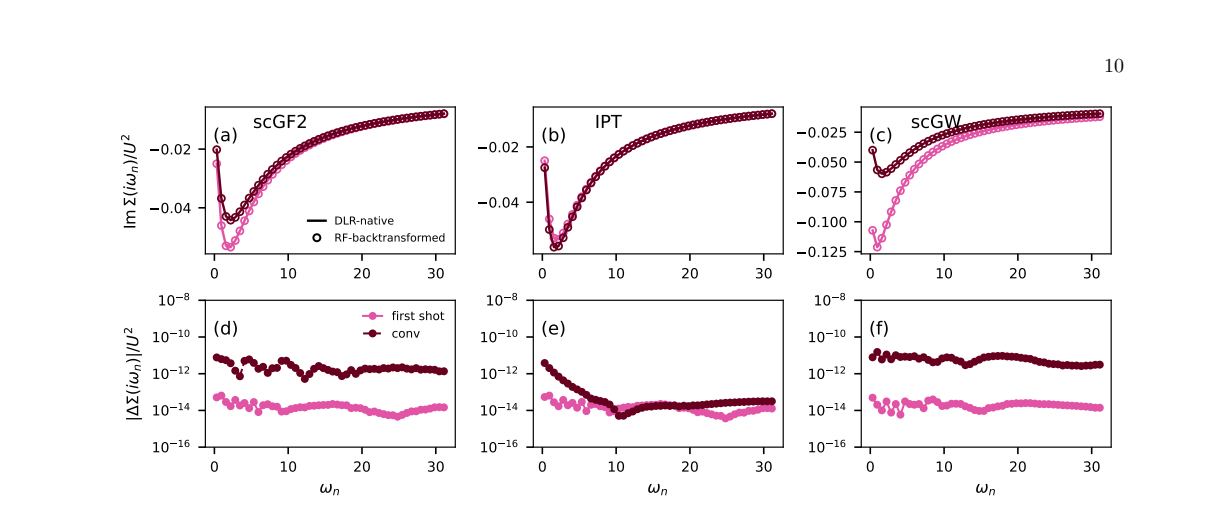
The convergence report says the iteration is stopped when the maximal change in Σ^R falls below 10^-12, while Fig. 7(d--f) shows that the back-transformed deviation from DLR grows to 10^-11--10^-12; the text attributes this to accumulated round-off. It would be helpful to state which quantity (maximal change, norm, frequency range) defines the stopping criterion, since the quoted 10^-12 appears in several places with different meanings.
The paper says, at Sec. V (quasi-particle residues)
Pith says: minor objection 4 of 5
The claim that 'a comparable error level in a Matsubara-axis calculation would likely degrade dynamical quantities far more severely' is speculative and not supported by a comparison; it could be removed or supported by a reference.
The paper says, at References
Pith says: minor objection 5 of 5
Ref. [38] (pole interpolation smoothness) is unpublished at the time of writing, yet it carries the moment-interpolation step used in Sec. IV C; the dependency should be made explicit in the main text so that the UEG results are not silently predicated on an unavailable source.
What would settle it
Repeat the self-consistent GW uniform-electron-gas calculation of Fig. 13 at r_s = 2, T/ε_F = 0.1 with doubled PSD pole counts (N_F from the used value to 32 and 64, N_B scaled commensurably) and report the momentum-resolved frequency support of the integrands in Eqs. 53–54. Pass/fail tests: (1) compute max |n_zeta^PSD(ω) − n_zeta^exact(ω)| over the full window W actually sampled by the k-integrated convolutions (roughly ω ∈ [−32, 32] ε_F); if the deviation exceeds the target tolerance (1e-8 or tighter) anywhere in that window, the window assumption is violated. (2) Check whether the scGW satellite position (−2.47 ε_F), damping (Im ξ ≈ 0.64 ε_F), and weight (Re A ≈ 0.19) shift by more than the stated compression tolerance when N_F is doubled; a shift indicates the PSD truncation, not the pole algebra, controls the reported values.
from the skeptic's reading
How the review went
4 readings by deepseek-v4-flash · 24 Sep 2026
- Reader holds up, with conditions
- Skeptic agrees
- Editor wrote the verdict above
- Referee major revision: 4 major objections, 5 minor
Not run on this paper: the simulated authors' defence.
Pith did not check this review's objections against the paper.
The review in full
The review in brief, machine-written
Two things to know. The core machinery — pole-space calculus for convolution, dressing, and Dyson steps, with ESPRIT recompression to keep pole counts bounded — is real and, on the evidence here, works. The validation is genuinely strong: back-transformation to the Matsubara axis agrees with DLR to 10−11–10−13, and the UEG dielectric function matches an independent AMI calculation. The operation table and the shared-pole treatment of the Kanamori model are clean. That part of the paper is solid.
The soft corner is the UEG satellite claim, which is the headline physics result. The impurity benchmarks state NF = 16, NB = 36 and explicitly check the PSD validity window against the ±2t/±4t support. The UEG section gives none of that: no NF, no NB, no bandwidth, no window check, and the satellite analysis is deferred to an unpublished companion ('Detailed results will be presented elsewhere'). That matters because the satellite is precisely the feature most sensitive to PSD window contamination. The k-integrals run to 4 kF, so bare energies reach ~16 εF and convolutions spread the support further; at β = 10 the fermionic PSD window with the impurity's NF = 16 is roughly ±25 εF — marginal against a support that self-consistency broadens. If that window is exceeded at any sampled momentum, the construction is silently wrong. The paper's own logic requires the window check to run through the UEG, and it does not.
To be fair on severity: this is a verification gap, not evidence of error. The satellite pole sits near -2.5 εF, well inside any reasonable window, and the AMI benchmark anchors the same rs and T regime independently. The fix is cheap — report the UEG PSD parameters and a window check. But the claim as stated, that the satellite survives scGW contrary to Holm–von Barth, currently rests on an untested assumption plus an unpublished companion. The paper is transparent about the deferral, which I credit; transparency does not make the claim assessable.
Two smaller soft spots. The residue-sum condition (Σj Aj = 0) needed for the integral operations is asserted as sufficient but not established for compressed self-consistent objects; the DLR agreement argues it holds numerically, so I call this minor. And no code ships — 'available on request' — which is common for this group but leaves the strong accuracy claims unreproducible without a rewrite.
Who this is for: people doing real-frequency diagrammatics, DMFT impurity solvers, and GW implementations. It deserves a serious referee. In revision I would require the UEG window check and PSD parameters, and I would ask the authors how much of the satellite and moment-interpolation content depends on the two unpublished companions.
The strongest objection
The central claim (self-consistent GW/GF2 spectra on the real axis at 10^-8–10^-12) rests on every lesser/greater object being built from the spectral function times the PSD of the distribution function via Eq. 4, so every diagram inherits the PSD validity window, which grows only quadratically with pole count N (Sec. II D). The paper tests this window for the impurity models: N_F = 16, N_B = 36 are stated (Sec. IV A), and the beta t = 10 semicircular support (±2t, bosonic ±4t) sits comfortably inside that window. The independent DLR cross-check (Fig. 7) therefore lives only in this safe regime, and the reported 10^-11–10^-13 agreement does not probe the window assumption elsewhere.
The UEG section reports none of this: it gives no N_F or N_B, quotes no bandwidth W or maximum sampled energy, and defers all details to an unpublished companion ('Detailed results will be presented elsewhere', Sec. IV C). Yet the UEG is the regime where the window is hardest to satisfy. The momentum integrals of Eqs. 53–54 range to k_max = 4 k_F, so bare energies reach ~16 ε_F and the screened interaction extends over twice the fermionic range. At T/ε_F = 0.1 (β = 10) the PSD requirement N ∝ sqrt(β W) already pushes N near 13–18 for W ~ 16–32 ε_F, before self-consistent dressing spreads spectral weight further. The headline claim — that the GW satellite survives scGW with weight Re A ≈ 0.19 and damping Im ξ ≈ 0.64 ε_F, contradicting Holm–von Barth (Fig. 13) — is precisely the high-frequency-sensitive observable most vulnerable to window contamination: a truncated PSD mis-represents the spectral tails that carry the convolution weight, and the cycle has no error estimator for this, only for the pole algebra. If the PSD window is exceeded at any sampled momentum, the construction is silently incorrect. The method is validated in a safe window and asserted in an unverified one.
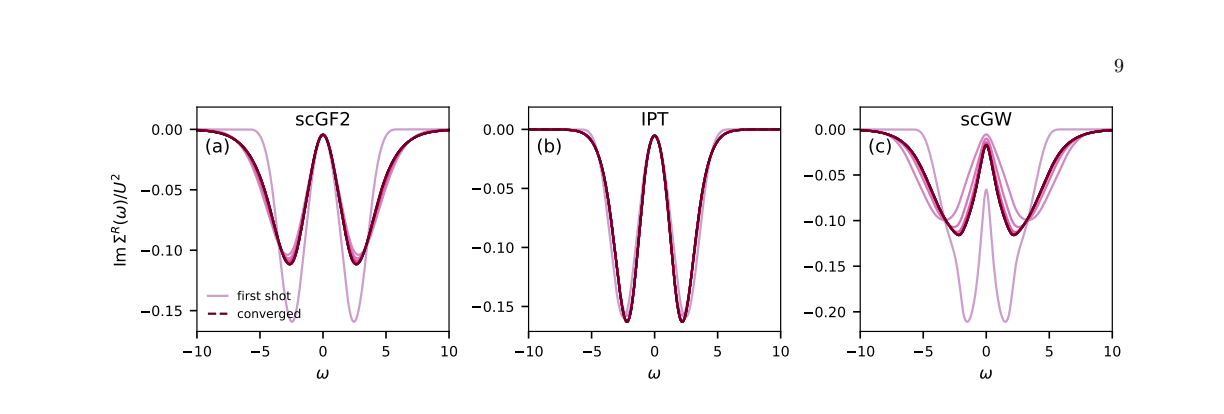
Stress-test summary: the central claim — self-consistent, conserving GW and GF2 solvable directly on the real axis with spectra at 10^-8–10^-12 — is genuinely supported in the impurity regime. The PSD pole counts (N_F = 16, N_B = 36) are stated, the βt = 10 semicircular support sits inside the PSD window, and the real-axis results back-transformed to the Matsubara axis match independent DLR/MiniPole benchmarks to 10^-11–10^-13 (Fig. 7). I find no internal inconsistency in the residue calculus of Eqs. 19–20 as used in these test cases; the sufficient condition P_j A^X_j = 0 for the integration operator is stated rather than proven for dressed self-consistent objects, and the PSD truncation is a separate error that the cycle does not estimate, but neither of these is a demonstrated failure in the window that was actually exercised.
The single most load-bearing risk is the PSD validity window applied to the UEG. Three facts combine: (i) the energy range sampled by the momentum integrals (Eqs. 53–54, k up to 4k_F giving W ~ 16–32 ε_F, requiring N ~ 13–18 at β = 10 even before dressing) is far wider than the impurity case; (ii) the paper omits the PSD parameters and any window or tail-negligibility check for the UEG; (iii) the headline physics result — the GW satellite surviving self-consistency against Holm–von Barth — is exactly the high-frequency-sensitive observable, and its details are deferred to an unpublished companion. This is a conditional concern, not a demonstrated failure: if the integrand support is verified to lie within the PSD window, the claim stands. The concrete test (pole-count doubling plus an explicit window sweep over the sampled support) settles it unambiguously.
Verdict: CONDITIONAL remains the right call. The impurity results justify acceptance of the method in the window where it is tested; the UEG satellite claim should not be ACCEPT until the PSD-window check is reported. I agree with the reader's identified weakest assumption (PSD window) and recommend keeping the verdict unchanged.
The referee's report
If the claims hold, this is a substantial practical advance: it replaces ill-conditioned analytic continuation with a directly real-frequency, tolerance-controlled representation, and it makes iterated conserving approximations (GW, GF2) feasible without frequency grids. The strongest parts of the paper are independently validated: the Fig. 7 back-transformation agreement with DLR (10^-11--10^-13) is an external benchmark, and the Fig. 12 dielectric-function comparison against AMI is an external benchmark in the non-interacting limit. The closed-form operation rules (Eqs. 18--20, 27--29, C4--C5) are cleanly derived and the compression error is controlled by an explicit tolerance. The weakest link is the UEG self-consistent satellite claim (Fig. 13), which contradicts a published result (Ref. [11]) and which, as argued in the major comments, is presented without the PSD window parameters and external cross-checks that the authors themselves supply for the impurity benchmarks. The self-consistent UEG result is the paper's most consequential physical statement, and it is currently the least supported.
Pith's reading of the paper (a machine's summary, not the authors')
This paper claims that finite-temperature many-body perturbation theories such as GW and second-order GF2 can be solved directly on the real frequency axis, without imaginary-time grids and without numeric analytic continuation. The objects of the theory are expanded as sums of simple complex poles, and every diagrammatic operation (product, frequency convolution, Dyson inversion) becomes closed-form algebra on those poles. The central enabler is a controlled recompression step: after each operation, the trigonometric moments of the pole sum are passed to the ESPRIT signal-processing method, which returns a compact equivalent representation and prevents the pole explosion that previously made real-frequency self-consistent cycles intractable. The authors demonstrate convergence of spectral quantities to $10^{-8}$ through $10^{-12}$ on Anderson impurity problems and the uniform electron gas, and argue that no analytic continuation is needed to read off spectral features.
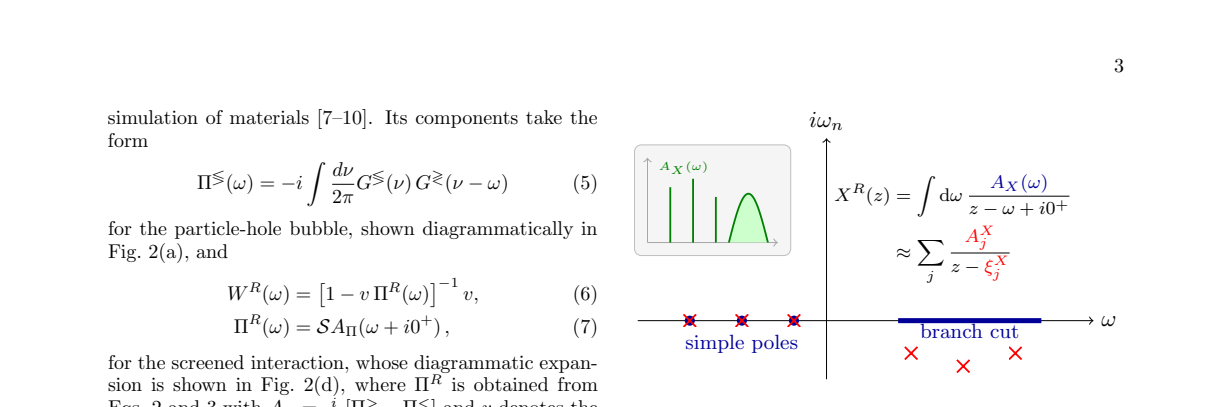
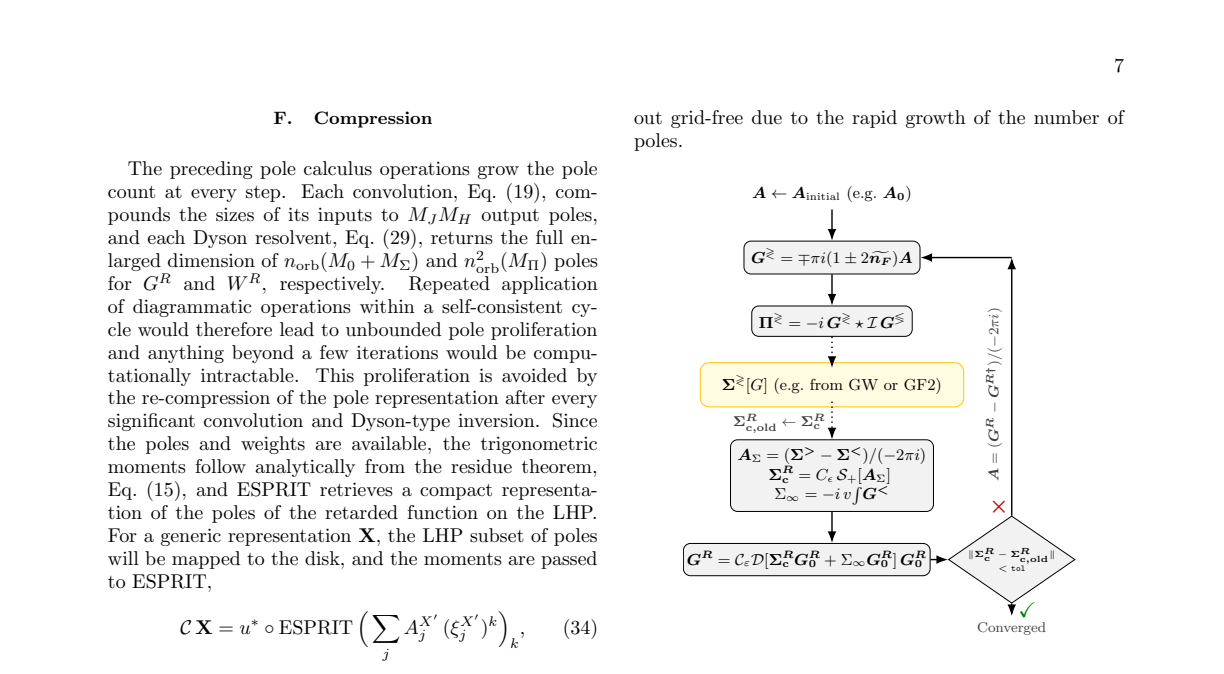
What carries the argument. The load-bearing objects are (i) the pole representation $X^{R}(z) \approx \sum_{j} A^{X}_{j}/(z-\xi^{X}_{j})$ with complex weights and lower-half-plane poles, obtained from a truncated trigonometric-moment sequence under the conformal map $u(z)=(z+i\omega_{p})/(z-i\omega_{p})$ onto the unit disk; (ii) the ESPRIT algorithm, which solves the Prony-type truncated moment problem and returns the minimal pole set for a tolerance $\varepsilon$; and (iii) the compression operator $C_{\varepsilon}$ that couples the two, converting an exploded pole sum back to a compact one after every convolution and Dyson step. Two analytic ingredients complete the calculus: the Pade spectral decomposition (PSD) of the Fermi and Bose distribution functions, which gives the lesser and greater components finite pole expansions, and a residue-theorem convolution rule that evaluates frequency integrals as a sum over pair poles lying in opposite half-planes. The compression is the step the authors identify as making self-consistent diagrammatics viable: without it the pole count grows without bound and the cycles cannot be carried out grid-free.
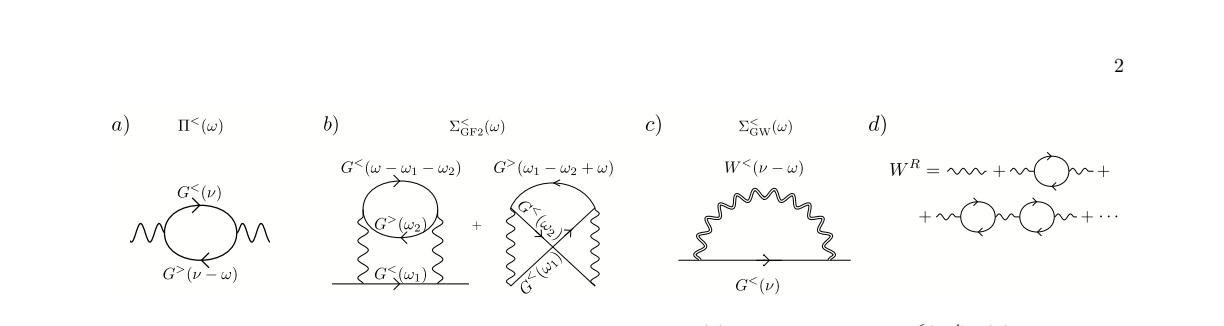
Core claim. The central claim is that spectral quantities of interacting quantum systems can be computed to numerical accuracy within self-consistent, conserving diagrammatic theories (GW and second-order GF2) by working entirely on the real axis in a pole and moment representation. Each function is written as $X^{R}(z) \approx \sum_{j} A^{X}_{j}/(z-\xi^{X}_{j})$ with complex weights and lower-half-plane poles that emulate branch cuts; the representation is built from a truncated trigonometric-moment sequence under a conformal map to the unit disk, and an ESPRIT-based recompression recovers a minimal pole set for a prescribed tolerance $\varepsilon$. Because the recompression keeps the pole count bounded, the iterative cycles -- polarization bubble, screened interaction, self-energy, Dyson inversion -- run grid-free. The paper validates the cycles against Matsubara-axis results to $10^{-11}$ to $10^{-12}$ in the self-energy, and against direct real-axis benchmarks for the uniform electron gas dielectric function. Its most concrete physical result is that plasmon satellites survive fully self-consistent GW in the electron gas, contradicting an earlier washout reported in the literature.
The premise it rests on. The truncated Pade spectral decomposition of the Fermi and Bose distribution functions is accurate only inside a finite frequency window whose width grows quadratically with the pole count, so a bandwidth $W$ at inverse temperature $\beta$ needs $N\propto\sqrt{\beta W}$ poles; every lesser and greater Green's function is built from these distributions, so if spectral weight lies beyond the window the construction is silently incorrect.
If the paper is right (Pith's inferences, not the authors')
Spectral functions for impurity solvers and for the uniform electron gas can be computed directly on the real axis to tolerances of $10^{-8}$ to $10^{-12}$, removing the error amplification of numerical analytic continuation.
The electron-gas result revises the earlier Holm-von Barth conclusion that GW self-consistency washes out plasmon satellites: this paper finds a satellite that survives self-consistency for all densities studied, albeit with reduced weight and increased damping.
Because the trigonometric moments are linear in the function, momentum and diagram summations can be performed in moment space, enabling Chebyshev interpolation of momentum-dependent pole families for continuum systems.
The Dyson equation is solved as an upfolded finite eigenvalue problem, so dressed poles come from a matrix diagonalization rather than from quadrature or grid search.
The shared-pole, matrix-valued representation permits multi-orbital models to be solved with one pole set shared across all screening channels, with spectral positivity and sum rules satisfied to within the compression tolerance.
If the framework extends to higher-order and vertex-corrected diagrammatics, it could become a standard route to spectral quantities in finite-temperature many-body theory, since the pole representation is valid throughout the complex plane rather than only at Matsubara points.
The satellite-survival result is directly testable: other self-consistent GW implementations that use Gaussian or smeared spectral fits should be re-checked, since the paper attributes the earlier washout specifically to smoothing of a weak but well-defined feature.
The compression tolerance $\varepsilon$ acts as a controlled accuracy knob with pole count growing only logarithmically in $1/\varepsilon$, giving a predictable cost-accuracy trade-off that grid-based real-frequency schemes lack.
Check this review
Pith stored no record of this review's passes and took no fingerprint of it. Reviews made by code from 13 Nov 2026 on carry both.
How often reviews like this one are right
Reviews like this one: written by deepseek-v4-flash, where what was read was not recorded.
How often objections from reviews like this one are right: not yet measured
Reviews by people
This review was written by a machine. No person has reviewed this paper on Pith yet. A scientist listed on Pith can review it for a fee, and their review is published here whatever it concludes.
The paper
Abstract
Finite-temperature many-body theories are typically formulated in imaginary time, where they are amenable to efficient numerical treatment. However, the extraction of spectral properties from the imaginary axis is difficult and requires numerical analytic continuation, while a direct formulation on the real axis requires prohibitively expensive numerical quadrature. In this paper, we represent the objects of many-body perturbation theory using systematically improvable pole and moment expansions and develop the corresponding framework for evaluating diagrammatic contributions directly on the real axis. We introduce a controlled recompression procedure that prevents the proliferation of poles under algebraic and diagrammatic operations. We benchmark the approach on paradigmatic quantum impurity problems and apply it to self-consistent calculations of the uniform electron gas. The resulting spectral quantities converge systematically towards numerical accuracy. This work provides a practical framework for controlled and systematically improvable calculations of spectral quantities within diagrammatic many-body theories, including self-consistent conserving approaches.
The paper's own sentences, arranged, kept beside the review and separate from it. Each label is drawn from a closed vocabulary; the number beside it is the probability the classifier gave that label. No sentence in this record was written by a model.
abstract compiled · 2026-09-24
The authors' main claim, as the classifier picked it out 0.99
“This work provides a practical framework for controlled and systematically improvable calculations of spectral quantities within diagrammatic many-body theories, including self-consistent conserving approaches.”
How the main claim is stated: asserted 1.00
What the abstract itself states, as probabilities: claims first 0.05 · states limitation 0.16 · human participants 0.01 · controlled comparison 0.05 · randomized assignment 0.01 · states quantitative result 0.05 · compares with prior results 0.46 · mentions code or data availability 0.02
The abstract, sentence by sentence
This table labels the abstract only (arXiv listing abstract v1). The number is the probability the classifier gave the label.
| Sentence | Role | The authors' own work | States the main conclusion | Strength |
|---|---|---|---|---|
| Finite-temperature many-body theories are typically formulated in imaginary time, where they are amenable to efficient numerical treatment. | background 1.00 | 0.05 | 0.02 | asserted 0.99 |
| However, the extraction of spectral properties from the imaginary axis is difficult and requires numerical analytic continuation, while a direct formulation on the real axis requires prohibitively expensive numerical quadrature. | background 0.58 | 0.07 | 0.03 | asserted 1.00 |
| In this paper, we represent the objects of many-body perturbation theory using systematically improvable pole and moment expansions and develop the corresponding framework for evaluating diagrammatic contributions directly on the real axis. | contribution 0.79 | 0.96 | 0.20 | asserted 1.00 |
| We introduce a controlled recompression procedure that prevents the proliferation of poles under algebraic and diagrammatic operations. | method 0.78 | 0.95 | 0.07 | asserted 1.00 |
| We benchmark the approach on paradigmatic quantum impurity problems and apply it to self-consistent calculations of the uniform electron gas. | contribution 0.53 | 0.96 | 0.06 | asserted 1.00 |
| The resulting spectral quantities converge systematically towards numerical accuracy. | result 1.00 | 0.91 | 0.18 | asserted 1.00 |
| This work provides a practical framework for controlled and systematically improvable calculations of spectral quantities within diagrammatic many-body theories, including self-consistent conserving approaches. | interpretation 0.52 | 0.81 | 0.88 | asserted 1.00 |
What kind of paper the classifier reports this is: method or tool 1.00 · evidence from simulation or computation 1.00
What was examined, and what was not
Sources read
- arXiv listing abstract v1
Not examined
- full text
- figures and tables
- references and citing sentences
- relations to other papers
Levels run
- P abstract
Not run
- S sections
- T body sentences
- C citations
- R cross-paper relations
How the labels were made
Compiled by classifier-1.13.0 via TypeSafe API, question bank abstract-p1-20260923, 2026-09-24: 1 request, 5,545 input tokens.
Every quoted sentence on this record is the authors'. Every label is from Pith's closed vocabulary, with the probability shown beside it. This record as JSON
Figures (15)




Showing 13 of the paper's 15 figures. Figures are the authors', reproduced from the paper.
References (104)
- [11] B. Holm and U. von Barth, Phys. Rev. B57, 2108 (1998) on Pith
- [38] X. Dong, I. Zemach, L. Zhang, G. Cohen, and E. Gull, Compact and stable representation of real- frequency spectral functions for machine learning (2026), arXiv:2607.11190 [physics.comp-ph] on PithPith's reviewarXiv
- [1] L. V. Keldysh, Zhurnal Eksperimental’noi i Teoretich- eskoi Fiziki47, 1515 (1964) on Pith
- [2] G. Stefanucci and R. van Leeuwen,Nonequilibrium Many-Body Theory of Quantum Systems: A Modern In- troduction(Cambridge University Press, 2013) on Pith
- [3] J. Rammer and H. Smith, Reviews of Modern Physics 58, 323 (1986) on Pith
- [4] D. C. Langreth, inLinear and Nonlinear Electron Transport in Solids, NATO Advanced Study Institute Series B, Vol. 17, edited by J. T. Devreese and V. E. van Doren (Plenum Press, New York, 1976) pp. 3–32 on Pith
- [5] L. Hedin, Phys. Rev.139, A796 (1965) on Pith
- [6] F. Aryasetiawan and O. Gunnarsson, Reports on Progress in Physics61, 237 (1998) on Pith
- [7] G. Onida, L. Reining, and A. Rubio, Rev. Mod. Phys. 74, 601 (2002) on Pith
- [8] R. Martin, L. Reining, and D. Ceperley,Interacting Electrons(Cambridge University Press, 2016) on Pith
- [9] L. Reining, WIREs Computational Molecular Science8, e1344 (2018), https://wires.onlinelibrary.wiley.com/doi/pdf/10.1002/wcms.1344 on Pithdoi:10.1002/wcms.1344
- [10] D. Golze, M. Dvorak, and P. Rinke, Frontiers in Chem- istryVolume 7 - 2019, 10.3389/fchem.2019.00377 (2019) on PitharXiv
- [12] C.-N. Yeh, S. Iskakov, D. Zgid, and E. Gull, Phys. Rev. B106, 235104 (2022) on Pith
- [13] S. Iskakov, C.-N. Yeh, P. Pokhilko, T. Chen, D. Zgid, and E. Gull, Comput. Phys. Commun.306, 109380 (2025) on Pith
- [14] A. Kutepov, K. Haule, S. Y. Savrasov, and G. Kotliar, Phys. Rev. B82, 045105 (2010) on Pith
- [15] P. Pokhilko, C.-N. Yeh, M. A. Morales, and D. Zgid, J. Chem. Phys.161, 084108 (2024) on Pith
- [16] C.-N. Yeh and M. A. Morales, J. Chem. Theory Com- put.20, 3184 (2024) on Pith
- [17] F. Nilsson, L. Boehnke, P. Werner, and F. Aryaseti- awan, Phys. Rev. Mater.1, 043803 (2017) on Pith
- [18] P. Sun and G. Kotliar, Phys. Rev. B66, 085120 (2002) on Pith
- [19] G. Kotliar, S. Y. Savrasov, K. Haule, V. S. Oudovenko, O. Parcollet, and C. A. Marianetti, Rev. Mod. Phys. 78, 865 (2006) on Pith
show 80 more
- [20] S. Biermann, F. Aryasetiawan, and A. Georges, Phys. Rev. Lett.90, 086402 (2003) on Pith
- [21] A. A. Kananenka, E. Gull, and D. Zgid, Phys. Rev. B 91, 121111(R) (2015) on Pith
- [22] T. N. Lan, A. Shee, J. Li, E. Gull, and D. Zgid, Phys. Rev. B96, 155106 (2017) on Pith
- [23] J. M. Tomczak, M. Casula, T. Miyake, F. Aryaseti- awan, and S. Biermann, Europhysics Letters100, 67001 (2012) on Pith
- [24] D. Zgid and E. Gull, New Journal of Physics19, 023047 (2017) on Pith
- [25] A. A. Rusakov, S. Iskakov, T. N. Lan, and D. Zgid, J. Chem. Theory Comput.15, 229 (2019) on Pith
- [26] N. E. Dahlen and R. van Leeuwen, The Journal of Chemical Physics122, 164102 (2005) on Pith
- [27] J. J. Phillips and D. Zgid, The Journal of Chemical Physics140, 241101 (2014) on Pith
- [28] J. J. Phillips, A. A. Kananenka, and D. Zgid, The Jour- nal of Chemical Physics142, 194108 (2015) on Pith
- [29] A. A. Rusakov and D. Zgid, The Journal of Chemical Physics144, 054106 (2016) on Pith
- [30] S. Iskakov, A. A. Rusakov, D. Zgid, and E. Gull, Phys. Rev. B100, 085112 (2019) on Pith
- [31] J. M. Luttinger and J. C. Ward, Phys. Rev.118, 1417 (1960) on Pith
- [32] G. Baym and L. P. Kadanoff, Phys. Rev.124, 287 (1961) on Pith
- [33] L. Zhang and E. Gull, Phys. Rev. B110, 035154 (2024) on Pith
- [34] L. Zhang, Y. Yu, and E. Gull, Phys. Rev. B110, 235131 (2024) on Pith
- [35] L. Zhang, A. Erpenbeck, Y. Yu, and E. Gull, J. Chem. Phys.162, 214111 (2025) on Pith
- [36] L. Ying, J. Comput. Phys.469, 111549 (2022) on Pith
- [37] L. Ying, J. Sci. Comput.92, 107 (2022) on Pith
- [39] N. Akhiezer,The Classical Moment Problem, University mathematical monographs (Oliver & Boyd, 1965) on Pith
- [40] Y. Hua and T. K. Sarkar, IEEE Transactions on Acous- tics, Speech, and Signal Processing38, 814 (1990) on Pith
- [41] T. K. Sarkar and O. Pereira, IEEE Antennas and Prop- agation Magazine37, 48 (1995) on Pith
- [42] R. Roy and T. Kailath, IEEE Transactions on Acous- tics, Speech, and Signal Processing37, 984 (1989) on Pith
- [43] D. Potts and M. Tasche, Linear Algebra Appl.439, 1024 (2013) on Pith
- [44] H. Takahashi, S. Rudge, C. Kaspar, M. Thoss, and R. Borrelli, J. Chem. Phys.160, 204105 (2024) on Pith
- [45] T. Matsubara, Progress of Theoretical Physics14, 351 (1955), https://academic.oup.com/ptp/article- pdf/14/4/351/5286981/14-4-351.pdf on Pith
- [46] T. Ozaki, Phys. Rev. B75, 035123 (2007) on Pith
- [47] A. Croy and U. Saalmann, Phys. Rev. B80, 073102 (2009) on Pith
- [48] J. Hu, R.-X. Xu, and Y. Yan, The Journal of Chemical Physics133, 101106 (2010) on Pith
- [49] J. Hu, M. Luo, F. Jiang, R.-X. Xu, and Y. Yan, The Journal of Chemical Physics134, 244106 (2011) on Pith
- [50] P. L¨ owdin, The Journal of Chemical Physics19, 1396 (1951) on Pith
- [51] T. Chiarotti, N. Marzari, and A. Ferretti, Phys. Rev. Res.4, 013242 (2022) on Pith
- [52] T. Chiarotti, A. Ferretti, and N. Marzari, Phys. Rev. Res.6, L032023 (2024) on Pith
- [53] P. Pokhilko, S. Iskakov, C.-N. Yeh, and D. Zgid, The Journal of Chemical Physics155, 024119 (2021) on Pith
- [54] A. Hewson,The Kondo Problem to Heavy Fermions, Cambridge History of Medicine (Cambridge University Press, 1993) on Pith
- [55] W. Metzner and D. Vollhardt, Phys. Rev. Lett.62, 324 (1989) on Pith
- [56] A. Georges and G. Kotliar, Phys. Rev. B45, 6479 (1992) on Pith
- [57] A. Georges, G. Kotliar, W. Krauth, and M. J. Rozen- berg, Rev. Mod. Phys.68, 13 (1996). 20 on Pith
- [58] A. N. Rubtsov, V. V. Savkin, and A. I. Lichtenstein, Phys. Rev. B72, 035122 (2005) on Pith
- [59] P. Werner, A. Comanac, L. de’ Medici, M. Troyer, and A. J. Millis, Phys. Rev. Lett.97, 076405 (2006) on Pith
- [60] E. Gull, P. Werner, O. Parcollet, and M. Troyer, Euro- physics Letters82, 57003 (2008) on Pith
- [61] E. Gull, A. J. Millis, A. I. Lichtenstein, A. N. Rubtsov, M. Troyer, and P. Werner, Rev. Mod. Phys.83, 349 (2011) on Pith
- [62] A. Ge, N. Ritz, E. Walter, S. Aguirre, J. von Delft, and F. B. Kugler, Phys. Rev. B109, 115128 (2024) on Pith
- [63] R. Bulla, T. A. Costi, and T. Pruschke, Rev. Mod. Phys. 80, 395 (2008) on Pith
- [64] F. A. Wolf, A. Go, I. P. McCulloch, A. J. Millis, and U. Schollw¨ ock, Phys. Rev. X5, 041032 (2015) on Pith
- [65] Y. Yu, L. Zhang, E. Gull, X. Cao, and X. Dong, Phys. Rev. Res.8, 023142 (2026) on Pith
- [66] J. Kaye, K. Chen, and O. Parcollet, Phys. Rev. B105, 235115 (2022) on Pith
- [67] J. Kaye, H. U. r. Strand, and N. Wentzell, Journal of Open Source Software9, 6297 (2024) on Pith
- [68] M. Imada, A. Fujimori, and Y. Tokura, Rev. Mod. Phys. 70, 1039 (1998) on Pith
- [69] A. Georges, L. d. Medici, and J. Mravlje, Annual Review of Condensed Matter Physics4, 137 (2013) on Pith
- [70] P. Werner, E. Gull, M. Troyer, and A. J. Millis, Phys. Rev. Lett.101, 166405 (2008) on Pith
- [71] P. Werner, E. Gull, and A. J. Millis, Phys. Rev. B79, 115119 (2009) on Pith
- [72] L. de’ Medici, J. Mravlje, and A. Georges, Phys. Rev. Lett.107, 256401 (2011) on Pith
- [73] J. Mravlje, M. Aichhorn, T. Miyake, K. Haule, G. Kotliar, and A. Georges, Phys. Rev. Lett.106, 096401 (2011) on Pith
- [74] P. Werner and A. J. Millis, Phys. Rev. B74, 155107 (2006) on Pith
- [75] J. P. F. LeBlanc, K. Chen, K. Haule, N. V. Prokof’ev, and I. S. Tupitsyn, Phys. Rev. Lett.129, 246401 (2022) on Pith
- [76] A. Taheridehkordi, S. H. Curnoe, and J. P. F. LeBlanc, Phys. Rev. B99, 035120 (2019) on Pith
- [77] H. Elazab, B. McNiven, and J. LeBlanc, Computer Physics Communications280, 108469 (2022) on Pith
- [78] M. Burke and J. LeBlanc, Computer Physics Commu- nications308, 109437 (2025) on Pith
- [79] G. Harsha, V. Abraham, M. Wen, and D. Zgid, Phys. Rev. B110, 235146 (2024) on Pith
- [80] R. Smit, Hyperfunction formulation of many body green’s functions and the matsubara formalism (2022), arXiv:2204.09697 [cond-mat.str-el] on PithPith's reviewarXiv
- [81] L. Boehnke, H. Hafermann, M. Ferrero, F. Lechermann, and O. Parcollet, Phys. Rev. B84, 075145 (2011) on Pith
- [82] A. A. Kananenka, A. R. Welden, T. N. Lan, E. Gull, and D. Zgid, Journal of Chemical Theory and Computation 12, 2250 (2016) on Pith
- [83] H. Shinaoka, J. Otsuki, M. Ohzeki, and K. Yoshimi, Phys. Rev. B96, 035147 (2017) on Pith
- [84] E. Gull, S. Iskakov, I. Krivenko, A. A. Rusakov, and D. Zgid, Phys. Rev. B98, 075127 (2018) on Pith
- [85] J. Li, M. Wallerberger, N. Chikano, C.-N. Yeh, E. Gull, and H. Shinaoka, Phys. Rev. B101, 035144 (2020) on Pith
- [86] D. Gazizova, L. Zhang, E. Gull, and J. P. F. LeBlanc, Phys. Rev. B110, 075158 (2024) on Pith
- [87] D. Gazizova, R. Farid, B. D. E. McNiven, I. Assi, E. G. Armstrong, and J. P. F. LeBlanc, Phys. Rev. B112, 035172 (2025) on Pith
- [88] B. I. Lundqvist, Phys. Kondens. Mater., 6: 193- 205(1967). (1967) on Pith
- [89] M. Bonacci, D. A. Leon, N. Spallanzani, E. Molinari, D. Varsano, A. Ferretti, and C. Cardoso, Journal of Chemical Theory and Computation22, 6718 (2026) on Pith
- [90] E. H. Hwang, R. E. Throckmorton, and S. Das Sarma, Phys. Rev. B98, 195140 (2018) on Pith
- [91] P. Larson, M. Dvorak, and Z. Wu, Phys. Rev. B88, 125205 (2013) on Pith
- [92] B.-C. Shih, Y. Xue, P. Zhang, M. L. Cohen, and S. G. Louie, Phys. Rev. Lett.105, 146401 (2010) on Pith
- [93] G. E. Engel and B. Farid, Phys. Rev. B47, 15931 (1993) on Pith
- [94] W. von der Linden and P. Horsch, Phys. Rev. B37, 8351 (1988) on Pith
- [95] M. S. Hybertsen and S. G. Louie, Phys. Rev. B34, 5390 (1986) on Pith
- [96] R. W. Godby and R. J. Needs, Phys. Rev. Lett.62, 1169 (1989) on Pith
- [97] D. A. Leon, C. Cardoso, T. Chiarotti, D. Varsano, E. Molinari, and A. Ferretti, Phys. Rev. B104, 115157 (2021) on Pith
- [98] J. Kaye, Z. Huang, H. U. R. Strand, and D. Goleˇ z, Phys. Rev. X14, 031034 (2024) on Pith
- [99] Y. N´ u˜ nez Fern´ andez, M. Jeannin, P. T. Dumitrescu, T. Kloss, J. Kaye, O. Parcollet, and X. Waintal, Phys. Rev. X12, 041018 (2022) on Pith
- [100] A. Erpenbeck, W.-T. Lin, T. Blommel, L. Zhang, S. Iskakov, L. Bernheimer, Y. N´ u˜ nez Fern´ andez, G. Co- hen, O. Parcollet, X. Waintal, and E. Gull, Phys. Rev. B107, 245135 (2023) on Pith
The first 100 of 104 references are listed here. All of them are in this paper's citation record.
Challenges and discussion
Disagree with the review, or know something it missed? Leave a comment, or challenge this review formally: a challenge becomes a permanent entry in this paper's record, and its decision is published here.
Come back by email
A short list of the week's newly reviewed papers. Nothing is sent until you confirm from your inbox, and every email has a link that stops it. No account.
No comments yet.
Sign in to comment