Robotics · arXiv:2609.28766 v2 · submitted 23 Sep 2026
TAPESIM: Efficient Simulation of Adhesive Tape Dispensing for Robotic Manipulation
The paper says
“Applying adhesive tape to secure wire harnesses or seal packages requires robots to coordinate a flexible strip, a moving roll, and surfaces that attach and detach.”
more of the abstract
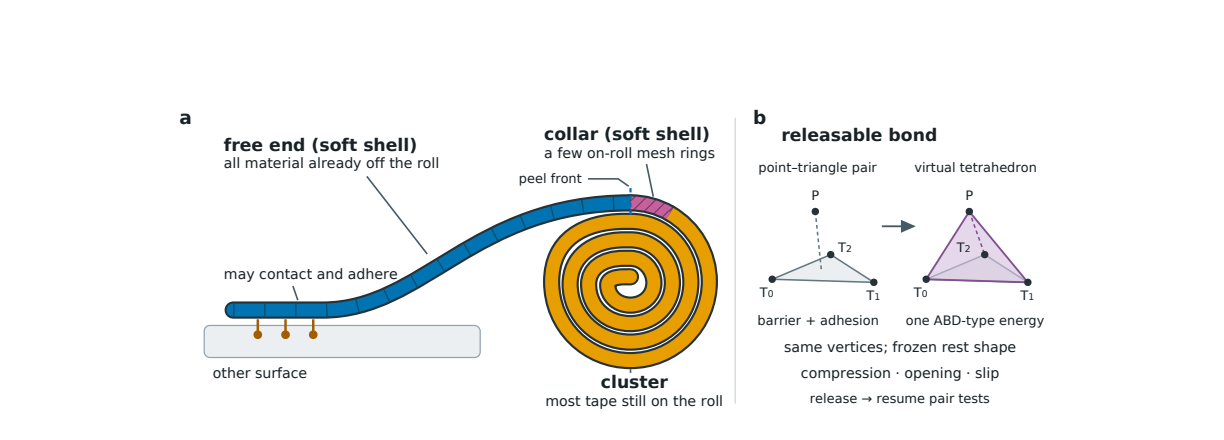
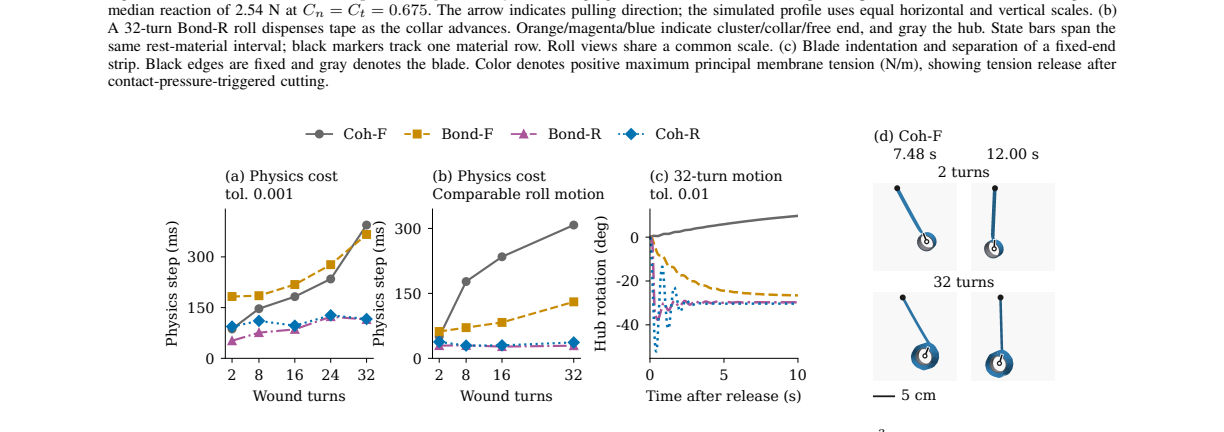
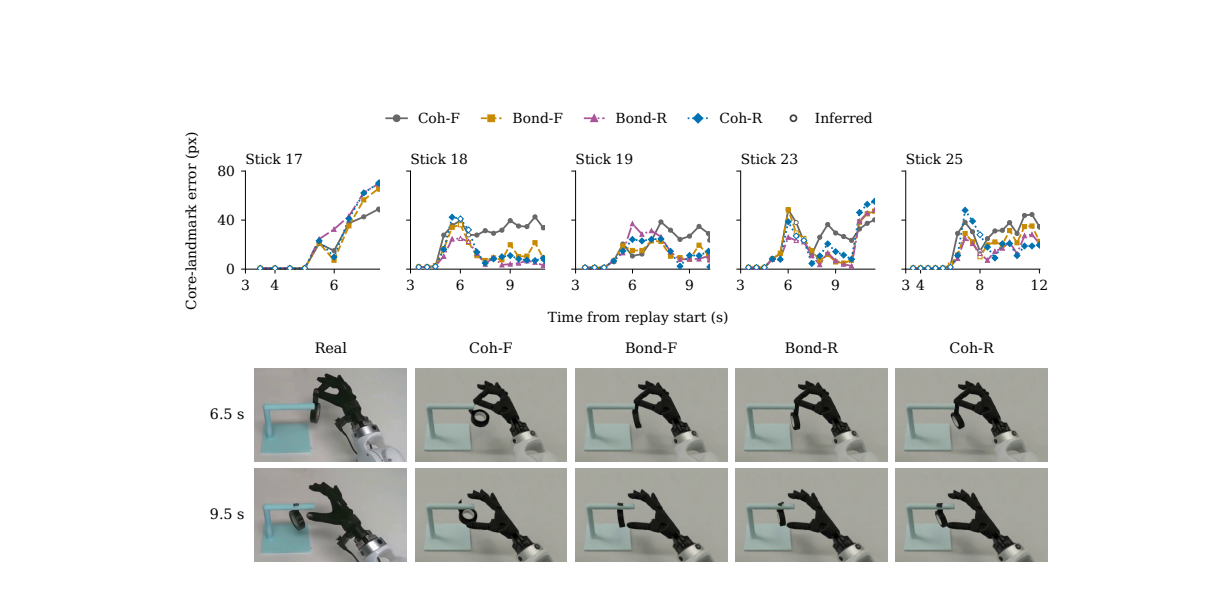
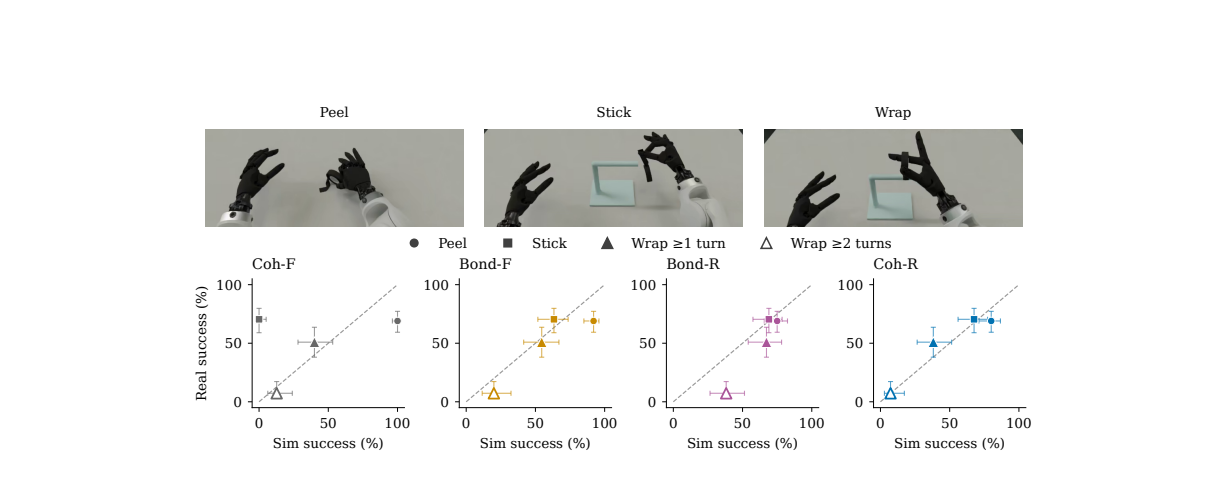
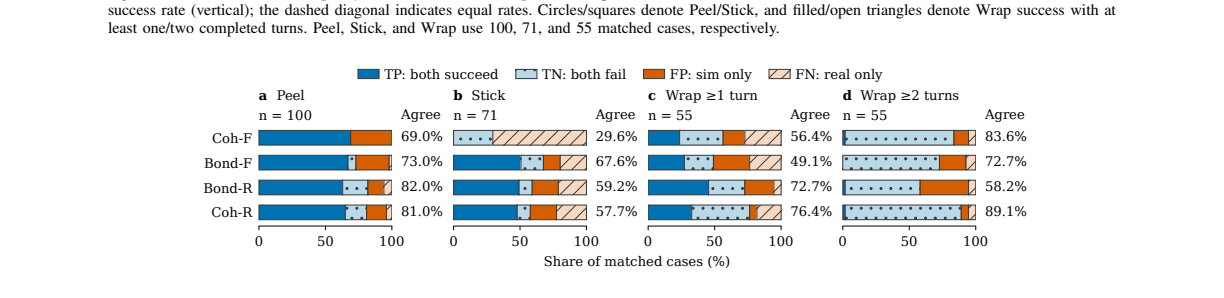
Simulation could make these interactions repeatable for robot development and evaluation, but resolving every adhesive layer is expensive and can suppress roll motion at practical solver tolerances, while a permanently rigid roll cannot release material. We present TapeSim, a tape simulator that concentrates deformation near the unwinding region and along the released strip. We will release the source code. A rigid cluster represents most wound material, while an advancing deformable collar enables payout and leaves released tape flexible and reattachable. Optional releasable bonds simplify adhesive interfaces and reduce mean step times for smaller rolls. Controlled swing tests show improved roll rotation. At 32 turns, clustering gives 3.2-3.4x mean physics-step speedups at a fixed Newton tolerance and 4.5-8.4x for comparable roll motion. Across five real-motion Stick replays, the clustered variants reduce mean image-plane core-landmark error by 23-29% relative to the full-shell cohesive baseline. On 100 paired Peel cases, they improve balanced accuracy from 50% to 72.9-76.3%, with interface rankings varying across tasks. A teleoperated box-sealing sequence demonstrates attachment, dispensing, cutting, and sealing in a continuous workflow.
from the abstract
Pith says
Machine review · deepseek-v4-flash · 25 Sep 2026 · of version 1 of the paper; version 2 is newer · what was read was not recorded · not checked by a person
It can be wrong. Challenge this review or reply to it.
Holds up, with conditions. Solid, honestly-reported simulation contribution where the speedups hold, but the 'recovered roll motion' claim lacks a convergence anchor and needs a sensitivity study before the physical-correctness interpretation is fully trusted. This line is wrong
4 major objections · 4 minor
How often objections from reviews like this one are right: not yet measured
Not checked: figures, code, what the references say.
The paper says, at IV-B, Fig. 3(c)
The review did not quote this passage.
Pith says: Objection 1 of 4 · major
The central physical-fidelity claim that clustering restores shell motion is not yet anchored. Tightening the 32-turn Coh-F Newton tolerance from 10^-2 to 10^-3 m/s raises the hub-rotation range from 9.7 deg to 38.1 deg, while Coh-R gives 52.2 deg and Bond-R gives 37.7 deg.
more of objection 1
The paper presents no full-shell convergence study beyond 10^-3 and no measured real hub rotation for the swing test. Therefore the extra 14.1 deg in Coh-R relative to the tightened full-shell result could be an over-release artifact of the rigid cluster's omitted member elasticity and internal adhesion (Section III-C) rather than recovered physics. Since the Stick replay and Peel agreement gains are attributed to this freed motion, the authors should either show full-shell convergence to roughly 52 deg, provide a measured real hub rotation, or state an explicit bound on the error introduced by rigidifying the wound bulk.
The paper says, at IV-B, Fig. 3(c)
The review did not quote this passage.
Pith says: Objection 2 of 4 · major
The two clustered models disagree by 14.5 deg (37.7 deg for Bond-R vs 52.2 deg for Coh-R), a spread nearly as large as the claimed recovery effect itself. Bond-R's 37.7 deg nearly coincides with the tightened full-shell Coh-F's 38.1 deg, which suggests that the physically meaningful plateau may be near 38 deg and that Coh-R's 52.2 deg may be an over-release artifact of the cohesive gate not requiring beta to reach zero before a collar vertex is released.
more of objection 2
The paper should explain the mechanism behind the Coh-R versus Bond-R difference and report how the gate and release histories differ between the two interface models.
The paper says, at III-C, front update
The review did not quote this passage.
Pith says: Objection 3 of 4 · major
The gate threshold delta = 0.9 mm and collar size N = 10 are hand-chosen, and no sensitivity study is reported for either parameter. Release-front behavior controls payout and, through the restored shell motion, the downstream replay and policy predictions.
more of objection 3
Please report sensitivity of hub rotation, Stick replay error, and Peel balanced accuracy to delta (e.g., 0.5–2.0 mm) and N (e.g., 5–20), or provide a principled selection criterion. Without this, the predictive gains cannot be fully separated from tuning of the reduction parameters. Similar sensitivity should also be reported for the bond parameters kappa_b = 10^6 Pa and f_break = 0.5 N on rolls where bonds are used.
The paper says, at IV-E, Fig. 7
The review did not quote this passage.
A classifier read this sentence of the paper as acknowledging the concern (probability 0.81):
“This coincidence shows why matching aggregate success alone cannot calibrate adhesion.”
Pith says: Objection 4 of 4 · major
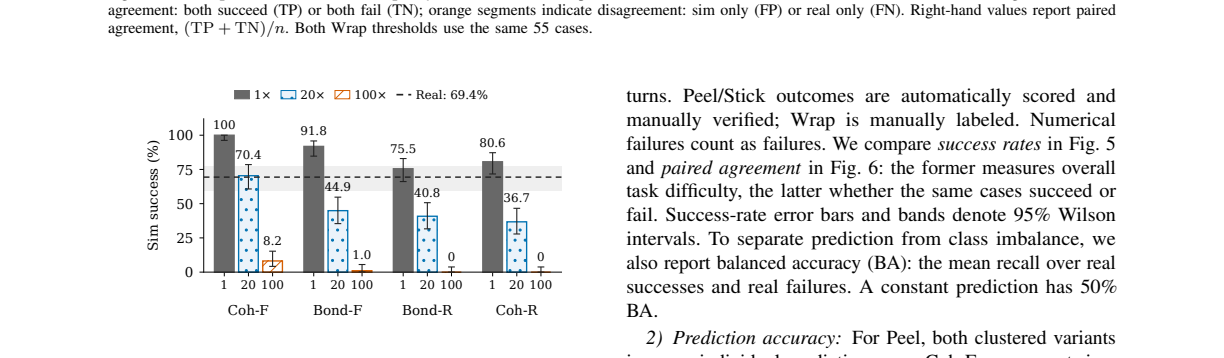
The Peel balanced-accuracy result (72.9–76.3%) is conditional on the single calibrated tabletop adhesion value Cn = Ct = 0.675, fitted to one 2.5 N peel-force measurement in Section IV-A.2. The sensitivity experiment in Section IV-E shows that a 20x increase in tabletop Cn makes both clustered models underpredict real success by 28.6–32.7 percentage points while Coh-F accidentally matches real success, illustrating that aggregate success alone is not diagnostic, as the paper itself notes.
more of objection 4
The Peel BA claim should therefore be reported with this calibration sensitivity stated prominently and, ideally, with an uncertainty interval over Cn and Ct obtained from repeated peel-force measurements. This does not invalidate the method, but it does temper how strongly the Peel result can be stated.
4 minor objections
The paper says, at General
Pith says: minor objection 1 of 4
The paper promises source-code release but provides no artifact link or version. A data/code availability statement with the exact solver settings, GPU/driver versions, and tape asset meshes would materially help reproducibility.
The paper says, at Fig. 4
Pith says: minor objection 2 of 4
Please clarify what the hollow markers represent and how the 'estimated real landmarks' differ from manually verified ones. In addition, reporting per-episode uncertainties or inter-annotation variability would help assess whether the 23–29% replay-error reduction is robust.
show 2 more
The paper says, at III-B, Eq. (2)
Pith says: minor objection 3 of 4
The symbol d_hat is used both as the IPC activation length and inside the definitions of a_n and a_t. Please state explicitly whether the same activation length is used for the releasable bonds and whether kappa_b is expected to be mesh-dependent.
The paper says, at Introduction
Pith says: minor objection 4 of 4
There are spacing typos in the opening sections, such as 'arigid cluster', 'TAPESIMproposes', and 'TAPESIMsimulates'. A careful proofread of the introductory paragraphs is needed.
What would settle it
Convergence check on the 32-turn swing benchmark: re-run the full-shell cohesive model (Coh-F) at Newton tolerances 10^-4 and 10^-5 (and if needed, dt = 5 ms), recording post-release hub-rotation range. Decision rule: if Delta-theta plateaus near 38.1 deg (matching Bond-R's 37.7 deg) rather than rising toward 52.2 deg, then the clustered Coh-R rotation is an over-release artifact of omitted internal wound resistance ([b90]) and the 'recovered physical response' claim in [b171] fails; the Stick-replay and Peel-BA gains would then need re-evaluation as possibly coincidental. If Delta-theta instead converges near 52 deg, clustering is validated and the speedup claim strengthens. A fiducial-tracked measurement of real hub rotation on the physical swing fixture would independently decide which value is physically correct.
from the skeptic's reading
How the review went
4 readings by deepseek-v4-flash · 25 Sep 2026
- Reader holds up, with conditions
- Skeptic agrees
- Editor wrote the verdict above
- Referee major revision: 4 major objections, 4 minor
Not run on this paper: the simulated authors' defence.
Pith did not check this review's objections against the paper.
The review in full
The review in brief, machine-written
You should know two things up front. First, the speed claims are real and I don't think they're contested: 3.2-3.4x at fixed tolerance and 4.5-8.4x for comparable motion are measured, mechanically plausible (fewer DOFs, fewer contact pairs), and internally consistent. Second, the load-bearing physical claim — that clustering restores physically correct roll motion — has a genuine validation gap that the stress-test note correctly identifies, and I think the note holds up on reading.
What's new: the release-front-driven reduction — a rigid wound cluster coupled to an advancing deformable collar that restores shell motion and adhesive history during payout — is a real step beyond affine body dynamics [12] and adaptive rigidification [13][14], neither of which handles a continuously releasing roll. The unified releasable bond replacing cohesive, contact, and friction terms with one interface energy is a clean specific contribution. The paper deserves credit for its honesty: it explicitly flags weak Stick discrimination [b232], task-dependent interface rankings [b237], and that aggregate success matching isn't diagnostic [b243]. That's the right temperament.
Now the soft spot, in proportion. The stress-test observation is sharp: tightening 32-turn Coh-F from 10−2 to 10−3 raises the angular range from 9.7 to 38.1 degrees [b168], while Coh-R gives 52.2 and Bond-R 37.7 [b171]. The coincidence that Bond-R nearly matches the tightened full-shell value is suggestive that ~38 degrees is the plateau and 52.2 is an over-release artifact of omitting member elasticity and internal contact/adhesion [b90]. The paper never distinguishes that case from the alternative where 52 is correct, and the 14.5-degree spread between the two clustered variants is left unexplained. This is a missing validation anchor, not an internal inconsistency — but it matters because the replay and Peel gains are attributed to that freed motion being correct. A convergence study of the full-shell baseline, a direct hub-rotation measurement, or even a sensitivity sweep over the gate threshold (delta = 0.9 mm) and collar size (N = 10) would close it. Right now those hand-chosen parameters control how much rotation is freed and get no sensitivity analysis.
Secondary, honestly reported issues: Peel coefficients are fitted to a measured peel force (acknowledged calibration), timing repeats are thin (two), and code is promised but not shipped. None of these are fatal.
Bottom line: this is a serious, competent paper for people building simulation for deformable and adhesive manipulation. It deserves a real referee, with the reviewer asking for the convergence study and sensitivity analysis rather than a desk reject.
The strongest objection
The central claim has two parts: speed and predictive fidelity. The speed component (3.2-3.4x and 4.5-8.4x in [b6][b176][b185]) is measured, mechanically plausible (fewer DOFs, fewer contact pairs), and I do not challenge it. The vulnerable link is the physical-correctness claim that clustering 'restores' roll motion, because the downstream predictive gains (Stick replay 23-29% error reduction [b7], Peel BA 50% to 72.9-76.3% [b8]) are attributed to that freed motion being correct.
The paper's evidence ([b168][b171]) is a single tightening step of the 32-turn full-shell baseline, from 10^-2 to 10^-3, raising hub-rotation range from 9.7 to 38.1 deg. Clustered Coh-R gives 52.2 deg and Bond-R gives 37.7 deg. Three observations are left unexplained: (1) there is no demonstration that 38.1 deg is the converged full-shell value; if the converged answer is ~38 deg, then the 14.1 deg gap to Coh-R's 52.2 deg is an over-release artifact of omitting member elasticity and internal contact/adhesion ([b90]), not recovered physics; (2) if instead the converged value is ~52 deg, clustering is validated and the claim strengthens - the two cases are never distinguished; (3) the two clustered variants differ by 14.5 deg (37.7 vs 52.2), a spread nearly as large as the claimed recovery effect itself, and the paper offers no explanation. The coincidence that Bond-R (37.7) nearly matches the tightened full-shell Coh-F (38.1) suggests ~38 deg is the physically meaningful plateau and that Coh-R's 52.2 deg is the outlier. Because the gate threshold (delta = 0.9 mm) and collar size (N=10) directly control how much material stays rigid, they also control how much rotation is freed, and no sensitivity analysis over them is reported. This is a missing validation anchor, not an internal inconsistency; the paper honestly flags related limits ([b66][b232][b237][b243]), but none closes the convergence gap.
The reader's CONDITIONAL verdict matches my assessment, and the weakest assumption identified is the same one I reach: the recovered 52.2-deg roll motion is asserted without a direct physical ground truth. I sharpen it with the specific numeric crux: the full-shell baseline is tightened only one step (9.7 to 38.1 deg, [b168]), with no evidence that 38.1 deg is converged, while clustered Coh-R reports 52.2 deg and Bond-R 37.7 deg ([b171]). The 14.5-deg spread between the two clustered variants is as large as the claimed recovery effect and is unaddressed; the fact that Bond-R (37.7) nearly matches the tightened full-shell Coh-F (38.1) is a discriminating observation suggesting 38 deg is the physical plateau and 52.2 deg is the over-release outlier. The Peel/Stick/Wrap predictive gains and the Stick replay errors all inherit the correctness of this freed rotation, so the concern is load-bearing for the 'more predictive' half of the central claim, not for the speedups, which I accept. The paper is honestly reported - it flags solver-induced suppression ([b66]), weak Stick discrimination ([b232]), task-dependent interface rankings ([b237]), and the calibration coincidence ([b243]) - and the hand-chosen gate delta and collar N are stated, but none of these closes the convergence gap. I did not find evidence of internal inconsistency; disagreement with my reading would only be resolved by the concrete convergence experiment or a real hub-rotation measurement. Verdict remains CONDITIONAL, conditioned on that validation plus code release, so I recommend no change.
The referee's report
The main contribution is a representation change whose value rests on two claims: it is faster, and it preserves or improves physical fidelity. The speed claim is measured with internally consistent timings and is mechanically plausible given the reduced degrees of freedom and contact pairs. The fidelity claim is genuinely useful if correct, because it would make closed-loop sim-to-real policy evaluation practical at reasonable cost. The paper's strengths are the clear coordinate reduction (Eq. 5), the honest limitation statements (e.g., Section IV-D on Stick balanced accuracy and Section IV-E on aggregate success matching), and a principled tabletop peel-force calibration protocol. The unresolved convergence and ground-truth questions around the recovered roll motion are what keep the manuscript from being fully convincing as submitted.
Pith's reading of the paper (a machine's summary, not the authors')
Robots that apply tape must coordinate a flexible strip, a rotating roll, and surfaces that attach and detach, but simulating all of it layer-by-layer is expensive and can lock the roll at practical solver tolerances. TapeSim's central claim is that most wound tape moves almost as a rigid body, so a rigid cluster coupled to an advancing deformable collar — with released tape left fully flexible and reattachable — preserves the physical response needed for payout while cutting cost. As evidence it reports 3.2–3.4x mean physics-step speedups at a fixed Newton tolerance and 4.5–8.4x for comparable roll motion at 32 turns, a 23–29% reduction in core-landmark error across five real Stick replays, and a rise in balanced accuracy from 50% to 72.9–76.3% on 100 paired Peel cases. If correct, the clustered representation dominates the full-shell cohesive model on both speed and predictive fidelity, which matters because repeatable simulation is what lets tape-handling policies be developed and evaluated off the real robot.
What carries the argument. The central object is the release-front-driven reduction: a rigid cluster C in which all tape vertices share six translation/rotation degrees of freedom, connected through a deformable collar L of N=10 mesh-graph edges to a fully flexible, reattachable shell F. A gate criterion (gi = ||xi − x̃i|| > δ with δ = 0.9 mm) detects when a collar vertex has deformed away from rigid cluster motion, releasing it into the free region and restoring deformation, rest geometry, and saved adhesive histories to newly freed elements as the cluster shrinks. An optional releasable bond replaces a point–triangle cohesive pair with a virtual tetrahedron carrying a single rigidity energy, defining an alternative finite-stiffness interface law that substitutes for the pair's normal-contact barrier, friction, and adhesion. The reduction's role is to allocate deformation where payout requires it while removing the stiff internal interfaces that slow every solve and suppress roll rotation under practical Newton stopping tolerances.
Core claim. The paper's central claim is that an efficient tape simulator should concentrate deformation near the advancing release front: most wound material is frozen into a rigid cluster sharing six rigid-body degrees of freedom, joined through a deformable collar of N mesh rings to the free shell region, with the gate criterion gi = ||xi − x̃i|| > δ (δ = 0.9 mm) releasing individual collar vertices into the free region as they deform away from rigid motion and restoring their saved elastic rest geometry, cohesive intensities, or bonds. At 32 turns this reduction gives 3.2–3.4x mean physics-step speedups at a fixed Newton tolerance and 4.5–8.4x when tolerances are chosen for comparable roll motion, and across five real-motion Stick replays it reduces mean image-plane core-landmark error by 23–29% relative to the full-shell cohesive baseline, while on 100 paired Peel cases it improves balanced accuracy from a constant-prediction 50% to 72.9–76.3%.
The premise it rests on. The rigid cluster omits member elasticity and internal contact/adhesion within the wound region, so the claim that clustering preserves physical response rests on the assumption that internal wound-layer mechanics do not materially affect roll rotation or payout resistance.
If the paper is right (Pith's inferences, not the authors')
Clustering most wound layers becomes the recommended default representation, since it dominates the full-shell cohesive baseline on both speed and predictive agreement.
Interface choice can be task-driven: releasable bonds are faster on small rolls and similar on Stick replay and Peel prediction, while cohesive interfaces predict Wrap outcomes better, especially two-turn success.
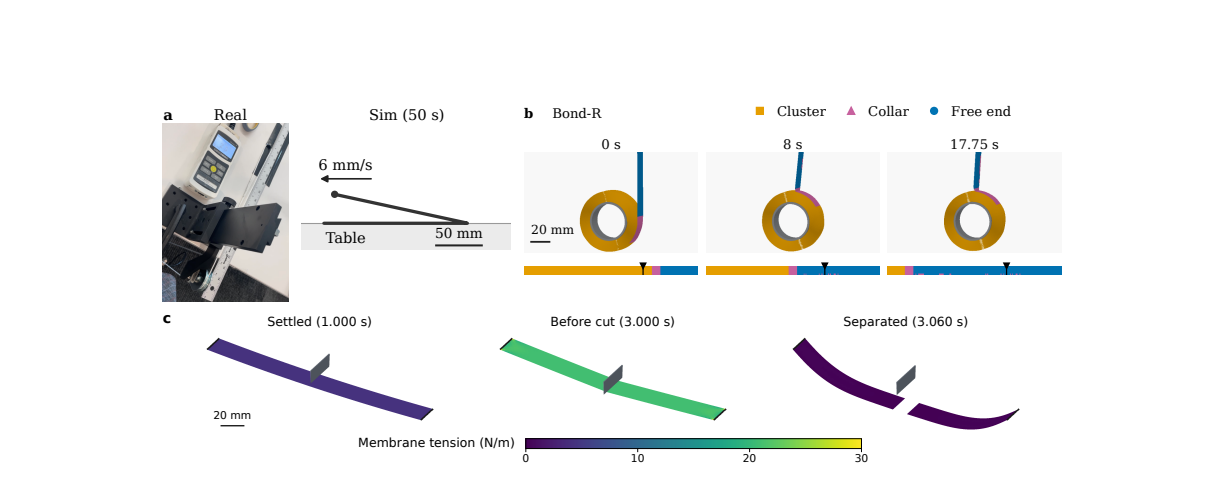
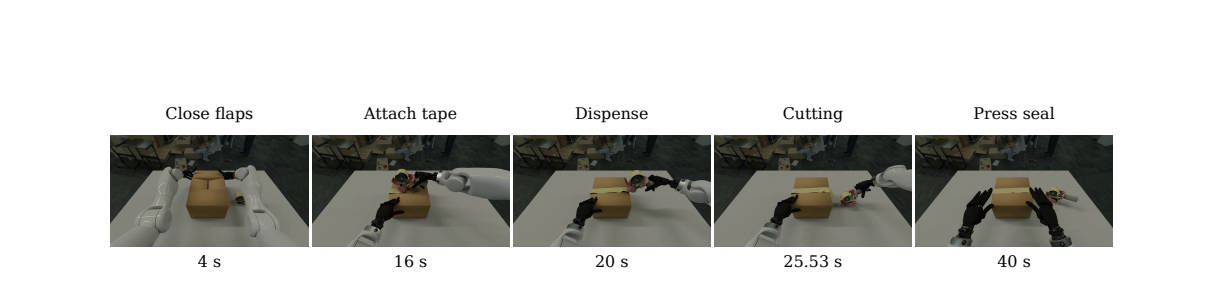
The reduction is compatible with cutting: the pressure-triggered kerf retriangulation runs within the clustered framework, so attachment, dispensing, cutting, and sealing can run as one continuous workflow.
An independent physical measurement (the 2.54 N peel-force calibration) fixes release resistance before testing, because matching aggregate success rates alone cannot calibrate adhesion and can produce coincidental agreement.
The gate threshold (δ = 0.9 mm) and collar size (N = 10) are hand-chosen; a sensitivity sweep over these parameters would show whether the speed/fidelity trade-off is robust or narrowly peaked.
Because the reduction is tied to the payout front rather than the roll's shape, the same mechanism plausibly extends to other wound flexible materials — wire, filament, ribbon — where a tightly wrapped body releases through a localized bend region.
The gap between the fixed-tolerance speedup (3.2–3.4x) and the comparable-motion speedup (4.5–8.4x) indicates clustering largely removes a solver-tolerance bottleneck, so even larger rolls than 32 turns may amplify the advantage.
Check this review
Pith stored no record of this review's passes and took no fingerprint of it. Reviews made by code from 13 Nov 2026 on carry both.
How often reviews like this one are right
Reviews like this one: written by deepseek-v4-flash, where what was read was not recorded.
How often objections from reviews like this one are right: not yet measured
Reviews by people
This review was written by a machine. No person has reviewed this paper on Pith yet. A scientist listed on Pith can review it for a fee, and their review is published here whatever it concludes.
The paper
Abstract
Applying adhesive tape to secure wire harnesses or seal packages requires robots to coordinate a flexible strip, a moving roll, and surfaces that attach and detach. Simulation could make these interactions repeatable for robot development and evaluation, but resolving every adhesive layer is expensive and can suppress roll motion at practical solver tolerances, while a permanently rigid roll cannot release material. We present TapeSim, a tape simulator that concentrates deformation near the unwinding region and along the released strip. We will release the source code. A rigid cluster represents most wound material, while an advancing deformable collar enables payout and leaves released tape flexible and reattachable. Optional releasable bonds simplify adhesive interfaces and reduce mean step times for smaller rolls. Controlled swing tests show improved roll rotation. At 32 turns, clustering gives 3.2-3.4x mean physics-step speedups at a fixed Newton tolerance and 4.5-8.4x for comparable roll motion. Across five real-motion Stick replays, the clustered variants reduce mean image-plane core-landmark error by 23-29% relative to the full-shell cohesive baseline. On 100 paired Peel cases, they improve balanced accuracy from 50% to 72.9-76.3%, with interface rankings varying across tasks. A teleoperated box-sealing sequence demonstrates attachment, dispensing, cutting, and sealing in a continuous workflow.
The paper's own sentences, arranged, kept beside the review and separate from it. Each label is drawn from a closed vocabulary; the number beside it is the probability the classifier gave that label. No sentence in this record was written by a model.
abstract compiled · 2026-09-25
The authors' main claim, as the classifier picked it out 0.40
“We present TapeSim, a tape simulator that concentrates deformation near the unwinding region and along the released strip.”
How the main claim is stated: asserted 1.00
What the abstract itself states, as probabilities: claims first 0.05 · states limitation 0.61 · human participants 0.23 · controlled comparison 0.96 · randomized assignment 0.02 · states quantitative result 0.99 · compares with prior results 0.94 · mentions code or data availability 0.93
The abstract, sentence by sentence
This table labels the abstract only (arXiv listing abstract v1). The number is the probability the classifier gave the label.
| Sentence | Role | The authors' own work | States the main conclusion | Strength |
|---|---|---|---|---|
| Applying adhesive tape to secure wire harnesses or seal packages requires robots to coordinate a flexible strip, a moving roll, and surfaces that attach and detach. | background 1.00 | 0.06 | 0.02 | asserted 0.99 |
| Simulation could make these interactions repeatable for robot development and evaluation, but resolving every adhesive layer is expensive and can suppress roll motion at practical solver tolerances, while a permanently rigid roll cannot release material. | background 0.52 | 0.15 | 0.05 | hedged possibility 0.71 |
| We present TapeSim, a tape simulator that concentrates deformation near the unwinding region and along the released strip. | contribution 0.96 | 0.87 | 0.26 | asserted 1.00 |
| We will release the source code. | future work 0.57 | 0.55 | 0.02 | asserted 0.92 |
| A rigid cluster represents most wound material, while an advancing deformable collar enables payout and leaves released tape flexible and reattachable. | method 0.98 | 0.80 | 0.15 | asserted 1.00 |
| Optional releasable bonds simplify adhesive interfaces and reduce mean step times for smaller rolls. | method 0.87 | 0.77 | 0.06 | asserted 0.78 |
| Controlled swing tests show improved roll rotation. | result 0.99 | 0.92 | 0.10 | asserted 1.00 |
| At 32 turns, clustering gives 3.2-3.4x mean physics-step speedups at a fixed Newton tolerance and 4.5-8.4x for comparable roll motion. | result 1.00 | 0.96 | 0.18 | asserted 1.00 |
| Across five real-motion Stick replays, the clustered variants reduce mean image-plane core-landmark error by 23-29% relative to the full-shell cohesive baseline. | result 1.00 | 0.95 | 0.14 | asserted 1.00 |
| On 100 paired Peel cases, they improve balanced accuracy from 50% to 72.9-76.3%, with interface rankings varying across tasks. | result 1.00 | 0.94 | 0.11 | asserted 1.00 |
| A teleoperated box-sealing sequence demonstrates attachment, dispensing, cutting, and sealing in a continuous workflow. | result 0.54 | 0.89 | 0.08 | asserted 1.00 |
What kind of paper the classifier reports this is: method or tool 1.00 · evidence from simulation or computation 0.84
What was examined, and what was not
Sources read
- arXiv listing abstract v1
Not examined
- full text
- figures and tables
- references and citing sentences
- relations to other papers
Levels run
- P abstract
Not run
- S sections
- T body sentences
- C citations
- R cross-paper relations
How the labels were made
Compiled by classifier-1.13.0 via TypeSafe API, question bank abstract-p1-20260923, 2026-09-25: 1 request, 8,157 input tokens.
Every quoted sentence on this record is the authors'. Every label is from Pith's closed vocabulary, with the probability shown beside it. This record as JSON
Figures (8)
Figures are the authors', reproduced from the paper.
Cited by 1 Pith paper
Reviewed papers on Pith that cite this one. The full citation record
Challenges and discussion
Disagree with the review, or know something it missed? Leave a comment, or challenge this review formally: a challenge becomes a permanent entry in this paper's record, and its decision is published here.
Come back by email
A short list of the week's newly reviewed papers. Nothing is sent until you confirm from your inbox, and every email has a link that stops it. No account.
No comments yet.
Sign in to comment