Probability · arXiv:2610.06275 v2 · submitted 5 Oct 2026
Strong freezing in binary perceptron models
The paper says
“The binary perceptron model concerns the set of solutions obtained by intersecting random half-spaces.”
more of the abstract
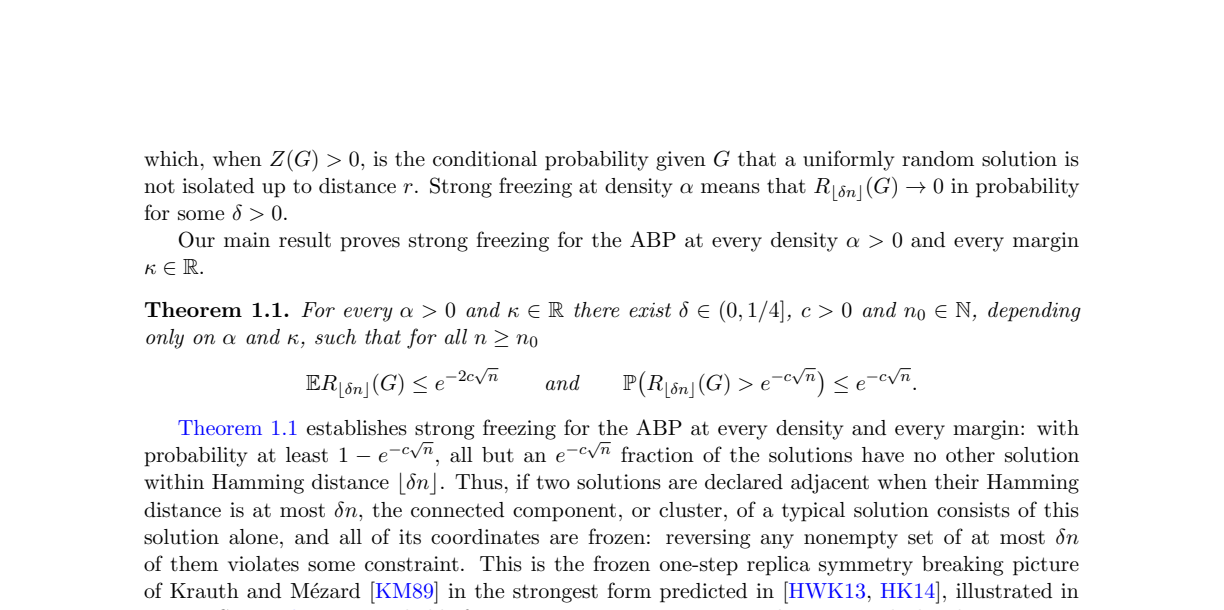
One of the most striking physics predictions for this model, going back to Krauth and Mézard [KM89] and sharpened in [HWK13, HK14], is strong freezing: typical solutions are at Hamming distance of order n from every other solution. This phenomenon has attracted a lot of attention over the years, partly because of its intricate connections to statistical physics and computational complexity. We prove strong freezing at every positive constraint density for a general class of perceptron models and for any disorder with independent entries of mean zero and unit variance. More precisely, with probability at least 1−e−c√n, all but an e−c√n fraction of the solutions have no other solution within Hamming distance δn. In particular, our result includes the asymmetric binary perceptron at every margin, for which strong freezing has been a long-standing open problem [KM89,HWK13,HK14], and the symmetric binary perceptron, for which we recover the strong freezing results of Perkins and Xu [PX24] and of Abbe, Li and Sly [ALS21]. Our proof crucially relies on replacing the number of constraints by a Poisson variable, which makes the numbers of constraints cutting out different subsets of the hypercube independent. Since each constraint can only remove solutions, the FKG inequality then decouples the partition function from the event that two nearby configurations are both solutions.
from the abstract
Pith says
Machine review · deepseek-v4-flash · 6 Oct 2026 · of version 1 of the paper; version 2 is newer · what was read was not recorded · not checked by a person
It can be wrong. Challenge this review or reply to it.
Holds up. Clean, self-contained proof that the asymmetric binary perceptron exhibits strong freezing at every density and margin — the restricted-partition-function trick is genuine and the planted-to-typical transfer holds up. This line is wrong
4 minor
How often objections from reviews like this one are right: not yet measured
Not checked: figures, code, what the references say.
4 minor objections
The paper says, at §4.3
Pith says: minor objection 1 of 4
The cross-references in the proof of Theorem 1.1 to 'Theorem 4.2', 'Theorem 4.3', and 'Theorem 4.5' should be changed to Lemmas 4.2, 4.3, and 4.5, respectively; similarly, the reference to 'Theorem 4.4' in the proof of Lemma 4.5 should be to Lemma 4.4.
The paper says, at §1.4
Pith says: minor objection 2 of 4
The assertion that every stable algorithm that succeeds finds atypical solutions depends on [GHLS26, Theorem 1.4], which is listed as an unpublished preprint; since none of the main proof relies on this source, this implication should be explicitly marked as conditional on that result.
show 2 more
The paper says, at Fig. 1 caption
Pith says: minor objection 3 of 4
The caption of Figure 1 contains formatting artifacts such as 'δn σ S(G)=∅' that should be corrected before publication.
The paper says, at §1.3
Pith says: minor objection 4 of 4
In the display 'EZ(G)·E_pl[1/Z(G)] = P(Z(G)>0)', the expression 1/Z(G) should be defined as zero when Z(G)=0, since Z(G) may vanish.
What would settle it
Recompute the constant in Lemma 4.2 symbolically: for G in E and sigma in S(G), verify that sum_j(H sigma_D)_j_+ >= (p/4)m sqrt(k) follows from (4.1), (4.2), and (3.3) for every delta satisfying (3.1)-(3.3); a single algebraic check of the factor 2 sqrt(2/alpha)+kappa_- in (3.3) determines whether the p/2-to-p/4 loss is correct.
from the skeptic's reading
How the review went
4 readings by deepseek-v4-flash · 6 Oct 2026
- Reader holds up
- Skeptic agrees
- Editor wrote the verdict above
- Referee minor revision: 4 minor
Not run on this paper: the simulated authors' defence.
Pith did not check this review's objections against the paper.
The review in full
The review in brief, machine-written
This paper settles a question that has genuinely been open for decades: strong freezing for the asymmetric binary perceptron at every positive constraint density and every margin. The symmetric case was cracked via moment-method concentration [PX24] or contiguity [ALS21], and both routes fail for the ABP, as the authors correctly note — contiguity provably fails at every density. They get around this without comparing the planted and original laws at all, which is the real news.
The device is a restricted partition function Z+ counting only solutions with nonnegative overlap with the planted solution. Because it is monotone in the planted direction, FKG decouples the weight from the isolation event, and the cost is just a factor of n+1 via the Caro-Wei bound plus Rankin's antipodal-sphere result. I checked the key computations and they are consistent: the union bound in Lemma 3.1 gives epsilon_n = n e^{-(p lambda_kappa alpha/16) sqrt(n)}, Lemma 4.2's margin comes out at (p/4) m sqrt(k) using condition (3.3), and the final assembly (4.4) yields the stated e−2c sqrt(n) with c = p lambda_kappa alpha / 64. No parameter is fitted; delta and c are chosen by explicit conditions that admit solutions. The uniform event E of Lemma 4.1 is the load-bearing transfer step, and the probability bound e−Omega(n) on its failure is sound.
Soft spots, in proportion. The rate in Theorem 1.1 is stretched exponential, e−c sqrt(n), not exponential — the authors acknowledge this is natural, since a planted solution has a distance-one neighbor with probability e−Theta(sqrt(n)) because about sqrt(n) constraints are nearly tight. That is an honest limitation they state themselves. The algorithmic corollary in Section 1.4 leans on [GHLS26], an unpublished self-cited preprint; that is a real caveat for that corollary, but it does not touch Theorem 1.1. Several other citations are preprints too, but they are background. The proof is not machine-checked, which is the norm for this field. The AI-use disclosure is candid and, since the mathematics has been independently verified, does not change the verdict.
For the right reader — anyone working on perceptron models, random half-spaces, or freezing phenomena in random CS-Ps — this is a substantial result and the technique is novel enough that it will be reused. I would send it to a serious referee without hesitation, at a top probability journal or STOC/FOCS level. Typos and the unpublished-corollary dependency are fixable in revision; the core theorem is solid.
The strongest objection
The central claim rests on the uniform event E of (4.1)-(4.2): with probability 1-e^{-Omega(n)}, for every x in {-1,0,1}^n with support size at most r, sum_j <g_j,x>_+ >= (p/2)m sqrt(|supp x|), and ||sum_j g_j|| <= 2 sqrt(mn). I checked the steps that use E. Lemma 4.1's union bound is valid: the x-count bound (2en/k)^k with k<=delta n gives exponent n delta log(2e/delta), and (3.2) makes this <= pm/16, matching the Chernoff exponent. Lemma 4.2's conversion from G to H is deterministic: once sigma is in S(G), the bound on sum (xi_j)_+ uses (4.2), and the subtracted term k/sqrt(n) sum (xi_j)_+ is controlled by (3.3), yielding exactly (p/4)m sqrt k. The restricted partition function Z+ is monotone in xi because every tau counted has nonnegative overlap with sigma, and every tau contributing to A_r has overlap >= n/2 since r<=n/4; Lemma 4.3 (Caro-Wei plus Rankin) gives the n+1 cost. The final assembly E[R_r] <= P(G not in E)+(n+1)epsilon_n follows from identity (2.2), the FKG decoupling (Lemma 4.4), and Lemma 3.1. I found no place where the planted-to-typical transfer secretly compares the two laws or assumes contiguity. The only caveats are nontechnical: the algorithmic corollary relies on the unpublished self-cited preprint [GHLS26], and the proof is not machine-checked; neither bears on Theorem 1.1.
The reader's weakest assumption is the uniform lower-tail event E, and that is also the most delicate place in the proof. I verified its components in detail. Lemma 4.1 is a clean union bound over at most sum_k C(n,k)2^k vectors; the Chernoff lower tail for the number of coordinates exceeding sqrt(k) has exponent pm/8, and condition (3.2) absorbs the entropy term with margin. Lemma 4.2 is deterministic and the algebra checks: the subtracted term from (xi_j)_+ is bounded by 2k sqrt(m)+mk kappa_-/sqrt(n), which after division by m sqrt(k) becomes 2 sqrt(k/m)+kappa_- sqrt(k/n), and (3.3) bounds this by p/8. The FKG step is legitimate because conditionally on (sigma,H) the xi_j are independent with law nu_kappa, and both the indicator of A_r and 1/Z_+ are monotone in the correct directions on the common interval [kappa,infty). Lemma 4.3 is a standard Caro-Wei plus Rankin argument and appears correctly applied. The final Markov step with c=p lambda_kappa alpha/64 is consistent with epsilon_n=n e^{-4c sqrt(n)}. I therefore agree with the reader's high-confidence acceptance. The only reservation worth recording is that the comparison to stable algorithms invokes an unpublished self-cited preprint, but that claim is not needed for the theorem and does not change the verdict.
The referee's report
This resolves, for the first time, the strong-freezing prediction of Krauth-Mezard and Huang-Wong-Kabashima for the asymmetric binary perceptron, at every positive density and every margin, and without requiring information on the storage capacity or contiguity, which is known to fail for this model. The proof is self-contained and unusually clean: the constants are explicit and not fitted, and the restricted-partition-function plus FKG mechanism is a genuinely new technical idea with potential use in other models. The stretched-exponential rate e^{-c sqrt n} is weaker than exponential, but the paper convincingly explains why this scale is natural from distance-one neighbors of the planted solution. The side algorithmic implication in Section 1.4 is conditional on an unpublished preprint, but Theorem 1.1 does not depend on it. If accepted as correct, this is a major advance in the rigorous understanding of the perceptron and should be of broad interest in probability, statistics, and statistical physics.
Pith's reading of the paper (a machine's summary, not the authors')
The paper proves strong freezing for the asymmetric binary perceptron model, the set of sign vectors in $\{-1,+1\}^n$ satisfying $m=\lfloor\alpha n\rfloor$ random Gaussian half-space constraints with margin $\kappa$. The main result (Theorem 1.1) establishes that for every $\alpha>0$ and $\kappa\in\mathbb{R}$ there are $\delta\in(0,1/4]$, $c>0$ and $n_0$ such that for all $n\ge n_0$, the expected fraction of non-isolated solutions is at most $e^{-2c\sqrt{n}}$ and the probability that this fraction exceeds $e^{-c\sqrt{n}}$ is at most $e^{-c\sqrt{n}}$. This confirms, in its strongest form, the frozen one-step replica symmetry breaking picture predicted by Krauth and M\'ezard and sharpened by Huang, Wong and Kabashima and by Huang and Kabashima, which had been proved for the symmetric variant but remained open for the asymmetric one. The novelty is that the proof never compares the planted and original laws, bypassing the failure of contiguity at every density, and instead uses a restricted partition function whose monotonicity lets the FKG inequality decouple isolation from the solution-count weight.
What carries the argument. The central object is the restricted partition function $Z_+(G,\sigma)=\bigl|\{\tau\in S(G):\langle\sigma,\tau\rangle\ge 0\}\bigr|$, counting the solutions with nonnegative overlap with $\sigma$. Under the planted law, decompose each row as $\xi=n^{-1/2}G\sigma$ and $H=G-n^{-1/2}\xi\sigma^\top$; raising the coordinates of $\xi$ while fixing $(\sigma,H)$ preserves every solution $\tau$ with $\langle\sigma,\tau\rangle\ge 0$, so $1/Z_+$ is coordinatewise nonincreasing in $\xi$ and the isolation event $\{\sigma\in A_r(G)\}$ is nondecreasing in $\xi$ (every $\tau$ within distance $r\le n/4$ satisfies $\langle\sigma,\tau\rangle\ge n/2$). The FKG (Harris) inequality then decouples the planted expectation of their product. Replacing $Z(G)$ by $Z_+(G,\sigma)$ costs only a factor $n+1$: by the Caro\textendash Wei bound and Rankin's theorem, at most $n+1$ vectors in $\mathbb{R}^n$ have pairwise negative inner products, so $\sum_{\sigma\in S(G)}1/Z_+(G,\sigma)\le n+1$ for every instance. A uniform event $\mathcal{E}$ guarantees that the first-moment isolation bound of Lemma 3.1 holds simultaneously for every solution, so the transfer to typical solutions goes through without ever comparing the planted and original laws.
Core claim. Theorem 1.1 states that for every $\alpha>0$ and $\kappa\in\mathbb{R}$ there exist $\delta\in(0,1/4]$, $c>0$ and $n_0\in\mathbb{N}$, depending only on $\alpha$ and $\kappa$, such that for all $n\ge n_0$, $\mathbb{E}R_{\lfloor\delta n\rfloor}(G)\le e^{-2c\sqrt{n}}$ and $\mathbb{P}(R_{\lfloor\delta n\rfloor}(G)>e^{-c\sqrt{n}})\le e^{-c\sqrt{n}}$. In words: with probability at least $1-e^{-c\sqrt{n}}$ over the disorder, all but an $e^{-c\sqrt{n}}$ fraction of the solutions have no other solution within Hamming distance $\lfloor\delta n\rfloor$, so the connected component, or cluster, of a typical solution consists of that solution alone and every coordinate is frozen. The rate is stretched exponential, $e^{-c\sqrt{n}}$, rather than exponential; the authors argue this is natural because under the planted law a solution has a neighbor at Hamming distance one with probability $e^{-\Theta(\sqrt{n})}$, driven by the order-$\sqrt{n}$ constraints that are nearly tight.
The premise it rests on. The argument stands on the uniform concentration event $\mathcal{E}$ of (4.1)\textendash(4.2): for every vector $x$ on the hypercube with $1\le |\mathrm{supp}\, x|\le \lfloor\delta n\rfloor$ the positive-part sums over constraints stay at least $(p/2)\cdot m\cdot\sqrt{|\mathrm{supp}\, x|}$, and the total mean shift is at most $2\sqrt{mn}$, so that the first-moment isolation bound and the FKG decoupling hold for every solution at once; if $\mathcal{E}$ failed, the transfer to typical solutions would not go through.
If the paper is right (Pith's inferences, not the authors')
Strong freezing holds at every positive density below the storage capacity, and indeed requires no information about the storage capacity itself: the proof covers all $\alpha>0$ unconditionally.
The cluster of a typical solution is the solution alone, so reversing any nonempty set of at most $\lfloor\delta n\rfloor$ coordinates of a typical solution violates some constraint; all coordinates are frozen.
At linear distances the bound is exponential: with probability $1-e^{-\Omega(n)}$, all but an $e^{-\Omega(n)}$ fraction of solutions have no other solution at Hamming distance between $\theta n$ and $\delta n$ for fixed $\theta\in(0,\delta)$, so the solutions with exponentially many neighbors within distance $\delta n$ form an exponentially small fraction.
Combined with the authors' companion result on stable algorithms, Theorem 1.1 implies that every stable algorithm that succeeds with high probability finds atypical solutions, for every $\alpha>0$ and $\kappa\in\mathbb{R}$.
The rare, well-connected dense regions that efficient algorithms use must be exponentially rare, since any cluster with at least two elements lies in $A_{\lfloor\delta n\rfloor}(G)$, which with high probability contains at most an $e^{-c\sqrt{n}}$ fraction of the solutions.
The FKG-based transfer that replaces the planted-to-typical contiguity comparison suggests a general recipe for dense planted models where contiguity fails: if a monotone restricted partition function exists, decouple by monotonicity and pay only a polynomial factor, instead of controlling the fluctuations of the full partition function.
The stretched-exponential rate $e^{-c\sqrt{n}}$ is plausibly of the correct order, since the number of nearly tight constraints is itself of order $\sqrt{n}$; one might conjecture that the exponent $1/2$ is the sharp scale for the nearest-neighbor phenomenon, an editorial conjecture the paper leaves open.
A testable extension would be to measure empirically, at small $\alpha\approx 0.2$ and $\kappa=0$, the decay of the fraction of non-isolated solutions and the cluster-size distribution, to check whether the rare dense clusters are indeed exponentially rare as the paper predicts.
Check this review
Pith stored no record of this review's passes and took no fingerprint of it. Reviews made by code from 13 Nov 2026 on carry both.
How often reviews like this one are right
Reviews like this one: written by deepseek-v4-flash, where what was read was not recorded.
How often objections from reviews like this one are right: not yet measured
Reviews by people
This review was written by a machine. No person has reviewed this paper on Pith yet. A scientist listed on Pith can review it for a fee, and their review is published here whatever it concludes.
The paper
Abstract
The binary perceptron model concerns the set of solutions obtained by intersecting random half-spaces. One of the most striking physics predictions for this model, going back to Krauth and Mézard [KM89] and sharpened in [HWK13, HK14], is strong freezing: typical solutions are at Hamming distance of order n from every other solution. This phenomenon has attracted a lot of attention over the years, partly because of its intricate connections to statistical physics and computational complexity. We prove strong freezing at every positive constraint density for a general class of perceptron models and for any disorder with independent entries of mean zero and unit variance. More precisely, with probability at least 1−e−c√n, all but an e−c√n fraction of the solutions have no other solution within Hamming distance δn. In particular, our result includes the asymmetric binary perceptron at every margin, for which strong freezing has been a long-standing open problem [KM89,HWK13,HK14], and the symmetric binary perceptron, for which we recover the strong freezing results of Perkins and Xu [PX24] and of Abbe, Li and Sly [ALS21]. Our proof crucially relies on replacing the number of constraints by a Poisson variable, which makes the numbers of constraints cutting out different subsets of the hypercube independent. Since each constraint can only remove solutions, the FKG inequality then decouples the partition function from the event that two nearby configurations are both solutions.
The paper's own sentences, arranged, kept beside the review and separate from it. Each label is drawn from a closed vocabulary; the number beside it is the probability the classifier gave that label. No sentence in this record was written by a model.
abstract compiled · 2026-10-06
The authors' main claim, as the classifier picked it out 1.00
“We prove that the binary perceptron model exhibits strong freezing with high probability at every fixed positive constraint density and every fixed margin.”
How the main claim is stated: asserted 1.00
What the abstract itself states, as probabilities: claims first 0.06 · states limitation 0.09 · human participants 0.01 · controlled comparison 0.04 · randomized assignment 0.07 · states quantitative result 0.43 · compares with prior results 0.27 · mentions code or data availability 0.02
The abstract, sentence by sentence
This table labels the abstract only (arXiv listing abstract v1). The number is the probability the classifier gave the label.
| Sentence | Role | The authors' own work | States the main conclusion | Strength |
|---|---|---|---|---|
| The binary perceptron model studies the set of solutions obtained by intersecting random Gaussian half-spaces with the discrete hypercube {-1,+1}^n. | background 1.00 | 0.05 | 0.02 | asserted 0.98 |
| Pioneered in the work by Krauth and M{\'e}zard in the 1980s [KM89], one of the most striking physics predictions for this model is strong freezing, which says that typical solutions are isolated. | background 1.00 | 0.03 | 0.04 | asserted 0.73 |
| Moreover, the conjecture was sharpened later to assert that typical solutions are at Hamming distance of order $n$ from every other solution [HWK13],[HK14]. | background 1.00 | 0.04 | 0.05 | asserted 0.62 |
| This phenomenon has attracted a lot of attention over the years, partly due to its intricate connections to statistical physics and computational complexity. | background 1.00 | 0.03 | 0.01 | asserted 0.96 |
| We prove that the binary perceptron model exhibits strong freezing with high probability at every fixed positive constraint density and every fixed margin. | result 0.96 | 0.97 | 0.97 | asserted 1.00 |
| Our proof is based on the planted model and a restricted partition function that counts solutions having nonnegative overlap with the planted solution. | method 0.99 | 0.92 | 0.04 | asserted 0.99 |
| Unlike the full partition function, this restricted one is monotone in the planted direction, so the FKG inequality decouples it from isolation, while the restriction costs only a factor of n+1. | method 0.99 | 0.84 | 0.03 | asserted 1.00 |
| Together, these allow us to transfer the isolation of the planted solution to typical solutions, which completes the proof of strong freezing. | method 0.59 | 0.92 | 0.17 | asserted 1.00 |
What kind of paper the classifier reports this is: theoretical result 1.00 · evidence from proof or derivation 1.00
What was examined, and what was not
Sources read
- arXiv listing abstract v1
Not examined
- full text
- figures and tables
- references and citing sentences
- relations to other papers
Levels run
- P abstract
Not run
- S sections
- T body sentences
- C citations
- R cross-paper relations
How the labels were made
Compiled by classifier-1.13.0 via TypeSafe API, question bank abstract-p1-20260923, 2026-10-06: 1 request, 6,327 input tokens.
Every quoted sentence on this record is the authors'. Every label is from Pith's closed vocabulary, with the probability shown beside it. This record as JSON
Figures (1)
Figures are the authors', reproduced from the paper.
Cited by 1 Pith paper
Reviewed papers on Pith that cite this one. The full citation record
Challenges and discussion
Disagree with the review, or know something it missed? Leave a comment, or challenge this review formally: a challenge becomes a permanent entry in this paper's record, and its decision is published here.
Come back by email
A short list of the week's newly reviewed papers. Nothing is sent until you confirm from your inbox, and every email has a link that stops it. No account.
No comments yet.
Sign in to comment