Strongly Correlated Electrons · arXiv:2610.28472 v1 · submitted 20 Oct 2026 · 43 references
Sum-over-poles framework for quantum embedding to approach the real-frequency axis
The paper says
“We introduce a real-frequency framework for the quantum embedding of solids, based on sum-over-poles (SOP) representations. We partition the lattice into periodically repeated interacting fragments and derive an embedded Dyson equation for the fragment, to be solved self-consistently.”
more of the abstract
The resulting scheme generalizes the algorithmic-inversion method of our previous work to interacting Hamiltonians and is closely related to dynamical mean-field theory (DMFT), especially when an extended impurity problem is introduced. By exploiting the compact pole expansion of the embedding potential, we carry out the self-consistent procedure close to the real axis, which avoids ill-posed analytic continuation. In addition, the SOP representation allows us to introduce a pole-and-residue dynamics, which we use to reach the self-consistent solution. After deriving the method, we benchmark it against exact-diagonalization implementations of DMFT on the one-dimensional Hubbard ring at half filling. The framework offers a natural route to real-space dynamical quantum embedding, for periodic systems as well as for strongly correlated defects in materials.
from the abstract
Pith says
Machine review · deepseek-v4-flash · 21 Oct 2026 · what was read was not recorded · not checked by a person
It can be wrong. Challenge this review or reply to it.
Holds up, with conditions. A real-frequency DMFT-style embedding loop built on sum-over-poles with a genuinely new pole-residue gradient dynamics; the imaginary-axis plumbing is externally benchmarked, but the real-frequency validation is self-referential and the thermodynamic claim outruns the data. This line is wrong
3 major objections · 5 minor
How often objections from reviews like this one are right: not yet measured
Not checked: figures, code, what the 43 references say.
The paper says, at Sec. III A, Fig. 3
The review did not quote this passage.
Pith says: Objection 1 of 3 · major
The black 'imaginary' reference curves in Fig. 3 are plotted as Im G_loc(omega-i0.1), but the manuscript never states how the converged imaginary-axis solution was turned into this real-frequency object. If these curves are obtained by direct rational evaluation at omega-i0.1 of the converged bi-Lanczos/SOP data, then the reference is a second variant of the same M-pole approximation and Fig. 3 …
more of objection 1
… provides no external spectral ground truth; if they instead come from a numerical analytic continuation of Matsubara data, the comparison uses exactly the ill-posed step the method is designed to avoid (Sec. II B). This distinction is load-bearing because the central claim that the erf path 'reproduces the dominant spectral features' (b154) is supported only by this comparison. Please state the construction explicitly and add at least one independent real-frequency reference for the same model: for example a higher-M calculation within this formalism, a DMRG/MPS impurity solver, a CT-HYB-plus-MaxEnt spectrum, or the known Bethe-ansatz spectral features of the 1D Hubbard model.
The paper says, at Sec. III A, b29/b154
The review did not quote this passage.
Pith says: Objection 2 of 3 · major
The claim that compact pole expansions 'reproduce the dominant spectral features' is not supported quantitatively. For U/t=4 and 7 the deviations between erf-path and reference grow with U and are concentrated in the high-energy features (b127-b129, b155), which carry most of the spectral weight at strong coupling; the authors acknowledge this eta- and M-dependence, but no integral measure (relative spectral …
more of objection 2
… weight per band, spectral moments, sum rule integral of Im G = -pi, or charge-gap estimate) is reported, so 'dominant' remains a qualitative judgment. In addition, there is no eta-to-0 series and no M>=10 calculation, so the advertised advantage of approaching the real-frequency axis in a controlled way is not demonstrated. I would like to see a quantitative error measure as a function of eta and M for each U, plus at least one comparison against an independent spectral reference (e.g., the exact charge gap or high-quality spectra available for the 1D Hubbard model).
The paper says, at Abstract and Sec. I, b29
The review did not quote this passage.
Pith says: Objection 3 of 3 · major
Sentence b29 claims that 'compact pole expansions suffice to recover the essential spectral and thermodynamic features of the model', but no thermodynamic observable is computed or plotted anywhere in Sec. III: there is no double occupancy, kinetic energy, total energy, or any frequency-integrated check beyond the enforced particle number.
more of objection 3
The converged auxiliary ground state of Eq. (7) makes such quantities essentially free to compute, so they should either be reported and compared with the imaginary-axis values, which would directly test the claim, or the word 'thermodynamic' should be removed from the abstract and Sec. I.
5 minor objections
The paper says, at Sec. II A and Appendix A
Pith says: minor objection 1 of 5
The equivalence between the auxiliary local Green's function and the embedded Dyson equation is stated in Sec. II A without qualification, while Appendix A shows it requires the Luttinger-Ward/Klein functional premise (Eqs. A1-A3, b171-b172). A sentence in the main text signaling this condition would help the reader, since the algebraic mapping v_emb = V R^{-1} V^dagger is exact, whereas the equality of self-energies is conditional on that standard, cited premise.
The paper says, at Eq. (11) and Sec. II B
Pith says: minor objection 2 of 5
The cost function in Eq. (11) does not specify the integration domain (real axis with the z(omega) substitution, or the erf contour) or the discretization used inside the self-consistent loop; the same applies to the gradient in Eq. (13). The later statement in Sec. II C that real poles and positive scalar residues are used implies a constraint on the minimization that should be stated where Eq. (11) is defined.
show 3 more
The paper says, at Fig. 4(a,c)
Pith says: minor objection 3 of 5
The caption of Fig. 4 states that ratios sigma_k/sigma_Ref and Gamma_k/Gamma_Ref are shown, but it is not stated which plotted trajectories are poles and which are residues; a legend or explicit labeling would remove the ambiguity.
The paper says, at Ref. [36]
Pith says: minor objection 4 of 5
The code is cited only as a public GitHub page; a versioned archive or DOI would make the reproducibility claim in Sec. II C checkable.
The paper says, at Sec. II B and Sec. III A
Pith says: minor objection 5 of 5
Minor wording issues: 'constant throwout the self-consistent cycle' should read 'throughout', and 'in perfect agreement to ED-DMFT' should read 'agreement with ED-DMFT'.
What would settle it
Reconstruct Fig. 3(c) from the announced code: converge the imaginary-axis DMFT loop at U/t=7, M=8 on the 1000-site ring, then evaluate G_loc(ω−iλ), λ/t=0.1, directly from converged pole data — the bi-Lanczos continued-fraction poles and residues for G_imp and the SOP v_emb entering the lattice sum in Eq. (9) — with no Padé or MaxEnt step, and compare Hubbard-band peak positions, gap edges, and the L2 distance on [-4t,4t] against the erf-path M=8 curves at η/t=0.5–2. Repeat the same reference construction at M=12. If the black curve cannot be reproduced by direct evaluation, the benchmark is uncontrolled. If the M=12 reference shifts spectral features by more than the η-family spread of Fig.
from the skeptic's reading
How the review went
4 readings by deepseek-v4-flash · 21 Oct 2026
- Reader holds up, with conditions
- Skeptic partly agrees
- Editor wrote the verdict above
- Referee major revision: 3 major objections, 5 minor
Not run on this paper: the simulated authors' defence.
Pith did not check this review's objections against the paper.
The review in full
The review in brief, machine-written
Two things worth knowing about this paper. First, it delivers a DMFT-style embedding self-consistency loop run directly on the erf contour z(ω)=ω+iη erf(ω), with v_emb represented as a sum of poles; this is a coherent route to real-frequency spectra without analytic continuation. Second, and the more interesting piece, the pole-and-residue gradient dynamics of Sec. III B: one gradient step of the fitting cost per self-consistency cycle, replacing full minimization, converges to the same solution as full fitting at M=8, U/t=7. That the embedding loop itself drives the SOP parameters is a genuine algorithmic result, and it is the part most clearly not present in the authors' prior work.
The formal skeleton is standard and honestly labeled. The embedded Dyson equation is the usual Schur complement, and the auxiliary mapping is the ED-DMFT discretized bath, both credited to earlier work. The imaginary-axis benchmark against Ref. [37] (Fig. 2, U/t=1,4) is real external support for the solver plumbing. Appendix A's Luttinger-Ward argument is the standard locality hypothesis of DMFT, credited to [41,42]; fine for a methods paper.
The soft spots are all in the real-frequency validation. Fig. 3 compares erf-path results only against the authors' own imaginary-axis curves at the same bath size, and the text never says how those reference curves were produced. Direct evaluation of the converged pole data on ω−iλ would be legitimate; numerical continuation would be exactly the ill-posed procedure the method claims to avoid. At U/t=7 there is no independent reference at all, and the disagreements that do appear concentrate in the high-energy Hubbard bands, which carry most of the spectral weight for U/t=4 and 7. So the claim that compact poles reproduce the dominant features is weakest where the weight is largest. The authors acknowledge that the η- and M-dependence is confined to high energy, but the conclusion still leans on that claim. Also, the abstract's "spectral and thermodynamic features" (b29) overstates what is shown: no thermodynamic observable is computed, particle number being fixed analytically at half filling. No M≥10 or η→0 trend is reported, and the announced code has no locator, so the comparison is not reproducible as written.
None of this is a demonstrated error, and none breaks the central algorithmic idea. What is missing is one independent spectral reference at U/t=7 and a sentence describing how the imaginary-axis curves in Fig. 3 were obtained. This paper is for DMFT and embedding practitioners who care about real-frequency spectra and alternatives to analytic continuation; it deserves a serious referee, with the expectation that the validation section gets strengthened.
The strongest objection
The central claim — compact pole expansions on the erf contour reproduce the dominant spectral features without analytic continuation (b154, b159) — is validated only against imaginary-axis ED-DMFT curves that share the same solver and the same bath size, and the strongest case (U/t=7) has no external reference at all. Fig. 2 checks the implementation on the imaginary axis against published ED-DMFT [37] for U/t=1,4, which validates the solver plumbing, not the new real-frequency step. Fig. 3's black 'imaginary' curves must be G_loc(ω−iλ) of the converged imaginary-axis solution, but the text never states whether these were obtained by direct rational evaluation of the bi-Lanczos pole data (legitimate) or by a numerical analytic continuation of Matsubara data (ill-posed, precisely what the method claims to avoid). The disagreements between erf-path and reference grow with U and concentrate in the high-energy Hubbard bands (b127-b129, b155), which carry most of the spectral weight for U/t=4,7; the claim that 'dominant' features are reproduced is therefore weakest exactly where the weight is largest. There is no M≥10 result, no η→0 trend, and no independent spectral reference (higher-M ED, CT-HYB plus MaxEnt, DMRG, or Bethe-ansatz-derived 1D features) anywhere. In addition, b29 asserts that compact pole expansions recover essential spectral and thermodynamic features, yet no thermodynamic observable (double occupancy, kinetic energy, total energy) is computed or plotted; particle number is fixed analytically at half filling (b100). The announced code [36] has no locator in the manuscript, so the comparison is not independently reproducible as written. These are validation-gap concerns rather than demonstrated errors, but as they stand the central quantitative claim is supported only by agreement between two variants of the same ED-DMFT approximation at the same bath size.
The paper's constructive content — embedded Dyson equation (5), SOP auxiliary mapping (7), self-consistency via Eqs. (9)-(11) on the erf contour (12) — is a real-frequency formulation of ED-DMFT, and the algebraic mapping v_emb = V R^{-1} V^dagger is exact. On the imaginary axis the code reproduces a published ED-DMFT implementation (Fig. 2 compared with Ref [37]), and Sec. III B shows that two very different optimization trajectories converge to the same solution at M=8, both real points in its favor. I cannot make the reader's weakest assumption my main attack: the Appendix A equality Sigma11 = Sigma_aux^F rests on the standard Klein/Luttinger-Ward argument of DMFT, explicitly credited to published sources ([41], [42], [13]); a failure there would equally undermine conventional ED-DMFT rather than this paper alone, and no use outside the sources' stated hypotheses is apparent. The genuinely load-bearing soft spot is empirical: the paper's new claim (real-frequency spectral features on the erf contour) is compared only with the same solver at the same bath size, the construction of the reference curves is unstated, no independent spectral reference exists for U/t=7, and the thermodynamic features asserted in b29 are never computed. These gaps do not demonstrate a wrong result; they show that the central validation is currently self-referential. That keeps the manuscript at CONDITIONAL — the reader's verdict — so I recommend UNCHANGED, with the conditions sharpened: specify the reference construction, add an independent real-frequency reference (e.g., larger-M ED or CT-HYB plus MaxEnt) at U/t=7, report an η- and M-convergence trend, supply the code locator, and show the thermodynamic quantities claimed in b29. Because the weakest link I identify is the validation chain rather than the Appendix A formalism, my agreement with the reader is partial.
The referee's report
If the method performs as claimed, it offers a practical route to spectral quantities from DMFT-like embedding without analytic continuation, and the SOP parameterization together with the pole-residue dynamics is a useful algorithmic contribution. The paper's strengths are: (i) a clean, mostly algebraic derivation of the auxiliary mapping, with the self-energy equality stated conditionally on a standard functional premise in Appendix A; (ii) an external check of the imaginary-axis implementation against an independent ED-DMFT code (Fig. 2, U/t=1 and 4); and (iii) an open-source implementation (Sec. II C, Ref. [36]). The main open risk is empirical: the headline real-frequency claim is validated only against the authors' own imaginary-axis calculation, with no independent real-frequency reference, no quantitative error metric, and no thermodynamic observable, so the accuracy of the new step is not yet established. The disagreement structure in Fig. 3, which is maximal in the high-energy Hubbard bands where most spectral weight sits for U/t=4 and 7, is exactly where an independent reference would matter most.
Pith's reading of the paper (a machine's summary, not the authors')
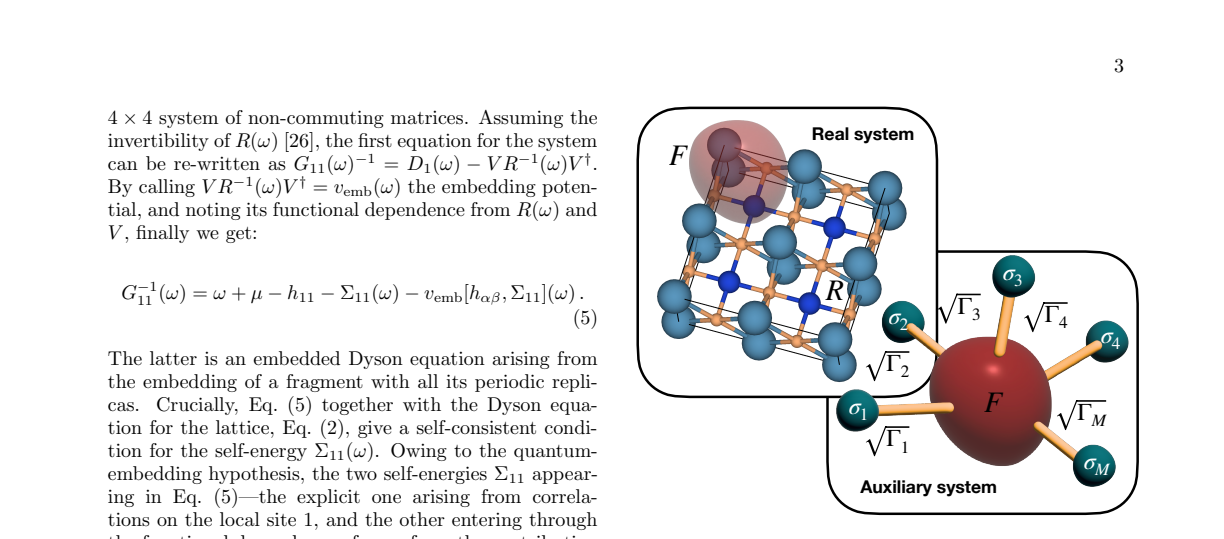
This paper aims to let dynamical quantum embedding run directly on the real frequency axis instead of on the imaginary axis, where spectral information is only recoverable through ill-posed analytic continuation. Its device is a sum-over-poles (SOP) representation of the frequency-dependent embedding potential: each pole becomes a fictitious non-interacting bath site, so the embedded Dyson equation for the interacting fragment turns into a small auxiliary Hamiltonian solvable by exact diagonalization. The self-consistency loop is then executed along the erf path $z(\omega) = \omega + i\eta\operatorname{erf}(\omega)$, a contour hugging the real axis, so densities of states emerge without a continuation step. On the half-filled 1000-site Hubbard ring at $U/t = 1, 4, 7$, six to eight poles already reproduce the dominant spectral features, with the residual dependence on the contour distance and pole count confined to high-energy parts of the spectrum. The authors further show that moving the poles and residues along minus the gradient of the fitting cost achieves the same converged solution, so a full fit is not required for self-consistency.
What carries the argument. Two objects carry the argument. The first is the sum-over-poles (SOP) representation of the embedding potential, $v_{\mathrm{emb}}(\omega) = \sum_m \Gamma_m/(\omega - \sigma_m)$, a compact rational form: its poles become the energies of fictitious non-interacting bath sites and its residues, factorized as $\Gamma_m = V_m \bar{V}_m^\dagger$, set the fragment-bath couplings, so the frequency-by-frequency Dyson equation is replaced by an auxiliary Hamiltonian (Eq. 7) that can be solved once by exact diagonalization. The second is the erf path $z(\omega) = \omega + i\eta\operatorname{erf}(\omega)$, a complex-frequency contour with a bounded imaginary part that lingers near the real axis, where spectral weight lives; evaluating all dynamical quantities there bypasses analytic continuation from the imaginary axis. A third, optional element is the pole-and-residue dynamics: instead of fully minimizing the fitting cost function (Eq. 11) at every cycle, the algorithm moves poles and residues along a single gradient step of the cost, and this suffices to reach the same converged solution.
Core claim. The paper's central claim is that the embedded Dyson equation $G_{11}^{-1} = \omega + \mu - h_{11} - \Sigma_{11} - v_{\mathrm{emb}}$, obtained by partitioning a periodic lattice into interacting fragments and assuming a block-diagonal local self-energy, can be solved self-consistently in real frequency when the embedding potential is written as a sum over poles $v_{\mathrm{emb}}(\omega) = \sum_m \Gamma_m/(\omega - \sigma_m)$. The SOP form is not just a fitting device: it defines an auxiliary free-energy operator in which the interacting fragment is coupled to non-interacting bath sites, with the pole positions $\sigma_m$ as bath energies and the factorized residues $\Gamma_m = V_m \bar{V}_m^\dagger$ as fragment-bath couplings. Appendix A proves that this auxiliary system's local Green's function satisfies the same embedded Dyson equation, so at the self-consistent fixed point the fragment Green's function coincides with the lattice-local Green's function. On the imaginary axis the implementation reproduces ED-DMFT exactly, and on the erf path the compact expansions reproduce the dominant spectral features of the half-filled 1000-site Hubbard ring at $U/t = 1, 4, 7$; the dependence on contour distance $\eta$ and pole number $M$ is concentrated in the high-energy part of the spectrum and grows with interaction strength, while low-energy features stay robust.
The premise it rests on. The entire self-consistency loop closes only because the self-energy of the periodic lattice and the self-energy of the small auxiliary fragment-plus-bath system are assumed to be the same functional of the same non-interacting local propagator; this equality is imported from the Luttinger-Ward/Klein functional formalism the paper cites (Appendix A, following Refs. [41, 42]), and if that diagrammatic premise fails, the two self-energies drift apart and the embedded Dyson equation no longer has the fixed point the algorithm seeks.
If the paper is right (Pith's inferences, not the authors')
On the imaginary axis the new self-consistent loop coincides exactly with ED-DMFT, giving a validated base from which the erf-axis results follow.
On the erf axis, $M = 6$ to $8$ poles reproduce the dominant spectral features of the half-filled 1000-site Hubbard ring for $U/t = 1, 4, 7$, with low-energy features (about $0 \le \omega/t \lesssim 2$) robust to both contour distance $\eta$ and pole count $M$, and only high-energy features sensitive to them.
Because the auxiliary system is just an interacting fragment plus a finite non-interacting bath, the framework can use any impurity solver, exact diagonalization here and tensor-network methods in principle, and the same construction generalizes to off-diagonal inter-fragment self-energies and to strongly correlated defects in solids.
A single gradient step on poles and residues per cycle converges to the same fixed point as full cost-function minimization, which means the embedding loop itself, not the fitting, drives convergence; at $M = 6$ the solution is only qualitatively right, while $M = 8$ gives quantitative agreement.
Working on the erf path gives direct access to real-frequency spectral quantities, avoiding the ill-posed analytic continuation that standard imaginary-axis DMFT implementations require.
Treating poles and residues as variational parameters opens a route the paper only gestures at: if the self-consistency fixed point can be reformulated as the minimum of a functional of the SOP parameters, frequency sampling could be bypassed entirely and replaced by direct optimization of a finite-dimensional rational representation.
The error pattern the paper reports, with $\eta$- and $M$-dependence concentrated at high energy and growing with $U$, suggests a testable extension: allocate poles adaptively where the embedding potential varies fastest, near the Hubbard bands, to reduce the pole count needed at strong coupling.
The Appendix A equality is the fragile link: any impurity solver or formulation in which the two-body interaction is not strictly local to the fragment breaks the identification of the self-energy functionals, so multi-orbital and screened-interaction extensions need to re-check the closure, not just the algebraic mapping $v_{\mathrm{emb}} = V R^{-1} V^\dagger$, which remains exact.
Since the erf path is a one-parameter family of contours approaching the real axis as $\eta \to 0^+$, the framework suggests a convergence diagnostic: run the same calculation at decreasing $\eta$; genuine spectral features should stabilize while spurious ones shift, giving an intrinsic error bar for the reported spectra.
Check this review
Pith stored no record of this review's passes and took no fingerprint of it. Reviews made by code from 13 Nov 2026 on carry both.
How often reviews like this one are right
Reviews like this one: written by deepseek-v4-flash, where what was read was not recorded.
How often objections from reviews like this one are right: not yet measured
Reviews by people
This review was written by a machine. No person has reviewed this paper on Pith yet. A scientist listed on Pith can review it for a fee, and their review is published here whatever it concludes.
The paper
Abstract
We introduce a real-frequency framework for the quantum embedding of solids, based on sum-over-poles (SOP) representations. We partition the lattice into periodically repeated interacting fragments and derive an embedded Dyson equation for the fragment, to be solved self-consistently. The resulting scheme generalizes the algorithmic-inversion method of our previous work to interacting Hamiltonians and is closely related to dynamical mean-field theory (DMFT), especially when an extended impurity problem is introduced. By exploiting the compact pole expansion of the embedding potential, we carry out the self-consistent procedure close to the real axis, which avoids ill-posed analytic continuation. In addition, the SOP representation allows us to introduce a pole-and-residue dynamics, which we use to reach the self-consistent solution. After deriving the method, we benchmark it against exact-diagonalization implementations of DMFT on the one-dimensional Hubbard ring at half filling. The framework offers a natural route to real-space dynamical quantum embedding, for periodic systems as well as for strongly correlated defects in materials.
The paper's own sentences, arranged, kept beside the review and separate from it. Each label is drawn from a closed vocabulary; the number beside it is the probability the classifier gave that label. No sentence in this record was written by a model.
abstract compiled · 2026-10-21
The authors' main claim, as the classifier picked it out 0.92
“The framework offers a natural route to real-space dynamical quantum embedding, for periodic systems as well as for strongly correlated defects in materials.”
How the main claim is stated: asserted 0.85
What the abstract itself states, as probabilities: claims first 0.05 · states limitation 0.11 · human participants 0.01 · controlled comparison 0.45 · randomized assignment 0.01 · states quantitative result 0.05 · compares with prior results 0.94 · mentions code or data availability 0.02
The abstract, sentence by sentence
This table labels the abstract only (arXiv listing abstract v1). The number is the probability the classifier gave the label.
| Sentence | Role | The authors' own work | States the main conclusion | Strength |
|---|---|---|---|---|
| We introduce a real-frequency framework for the quantum embedding of solids, based on sum-over-poles (SOP) representations. | contribution 1.00 | 0.95 | 0.17 | asserted 1.00 |
| We partition the lattice into periodically repeated interacting fragments and derive an embedded Dyson equation for the fragment, to be solved self-consistently. | method 0.97 | 0.95 | 0.06 | asserted 1.00 |
| The resulting scheme generalizes the algorithmic-inversion method of our previous work to interacting Hamiltonians and is closely related to dynamical mean-field theory (DMFT), especially when an extended impurity problem is introduced. | interpretation 0.45 | 0.60 | 0.10 | asserted 0.99 |
| By exploiting the compact pole expansion of the embedding potential, we carry out the self-consistent procedure close to the real axis, which avoids ill-posed analytic continuation. | method 0.95 | 0.93 | 0.18 | asserted 1.00 |
| In addition, the SOP representation allows us to introduce a pole-and-residue dynamics, which we use to reach the self-consistent solution. | method 0.95 | 0.94 | 0.07 | asserted 0.97 |
| After deriving the method, we benchmark it against exact-diagonalization implementations of DMFT on the one-dimensional Hubbard ring at half filling. | method 0.87 | 0.96 | 0.07 | asserted 0.98 |
| The framework offers a natural route to real-space dynamical quantum embedding, for periodic systems as well as for strongly correlated defects in materials. | interpretation 0.95 | 0.48 | 0.48 | asserted 0.85 |
What kind of paper the classifier reports this is: method or tool 1.00 · evidence from simulation or computation 0.64
What was examined, and what was not
Sources read
- arXiv listing abstract v1
Not examined
- full text
- figures and tables
- references and citing sentences
- relations to other papers
Levels run
- P abstract
Not run
- S sections
- T body sentences
- C citations
- R cross-paper relations
How the labels were made
Compiled by classifier-1.13.0 via TypeSafe API, question bank abstract-p1-20260923, 2026-10-21: 1 request, 5,609 input tokens.
Every quoted sentence on this record is the authors'. Every label is from Pith's closed vocabulary, with the probability shown beside it. This record as JSON
Figures (4)


Figures are the authors', reproduced from the paper.
References (43)
- [37] M. Capone, M. Civelli, S. S. Kancharla, C. Castellani, and G. Kotliar, Phys. Rev. B69, 195105 (2004) on Pith
- [36] A. Carbone, “sop lake: a computational framework for 11 dynamical quantum embedding based on sum-over-poles representations,” (2026), public GitHub repository on Pith
- [1] M. Imada, A. Fujimori, and Y. Tokura, Rev. Mod. Phys. 70, 1039 (1998) on Pith
- [2] J. Sch¨ afer, D. Schrupp, E. Rotenberg, K. Rossnagel, H. Koh, P. Blaha, and R. Claessen, Phys. Rev. Lett. 92, 097205 (2004) on Pith
- [3] E. S. Sørensen and I. Affleck, Phys. Rev. B53, 9153 (1996) on Pith
- [4] Y. Cao, V. Fatemi, S. Fang, K. Watanabe, T. Taniguchi, E. Kaxiras, and P. Jarillo-Herrero, Nature556, 43 (2018) on Pith
- [5] W. Kohn and L. J. Sham, Physical Review140, 1133 (1965) on Pith
- [6] G. Knizia and G. K.-L. Chan, Journal of Chemical The- ory and Computation9, 1428 (2013), pMID: 26587604, https://doi.org/10.1021/ct301044e on Pithdoi:10.1021/ct301044e
- [7] S. Wouters and C. A. Jimen, J. Chem. Theory Comput. (2016) on Pith
- [8] P. V. Sriluckshmy, M. Nusspickel, E. Fertitta, and G. H. Booth, Phys. Rev. B103, 085131 (2021) on Pith
- [9] S. Chen, V. W.-z. Yu, Y. Jin, M. Govoni, and G. Galli, Journal of Chemical Theory and Com- putation21, 7797 (2025), pMID: 40802497, https://doi.org/10.1021/acs.jctc.5c00559 on Pithdoi:10.1021/acs.jctc.5c00559
- [10] T. N. Lan and D. Zgid, The Journal of Physical Chem- istry Letters8, 2200 (2017) on Pith
- [11] N. Lanat` a, Phys. Rev. B108, 235112 (2023) on Pith
- [12] C. Mejuto-Zaera, Faraday Discuss.254, 653 (2024) on Pith
- [13] A. Georges, G. Kotliar, W. Krauth, and M. J. Rozen- berg, Rev. Mod. Phys.68, 13 (1996) on Pith
- [14] L. Zhang, A. Erpenbeck, Y. Yu, and E. Gull, “Mini- mal pole representation for spectral functions,” (2025), arXiv:2504.01163 [cond-mat.str-el] on PithPith's reviewarXiv
- [15] R. Roy and T. Kailath, IEEE Transactions on Acoustics, Speech, and Signal Processing37, 984 (1989) on Pith
- [16] Z. Huang, D. Goleˇ z, H. U. R. Strand, and J. Kaye, Sci- Post Phys.19, 121 (2025) on Pith
- [17] T. Chiarotti, N. Marzari, and A. Ferretti, Phys. Rev. Research4, 013242 (2022) on Pith
- [18] T. Chiarotti, A. Ferretti, and N. Marzari, Phys. Rev. Res.6, L032023 (2024) on Pith
show 23 more
- [19] B. Farid, inElectron Correlation in the Solid State(PUB- LISHED BY IMPERIAL COLLEGE PRESS AND DIS- TRIBUTED BY WORLD SCIENTIFIC PUBLISHING CO., 1999) pp. 103–261 on Pith
- [20] M. Caffarel and W. Krauth, Phys. Rev. Lett.72, 1545 (1994) on Pith
- [21] A. Amaricci, L. Crippa, A. Scazzola, F. Petocchi, G. Mazza, L. de Medici, and M. Capone, Computer Physics Communications273, 108261 (2022) on Pith
- [22] S. Nishimoto, F. Gebhard, and E. Jeckelmann, Phys- ica B: Condensed Matter Proceedings of the Interna- tional Conference on Strongly Correlated Electron Sys- tems,378-380, 283 (2006) on Pith
- [23] F. A. Wolf, I. P. McCulloch, and U. Schollw¨ ock, Phys. Rev. B90, 235131 (2014) on Pith
- [24] D. Bauernfeind, M. Zingl, R. Triebl, M. Aichhorn, and H. G. Evertz, Phys. Rev. X7, 031013 (2017) on Pith
- [25] N. Ba` u, M. Dowlatabadi, T. Chiarotti, M. Capone, and A. Marrazzo, Physical Review Research8, 033184 (2026) on Pith
- [26] Note that this is a very weak assumption asR(ω) is the Dyson equation for the lattice with one site removed, since we assume that the solution of this system can al- ways be found regardless the number of sites,R(ω) is invertible on Pith
- [27] Such interfragment self-energy should not be confused with the intersite self-energy within a given fragment on Pith
- [28] M. Capone, L. de’ Medici, and A. Georges, Phys. Rev. B76, 245116 (2007) on Pith
- [29] D. S´ en´ echal, D. Perez, and M. Pioro-Ladri` ere, Phys. Rev. Lett.84, 522 (2000) on Pith
- [30] Note that asv (i)emb[Σ(i−1)11 ], Eq. (8) is different than the self-consistent equation (5), exactly bringing the differ- ence betweenG F and the local Green’s functionG 11 if not at self consistency on Pith
- [31] J. Fei, C.-N. Yeh, and E. Gull, Phys. Rev. Lett.126, 056402 (2021) on Pith
- [32] X.-J. Han, H.-J. Liao, H.-D. Xie, R.-Z. Huang, Z.-Y. Meng, and T. Xiang, Chinese Physics Letters34, 077102 (2017), publisher: Chinese Physical Society and IOP Publishing Ltd on Pith
- [33] J. Nocedal and S. Wright,Numerical Optimization, 2nd ed., Springer Series in Operations Research and Financial Engineering (Springer, New York, NY, 2006) on Pith
- [34] L. Crippa, I. Krivenko, S. Giuli, G. Bellomia, A. Kowal- ski, F. Petocchi, A. Scazzola, M. Wallerberger, G. Mazza, L. de Medici, G. Sangiovanni, M. Capone, and A. Amar- icci, SciPost Phys. Codebases , 58 (2025) on Pith
- [35] A. Bhattacharya, P. Nandy, P. P. Nath, and H. Sahu, Journal of High Energy Physics2023, 66 (2023) on Pith
- [38] R. Peters and T. Pruschke, New Journal of Physics11, 083022 (2009) on Pith
- [39] Y. Yu, S. Iskakov, and E. Gull, Phys. Rev. B108, 155116 (2023) on Pith
- [40] This follows directly from the functional definition of the self-energy. Under the current hypotheses we have δΦ δGαβ = 0 if (α, β)/∈the fragment, and thus Φ inde- pendent (or constant) fromGoutside the fragment, or equivalently Φ[G11] on Pith
- [41] A. Ferretti, T. Chiarotti, and N. Marzari, Phys. Rev. B 110, 045149 (2024) on Pith
- [42] R. M. Martin, L. Reining, and D. M. Ceperley,Inter- acting Electrons: Theory and Computational Approaches (Cambridge University Press, 2016) on Pith
- [43] E. Dagotto, Rev. Mod. Phys.66, 763 (1994) on Pith
Challenges and discussion
Disagree with the review, or know something it missed? Leave a comment, or challenge this review formally: a challenge becomes a permanent entry in this paper's record, and its decision is published here.
Come back by email
A short list of the week's newly reviewed papers. Nothing is sent until you confirm from your inbox, and every email has a link that stops it. No account.
No comments yet.
Sign in to comment