Quantum Algebra · arXiv:2610.29130 v1 · submitted 21 Oct 2026 · 32 references
G-crossed braided tensor categories of twisted modules
The paper says
“Let V be a strongly rational vertex operator algebra and G ≤ Aut(V) a finite group. We prove Huang's conjecture that the categories of g-twisted V-modules, for g ∈ G, form a G-crossed braided fusion category.”
more of the abstract
This category is faithfully G-graded, with tensor products representing the complete twisted intertwining operators of Du-Huang, the canonical pullback G-action, and crossed braiding. In particular, the associativity, coherence and rigidity required by the conjecture all hold.
from the abstract
Pith says
Machine review · deepseek-v4-flash · 22 Oct 2026 · what was read was not recorded · not checked by a person
It can be wrong. Challenge this review or reply to it.
Holds up. A major result in VOA representation theory: the paper proves Huang's conjecture on G-crossed fusion categories for twisted modules, with a detailed and convincing 65-page proof. This line is wrong
8 minor
How often objections from reviews like this one are right: not yet measured
Not checked: figures, code, what the 32 references say.
8 minor objections
The paper says, at Section 1.3, outline of the proof
Pith says: minor objection 1 of 8
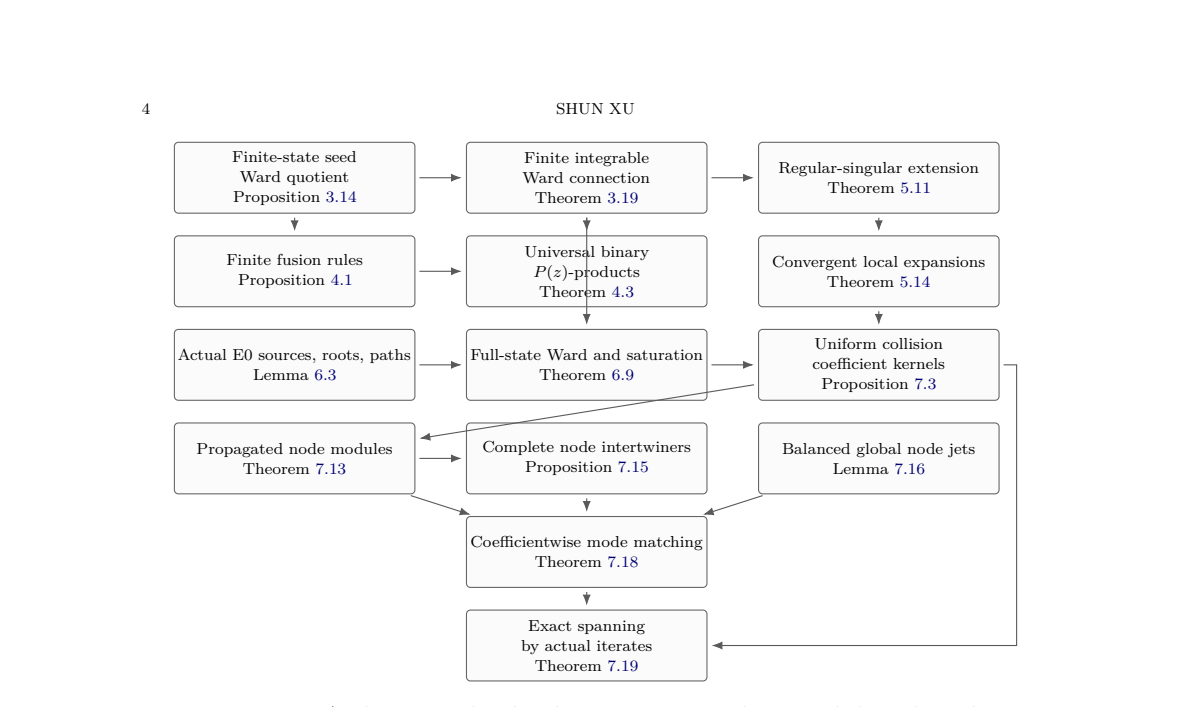
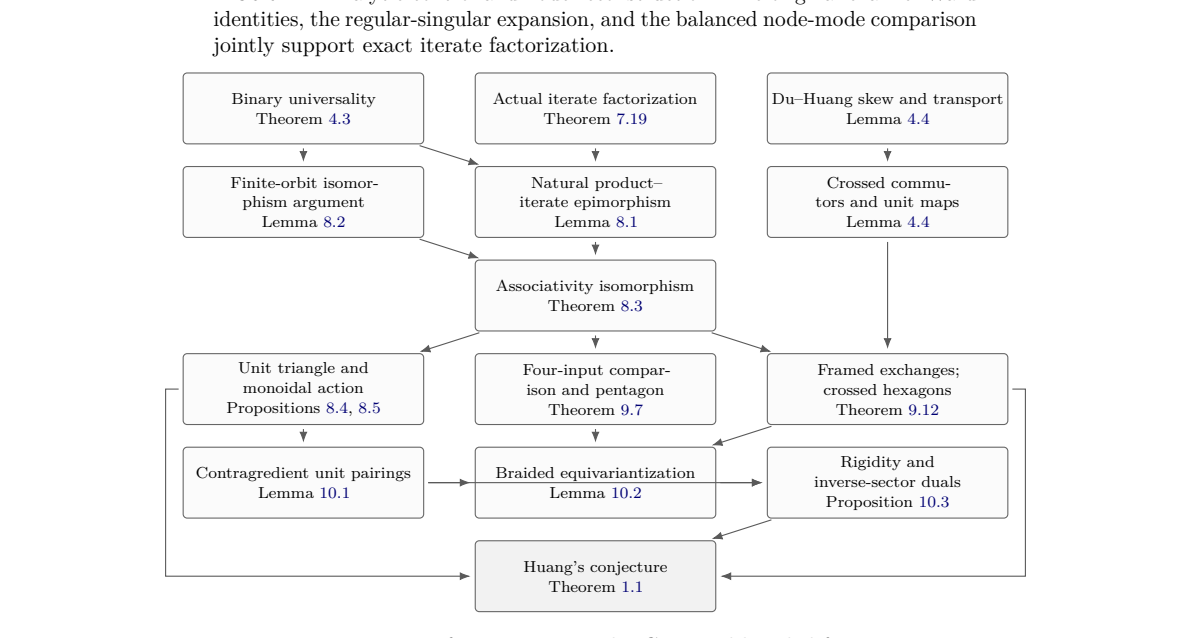
The dependency diagrams (Figures 1 and 2) are helpful but appear before any of the referenced theorems are stated. Consider moving them to the end of the introduction or adding parenthetical theorem numbers in the figure captions for easier cross-referencing.
The paper says, at Section 2.2, Definition 2.3
Pith says: minor objection 2 of 8
The definition of twisted intertwining operators is quoted from [10] but the paper uses the group-element labels to restrict the output sector to C^{gh}. This modification should be stated more prominently; currently it appears only in the sentence immediately before condition (iv).
show 6 more
The paper says, at Section 2.5, principal parts
Pith says: minor objection 3 of 8
The exposition of covers, currents, and principal parts is very dense. A brief glossary or a table of frequently used symbols (e.g., N_i, u_i, R_i(s), Q, etc.) would aid readability, especially given the paper's length.
The paper says, at Section 3.2, Lemma 3.8
Pith says: minor objection 4 of 8
The statement that both A_N(t) and A_N(t)^{-1} have finite Laurent entries is clear, but the proof could note explicitly that the dependence on the mode index n is absent because the state space E is fixed; this is stated in the lemma but a short remark would help.
The paper says, at Section 3.4, Theorem 3.19
Pith says: minor objection 5 of 8
The proof of local freeness of Q cites [25, Proposition 8.8], which applies to a coherent module with an integrable connection on a smooth variety over C. The paper should confirm that the setting (a finite étale chart over the smooth base U ⊂ F_m(C^*)) satisfies the necessary smoothness and Noetherian hypotheses; this is plausible but a brief verification would be welcome.
The paper says, at Section 5.1, Lemma 5.2
Pith says: minor objection 6 of 8
The description of boundary primes for the wonderful compactification of F_m(C^*) is used heavily. A citation to the specific wonderful compactification construction (e.g., [27]) is given in Definition 5.1, but the explicit local models in Lemma 5.2 are derived from that construction; a short remark on why only those three types of clusters appear (free finite, 0-anchored, ∞-anchored) would help readers unfamiliar with wonderful models.
The paper says, at Section 6.1, Lemma 6.2
Pith says: minor objection 7 of 8
The proof of the balanced node transition Σ = e^{L(1)} (-1)^{L(0)+1} is given, but the cancellation of the Schwarzian derivative for the fractional-linear transformation y = ρ / x could be mentioned explicitly, as it is used to justify that no extra vacuum term appears.
The paper says, at Section 10
Pith says: minor objection 8 of 8
The rigidity argument via the Etingof–Penneys criterion is elegant but relies on the braided equivariantization C_G^G. The paper should check that the forgetful functor is indeed strong monoidal and that the moderate-growth condition holds; it is asserted but not elaborated. A brief comment (e.g., referring to the finite semisimplicity and the growth bound from Proposition 4.1) would suffice.
What would settle it
As a sanity check, trace the proof of Theorem 5.11 (regular singularity of the Ward connection) for a concrete non-trivial example, e.g., V = lattice VOA for an even lattice, G = {±1} acting by a lattice involution, and a boundary divisor corresponding to a two-point collision with inertia label −1. Verify that the admissible cover construction of Lemma 5.5 can be carried out explicitly without obstruction, and that the eigenvalue bounds in Lemma 5.9 produce a full lattice as claimed. This test would expose any hidden assumption about the covering compactification that might not hold in this basic case.
from the skeptic's reading
How the review went
4 readings by deepseek-v4-flash · 22 Oct 2026
- Reader holds up
- Skeptic agrees
- Editor wrote the verdict above
- Referee accept: 8 minor
Not run on this paper: the simulated authors' defence.
Pith did not check this review's objections against the paper.
The review in full
The review in brief, machine-written
This paper proves Huang's conjecture that, for a strongly rational vertex operator algebra V and a finite automorphism group G, the categories of g-twisted V-modules form a G-crossed braided fusion category. This is a significant result that has been open for about two decades, and the paper gives a complete, self-contained construction. The proof is thorough: it builds analytic control (Ward identities, regular singular connections) on top of the Du–Huang binary tensor products, then reconstructs associativity, crossed braiding, and rigidity. The reasoning appears logically sound, and the paper is careful about branches, convergence, and the underlying geometry. The reader's report and stress test agree that no load-bearing flaw is visible. I think the work is solid and deserves serious attention. The main soft spot is the paper's length and technical density—verifying every analytic detail will take time—but that reflects the difficulty of the problem, not a defect in the argument. I would bring this to my reading group, cite it in related work, and recommend sending it to a top journal. It is a clear candidate for peer review.
The strongest objection
The paper is a detailed and rigorous construction of a G-crossed braided fusion category from twisted modules of a strongly rational VOA. All steps are heavily referenced to established results (e.g., [2], [10], [14]) and the paper's own analytic arguments are carefully laid out. The reader's verdict of ACCEPT with high confidence appears justified. I was unable to identify a specific, load-bearing concern that would undermine the central claim. The main technical results (finite Ward quotient, regular singularity, exact iterate factorization, coherence) are supported by extensive algebraic and analytic work, and the assumptions (strong rationality, finite G) are standard and well-motivated. No internal inconsistency or missing step was detected that would change the verdict.
The reader's verdict ACCEPT and high confidence align with my assessment. I find no evidence of a flawed argument, missing hypothesis, or internal contradiction. The paper builds on a substantial body of prior work (twisted modules, tensor product theory, analytic continuation techniques) and presents a coherent, step-by-step proof of a well-known conjecture. Although the proof is extremely technical and relies on many auxiliary results, the authors have been careful to specify all assumptions and to cite sources for the key external theorems (e.g., regularity of fixed points, admissible cover compactification, regular singular connections). The central claim (Theorem 1.1) follows logically from the constructed structures. Therefore I recommend no change to the verdict.
The referee's report
This is a major result in vertex operator algebra theory and orbifold conformal field theory. It resolves a long-standing conjecture of Huang and provides rigorous categorical foundations for the orbifold construction, unifying the representation theory of a strongly rational VOA and its finite automorphism group. The proof is technically demanding but carefully structured, integrating analytic, geometric, and algebraic arguments. The paper extends the classic tensor-product theory of Huang–Lepowsky to the twisted setting and lays the groundwork for future applications in mathematical physics and representation theory. The construction is self-contained modulo well-established results, and the authors give explicit credit to prior work, including the regularity results of Carnahan–Miyamoto, the twisted-intertwining operators of Du–Huang, and the analytic methods of Huang. The main theorem (Theorem 1.1) is a definitive contribution.
Pith's reading of the paper (a machine's summary, not the authors')
The paper proves a long-standing conjecture: for a strongly rational vertex operator algebra V and a finite group G of automorphisms, the categories of g-twisted V-modules (for each g in G) organize into a G-crossed braided fusion category. This structure is the expected categorical framework for orbifold conformal field theory. The proof constructs the tensor product, associativity, braiding, and rigidity directly from twisted intertwining operators, without passing through the fixed-point subalgebra. The result establishes a direct link between vertex operator algebra theory and braided G-crossed tensor categories.
What carries the argument. The central machinery is the finite differential Ward quotient built from a finite-dimensional, G-stable subspace E of V and its associated current bundle on a framed Hurwitz cover. This yields a finite-rank locally free sheaf Q with an integrable connection. Regular singularity of this connection, together with collision expansions and coefficientwise node matching, gives exact factorization of iterated twisted intertwining operators. This factorization, combined with the binary universal tensor product (constructed from finite fusion rules), produces the associativity isomorphisms and the crossed braiding. Rigidity is proved via equivariantization and the Etingof–Penneys criterion.
Core claim. The central discovery is that the collection of all g-twisted modules of a strongly rational VOA V, with g ranging over a finite subgroup G of Aut(V), carries a natural structure of a faithfully G-graded, G-crossed braided fusion category. The category is built from complete twisted intertwining operators (Du–Huang), the pullback G-action, and a crossed braiding; its tensor product sends C_g × C_h to C_{gh}, and the crossed braiding c_{X,Y}: X ⊠ Y → T_g Y ⊠ X is defined for X ∈ C_g. The pentagon, triangle, crossed hexagons, and rigidity all hold. This confirms Huang's conjecture [22, Conjecture 6.2] and its restatement by Du–Huang [10, Conjecture 1.2].
The premise it rests on. The vertex operator algebra V must be strongly rational (simple, CFT-type, self-contragredient, rational, C₂-cofinite), and the group G must be a finite subgroup of Aut(V).
If the paper is right (Pith's inferences, not the authors')
The orbifold construction for a strongly rational VOA with a finite automorphism group yields a G-crossed braided fusion category, providing the categorical foundation for orbifold conformal field theory.
The category CG is rigid, so each twisted module has a dual in the inverse-sector, establishing a nondegenerate pairing between g- and g⁻¹-twisted sectors.
The tensor product represents the complete twisted intertwining operators, giving a precise sense in which fusion rules are encoded by analytic data.
The proof of Huang's conjecture completes a program that relates vertex operator algebras to braided tensor categories in the presence of group actions.
The framework may be extended to logarithmic vertex operator algebras, where twisted modules have logarithmic modes; the regular-singular expansions developed here could serve as a starting point.
The techniques likely generalize to actions of more general Hopf algebras on vertex algebras, providing a categorical framework for orbifolds by non-group symmetries.
The explicit construction of associativity isomorphisms via analytic continuation of correlation functions may allow computation of F-matrices in concrete examples such as lattice VOAs or affine VOAs at positive integer level.
Check this review
Pith stored no record of this review's passes and took no fingerprint of it. Reviews made by code from 13 Nov 2026 on carry both.
How often reviews like this one are right
Reviews like this one: written by deepseek-v4-flash, where what was read was not recorded.
How often objections from reviews like this one are right: not yet measured
Reviews by people
This review was written by a machine. No person has reviewed this paper on Pith yet. A scientist listed on Pith can review it for a fee, and their review is published here whatever it concludes.
The paper
Abstract
Let V be a strongly rational vertex operator algebra and G ≤ Aut(V) a finite group. We prove Huang's conjecture that the categories of g-twisted V-modules, for g ∈ G, form a G-crossed braided fusion category. This category is faithfully G-graded, with tensor products representing the complete twisted intertwining operators of Du-Huang, the canonical pullback G-action, and crossed braiding. In particular, the associativity, coherence and rigidity required by the conjecture all hold.
The paper's own sentences, arranged, kept beside the review and separate from it. Each label is drawn from a closed vocabulary; the number beside it is the probability the classifier gave that label. No sentence in this record was written by a model.
abstract compiled · 2026-10-22
The authors' main claim, as the classifier picked it out 1.00
“We prove Huang's conjecture that the categories of $g$-twisted $V$-modules, for $g\in G$, form a $G$-crossed braided fusion category.”
How the main claim is stated: asserted 1.00
What the abstract itself states, as probabilities: claims first 0.04 · states limitation 0.07 · human participants 0.01 · controlled comparison 0.01 · randomized assignment 0.01 · states quantitative result 0.03 · compares with prior results 0.17 · mentions code or data availability 0.01
The abstract, sentence by sentence
This table labels the abstract only (arXiv listing abstract v1). The number is the probability the classifier gave the label.
| Sentence | Role | The authors' own work | States the main conclusion | Strength |
|---|---|---|---|---|
| Let $V$ be a strongly rational vertex operator algebra and $G\leq\operatorname{Aut}(V)$ a finite group. | background 1.00 | 0.08 | 0.02 | asserted 0.71 |
| We prove Huang's conjecture that the categories of $g$-twisted $V$-modules, for $g\in G$, form a $G$-crossed braided fusion category. | result 0.74 | 0.94 | 0.95 | asserted 1.00 |
| This category is faithfully $G$-graded, with tensor products representing the complete twisted intertwining operators of Du-Huang, the canonical pullback $G$-action, and crossed braiding. | result 0.84 | 0.76 | 0.16 | asserted 1.00 |
| In particular, the associativity, coherence and rigidity required by the conjecture all hold. | result 0.81 | 0.79 | 0.13 | asserted 1.00 |
What kind of paper the classifier reports this is: theoretical result 1.00 · evidence from proof or derivation 1.00
What was examined, and what was not
Sources read
- arXiv listing abstract v1
Not examined
- full text
- figures and tables
- references and citing sentences
- relations to other papers
Levels run
- P abstract
Not run
- S sections
- T body sentences
- C citations
- R cross-paper relations
How the labels were made
Compiled by classifier-1.13.0 via TypeSafe API, question bank abstract-p1-20260923, 2026-10-22: 1 request, 3,644 input tokens.
Every quoted sentence on this record is the authors'. Every label is from Pith's closed vocabulary, with the probability shown beside it. This record as JSON
Figures (2)
Figures are the authors', reproduced from the paper.
References (32)
- [1] T. Abe, G. Buhl, and C. Dong,Rationality, regularity, andC2-cofiniteness, Trans. Amer. Math. Soc.356 (2004), 3391–3402 on Pith
- [2] D. Abramovich, A. Corti, and A. Vistoli,Twisted bundles and admissible covers, Comm. Algebra31(2003), no. 8, 3547–3618, doi:10.1081/AGB-120022434, arXiv:math/0106211 on PithPith's reviewarXiv
- [3] Y. André,An algebraic proof of Deligne’s regularity criterion for integrable connections, preprint, 2007, arXiv:math/0701895 on PithPith's reviewarXiv
- [4] S. Carnahan and M. Miyamoto,Regularity of fixed-point vertex operator subalgebras, preprint, 2016, revised 2018, arXiv:1603.05645 on PithPith's reviewarXiv
- [5] P. Deligne,Équations différentielles à points singuliers réguliers, Lecture Notes in Mathematics, vol. 163, Springer, Berlin, 1970; see also the author’s erratum (correcting Chapter II, Sections 1.23 and 4.1) on Pith
- [6] R. Dijkgraaf, C. Vafa, E. Verlinde, and H. Verlinde,The operator algebra of orbifold models, Comm. Math. Phys.123(1989), 485–526, doi:10.1007/BF01238812 on Pithdoi:10.1007/bf01238812
- [7] C. Dong, H. Li, and G. Mason,Twisted representations of vertex operator algebras, Math. Ann.310(1998), 571–600 on Pith
- [8] C. Dong, H. Li, and G. Mason,Modular-invariance of trace functions in orbifold theory and generalized moonshine, Comm. Math. Phys.214(2000), 1–56, arXiv:q-alg/9703016 on PithPith's reviewarXiv
- [9] C. Dong and L. Ren,Congruence property in orbifold theory, Proc. Amer. Math. Soc.146(2018), no. 2, 497–506 on Pith
- [10] J. Du and Y.-Z. Huang,Twisted intertwining operators and tensor products of (generalized) twisted modules, SIGMA22(2026), 086, 64 pp., doi:10.3842/SIGMA.2026.086 on Pithdoi:10.3842/sigma.2026.086
- [11] V. Drinfeld, S. Gelaki, D. Nikshych, and V. Ostrik,On braided fusion categories I, Selecta Math. (N.S.)16 (2010), 1–119, doi:10.1007/s00029-010-0017-z on Pithdoi:10.1007/s00029-010-0017-z
- [12] P. Etingof and D. Penneys,Rigidity of non-negligible objects of moderate growth in braided categories, Forum Math. Pi14(2026), e7, doi:10.1017/fmp.2025.10020, arXiv:2412.17681 on PithPith's reviewarXiv
- [13] P. Etingof, S. Gelaki, D. Nikshych, and V. Ostrik,Tensor Categories, Mathematical Surveys and Monographs, vol. 205, American Mathematical Society, Providence, RI, 2015, doi:10.1090/surv/205 on Pithdoi:10.1090/surv/205
- [14] E. Frenkel and M. Szczesny,Twisted modules over vertex algebras on algebraic curves, Adv. Math.187(2004), 195–227 on Pith
- [15] A. Grothendieck et al.,Revêtements étales et groupe fondamental (SGA 1), Lecture Notes in Mathematics, vol. 224, Springer, Berlin, 1971; revised edition, Documents Mathématiques, vol. 3, Société Mathématique de France, 2003, arXiv:math/0206203 on PithPith's reviewarXiv
- [16] B. Gui and H. Zhang,Analytic conformal blocks ofC2-cofinite vertex operator algebras I: propagation and dual fusion products, New York J. Math.32(2026), 859–942. Published version. All numbered references to this work use the published version on Pith
- [17] B. Gui and H. Zhang,Analytic conformal blocks of C2-cofinite vertex operator algebras III: the sewing- factorization theorems, Proc. Lond. Math. Soc. (3)132(2026), no. 2, Paper No. e70130, doi:10.1112/plms.70130. arXiv:2503.23995v4, February 19, 2026 on PitharXiv
- [18] R. Hartshorne,Algebraic Geometry, Graduate Texts in Mathematics, vol. 52, Springer, New York, 1977 on Pith
- [19] Y.-Z. Huang,Differential equations and intertwining operators, Comm. Contemp. Math.7(2005), 375–400, arXiv:math/0206206 on PithPith's reviewarXiv
- [20] Y.-Z. Huang,Rigidity and modularity of vertex tensor categories, Comm. Contemp. Math.10(2008), 871–911, arXiv:math/0502533 on PithPith's reviewarXiv
show 12 more
- [21] Y.-Z. Huang,Generalized twisted modules associated to general automorphisms of a vertex operator algebra, Comm. Math. Phys.298(2010), 265–292 on Pith
- [22] Y.-Z. Huang,Some open problems in mathematical two-dimensional conformal field theory, Contemp. Math. 695(2017), 123–138, arXiv:1606.04493. G-CROSSED TENSOR CATEGORIES 153 on PithPith's reviewarXiv
- [23] Y.-Z. Huang and J. Lepowsky,A theory of tensor products for module categories for a vertex operator algebra, I, Selecta Math. (N.S.)1(1995), 699–756, doi:10.1007/BF01587908 on Pithdoi:10.1007/bf01587908
- [24] Y.-Z. Huang, J. Lepowsky, and L. Zhang,Logarithmic tensor category theory, VIII: Braided tensor category structure on categories of generalized modules for a conformal vertex algebra, preprint, 2011, revised 2012, arXiv:1110.1931 on PithPith's reviewarXiv
- [25] N. M. Katz,Nilpotent connections and the monodromy theorem: applications of a result of Turrittin, Publ. Math. Inst. Hautes Études Sci.39(1970), 175–232, doi:10.1007/BF02684688 on Pithdoi:10.1007/bf02684688
- [26] A. Kirillov, Jr.,OnG-equivariant modular categories, arXiv:math/0401119, 2004 on PithPith's reviewarXiv
- [27] L. Li,Wonderful compactification of an arrangement of subvarieties, Michigan Math. J.58(2009), 535–563 on Pith
- [28] R. McRae,Twisted modules and G-equivariantization in logarithmic conformal field theory, Comm. Math. Phys.383(2021), no. 3, 1939–2019, doi:10.1007/s00220-020-03882-2, arXiv:1910.13226 on PithPith's reviewarXiv
- [29] J.-P. Serre,Géométrie algébrique et géométrie analytique, Ann. Inst. Fourier6(1956), 1–42, doi:10.5802/aif.59 on Pithdoi:10.5802/aif.59
- [30] The Stacks Project Authors,The Stacks Project,https://stacks.math.columbia.edu/. Individual results are identified by their tags in the text on Pith
- [31] D. Tan,Cn-cofinite twisted modules forC2-cofinite vertex operator algebras, preprint, revised October 4, 2026, arXiv:2510.26657v2 on PithPith's reviewarXiv
- [32] D. Tan,Differential equations for intertwining operators among untwisted and twisted modules, preprint, 2025, arXiv:2510.14860v2. School of Mathematical Sciences, Anhui University, Hefei 230601, Anhui, China Email address:shunxu@ahu.edu.cn on PithPith's reviewarXiv
Cited by 2 Pith papers
Reviewed papers on Pith that cite this one. The full citation record
- Associated Varieties of Finite-Group Orbifolds math.QA · Nov 2026
- Crossed modularity of twisted VOA modules math.QA · Oct 2026
Challenges and discussion
Disagree with the review, or know something it missed? Leave a comment, or challenge this review formally: a challenge becomes a permanent entry in this paper's record, and its decision is published here.
Come back by email
A short list of the week's newly reviewed papers. Nothing is sent until you confirm from your inbox, and every email has a link that stops it. No account.
No comments yet.
Sign in to comment