Differential Geometry · arXiv:2610.29596 v2 · submitted 21 Oct 2026
Scalar curvature integrals on geodesic balls
The paper says
“We prove bounds for scalar curvature integrals over geodesic balls on complete noncompact manifolds with nonnegative sectional curvature.”
more of the abstract
In every dimension n ≥ 3, when the asymptotic volume ratio is close to one, we obtain upper and lower estimates with the sharp first-order coefficient and a quadratic remainder. The leading terms involve the asymptotic and local volume deficits, respectively. Rotationally symmetric examples show that both first-order coefficients are optimal and that a quadratic remainder is necessary in the upper bound. For dimensions three, four, and five we give estimates for any positive asymptotic volume ratio. When the center is a pole, we give an estimate in dimension three under nonnegative Ricci curvature and in every dimension n ≥ 4 under nonnegative sectional curvature. This estimate is sharp when the asymptotic volume ratio is at most 2−(n−1).
from the abstract
Pith says
Machine review · deepseek-v4-flash · 22 Oct 2026 · of version 1 of the paper; version 2 is newer · what was read was not recorded · not checked by a person
It can be wrong. Challenge this review or reply to it.
Holds up, with conditions. The fixed-radius rotational and pole results are sharp and well supported, but Theorems 1.3 and 1.4 hinge on an unproved self-cited asymptotic identity; referee it with that as the focus. This line is wrong
3 major objections · 4 minor
How often objections from reviews like this one are right: not yet measured
Not checked: figures, code, what the references say.
The paper says, at Section 4.3, Proposition 4.4; Section 5.3, Eq. (5.12)
The review did not quote this passage.
Pith says: Objection 1 of 3 · major
Theorems 1.3 and 1.4 pass through Proposition 4.4, where the limit Λ=lim_{t→∞} I_p(t)/t is identified with 8π(1−v). This identity, displayed as (1.7), is not proved in the present manuscript: it is cited from [Hu26, Theorem 1.1 and equation (1.4)] and [Xu26b, Theorem 4.2], both arXiv preprints, with [Hu26] sharing the present author.
more of objection 1
The published theorem [Xu24, Theorem 1.4] cited in the introduction proves the analogous formula only in the pole case, whereas Theorems 1.3 and 1.4 make no pole assumption. Since every subsequent display in Sections 4.3 and 5.3 multiplies Λ by the quantities L_0/κ from the convex-function construction, the explicit constants 12π(1−v)v^{-3} and 8π(1−v)+200π(1−v)^2 are unsupported unless (1.7) is established in the exact K≥0, v>0, arbitrary-center generality. The manuscript should either prove this asymptotic identity, state Theorems 1.3–1.4 as conditional on it, or replace the citation with an independently verifiable source.
The paper says, at Section 4.2, Lemma 4.2
The review did not quote this passage.
Pith says: Objection 2 of 3 · major
The direction-transfer lemma is load-bearing for the weighted moment estimates (4.9) and (5.3)–(5.5), since it converts integrals over the asymptotic radial directions R_p into integrals over S_xM. The proof is too compressed to verify as written: it asserts a Fubini-type interchange for the uncountable family {b_u}_{u∈R_p}, uses almost-everywhere differentiability of each b_u in a way that is not fully specified, and passes to the limit f_{T,x}→j_x under the integral with only a sketch of the uniform integrability.
more of objection 2
Please expand this argument, including the measurability framework and the dominated-convergence steps; as it stands, the moment estimates used in Lemmas 4.3 and 5.1 are not fully justified.
The paper says, at Section 5.2, Lemma 5.2
The review did not quote this passage.
Pith says: Objection 3 of 3 · major
The proof of Lemma 5.2 contains the assertion 'Since δ≤1/100 gives √D≤7/12', which is false because D=1+δ+δ^2/3≥1, so √D≥1. The subsequent displayed bound on a^2 therefore does not follow from the sentence as written. The final Lipschitz estimate Lip(F)≤1+10δ/3 is recoverable for δ≤1/100 by a cruder bound on √D, and this is likely a local fix, but the proof needs a corrected numerical estimate.
This review says the paper's mathematics is wrong. Pith did not check that against the paper's source.
4 minor objections
The paper says, at Section 3.1, Definition 3.3
Pith says: minor objection 1 of 4
There is a grammatical slip: 'LetP(E)=|DχE|(M)denotes' should read 'denote', and the definition should be separated cleanly from the subsequent sentence about the reduced boundary.
The paper says, at Section 5.2, Eqs. (5.7)–(5.11)
Pith says: minor objection 2 of 4
The distributional product and chain rules for q=√(b^2), including the statement that the singular part of the Hessian of distance is nonpositive, are used without a detailed justification; since (5.10) involves products of Hessian measures and gradients, a short explanation or a precise reference for the product rule in this generality would help the reader.
show 2 more
The paper says, at Appendix A, Eqs. (A.5)–(A.7)
Pith says: minor objection 3 of 4
The iterated limits ε↓0, η↓0, τ↑1 and the notation I^{τM_{θ,η,ε}}_{τp_ε}(1) are heavy; a brief comment on why the order of limits is forced (rather than merely convenient) would make the construction substantially easier to check.
The paper says, at Section 1, Eqs. (1.8)–(1.9)
Pith says: minor objection 4 of 4
The lower bound for C(v) uses the rotational examples of Theorem 1.1; it would be helpful to state explicitly that these examples have K≥0, so they genuinely belong to the class defining C(v), because the rotational examples in Section 2 are introduced under Ric≥0.
What would settle it
Read [Hu26, Theorem 1.1 and equation (1.4)] and [Xu26b, Theorem 4.2] against the hypotheses used in (1.7): complete three-manifold, K>=0, asymptotic volume ratio v>0, and an arbitrary center p, with no pole or rotational-symmetry assumption. Confirm that each source states and proves exactly this limit and that [Hu26] does not rely on the present paper for it. If either source imposes extra hypotheses or only covers the pole or rotationally symmetric case, the proofs of Theorems 1.3 and 1.4 are incomplete and the verdict remains CONDITIONAL until (1.7) is independently established.
from the skeptic's reading
How the review went
4 readings by deepseek-v4-flash · 22 Oct 2026
- Reader holds up, with conditions
- Skeptic agrees
- Editor wrote the verdict above
- Referee major revision: 3 major objections, 4 minor
Not run on this paper: the simulated authors' defence.
Pith did not check this review's objections against the paper.
The review in full
The review in brief, machine-written
Here is my read. The genuinely new material is Theorem 1.1: a sharp endpoint bound for rotationally symmetric Ric >= 0 metrics, with the sharpness construction actually carried out for each fixed asymptotic volume ratio. Theorem 1.2 is also a real advance: the 16 pi r pole bound in dimension three without any volume growth assumption, plus the explicit P(v) interpolation. The rotational proof is elementary and checkable; the pole proof uses the polar Jacobian, Gauss–Bonnet, and the published Benatti–Fogagnolo–Mazzieri Minkowski inequality, which applies cleanly here. The outward-minimality lemma for balls at a pole looks right. Appendix A is sketchier, but the limiting computation is explicit enough to verify, and it convincingly shows why the pole assumption cannot simply be dropped.
My main reservation is not in those parts. Theorems 1.3 and 1.4 pass through identity (1.7), which asserts Lambda = 8 pi (1 - v) under K >= 0, v > 0, at arbitrary centers. That identity is cited to [Hu26] and [Xu26b], both arXiv preprints, one of them by the present author. The published [Xu24] theorem in the introduction proves the same formula only at a pole, so the arbitrary-center generality is exactly the missing piece. Proposition 4.4 uses (1.7) as a premise; without that identity in the stated generality, the two arbitrary-center theorems lack a necessary premise. This is a verification gap, not an observed contradiction. The direction-transfer Lemma 4.2 is also terse and deserves a detailed proof, but the asymptotic identity is the load-bearing external input.
The lower-bound half of Theorem 1.4, including the sharp leading coefficient 8 pi, is independent of this gap because it comes from the rotational examples. And the fixed-radius inequalities in Theorems 1.1 and 1.2 are not circular: no fitted constants appear, and the sharp rotational cases are derived directly. So the circularity burden is real but confined to Theorems 1.3 and 1.4.
This paper is for people working on local scalar-curvature integral bounds and the Yau/Naber questions. It deserves a serious referee. I would not desk-reject it. I would send it out with explicit instructions to verify (1.7) in exactly the K >= 0, v > 0, arbitrary-center setting, and to check Lemma 4.2. If those check out, the paper should be accepted; if not, Theorems 1.3 and 1.4 should be revised to state the conditional dependence clearly.
The strongest objection
Theorem 1.3 (Section 4.3, equation (4.16)) and Theorem 1.4 (Section 5.3, equation (5.12)) both pass through Proposition 4.4, whose conclusion is I_p(r) <= (L0/kappa) Lambda with Lambda = lim_{t->infinity} I_p(t)/t. The paper does not prove the existence or value of this limit. Instead, equation (1.7), Lambda = 8*pi*(1-v), is cited to [Hu26, Theorem 1.1 and equation (1.4)] and [Xu26b, Theorem 4.2], both arXiv preprints, with [Hu26] sharing the present author. The published theorem [Xu24, Theorem 1.4] quoted in the introduction proves the same formula only in the pole case, whereas Theorems 1.3 and 1.4 assert arbitrary centers under K>=0 with no pole assumption. If (1.7) has not been established in exactly that generality, both arbitrary-center theorems lack a necessary premise. The direction-transfer Lemma 4.2 is also terse, but the asymptotic identity is the load-bearing external input, and the rest of the convex-function argument appears internally consistent.
The reader's weakest assumption identifies the same load-bearing concern: Theorems 1.3 and 1.4 reduce a fixed-radius bound to the asymptotic limit (1.7), and that limit is not proved in this paper. My reading of the manuscript confirms this. The internal arguments supporting Theorems 1.1 and 1.2 are detailed and coherent: the rotational case follows cleanly from the Riccati/monotonicity estimates in Lemma 2.1, the sharpness construction is explicit, and the pole-based argument in Section 3 uses the Benatti-Fogagnolo-Mazzieri Minkowski inequality with the outward-minimality of geodesic balls checked in Lemma 3.4. The convex-hypersurface construction in Appendix A is independent evidence that the pole assumption cannot be dropped, though it concerns v=0 and does not affect Theorems 1.3 and 1.4. For the arbitrary-center theorems, the local-to-asymptotic comparison in Proposition 4.4 is valid once a limit Lambda is available, and the Busemann-function estimates in Lemmas 4.1-4.3 and 5.1-5.2 are plausible and internally consistent. Thus the main unresolved point is external: whether the cited preprints, especially the same-author preprint [Hu26], actually prove (1.7) under nonnegative sectional curvature, positive asymptotic volume ratio, and arbitrary centers. Since the reader already marks this as a verification gap and assigns CONDITIONAL, my stress-test does not move the verdict. I found no internal contradiction that would justify rejection, and I would not accept unconditionally until the asymptotic identity is independently confirmed.
The referee's report
The rotational and pole results are the most convincing part: the proofs are self-contained, the sharpness constructions are explicit, and Theorems 1.1–1.2 would be valuable additions to the literature on scalar-curvature integral estimates. The arbitrary-center Theorems 1.3–1.4 are also attractive because they give explicit constants and a sharp leading coefficient near Euclidean volume. Their validity, however, currently depends on the asymptotic identity (1.7), which is cited from two unpublished preprints rather than proved. If (1.7) is independently confirmed, the convex-function argument comparing fixed-radius integrals with that asymptote is coherent and the results are significant; if not, the two arbitrary-center theorems lack a necessary premise. The paper also appropriately acknowledges that recent counterexamples have zero asymptotic volume ratio, so they do not invalidate the positive-volume statements.
Pith's reading of the paper (a machine's summary, not the authors')
On a complete noncompact manifold with nonnegative curvature, can the total scalar curvature of a geodesic ball be bounded by an explicit function of the radius and of how much volume the manifold loses at infinity? This paper answers yes in three settings: rotationally symmetric manifolds of any dimension with $\mathrm{Ric}\ge 0$ centered at the rotational origin, three-manifolds with a pole, and three-manifolds with $K\ge 0$ at arbitrary centers. The sharp constant is always governed by the asymptotic volume ratio $v=\lim_{r\to\infty}\mathrm{Vol}(B_p(r))/(\omega_n r^n)$ through the volume deficit $1-v$; for instance, every ball in the rotationally symmetric case satisfies $I_p(r)\le 2n(n-1)\omega_n(1-v^{1/(n-1)})r^{n-2}$, a bound attained in the limit by explicit cone-ended metrics for every $v$. The point of making the constants explicit is that they answer, in these settings, a local version of Yau's scalar-curvature question that recent counterexamples show to be false in complete generality.
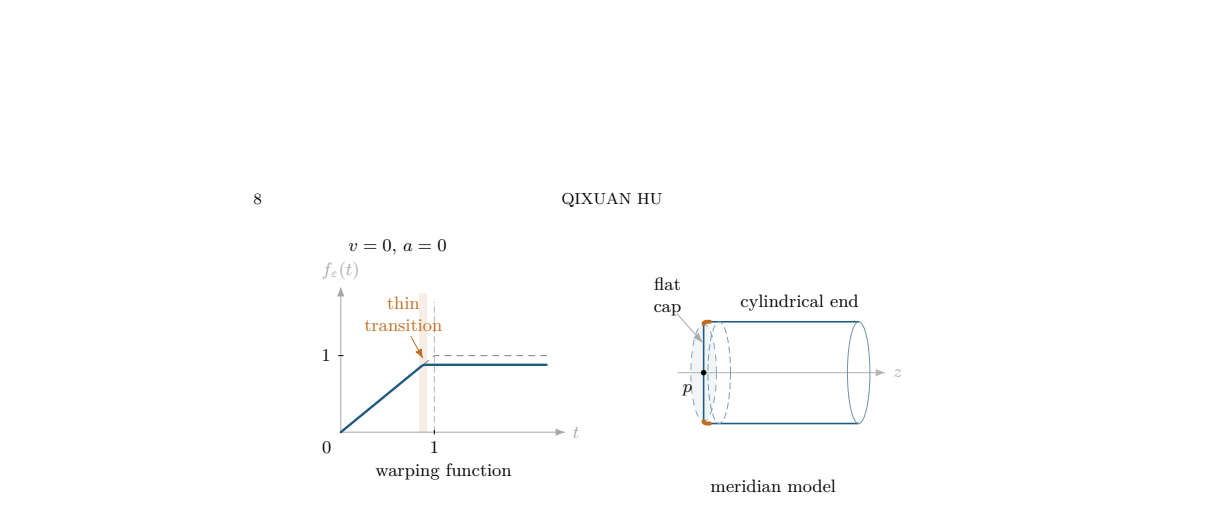
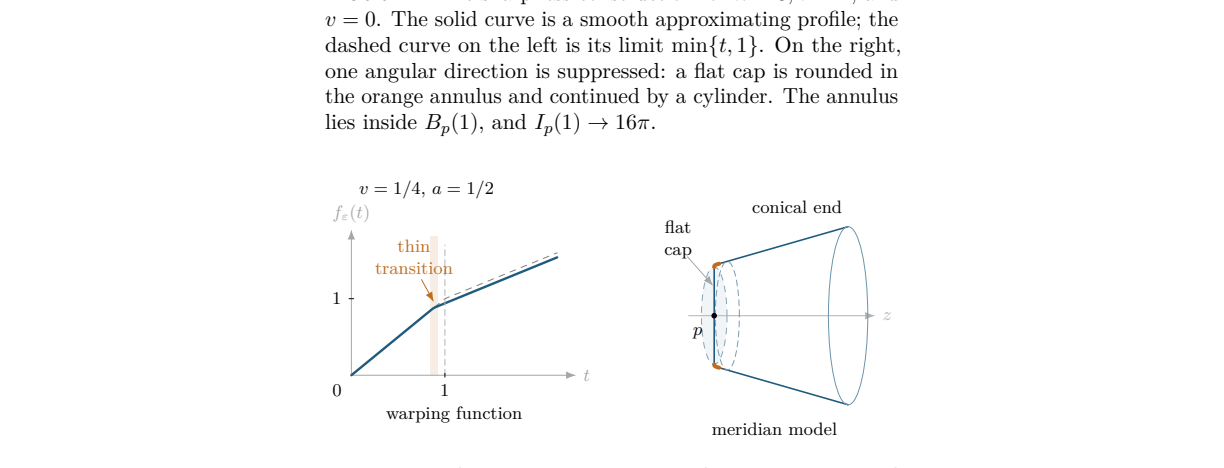
What carries the argument. Three mechanisms carry the argument. For Theorem 1.1 it is the warping function of the rotational metric $g=dt^2+f(t)^2g_{S^{n-1}}$: nonnegative Ricci curvature forces $f''\le 0$ and $0\le f'\le 1$, so $a=\lim_{t\to\infty}f'(t)$ exists and $v=a^{n-1}$; inserting the scalar curvature formula $S=-2(n-1)f''/f+(n-1)(n-2)(1-(f')^2)/f^2$ into $I_p(r)$ and using $f\le t$, $f'\ge a$ yields the sharp bound, while the cone-ended profiles (2.7) realize it in the limit. For Theorem 1.2 the object is the polar volume density $j(t,\theta)=\sqrt{J(t,\theta)}$: the Riccati equation gives $j''\le 0$, $j\le t$, and $H\le 2/t$, Gauss–Bonnet on the spheres $\partial B_p(t)$ gives $I_p(r)\le 8\pi r+2\int_{S^2}\int_0^r (j')^2\,dt\,d\theta-2A'(r)$, and the Minkowski inequality for outward-minimizing balls of [BFM24] upgrades $A'(t)$ to a genuinely $v$-dependent estimate. For Theorems 1.3 and 1.4 the object is a family of Busemann functions $b_u(x)=\lim_{t\to\infty}(t-d(x,\gamma_u(t)))$ of rays from $p$, averaged against the asymptotic polar density $j_p(u)$ through $F=(4\pi v)^{-1}\int_{R_p}j_p(u)\phi_r(b_u(x))\,d\theta_p(u)$; a direction-transfer lemma converts spherical moment estimates on $j_x$ into Hessian and Lipschitz bounds for $F$, and the divergence-free nonnegative tensor $T=\tfrac{1}{2}Sg-\mathrm{Ric}$ converts these into $I_p(r)\le (L_0/\kappa)\Lambda$ with $\Lambda=\lim_{t\to\infty}I_p(t)/t=8\pi(1-v)$, a limit the paper quotes from the cited identity (1.7) rather than proving in this text.
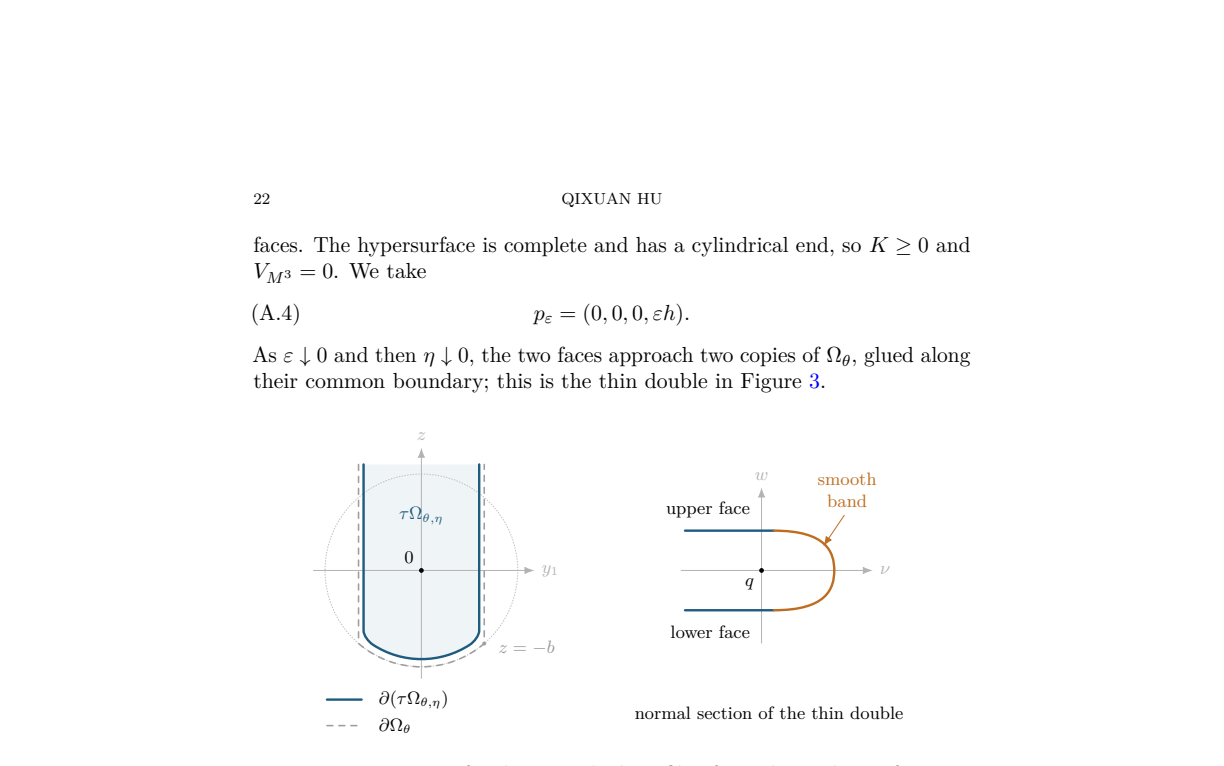
Core claim. The paper's central claim is that the scalar-curvature integral over a geodesic ball, $I_p(r)=\int_{B_p(r)}S\,d\mu_g$, is controlled with sharp constants by the asymptotic volume ratio $v=V_{M^n}$ rather than by dimension and radius alone. Theorem 1.1 states that on a rotationally symmetric metric $g=dt^2+f(t)^2g_{S^{n-1}}$ with $\mathrm{Ric}\ge 0$, every ball satisfies $I_p(r)\le 2n(n-1)\omega_n(1-v^{1/(n-1)})r^{n-2}$, and the bound is sharp for every fixed $v\in[0,1]$. Theorem 1.2 states that on a three-manifold with $\mathrm{Ric}\ge 0$ and a pole, $I_p(r)\le P(v)r$ with $P(v)=16\pi(1-\sqrt v)$ for $v\le 1/4$ and $P(v)=8\pi(1-\sqrt v)(1+2\sqrt v)$ for $1/4<v\le 1$, sharp for $v\le 1/4$ and at $v=1$; in particular the sharp bound $I_p(r)\le 16\pi r$ holds with no positive volume growth assumption. Theorems 1.3 and 1.4 state that under $K\ge 0$ with $v>0$ the center is arbitrary: $I_p(r)\le 12\pi(1-v)v^{-3}r$ for every $v>0$, and for $0\le 1-v\le 1/100$ the sharper bound $I_p(r)\le[8\pi(1-v)+200\pi(1-v)^2]r$ holds, with leading coefficient $8\pi$ sharp and a quadratic remainder necessary. Finally, the appendix shows the pole hypothesis cannot simply be dropped: smooth complete convex hypersurfaces in $\mathbb{R}^4$ with $v=0$ have unit-ball integrals approaching $E(\theta)=16\pi+8\pi\theta\cos\theta$, whose maximum $E_*=64.367...$ exceeds $16\pi$.
The premise it rests on. For Theorems 1.3 and 1.4 the load-bearing premise is the asymptotic identity (1.7), $\lim_{t\to\infty}I_p(t)/t=8\pi(1-v)$ under $K\ge 0$ and $v>0$: the paper states this identity in Section 4.3 but does not prove it, citing the preprints [Hu26, Theorem 1.1 and equation (1.4)] and [Xu26b, Theorem 4.2], the former sharing the present author, and the arbitrary-center bounds are exactly that limit multiplied by the ratio produced by the convex comparison (4.15); if that limit were false or carried an unstated hypothesis, Theorems 1.3 and 1.4 would not follow from the otherwise detailed argument.
If the paper is right (Pith's inferences, not the authors')
On every ball in a rotationally symmetric $\mathrm{Ric}\ge 0$ manifold, the scale-invariant quantity $r^{2-n}I_p(r)$ is bounded by $2n(n-1)\omega_n(1-v^{1/(n-1)})$, and every value of $v\in[0,1]$ is realized sharply by a cone-ended metric in the limit.
In dimension three, a pole suffices with no volume-growth assumption: $I_p(r)\le 16\pi r$ for every $r$, the bound is sharp, and for each fixed $v\le 1/4$ the exact limit value is $16\pi(1-\sqrt v)r$.
Under $K\ge 0$ with $v>0$, the center is arbitrary: $I_p(r)\le 12\pi(1-v)v^{-3}r$ for every ball, replacing a dimension constant with an explicit function of $v$.
Near Euclidean volume (with $0\le 1-v\le 1/100$), the sharp first-order coefficient is exactly $8\pi(1-v)$, a quadratic remainder is forced, and $C(v)/(1-v)$ is bounded below by $8\pi+2\pi(1-v)$ while tending to $8\pi$ as $v\uparrow 1$.
The pole hypothesis in the three-dimensional theorem is essential: smooth complete convex hypersurfaces in $\mathbb{R}^4$ with $v=0$ have unit-ball integrals approaching $E(\theta)=16\pi+8\pi\theta\cos\theta$, with maximum $E_*=64.367...>16\pi$, and in dimensions $n\ge 4$, pole examples with $v=0$ already show diverging normalized integrals, so the three-dimensional bound has no direct analogue.
Because Theorem 1.2 is explicit but provably sharp only for $v\le 1/4$ and at $v=1$, the natural open question is whether the true extremal metric for $1/4<v<1$ is rotationally symmetric at all; a non-rotationally symmetric example would lower the piecewise function $P(v)$ in that range.
The arbitrary-center theory funnels entirely through the asymptotic identity (1.7); deriving that identity with an explicit remainder term would extend the near-Euclidean quadratic bound to the full range of $v$ and likely improve the coefficient $12\pi v^{-3}$ away from $v=1$.
The explicit thin-double formula $E(\theta)=16\pi+8\pi\theta\cos\theta$ suggests an extremal question the paper leaves implicit: whether $E_*=64.367...$ is the maximum possible unit-ball scalar-curvature integral over all $K\ge 0$, $v=0$ three-manifolds without a pole, or whether other convex configurations push higher.
The pole argument uses Gauss–Bonnet on $S^2$, which is why it stops at dimension three; a plausible extension is a higher-dimensional arbitrary-center bound with an explicit constant times $1-v$, where currently only an abstract version is known.
Check this review
Pith stored no record of this review's passes and took no fingerprint of it. Reviews made by code from 13 Nov 2026 on carry both.
How often reviews like this one are right
Reviews like this one: written by deepseek-v4-flash, where what was read was not recorded.
How often objections from reviews like this one are right: not yet measured
Reviews by people
This review was written by a machine. No person has reviewed this paper on Pith yet. A scientist listed on Pith can review it for a fee, and their review is published here whatever it concludes.
The paper
Abstract
We prove bounds for scalar curvature integrals over geodesic balls on complete noncompact manifolds with nonnegative sectional curvature. In every dimension n ≥ 3, when the asymptotic volume ratio is close to one, we obtain upper and lower estimates with the sharp first-order coefficient and a quadratic remainder. The leading terms involve the asymptotic and local volume deficits, respectively. Rotationally symmetric examples show that both first-order coefficients are optimal and that a quadratic remainder is necessary in the upper bound. For dimensions three, four, and five we give estimates for any positive asymptotic volume ratio. When the center is a pole, we give an estimate in dimension three under nonnegative Ricci curvature and in every dimension n ≥ 4 under nonnegative sectional curvature. This estimate is sharp when the asymptotic volume ratio is at most 2−(n−1).
The paper's own sentences, arranged, kept beside the review and separate from it. Each label is drawn from a closed vocabulary; the number beside it is the probability the classifier gave that label. No sentence in this record was written by a model.
abstract compiled · 2026-10-22
The authors' main claim, as the classifier picked it out 0.92
“Under nonnegative Ricci curvature and rotational symmetry, we prove the sharp bound \[ \int_{B_p(r)}S\text{d}\mu_g \le 2n(n-1)\omega_n \bigl(1-v^{1/(n-1)}\bigr)r^{n-2}, \] when $p$ is the rotational origin.”
How the main claim is stated: asserted 1.00
What the abstract itself states, as probabilities: claims first 0.03 · states limitation 0.39 · human participants 0.01 · controlled comparison 0.02 · randomized assignment 0.01 · states quantitative result 0.99 · compares with prior results 0.15 · mentions code or data availability 0.01
The abstract, sentence by sentence
This table labels the abstract only (arXiv listing abstract v1). The number is the probability the classifier gave the label.
| Sentence | Role | The authors' own work | States the main conclusion | Strength |
|---|---|---|---|---|
| We study scalar curvature integrals over geodesic balls on complete noncompact manifolds. | contribution 0.82 | 0.86 | 0.05 | asserted 0.69 |
| Under nonnegative Ricci curvature and rotational symmetry, we prove the sharp bound \[ \int_{B_p(r)}S\text{d}\mu_g \le 2n(n-1)\omega_n \bigl(1-v^{1/(n-1)}\bigr)r^{n-2}, \] when $p$ is the rotational origin. | result 0.99 | 0.96 | 0.56 | asserted 1.00 |
| Here $\omega_n$ is the volume of the Euclidean unit ball and $v=V_{M^n}$ is the asymptotic volume ratio. | background 0.74 | 0.26 | 0.03 | asserted 0.90 |
| In dimension three, with the center at a pole, we obtain a sharp bound \[ \int_{B_p(r)}S\text{d}\mu_g\le16\pi r, \] without any positive volume growth assumption. | result 1.00 | 0.96 | 0.17 | asserted 1.00 |
| We also obtain a bound for every asymptotic volume ratio which is sharp for $0\le v\le1/4$. | result 0.97 | 0.95 | 0.12 | asserted 1.00 |
| Under nonnegative sectional curvature and $v>0$, we prove the explicit bound at arbitrary centers \[ \int_{B_p(r)}S\text{d}\mu_g\le12\pi(1-v)v^{-3}r. | result 0.99 | 0.95 | 0.15 | asserted 1.00 |
| \] If $0\le1-v\le1/100$, we further obtain \[ \int_{B_p(r)}S\text{d}\mu_g\le\bigl[8\pi(1-v)+200\pi(1-v)^2\bigr]r. | result 1.00 | 0.93 | 0.08 | asserted 1.00 |
| \] The leading coefficient $8\pi$ is sharp, and a remainder of quadratic order in $1-v$ is necessary. | result 0.51 | 0.91 | 0.12 | asserted 1.00 |
What kind of paper the classifier reports this is: theoretical result 1.00 · evidence from proof or derivation 1.00
What was examined, and what was not
Sources read
- arXiv listing abstract v1
Not examined
- full text
- figures and tables
- references and citing sentences
- relations to other papers
Levels run
- P abstract
Not run
- S sections
- T body sentences
- C citations
- R cross-paper relations
How the labels were made
Compiled by classifier-1.13.0 via TypeSafe API, question bank abstract-p1-20260923, 2026-10-22: 1 request, 6,583 input tokens.
Every quoted sentence on this record is the authors'. Every label is from Pith's closed vocabulary, with the probability shown beside it. This record as JSON
Figures (3)
Figures are the authors', reproduced from the paper.
Challenges and discussion
Disagree with the review, or know something it missed? Leave a comment, or challenge this review formally: a challenge becomes a permanent entry in this paper's record, and its decision is published here.
Come back by email
A short list of the week's newly reviewed papers. Nothing is sent until you confirm from your inbox, and every email has a link that stops it. No account.
No comments yet.
Sign in to comment