Methodology · arXiv:2610.39422 v1 · submitted 29 Oct 2026 · 293 references
Nonlinear Sufficient Dimension Reduction for Causal Inference with Continuous Treatments
The paper says
“Causal inference with continuous treatments requires estimating nuisance functions to adjust for the potentially high-dimensional confounder, but nonparametric estimation of these functions is severely hampered by the curse of dimensionality.”
more of the abstract
To address this challenge, we propose a nonlinear sufficient dimension reduction framework to construct low-dimensional sufficient confounders to preserve the unbiasedness of the treatment effect. We estimate the causal effect by combining the generalized Sliced Inverse Regression with the inverse probability weighting, outcome regression, and augmented inverse probability weighting, respectively. We further establish the convergence rates of the first two estimators and derive the asymptotic distributions of the third. Our theoretical results show that, compared to estimators based on the full covariates, dimension reduction yields faster convergence rates and weaker rate conditions without inflating the asymptotic variance. Simulation studies demonstrate that the proposed estimators improve finite-sample performance over their counterparts without dimension reduction, particularly when the original covariate dimension is high. These results demonstrate that sufficient dimension reduction provides a flexible approach to mitigating the curse of dimensionality in causal inference with continuous treatments.
from the abstract
Pith says
Machine review · deepseek-v4-flash · 30 Oct 2026 · what was read was not recorded · not checked by a person
It can be wrong. Challenge this review or reply to it.
Holds up, with conditions. Solid, workmanlike extension of SDR to continuous-treatment causal inference, but the central AIPW result leans on a same-author unpublished GSIR sup-norm rate; by the authors' own tables the published rate is too slow. This line is wrong
2 major objections · 5 minor
How often objections from reviews like this one are right: not yet measured
Not checked: figures, code, what the 293 references say.
The paper says, at Section 6.2; Corollary 6.3; Eq. (6.8); Table H.2; Section 6.4
The review did not quote this passage.
Pith says: Objection 1 of 2 · major
The practical force of the results rests on the improved GSIR sup-norm rate r_n ≍ n^{-δ} with δ=1/3 attributed to Choi et al. (2026), a companion paper cited without venue, volume, or preprint identifier and not available in the reviewed text.
more of objection 1
This dependence is load-bearing. The manuscript itself states in Section 6.2 that at the published rate δ=1/4 (Li & Song 2017) "the required rate conditions fail to hold in many of the settings considered." The arithmetic confirms the threshold: with the Gaussian kernels used in the simulations (q=s=2) and the optimal localization bandwidth h ≍ n^{-1/5}, the condition ζ < -q/{2(2q+1)} = -1/5 from Corollary 6.3 via (6.8) requires δ > 3/10 when d=1 and δ > 7/20 when d=2; hence δ=1/3 rescues only the d=1 settings, and the favorable conclusions of Section 6.4 (including Table H.4) depend on a result that cannot be verified from this manuscript. The authors should state the needed GSIR rate as a self-contained assumption or theorem with the argument supplied in the supplement, or recast the conclusions so that the guaranteed regime is δ=1/4 and the δ=1/3-based claims are explicitly labelled as conditional on Choi et al. (2026).
The paper says, at Assumptions (A1)-(A8); Theorems 4.1-4.4 and 6.1-6.2; Eq. (6.7); Tables H.1-H.4
The review did not quote this passage.
Pith says: Objection 2 of 2 · major
As submitted, the central results cannot be checked. Assumptions (A1)-(A8), on which Theorems 4.1, 4.4, Lemmas 6.1, and 6.2 depend, are not stated in the reviewed text; the proofs of the main theorems are deferred to a supplementary file that was not provided; the rate u_n = v_n in (6.7) contains the term t_{n,eh,b} that is only defined in (D.9); and the comparisons in Sections 4.3 and 6.4 rely on Tables H.1-H.4, none of which appear in the reviewed text.
more of objection 2
Consequently a referee cannot verify the hypotheses of the main theorems, the derivation of the optimized rates (4.3) and (6.8), or the numerical claims such as "once p≥10, GSIR achieves a faster convergence rate in all settings considered, except for δ=1/4, d=2 and p=10." A complete version containing the assumptions, the proofs, and the comparison tables must be provided for the paper to be evaluated.
5 minor objections
The paper says, at Sections 3.2 and 5.3
Pith says: minor objection 1 of 5
The notation \hat\mu^{(t)}_{GSIR-IPW}(t) and \hat\mu^{(T)}_{GSIR-IPW}(t) repeats the argument t both in the superscript and as the function argument, which is confusing given that the superscripts (t) and (T) distinguish two different estimators; a cleaner notation such as \hat\mu^{(t)}_{GSIR-IPW} would help.
The paper says, at Throughout
Pith says: minor objection 2 of 5
There are several typos and infelicities: "SUTV A" instead of "SUTVA" in Section 2, "Hernan & Robins" instead of "Hernán & Robins" in the references, "when when p=5" in Section 6.4, "single treatments" in Section 9, "MA VE" for the MAVE software, and "response-dose estimators" in the Discussion; a careful copy-editing pass is needed.
show 3 more
The paper says, at Section 8
Pith says: minor objection 3 of 5
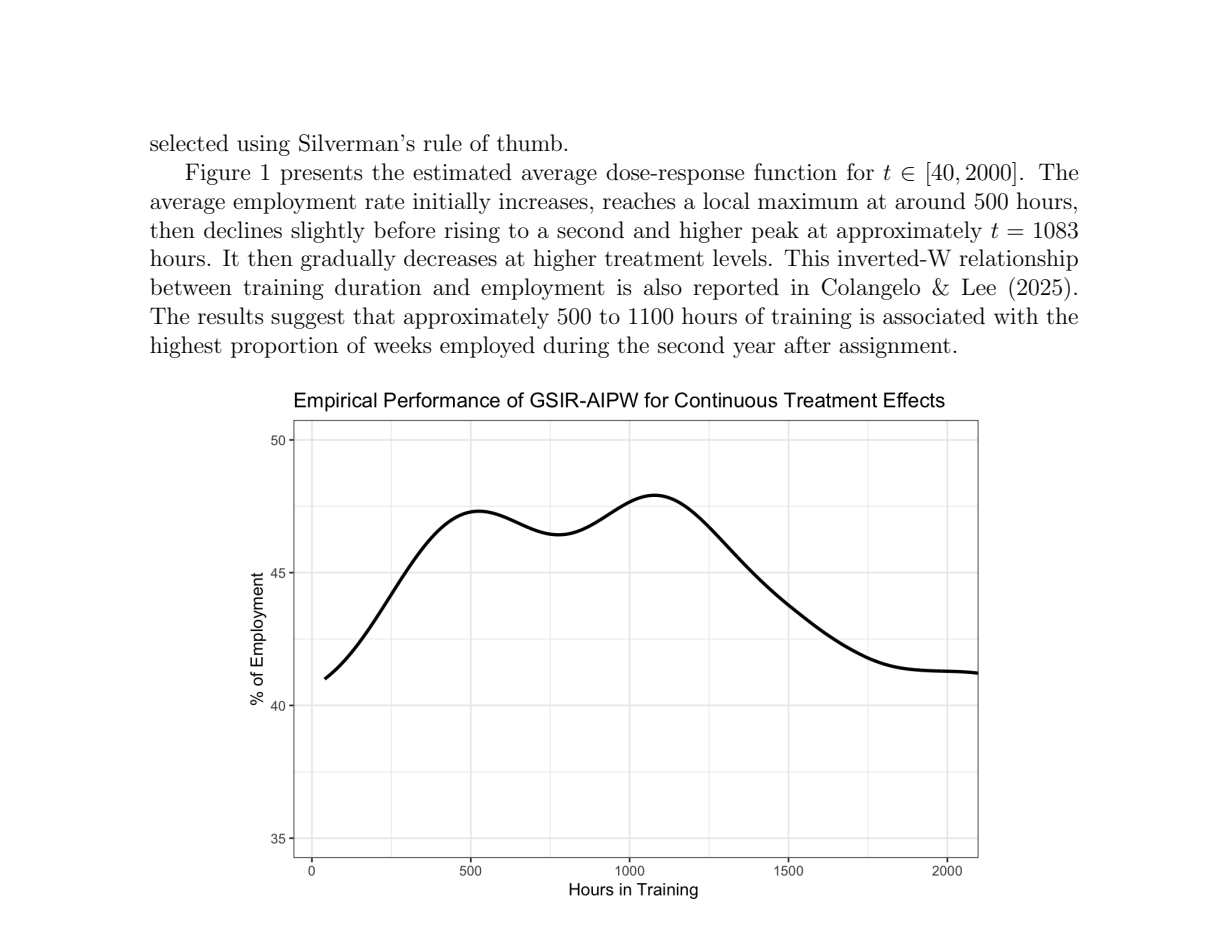
The data application uses the non-cross-fitted estimator (5.3), while the asymptotic theory in Section 6 covers only the cross-fitted versions (5.5)-(5.6); since the paper reports no standard errors or confidence bands for Figure 1, it should state explicitly that the displayed curve does not inherit the guarantees of Corollaries 6.1-6.2.
The paper says, at Section 7
Pith says: minor objection 4 of 5
In the simulation study the structural dimension of GSIR and MAVE is treated as known, so the finite-sample results do not exercise the dimension-selection problem discussed in Section 9; a sentence acknowledging this when the tables are interpreted would help readers calibrate the practical claims.
The paper says, at References
Pith says: minor objection 5 of 5
Several references lack bibliographic completion: Choi et al. (2026) has no venue or identifier (see major comment), Smucler et al. (2019) and Chernozhukov et al. (2018) appear as preprints without arXiv numbers, and Tang & Li (2025) is marked "to appear"; the reference list should be completed before resubmission.
What would settle it
Obtain Choi et al. (2026) and verify that it establishes sup_x ||hat z(x)-z(x)|| = O_p(n^{-δ}) with δ > 1/4, and specifically δ > 3/10 for the q=s=2, d=1 Gaussian-kernel AIPW case, for GSIR with the bivariate response {Y(T),T} under assumptions matching A1–A7; then recompute the admissibility condition ζ < −q/{2(2q+1)} in Table H.2 using that δ and the kernel orders actually used. If the companion proves only L2 or subspace convergence, or only δ ≤ 1/4, then the kernel-based Corollaries 6.1–6.2 are not verified in the settings advertised.
from the skeptic's reading
How the review went
4 readings by deepseek-v4-flash · 30 Oct 2026
- Reader holds up, with conditions
- Skeptic agrees
- Editor wrote the verdict above
- Referee major revision: 2 major objections, 5 minor
Not run on this paper: the simulated authors' defence.
Pith did not check this review's objections against the paper.
The review in full
The review in brief, machine-written
Two things to know. First, this is a real contribution, not a repackaging: it moves the linear-SDR-plus-causal line (Luo et al. 2017, Huang and Chan 2018) to nonlinear GSIR, introduces balancing and prognostic-balancing sufficient confounders, and gives a genuinely useful variance decomposition in Theorem 6.3. The identification logic is standard conditional on (2.14), and the paper is honest about which conditions do the work. Second, the stress-test concern holds up: the headline AIPW normality result is conditional on a uniform sup-norm GSIR rate rn ~ n−delta, and the kernel rate double-robustness condition needs delta above about 3/10 for Gaussian kernels with d=1. The authors' own Table H.2 shows the published Li-Song rate delta=1/4 fails in most settings; the delta=1/3 that saves the claim comes from Choi et al. 2026, same authors, no stated venue. That is not an internal contradiction, but it means the central asymptotic claim currently rests on a rate result the referee cannot inspect. The main-text theory is otherwise coherent: Theorems 4.1-4.4 give rates for IPW and OR conditional on rn, and Theorem 6.1 plus Corollaries 6.1-6.2 give sqrt(nh) normality with the same leading variance as the full-covariate estimator. The variance decomposition is the cleanest part of the paper: for a prognostic-balancing confounder the AIPW variance is preserved, while a merely balancing confounder can inflate it. That is a real insight and worth keeping regardless of what happens to the rate comparisons. Proofs are deferred to a supplement not present in the reviewed text, so the theorems could not be checked from the version I saw. That is a practical referee problem, but not itself a flaw in the mathematics. The structural dimension is assumed known; the authors acknowledge this in Section 9 and point to existing BIC procedures. Simulations are informative, especially the contrast between GSIR and linear MAVE when the true reduction is nonlinear. The Job Corps application is brief but fine as an illustration. Who is this for? Researchers working on continuous treatments and sufficient dimension reduction. The conceptual framework and the variance comparison are worth their time even if the rate theorems need tightening. The paper deserves a serious referee. I would send it to review with a request for the supplement, a clear statement of what exactly Choi et al. 2026 proves and where it stands, and either verification or explicit restatement of the AIPW theorems under directly checkable assumptions on the GSIR rate.
The strongest objection
The most load-bearing step is not the causal identification, which is standard conditional on (2.14), but the conversion of GSIR estimation error into the rate conditions for the AIPW estimator. Theorem 6.1 and Corollaries 6.1–6.2 deliver n^{1/2}h^{1/2} normality only under the high-level rates u_n, v_n in (6.1); for the kernel implementation in Lemma 6.1 these rates are (6.7), and Corollary 6.3 reduces them to the exponent ζ in (6.8). With the Gaussian kernels used in the simulations (q=s=2) and d=1, the rate double-robustness condition n^{1/2}h^{1/2}u_nv_n → 0 requires ζ < −1/5, i.e. δ > 3/10. The paper's own Table H.2 states that at δ=1/4, the rate established by Li & Song (2017), the required conditions fail in most settings; the δ=1/3 rate that rescues the claim is attributed to the same-authors companion Choi et al. (2026), which has no stated venue. Since (4.1) is a sup-norm uniform rate, not an L2 or subspace rate, and the companion's result is not available in the reviewed text, the central asymptotic-normality claim currently rests on an external rate result that cannot be checked from the manuscript. This is not an inconsistency, but it is the condition on which the headline benefit depends; the acknowledged unsolved dimension-selection issue is secondary.
The reader's verdict is CONDITIONAL, and this pass supports that. The causal identification argument is coherent: Theorem 2.1 and Lemma 2.1 supply the needed formulas, and Theorem 6.3 correctly shows that a prognostic-balancing sufficient confounder preserves the leading AIPW variance. The soft spot is the GSIR rate r_n in (4.1). Every downstream guarantee—s_n in Theorem 4.3, u_n and v_n in Lemma 6.1, ζ in Corollary 6.3, and the admissibility thresholds in Section 6.4—is a function of δ. The numerical comparisons in Tables H.1–H.4 are all indexed by δ, and the paper itself notes in the Table H.2 discussion that at the published δ=1/4 the rate double-robustness conditions fail in most settings. The improved δ=1/3 is attributed to Choi et al. (2026), a same-author companion with no stated venue, so the main asymptotic claim cannot be independently checked from the manuscript or its cited published literature. This is a load-bearing concern, but it is an external-support concern rather than a detected mathematical contradiction. The paper also flags the structural-dimension assumption in Section 9, so that is not a new objection. Given the honest caveats and the conditional form of the theorems, the reader's CONDITIONAL verdict stands unchanged.
The referee's report
If the theorems hold, this is a valuable contribution: it transfers high-dimensional nuisance estimation in continuous-treatment causal inference to a low-dimensional sufficient predictor, extending Huang & Chan (2018) from linear to nonlinear SDR, and it explicitly tracks the effect of the GSIR estimation error on the dose-response estimator's rate. The variance decomposition in Theorem 6.3 is a clean conceptual contribution that identifies which reduction property preserves full-covariate efficiency. The paper is commendably transparent: it states the rates as theoretical upper bounds, reports that cross-fitting worsens finite-sample RMSE, and flags the known-dimension limitation. The main risk is not internal coherence—the rate bookkeeping in (6.8) and the threshold ζ<-1/5 check out and match the paper's own reported Table H.2 conclusions—but verifiability and external dependence: the favorable comparisons presuppose a GSIR sup-norm rate δ=1/3 from Choi et al. (2026), a companion paper with no venue or identifier, while the published rate δ=1/4 is acknowledged to fail in many settings; and the assumptions, proofs, and Tables H.1-H.4 are not in the reviewed text.
Pith's reading of the paper (a machine's summary, not the authors')
Dose-response curves for continuous treatments require estimating auxiliary functions — the conditional treatment density and the conditional mean outcome — from potentially many confounders, and nonparametric estimation of those functions degrades as covariate dimension grows. This paper argues that a nonlinear sufficient dimension reduction step removes the problem: if a low-dimensional transformation $z(X)$ of the covariates carries all the treatment-assignment and outcome information, it can replace the full covariate vector in the inverse probability weighting, outcome regression, and augmented inverse probability weighting identification formulas without changing the causal target. The paper proves that the resulting dimension-reduced estimators converge at a rate controlled by the dimension-reduction error, that a cross-fitted dimension-reduced AIPW estimator is asymptotically normal with no larger leading variance than the full-covariate estimator, and that the rate conditions on the nuisance estimators become weaker. If correct, high-dimensional confounding no longer forces a choice between parametric misspecification and the nonparametric curse of dimensionality in continuous-treatment studies.
What carries the argument. The load-bearing object is the sufficient confounder: a function $z:\mathbb{R}^p\to\mathbb{R}^d$ satisfying either the balancing condition $T\perp\!\!\perp X\mid z(X)$ or the stronger prognostic-balancing condition $\{Y(T),T\}\perp\!\!\perp X\mid z(X)$, which Theorem 2.2 shows is equivalent to $z(X)$ being simultaneously balancing and prognostic. The estimator carrying the argument is generalized sliced inverse regression (GSIR), a kernel-based nonlinear sufficient dimension reduction method that estimates $z$ by solving a regularized eigenvalue problem; its uniform convergence rate $r_n$ enters every downstream convergence rate and rate condition. Theorems 2.1 and 6.3 do the conceptual work: the first lets $z(X)$ replace $X$ in all three identification formulas, and the second shows the prognostic-balancing choice keeps the leading asymptotic variance equal to that of the full-covariate estimator.
Core claim. The paper's central claim is that estimating the dose-response curve through a low-dimensional sufficient confounder $\hat{z}(X)$, found by generalized sliced inverse regression (GSIR), preserves the causal target while removing the curse of dimensionality. Theorems 4.1–4.4 show the GSIR-IPW and GSIR-OR estimators are consistent at a rate $s_n$ that depends on the GSIR estimation rate $r_n$, the reduced dimension $d$, and the kernel bandwidths; Theorem 6.1 and Corollaries 6.1–6.2 show the cross-fitted GSIR-AIPW estimator is $n^{1/2}h^{1/2}$-asymptotically normal with the same leading variance $V_Z(t)$ as the full-covariate estimator whenever $z$ satisfies the prognostic-balancing condition that $\{Y(T), T\}$ is independent of $X$ given $z(X)$. Theorem 6.3 decomposes the variance difference $V_Z(t)-V_X(t)$ into three terms and shows that a balancing sufficient confounder can inflate the variance, whereas a prognostic-balancing sufficient confounder does not. The paper concludes that for moderate to high covariate dimension the reduction yields faster convergence and weaker rate conditions than full-covariate estimation, and it reports simulation and data-application results consistent with that conclusion.
The premise it rests on. The argument presupposes that a fixed low-dimensional transformation $z(X)$ satisfying the joint conditional-independence condition $\{Y(T),T\}\perp\!\!\perp X \mid z(X)$ (or at least the balancing condition) actually exists, that GSIR estimates it uniformly at speed $r_n$ with the structural dimension $d$ known, and that the resulting rate conditions hold.
If the paper is right (Pith's inferences, not the authors')
For covariate dimension $p \ge 10$, the dimension-reduced IPW, OR, and AIPW estimators have strictly faster convergence rates than their full-covariate counterparts in the rate comparisons of Section 4.3, and the advantage grows with $p$.
The cross-fitted GSIR-AIPW estimator inherits the full-covariate asymptotic variance whenever a prognostic-balancing sufficient confounder exists, so the reduction is not paid for in asymptotic efficiency.
After reduction, the nuisance functions can be estimated with lower-order kernels and weaker smoothness assumptions, because the required kernel order depends on the reduced dimension $d$ and the GSIR rate $\delta$ rather than on $p$.
When GSIR converges at the faster near-$n^{-1/3}$ rates, the rate double-robustness condition for GSIR-AIPW holds in settings where full-covariate AIPW fails, making doubly robust inference feasible at moderate covariate dimension.
A balancing sufficient confounder that discards outcome information can inflate the leading AIPW variance, so the choice of which sufficient confounder to estimate matters for efficiency and not only for bias.
A corollary the authors leave implicit: the variance decomposition suggests that a purely prognostic confounder, dropping treatment-assignment information irrelevant to the outcome, could strictly reduce the leading AIPW variance below that of the full-covariate estimator — an efficiency gain the paper notes in Section 9 but does not implement.
The high-level rate conditions of Theorem 6.1 are agnostic to how the nuisance functions are estimated, so the framework should transfer to other nonlinear SDR estimators (GSAVE, neural-network reductions) or to an oracle sufficient confounder, provided a comparable uniform convergence rate is available.
A practical recipe implied by the theory is to select the structural dimension with the cross-validated BIC procedures cited in Section 9 and then check stability of the estimated dose-response curve across candidate dimensions; the paper's theorems do not cover the uncertainty introduced by that selection step.
The simulations indicate that cross-fitting widens finite-sample RMSE, especially at small sample sizes, so a practitioner estimating a curve rather than testing a hypothesis may reasonably prefer the non-cross-fitted GSIR-AIPW estimator, as the authors themselves do in the data application.
Check this review
Pith stored no record of this review's passes and took no fingerprint of it. Reviews made by code from 13 Nov 2026 on carry both.
How often reviews like this one are right
Reviews like this one: written by deepseek-v4-flash, where what was read was not recorded.
How often objections from reviews like this one are right: not yet measured
Reviews by people
This review was written by a machine. No person has reviewed this paper on Pith yet. A scientist listed on Pith can review it for a fee, and their review is published here whatever it concludes.
The paper
Abstract
Causal inference with continuous treatments requires estimating nuisance functions to adjust for the potentially high-dimensional confounder, but nonparametric estimation of these functions is severely hampered by the curse of dimensionality. To address this challenge, we propose a nonlinear sufficient dimension reduction framework to construct low-dimensional sufficient confounders to preserve the unbiasedness of the treatment effect. We estimate the causal effect by combining the generalized Sliced Inverse Regression with the inverse probability weighting, outcome regression, and augmented inverse probability weighting, respectively. We further establish the convergence rates of the first two estimators and derive the asymptotic distributions of the third. Our theoretical results show that, compared to estimators based on the full covariates, dimension reduction yields faster convergence rates and weaker rate conditions without inflating the asymptotic variance. Simulation studies demonstrate that the proposed estimators improve finite-sample performance over their counterparts without dimension reduction, particularly when the original covariate dimension is high. These results demonstrate that sufficient dimension reduction provides a flexible approach to mitigating the curse of dimensionality in causal inference with continuous treatments.
The paper's own sentences, arranged, kept beside the review and separate from it. Each label is drawn from a closed vocabulary; the number beside it is the probability the classifier gave that label. No sentence in this record was written by a model.
abstract compiled · 2026-10-30
The authors' main claim, as the classifier picked it out 0.99
“These results demonstrate that sufficient dimension reduction provides a flexible approach to mitigating the curse of dimensionality in causal inference with continuous treatments.”
How the main claim is stated: asserted 1.00
What the abstract itself states, as probabilities: claims first 0.04 · states limitation 0.12 · human participants 0.06 · controlled comparison 0.17 · randomized assignment 0.02 · states quantitative result 0.16 · compares with prior results 0.92 · mentions code or data availability 0.02
The abstract, sentence by sentence
This table labels the abstract only (arXiv listing abstract v1). The number is the probability the classifier gave the label.
| Sentence | Role | The authors' own work | States the main conclusion | Strength |
|---|---|---|---|---|
| Causal inference with continuous treatments requires estimating nuisance functions to adjust for the potentially high-dimensional confounder, but nonparametric estimation of these functions is severely hampered by the curse of dimensionality. | background 0.94 | 0.05 | 0.03 | asserted 1.00 |
| To address this challenge, we propose a nonlinear sufficient dimension reduction framework to construct low-dimensional sufficient confounders to preserve the unbiasedness of the treatment effect. | contribution 0.85 | 0.86 | 0.12 | asserted 0.98 |
| We estimate the causal effect by combining the generalized Sliced Inverse Regression with the inverse probability weighting, outcome regression, and augmented inverse probability weighting, respectively. | method 0.99 | 0.92 | 0.05 | asserted 1.00 |
| We further establish the convergence rates of the first two estimators and derive the asymptotic distributions of the third. | contribution 0.51 | 0.96 | 0.05 | asserted 0.99 |
| Our theoretical results show that, compared to estimators based on the full covariates, dimension reduction yields faster convergence rates and weaker rate conditions without inflating the asymptotic variance. | result 0.92 | 0.94 | 0.45 | asserted 1.00 |
| Simulation studies demonstrate that the proposed estimators improve finite-sample performance over their counterparts without dimension reduction, particularly when the original covariate dimension is high. | result 1.00 | 0.96 | 0.14 | asserted 1.00 |
| These results demonstrate that sufficient dimension reduction provides a flexible approach to mitigating the curse of dimensionality in causal inference with continuous treatments. | interpretation 1.00 | 0.83 | 0.87 | asserted 1.00 |
What kind of paper the classifier reports this is: method or tool 1.00 · evidence from proof or derivation 0.58
What was examined, and what was not
Sources read
- arXiv listing abstract v1
Not examined
- full text
- figures and tables
- references and citing sentences
- relations to other papers
Levels run
- P abstract
Not run
- S sections
- T body sentences
- C citations
- R cross-paper relations
How the labels were made
Compiled by classifier-1.13.0 via TypeSafe API, question bank abstract-p1-20260923, 2026-10-30: 1 request, 5,646 input tokens.
Every quoted sentence on this record is the authors'. Every label is from Pith's closed vocabulary, with the probability shown beside it. This record as JSON
Figures (1)
Figures are the authors', reproduced from the paper.
References (293)
- [1] The prognostic analogue of the propensity score , author=. Biometrika , volume=. 2008 , publisher= on Pith
- [2] Variable-dependent partial dimension reduction , author=. Test , volume=. 2023 , publisher= on Pith
- [3] Optimal sufficient dimension reduction in regressions with categorical predictors , author=. Journal of Statistical Planning and Inference , volume=. 2007 , publisher= on Pith
- [4] Dimension reduction for regression: Theoretical and methodological developments , author=. 2023 , school= on Pith
- [5] Sufficient dimension reduction in regressions with categorical predictors , author=. Annals of Statistics , pages=. 2002 , publisher= on Pith
- [6] On partial sufficient dimension reduction with applications to partially linear multi-index models , author=. Journal of the American Statistical Association , volume=. 2013 , publisher= on Pith
- [7] A Distribution-Free Theory of Nonparametric Regression , author=. 2002 , publisher= on Pith
- [8] Bing Li and Kyongwon Kim , title =. Journal of Machine Learning Research , year = on Pith
- [9] Michael Kohler and Sophie Langer , title =. The Annals of Statistics , number =. 2021 , doi = on Pith
- [10] Fukumizu, Kenji and Gretton, Arthur and Lanckriet, Gert and Sch\". Kernel Choice and Classifiability for RKHS Embeddings of Probability Distributions , url =. Advances in Neural Information Processing Systems , editor = on Pith
- [11] Lu, Jianfeng and Shen, Zuowei and Yang, Haizhao and Zhang, Shijun , title =. SIAM Journal on Mathematical Analysis , volume =. 2021 , doi =. https://doi.org/10.1137/20M134695X , abstract = on Pithdoi:10.1137/20m134695x
- [12] Peter L. Bartlett and Nick Harvey and Christopher Liaw and Abbas Mehrabian , title =. Journal of Machine Learning Research , year = on Pith
- [13] Arthur Gretton and Karsten M. Borgwardt and Malte J. Rasch and Bernhard Sch. A Kernel Two-Sample Test , journal =. 2012 , volume = on Pith
- [14] Bagirov, Adil M. and Clausen, Conny and Kohler, Michael , journal=. Estimation of a Regression Function by Maxima of Minima of Linear Functions , year= on Pith
- [15] Harvey, Nick and Liaw, Christopher and Mehrabian, Abbas , booktitle =. Nearly-tight. 2017 , editor = on Pith
- [16] Anthony, Martin and Bartlett, Peter L. , year=. Neural Network Learning: Theoretical Foundations , publisher= on Pith
- [17] Sufficient Dimension Reduction: Methods and Applications with R , author=. 2018 , publisher= on Pith
- [18] A nonparametric test for elliptical distribution based on kernel embedding of probabilities , author=. 2024 , eprint= on Pith
- [19] Daniel Kapla and Lukas Fertl and Efstathia Bura , keywords =. Fusing sufficient dimension reduction with neural networks , journal =. 2022 , issn =. doi:https://doi.org/10.1016/j.csda.2021.107390 , url = on Pithdoi:10.1016/j.csda.2021.107390
- [20] Exploring the Complexity of Deep Neural Networks through Functional Equivalence , author=. Forty-first International Conference on Machine Learning , year= on Pith
show 80 more
- [21] Wainwright, Martin J. , year=. High-Dimensional Statistics: A Non-Asymptotic Viewpoint , publisher= on Pith
- [22] Shen , Zuowei and Yang , Haizhao and Zhang , Shijun , title =. Communications in Computational Physics , year = on Pith
- [23] Using dimension-reduction subspaces to identify important inputs in models of physical systems , author=. In 1994 Proceedings of the Section on Physical and Engineering Sciences. American Statistical Association, Alexandria, VA. , pages= on Pith
- [24] Regression Graphics: Ideas for Studying Regressions through Graphics , author= on Pith
- [25] Li, Ker-Chau , journal =. Sliced inverse regression for dimension reduction , volume = on Pith
- [26] Regression analysis under link violation , author=. The Annals of Statistics , volume= on Pith
- [27] Estimating the structural dimension of regressions via parametric inverse , author=. Journal of the Royal Statistical Society, Series B , pages= on Pith
- [28] Dimension reduction based on canonical correlation , author=. Statistica Sinica , pages= on Pith
- [29] Asymptotics for kernel estimate of sliced inverse regression , author=. The Annals of Statistics , volume= on Pith
- [30] Cook, R Dennis and Weisberg, Sanford , number =. Journal of the American Statistical Association , volume = on Pith
- [31] Li, Bing and Zha, Hongyuan and Chiaromonte, Francesca , journal = on Pith
- [32] On directional regression for dimension reduction , author =. 2007 , journal = on Pith
- [33] On Principal Hessian Directions for Data Visualization and Dimension Reduction: Another Application of Stein's Lemma , author=. Journal of the American Statistical Association , volume= on Pith
- [34] Cook, R Dennis and Li, Bing , journal = on Pith
- [35] Determining the dimension of iterative Hessian transformation , author=. The Annals of Statistics , volume= on Pith
- [36] An adaptive estimation of dimension reduction space , author=. Journal of Royal Statistical Society, Series B , volume= on Pith
- [37] Principal support vector machines for linear and nonlinear sufficient dimension reduction , author=. The Annals of Statistics , volume= on Pith
- [38] A general theory for nonlinear sufficient dimension reduction: formulation and estimation , author=. The Annals of Statistics , volume= on Pith
- [39] Nonlinear Dimension Reduction with Kernel Sliced Inverse Regression , author=. IEEE Transactions on Knowledge and Data Engineering , pages=. 2009 , publisher= on Pith
- [40] Fukumizu, K and Bach, F R and Gretton, A , journal = on Pith
- [41] Li, B. and Kim, K, , journal =. On sufficient graphical models , volume = on Pith
- [42] A semiparametric approach to dimension reduction , author=. Journal of the American Statistical Association , pages=. 2012 , volume= on Pith
- [43] Efficient estimation in sufficient dimension reduction , author=. The Annals of Statistics , pages=. 2013 , volume= on Pith
- [44] Sufficient Dimension Reduction via Inverse Regression A Minimum Discrepancy Approach , author=. Journal of the American Statistical Association , volume= on Pith
- [45] On hybrid methods of inverse regression-based algorithms , author=. Computational Statistics and Data Analysis , pages=. 2007 , volume= on Pith
- [46] Ma, Yanyuan and Zhu, Liping , title =. International Statistical Review , volume =. doi:https://doi.org/10.1111/j.1751-5823.2012.00182.x , abstract = on Pithdoi:10.1111/j.1751-5823.2012.00182.x
- [47] Nonlinear Sufficient Dimension Reduction with a Stochastic Neural Network , author=. Advances in Neural Information Processing Systems , editor= on Pith
- [48] Sun, Yan and Liang, Faming , title = ". Journal of the Royal Statistical Society Series B: Statistical Methodology , volume =. 2022 , month = on Pith
- [49] YinFeng Chen and YuLing Jiao and Rui Qiu and Zhou Yu , title =. The Annals of Statistics , number =. 2024 , doi = on Pith
- [50] Lu Li and Chenlu Ke and Xiangrong Yin and Zhou Yu , keywords =. Generalized martingale difference divergence: Detecting conditional mean independence with applications in variable screening , journal =. 2023 , issn =. doi:https://doi.org/10.1016/j.csda.2022.107618 , url = on Pithdoi:10.1016/j.csda.2022.107618
- [51] Bing Li and Songqiao Wen and Lixing Zhu , title =. Journal of the American Statistical Association , volume =. 2008 , publisher =. doi:10.1198/016214508000000445 , URL = on Pithdoi:10.1198/016214508000000445
- [52] Q. Zhang and L. Xue and B. Li , title =. Journal of the American Statistical Association, on Pith
- [53] B. Li and J. Song , title =. The Annals of Statistics , year = on Pith
- [54] Yu Zhu and Peng Zeng , title =. Journal of the American Statistical Association , volume =. 2006 , publisher =. doi:10.1198/016214506000000140 , URL = on Pithdoi:10.1198/016214506000000140
- [55] Peng Zeng and Yu Zhu , keywords =. An integral transform method for estimating the central mean and central subspaces , journal =. 2010 , issn =. doi:https://doi.org/10.1016/j.jmva.2009.08.004 , url = on Pithdoi:10.1016/j.jmva.2009.08.004
- [56] Sufficient dimension reduction based on an ensemble of minimum average variance estimators , author=. The Annals of Statistics , volume= on Pith
- [57] Nonlinear Component Analysis as a Kernel Eigenvalue Problem , author=. Neural Computation , volume= on Pith
- [58] Measuring and testing dependence by correlation of distances , author=. The Annals of Statistics , volume= on Pith
- [59] Lukas Fertl and Efstathia Bura , title =. Electronic Journal of Statistics , number =. 2022 , doi = on Pith
- [60] Huang, Jian and Jiao, Yuling and Liao, Xu and Liu, Jin and Yu, Zhou , journal=. Deep Dimension Reduction for Supervised Representation Learning , year= on Pith
- [61] Banijamali, Ershad and Karimi, Amir-Hossein and Ghodsi, Ali , year =. Deep Variational Sufficient Dimensionality Reduction , doi = on Pith
- [62] Deep Learning , author= on Pith
- [63] Roberts, Daniel A. and Yaida, Sho and Hanin, Boris. The Principles of Deep Learning Theory. 2022. arXiv:2106.10165 on PithPith's reviewarXiv
- [64] Deep Learning: Foundations and Concepts , author=. 2024 , publisher= on Pith
- [65] Shahinzadeh, Hossein and Mahmoudi, Arezou and Asilian, Amirhosein and Sadrarhami, Hamidreza and Hemmati, Mohammadreza and Saberi, Yaghoub , booktitle=. Deep Learning: A Overview of Theory and Architectures , year= on Pith
- [66] Yuan, Yubai and Deng, Yujia and Zhang, Yanqing and Qu, Annie , title =. Stat , volume =. doi:https://doi.org/10.1002/sta4.294 , url =. https://onlinelibrary.wiley.com/doi/pdf/10.1002/sta4.294 , note = on Pithdoi:10.1002/sta4.294
- [67] Bartlett, Peter L. and Montanari, Andrea and Rakhlin, Alexander , year=. Deep learning: a statistical viewpoint , volume=. doi:10.1017/S0962492921000027 , journal= on Pithdoi:10.1017/s0962492921000027
- [68] Alzubaidi, Laith and Zhang, Jinglan and Humaidi, Amjad J. and Al-Dujaili, Ayad and Duan, Ye and Al-Shamma, Omran and Santamar. Review of deep learning: concepts, CNN architectures, challenges, applications, future directions , url =. Journal of Big Data , number =. 2021 , bdsk... on Pithdoi:10.1186/s40537-021-00444-8
- [69] Jürgen Schmidhuber , keywords =. Deep learning in neural networks: An overview , journal =. 2015 , issn =. doi:https://doi.org/10.1016/j.neunet.2014.09.003 , url = on Pithdoi:10.1016/j.neunet.2014.09.003
- [70] Sarker, Iqbal H. , date =. Deep Learning: A Comprehensive Overview on Techniques, Taxonomy, Applications and Research Directions , url =. SN Computer Science , number =. 2021 , bdsk-url-1 =. doi:10.1007/s42979-021-00815-1 , id = on Pithdoi:10.1007/s42979-021-00815-1
- [71] Benedikt Bauer and Michael Kohler , title =. The Annals of Statistics , number =. 2019 , doi = on Pith
- [72] Johannes Schmidt-Hieber , title =. The Annals of Statistics , number =. 2020 , doi = on Pith
- [73] Sophie Langer , keywords =. Analysis of the rate of convergence of fully connected deep neural network regression estimates with smooth activation function , journal =. 2021 , issn =. doi:https://doi.org/10.1016/j.jmva.2020.104695 , url = on Pithdoi:10.1016/j.jmva.2020.104695
- [74] Daniel F. McCaffrey and A. Convergence rates for single hidden layer feedforward networks , journal =. 1994 , issn =. doi:https://doi.org/10.1016/0893-6080(94)90063-9 , url = on Pithdoi:10.1016/0893-6080(94)90063-9
- [75] Barron, A.R. , journal=. Universal approximation bounds for superpositions of a sigmoidal function , year= on Pith
- [76] Pinkus, Allan , year=. Approximation theory of the MLP model in neural networks , volume=. doi:10.1017/S0962492900002919 , journal= on Pithdoi:10.1017/s0962492900002919
- [77] DeVore, Ronald and Hanin, Boris and Petrova, Guergana , year=. Neural network approximation , volume=. doi:10.1017/S0962492921000052 , journal= on Pithdoi:10.1017/s0962492921000052
- [78] Elbrächter, Dennis and Perekrestenko, Dmytro and Grohs, Philipp and Bölcskei, Helmut , journal=. Deep Neural Network Approximation Theory , year= on Pith
- [79] Alina Braun and Michael Kohler and Jeongik Cho and Adam Krzyżak , title =. Electronic Journal of Statistics , number =. 2024 , doi = on Pith
- [80] Yang, Yunfei and Zhou, Ding-Xuan , date =. Constructive Approximation , title =. 2024 , bdsk-url-1 =. doi:10.1007/s00365-024-09679-z , id = on Pithdoi:10.1007/s00365-024-09679-z
- [81] Tong Mao and Ding-Xuan Zhou , keywords =. Rates of approximation by ReLU shallow neural networks , journal =. 2023 , issn =. doi:https://doi.org/10.1016/j.jco.2023.101784 , url = on Pithdoi:10.1016/j.jco.2023.101784
- [82] Zuowei Shen and Haizhao Yang and Shijun Zhang , keywords =. Nonlinear approximation via compositions , journal =. 2019 , issn =. doi:https://doi.org/10.1016/j.neunet.2019.07.011 , url = on Pithdoi:10.1016/j.neunet.2019.07.011
- [83] Philipp Petersen and Felix Voigtlaender , keywords =. Optimal approximation of piecewise smooth functions using deep ReLU neural networks , journal =. 2018 , issn =. doi:https://doi.org/10.1016/j.neunet.2018.08.019 , url = on Pithdoi:10.1016/j.neunet.2018.08.019
- [84] Zuowei Shen and Haizhao Yang and Shijun Zhang , keywords =. Optimal approximation rate of ReLU networks in terms of width and depth , journal =. 2022 , issn =. doi:https://doi.org/10.1016/j.matpur.2021.07.009 , url = on Pithdoi:10.1016/j.matpur.2021.07.009
- [85] Jonathan W. Siegel and Jinchao Xu , keywords =. Approximation rates for neural networks with general activation functions , journal =. 2020 , issn =. doi:https://doi.org/10.1016/j.neunet.2020.05.019 , url = on Pithdoi:10.1016/j.neunet.2020.05.019
- [86] Siegel, Jonathan W. and Xu, Jinchao , date =. Sharp Bounds on the Approximation Rates, Metric Entropy, and n-Widths of Shallow Neural Networks , url =. Foundations of Computational Mathematics , number =. 2024 , bdsk-url-1 =. doi:10.1007/s10208-022-09595-3 , id = on Pithdoi:10.1007/s10208-022-09595-3
- [87] James, Gareth and Witten, Daniela and Hastie, Trevor and Tibshirani, Robert and Taylor, Jonathan. An Introduction to Statistical Learning: with Applications in Python. 2023. doi:10.1007/978-3-031-38747-0_10 on Pithdoi:10.1007/978-3-031-38747-0_10
- [88] Dimension Reduction for the Conditional kth Moment in Regression , author=. Journal of the Royal Statistical Society, Series B , volume= on Pith
- [89] Kam Hamidieh , keywords =. A data-driven statistical model for predicting the critical temperature of a superconductor , journal =. 2018 , issn =. doi:https://doi.org/10.1016/j.commatsci.2018.07.052 , url = on Pithdoi:10.1016/j.commatsci.2018.07.052
- [90] Hamidieh, Kam , title =. 2018 , howpublished = on Pith
- [91] Predicting the Geographical Origin of Music , author=. 2014 IEEE International Conference on Data Mining , year= on Pith
- [92] Zhou, Fang , title =. 2014 , howpublished = on Pith
- [93] Scholz, Matthias and Fraunholz, Martin and Selbig, Joachim. Nonlinear Principal Component Analysis: Neural Network Models and Applications. Principal Manifolds for Data Visualization and Dimension Reduction. 2008 on Pith
- [94] Kramer, Mark A. , title =. AIChE Journal , volume =. doi:https://doi.org/10.1002/aic.690370209 , url =. https://aiche.onlinelibrary.wiley.com/doi/pdf/10.1002/aic.690370209 , abstract = on Pithdoi:10.1002/aic.690370209
- [95] M.A. Kramer , abstract =. Autoassociative neural networks , journal =. 1992 , note =. doi:https://doi.org/10.1016/0098-1354(92)80051-A , url = on Pithdoi:10.1016/0098-1354(92)80051-a
- [96] Bourlard, H. and Kamp, Y. , date =. Auto-association by multilayer perceptrons and singular value decomposition , url =. Biological Cybernetics , number =. 1988 , bdsk-url-1 =. doi:10.1007/BF00332918 , id = on Pithdoi:10.1007/bf00332918
- [97] Hinton, Geoffrey E and Zemel, Richard , booktitle =. Autoencoders, Minimum Description Length and Helmholtz Free Energy , url = on Pith
- [98] Hinton, Geoffrey E and McClelland, James , booktitle =. Learning Representations by Recirculation , url = on Pith
- [99] Jun Song and Bing Li , keywords =. Nonlinear and additive principal component analysis for functional data , journal =. 2021 , issn =. doi:https://doi.org/10.1016/j.jmva.2020.104675 , url = on Pithdoi:10.1016/j.jmva.2020.104675
- [100] J. O. Ramsay and B. W. Silverman , title=. 2005 , publisher= on Pith
The first 100 of 293 references are listed here. All of them are in this paper's citation record.
Challenges and discussion
Disagree with the review, or know something it missed? Leave a comment, or challenge this review formally: a challenge becomes a permanent entry in this paper's record, and its decision is published here.
Come back by email
A short list of the week's newly reviewed papers. Nothing is sent until you confirm from your inbox, and every email has a link that stops it. No account.
No comments yet.
Sign in to comment