Human-Computer Interaction · arXiv:2610.41432 v1 · submitted 30 Oct 2026 · 40 references
Hybrid Computer Use: A Unified Programmatic, Semantic, and Visual Interface for General Agents
The paper says
“Computer-use agents increasingly tackle tasks ranging from everyday desktop activities to long-horizon professional workflows. Yet interfaces centered on screenshots and mouse-and-keyboard actions can impose a human-interaction prior, requiring repeated screen interpretation while leaving the computer's semantic and programmatic capabilities underexposed.”
more of the abstract
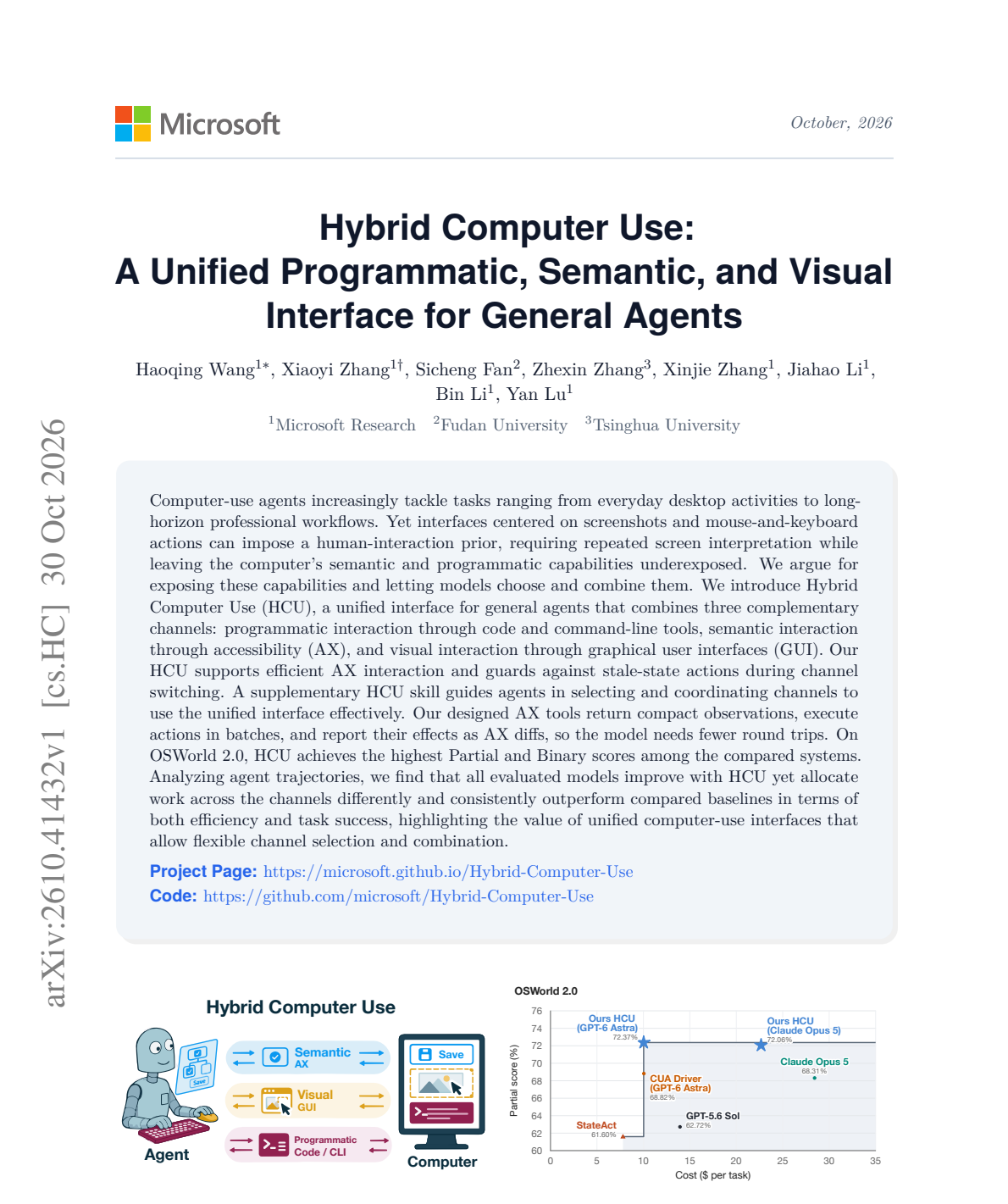
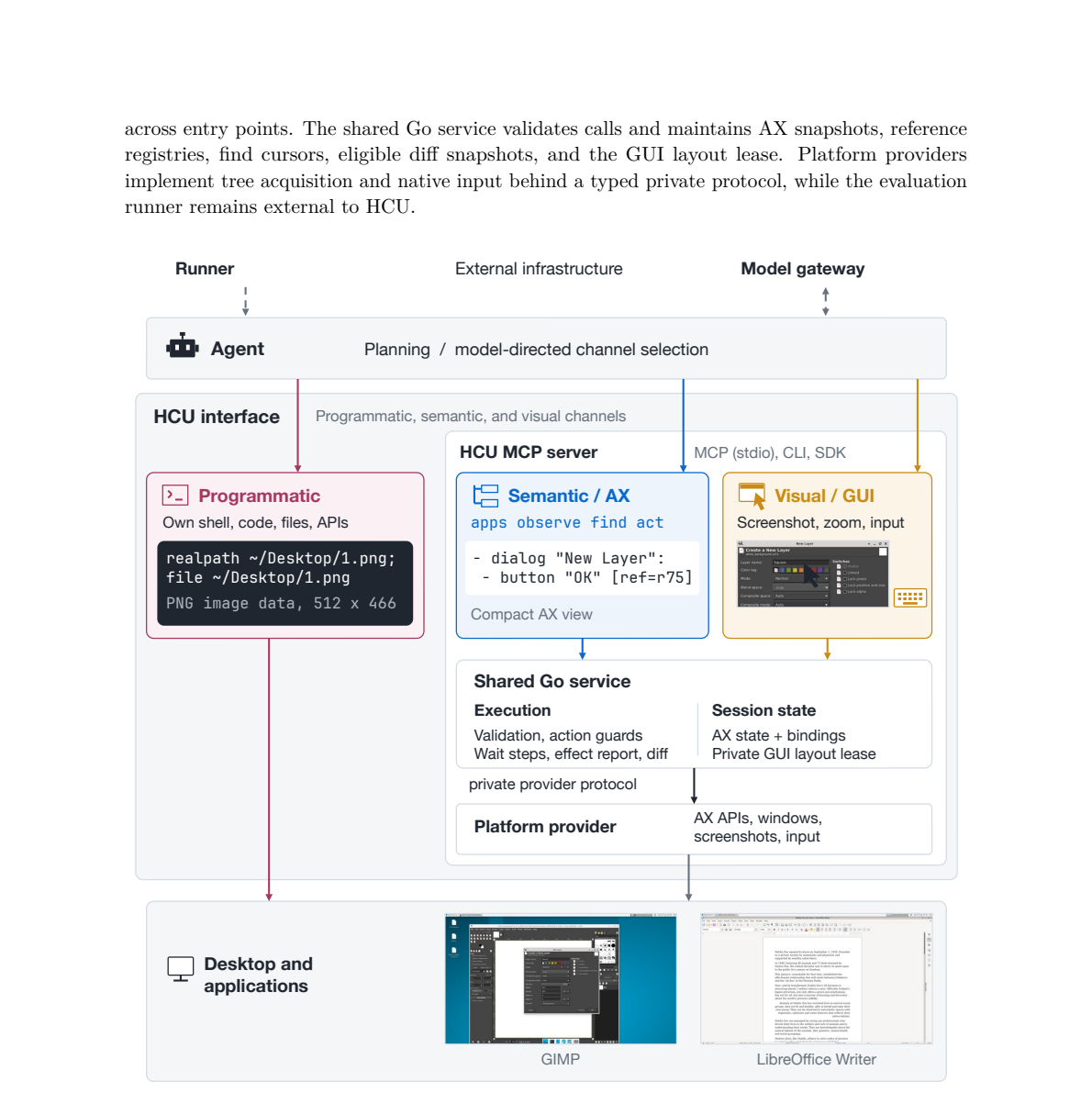
We argue for exposing these capabilities and letting models choose and combine them. We introduce Hybrid Computer Use (HCU), a unified interface for general agents that combines three complementary channels: programmatic interaction through code and command-line tools, semantic interaction through accessibility (AX), and visual interaction through graphical user interfaces (GUI). Our HCU supports efficient AX interaction and guards against stale-state actions during channel switching. A supplementary HCU skill guides agents in selecting and coordinating channels to use the unified interface effectively. Our designed AX tools return compact observations, execute actions in batches, and report their effects as AX diffs, so the model needs fewer round trips. On OSWorld 2.0, HCU achieves the highest Partial and Binary scores among the compared systems. Analyzing agent trajectories, we find that all evaluated models improve with HCU yet allocate work across the channels differently and consistently outperform compared baselines in terms of both efficiency and task success, highlighting the value of unified computer-use interfaces that allow flexible channel selection and combination.
from the abstract
Pith says
Machine review · deepseek-v4-flash · 2 Nov 2026 · what was read was not recorded · not checked by a person
It can be wrong. Challenge this review or reply to it.
Holds up, with conditions. Solid systems paper with a genuinely useful AX interface design; the matched-baseline evidence holds up, but the headline OSWorld 2.0 ranking rests on single runs and should not be stated as-is. This line is wrong
3 major objections · 4 minor
How often objections from reviews like this one are right: not yet measured
Not checked: figures, code, what the 40 references say.
The paper says, at Section 4.2, Table 1; Appendix B.1
The review did not quote this passage.
Pith says: Objection 1 of 3 · major
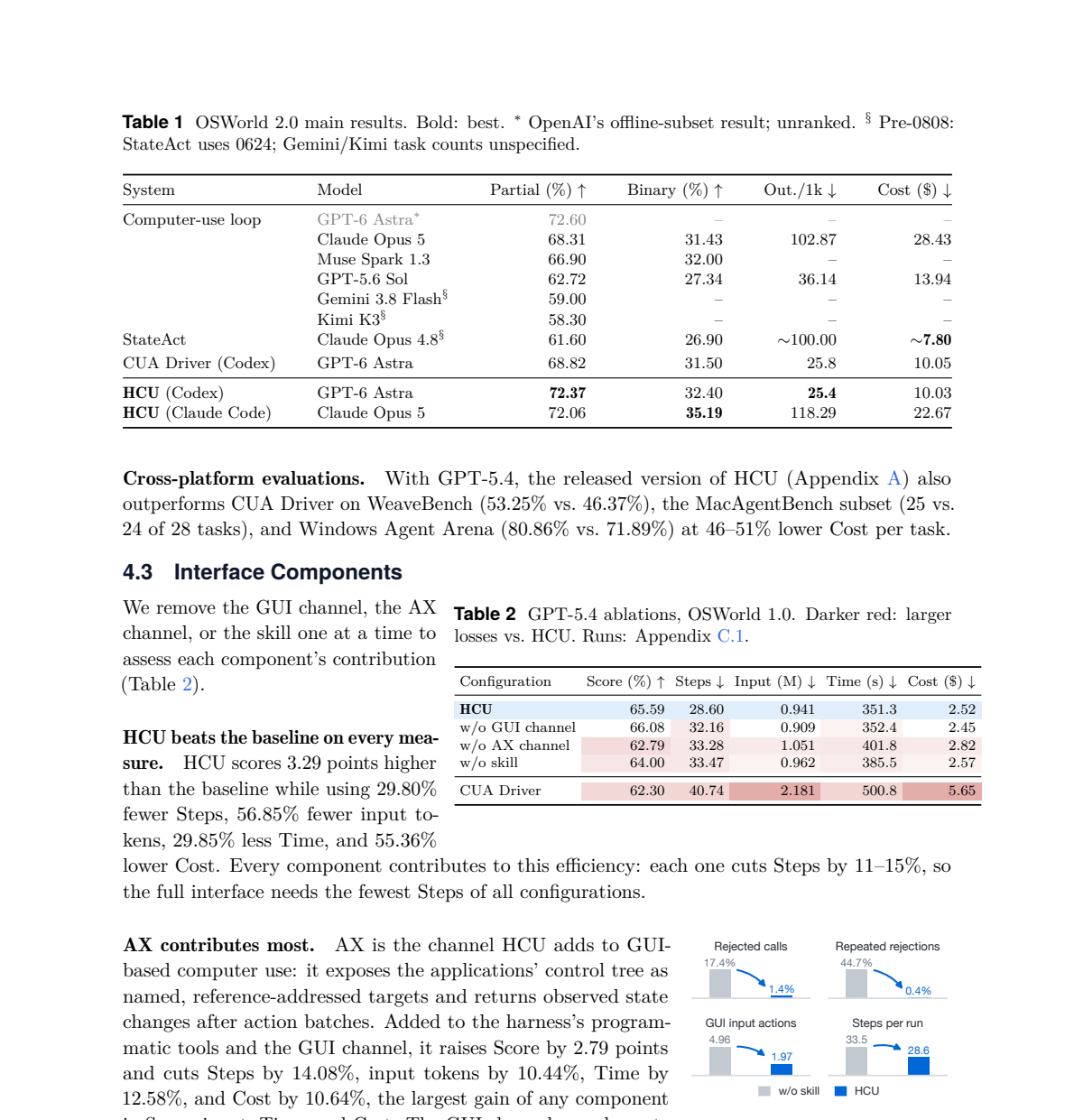
The headline claim that HCU achieves the highest Partial and Binary scores on OSWorld 2.0 rests on single-run evaluations whose margins sit inside the run-to-run variability the paper itself reports. Appendix B.1 enumerates the configurations with multiple runs and lists only the five GPT-5.4 ablation arms (three runs) and Claude Opus 5.5 HCU (two runs); HCU (GPT-6 Astra), HCU (Claude Opus 5), and CUA Driver (GPT-6 Astra) are absent from that list, and no per-run figures are given for them.
more of objection 1
Table 10 reports three-run Score spreads of 1.21 points (HCU), 2.20 points (CUA Driver), and up to 3.22 points (HCU w/o GUI) on the 361-task OSWorld 1.0 set, while the OSWorld 2.0 full set has only 108 tasks, so per-run spread should plausibly be larger. Against that noise, the matched Partial margin is 3.55 points and the matched Binary margin is 0.90 points (about one task in 108). Because the abstract, contribution 2, and Section 5 state the ranking without flagging it as single-run, a single additional run could change part of the headline. Please run the main OSWorld 2.0 configurations at least three times and report per-run values, or explicitly present the results as single-run point estimates and qualify the 'highest' claim.
The paper says, at Table 1; Appendix B.2; Section 4.2
The review did not quote this passage.
Pith says: Objection 2 of 3 · major
The 'highest Binary' ranking and the claimed gains over the official Claude Opus 5 leaderboard result mix releases, harnesses, and protocols. StateAct's figures come from the 0624 release while HCU and CUA Driver ran on the 0808 release, and Gemini and Kimi task counts are unspecified; this is footnoted in Table 1 and documented in Appendix B.2, so the release-date issue is acknowledged.
more of objection 2
What is not acknowledged is that the Claude Opus 5 comparison (Section 4.2: 'improves Partial by 3.75 points and Binary by 3.76 points over the model's official leaderboard result') is a cross-harness comparison: HCU ran in Claude Code under the authors' settings, while the official figure's harness, reasoning settings, and evaluation protocol are not disclosed or matched, and neither side has reported variance. The unqualified 'highest ... Binary' statement in the abstract therefore exceeds the evidence. Please state the release, harness, and run count next to every external entry in Table 1, and restrict the ranking claim to the matched comparison or label the rest explicitly as context.
The paper says, at Section 3.3; Section 4.3; Table 2
The review did not quote this passage.
Pith says: Objection 3 of 3 · major
The skill was distilled from the authors' own development trajectories on these benchmarks (Section 3.3 mentions 'recurring mistakes in development trajectories'), which the paper acknowledges, so the skill ablation in Section 4.3 measures the skill on the same distribution from which it was tuned.
more of objection 3
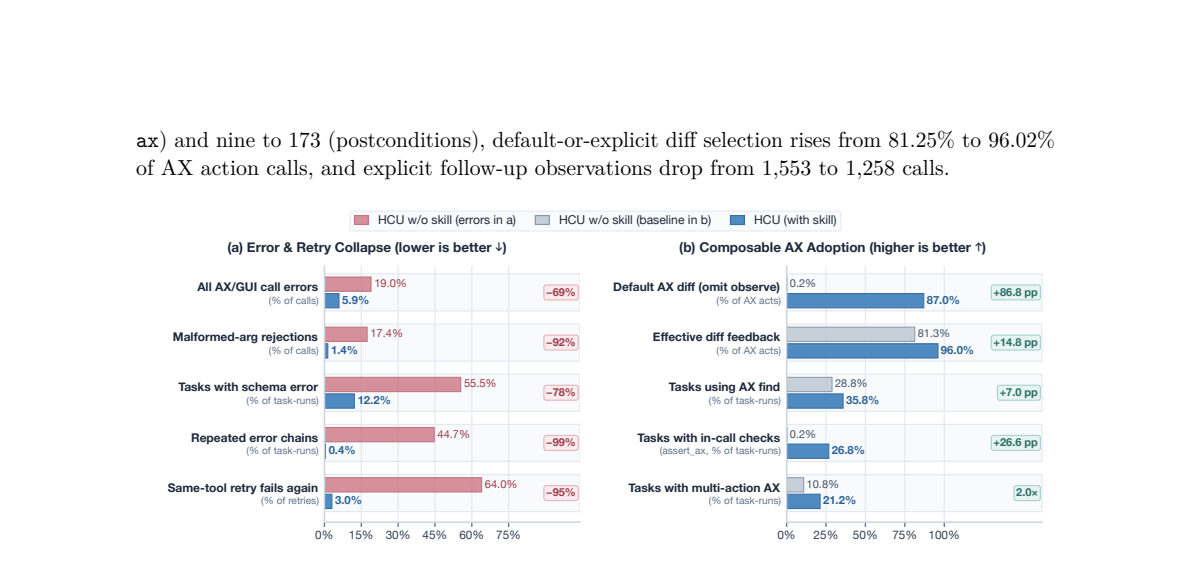
The reduction in malformed-argument rejections from 17.37% to 1.36% is an interface-level behavior that plausibly generalizes, and the Appendix A results on WeaveBench and Windows Agent Arena provide partial transfer evidence, but those appendix runs are also single-shot per configuration. To support the generality claim, please report the skill's effect on a task set or platform held out from the distillation process, or state the dependence on the development distribution explicitly in the abstract and in Section 5.
4 minor objections
The paper says, at Section 1; Appendix A
Pith says: minor objection 1 of 4
The main text reports a 70.13% OSWorld 1.0 Score and the cross-platform numbers from the released version of HCU, while Section 4 uses the evaluated version; Appendix B.1 lists the differences, but the introduction does not say which reported numbers correspond to the released artifact. Please add one sentence making the version mapping explicit.
The paper says, at Table 3; Appendix D.1
Pith says: minor objection 2 of 4
Claude Opus 5.5's CUA Driver baseline evaluates 360 tasks rather than 361 because one task was refused, and this is disclosed only in Appendix D.1; a footnote in Table 3 would make the per-model comparison self-contained.
show 2 more
The paper says, at Section 4.3, Figure 3; Table 11
Pith says: minor objection 3 of 4
Figure 3 and Table 11 mix two denominators ('calls' and 'task-runs'); the figure caption should state which of the two it shows for each panel so the 17.4%→1.4% and 44.7%→0.4% labels cannot be misread as the same quantity.
The paper says, at Appendix D.3, Figure 11
Pith says: minor objection 4 of 4
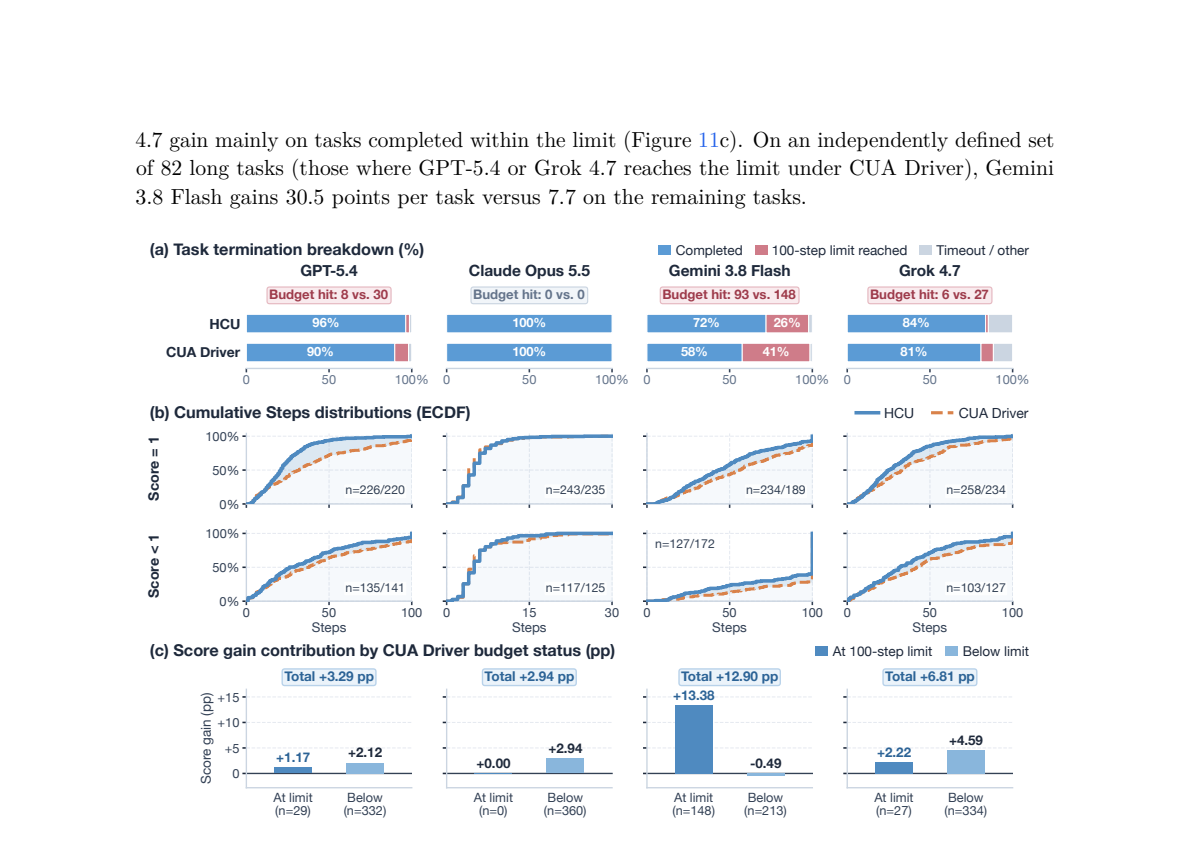
The paired-task counts shown in Figure 11(b) (for example n=226/220 for GPT-5.4) are not defined in the text; please add one sentence explaining how the pairs are formed and how the reported per-group step distributions are computed.
What would settle it
Re-run the two decisive OSWorld 2.0 configurations — HCU (GPT-6 Astra) and CUA Driver (GPT-6 Astra) in Codex on the 0808 full set — for three additional independent runs each (five total including the reported run) and report per-run Partial and Binary. If the minimum HCU Partial run does not exceed the maximum CUA Driver run, the 3.55-point matched margin is within documented run-to-run noise and the 'highest' ranking should be recast as within-variance. Tally per-task outcome flips across runs to bound the Binary margin (currently 0.90 points, about one task, in the matched comparison), and re-derive the headline 35.19% Binary claim only against baselines re-run under the same harness and settings as HCU rather than against unspecified official entries.
from the skeptic's reading
How the review went
4 readings by deepseek-v4-flash · 2 Nov 2026
- Reader holds up, with conditions
- Skeptic agrees
- Editor wrote the verdict above
- Referee major revision: 3 major objections, 4 minor
Not run on this paper: the simulated authors' defence.
Pith did not check this review's objections against the paper.
The review in full
The review in brief, machine-written
Worth your time. The engineering is real; the headline ranking claim is the weak part. Anyone building computer-use agents or interface toolkits will get concrete, usable design ideas here.
What's actually new is the AX design. The three-channel idea isn't novel — CUA Driver already blends programmatic, semantic, and visual input — but HCU's specifics are a contribution: target references bound to elements before the view is compressed, so compact observations don't break identity; batches of up to 64 actions with wait steps; per-target effect reports plus AX diffs as post-action feedback; and cross-channel guards that re-resolve references and check the GUI layout lease before input. The design is well motivated by documented AX failure modes, and the recorded rejection traces show the guards actually firing. Code and a project page are up, and the paper reports per-run data where it matters.
The OSWorld 1.0 evidence is the strongest part and it holds up. Three runs per configuration, per-run scores in Table 10, HCU ahead of CUA Driver in every run by 2.44–4.56 points, direction replicated across four models and three additional benchmarks at roughly half the cost. The skill ablation is also honest: malformed-argument rejections drop from 17.4% to 1.4% of calls, with per-call error tables in the appendix. This is careful systems work.
The soft spot is the OSWorld 2.0 headline. The main configurations look single-run: Appendix B.1 lists only the ablation arms and Claude Opus 5.5 as multi-run, and Section 4 never flags the main table as one draw each. The paper's own OSWorld 1.0 runs spread 1.21–3.22 points on a 361-task set; the 108-task OSWorld 2.0 set should spread wider. So the 3.55-point Partial margin over the matched baseline sits inside plausible noise, and the 0.90-point Binary margin is about one task. The Binary best also beats unmatched external entries (Muse Spark 32.00%, official Claude Opus 5 at 31.43%) by three to four tasks, with no matched harnesses or protocols. To be fair, the release mismatch for StateAct and the other external entries is footnoted in Table 1, and the 3.55-point margin matches the 3.29-point OSWorld 1.0 margin with a different model — the direction is solid. It's the "highest on OSWorld 2.0" claim that outruns the evidence.
Minor note: the skill was distilled from the authors' own development trajectories on these benchmarks (stated plainly in Section 3.3), so the skill ablation partly measures tuning to the test distribution. Standard practice; a held-out set would have been better.
Recommendation: send to peer review. Ask for run-to-run variance on the main OSWorld 2.0 results, matched reruns of key baselines on the same release, and either variance figures or softer language behind the ranking claim. This deserves referee time.
The strongest objection
The headline claim that HCU achieves the highest Partial and Binary scores on OSWorld 2.0 rests on comparisons that are single-run and partly unmatched. Appendix B.1 enumerates 'configurations with multiple runs' and lists only the five GPT-5.4 ablation arms (three runs) and Claude Opus 5.5 HCU (two runs); the main OSWorld 2.0 configurations — HCU (GPT-6 Astra), HCU (Claude Opus 5), and CUA Driver (GPT-6 Astra) — are absent from that list and no per-run figures are given for them, so Table 1's entries are best read as one draw each. The paper's own Table 10 shows three-run spreads of 1.21 points (HCU), 2.20 points (CUA Driver), and up to 3.22 points (HCU w/o GUI) on the 361-task OSWorld 1.0 set; the OSWorld 2.0 full set has only 108 tasks, so per-run spread should plausibly be larger. Against that noise, the matched Partial margin is 3.55 points (72.37 vs. 68.82) and the matched Binary margin is only 0.90 points — about one task out of 108. The headline 35.19% Binary beats the closest external entries by roughly three to four tasks (Muse Spark 1.3 at 32.00%; official Claude Opus 5 at 31.43%), and those entries' harnesses, reasoning settings, and evaluation protocols are not disclosed or matched; StateAct's figure additionally comes from the 0624 release while HCU and CUA Driver ran on 0808. The paper nowhere flags the main results as single-run, so this is not an acknowledged limitation. This concern does not touch the multi-run OSWorld 1.0 ablations (per-run tables, consistent arithmetic) or the direction-consistent cross-model trend; the vulnerability is specific to the 'highest Partial and Binary' ranking claim.
The central claim that HCU achieves the highest Partial and Binary scores on OSWorld 2.0 is the least secure part of the paper, and it is insecure for exactly the reason the reader identified: the decisive numbers are single draws. Appendix B.1's run accounting covers only the GPT-5.4 ablation arms (three runs) and Claude Opus 5.5 HCU (two runs); the main OSWorld 2.0 configurations are not listed as multi-run and no per-run figures are given for them. The paper's own Table 10 shows that on 361 tasks, three runs of the same configuration spread 1.21–3.22 points; the OSWorld 2.0 full set is 108 tasks, so the run-to-run spread should be no smaller. The matched Partial margin is 3.55 points and the matched Binary margin is 0.90 points (about one task), so a rerun could plausibly erase both. The headline Binary (35.19%) beats the nearest external systems by only three or four tasks, and those systems' harnesses and settings are not disclosed, let alone matched; StateAct's comparison also crosses benchmark releases (0624 vs. 0808). The paper does not flag the main results as single-run anywhere, so this is not an acknowledged limitation. I checked the alternatives: the skill text in Appendix F.2 is genuinely generic routing guidance and is transferred to WeaveBench, MacAgentBench, and Windows Agent Arena in Appendix A, mitigating a tuning-circularity reading; the harness pairing (each model in its own harness, both interfaces in the same harness) controls for harness effects; and the reported arithmetic is internally consistent (e.g., Table 10 means match Table 2). So the variance/comparability cluster is genuinely the most load-bearing concern rather than a manufactured one. Credit is due for the multi-run OSWorld 1.0 ablations with per-run tables, the honest Score/Steps decomposition, and the released-version cross-platform evaluations, which support the 'improves over CUA Driver' claim; they do not, by themselves, support the 'highest on OSWorld 2.0' ranking. The reader's CONDITIONAL verdict therefore stands unchanged, with the same test: rerun the decisive configurations and report per-run variance.
The referee's report
If the results hold, HCU is a solid systems contribution: it demonstrates, without model training, simultaneous gains in task success and interaction efficiency across four backbone models and three operating systems, and the cross-channel action guards and AX-diff feedback are well motivated by concrete failure modes. The reporting is a genuine strength — per-run ablation scores (Table 10), step-limit termination decompositions (Figure 11), post-error channel-transition analyses (Figure 12), and the full tool definitions and skill text (Appendix F) make the experimental claims unusually inspectable, and the code and project page are released. The principal risk is not internal consistency but the strength of the headline OSWorld 2.0 ranking, which is single-run, partly cross-release, and within the run-to-run spread the paper itself reports; the more robust evidence is the multi-run, matched OSWorld 1.0 comparison. The skill's distillation from the authors' own trajectories on the evaluation benchmarks is acknowledged and partially mitigated by the cross-platform results.
Pith's reading of the paper (a machine's summary, not the authors')
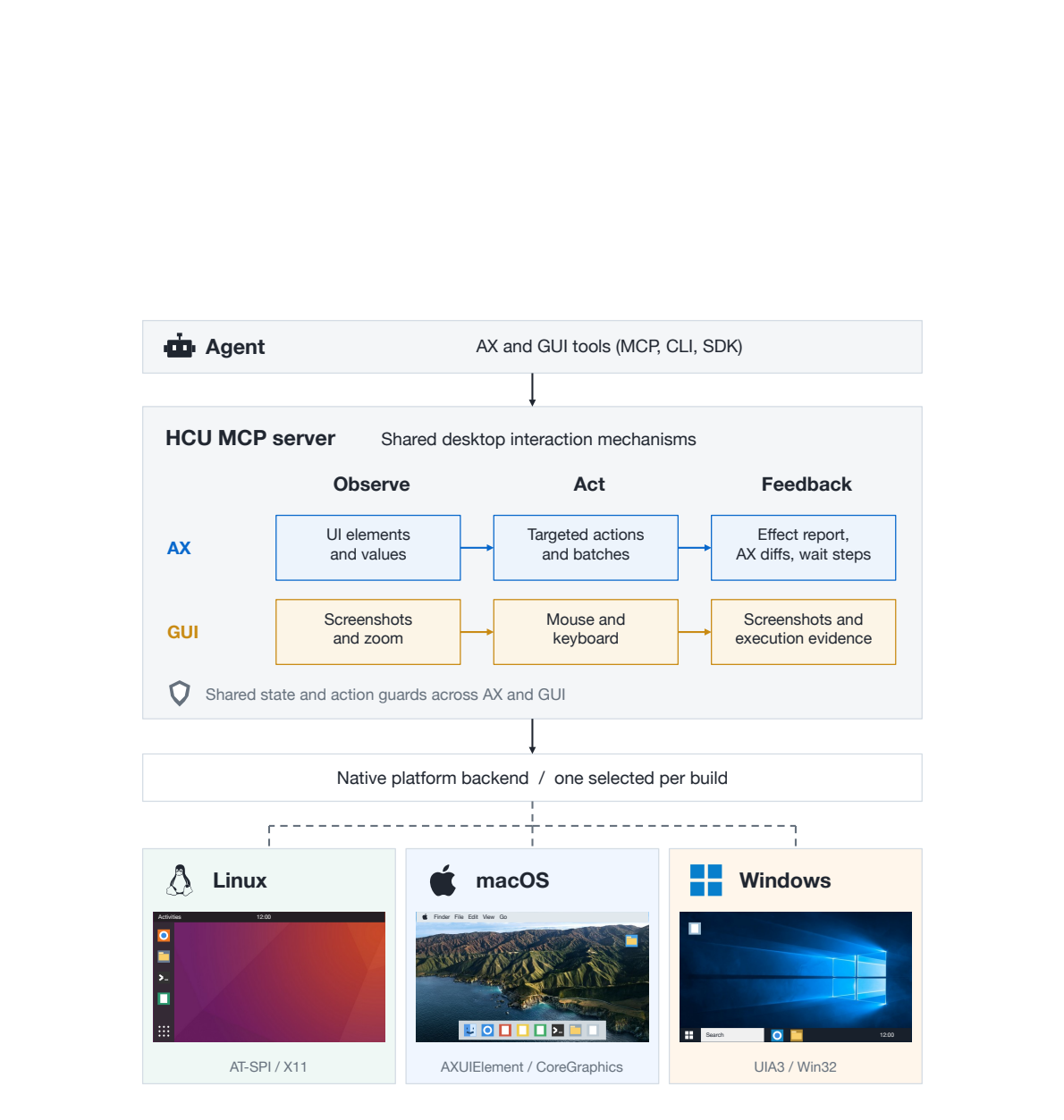
The paper claims that agents operating a computer pay a hidden cost when they imitate human interaction — screenshot, locate, click — and that giving the same agent three channels to choose from — programmatic code and shell tools, semantic accessibility (AX) trees, and visual screenshots — improves both task success and efficiency. Its Hybrid Computer Use (HCU) interface adds AX and GUI tools to the agent's own programmatic tools, lets the model pick and combine channels per task, and guards against acting on stale state when switching channels. HCU reports the highest Partial (mean task score; 72.37% with GPT-6 Astra) and Binary (full-credit rate; 35.19% with Claude Opus 5) results among full-set OSWorld 2.0 systems, and beats the CUA Driver baseline on OSWorld 1.0 with four further backbone models, averaging 6.48 more Score points with 17% fewer steps and 30% lower cost. If these results hold, the design principle — expose the computer's own capabilities and let the model route between them — transfers across Linux, macOS, and Windows rather than being tied to one model or harness.
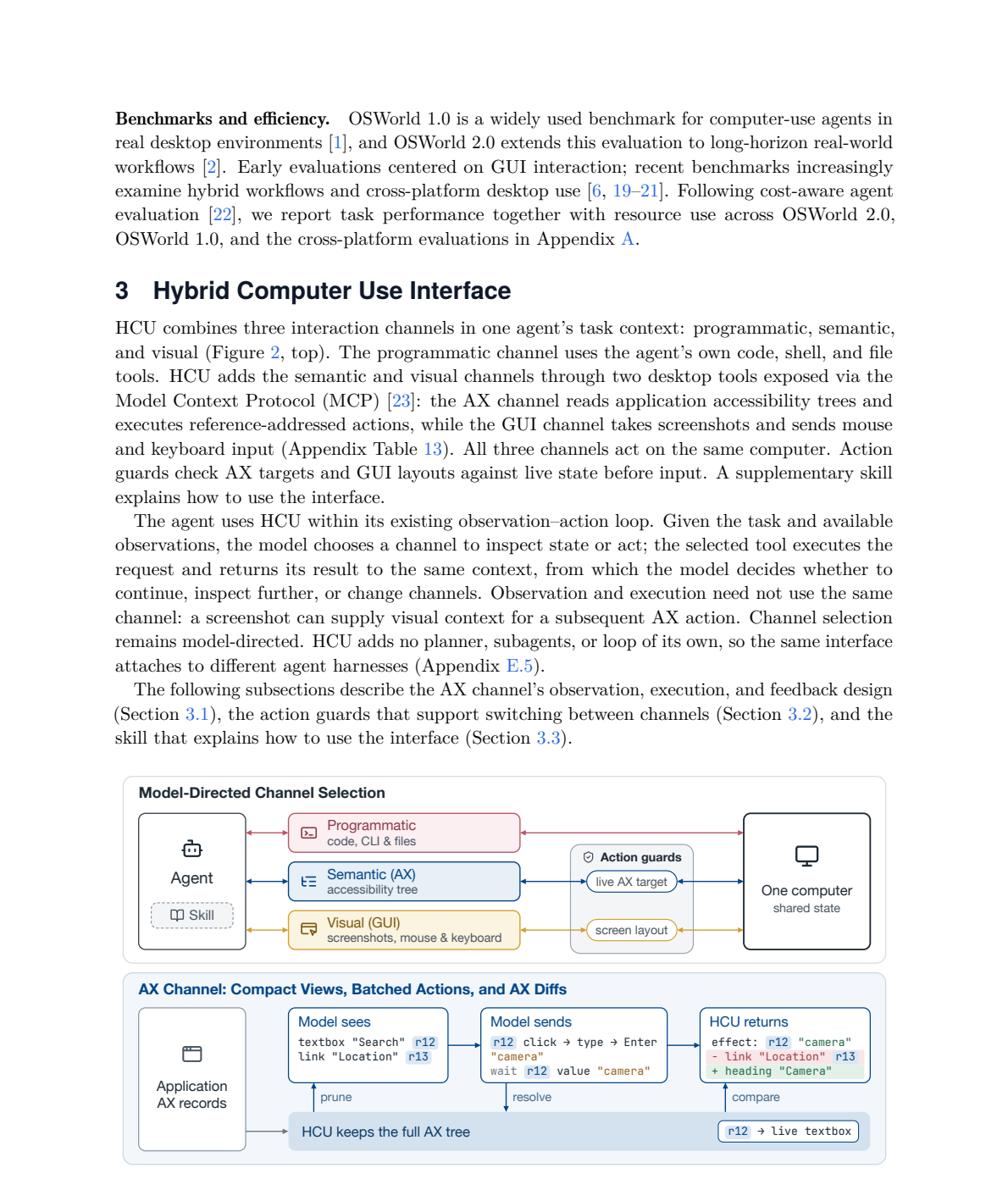
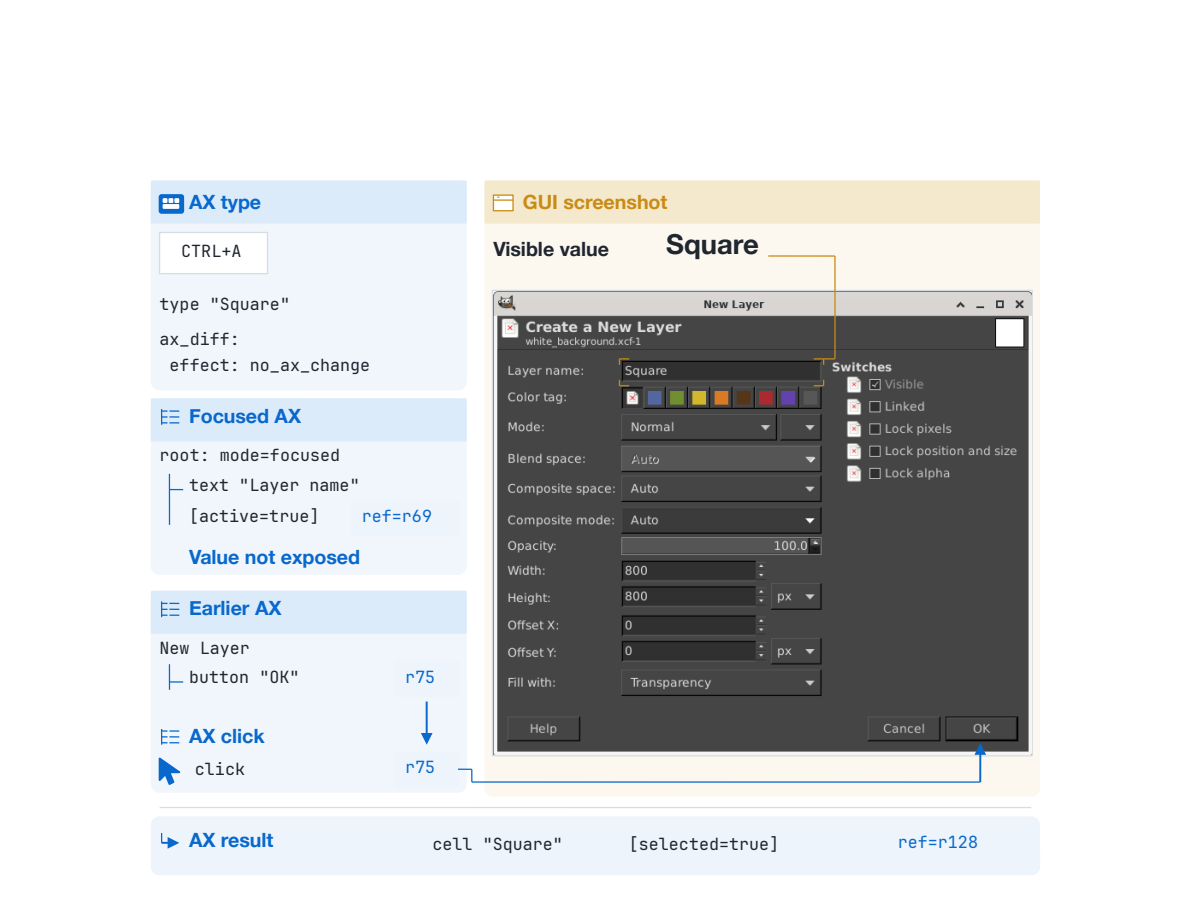
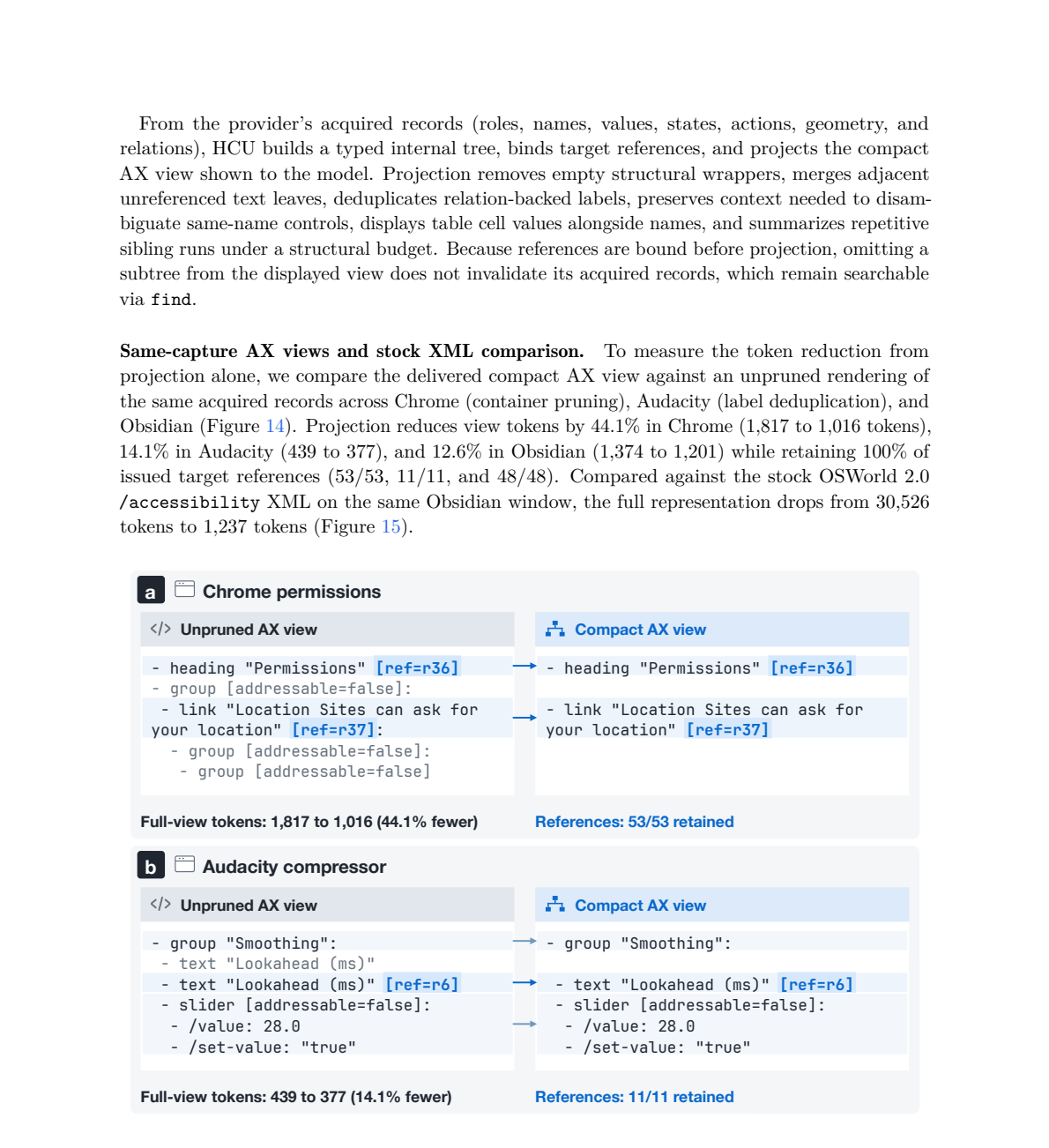
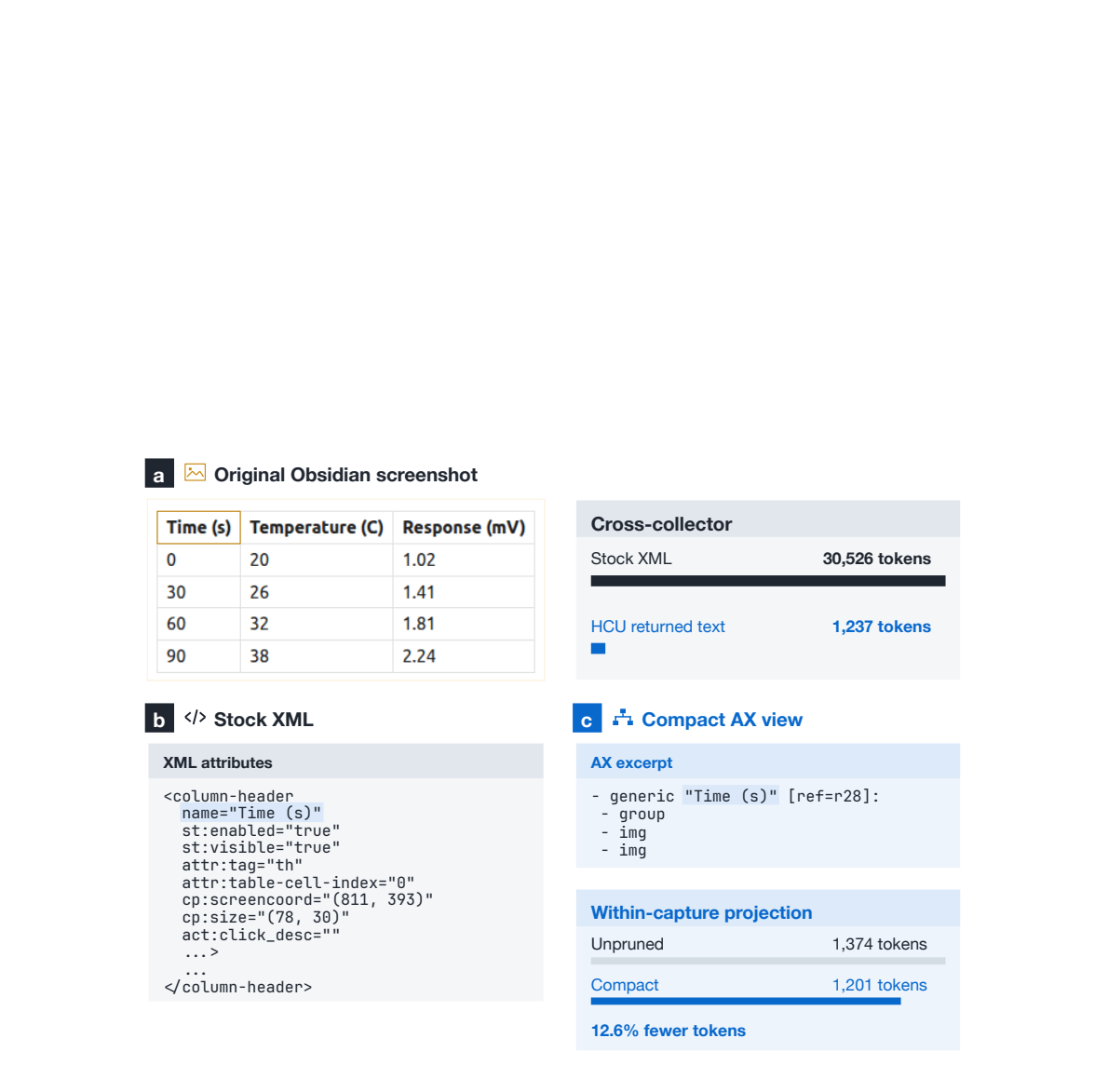
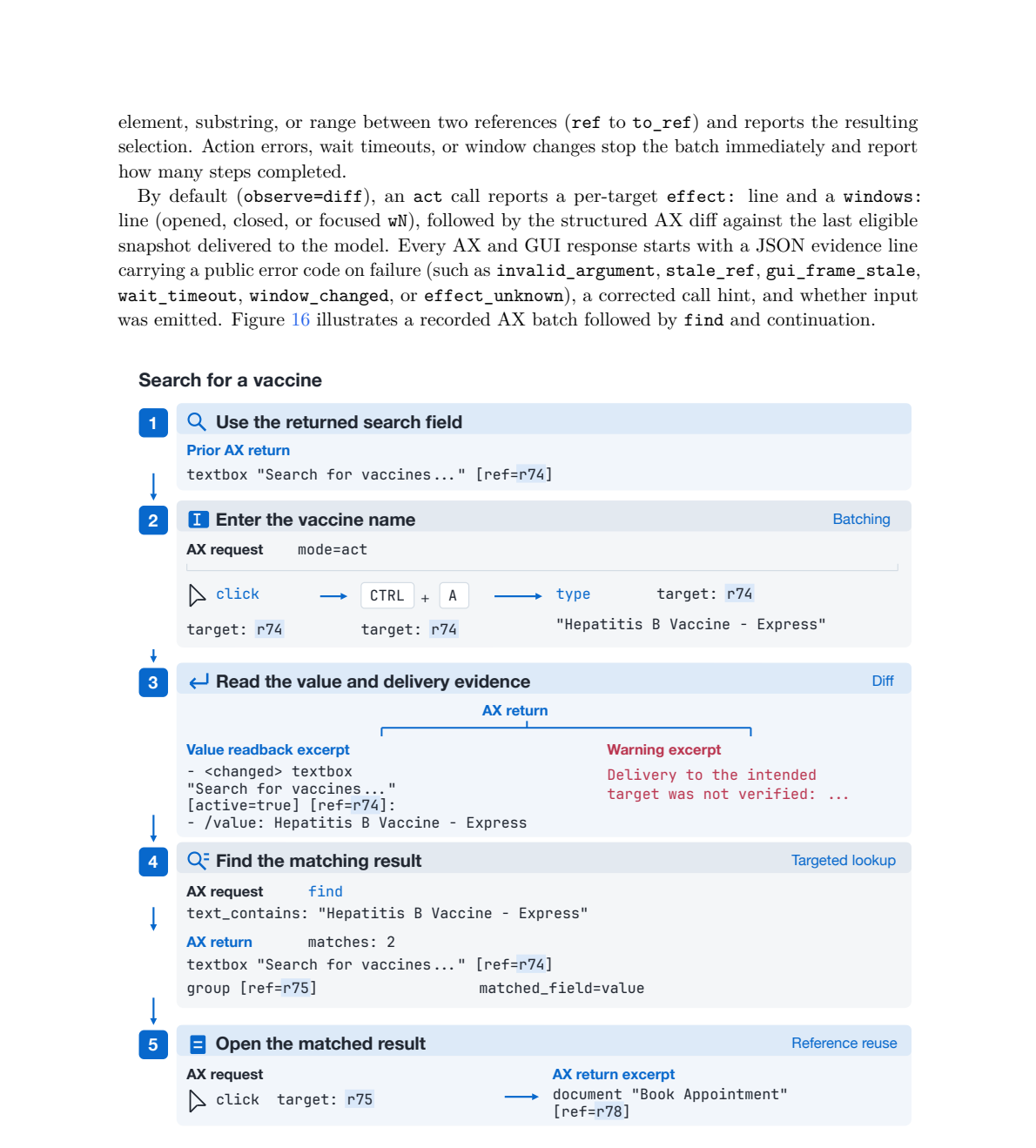
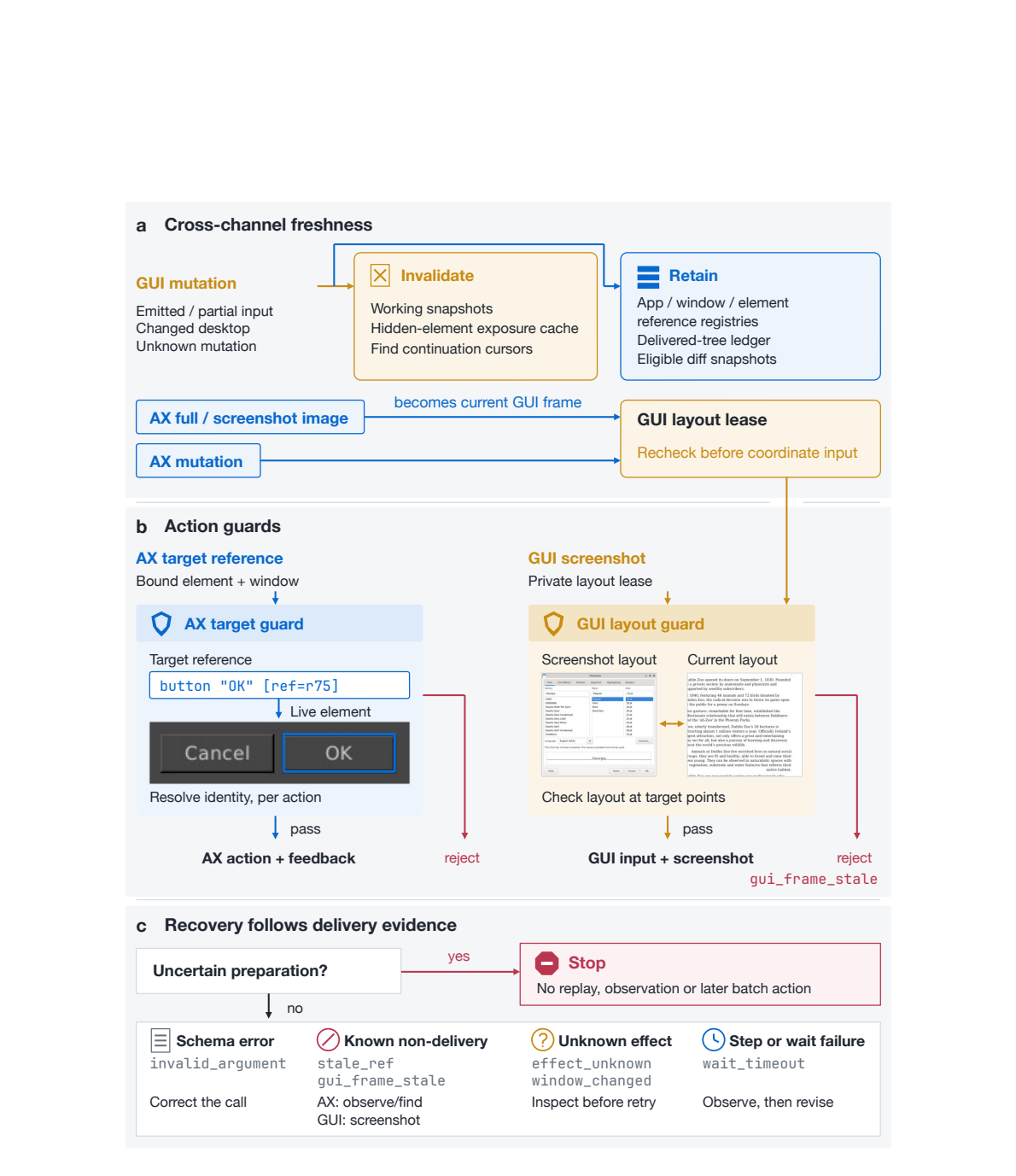
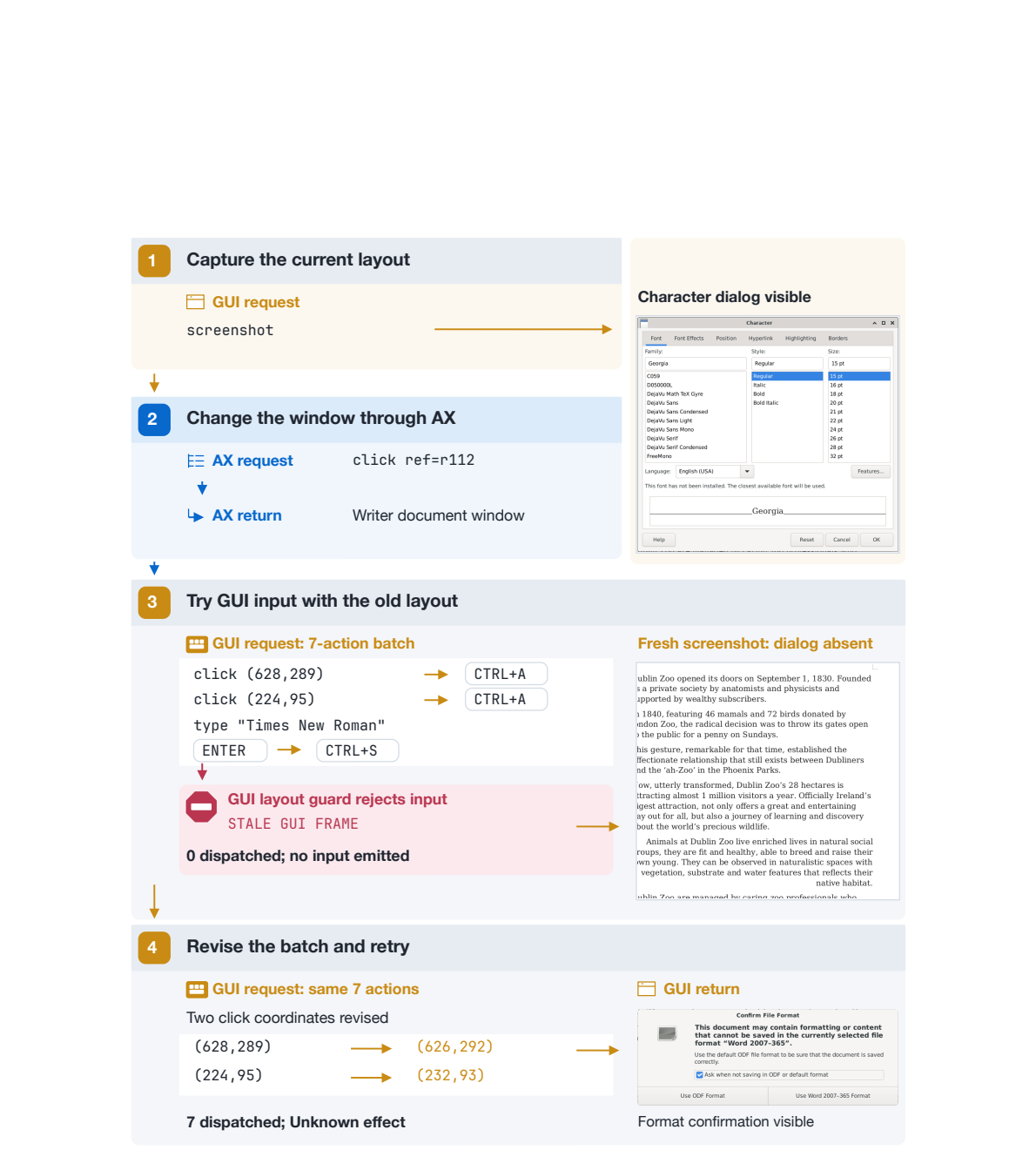
What carries the argument. The mechanism that carries the argument is the AX channel's reference-addressed execution loop. HCU separates the accessibility records it retains from the compact view shown to the model: target references are bound to elements before view compression, so shortening the view does not change what a reference names, and the retained records support targeted find, scoped observation, and AX diffs after actions. An act call executes ordered actions plus optional wait steps within one window, stopping at the first failed step or timed-out wait, and returns per-target effect summaries and a structured diff against the last delivered observation, letting the model continue without a separate read. The cross-channel action guards sit at the boundary: the AX target guard resolves every reference against live state and rejects missing, ambiguous, or replaced elements without sending input, and the GUI layout guard blocks coordinate input when the current window layout no longer matches the screenshot it was planned from, returning a fresh screenshot instead. Around these sits a skill, distilled from recurring trajectory errors, that routes work by where the state lives and explains the error-code recovery contract; it cuts malformed-call rejections from 17.37% to 1.36% and roughly doubles multi-action AX adoption.
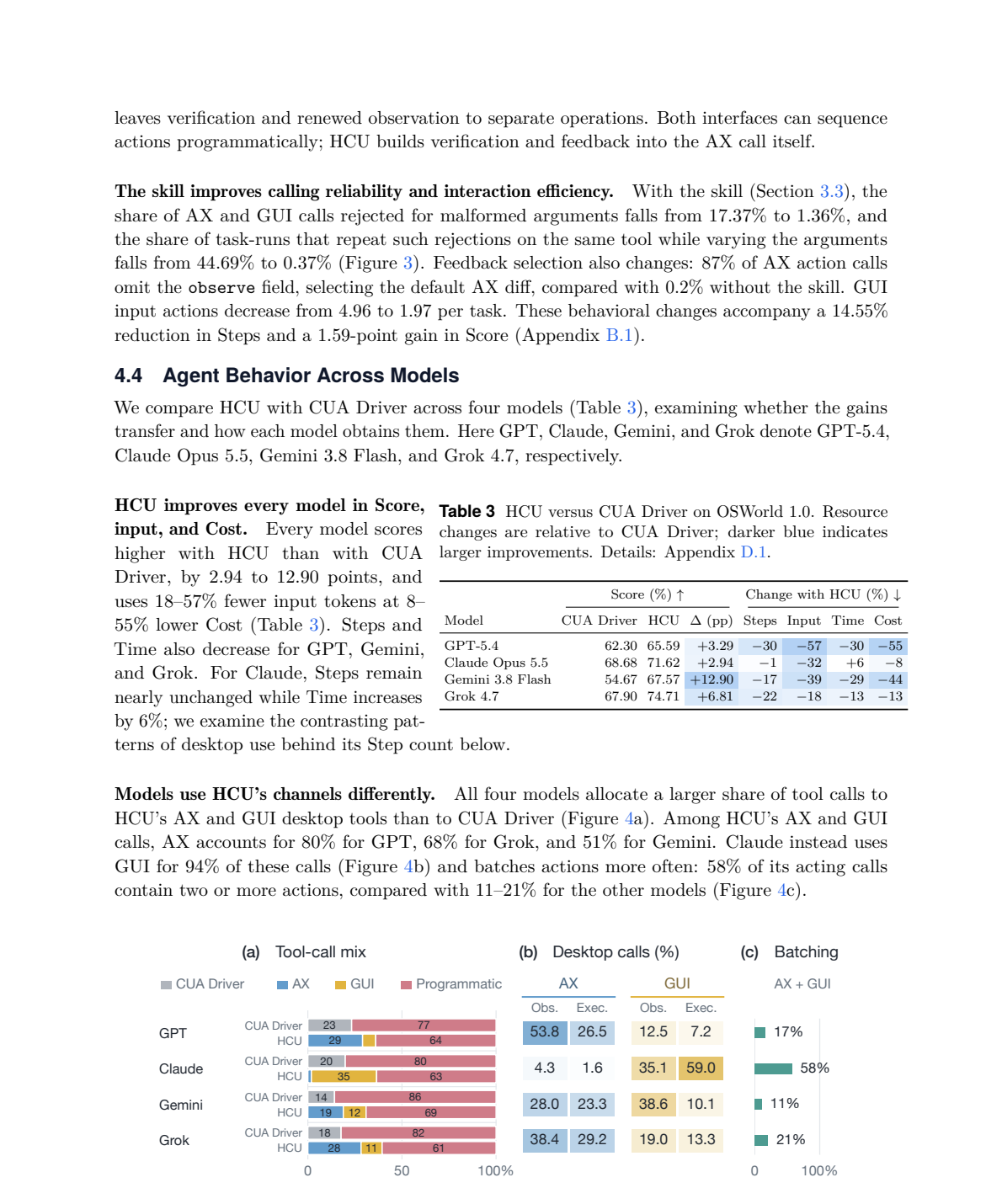
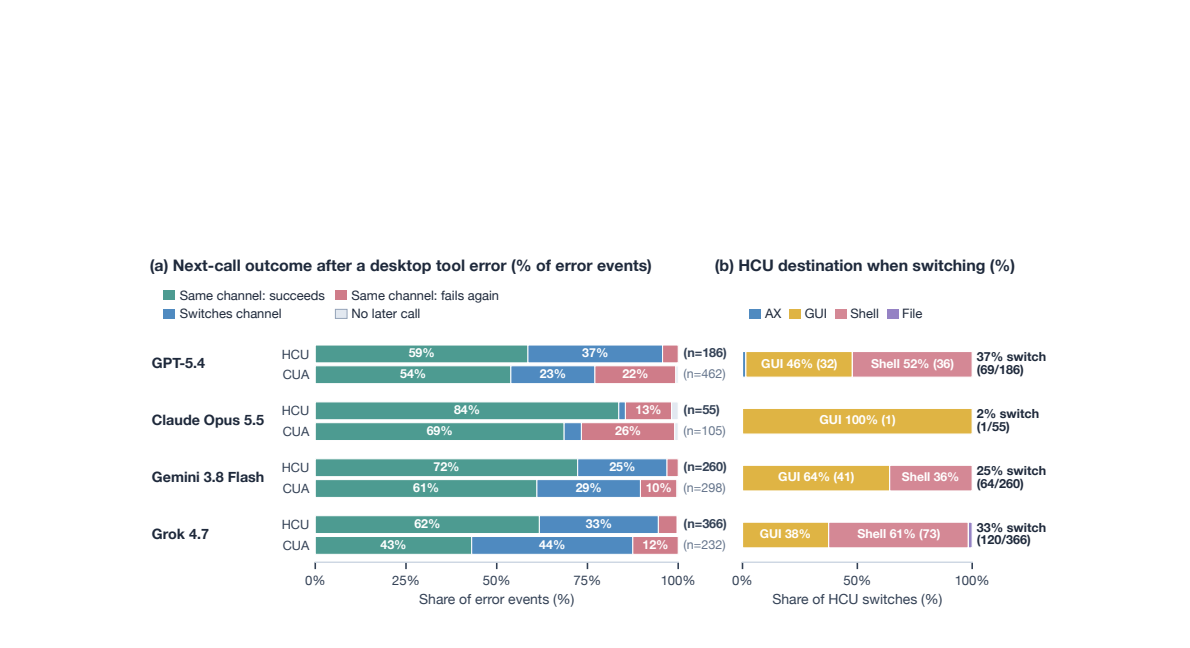
Core claim. The central claim is that the interface, not the model, is a large part of what limits computer-use agents, and that a unified interface with model-directed channel selection releases capabilities already present in frontier models without any training. HCU's load-bearing design moves execution and verification into the accessibility channel: target references stay bound to live elements while the displayed view is compressed, one act call batches up to 64 ordered actions with optional wait steps and stops at the first failure, and the returned AX diff reports what changed relative to the last observation the model actually received. Cross-channel action guards re-check AX targets and GUI window layouts against live state immediately before input, so a model may observe through one channel and act through another without acting on stale evidence. Across models, channel allocation differs sharply — Claude sends 94% of desktop calls through GUI while GPT, Gemini, and Grok send 51–80% through AX — yet every evaluated model scores higher and spends less, and the score gains concentrate on tasks that actually invoke the desktop tools. The paper concludes that a strong human-like interface that fixes how the computer is used can limit what increasingly capable models can do with it, since the semantic and programmatic capabilities HCU exposes already exist on standard desktops.
The premise it rests on. The comparison assumes that one evaluation run per configuration captures the true ranking and that external leaderboard rows are comparable across benchmark releases — the paper's own OSWorld 1.0 ablations show run-to-run Score spreads from 1.21 to 3.22 points, which is the same size as the 3.55-point Partial gap that carries the headline claim.
If the paper is right (Pith's inferences, not the authors')
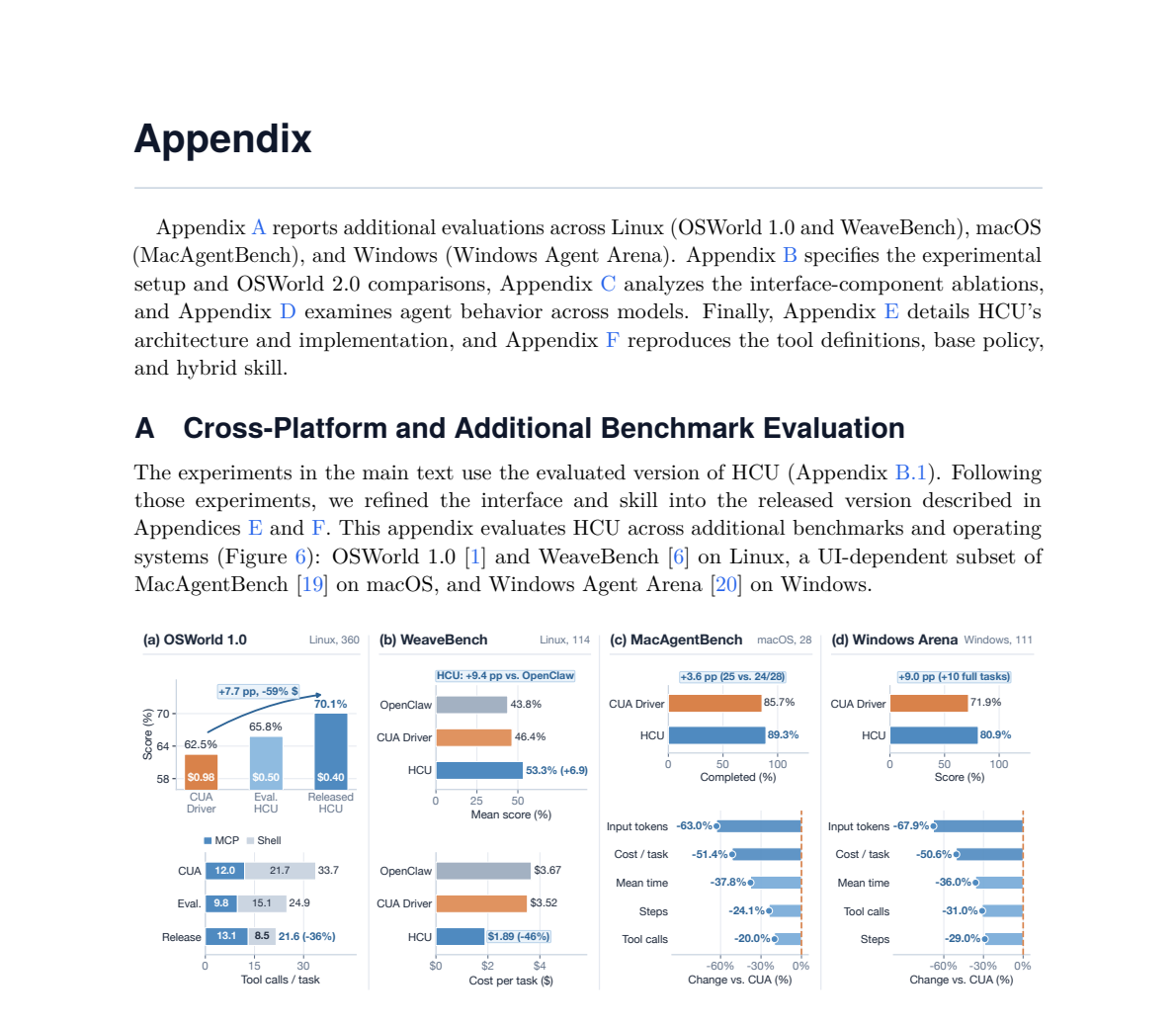
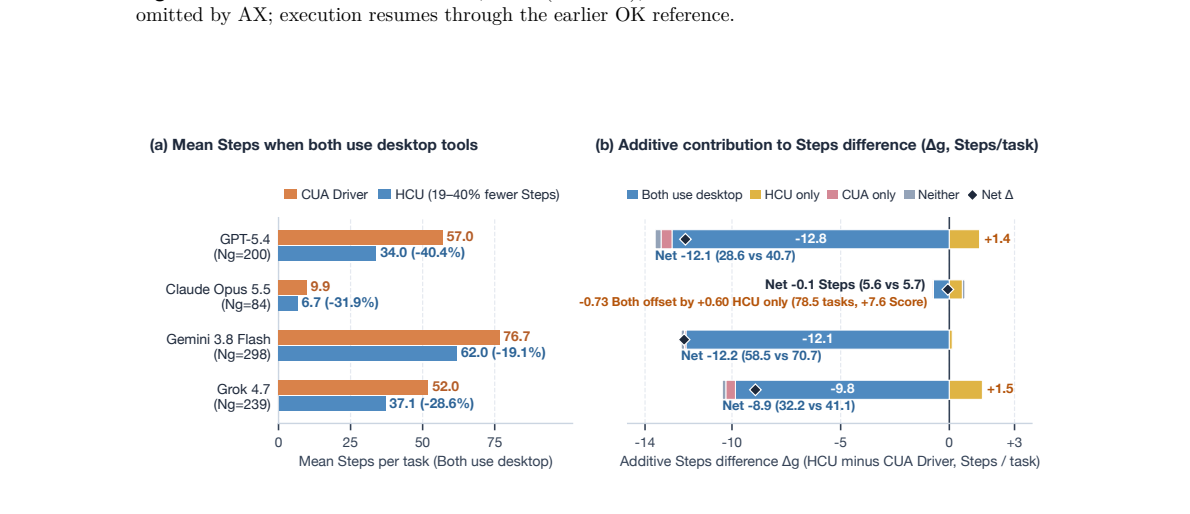
Screenshot-only interfaces are leaving both success and cost on the table: with the same models and harnesses, HCU beats CUA Driver on every OSWorld 1.0 efficiency measure, and the gains transfer to WeaveBench, MacAgentBench, and Windows Agent Arena at roughly half the cost per task.
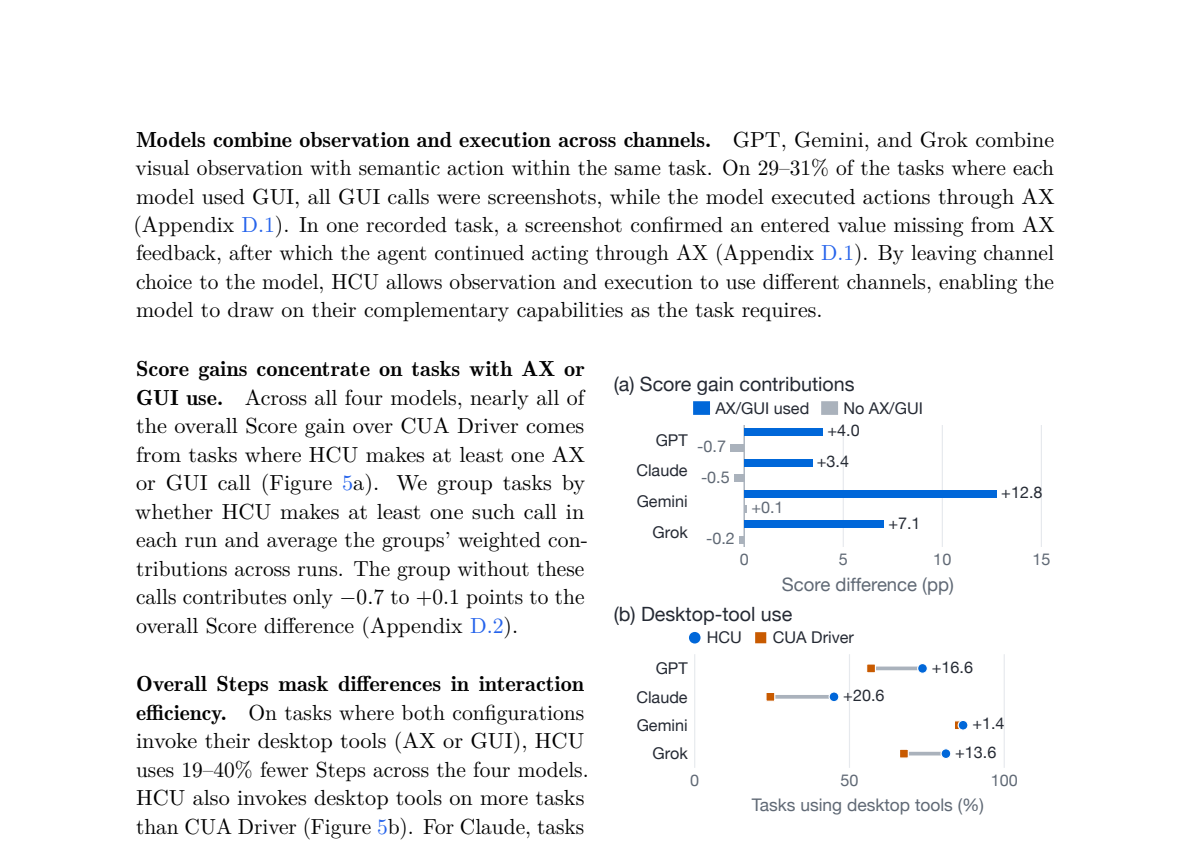
Accessibility becomes a first-class agent channel: across three of four models, AX carries 51–80% of desktop tool calls, and observation cost tracks changes (AX diffs) rather than full screen state, so evaluations should count tokens and steps, not just success.
Channel choice can be left to the model: on 29–31% of tasks where GPT, Gemini, or Grok used GUI at all, every GUI call was a screenshot while actions ran through AX, so no fixed routing policy is required.
Interface conventions interact with model habits: swapping in a GUI action vocabulary matched to a model's native calling style shifts scores by −2.03 to +0.82 points and cuts convention errors, implying interface design is partly model-specific.
Because AX exposes element states that code can read and act on, batched AX actions with wait steps make it possible to treat the desktop as a programmable environment and compose desktop work inside programmatic tool calls.
The headline 3.55-point Partial margin over the matched baseline sits close to the run-to-run spreads the paper itself measures on OSWorld 1.0 (1.21 to 3.22 points); a multi-run OSWorld 2.0 evaluation could shrink or erase the margin, though the efficiency gains (30–57% fewer input tokens, 8–55% lower cost) are larger and more likely to persist.
The AX-diff design suggests a general principle for agent interfaces: return what changed, not the whole state. Testing change-oriented feedback in other long-horizon agent settings — file trees, database states, web pages — would show whether the efficiency gain generalizes beyond desktop accessibility.
The cross-release leaderboard comparison (StateAct on the 0624 release, HCU on the 0808 release, Gemini and Kimi on unspecified task counts) is fragile; re-running StateAct, Gemini, and Kimi under the 0808 protocol with matched budgets would test whether the reported Pareto frontier and the ranking survive.
The GUI-vocabulary result implies tool schemas could be selected per model family at runtime; a natural extension is an adaptive interface that detects a model's calling conventions and shapes tool descriptions, wait steps, and action vocabulary accordingly.
Check this review
Pith stored no record of this review's passes and took no fingerprint of it. Reviews made by code from 13 Nov 2026 on carry both.
How often reviews like this one are right
Reviews like this one: written by deepseek-v4-flash, where what was read was not recorded.
How often objections from reviews like this one are right: not yet measured
Reviews by people
This review was written by a machine. No person has reviewed this paper on Pith yet. A scientist listed on Pith can review it for a fee, and their review is published here whatever it concludes.
The paper
Abstract
Computer-use agents increasingly tackle tasks ranging from everyday desktop activities to long-horizon professional workflows. Yet interfaces centered on screenshots and mouse-and-keyboard actions can impose a human-interaction prior, requiring repeated screen interpretation while leaving the computer's semantic and programmatic capabilities underexposed. We argue for exposing these capabilities and letting models choose and combine them. We introduce Hybrid Computer Use (HCU), a unified interface for general agents that combines three complementary channels: programmatic interaction through code and command-line tools, semantic interaction through accessibility (AX), and visual interaction through graphical user interfaces (GUI). Our HCU supports efficient AX interaction and guards against stale-state actions during channel switching. A supplementary HCU skill guides agents in selecting and coordinating channels to use the unified interface effectively. Our designed AX tools return compact observations, execute actions in batches, and report their effects as AX diffs, so the model needs fewer round trips. On OSWorld 2.0, HCU achieves the highest Partial and Binary scores among the compared systems. Analyzing agent trajectories, we find that all evaluated models improve with HCU yet allocate work across the channels differently and consistently outperform compared baselines in terms of both efficiency and task success, highlighting the value of unified computer-use interfaces that allow flexible channel selection and combination.
The paper's own sentences, arranged, kept beside the review and separate from it. Each label is drawn from a closed vocabulary; the number beside it is the probability the classifier gave that label. No sentence in this record was written by a model.
abstract compiled · 2026-11-02
The authors' main claim, as the classifier picked it out 0.99
“Analyzing agent trajectories, we find that all evaluated models improve with HCU yet allocate work across the channels differently and consistently outperform compared baselines in terms of both efficiency and task success, highlighting the value of unified computer-use interfaces that allow flexible channel selection and combination.”
How the main claim is stated: asserted 1.00
What the abstract itself states, as probabilities: claims first 0.08 · states limitation 0.13 · human participants 0.05 · controlled comparison 0.89 · randomized assignment 0.02 · states quantitative result 0.22 · compares with prior results 0.97 · mentions code or data availability 0.05
The abstract, sentence by sentence
This table labels the abstract only (arXiv listing abstract v1). The number is the probability the classifier gave the label.
| Sentence | Role | The authors' own work | States the main conclusion | Strength |
|---|---|---|---|---|
| Computer-use agents increasingly tackle tasks ranging from everyday desktop activities to long-horizon professional workflows. | background 1.00 | 0.04 | 0.02 | asserted 0.99 |
| Yet interfaces centered on screenshots and mouse-and-keyboard actions can impose a human-interaction prior, requiring repeated screen interpretation while leaving the computer's semantic and programmatic capabilities underexposed. | background 0.50 | 0.07 | 0.04 | asserted 0.63 |
| We argue for exposing these capabilities and letting models choose and combine them. | contribution 0.46 | 0.14 | 0.38 | asserted 0.72 |
| We introduce Hybrid Computer Use (HCU), a unified interface for general agents that combines three complementary channels: programmatic interaction through code and command-line tools, semantic interaction through accessibility (AX), and visual interaction through graphical user interfaces (GUI). | contribution 0.87 | 0.89 | 0.16 | asserted 1.00 |
| Our HCU supports efficient AX interaction and guards against stale-state actions during channel switching. | method 0.81 | 0.87 | 0.05 | asserted 1.00 |
| A supplementary HCU skill guides agents in selecting and coordinating channels to use the unified interface effectively. | method 0.62 | 0.85 | 0.06 | asserted 1.00 |
| Our designed AX tools return compact observations, execute actions in batches, and report their effects as AX diffs, so the model needs fewer round trips. | method 0.97 | 0.91 | 0.05 | asserted 1.00 |
| On OSWorld 2.0, HCU achieves the highest Partial and Binary scores among the compared systems. | result 1.00 | 0.95 | 0.22 | asserted 1.00 |
| Analyzing agent trajectories, we find that all evaluated models improve with HCU yet allocate work across the channels differently and consistently outperform compared baselines in terms of both efficiency and task success, highlighting the value of unified computer-use interfaces that allow flexible channel selection and combination. | result 0.58 | 0.95 | 0.67 | asserted 1.00 |
What kind of paper the classifier reports this is: method or tool 1.00 · evidence from observation or experiment 0.99
What was examined, and what was not
Sources read
- arXiv listing abstract v1
Not examined
- full text
- figures and tables
- references and citing sentences
- relations to other papers
Levels run
- P abstract
Not run
- S sections
- T body sentences
- C citations
- R cross-paper relations
How the labels were made
Compiled by classifier-1.13.0 via TypeSafe API, question bank abstract-p1-20260923, 2026-11-02: 1 request, 6,900 input tokens.
Every quoted sentence on this record is the authors'. Every label is from Pith's closed vocabulary, with the probability shown beside it. This record as JSON
Figures (19)
Figures are the authors', reproduced from the paper.
References (40)
- [1] Tianbao Xie, Danyang Zhang, Jixuan Chen, Xiaochuan Li, Siheng Zhao, Ruisheng Cao, Toh Jing Hua, Zhoujun Cheng, Dongchan Shin, Fangyu Lei, Yitao Liu, Yiheng Xu, Shuyan Zhou, Silvio Savarese, Caiming Xiong, Victor Zhong, and Tao Yu. OSWorld: Benchmarking multimodal agents for op... on PithPith's reviewarXiv
- [2] Mengqi Yuan, Zilong Zhou, Xinzhuang Xiong, Weiming Wu, Jiayang Sun, Jiamin Song, Kaiqian Cui, Bowen Wang, Haoyuan Wu, Yitong Li, Dunjie Lu, Haikong Lu, Qi Zhen, Xinyuan Wang, Jiaqi Deng, Yuhao Yang, Cheng Chen, Boyuan Zheng, Alex Su, Xiao Yu, Hao Zou, Saaket Agashe, Xing Han L... on PithPith's reviewarXiv
- [3] The Qt Company. Accessibility. Qt 6 documentation, 2026. URL https://doc.qt.io/qt-6/acc essible.html. Accessed September 19, 2026 on Pith
- [4] Microsoft. UI Automation control patterns overview. Microsoft Learn, Win32 documentation, on Pith
- [5] Yiyou Sun, Xinyang Han, Weichen Zhang, et al. Agents’ last exam. arXiv preprint arXiv:2606.05405, 2026. URL https://arxiv.org/abs/2606.05405v2. Version 2, June 11, 2026; first submitted June 3, 2026 on PitharXiv
- [6] Wanli Li, Bowen Zhou, Yunyao Yu, Zhou Xu, Yifan Yang, Dongsheng Li, and Caihua Shan. WeaveBench: A long-horizon, real-world benchmark for computer-use agents with hybrid interfaces. arXiv preprint arXiv:2606.09426, 2026. URL https://arxiv.org/abs/2606.09426v3. Version 3, July ... on PithPith's reviewarXiv
- [7] Chaoyun Zhang, He Huang, Chiming Ni, Jian Mu, Si Qin, Shilin He, Lu Wang, Fangkai Yang, Pu Zhao, Chao Du, Liqun Li, Yu Kang, Zhao Jiang, Suzhen Zheng, Rujia Wang, Jiaxu Qian, Minghua Ma, Jian-Guang Lou, Qingwei Lin, Saravan Rajmohan, and Dongmei Zhang. UFO2: The desktop AgentO... on PithPith's reviewarXiv
- [8] Yong Liu, Zhenyi Zhong, and Zhanpeng Shi. Tactile: Giving computer-using agents hands and feet. arXiv preprint arXiv:2607.14443, 2026. URL https://arxiv.org/abs/2607.14443v1. Version 1, July 16, 2026 on PithPith's reviewarXiv
- [9] Cua. Best-effort background. Cua Driver documentation, 2026. URL https://github.com/try cua/cua/blob/5fcd67326dd0406bca823e5488cf39f47491c869/docs/content/docs/concepts/t he-no-foreground-contract.mdx. Snapshot dated September 15, 2026; accessed September 15, 2026 on Pith
- [10] Saaket Agashe, Kyle Wong, Vincent Tu, Jiachen Yang, Ang Li, and Xin Eric Wang. Agent S2: A compositional generalist-specialist framework for computer use agents. arXiv preprint arXiv:2504.00906, 2025. URL https://arxiv.org/abs/2504.00906v1. Version 1, April 1, 2025 on PithPith's reviewarXiv
- [11] OSWorld Team. OSWorld 2.0: Official leaderboard and performance–efficiency data, 2026. URL https://osworld-v2.xlang.ai/. Leaderboard and interactive-chart data retrieved September 22, 2026; releases 2026.08.08 and 2026.06.24. 11 on Pith
- [12] Linxin Song, Yutong Dai, Viraj Prabhu, Jieyu Zhang, Taiwei Shi, Li Li, Junnan Li, Silvio Savarese, Zeyuan Chen, Jieyu Zhao, Ran Xu, and Caiming Xiong. CoAct-1: Computer- using multi-agent system with coding actions. arXiv preprint arXiv:2508.03923, 2026. URL https://arxiv.org/... on PitharXiv
- [13] Yan Yang, Xiangru Jian, Ziyang Luo, Zirui Zhao, Yutong Dai, Ziji Shi, Hanshu Yan, Jun Hao Liew, Silvio Savarese, and Junnan Li. StateAct: Program state, before pixels, for long-horizon computer-use agents. arXiv preprint arXiv:2607.22798, 2026. URL https://arxiv.org/html/2 607... on PithPith's reviewarXiv
- [14] Microsoft Mage Team. Mage-VL-Cowork: Learning hybrid computer use capability from evolved harness. Technical report, 2026. URL https://github.com/microsoft/Mage/tree/mai n/mage_vl_cowork. Accessed October 2026 on Pith
- [15] John Yang, Carlos E. Jimenez, Alexander Wettig, Kilian Lieret, Shunyu Yao, Karthik Narasimhan, and Ofir Press. SWE-agent: Agent-computer interfaces enable automated software engineering. InAdvances in Neural Information Processing Systems, volume 37, pages 50528–50652. Curran ... on Pithdoi:10.52202/079017-1601
- [16] OSWorld Contributors. OSWorld reference PromptAgent and Set-of-Mark action parser. Source code, xlang-ai/OSWorld repository, 2024. URL https://github.com/xlang-ai/OSWorl d/blob/f8e604082f0bc35d37f887a99b69ee1ca6fa9fde/mm_agents/agent.py. Snapshot dated May 30, 2024; descriptiv... on Pith
- [17] Microsoft. Playwright MCP. Software and documentation, 2025. URL https://github.com/mic rosoft/playwright-mcp/blob/850520321bbc2a2b6e814dde43f4980a452ad8b1/README.md. Snapshot dated December 11, 2025; accessed September 15, 2026 on Pith
- [18] CocoaBench Team. CocoaBench: Evaluating unified digital agents in the wild. arXiv preprint arXiv:2604.11201, 2026. URL https://arxiv.org/abs/2604.11201v2. Version 2, April 14, 2026; first submitted April 13, 2026 on PithPith's reviewarXiv
- [19] Yikun Fu, Bowen Fu, Zhenyu Wu, Kaiyan Zhang, and Biqing Qi. MacAgentBench: Bench- marking AI agents on real-world macOS desktop. Benchmark repository, 2026. URL https://github.com/JetAstra/MacAgentBench. Accessed October 2026 on Pith
- [20] Rogerio Bonatti, Dan Zhao, Francesco Bonacci, Dillon Dupont, Sara Abdali, Yinheng Li, Yadong Lu, Justin Wagle, Kazuhito Koishida, Arthur Bucker, Lawrence Jang, and Zack Hui. Windows Agent Arena: Evaluating multi-modal OS agents at scale. arXiv preprint arXiv:2409.08264, 2024. ... on PithPith's reviewarXiv
show 20 more
- [21] Shuai Bai, Jiayong Deng, Yikun Fu, Chang Gao, Xuhao Hu, Mianqiu Huang, Yizhen Jiang, Yuheng Jing, Dehui Kong, Keliang Li, Ning Li, Wanli Li, Dayiheng Liu, Dunjie Lu, Changwei Luo, Que Shen, Zheyuan Wang, Zijian Wang, Jie Wu, Gao Wu, Zhihui Xie, Rui Xie, Haiyang Xu, An Yang, Ji... on PithPith's reviewarXiv
- [22] Sayash Kapoor, Benedikt Stroebl, Zachary S. Siegel, Nitya Nadgir, and Arvind Narayanan. AI agents that matter. arXiv preprint arXiv:2407.01502, 2024. URL https://arxiv.org/abs/ 2407.01502v1. Version 1, July 1, 2024. 12 on PithPith's reviewarXiv
- [23] Model Context Protocol. Architecture. Model Context Protocol specification, 2025. URL https://modelcontextprotocol.io/specification/2025-06-18/architecture. Specification version 2025-06-18; accessed September 15, 2026 on Pith
- [24] Microsoft. Working with virtualized items. Microsoft Learn, Win32 documentation, 2025. URL https://learn.microsoft.com/en-us/windows/win32/winauto/uiauto-workingwithvirt ualizeditems. Document date July 14, 2025; accessed September 21, 2026 on Pith
- [25] Cua. Capture and delivery modalities. Cua Driver documentation, 2026. URL https: //github.com/trycua/cua/blob/6d5e1db7243d094efb215a10aa2a413adcc72952/docs/conte nt/docs/concepts/capture-and-delivery-modalities.mdx. Snapshot dated September 14, 2026; accessed September 25, 2026 on Pith
- [26] GNOME Project. Atspi.StateType. AT-SPI 2 API documentation, 2026. URL https: //docs.gtk.org/atspi2/enum.StateType.html. Accessed September 21, 2026 on Pith
- [27] Cua. Action results and postcondition verification. Cua Driver documentation, 2026. URL https://github.com/trycua/cua/blob/5fcd67326dd0406bca823e5488cf39f47491c869/libs/c ua-driver/docs/action-result-contract.md. Snapshot dated September 15, 2026; accessed September 24, 2026 on Pith
- [28] Cua. Cua Driver MCP server instructions. Cua Driver source code, protocol.rs, 2026. URL https://github.com/trycua/cua/blob/5fcd67326dd0406bca823e5488cf39f47491c869/li bs/cua-driver/rust/crates/cua-driver-core/src/protocol.rs#L363-L396. Snapshot dated September 15, 2026; access... on Pith
- [29] GNOME Project. Atspi.Action.do_action. AT-SPI 2 API documentation, 2026. URL https://docs.gtk.org/atspi2/method.Action.do_action.html. Accessed September 21, 2026 on Pith
- [30] Microsoft. Assertions. Playwright documentation, 2026. URL https://playwright.dev/docs/ test-assertions. Accessed September 21, 2026 on Pith
- [31] OpenAI. GPT-6 Astra: A new generation of intelligence, 2026. URL https://openai.com/z h-Hans-CN/index/gpt-6-astra/. Accessed September 22, 2026 on Pith
- [32] Meta. Muse Spark 1.3, 2026. URL https://dev.meta.ai/models/muse-spark/. Accessed September 24, 2026 on Pith
- [33] Google DeepMind. Gemini 3.8 Flash: Model card, 2026. URL https://deepmind.google/mo dels/model-cards/gemini-3-8-flash/. Published September 2, 2026; accessed September 24, 2026 on Pith
- [34] Kimi Team. Kimi K3: Open frontier intelligence. Technical report, 2026. URL https: //github.com/MoonshotAI/Kimi-K3/blob/3cb39dfd32e51c3328e2e4b4af21341247d06c43/ k3_tech_report.pdf. Revised August 6, 2026; accessed September 24, 2026 on Pith
- [35] Rich Sutton. The bitter lesson. Author’s essay, March 2019. URL http://www.incompleteid eas.net/IncIdeas/BitterLesson.html. March 13, 2019; accessed September 15, 2026 on Pith
- [36] Xingyao Wang, Yangyi Chen, Lifan Yuan, Yizhe Zhang, Yunzhu Li, Hao Peng, and Heng Ji. Executable code actions elicit better LLM agents. arXiv preprint arXiv:2402.01030, 2024. URL https://arxiv.org/abs/2402.01030v4. Version 4, June 7, 2024 on PithPith's reviewarXiv
- [37] Meta. Muse Spark 1.3: Evaluation methodology, 2026. URL https://research.meta.ai/static/ muse-spark-1-3-multimodal-evaluation-methodology. Accessed September 24, 2026. 13 on Pith
- [38] Google DeepMind. Gemini 3.8 Flash: Model evaluation, 2026. URL https://deepmind.googl e/models/evals-methodology/gemini-3-8-flash/. September 2026; accessed September 24, 2026 on Pith
- [39] Alibaba Cloud Community. Qwen3.8-Max: A new bar for coding and cowork, 2026. URL https: //www.alibabacloud.com/blog/qwen3-8-max-a-new-bar-for-coding-and-cowork_603421. Published August 3, 2026; accessed September 24, 2026. 14 Appendix Appendix A reports additional evaluations ... on Pith
- [2025] URL https://learn.microsoft.com/en-us/windows/win32/winauto/uiauto-controlpatter nsoverview. Document date July 14, 2025; accessed September 19, 2026 on Pith
Challenges and discussion
Disagree with the review, or know something it missed? Leave a comment, or challenge this review formally: a challenge becomes a permanent entry in this paper's record, and its decision is published here.
Come back by email
A short list of the week's newly reviewed papers. Nothing is sent until you confirm from your inbox, and every email has a link that stops it. No account.
No comments yet.
Sign in to comment