Functional Analysis · arXiv:2611.09495 v1 · submitted 6 Nov 2026 · 47 references
The small ball problem for the Brownian sheet: sharp bounds via entropy numbers in L∞
The paper says
“We settle the uniform small deviation conjecture for the Brownian sheet in every dimension d ≥ 2, namely, that the logarithmic exponent is 2d−1.”
more of the abstract
Our proof proceeds through sharp entropy and Kolmogorov estimates for the associated anchored mixed Sobolev embedding in the uniform norm. Their connection to small deviations is known from the Kuelbs–Li theorem. To establish the entropy estimates, the key is a probabilistic small ball inequality for smooth tensor product atoms whose exceptional set has Gaussian measure exponentially small in the number of atoms. Its proof combines a count of dyadic rectangles with tools from probability, in particular Ehrhard's Gaussian Brunn–Minkowski inequality. This also yields sharp entropy and Kolmogorov number estimates for embeddings of periodic mixed Sobolev, Besov and Nikol'skii classes with smoothness r > 1/2 in L∞. Finally, we extend our results to fractional and integrated Brownian sheets.
from the abstract
Pith says
Machine review · deepseek-v4-flash · 9 Nov 2026 · what was read was not recorded · not checked by a person
It can be wrong. Challenge this review or reply to it.
Holds up, with conditions. A serious, apparently correct resolution of the Brownian sheet small deviation conjecture; the central proof holds up under hand-checking, with peripheral caveats around a Lean certificate claim and one unpublished dependency. This line is wrong
6 minor
How often objections from reviews like this one are right: not yet measured
Not checked: figures, code, what the 47 references say.
6 minor objections
The paper says, at Section 5.2, Corollary 5.3
Pith says: minor objection 1 of 6
Corollary 5.3 is load-bearing for the Matérn-field claims and rests on [1, Prop. 1(b)], but [1] is an unpublished arXiv preprint. The identification of H_X with cΠ_i H^r(0,1) should either be proved in the paper or cited from a published source; otherwise the Matérn corollary is not fully supported.
The paper says, at Header, 'Lean certificate'
Pith says: minor objection 2 of 6
The header claims a Lean certificate with only a GitHub URL, but the manuscript gives no theorem statement mapping, repository version, or environment information, so the certificate cannot be checked from the paper. This claim should either be accompanied by a verifiable artifact description or removed; it does not affect the mathematical argument.
show 4 more
The paper says, at Proof of Theorem 1.2, Section 3.1
Pith says: minor objection 3 of 6
The entropy upper bound for 1<p<2 is compressed into a short paragraph: bounded mixed Sobolev extension, periodization, coordinatewise mean-zero decomposition, application of Belinsky's estimate [5, Thm. 1.1], and covering of the constant component. Since this is an asserted part of Theorem 1.2, the reduction should be expanded so the constants and the periodization step can be checked.
The paper says, at Proposition 2.6
Pith says: minor objection 4 of 6
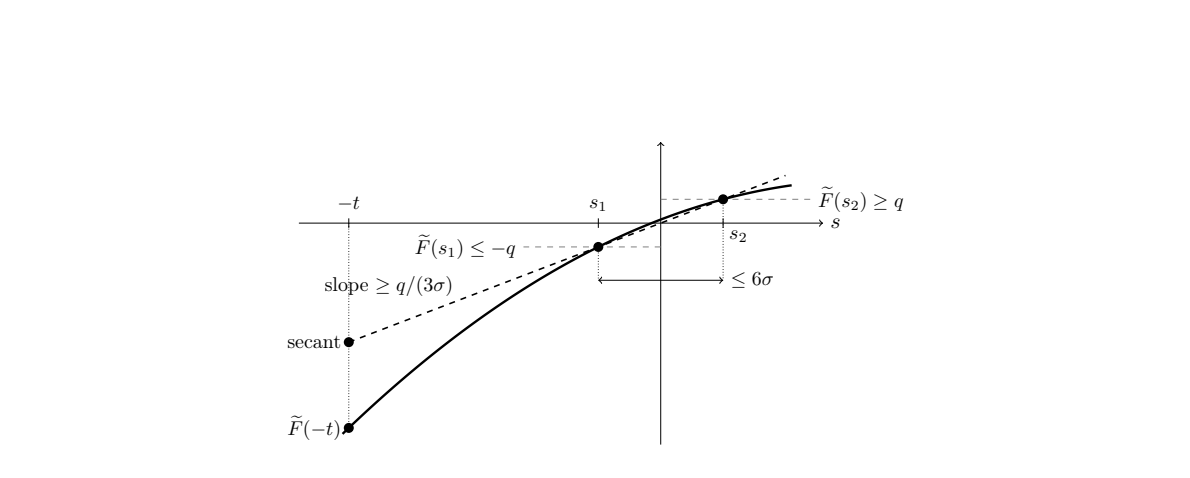
The proof assumes a secant through s_1=log(1-2σ) and s_2=log(1+2σ); if Var(e^f)=0 then s_1=s_2 and the secant is undefined. In that case e^f=1 almost surely and the conclusion is trivial, but this degenerate case should be stated explicitly for completeness.
The paper says, at Section 3.1, after (3.11)
Pith says: minor objection 5 of 6
The extension of the lower bound from the subsequence k_n ≍ 2^n n^{d-1} to all k is described only as 'monotonicity.' The argument uses k_{n+1} ≤ C k_n so that e_k ≥ e_{k_{n+1}} for k ≤ k_{n+1}; a sentence making this explicit would improve readability.
The paper says, at Throughout
Pith says: minor objection 6 of 6
The typesetting has several spacing and symbol-rendering artifacts, for example 'inL ∞' in the title and many inline formulas in which L∞ and 2d−1 appear without proper spacing. These should be corrected in the final version; they do not affect the mathematics.
What would settle it
Perform an independent recomputation of Lemma 2.4 in dimensions d = 3 and d = 4: evaluate the variance sum (2.28) with S_h = binom(h+d-1, d-1), confirm that the factors of S_n cancel, that C_{d,psi} = c^{-4} sum_h 2^{-h/2} S_h^3 is finite, and that substituting k_n ~ 2^n n^{d-1} into (3.13) yields exactly k^{-1}(log k)^{d-1/2}. If the algebra produces an extra power of n or log n, the entropy and small-deviation exponents would require revision.
from the skeptic's reading
How the review went
4 readings by deepseek-v4-flash · 9 Nov 2026
- Reader holds up, with conditions
- Skeptic partly agrees
- Editor wrote the verdict above
- Referee minor revision: 6 minor
Not run on this paper: the simulated authors' defence.
Pith did not check this review's objections against the paper.
The review in full
The review in brief, machine-written
The one thing you should know: this paper looks right on the central claim, and it is a real result. Theorem 1.1 settles the uniform small deviation exponent for the Brownian sheet in every dimension d ≥ 2, and the proof is not a repackaging of known ideas. The new engine is Theorem 2.1, a probabilistic small ball inequality for Gaussian sums of smooth dyadic atoms, which is exactly the kind of input that was missing since the deterministic small ball inequality remains open in d ≥ 3. The entropy lower bounds for the anchored and periodic mixed-smoothness embeddings then follow by a clean covering argument, and the Kuelbs–Li–Linde bridge converts them into the small deviation rate. I see no fitted parameter: the exponent 2d−1 comes from the dyadic count and the scale √(nS_n).
I agree with the reader and the stress-test that the core chain is internally consistent. I hand-checked the variance bound in Lemma 2.4, the hull counting, the ratio bound on Sh/Sn, and the secant argument in Proposition 2.6; the algebra matches. I also appreciated that the authors state their own limitations plainly: the d = 1 failure in Remark 2.9, the still-open small-smoothness range, and the fact that Kolmogorov numbers for p < 2 decay slower. None of these affect Theorem 1.1.
The soft spots are real but peripheral. The header claims a Lean certificate with a GitHub link but gives no commit hash, no scope statement, and no reference to it anywhere in the body. As written, that claim is unverifiable and should either be backed with concrete information or removed. Corollary 5.3 depends on an unpublished 2026 preprint for its main identification; that is acceptable for a side corollary but should be updated before publication. The 1 < p < 2 entropy upper bound for Td,p is a two-sentence reduction to Belinsky; it is plausible but thinner than the rest. None of these touch the central theorem, whose proof is complete and, as far as I can tell, correct.
Who is this for? Anyone working on small deviations, metric entropy of mixed-smoothness classes, or Gaussian processes in the sup-norm. It deserves a serious referee and, if the referee confirms the probabilistic small ball inequality, publication in a top journal. My recommendation: send it to peer review, and ask the referees specifically to check Theorem 2.1 and the p < 2 reduction.
The strongest objection
I cannot identify a load-bearing gap in the central claim. The most delicate step is Theorem 2.1, in particular Lemma 2.4's bound Var(U_tau) <= C tau^2 / |D_n|. I checked the chain of estimates: the hull measure formula (2.13), the correlation bound (2.14), the density bound (2.25), the ratio S_h/S_n <= (h+1)/(n+1) for h <= n, the trivial extension for h > n, the factorization S_{n+h} <= S_n S_h, and the convergence of sum_h 2^{-h/2} S_h^3. No missing factor of n appears: with k_n ~ 2^n n^{d-1} and log k_n ~ n, the lower bound 2^{-n} sqrt(n) is exactly k_n^{-1} (log k_n)^{d-1/2}. The covering implication (3.11), the choice of L_n in (3.12), and the conversion (3.13) are algebraically sound. Proposition 2.6 is also internally consistent: Ehrhard's inequality gives concavity of Phi^{-1} o F, and the secant argument correctly produces the e^{-c/sigma^2} tail. The peripheral issues that motivated the reader's CONDITIONAL verdict -- the unverifiable Lean certificate header, the unpublished reference [1] used in Corollary 5.3, and the compressed p < 2 upper-bound reduction -- do not affect Theorem 1.1, which relies on the p = 2 case, the published upper bound [20], and the published Li-Linde correspondence. I therefore find no central objection that changes the assessment.
The reader's weakest-assumption analysis correctly located the delicate point: the variance bound for the soft maximum U_tau in Theorem 2.1. But after checking the proof in detail, the mechanism is sound and no countervailing factor appears. The hull-counting estimate (2.13), correlation bound (2.14), measure bound (2.25), and ratio S_h/S_n <= (h+1)/(n+1) combine exactly to give Var(U_tau) <= C tau^2 / |D_n|. The extension from entropy lower bounds along k_n to all k is justified by monotonicity and the bounded ratio k_{n+1}/k_n. The Kuelbs-Li-Linde conversion is cited from published work and is used in the stated direction. The reader's CONDITIONAL verdict rests on extra-mathematical or peripheral concerns: the Lean certificate is unverifiable from the manuscript, Corollary 5.3 depends on an unpublished preprint, and the 1 < p < 2 entropy upper bound is terse. These do not bear on Theorem 1.1, whose proof is complete and whose p = 2 upper bound is supplied by the published result [20]. I therefore recommend no change to the reader's verdict, while agreeing partially with the reader's identification of the variance step as the place where a hidden flaw would most likely surface.
The referee's report
If correct, Theorem 1.1 settles a longstanding conjecture and gives the first sharp entropy and Kolmogorov-number orders in the uniform norm for mixed-smoothness embeddings in dimension d≥3. The main technical novelty, Theorem 2.1, is substantial: it supplies a probabilistic small ball inequality for smooth atoms without moment conditions, bypassing the open deterministic small ball inequality. The derivation is benchmarked against known published results, namely the upper bound of Dunker et al. [20], Talagrand's two-dimensional result [41], and the Kuelbs–Li–Linde correspondence [28, 30], and the exponent 2d-1 is not fitted but emerges from the dyadic count S_n ≍ n^{d-1} and the scale √(nS_n). I found the central argument sound, with no load-bearing gap: the variance mechanism in Lemma 2.4, the Ehrhard-based tail bound in Proposition 2.6, and the passage from small balls to entropy in (3.11) all check out. The peripheral issues noted below concern only extensions and presentation, not the main theorem.
Pith's reading of the paper (a machine's summary, not the authors')
The paper settles the uniform small ball conjecture for the Brownian sheet: in every dimension $d\ge2$, the probability that the sheet stays within a tube of radius $\varepsilon$ around zero satisfies $-\log P\{\|B\|_\infty\le\varepsilon\}\asymp_d\varepsilon^{-2}(\log(1/\varepsilon))^{2d-1}$ as $\varepsilon\downarrow0$. The exponent $2d-1$ had been known as an upper bound for all dimensions and was matched from below only in dimension two; the missing piece was a lower bound in every dimension. The proof bypasses the open deterministic small ball inequality by proving a probabilistic version: a Gaussian sum of smooth dyadic atoms has sup-norm at most $a\sqrt{nS_n}$ with probability exponentially small in the number of atoms. A covering argument converts that inequality into sharp entropy and Kolmogorov number estimates for the anchored mixed Sobolev embedding into $L_\infty$, and the metric-entropy-to-small-ball correspondence turns those into the small-deviation rate. The same machinery yields sharp uniform-norm entropy orders for periodic mixed Sobolev, Besov, and Nikol'skii classes, and for fractional and integrated Brownian sheets.
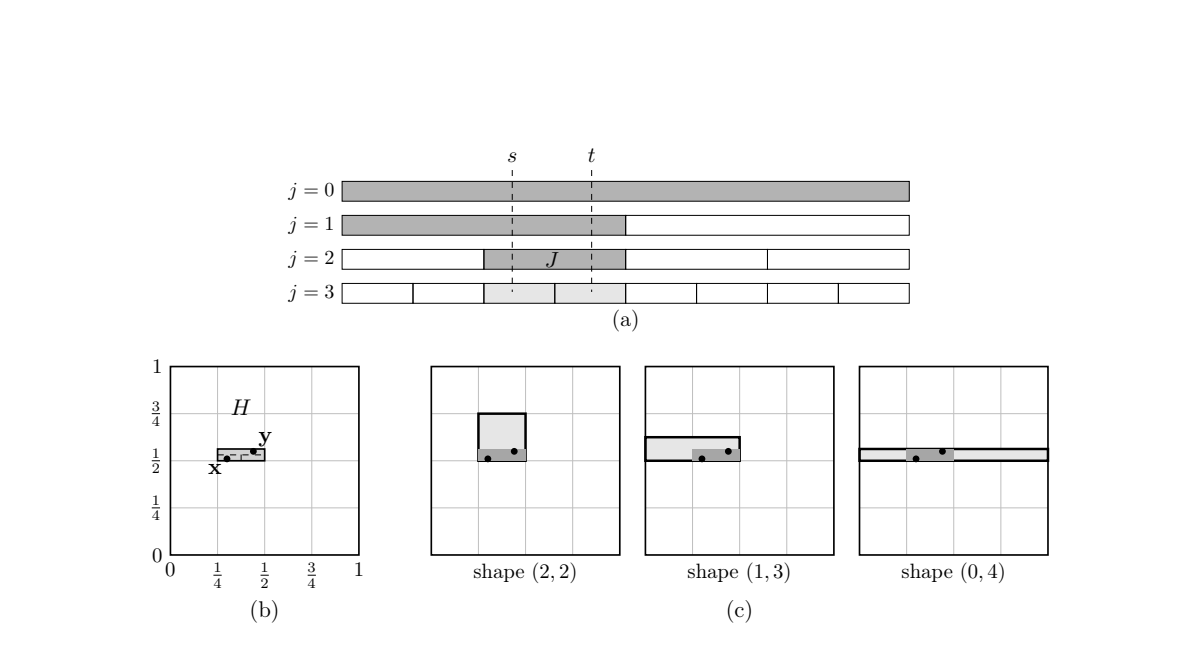
What carries the argument. The engine is Theorem 2.1, the probabilistic small ball inequality: $P\{\|V_n\|_\infty\le a\sqrt{nS_n}\}\le e^{-b|D_n|}$ for $V_n$ a Gaussian-coefficient sum over smooth dyadic atoms $a_R(x)=\prod_i\psi(2^{s_i}x_i-m_i)$ with $\psi\in C_c^\infty(0,1)$, where $S_n\asymp n^{d-1}$ counts coordinate-shape compositions and $|D_n|=2^nS_n$ counts the atoms. Three components drive the proof. First, the good region $A_n=\{x:v_n(x)\ge\bar v_n/2\}$ where the pointwise variance $v_n$ of $V_n$ is at least half its spatial mean, which carries a fixed positive fraction of the cube. Second, the soft maximum $U_\tau=e^{-\tau/2}\int_{A_n}\cosh(\sqrt{\tau}Y_x)\,d\nu_n(x)$, whose logarithm is a convex function of the Gaussian coefficients with expectation exactly 1 and variance controlled by grouping point pairs by their dyadic hulls: the hull volume distribution $\lambda^{2d}\{\mathrm{Hull}(x,y)\in\mathcal D_u\}=2^{-u-d}S_u$ and the correlation bound $|\rho(x,y)|\le c^{-1}S_h/S_n$ on hulls of volume $2^{-n-h}$ give $\mathrm{Var}(U_\tau)\le C_{d,\psi}\tau^2/|D_n|$ for $\tau\le\kappa(n+1)$. Third, Proposition 2.6, built on Ehrhard's Gaussian Brunn–Minkowski inequality, converts the small variance into a Gaussian lower tail for the convex $\log U_\tau$. The covering argument (3.11) then turns the small-ball bound into the entropy lower bound $e_{k_n}(T_{d,p})\gtrsim2^{-n}\sqrt n\asymp k_n^{-1}(\log k_n)^{d-1/2}$, and the Kuelbs–Li–Linde correspondence (4.1) converts entropy into small-deviation rates.
Core claim. The central claim, Theorem 1.1, is that for the Brownian sheet in dimension $d\ge2$, $-\log P\{\|B\|_\infty\le\varepsilon\}\asymp_d\varepsilon^{-2}(\log(1/\varepsilon))^{2d-1}$, so the logarithmic exponent is exactly $2d-1$ in every dimension, not merely somewhere between the old bounds. The paper's own route is Theorem 1.2: the anchored mixed Sobolev integration operator $T_{d,p}:L_p([0,1]^d)\to C([0,1]^d)$ satisfies $e_k(T_{d,p})\asymp k^{-1}(\log k)^{d-1/2}$, with the same order for Kolmogorov numbers when $p\ge2$. The load-bearing new fact behind that entropy lower bound is Theorem 2.1, a probabilistic small ball inequality for hyperbolic sums of smooth tensor-product dyadic atoms: $P\{\|V_n\|_\infty\le a\sqrt{nS_n}\}\le e^{-b|D_n|}$, where $|D_n|\asymp2^n n^{d-1}$ counts the atoms at volume level $2^{-n}$. The inequality holds because the soft maximum $U_\tau$ of the variance-normalized field has expectation 1 and variance $O(\tau^2/|D_n|)$ up to $\tau\asymp n$, so it concentrates near 1, while the small-ball event forces it below $e^{-\tau/4}$; Ehrhard's Gaussian Brunn–Minkowski inequality supplies the lower-tail estimate that makes this contradiction quantitatively exponential.
The premise it rests on. The load-bearing premise is Lemma 2.4's variance bound $\mathrm{Var}(U_\tau)\le C\tau^2/|D_n|$ up to the scale $\tau\asymp n$, which rests on the dyadic-hull correlation estimate $|\rho|\le c^{-1}S_h/S_n$ and the positive $L^2$-mass condition $c_{d,\psi}=\tfrac12\|\psi\|_2^{2d}>0$ for the bump; the authors show the mechanism itself fails in $d=1$, where the ratio bound $S_h/S_n\le(h+1)/(n+1)$ degenerates.
If the paper is right (Pith's inferences, not the authors')
The uniform small ball conjecture for the Brownian sheet holds: in every dimension $d\ge2$, $-\log P\{\|B\|_\infty\le\varepsilon\}\asymp_d\varepsilon^{-2}(\log(1/\varepsilon))^{2d-1}$, matching the previously known upper bound from below.
Entropy and Kolmogorov numbers of the anchored mixed Sobolev embedding satisfy $e_k(T_{d,p})\asymp d_k(T_{d,p})\asymp k^{-1}(\log k)^{d-1/2}$ for $p\ge2$ (entropy for all $1<p<\infty$), settling the stated conjecture for these operators.
Periodic mixed Sobolev, Besov, and Hölder–Nikol'skii classes with smoothness $r>1/2$ now have matching uniform-norm entropy and Kolmogorov orders in every dimension $d\ge2$, resolving the corresponding open problems in the parameter ranges covered.
Fractional Brownian sheets whose smallest Hurst parameter occurs in at least two coordinates, integrated sheets, and tensor-product Matérn fields inherit sharp small-deviation rates, and the sheet laws' optimal functional quantization rates follow.
In dimension two the previously established exponent 3 is recovered as the $d=2$ instance of the general formula.
Because Theorem 2.1 needs no vanishing moments and only a positive $L^2$-mass condition on the atoms, an adapted variance-concentration argument is a plausible route to the small-smoothness range $1/p<r\le1/2$ that the paper leaves open for mixed Sobolev classes.
The mechanism's failure in $d=1$ (Remark 2.9) suggests the exponent law $2d-1$ is intrinsically two-dimensional or higher: the ratio bound $S_h/S_n\le(h+1)/(n+1)$ that powers the variance estimate degenerates in one dimension, and Brownian motion itself shows no logarithmic factor, so a dimension-free version of the formula should not be expected.
The probabilistic small ball inequality implies that hyperbolic sums of smooth atoms are badly behaved only on a Gaussian-exponential exceptional set; analogous statements under other log-concave coefficient distributions would immediately transfer the entropy lower bounds to new function classes.
Corollary 5.4 yields a concrete checkable statement for practice: empirical measures of $m$ independent sheet copies attain the optimal uniform-norm quantization error up to a power of $\log\log m$, so random sampling nearly saturates the information-theoretic limit for these Gaussian laws.
Check this review
Pith stored no record of this review's passes and took no fingerprint of it. Reviews made by code from 13 Nov 2026 on carry both.
How often reviews like this one are right
Reviews like this one: written by deepseek-v4-flash, where what was read was not recorded.
How often objections from reviews like this one are right: not yet measured
Reviews by people
This review was written by a machine. No person has reviewed this paper on Pith yet. A scientist listed on Pith can review it for a fee, and their review is published here whatever it concludes.
The paper
Abstract
We settle the uniform small deviation conjecture for the Brownian sheet in every dimension d ≥ 2, namely, that the logarithmic exponent is 2d−1. Our proof proceeds through sharp entropy and Kolmogorov estimates for the associated anchored mixed Sobolev embedding in the uniform norm. Their connection to small deviations is known from the Kuelbs–Li theorem. To establish the entropy estimates, the key is a probabilistic small ball inequality for smooth tensor product atoms whose exceptional set has Gaussian measure exponentially small in the number of atoms. Its proof combines a count of dyadic rectangles with tools from probability, in particular Ehrhard's Gaussian Brunn–Minkowski inequality. This also yields sharp entropy and Kolmogorov number estimates for embeddings of periodic mixed Sobolev, Besov and Nikol'skii classes with smoothness r > 1/2 in L∞. Finally, we extend our results to fractional and integrated Brownian sheets.
The paper's own sentences, arranged, kept beside the review and separate from it. Each label is drawn from a closed vocabulary; the number beside it is the probability the classifier gave that label. No sentence in this record was written by a model.
abstract compiled · 2026-11-09
The authors' main claim, as the classifier picked it out 1.00
“We settle the uniform small deviation conjecture for the Brownian sheet in every dimension $d\ge2$, namely, that the logarithmic exponent is $2d-1$.”
How the main claim is stated: asserted 1.00
What the abstract itself states, as probabilities: claims first 0.07 · states limitation 0.12 · human participants 0.01 · controlled comparison 0.01 · randomized assignment 0.01 · states quantitative result 0.98 · compares with prior results 0.17 · mentions code or data availability 0.02
The abstract, sentence by sentence
This table labels the abstract only (arXiv listing abstract v1). The number is the probability the classifier gave the label.
| Sentence | Role | The authors' own work | States the main conclusion | Strength |
|---|---|---|---|---|
| We settle the uniform small deviation conjecture for the Brownian sheet in every dimension $d\ge2$, namely, that the logarithmic exponent is $2d-1$. | result 0.93 | 0.95 | 0.96 | asserted 1.00 |
| Our proof proceeds through sharp entropy and Kolmogorov estimates for the associated anchored mixed Sobolev embedding in the uniform norm. | method 0.98 | 0.92 | 0.04 | asserted 1.00 |
| Their connection to small deviations is known from the Kuelbs--Li theorem. | background 1.00 | 0.04 | 0.02 | asserted 1.00 |
| To establish the entropy estimates, the key is a probabilistic small ball inequality for smooth tensor product atoms whose exceptional set has Gaussian measure exponentially small in the number of atoms. | method 0.93 | 0.83 | 0.03 | asserted 1.00 |
| Its proof combines a count of dyadic rectangles with tools from probability, in particular Ehrhard's Gaussian Brunn--Minkowski inequality. | method 0.99 | 0.83 | 0.02 | asserted 1.00 |
| This also yields sharp entropy and Kolmogorov number estimates for embeddings of periodic mixed Sobolev, Besov and Nikol'skii classes with smoothness $r>1/2$ in $L_\infty$. | result 0.94 | 0.90 | 0.05 | asserted 1.00 |
| Finally, we extend our results to fractional and integrated Brownian sheets. | contribution 0.53 | 0.93 | 0.05 | asserted 1.00 |
What kind of paper the classifier reports this is: theoretical result 1.00 · evidence from proof or derivation 1.00
What was examined, and what was not
Sources read
- arXiv listing abstract v1
Not examined
- full text
- figures and tables
- references and citing sentences
- relations to other papers
Levels run
- P abstract
Not run
- S sections
- T body sentences
- C citations
- R cross-paper relations
How the labels were made
Compiled by classifier-1.13.0 via TypeSafe API, question bank abstract-p1-20260923, 2026-11-09: 1 request, 5,579 input tokens.
Every quoted sentence on this record is the authors'. Every label is from Pith's closed vocabulary, with the probability shown beside it. This record as JSON
Figures (2)
Figures are the authors', reproduced from the paper.
References (47)
- [20] T. Dunker, W. Linde, T. Kühn, and M. A. Lifshits. Metric entropy of integration operators and small ball probabilities for the Brownian sheet.J. Approx. Theory, 101(1):63–77, 1999. doi:10.1006/jath.1999.3354 on Pithdoi:10.1006/jath.1999.3354
- [9] D. Bilyk, M. T. Lacey, and A. Vagharshakyan. On the small ball inequality in all dimensions. J. Funct. Anal., 254(9):2470–2502, 2008.doi:10.1016/j.jfa.2007.09.010 on Pithdoi:10.1016/j.jfa.2007.09.010
- [41] M. Talagrand. The small ball problem for the Brownian sheet.Ann. Probab., 22(3):1331– 1354, 1994.doi:10.1214/aop/1176988605 on Pithdoi:10.1214/aop/1176988605
- [1] E. J. Addy and A. L. Teckentrup. Asymptotic and pre-asymptotic convergence of sparse grids for anisotropic kernel interpolation, 2026.doi:10.48550/arXiv.2604.10872 on PithPith's reviewarXivdoi:10.48550/arxiv.2604.10872
- [2] F. Aurzada. Path regularity of Gaussian processes via small deviations.Probab. Math. Statist., 31(1):61–78, 2011.doi:10.48550/arXiv.0905.3358 on PithPith's reviewarXivdoi:10.48550/arxiv.0905.3358
- [3] F. Aurzada and M. Lifshits. Small deviation probability via chaining.Stochastic Process. Appl., 118(12):2344–2368, 2008.doi:10.1016/j.spa.2008.01.005 on Pithdoi:10.1016/j.spa.2008.01.005
- [4] E. Belinsky and W. Linde. Small ball probabilities of fractional Brownian sheets via frac- tional integration operators.J. Theoret. Probab., 15(3):589–612, 2002.doi:10.1023/A: 1016263614257 on Pithdoi:10.1023/a:
- [5] E. S. Belinsky. Estimates of entropy numbers and Gaussian measures for classes of functions with bounded mixed derivative.J. Approx. Theory, 93(1):114–127, 1998.doi:10.1006/ jath.1997.3157 on Pith
- [6] D.Bilyk. OnRoth’sorthogonalfunctionmethodindiscrepancytheory.Uniform Distribution Theory, 6(1):143–184, 2011. URL:https://www-users.cse.umn.edu/~dbilyk/papers/ bilyk-survey.pdf on Pith
- [7] D. Bilyk. Roth’s orthogonal function method in discrepancy theory and some new con- nections. In W. Chen, A. Srivastav, and G. Travaglini, editors,A Panorama of Discrep- ancy Theory, volume 2107 ofLecture Notes in Math., pages 71–158. Springer, Cham, 2014. doi:10.1007/978-3-31... on Pithdoi:10.1007/978-3-319-04696-9_2
- [8] D. Bilyk and M. Lacey. The supremum norm of the discrepancy function: recent results and connections. In J. Dick, F. Y. Kuo, G. W. Peters, and I. H. Sloan, editors,Monte Carlo and Quasi-Monte Carlo Methods 2012, volume 65 ofSpringer Proc. Math. Stat., pages 23–38. Springer, Be... on Pithdoi:10.1007/978-3-642-41095-6_2
- [10] V. I. Bogachev.Gaussian Measures, volume 62 ofMathematical Surveys and Monographs. American Mathematical Society, 1998.doi:10.1090/surv/062 on Pithdoi:10.1090/surv/062
- [11] E. Boissard and T. Le Gouic. On the mean speed of convergence of empirical and occupation measures in Wasserstein distance.Ann. Inst. Henri Poincaré Probab. Stat., 50(2):539–563, 2014.doi:10.1214/12-AIHP517. 19 on Pithdoi:10.1214/12-aihp517
- [12] B. Carl. Entropy numbers,s-numbers, and eigenvalue problems.J. Funct. Anal., 41(3):290– 306, 1981.doi:10.1016/0022-1236(81)90076-8 on Pithdoi:10.1016/0022-1236(81)90076-8
- [13] W.-K. Chen. A Gaussian convexity for logarithmic moment generating functions with ap- plications in spin glasses.Ann. Inst. Henri Poincaré Probab. Stat., 62(1):195–206, 2026. doi:10.1214/24-AIHP1527 on Pithdoi:10.1214/24-aihp1527
- [14] F. Cobos and T. Kühn. Approximation and entropy numbers in Besov spaces of generalized smoothness.J. Approx. Theory, 160(1–2):56–70, 2009.doi:10.1016/j.jat.2007.11.007 on Pithdoi:10.1016/j.jat.2007.11.007
- [15] F. Cobos, T. Kühn, and W. Sickel. Optimal approximation of multivariate periodic Sobolev functions in the sup-norm.J. Funct. Anal., 270(11):4196–4212, 2016.doi:10.1016/j.jfa. 2016.03.018 on Pithdoi:10.1016/j.jfa
- [16] J. Creutzig, S. Dereich, T. Müller-Gronbach, and K. Ritter. Infinite-dimensional quadrature and approximation of distributions.Found. Comput. Math., 9(4):391–429, 2009.doi: 10.1007/s10208-008-9029-x on Pithdoi:10.1007/s10208-008-9029-x
- [17] S. Dereich, F. Fehringer, A. Matoussi, and M. Scheutzow. On the link between small ball probabilities and the quantization problem for Gaussian measures on Banach spaces.J. Theoret. Probab., 16(1):249–265, 2003.doi:10.1023/A:1022242924198 on Pithdoi:10.1023/a:1022242924198
- [18] M. Dolbeault, D. Krieg, and M. Ullrich. A sharp upper bound for sampling numbers inL2. Appl. Comput. Harmon. Anal., 63:113–134, 2023.doi:10.1016/j.acha.2022.12.001 on Pithdoi:10.1016/j.acha.2022.12.001
show 27 more
- [19] D. D˜ ung, V. Temlyakov, and T. Ullrich.Hyperbolic Cross Approximation. Advanced Courses in Mathematics – CRM Barcelona. Birkhäuser, Cham, 2018.doi:10.1007/ 978-3-319-92240-9 on Pith
- [21] A. Ehrhard. Symétrisation dans l’espace de Gauss.Math. Scand., 53(2):281–301, 1983. doi:10.7146/math.scand.a-12035 on Pithdoi:10.7146/math.scand.a-12035
- [22] S. Graf, H. Luschgy, and G. Pagès. Functional quantization and small ball probabilities for Gaussian processes.J. Theoret. Probab., 16(4):1047–1062, 2003.doi:10.1023/B:JOTP. 0000012005.32667.9d on Pithdoi:10.1023/b:jotp
- [23] A. Hinrichs, A. Kolleck, and J. Vybíral. Carl’s inequality for quasi-Banach spaces.J. Funct. Anal., 271(8):2293–2307, 2016.doi:10.1016/j.jfa.2016.05.011 on Pithdoi:10.1016/j.jfa.2016.05.011
- [24] A. Horst, T. Jahn, and F. Voigtlaender. Besov regularity of random wavelet series.Studia Mathematica, 2026.doi:10.4064/sm241205-13-10 on Pithdoi:10.4064/sm241205-13-10
- [25] H. Kempka, C. Schneider, and J. Vybíral. Path regularity of the Brownian motion and the Brownian sheet.Constr. Approx., 59:485–539, 2024.doi:10.1007/s00365-023-09647-z on Pithdoi:10.1007/s00365-023-09647-z
- [26] D. Krieg, K. Pozharska, M. Ullrich, and T. Ullrich. Sampling projections in the uniform norm.J. Math. Anal. Appl., 553(2):129873, 2026.doi:10.1016/j.jmaa.2025.129873 on Pithdoi:10.1016/j.jmaa.2025.129873
- [27] D. Krieg and M. Ullrich. Approximation of functions: Optimal sampling and complexity. Acta Numer., 35:273–457, 2026.doi:10.1017/S0962492925100287 on Pithdoi:10.1017/s0962492925100287
- [28] J. Kuelbs and W. V. Li. Metric entropy and the small ball problem for Gaussian measures. J. Funct. Anal., 116(1):133–157, 1993.doi:10.1006/jfan.1993.1107. 20 on Pithdoi:10.1006/jfan.1993.1107
- [29] T. Kühn and W. Linde. Optimal series representation of fractional Brownian sheets. Bernoulli, 8(5):669–696, 2002. URL:https://users.fmi.uni-jena.de/~hicke/inst_ stoch/Linde/SERREP5.pdf on Pith
- [30] W.V.LiandW.Linde. Approximation, metricentropyandsmallballestimatesforGaussian measures.Ann. Probab., 27(3):1556–1578, 1999.doi:10.1214/aop/1022677459 on Pithdoi:10.1214/aop/1022677459
- [31] I. Limonova and V. Temlyakov. On sampling discretization inL2.J. Math. Anal. Appl., 515(2):126457, 2022.doi:10.1016/j.jmaa.2022.126457 on Pithdoi:10.1016/j.jmaa.2022.126457
- [32] H. Luschgy and G. Pagès. High-resolution product quantization for Gaussian processes under sup-norm distortion.Bernoulli, 13(3):653–671, 2007.doi:10.3150/07-BEJ6025 on Pithdoi:10.3150/07-bej6025
- [33] S. Mayer and T. Ullrich. Entropy numbers of finite dimensional mixed-norm balls and function space embeddings with small mixed smoothness.Constr. Approx., 53:249–279, 2021.doi:10.1007/s00365-020-09510-5 on Pithdoi:10.1007/s00365-020-09510-5
- [34] N. Nagel, M. Schäfer, and T. Ullrich. A new upper bound for sampling numbers.Found. Comput. Math., 22(2):445–468, 2022.doi:10.1007/s10208-021-09504-0 on Pithdoi:10.1007/s10208-021-09504-0
- [35] S. Neumayer, M. Schäfer, and T. Ullrich. Random nodes with positive weights: Richter– Tchakaloff rules and optimal positive quadrature, 2026.doi:10.48550/arXiv.2610.32699 on PithPith's reviewarXivdoi:10.48550/arxiv.2610.32699
- [36] E. Novak. Quadrature and widths.J. Approx. Theory, 47(3):195–202, 1986.doi:10.1016/ 0021-9045(86)90027-4 on Pith
- [37] A. Pajor and N. Tomczak-Jaegermann. Subspaces of small codimension of finite- dimensional Banach spaces.Proc. Amer. Math. Soc., 97(4):637–642, 1986.doi:10.1090/ S0002-9939-1986-0845980-8 on Pith
- [38] G. Paouris and P. Valettas. A Gaussian small deviation inequality for convex functions. Ann. Probab., 46(3):1441–1454, 2018.doi:10.1214/17-AOP1206 on Pithdoi:10.1214/17-aop1206
- [39] A. S. Romanyuk. Entropy numbers and widths for the Nikol’skii–Besov classes of functions of many variables in the spaceL ∞.Anal. Math., 45(1):133–151, 2019.doi:10.1007/ s10476-018-0611-4 on Pith
- [40] A. S. Romanyuk and S. Y. Yanchenko. Estimates for the entropy numbers of the Nikol’skii– Besov classes of functions with mixed smoothness in the space of quasi-continuous functions. Math. Nachr., 296(6):2575–2587, 2023.doi:10.1002/mana.202100202 on Pithdoi:10.1002/mana.202100202
- [42] V. Temlyakov. On the entropy numbers of the mixed smoothness function classes.J. Approx. Theory, 217:26–56, 2017.doi:10.1016/j.jat.2017.02.002 on Pithdoi:10.1016/j.jat.2017.02.002
- [43] V. Temlyakov and T. Ullrich. Bounds on Kolmogorov widths and sampling recovery for classes with small mixed smoothness.J. Complexity, 67:101575, 2021.doi:10.1016/j. jco.2021.101575 on Pithdoi:10.1016/j
- [44] V. N. Temlyakov. On optimal recovery inL 2.J. Complexity, 65:101545, 2021.doi: 10.1016/j.jco.2020.101545 on Pithdoi:10.1016/j.jco.2020.101545
- [45] V.N.TemlyakovandT.Ullrich. Approximationoffunctionswithsmallmixedsmoothnessin the uniform norm.J. Approx. Theory, 277:105718, 2022.doi:10.1016/j.jat.2022.105718. 21 on Pithdoi:10.1016/j.jat.2022.105718
- [46] R. M. Trigub and E. S. Belinsky.Fourier Analysis and Approximation of Functions. Kluwer Academic Publishers, Dordrecht, 2004.doi:10.1007/978-1-4020-2876-2 on Pithdoi:10.1007/978-1-4020-2876-2
- [47] J. Vybíral. Function spaces with dominating mixed smoothness.Dissertationes Math., 436:1–73, 2006.doi:10.4064/dm436-0-1. 22 on Pithdoi:10.4064/dm436-0-1
Cited by 1 Pith paper
Reviewed papers on Pith that cite this one. The full citation record
- Low Moments, Small Balls and Star Discrepancy math.CA · Nov 2026
Challenges and discussion
Disagree with the review, or know something it missed? Leave a comment, or challenge this review formally: a challenge becomes a permanent entry in this paper's record, and its decision is published here.
Come back by email
A short list of the week's newly reviewed papers. Nothing is sent until you confirm from your inbox, and every email has a link that stops it. No account.
No comments yet.
Sign in to comment