Differential Geometry · arXiv:2611.25716 v2 · submitted 19 Nov 2026
Noncompactifiable Kähler threefolds with positive Ricci curvature
The paper says
“We construct a complete Kähler threefold (M,ω) with positive Ricci curvature and infinite-dimensional third rational homology. It admits no analytic compactification, answering Yau's compactification question negatively (see i̧teYau1992, Problem 71, p. 304).”
more of the abstract
The metric is obtained by solving a complex Monge–Ampère equation on an affine threefold and lifting the solution to an infinite cyclic cover. Its Ricci form ρω satisfies ∫Mρω3 = ∞, disproving the top Yang–Yau conjecture.
from the abstract
Pith says
Machine review · deepseek-v4-flash · 20 Nov 2026 · of version 1 of the paper; version 2 is newer · read the full text (110,756 characters) · not checked by a person
It can be wrong. Challenge this review or reply to it.
Holds up. This paper constructs a complete Kähler threefold with positive Ricci curvature that cannot be compactified and whose top Ricci integral diverges, disproving two long-standing conjectures in complex dimension three. This line is wrong
3 minor · 1 open question
How often objections from reviews like this one are right: not yet measured
The paper, first character to last
The reviewer was given the whole text, 110,756 characters. Not checked: figures, code, what the references say.
3 minor objections
The paper says, at Corollary 1.3
Pith says: minor objection 1 of 3
The planar metric g_C = |d\zeta|^2/sqrt(1+|\zeta|^2) is a smooth positive (1,1)-form on C and hence a K\"ahler form, and its Ricci form is indeed (1/2)ddc log(1+|\zeta|^2) > 0, so the product construction is valid. However, this K\"ahler form has no global smooth K\"ahler potential (the unique rotation-invariant potential solving \varphi_{\zeta\bar\zeta} = (1+|\zeta|^2)^{-1/2} behaves like 2\log|\zeta| near the origin). A one-sentence remark noting that K\"ahler forms need not admit global potentials would prevent a reader from misreading the example as singular.
The paper says, at Section 4.3
Pith says: minor objection 2 of 3
The verification of Condition C is the most delicate step of the paper (volume growth, remote-ball lower bound, annular connectivity, and the Ricci lower bound). The argument is present and I found it coherent, but a short summary paragraph stating which estimate (equation number) feeds which of the four hypotheses in (eq:SOBrequirements) would substantially improve readability, especially for a reader applying Hein's theorem to a different background metric.
show 1 more
The paper says, at Figures
Pith says: minor objection 3 of 3
I could not view Figures 1--4 (the TikZ drawing code was not available to me). The arguments that reference them (the model-region figure in Remark 3.2 and the remote-volume square in the proof of Lemma 4.4) appear text-based and self-contained, but the authors may wish to confirm that no step depends on information visible only in the figures.
Open questions (1)
Pith raised these and could not confirm them against the text of the paper it read. They are questions for the authors, not findings.
- Section 2, Lemma 2.2 In Lemma 2.2, with f_α as listed (√2 z_j, z_i z_j, u-u^{-1}), does the identity S = 1 + Σ|f_α|^2 hold exactly when S=(1+t)^2 + |u-u^{-1}|^2, given the coefficient of the cross terms?
What would settle it
A concrete calculation that would settle the central claim is to compute the third rational homology of M directly: if H_3(M;ℚ) were finite-dimensional, the argument that M cannot be compactifiable would collapse. Alternatively, if one could embed M as a Zariski open subset of a compact complex manifold (e.g., by finding a compactification with analytic complement), the main conclusion would be false. A numerical check of the volume ratio $ω_0^{3}$/ν on the transition strip for a specific large x (e.g., x = 100) using the explicit formulas for F, Φ, Ψ would test the gluing estimates.
from Pith's summary of the paper
How the review went
5 passes by deepseek-v4-flash · 20 Nov 2026
- Reader holds up
- Skeptic concern withdrawn: Pith's reviewer misread the paper
- Referee 3 minor
- Check against the paper kept 0 of 2 objections
- Editor wrote the verdict above
Not run on this paper: the simulated authors' defence.
Pith's passes raised 2 objections. A check against the paper's text kept 0, withdrew 1 (1 Pith's reviewer misread the paper) and left 1 as a question.
The review in full
The review in brief, machine-written
This paper constructs a complete Kähler threefold with positive Ricci curvature that cannot be compactified and whose top Ricci integral diverges, disproving two long-standing conjectures in complex dimension three.
The stress test's concern
Withdrawn: Pith's reviewer misread the paper.
The paper says
“We construct holomorphic local diffeomorphisms \(\Phi_p:4B\to X\) with \(\Phi_p(0)=p\), estimate the pullback metrics on \(3B\), and restrict to \(2B\).”
The referee's report
Not published. Pith's referee wrote this assessment before its objections were checked against the paper, and 1 of its 1 major objections did not survive that check.
Pith's reading of the paper (a machine's summary, not the authors')
The paper constructs a complete Kähler threefold (M,ω) with strictly positive Ricci curvature and infinite-dimensional third rational homology. It proves that M admits no analytic compactification, answering Yau's compactification conjecture in the negative. The metric is obtained by solving a complex Monge–Ampère equation on an affine threefold and lifting the solution to an infinite cyclic cover. The Ricci form satisfies ∫_M $ρ^{3}$ = ∞, disproving the top Yang–Yau conjecture. Products give counterexamples in every complex dimension n ≥ 3.
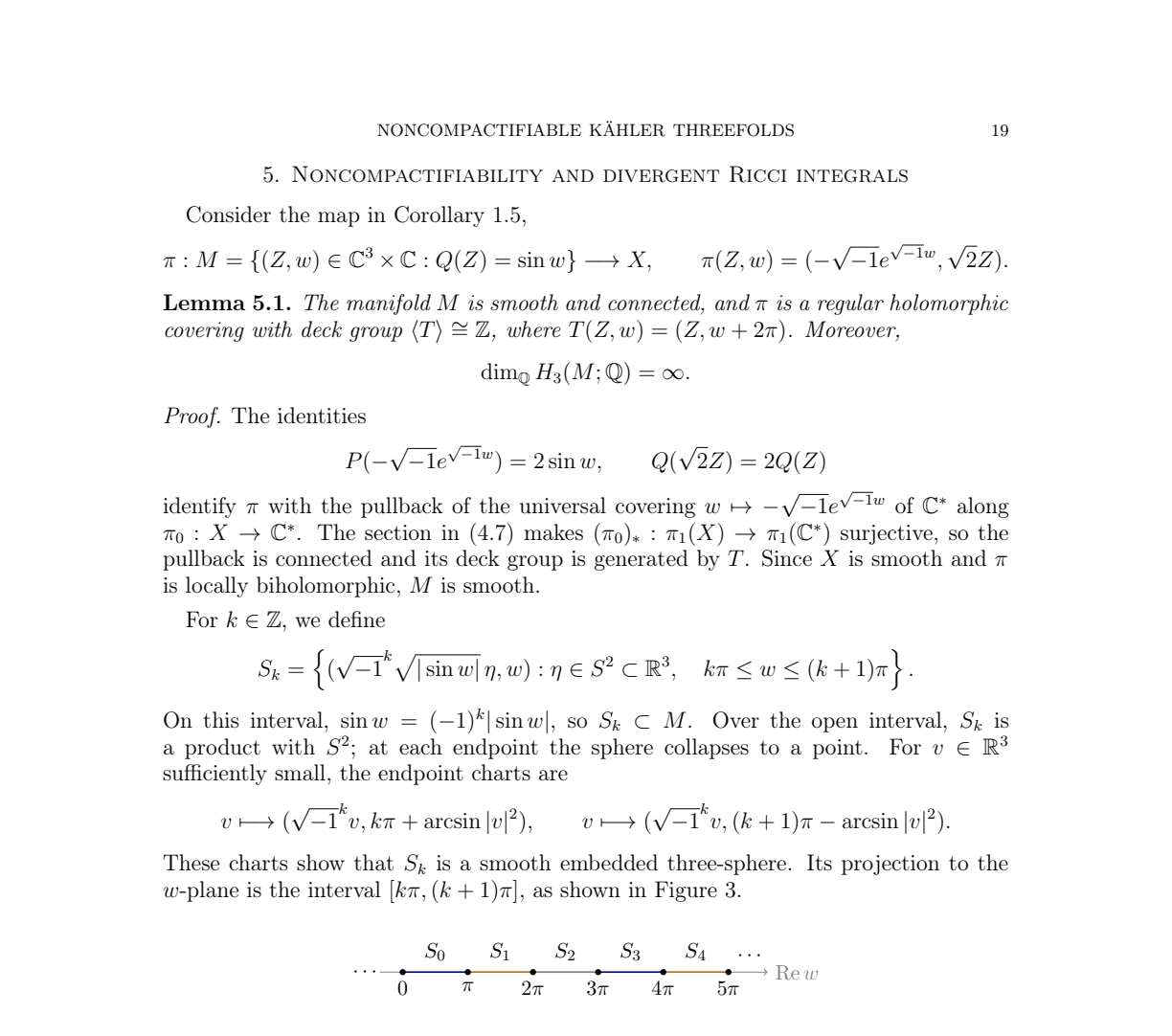
What carries the argument. The central object is the affine threefold X = {∑ $z_j^{2}$ = u + $u^{{-1}}$} ⊂ ℂ^* × $ℂ^{3}$ with its nowhere-vanishing holomorphic residue form Ω. The prescribed volume form ν = 6 $i^{9}$ Ω∧Ω̄ / √((1+|z|^2)^2 + |u−$u^{{-1}}$|^2) has positive Ricci form ρ_ν = ½ dd^c log((1+|z|^2)^2 + |u−$u^{{-1}}$|^2). The background metric g_0 is built by gluing a homogeneous outer potential F(ξ,r) (degree 5/3, solving 4F_r det $D^{2}$F = 1) to a smooth inner potential K_i = H_0 $x^{{5/3}}$ + B_0 $x^{{1/6}}$ Φ(s) + B_0 $x^{{-4/3}}$ Ψ(s) on the ends, where x = |log|u|^2| and s = arcosh(t/|P(u)|). The correction Ψ cancels the leading volume error. Hein's theorem (in Y. Li's formulation) is applied with Conditions A (quasi-atlas), B (f decays faster than $distance^{{-2}}$), and C (SOB(12/5) via annular connectivity, volume growth bounds, and Ricci lower bound). The infinite cyclic cover M = {∑ $Z_j^{2}$ = sin w} has deck group ℤ; the spheres S_k = {Z = i^k √|sin w| η, kπ ≤ w ≤ (k+1)π} give infinitely many independent classes in H_3(M;ℚ).
Core claim. The authors construct a complete Kähler threefold (M,ω) with positive Ricci curvature and infinite-dimensional third rational homology that cannot be biholomorphically embedded as a Zariski open subset of any compact complex manifold. This disproves Yau's compactification conjecture (Problem 71 in Yau 1992). The same manifold also has divergent top Ricci integral ∫_M $ρ^{3}$ = ∞, contradicting the top-degree case of the Yang–Yau conjecture. The construction uses Hein's existence theorem for the complex Monge–Ampère equation on an affine threefold X = {∑ $z_j^{2}$ = u + $u^{{-1}}$} ⊂ ℂ^* × $ℂ^{3}$, then lifts the metric to an infinite cyclic cover M = {∑ $Z_j^{2}$ = sin w} ⊂ $ℂ^{3}$ × ℂ. The Ricci form is explicitly given by ρ = ½ dd^c log((1+|z|^2)^2 + |u−$u^{{-1}}$|^2) > 0.
The premise it rests on. The application of Hein's existence theorem requires that the background metric g_0 satisfies Conditions A, B, and C; the verification of Condition B (decay of f) and Condition C (SOB(12/5)) relies on detailed estimates of the background metric and the volume form ν, and any mistake in the gluing or in the chart estimates could break the conditions.
If the paper is right (Pith's inferences, not the authors')
Yau's compactification conjecture (Problem 71) is false in complex dimension three: positive Ricci curvature alone does not force a complete Kähler manifold to be biholomorphic to a Zariski open subset of a compact Kähler manifold.
The top Yang–Yau conjecture (∫_M ρ^n < ∞ under nonnegative Ricci curvature) fails in every complex dimension n ≥ 3, because products M × ℙ^{k-3} × ℂ^{n-k} give counterexamples with divergent Ricci integrals.
The Cohn–Vossen-type integral bounds for Kähler manifolds (Conjecture 1.2 in Yang 2013) cannot hold without additional curvature or volume-growth assumptions.
Any proof of quasi-projectivity for positively Ricci-curved Kähler manifolds must use more than Ricci positivity alone; the example shows that infinite topological type and divergent top Ricci integral can coexist with positive Ricci curvature.
The example suggests that the obstruction to compactification is not merely the failure of the top Ricci integral to be finite, but also the presence of infinite-dimensional homology in odd degree. A compactifiable manifold must have finite CW type, so infinite-dimensional H_3 (or any odd-degree homology) precludes compactification regardless of curvature.
The construction relies on the existence of a holomorphic ℤ-cover with infinitely many vanishing spheres. Similar covers of other affine hypersurfaces with non-trivial π_1 might yield further counterexamples in different dimensions or with different curvature positivity conditions.
The gluing method and the use of Hein's theorem on a noncompact threefold with prescribed volume form may be adaptable to construct complete Kähler metrics with prescribed Ricci forms on other affine varieties, provided the background metric satisfies the weighted Sobolev inequalities.
The paper leaves open whether a complete Kähler manifold with positive Ricci curvature and finite top Ricci integral must be compactifiable, and whether the compactification conjecture holds under additional assumptions such as maximal volume growth or quadratic curvature decay.
Check this review
What was read
The passes were given all 110,756 characters of the paper's LaTeX source.
Fingerprint of that text (SHA-256): e90a663f1086091c34990cc7ad870ddab8389816355a437937a4ee0d2a7583f5
Pith does not keep that text. Rebuilt from the paper's source or PDF by the same code, it has this fingerprint if it is the same text. From a copy of Pith's code:
PYTHONPATH=. python scripts/review_input_check.py 2611.25716
The passes, in the order they ran
- Reader deepseek-v4-flash · medium effort · $0.0048 · instructions of the Reader, fingerprint f9ead7300382…
- Skeptic deepseek-v4-flash · medium effort · $0.0040 · instructions of the Skeptic, fingerprint 8f88c0f61488…
- Referee deepseek-v4-flash · medium effort · $0.015 · instructions of the Referee, fingerprint a852d99aea0d…
- Check against the paper deepseek-v4-flash · medium effort · $0.0082 · instructions of the Check against the paper, fingerprint 6c7a6883d551…
- Editor deepseek-v4-flash · medium effort · $0.0040 · instructions of the Editor, fingerprint e7211f6a3d27…
- Circularity check deepseek-v4-flash · medium effort · $0.0040 · instructions of the Circularity check, fingerprint e9946e39d67b…
- Summary for the page deepseek-v4-flash · medium effort · temperature 0.2 · $0.0044 · instructions of the Summary for the page, fingerprint e4f56bf568e7…
The passes cost $0.044 in model calls together.
Version stamped on this review: pith-pipeline@v1.4.1-daily-deepseek-or-medium+deepseek/deepseek-v4-flash+p.d60f54226f00
Each link opens a pass's instructions as plain text, the exact bytes its fingerprint was taken over. Every stored set of instructions.
curl -s https://pith.science/methodology/prompts/f9ead730038216984cfb56d7cb34332bdf691828296a1de4245f3d6667d4bf56 | sha256sum
prints the fingerprint of the reader's instructions. The same works for every pass.
The receipt
The review's fingerprint was taken on 20 Nov 2026. The review you are reading still matches it.
Fingerprint of the review (SHA-256): a3ee3cb36754e599d63cf276ff402eb14f11a1dabbf8b2e72b34bb1d79ef7dc6
curl -s 'https://pith.science/api/v1/verdicts/2611.25716?form=canonical' | sha256sum
prints the fingerprint of the review as it stands now. The rule, in four steps.
A matching fingerprint shows the review has not changed since that date. It does not show that the review is right.
How often reviews like this one are right
Reviews like this one: written by deepseek-v4-flash, from the paper's LaTeX source.
How often objections from reviews like this one are right: not yet measured
Reviews by people
This review was written by a machine. No person has reviewed this paper on Pith yet. A scientist listed on Pith can review it for a fee, and their review is published here whatever it concludes.
The paper
Abstract
We construct a complete Kähler threefold (M,ω) with positive Ricci curvature and infinite-dimensional third rational homology. It admits no analytic compactification, answering Yau's compactification question negatively (see i̧teYau1992, Problem 71, p. 304). The metric is obtained by solving a complex Monge–Ampère equation on an affine threefold and lifting the solution to an infinite cyclic cover. Its Ricci form ρω satisfies ∫Mρω3 = ∞, disproving the top Yang–Yau conjecture.
The paper's own sentences, arranged, kept beside the review and separate from it. Each label is drawn from a closed vocabulary; the number beside it is the probability the classifier gave that label. No sentence in this record was written by a model.
abstract compiled · 2026-11-20
The authors' main claim, as the classifier picked it out 0.67
“It admits no analytic compactification, answering Yau's compactification question negatively (see \cite{Yau1992}{}, Problem~71, p.~304).”
How the main claim is stated: asserted 1.00
What the abstract itself states, as probabilities: claims first 0.06 · states limitation 0.19 · human participants 0.01 · controlled comparison 0.02 · randomized assignment 0.01 · states quantitative result 0.64 · compares with prior results 0.70 · mentions code or data availability 0.02
The abstract, sentence by sentence
This table labels the abstract only (arXiv listing abstract v1). The number is the probability the classifier gave the label.
| Sentence | Role | The authors' own work | States the main conclusion | Strength |
|---|---|---|---|---|
| We construct a complete K\"ahler threefold \((M,\omega)\) with positive Ricci curvature and infinite-dimensional third rational homology. | contribution 0.78 | 0.97 | 0.76 | asserted 1.00 |
| It admits no analytic compactification, answering Yau's compactification question negatively (see \cite{Yau1992}{}, Problem~71, p.~304). | interpretation 0.49 | 0.81 | 0.56 | asserted 1.00 |
| The metric is obtained by solving a complex Monge--Amp\`ere equation on an affine threefold and lifting the solution to an infinite cyclic cover. | method 1.00 | 0.92 | 0.04 | asserted 1.00 |
| Its Ricci form \(\rho_\omega\) satisfies \(\int_M\rho_\omega^3=\infty\), disproving the top Yang--Yau conjecture. | result 0.78 | 0.90 | 0.20 | asserted 1.00 |
What kind of paper the classifier reports this is: theoretical result 1.00 · evidence from proof or derivation 1.00
What was examined, and what was not
Sources read
- arXiv listing abstract v1
Not examined
- full text
- figures and tables
- references and citing sentences
- relations to other papers
Levels run
- P abstract
Not run
- S sections
- T body sentences
- C citations
- R cross-paper relations
How the labels were made
Compiled by classifier-1.13.0 via TypeSafe API, question bank abstract-p1-20260923, 2026-11-20: 1 request, 3,681 input tokens.
Every quoted sentence on this record is the authors'. Every label is from Pith's closed vocabulary, with the probability shown beside it. This record as JSON
Figures (4)

Figures are the authors', reproduced from the paper.
Challenges and discussion
Disagree with the review, or know something it missed? Leave a comment, or challenge this review formally: a challenge becomes a permanent entry in this paper's record, and its decision is published here.
Come back by email
A short list of the week's newly reviewed papers. Nothing is sent until you confirm from your inbox, and every email has a link that stops it. No account.
No comments yet.
Sign in to comment