REVIEW 4 major objections 5 minor 39 references
Disorder-induced exceptional and hybrid rings in Weyl/Dirac semimetals
T0 review · 4 major / 5 minor · reviewed 2026-08-14 · deepseek-v4-flash
Pith's one-line read Generic disorder in Weyl semimetals creates Weyl exceptional rings whenever impurity scattering is not in the unitarity limit and Weyl points are off the Brillouin zone's symmetric points.
desk verdict The paper's WERs are exceptional points of the fixed-frequency Hamiltonian, not coalescing poles of the Green's function, so the central observable claim is not supported. read the letter →
The pith
A machine-rendered reading of the paper's core claim, the machinery that carries it, and where it could break.
The reading
What carries the argument
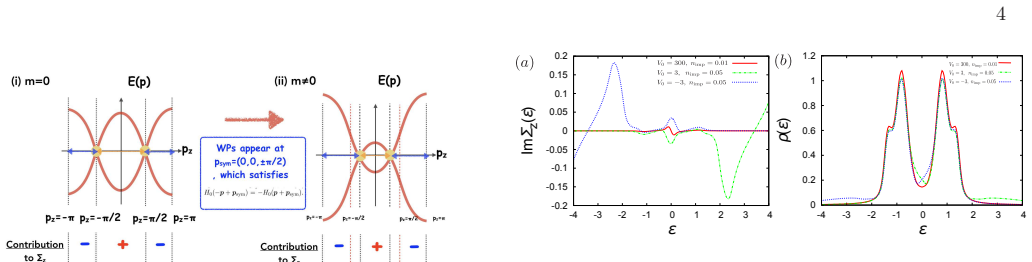
The load-bearing object is the effective quasiparticle Hamiltonian $H_{\rm eff}(p)=[1-\Sigma_1]^{-1}(H_0(p)+\Sigma_0)$ obtained from the poles of the dressed retarded Green's function; its non-Hermiticity encodes quasiparticle lifetime. The decisive quantity is the $\sigma_z$ component of the self-energy, $\Sigma_z(\epsilon)$. In the two-band Weyl model the integrated Green's function decomposes as $G_0(\epsilon)+G_z(\epsilon)\sigma_z$, and $G_z$ is nonzero exactly when the Weyl points are displaced from the symmetric points of the Brillouin zone. The self-consistent $T$-matrix equations then produce a finite $\mathrm{Im}\,\Sigma_z$ for scalar disorder, and the condition for non-diagonalizability of $H_{\rm eff}$---$\mathrm{Re}\,R'_z=0$ together with $R'_x{}^2+R'_y{}^2=\mathrm{Im}\,R'_z{}^2$---defines the Weyl exceptional ring. Repeating the same structure with two opposite-chirality copies gives the hybrid point ring at the topological Dirac semimetal transition.
What would settle it
Compute the spectral function of the same two-band lattice model with random scalar impurities ($\beta=0$, $m\neq 0$, moderate $V_0$) on finite real-space systems by exact diagonalization, average over impurity configurations, and look for the predicted ring of coalescing quasiparticle poles with a flat interior in $G(p,p)$; if no such ring appears, the T-matrix averaging invented it. In a candidate material such as Co$_3$Sn$_2$S$_2$ or Cd$_3$As$_2$, angle-resolved photoemission showing no ring-shaped anisotropic broadening around the Weyl points at the predicted radius would likewise falsify the claim.
Extended reading notes
Core claim
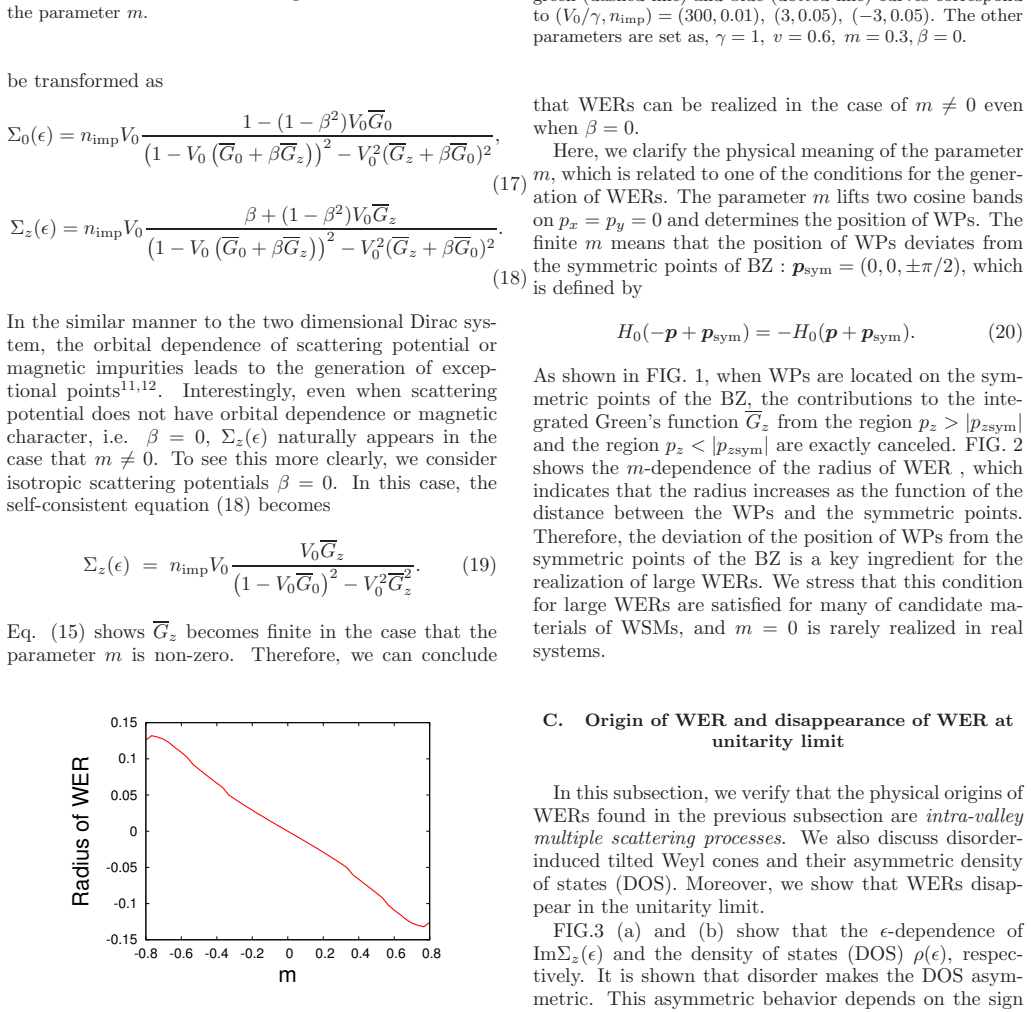
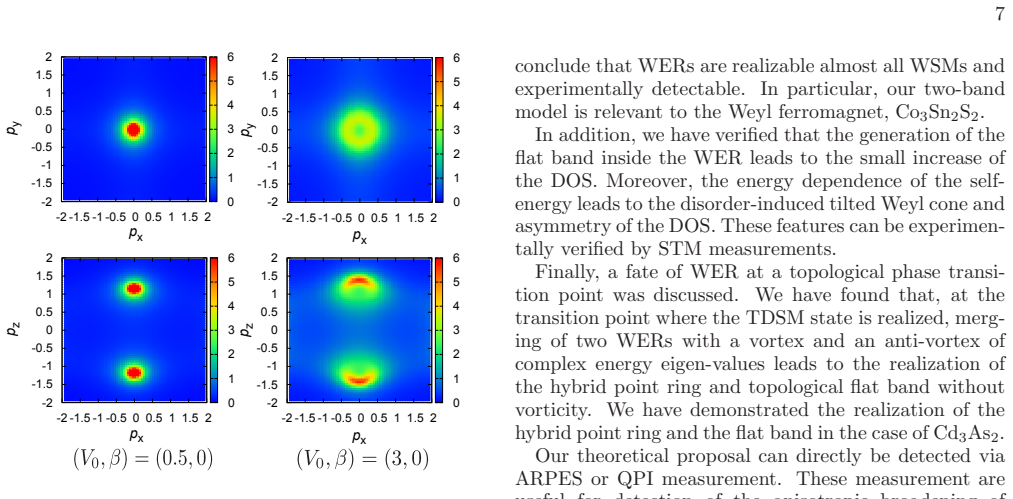
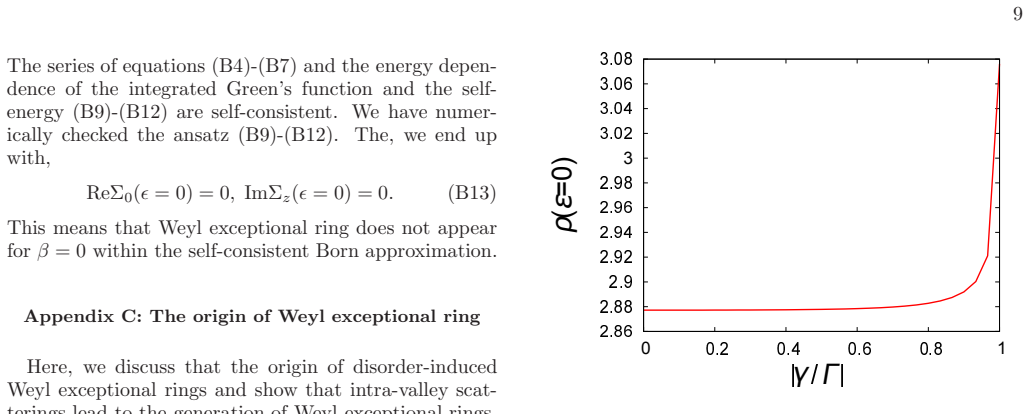
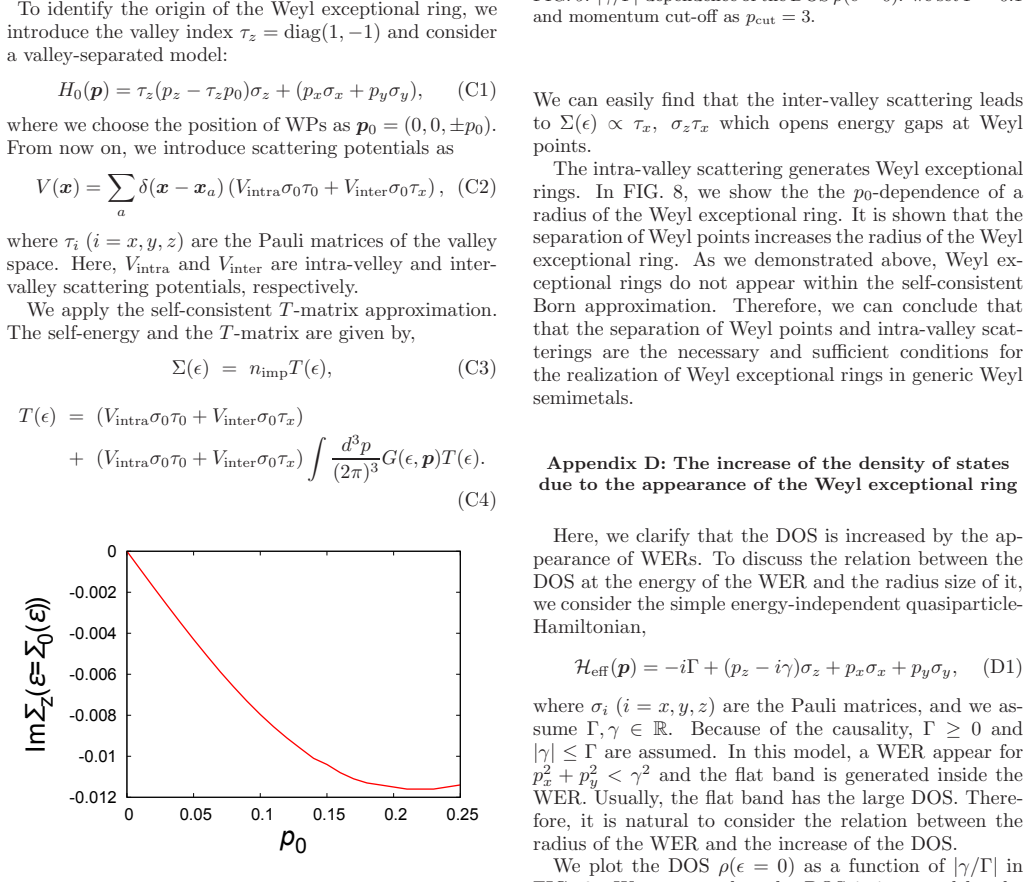
The paper's central claim is that a disordered Weyl semimetal generically exhibits Weyl exceptional rings, controlled by two conditions: (i) deviation of the Weyl points from the symmetric points of the Brillouin zone and (ii) deviation of the impurity scattering from the unitarity limit. The argument uses a minimal two-band model $H_0(p)=R(p)\cdot\sigma$, with $R(p)=(v\sin p_x,v\sin p_y,\gamma(\cos p_z-m))$, where $m$ moves the Weyl points away from the symmetric points $p_{\rm sym}=(0,0,\pm\pi/2)$. The disorder-averaged self-energy, computed self-consistently in the $T$-matrix approximation, has the form $\Sigma(\epsilon)=\Sigma_0(\epsilon)\sigma_0+\Sigma_z(\epsilon)\sigma_z$; even for purely scalar scattering the $\sigma_z$ component is nonzero whenever $m\neq 0$. Its imaginary part sets the radius of the exceptional ring through $R'_x{}^2+R'_y{}^2=\mathrm{Im}\,R'_z{}^2$ at $\mathrm{Re}\,R'_z=0$, and inside the ring the real part of the complex eigenvalue vanishes, giving a flat band. The paper shows that $\mathrm{Im}\,\Sigma_z$ vanishes in the unitarity limit and in the Born approximation, so intra-valley multiple scattering by moderate-strength impurities is the operative origin of the rings; at the Weyl-to-Dirac transition two rings of opposite vorticity merge into a hybrid point ring with a vorticity-free flat band.
Load-bearing premise
The whole construction identifies the physical quasiparticle spectrum with the complex poles of the disorder-averaged, momentum-diagonal Green's function built from a momentum-independent self-energy; if effects that averaging leaves out—rare spatial regions, momentum-dependent broadening, or interference between scattering events—shift or destroy those poles, the exceptional rings are an artifact of the averaging scheme.
Editorial extensions
If this is right
- Most real Weyl semimetals have Weyl points away from the symmetric points, so ordinary scalar disorder should create Weyl exceptional rings; neither magnetic impurities, orbital-dependent potentials, nor tilted cones are needed.
- The effect requires moderate-strength impurities: it disappears in the unitarity limit and in the Born approximation, so intra-valley multiple scattering is the operative process.
- In a valley-separated model, intervalley scattering opens gaps at the Weyl points, so the intra-valley channel must dominate for the rings to survive.
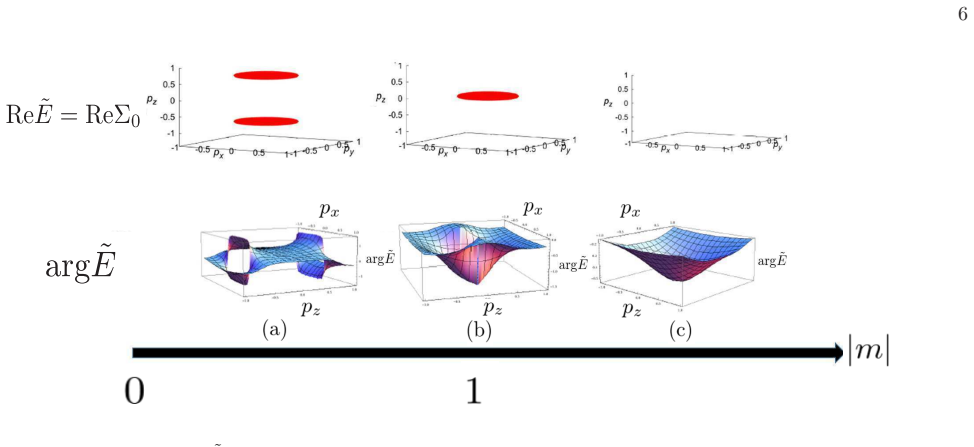
- At the Weyl-to-Dirac transition, two Weyl exceptional rings with opposite vorticity annihilate into a hybrid point ring whose flat band has no vorticity; this is demonstrated in the Cd$_3$As$_2$ effective model.
- The resulting anisotropic broadening of quasiparticle peaks and the slightly asymmetric density of states are directly measurable by ARPES, quasiparticle interference, and STM.
Reading between the lines
- The paper leaves implicit that the absence of ring-shaped spectral broadening in a candidate Weyl semimetal would itself be diagnostic: it would mean the disorder is effectively in the unitarity limit or the Weyl points sit at symmetric points, rather than that the mechanism fails.
- A natural next test, suggested by the paper's own appeal to real-space comparisons, is exact diagonalization of finite disordered lattices; if the momentum-diagonal spectral function does not show the ring, the T-matrix averaging invented it.
- The hybrid-point-ring mechanism should be generic for any non-Hermitian topological transition at which two exceptional rings of opposite vorticity annihilate, so engineered photonic or cold-atom analogs may realize the same vorticity-free flat bands outside solids.
- Because the ring radius grows with the displacement of the Weyl points from symmetric points and with orbital or magnetic scattering asymmetry, strain or doping that moves the Weyl points should produce a measurable migration of the ring in ARPES.
Signed reviews
Editorial analysis
A structured set of objections, weighed in public.
Referee Report
Summary. The paper studies disorder-induced non-Hermitian effects in Weyl and Dirac semimetals. Using a two-band lattice model of a Weyl semimetal with randomly distributed impurities, the authors compute the disorder self-energy in the self-consistent T-matrix approximation and construct an energy-independent effective quasiparticle Hamiltonian. They argue that when the Weyl points deviate from symmetric points of the Brillouin zone and the impurity scattering is not in the unitarity limit, Weyl exceptional rings (WERs) and flat bands inside them are generically realized, independent of the details of the scattering potential. They further claim that at the transition to a topological Dirac semimetal the two WERs merge into a hybrid point ring, and they illustrate the scenario for a Cd3As2 model. The paper explicitly claims these features are observable in ARPES or quasiparticle interference experiments.
Significance. If the central claim is correct, the paper would substantially generalize earlier work that required tilted Weyl cones or magnetic impurities, establishing that generic disorder in almost any Weyl semimetal produces ring-shaped degeneracies of the effective quasiparticle Hamiltonian. The identification of the two conditions (deviation from the unitarity limit and deviation of the Weyl points from symmetric BZ points) is concrete and potentially testable in known materials such as Co3Sn2S2 and Cd3As2. The paper also provides a useful clarification that intra-valley multiple scattering, rather than inter-valley scattering or orbital-dependent potentials, is the origin of the effect. The analytical derivation of the self-energy structure is coherent, and the connection to non-Hermitian band topology is timely. However, the observability claim rests on a mapping between the defective fixed-frequency Hamiltonian and the actual poles of the retarded Green's function, which is not established in the manuscript.
major comments (4)
- [Sec. III B, Eq. (16)] The WER condition is defined for the fixed-frequency matrix H0(p)+Σ(ε) at ε = ReΣ0(ε), but at this point the retarded Green's function does not have a pole. Evaluating det[ε−H0−Σ] at ε = ReΣ0(ε) gives (ε−Σ0)^2 = −(ImΣ0)^2, which is generically nonzero because of the finite quasiparticle lifetime. The actual quasiparticle poles are complex solutions of det[ε−H0(p)−Σ(ε)] = 0, and the paper neither solves this equation nor checks whether the coalescing poles lie on the physical sheet (Im ε < 0). Without this check, the claimed flat bands and exceptional rings may not appear in the retarded spectral function measured by ARPES, and the central observable claim is unsupported. The appeal to Ref. [12] for real-space validation is not a substitute for a direct check of the pole condition in the present model.
- [Sec. III A, Eqs. (7)-(11)] The exceptional-ring condition Re[R'_z] = 0 and R'_x^2 + R'_y^2 = Im[R'_z]^2 implicitly assumes that the transverse combination R'_x^2 + R'_y^2 is real and non-negative. From Eqs. (8) and (9), R'_x^2 + R'_y^2 = [(1−Σ1_0)^2 − (Σ1_z)^2] v^2(sin^2 px + sin^2 py), which is complex for generally complex coefficients Σ1_0 and Σ1_z. The actual condition for the radical in Eq. (11) to vanish is the complex equation R'_x^2 + R'_y^2 + R'_z^2 = 0, which may have different solutions or none. The paper does not justify neglecting the imaginary part of the transverse sum, so the existence of the WER is not rigorously established.
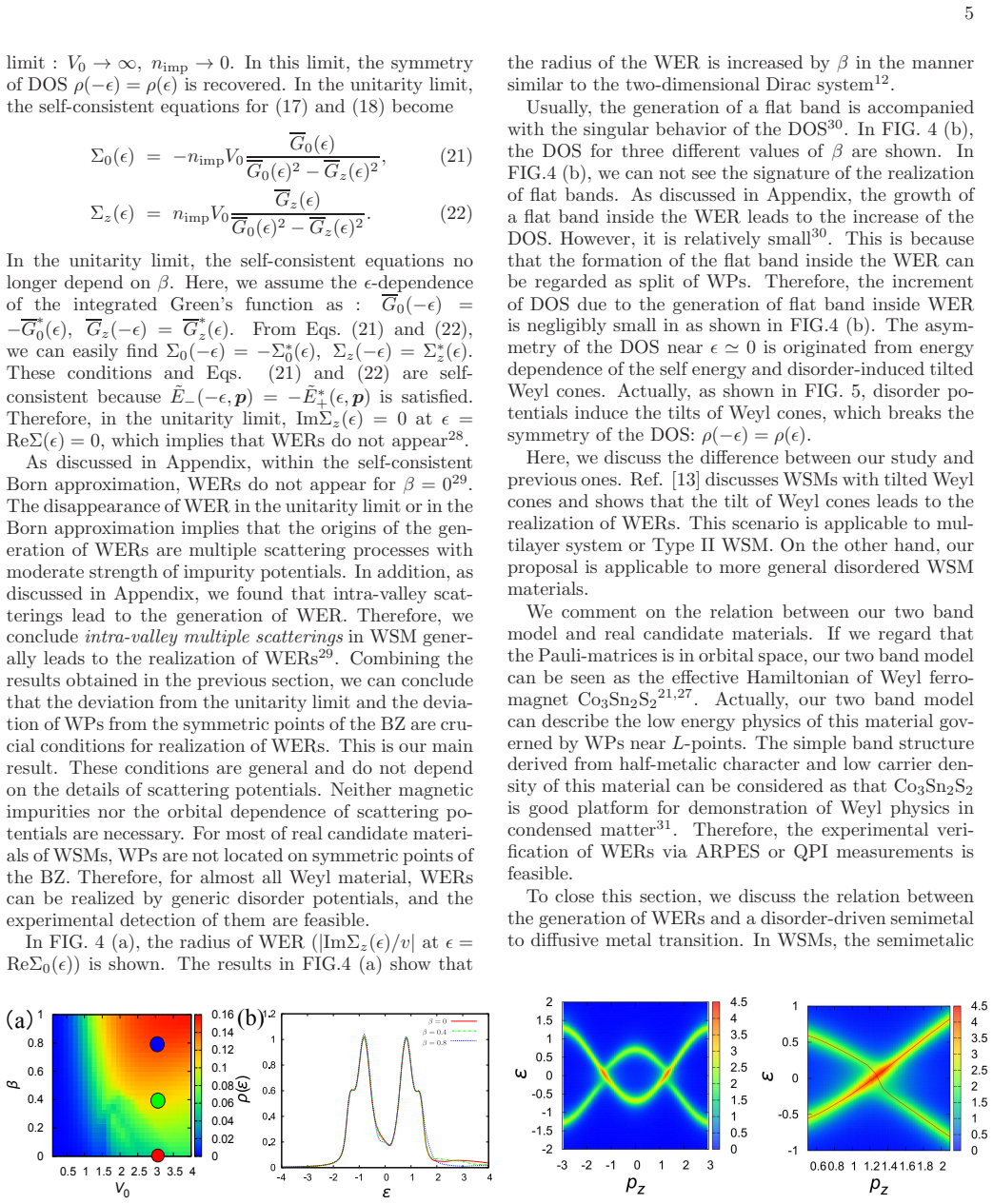
- [Sec. II, Eq. (2), and Sec. III B] The effective Hamiltonian Heff is derived by truncating the frequency expansion of the self-energy at first order, Σ(ε) = Σ0 + Σ1ε + O(ε^2), and the self-consistent T-matrix equations are solved for real ε, with the WER evaluated at ε = ReΣ0(ε). The validity range of this linear expansion is not established; the values of |ImΣ_z/v| shown in Figs. 2 and 4 are not obviously small compared with the bandwidth, and the O(ε^2) terms could modify the ring condition. The paper should provide an estimate of the truncation error or, preferably, solve the pole equation at the complex pole energy to justify the approximation.
- [Sec. III B and Sec. V] The numerical solutions of the self-consistent T-matrix equations (17)-(18) are performed on a 35^3 momentum mesh with no convergence analysis, no specification of the i0+ broadening used to treat the Green's function singularities, and no error estimates. The WER radius and DOS results in Figs. 2-4 and the spectral functions in Figs. 5 and 7 are quantitative claims, and the reliability of these numbers is not demonstrated. Convergence tests with different mesh sizes and broadening parameters are needed to support the quantitative predictions.
minor comments (5)
- [Throughout] The manuscript contains several typos: 'Fourior' in Sec. II, 'featrure' in Sec. III C, 'We, now, consider' in Sec. III A, and the inconsistent use of 'Weyl exceptional ring' versus 'hybrid point rings' in the title and abstract.
- [Sec. III B] The condition 'sin^2 px + sin 2 py = |ImΣ z(ǫ)/v|' is dimensionally inconsistent; it should be sin^2 px + sin^2 py = (ImΣ_z(ǫ)/v)^2 (up to model-dependent prefactors) to match the condition R'_x^2 + R'_y^2 = Im[R'_z]^2 in Sec. III A.
- [Fig. 3 caption] The red solid curve is described as the unitarity limit (V0→∞, nimp→0), but the parameters used are V0=300, nimp=0.01; the text should clarify that this is an approximation to the limit and state the convergence check used.
- [References] References [3] and [5] share the same arXiv number 1902.08479; please verify the correct identifiers, as the titles and author lists differ.
- [Sec. V, Eq. (23)] The Hamiltonian uses 'mp' in h(p) but defines 'm_k' in the following line; the notation should be made consistent.
Circularity Check
No significant circularity: the WER/hybrid-ring results are computed from a self-contained model and self-consistent T-matrix equations, with no fitted targets or load-bearing self-citations.
full rationale
The derivation chain is self-contained. The paper defines the quasiparticle Hamiltonian H_eff(p) from H0(p)+Sigma(epsilon), with Sigma(epsilon) solved from the self-consistent T-matrix equations (12)-(18). The Weyl exceptional ring condition in Sec. III B is obtained by solving the eigenvalue problem of this non-Hermitian Hamiltonian, not by imposing the desired ring as an input. The claimed conditions, namely deviation from the unitarity limit and Weyl points away from symmetric BZ points, are identified from the computed m and V0 dependence of Im Sigma_z, and the paper demonstrates that the ring disappears in the unitarity limit and within the Born approximation, providing independent checks. No experimental data are fitted, and no fitted parameter is renamed as a prediction. Earlier exceptional-ring work cited in Refs. 11-13 is background and is not by the present authors; there is no load-bearing self-citation, imported uniqueness theorem, or ansatz smuggled in through earlier authorship. Potential concerns about whether fixed-energy non-diagonalizability corresponds to physical poles of the retarded Green's function are correctness risks rather than circularity under the stated criteria.
Assumptions & free parameters
free parameters (5)
- m (Weyl point position parameter) =
0.3 for main curves; 0 to 0.8 in Fig. 2
- V0 and nimp =
V0=3, nimp=0.05 for main curves; V0/γ=300, nimp=0.01 for unitarity-limit curve
- v and γ =
v=0.6, γ=1
- β =
0 for the main claim; up to 0.8 in Fig. 4
- Cd3As2 model parameters =
t0=-1, t1=1, t2=0.3, Λ=0.7, V0=0.5 or 3, nimp=0.05
assumptions (5)
- domain assumption The quasiparticle spectrum is determined by the complex poles of the retarded Green's function, det[ǫ - H_eff(p)] = 0.
- domain assumption The self-energy is momentum-independent and the disorder average restores translational invariance.
- domain assumption The low-energy expansion Σ(ǫ)=Σ0+Σ1 ǫ+O(ǫ2) is valid in the region where WERs are predicted.
- ad hoc to paper In the unitarity limit, the energy dependence ansatz G0(-ǫ)=-G0*(ǫ) and Gz(-ǫ)=Gz*(ǫ) holds.
- domain assumption The self-consistent T-matrix approximation captures intra-valley multiple scattering sufficiently for the central claim.
Cite this review
Pith. "Pith review of Disorder-induced exceptional and hybrid rings in Weyl/Dirac semimetals." pith.science (2026). https://pith.science/paper/26D3TJ7T
@misc{pith2026190803345,
  author       = {Pith},
  title        = {Pith review of: Disorder-induced exceptional and hybrid rings in Weyl/Dirac semimetals},
  year         = {2026},
  howpublished = {\url{https://pith.science/paper/26D3TJ7T}},
  note         = {Machine review of arXiv:1908.03345}
}
read the original abstract
Non-Hermiticity in Weyl Hamiltonian leads to the realization of Weyl exceptional rings and flat bands inside the Weyl exceptional rings. Recently, the platform of non-Hermitian physics is extended to many-body or disordered systems where quasiparticles possess finite lifetime. Here, we clarify that the deviation from unitarity limit in a disordered Weyl semimetal leads to the generation of Weyl exceptional rings regardless of the detail of the scattering potential. In the case of topological Dirac semimetals, hybrid rings and flat bands without vorticity of complex-energy eigenvalues are realized. This scenario is applicable to any Weyl or Dirac semimetals. These effects are detectable by using photoemission or quasiparticle interference experiments.
Figures
Figures from the paper (4 more)
Reference graph
Works this paper leans on
-
[12]
author M. Papaj , author H. Isobe , and author L. Fu , journal Phys. Rev. B volume 99 , pages 201107 ( year 2019 )
work page 2019
-
[1]
author H. Shen , author B. Zhen , and author L. Fu , journal Phys. Rev. Lett. volume 120 , pages 146402 ( year 2018 )
work page 2018
-
[2]
Gong , author Y
author Z. Gong , author Y. Ashida , author K. Kawabata , author K. Takasan , author S. Higashikawa , and author M. Ueda , journal Phys. Rev. X volume 8 , pages 031079 ( year 2018 )
2018
-
[4]
author T. E. Lee , journal Phys. Rev. Lett. volume 116 , pages 133903 ( year 2016 )
work page 2016
-
[5]
Classification of Exceptional Points and Non-Hermitian Topological Semimetals
author K. Kawabata , author T. Bessho , and author M. Sato , journal arXiv : 1902.08479 ( year 2019 )
work page Pith review arXiv 1902
-
[6]
author N. Hatano and author D. R. Nelson , journal Phys. Rev. Lett. volume 77 , pages 570 ( year 1996 )
work page 1996
-
[7]
author K. Kawabata , author Y. Ashida , author H. Katsura , and author M. Ueda , journal Phys. Rev. B volume 98 , pages 085116 ( year 2018 b )
work page 2018
-
[8]
author I. Rotter , journal J. Phys. A: Math. Theor volume 42 , pages 153001 ( year 2009 )
work page 2009
Show all 39 references
-
[9]
author A. J. Daley , journal Adv. Phys volume 63 , pages 77 ( year 2014 )
2014
-
[10]
Hatano , journal Molecular Physics pp
author N. Hatano , journal Molecular Physics pp. pages 1--7 ( year 2019 )
2019
-
[11]
Kozii and author L
author V. Kozii and author L. Fu , journal arXiv : 1708.05841 ( year 2017 )
2017 arXiv
-
[13]
author A. A. Zyuzin and author A. Y. Zyuzin , journal Phys. Rev. B volume 97 , pages 041203 ( year 2018 )
2018
-
[14]
Moors , author A
author K. Moors , author A. A. Zyuzin , author A. Y. Zyuzin , author R. P. Tiwari , and author T. L. Schmidt , journal Phys. Rev. B volume 99 , pages 041116 ( year 2019 )
2019
-
[15]
Yoshida , author R
author T. Yoshida , author R. Peters , and author N. Kawakami , journal Phys. Rev. B volume 98 , pages 035141 ( year 2018 )
2018
-
[16]
Michishita , author T
author Y. Michishita , author T. Yoshida , and author R. Peters , journal arXiv:1905.12287 ( year 2019 )
1905 arXiv
-
[17]
Yoshida , author R
author T. Yoshida , author R. Peters , author N. Kawakami , and author Y. Hatsugai , journal Phys. Rev. B volume 99 , pages 121101 ( year 2019 )
2019
-
[18]
Kimura , author T
author K. Kimura , author T. Yoshida , and author N. Kawakami , journal Phys. Rev. B volume 100 , pages 115124 ( year 2019 )
2019
-
[19]
Okugawa and author T
author R. Okugawa and author T. Yokoyama , journal Phys. Rev. B volume 99 , pages 041202 ( year 2019 )
2019
-
[20]
author J. C. Budich , author J. Carlstr\"om , author F. K. Kunst , and author E. J. Bergholtz , journal Phys. Rev. B volume 99 , pages 041406 ( year 2019 )
2019
-
[21]
Xu , author S.-T
author Y. Xu , author S.-T. Wang , and author L.-M. Duan , journal Phys. Rev. Lett. volume 118 , pages 045701 ( year 2017 )
2017
-
[22]
Cerjan , author S
author A. Cerjan , author S. Huang , author M. Wang , author K. P. Chen , author Y. Chong , and author M. C. Rechtsman , journal Nat. Photonics p. pages 1 ( year 2019 )
2019
-
[23]
author P. A. McClarty and author J. G. Rau , journal arXiv:1904.02160 ( year 2019 )
1904 arXiv
-
[24]
author B. Q. Lv , author H. M. Weng , author B. B. Fu , author X. P. Wang , author H. Miao , author J. Ma , author P. Richard , author X. C. Huang , author L. X. Zhao , author G. F. Chen , et al. , journal Phys. Rev. X volume 5 , pages 031013 ( year 2015 )
2015
-
[25]
Wang , author Y
author Q. Wang , author Y. Xu , author R. Lou , author Z. Liu , author M. Li , author Y. Huang , author D. Shen , author H. Weng , author S. Wang , and author H. Lei , journal Nature communications volume 9 , pages 3681 ( year 2018 )
2018
-
[26]
Shen and author L
author H. Shen and author L. Fu , journal Phys. Rev. Lett. volume 121 , pages 026403 ( year 2018 )
2018
-
[27]
Ozawa and author K
author A. Ozawa and author K. Nomura , journal arXiv : 1904.08148 ( year 2019 )
1904 arXiv
-
[28]
note We numerically checked the absence of other solutions
-
[29]
Marchenko , author D
author D. Marchenko , author D. Evtushinsky , author E. Golias , author A. Varykhalov , author T. Seyller , and author O. Rader , journal Science Advances volume 4 , pages eaau0059 ( year 2018 )
2018
-
[30]
Liu , author Y
author E. Liu , author Y. Sun , author N. Kumar , author L. Muechler , author A. Sun , author L. Jiao , author S.-Y. Yang , author D. Liu , author A. Liang , author Q. Xu , et al. , journal Nat Phys volume 14 , pages 1125 ( year 2018 )
2018
-
[31]
Fradkin , journal Phys
author E. Fradkin , journal Phys. Rev. B volume 33 , pages 3263 ( year 1986 )
1986
-
[32]
Kobayashi , author T
author K. Kobayashi , author T. Ohtsuki , author K.-I. Imura , and author I. F. Herbut , journal Phys. Rev. Lett. volume 112 , pages 016402 ( year 2014 )
2014
-
[33]
Bera , author J
author S. Bera , author J. D. Sau , and author B. Roy , journal Phys. Rev. B volume 93 , pages 201302 ( year 2016 )
2016
-
[34]
Shapourian and author T
author H. Shapourian and author T. L. Hughes , journal Phys. Rev. B volume 93 , pages 075108 ( year 2016 )
2016
-
[35]
author J. H. Pixley , author D. A. Huse , and author S. Das Sarma , journal Phys. Rev. X volume 6 , pages 021042 ( year 2016 )
2016
-
[36]
author J. H. Pixley , author Y.-Z. Chou , author P. Goswami , author D. A. Huse , author R. Nandkishore , author L. Radzihovsky , and author S. Das Sarma , journal Phys. Rev. B volume 95 , pages 235101 ( year 2017 )
2017
-
[37]
[33], non-perturbative contributions to the DOS have weak frequency dependence
note As discussed in Ref. [33], non-perturbative contributions to the DOS have weak frequency dependence. Phenomenologically, it can be described by the finite DOS, namely the smearing factor of the bare Green's function. We found that the finite DOS due to the smearing fator ...
-
[38]
Borisenko , author Q
author S. Borisenko , author Q. Gibson , author D. Evtushinsky , author V. Zabolotnyy , author B. B \"u chner , and author R. J. Cava , journal Phys. Rev. Lett. volume 113 , pages 027603 ( year 2014 )
2014
-
[39]
Kobayashi and author M
author S. Kobayashi and author M. Sato , journal Phys. Rev. Lett. volume 115 , pages 187001 ( year 2015 )
2015
-
[40]
Wang , author H
author Z. Wang , author H. Weng , author Q. Wu , author X. Dai , and author Z. Fang , journal Phys. Rev. B volume 88 , pages 125427 ( year 2013 )
2013
Reviewed August 14, 2026 · model on record in the stance chip above.
Discussion (0). Continue with ORCID to comment.