REVIEW 4 major objections 5 minor 47 references
Tripartite Weight-Space Ensemble for Few-Shot Class-Incremental Learning
T0 review · 4 major / 5 minor · reviewed 2026-08-07 · deepseek-v4-flash
Pith's one-line read A tripartite weight-space ensemble that interpolates the base, previous, and current classification heads, regularized by distillation on amplified few-shot data, achieves state-of-the-art accuracy in few-shot class-incremental learning…
desk verdict A solid empirical FSCIL paper with a genuinely new weight-space ensembling idea and strong ablations, but the ADKD mechanism is oversold and the SOTA margins rest on single runs without code. read the letter →
The pith
A machine-rendered reading of the paper's core claim, the machinery that carries it, and where it could break.
The reading
What carries the argument
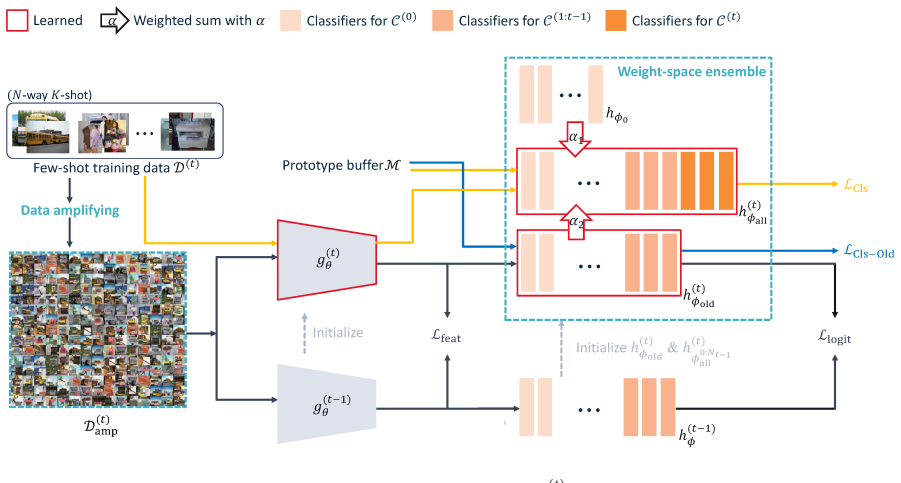
The central object is the tripartite weight-space ensemble (Tri-WE), defined by the interpolation rule in Eq. (1): for each class, the final head weight is a convex combination of the corresponding class weights from the base head, the previous head, and the current all-class head, with learnable scalars $\alpha_1$ and $\alpha_2$ normalized by Eq. (2). Only the classification head is ensembled; the feature extractor is updated with a reduced learning rate. The companion mechanism is amplified data knowledge distillation (ADKD), which uses CutMix to amplify the $N$-way $K$-shot training set to $16NK$ samples per class and then applies feature-level and logit-level distillation losses from the frozen previous model. A third loss, $L_{\text{Cls-Old}}$, keeps the previous head consistent with the lightly updated feature extractor.
What would settle it
Measure linear mode connectivity between the base head, the previous head, and the current head after incremental training: if the interpolation path between any two heads passes through a region of substantially higher loss than either endpoint, or if the interpolated head's accuracy is no better than the better endpoint on a held-out set, the core Tri-WE claim is refuted. A second concrete test is to run the method on an architecture whose weights are known not to be linearly connected after fine-tuning and observe whether the accuracy advantage over a single-head baseline disappears.
Extended reading notes
Core claim
The central claim is that a model can be continually updated on only a few examples per class without catastrophic forgetting if its classification head is periodically rebuilt by weight-space ensembling of the base, immediately previous, and current session heads, and if the previous model is distilled on amplified few-shot data. Concretely, the head weight for a class is a normalized convex combination with two learnable scalars, and the feature extractor is lightly updated rather than frozen. The paper reports 70.62% average accuracy on miniImageNet (60.13% in the last session), surpassing prior methods while deploying a smaller classifier ensemble than BiDistill or SAVC and without knowing the total number of incremental classes in advance, unlike NC-FSCIL and OrCo.
Load-bearing premise
The three classification heads of the base, previous, and current sessions are close enough in weight space that a convex interpolation of their weights yields a classifier that is at least as good as any one of them, and this closeness is assumed rather than measured.
Editorial extensions
If this is right
- If the head interpolation works as claimed, FSCIL methods no longer need to freeze the feature extractor after base training, opening the door to whole-model adaptation in low-data regimes.
- The deployed model is a single classification head, so the approach avoids the test-time model-size growth of BiDistill and SAVC while still outperforming them.
- The method does not require knowing the number of future incremental classes at base time, a constraint imposed by NC-FSCIL and OrCo, making it applicable to open-ended learning scenarios.
- Data amplification by mixing, specifically CutMix, is shown to be a simple and effective way to make knowledge distillation useful when only a handful of examples per new class are available.
- The learnable interpolation coefficients adapt per session, suggesting that the balance between base knowledge and new-class adaptability can be set automatically rather than tuned by hand.
Reading between the lines
- The paper does not analyze linear mode connectivity between the three classification heads; if those heads do not lie on a near-convex connected loss surface for other architectures or datasets, the interpolation could fail, so the method's generality hinges on an empirically untested geometric property.
- A natural extension beyond the paper is to make the interpolation weights class-conditioned or predicted from a small meta-model, rather than using only two global scalars, which could better handle heterogeneous old and new class distributions.
- One testable implication is that ADKD with CutMix works because mixing forces the distilled representation to preserve locally invariant features; a different mixing scheme that destroys local structure should degrade performance, and this could be verified directly.
- The Tri-WE idea could transfer to large-scale continual learning settings with more abundant data, where weight-space interpolation of successive checkpoints is already known to help, though the paper only demonstrates it in the few-shot regime.
Editorial analysis
A structured set of objections, weighed in public.
Referee Report
Summary. The manuscript proposes a few-shot class-incremental learning (FSCIL) method combining a tripartite weight-space ensemble (Tri-WE) and an amplified-data knowledge distillation loss (ADKD). Tri-WE interpolates the per-class classification-head weight vectors of the base, immediately previous, and current session models, with two learnable scalar coefficients, while keeping the feature extractor only lightly updated. ADKD augments the current session's few-shot data with CutMix and distills the previous model's features and logits on the amplified data. The base model is trained with ALICE-style techniques plus a geometric auxiliary classification head. Experiments on miniImageNet, CUB200, and CIFAR100 report state-of-the-art average accuracies, e.g., 70.62% on miniImageNet with a last-session accuracy of 60.13%, and ablation studies attribute gains to both Tri-WE and ADKD.
Significance. If the results are reproducible, the paper makes a useful empirical contribution: Tri-WE is a simple, low-cost mechanism that improves average accuracy by 2.70% over No-WE on miniImageNet, ADKD adds 1.57% over no data amplification, and the deployed model is smaller than BiDistill and SAVC. The ablation suite is more thorough than is typical for this area, and the comparison table is internally consistent. However, the central claims are currently supported only by single-run joint accuracies: no uncertainty estimates are reported, and the ADKD loss is not shown to preserve old-class knowledge specifically, as opposed to acting as a generic feature-smoothness regularizer. These issues need to be addressed before the stated conclusions can be accepted.
major comments (4)
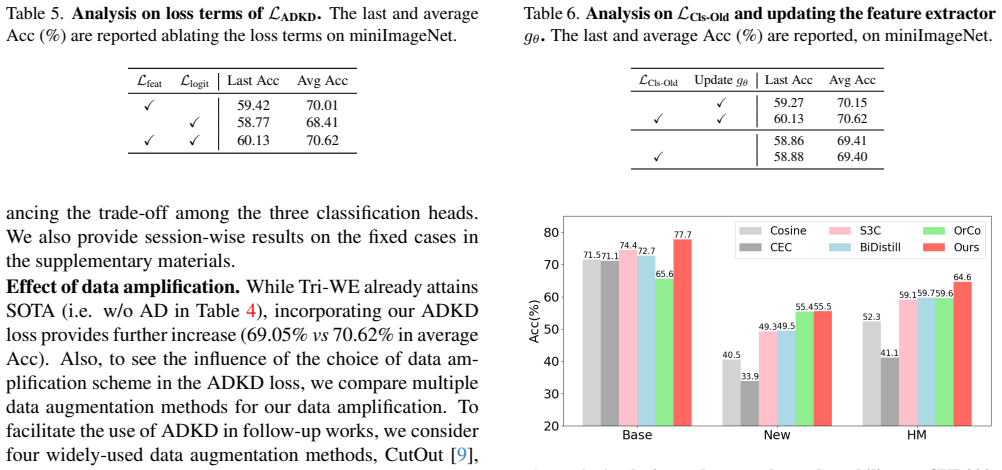
- [Sec. 3.2, Eqs. (5)-(7); Table 5] ADKD is computed on D_amp^t, which is generated from the current session's new-class data D^t. The frozen teacher f^{t-1} was trained only on classes C^{0:t-1}, so its features and logits on these inputs are not a record of old-class decision boundaries. The manuscript nevertheless motivates ADKD as transferring generalized knowledge for previous classes and credits it with preventing catastrophic forgetting, but Table 5 reports only joint accuracy over all classes. The observed gain could come entirely from a generic feature/logit-smoothness regularizer on new-class data. Please either recharacterize ADKD as a feature-smoothness regularizer, or provide an ablation that isolates old-class accuracy (e.g., accuracy on C^{0:t-1} only, or the base/novel breakdown already used in Fig. 6) with and without the L_ADKD terms.
- [Tables 1-6 and Fig. 4] All reported accuracies come from a single run, with no multiple seeds or error bars. For 5-shot tasks, stochasticity in optimization and data sampling can plausibly shift results by more than the reported SOTA margins, such as the 1.82% average gain on miniImageNet. Please report means and standard deviations over at least three seeds, or explicitly justify a fully deterministic pipeline; without this, the state-of-the-art claim is not statistically grounded.
- [Sec. 3, Eqs. (3)-(4)] The prototype buffer M is described as storing "the averaged feature of the K examples per class," but Eq. (3) computes CE(h^{(t)}_phi(g^{(t)}_theta(p)), y) for p drawn from M, which is only meaningful if p is an input image. In contrast, Eq. (4) passes p directly to the classification head, consistent with p being a feature vector. Please clarify the representation stored in M and correct Eqs. (3)-(4) accordingly; the current inconsistency makes the optimization procedure ambiguous and harms reproducibility.
- [Sec. 4, Implementation details; Table 4; Fig. 5] Several key hyperparameters (gamma1=1.2, gamma2=10.0, the 16x amplification factor, the CutMix scheme, and the initial values of alpha1 and alpha2) are selected using the same three benchmark datasets on which state-of-the-art performance is claimed. The main text reports no validation protocol or sensitivity analysis for the loss weights, and the amplification-factor analysis is deferred to the supplementary material. Please provide an explicit model-selection protocol or report sensitivity of the results to these hyperparameters; otherwise the risk of selection bias on the test sets is not addressed.
minor comments (5)
- [Sec. 4, Implementation details] The implementation details refer to "Loss weights lambda1 and lambda2," while Eq. (8) uses gamma1 and gamma2; the notation should be unified.
- [Fig. 2] Figure 2 is labeled "10-way 5-shot miniImageNet," but the main FSCIL protocol for miniImageNet is described as 5-way 5-shot; please clarify whether Fig. 2 is a separate transfer-learning experiment and how it relates to the reported protocol.
- [Eq. (7)] The notation f^{(t)}_{theta,phi_{0:N_{t-1}}}(x) should explicitly define which slice of the output vector is used in the cross-entropy with the teacher's logits.
- [Abstract / Contributions] The contributions bullet "attain SOTA results across on miniImageNet" contains a grammatical error ("across on") and should be corrected.
- [Eq. (2)] Since alpha1 and alpha2 are learnable scalars initialized to 1.0 in every session, please state explicitly whether the normalized coefficients in Eq. (2) are recomputed at every optimizer step and how the special case alpha2=0 at t=1 is handled during backpropagation.
Circularity Check
No significant circularity: Tri-WE and ADKD are model-construction choices, not predictions reduced to their inputs.
full rationale
The paper's central claims are empirical: Tri-WE interpolates classification-head weights via Eq. (1), ADKD adds feature and logit distillation losses in Eqs. (5)-(7), and the combined method is evaluated against external benchmarks. None of these components is defined in terms of the reported accuracy numbers, and no fitted constant is renamed as a prediction. The learnable scalars alpha1 and alpha2 are optimized per session; the fixed loss weights gamma1=1.2 and gamma2=10.0 are hyperparameters tuned on the same benchmarks, which is a potential overfitting risk but not a circular reduction. The ADKD mechanism is motivated as transferring previous-class knowledge, but Eqs. (6)-(7) are computed on D_amp^(t), amplified current-session new-class data, and Table 5 reports only joint accuracy; this is a limitation in mechanism validation, not circularity. No load-bearing self-citations are present, and the base session training borrows ALICE as an external baseline technique. The derivation chain is self-contained against external benchmarks, so the appropriate finding is no significant circularity.
Assumptions & free parameters
free parameters (5)
- Alpha_1 (alpha1) =
learned per session, init 1.0
- Alpha_2 (alpha2) =
learned per session, init 1.0 (set to 0 at t=1)
- Gamma_1 (gamma1) =
1.2
- Gamma_2 (gamma2) =
10.0
- Amplification factor =
16 x N x K
assumptions (5)
- domain assumption The FSCIL setting grants access only to current few-shot data plus one prototype per old class.
- domain assumption Convex interpolation of the base, previous, and current classification heads in weight space yields a valid classifier that balances old and new knowledge.
- domain assumption Updating the feature extractor with a strongly reduced learning rate preserves the feature space sufficiently to keep prototypes meaningful.
- domain assumption Distilling the frozen previous model's outputs on amplified images of only the current new classes transfers knowledge relevant to old classes.
- domain assumption CutMix is a valid amplifier for KD in FSCIL.
Cite this review
Pith. "Pith review of Tripartite Weight-Space Ensemble for Few-Shot Class-Incremental Learning." pith.science (2026). https://pith.science/paper/26ZBENNO
@misc{pith2026250615720,
  author       = {Pith},
  title        = {Pith review of: Tripartite Weight-Space Ensemble for Few-Shot Class-Incremental Learning},
  year         = {2026},
  howpublished = {\url{https://pith.science/paper/26ZBENNO}},
  note         = {Machine review of arXiv:2506.15720}
}
read the original abstract
Few-shot class incremental learning (FSCIL) enables the continual learning of new concepts with only a few training examples. In FSCIL, the model undergoes substantial updates, making it prone to forgetting previous concepts and overfitting to the limited new examples. Most recent trend is typically to disentangle the learning of the representation from the classification head of the model. A well-generalized feature extractor on the base classes (many examples and many classes) is learned, and then fixed during incremental learning. Arguing that the fixed feature extractor restricts the model's adaptability to new classes, we introduce a novel FSCIL method to effectively address catastrophic forgetting and overfitting issues. Our method enables to seamlessly update the entire model with a few examples. We mainly propose a tripartite weight-space ensemble (Tri-WE). Tri-WE interpolates the base, immediately previous, and current models in weight-space, especially for the classification heads of the models. Then, it collaboratively maintains knowledge from the base and previous models. In addition, we recognize the challenges of distilling generalized representations from the previous model from scarce data. Hence, we suggest a regularization loss term using amplified data knowledge distillation. Simply intermixing the few-shot data, we can produce richer data enabling the distillation of critical knowledge from the previous model. Consequently, we attain state-of-the-art results on the miniImageNet, CUB200, and CIFAR100 datasets.
Figures


Figures from the paper (3 more)


Reference graph
Works this paper leans on
-
[1]
Noor Ahmed, Anna Kukleva, and Bernt Schiele. Orco: To- wards better generalization via orthogonality and contrast for few-shot class-incremental learning. InIEEE Conf. Comput. Vis. Pattern Recog., 2024. 2, 3, 6
work page 2024
-
[2]
Il2m: Class incremen- tal learning with dual memory
Eden Belouadah and Adrian Popescu. Il2m: Class incremen- tal learning with dual memory. InIEEE Conf. Comput. Vis. Pattern Recog., 2019. 2
work page 2019
-
[3]
Efficient lifelong learning with a- gem.arXiv preprint arXiv:1812.00420, 2018
Arslan Chaudhry, Marc’Aurelio Ranzato, Marcus Rohrbach, and Mohamed Elhoseiny. Efficient lifelong learning with a- gem.arXiv preprint arXiv:1812.00420, 2018. 2
arXiv 2018
-
[4]
Incremental few-shot learn- ing via vector quantization in deep embedded space
Kuilin Chen and Chi-Guhn Lee. Incremental few-shot learn- ing via vector quantization in deep embedded space. InInt. Conf. Learn. Represent., 2020. 6
work page 2020
-
[5]
Synthesized feature based few-shot class- incremental learning on a mixture of subspaces
Ali Cheraghian, Shafin Rahman, Sameera Ramasinghe, Pengfei Fang, Christian Simon, Lars Petersson, and Mehrtash Harandi. Synthesized feature based few-shot class- incremental learning on a mixture of subspaces. InInt. Conf. Comput. Vis., 2021. 6
work page 2021
-
[6]
Metafscil: A meta-learning approach for few- shot class incremental learning
Zhixiang Chi, Li Gu, Huan Liu, Yang Wang, Yuanhao Yu, and Jin Tang. Metafscil: A meta-learning approach for few- shot class incremental learning. InIEEE Conf. Comput. Vis. Pattern Recog., 2022. 6
work page 2022
-
[7]
Randaugment: Practical automated data augmentation with a reduced search space
Ekin D Cubuk, Barret Zoph, Jonathon Shlens, and Quoc V Le. Randaugment: Practical automated data augmentation with a reduced search space. InIEEE Conf. Comput. Vis. Pattern Recog. Worksh., 2020. 7, 8
work page 2020
-
[8]
Imagenet: A large-scale hierarchical image database
Jia Deng, Wei Dong, Richard Socher, Li-Jia Li, Kai Li, and Li Fei-Fei. Imagenet: A large-scale hierarchical image database. InIEEE Conf. Comput. Vis. Pattern Recog., 2009. 5
work page 2009
Show all 47 references
-
[9]
Improved regular- ization of convolutional neural networks with cutout.arXiv preprint arXiv:1708.04552, 2017
Terrance DeVries and Graham W Taylor. Improved regular- ization of convolutional neural networks with cutout.arXiv preprint arXiv:1708.04552, 2017. 7, 8
2017 arXiv
-
[10]
Ensemble methods in machine learn- ing
Thomas G Dietterich. Ensemble methods in machine learn- ing. InInternational Workshop on Multiple Classifier Sys- tems, 2000. 3
2000
-
[11]
Few-shot class- incremental learning via relation knowledge distillation
Songlin Dong, Xiaopeng Hong, Xiaoyu Tao, Xinyuan Chang, Xing Wei, and Yihong Gong. Few-shot class- incremental learning via relation knowledge distillation. In AAAI, 2021. 6
2021
-
[12]
Podnet: Pooled outputs distilla- tion for small-tasks incremental learning
Arthur Douillard, Matthieu Cord, Charles Ollion, Thomas Robert, and Eduardo Valle. Podnet: Pooled outputs distilla- tion for small-tasks incremental learning. InEur. Conf. Com- put. Vis., 2020. 2
2020
-
[13]
Neural network en- sembles.IEEE Trans
Lars Kai Hansen and Peter Salamon. Neural network en- sembles.IEEE Trans. Pattern Anal. Mach. Intell., 12(10): 993–1001, 1990. 3
1990
-
[14]
Deep residual learning for image recognition
Kaiming He, Xiangyu Zhang, Shaoqing Ren, and Jian Sun. Deep residual learning for image recognition. InIEEE Conf. Comput. Vis. Pattern Recog., 2016. 5
2016
-
[15]
Learning a unified classifier incrementally via re- balancing
Saihui Hou, Xinyu Pan, Chen Change Loy, Zilei Wang, and Dahua Lin. Learning a unified classifier incrementally via re- balancing. InIEEE Conf. Comput. Vis. Pattern Recog., 2019. 2
2019
-
[16]
Snapshot ensembles: Train 1, get m for free
Gao Huang, Yixuan Li, Geoff Pleiss, Zhuang Liu, John E Hopcroft, and Kilian Q Weinberger. Snapshot ensembles: Train 1, get m for free. InInt. Conf. Learn. Represent.2017. 3
2017
-
[17]
S3c: Self-supervised stochastic classifiers for few-shot class-incremental learning
Jayateja Kalla and Soma Biswas. S3c: Self-supervised stochastic classifiers for few-shot class-incremental learning. InEur. Conf. Comput. Vis., 2022. 1, 2, 3, 6, 8
2022
-
[18]
On the soft- subnetwork for few-shot class incremental learning
Haeyong Kang, Jaehong Yoon, Sultan Rizky Hikmawan Madjid, Sung Ju Hwang, and Chang D Yoo. On the soft- subnetwork for few-shot class incremental learning. InInt. Conf. Learn. Represent., 2023. 2, 5, 6
2023
-
[19]
Warping the space: Weight space rotation for class- incremental few-shot learning
Do-Yeon Kim, Dong-Jun Han, Jun Seo, and Jaekyun Moon. Warping the space: Weight space rotation for class- incremental few-shot learning. InInt. Conf. Learn. Repre- sent., 2023. 2, 6
2023
-
[20]
Learning multiple layers of features from tiny images
Alex Krizhevsky, Geoffrey Hinton, et al. Learning multiple layers of features from tiny images. 2009. 5
2009
-
[21]
Imagenet classification with deep convolutional neural net- works
Alex Krizhevsky, Ilya Sutskever, and Geoffrey E Hinton. Imagenet classification with deep convolutional neural net- works. InAdv. Neural Inform. Process. Syst.2012. 3
2012
-
[22]
Learning without forgetting
Zhizhong Li and Derek Hoiem. Learning without forgetting. IEEE Trans. Pattern Anal. Mach. Intell., 40(12):2935–2947,
-
[23]
Few-shot class-incremental learn- ing via entropy-regularized data-free replay
Huan Liu, Li Gu, Zhixiang Chi, Yang Wang, Yuanhao Yu, Jun Chen, and Jin Tang. Few-shot class-incremental learn- ing via entropy-regularized data-free replay. InEur. Conf. Comput. Vis., 2022. 6
2022
-
[24]
Closer: Towards better representation learning for few-shot class- incremental learning
Junghun Oh, Sungyong Baik, and Kyoung Mu Lee. Closer: Towards better representation learning for few-shot class- incremental learning. InEur. Conf. Comput. Vis., 2024. 6
2024
-
[25]
Few-shot class-incremental learning from an open- set perspective
Can Peng, Kun Zhao, Tianren Wang, Meng Li, and Brian C Lovell. Few-shot class-incremental learning from an open- set perspective. InEur. Conf. Comput. Vis., 2022. 1, 2, 5, 6
2022
-
[26]
Learn- ing transferable visual models from natural language super- vision
Alec Radford, Jong Wook Kim, Chris Hallacy, Aditya Ramesh, Gabriel Goh, Sandhini Agarwal, Girish Sastry, Amanda Askell, Pamela Mishkin, Jack Clark, et al. Learn- ing transferable visual models from natural language super- vision. InInt. Conf. Machine Learning, 2021. 3
2021
-
[27]
icarl: Incremental clas- sifier and representation learning
Sylvestre-Alvise Rebuffi, Alexander Kolesnikov, Georg Sperl, and Christoph H Lampert. icarl: Incremental clas- sifier and representation learning. InIEEE Conf. Comput. Vis. Pattern Recog., 2017. 2, 4, 6
2017
-
[28]
Experience replay for continual learning
David Rolnick, Arun Ahuja, Jonathan Schwarz, Timothy Lil- licrap, and Gregory Wayne. Experience replay for continual learning. 2019. 2
2019
-
[29]
Learning with fantasy: Semantic-aware virtual contrastive constraint for few-shot class-incremental learning
Zeyin Song, Yifan Zhao, Yujun Shi, Peixi Peng, Li Yuan, and Yonghong Tian. Learning with fantasy: Semantic-aware virtual contrastive constraint for few-shot class-incremental learning. InIEEE Conf. Comput. Vis. Pattern Recog., 2023. 1, 2, 3, 5, 6
2023
-
[30]
Going deeper with convolutions
Christian Szegedy, Wei Liu, Yangqing Jia, Pierre Sermanet, Scott Reed, Dragomir Anguelov, Dumitru Erhan, Vincent Vanhoucke, and Andrew Rabinovich. Going deeper with convolutions. InIEEE Conf. Comput. Vis. Pattern Recog
-
[31]
Rethinking few-shot class-incremental learning: Learning from yourself
Yu-Ming Tang, Yi-Xing Peng, Jingke Meng, and Wei-Shi Zheng. Rethinking few-shot class-incremental learning: Learning from yourself. InEur. Conf. Comput. Vis., 2024. 6
2024
-
[32]
Few-shot class- incremental learning
Xiaoyu Tao, Xiaopeng Hong, Xinyuan Chang, Songlin Dong, Xing Wei, and Yihong Gong. Few-shot class- incremental learning. InIEEE Conf. Comput. Vis. Pattern Recog., 2020. 2, 3, 5, 6
2020
-
[33]
Matching networks for one shot learning
Oriol Vinyals, Charles Blundell, Tim Lillicrap, Koray Kavukcuoglu, and Daan Wierstra. Matching networks for one shot learning. InNeurIPS, 2016. 5, 8
2016
-
[34]
The caltech-ucsd birds-200-2011 dataset
Catherine Wah, Steve Branson, Peter Welinder, Pietro Per- ona, and Serge Belongie. The caltech-ucsd birds-200-2011 dataset. 2011. 5
2011
-
[35]
Learning to prompt for continual learning
Zifeng Wang, Zizhao Zhang, Chen-Yu Lee, Han Zhang, Ruoxi Sun, Xiaoqi Ren, Guolong Su, Vincent Perot, Jen- nifer Dy, and Tomas Pfister. Learning to prompt for continual learning. InIEEE Conf. Comput. Vis. Pattern Recog., 2022. 2
2022
-
[36]
Model soups: averaging weights of multiple fine-tuned models improves accuracy without increasing in- ference time
Mitchell Wortsman, Gabriel Ilharco, Samir Ya Gadre, Re- becca Roelofs, Raphael Gontijo-Lopes, Ari S Morcos, Hongseok Namkoong, Ali Farhadi, Yair Carmon, Simon Ko- rnblith, et al. Model soups: averaging weights of multiple fine-tuned models improves accuracy without increasing ...
2022
-
[37]
Robust fine-tuning of zero-shot models
Mitchell Wortsman, Gabriel Ilharco, Jong Wook Kim, Mike Li, Simon Kornblith, Rebecca Roelofs, Raphael Gon- tijo Lopes, Hannaneh Hajishirzi, Ali Farhadi, Hongseok Namkoong, and Ludwig Schmidt. Robust fine-tuning of zero-shot models. InIEEE Conf. Comput. Vis. Pattern Recog., 2022. 2, 3
2022
-
[38]
Large scale incre- mental learning
Yue Wu, Yinpeng Chen, Lijuan Wang, Yuancheng Ye, Zicheng Liu, Yandong Guo, and Yun Fu. Large scale incre- mental learning. InIEEE Conf. Comput. Vis. Pattern Recog.,
-
[39]
Der: Dynam- ically expandable representation for class incremental learn- ing
Shipeng Yan, Jiangwei Xie, and Xuming He. Der: Dynam- ically expandable representation for class incremental learn- ing. InIEEE Conf. Comput. Vis. Pattern Recog., 2021. 2
2021
-
[40]
Neural collapse inspired feature- classifier alignment for few-shot class incremental learning
Yibo Yang, Haobo Yuan, Xiangtai Li, Zhouchen Lin, Philip Torr, and Dacheng Tao. Neural collapse inspired feature- classifier alignment for few-shot class incremental learning. InInt. Conf. Learn. Represent., 2023. 2, 3, 5, 6
2023
-
[41]
Cutmix: Regu- larization strategy to train strong classifiers with localizable features
Sangdoo Yun, Dongyoon Han, Seong Joon Oh, Sanghyuk Chun, Junsuk Choe, and Youngjoon Yoo. Cutmix: Regu- larization strategy to train strong classifiers with localizable features. InInt. Conf. Comput. Vis., 2019. 4, 7, 8
2019
-
[42]
Few-shot incremental learning with contin- ually evolved classifiers
Chi Zhang, Nan Song, Guosheng Lin, Yun Zheng, Pan Pan, and Yinghui Xu. Few-shot incremental learning with contin- ually evolved classifiers. InIEEE Conf. Comput. Vis. Pattern Recog., 2021. 1, 2, 3, 5, 6, 8
2021
-
[43]
mixup: Beyond empirical risk minimiza- tion.arXiv preprint arXiv:1710.09412, 2017
Hongyi Zhang, Moustapha Cisse, Yann N Dauphin, and David Lopez-Paz. mixup: Beyond empirical risk minimiza- tion.arXiv preprint arXiv:1710.09412, 2017. 4, 7, 8
2017 arXiv
-
[44]
Maintaining discrimination and fairness in class incremental learning
Bowen Zhao, Xi Xiao, Guojun Gan, Bin Zhang, and Shu- Tao Xia. Maintaining discrimination and fairness in class incremental learning. InIEEE Conf. Comput. Vis. Pattern Recog., 2020. 2
2020
-
[45]
Few-shot class- incremental learning via class-aware bilateral distillation
Linglan Zhao, Jing Lu, Yunlu Xu, Zhanzhan Cheng, Dashan Guo, Yi Niu, and Xiangzhong Fang. Few-shot class- incremental learning via class-aware bilateral distillation. In IEEE Conf. Comput. Vis. Pattern Recog., 2023. 1, 2, 3, 5, 6, 8
2023
-
[46]
Forward compatible few-shot class-incremental learning
Da-Wei Zhou, Fu-Yun Wang, Han-Jia Ye, Liang Ma, Shil- iang Pu, and De-Chuan Zhan. Forward compatible few-shot class-incremental learning. InIEEE Conf. Comput. Vis. Pat- tern Recog., 2022. 6, 8
2022
-
[47]
Gkeal: Gaussian kernel embedded analytic learning for few-shot class incremental task
Huiping Zhuang, Zhenyu Weng, Run He, Zhiping Lin, and Ziqian Zeng. Gkeal: Gaussian kernel embedded analytic learning for few-shot class incremental task. InIEEE Conf. Comput. Vis. Pattern Recog., 2023. 2, 6
2023
Reviewed August 7, 2026 · model on record in the stance chip above.
Discussion (0). Sign in to comment.