QCD critical surface from constant entropy contours
Pith reviewed 2026-06-29 01:53 UTC · model grok-4.3
The pith
An expansion along constant entropy contours maps the QCD critical surface across baryon, charge and strangeness chemical potentials.
A machine-rendered reading of the paper's core claim, the machinery that carries it, and where it could break.
Core claim
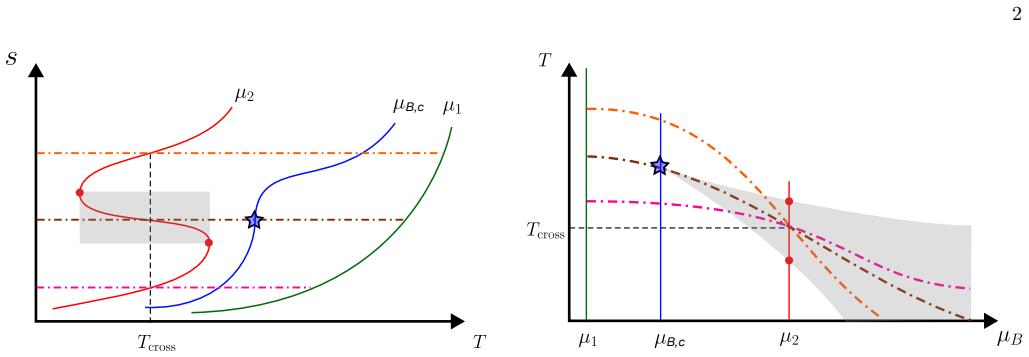
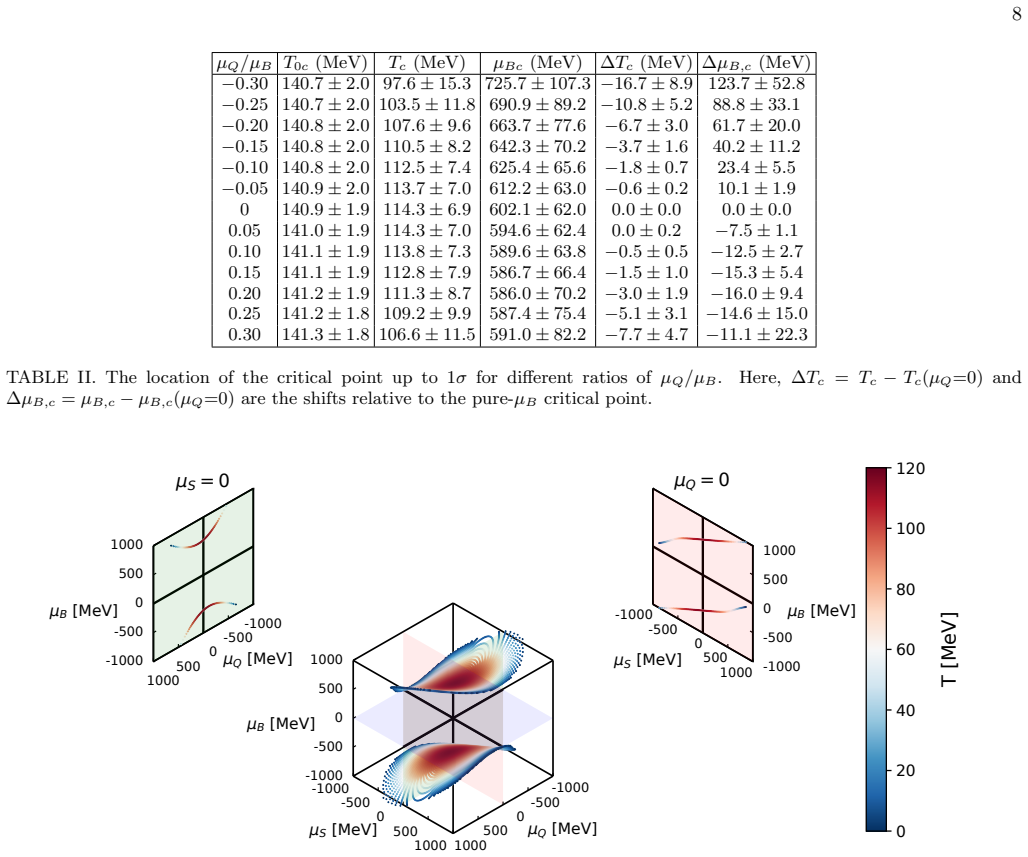
We provide the first mapping of the critical surface in (2+1)-flavor QCD in the full (T,μ_B,μ_Q,μ_S) space, anchored on lattice QCD results at vanishing chemical potentials and obtained within an expansion along contours of constant entropy density. In the pure μ_B direction this yields a critical point at (T_c, μ_{B,c}) ≃ (114, 602) MeV. Extending to arbitrary directions shows that μ_{B,c} increases by 40-100 MeV along the strangeness-neutral direction while T_c stays essentially unchanged, and the location is unchanged in the charge-neutral weak-equilibrium direction. No critical point is found at large isospin densities or along pure electric-charge or strangeness directions.
What carries the argument
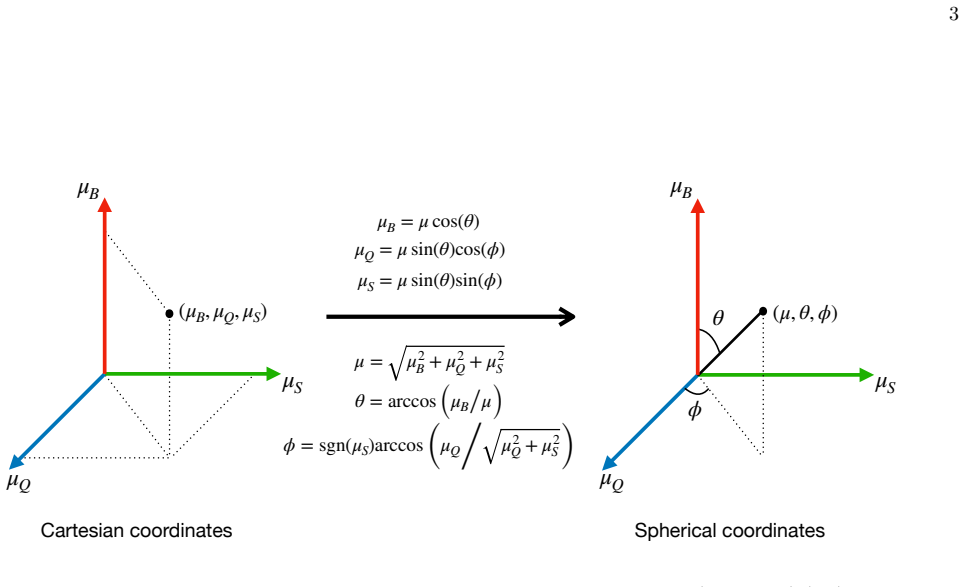
Expansion along contours of constant entropy density truncated at second order in the chemical potentials, using spherical coordinates to parametrize the three-dimensional chemical-potential space.
If this is right
- The critical baryon chemical potential is 40-100 MeV higher in the direction relevant for heavy-ion collisions.
- The first-order phase transition remains present at the same (T, μ_B) for conditions in neutron star mergers.
- Critical points do not appear along trajectories with large isospin chemical potential relevant to the early universe.
- The critical temperature shows little dependence on the direction in chemical-potential space.
Where Pith is reading between the lines
- Heavy-ion collision experiments may need to reach higher beam energies to access the critical region than previously estimated from the pure baryon direction.
- Simulations of neutron star mergers can approximate the location of any first-order transition using the pure μ_B critical point.
- Cosmic trajectories in the early universe likely avoid the QCD critical surface entirely.
- Future lattice calculations at moderate chemical potentials could test the accuracy of the second-order truncation.
Load-bearing premise
That a second-order truncation of the constant-entropy expansion suffices to locate the critical surface without large higher-order corrections in any direction.
What would settle it
A lattice QCD calculation at moderate non-zero strangeness chemical potential that places the critical baryon chemical potential more than 50 MeV away from the 640-700 MeV interval predicted for the strangeness-neutral direction.
Figures
read the original abstract
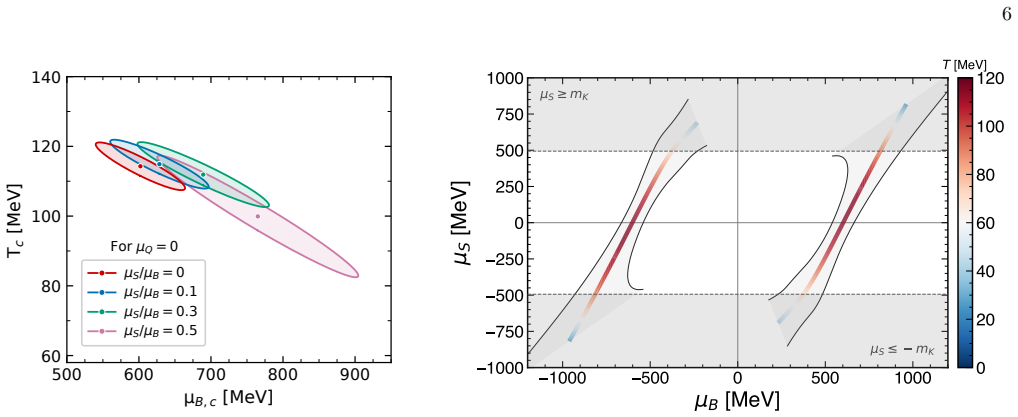
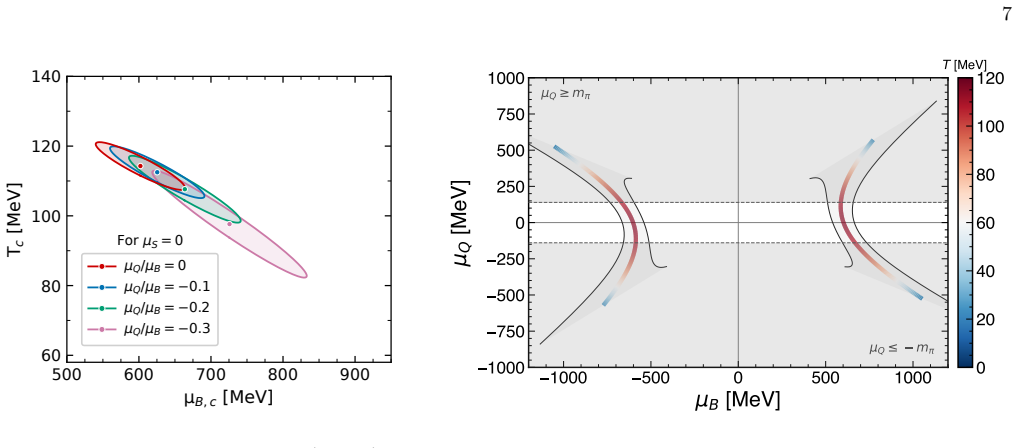
We provide the first mapping of the critical surface in (2+1)-flavor QCD in the full $(T,\mu_B,\mu_Q,\mu_S)$ space, anchored on lattice QCD results at vanishing chemical potentials and obtained within an expansion along contours of constant entropy density. In the pure $\mu_B$ direction, this framework yields a critical point at $(T_c,\mu_{B,c}) \simeq (114,\, 602)$ MeV. Here we extend the construction to arbitrary directions in the three-dimensional chemical-potential space, parametrized by spherical coordinates $(\mu,\theta,\varphi)$, with the radial expansion truncated at $\mathcal{O}(\mu^2)$. The resulting two-dimensional surface carries a direction-dependent critical temperature $T_c(\theta,\varphi)$ and baryochemical potential $\mu_{B,c}(\theta,\varphi)$, which quantify the shift of the critical point relative to the pure $\mu_B$ direction. We find that $\mu_{B,c}$ increases by 40-100 MeV along the approximately strangeness neutral direction [$\mu_S \approx (0.15$--$0.33)\, \mu_B$, $\mu_Q \approx 0$] relevant for heavy-ion collisions, while the critical temperature stays essentially unchanged. In the charge-neutral, weak-equilibrium direction~[$\mu_Q \approx -(0.05$--$0.1) \,\mu_B$, $\mu_S = 0$] relevant for neutron star mergers, the critical point, and the associated first-order phase transition, remain present at essentially the same location in the $(T,\mu_B)$ plane. We find no evidence for a critical point at large isospin densities, $|\mu_Q| / \mu_B \gtrsim 1$, relevant for cosmic trajectories in the early Universe, nor along the pure electric-charge or strangeness directions, at least outside the regions where pion or kaon condensation may occur.
Editorial analysis
A structured set of objections, weighed in public.
Referee Report
Summary. The manuscript claims to map the QCD critical surface in (2+1)-flavor QCD over the full (T, μ_B, μ_Q, μ_S) space. Thermodynamic quantities are expanded along constant-entropy-density contours starting from lattice QCD results at vanishing chemical potentials, with the radial expansion in spherical coordinates (μ, θ, ϕ) truncated at O(μ²). This yields a direction-dependent critical surface; in the pure-μ_B direction the critical point is reported at (T_c, μ_{B,c}) ≃ (114, 602) MeV, with shifts of 40–100 MeV in μ_{B,c} along the strangeness-neutral direction and essentially unchanged location in the charge-neutral weak-equilibrium direction.
Significance. If the truncation and contour construction remain valid, the work supplies a concrete, lattice-anchored procedure for extending zero-density results into the three-dimensional chemical-potential space without direct finite-density simulations. The approach is noteworthy for its use of independent lattice input at μ=0 and for exploring multiple physically relevant trajectories (heavy-ion, neutron-star, early-Universe).
major comments (3)
- [Abstract / radial-expansion description] Abstract and the description of the radial expansion: the O(μ²) truncation is applied to locate the critical point at μ_B,c/T ≃ 5.3. At this value the dimensionless expansion parameter is O(5), so omitted O(μ⁴) and higher terms are expected to be comparable to or larger than the retained terms; no explicit truncation-error estimate, convergence test against higher orders, or demonstration that the constant-s contour remains well-defined through the critical region is supplied. This directly affects the reliability of all reported critical coordinates.
- [Results section on critical-surface construction] Results for the critical surface (pure-μ_B and direction-dependent cases): the locus is defined by the vanishing curvature of an effective potential or divergence of a susceptibility obtained from the truncated expansion. Because the critical point itself introduces non-analyticities, a local polynomial expansion cannot consistently capture the singularity; the manuscript provides no test of whether the reported coordinates remain stable when the truncation order is increased or when the expansion is performed in a different thermodynamic variable.
- [Method / lattice-anchoring subsection] Treatment of lattice input uncertainties: the central numbers are obtained from an O(μ²) expansion anchored at zero density; the propagation of lattice statistical and systematic errors through the constant-entropy contour construction and into the final (T_c, μ_{B,c}) values is not quantified, which is required to assess whether the quoted critical-point coordinates are predictions or effective fits.
minor comments (2)
- [Method] Notation for the spherical coordinates (μ, θ, ϕ) and the mapping to (μ_B, μ_Q, μ_S) should be stated explicitly once in the text to avoid ambiguity when comparing different directions.
- [Abstract] The abstract states that no critical point is found “at least outside the regions where pion or kaon condensation may occur”; a brief clarification of how those condensation boundaries are identified within the present framework would improve readability.
Simulated Author's Rebuttal
We thank the referee for the careful reading and constructive criticism. We respond to each major comment below. We agree that the truncation limitations and lack of error propagation require additional discussion in a revised manuscript.
read point-by-point responses
-
Referee: [Abstract / radial-expansion description] Abstract and the description of the radial expansion: the O(μ²) truncation is applied to locate the critical point at μ_B,c/T ≃ 5.3. At this value the dimensionless expansion parameter is O(5), so omitted O(μ⁴) and higher terms are expected to be comparable to or larger than the retained terms; no explicit truncation-error estimate, convergence test against higher orders, or demonstration that the constant-s contour remains well-defined through the critical region is supplied. This directly affects the reliability of all reported critical coordinates.
Authors: We agree the expansion parameter reaches O(5) at the reported location, rendering higher-order contributions potentially significant. The O(μ²) truncation is the highest order for which the required lattice susceptibilities exist; constant-entropy contours were selected to remain as close as possible to the μ=0 anchor. We will add an explicit discussion of expected truncation size inferred from the series at smaller μ and a statement that the constant-s contour is assumed to remain defined up to the reported critical point within the approximation. revision: partial
-
Referee: [Results section on critical-surface construction] Results for the critical surface (pure-μ_B and direction-dependent cases): the locus is defined by the vanishing curvature of an effective potential or divergence of a susceptibility obtained from the truncated expansion. Because the critical point itself introduces non-analyticities, a local polynomial expansion cannot consistently capture the singularity; the manuscript provides no test of whether the reported coordinates remain stable when the truncation order is increased or when the expansion is performed in a different thermodynamic variable.
Authors: The reported critical coordinates are defined inside the truncated analytic expansion; the vanishing curvature signals the breakdown of that expansion rather than the exact non-analytic critical point. We will revise the text to state clearly that the coordinates are estimates within the O(μ²) framework and that stability under higher orders cannot be tested without additional lattice data for the μ⁴ coefficients. revision: yes
-
Referee: [Method / lattice-anchoring subsection] Treatment of lattice input uncertainties: the central numbers are obtained from an O(μ²) expansion anchored at zero density; the propagation of lattice statistical and systematic errors through the constant-entropy contour construction and into the final (T_c, μ_{B,c}) values is not quantified, which is required to assess whether the quoted critical-point coordinates are predictions or effective fits.
Authors: We will add a dedicated subsection quantifying propagation of the input lattice uncertainties (both statistical and systematic) through the entropy-contour construction to the final critical coordinates, using standard error-propagation formulas on the Taylor coefficients. revision: yes
- Explicit convergence tests against O(μ⁴) or higher, or against a different expansion variable, cannot be performed because the required higher-order lattice susceptibilities at μ=0 are not available.
Circularity Check
No significant circularity; anchored on external lattice data with independent contour expansion
full rationale
The derivation begins from independent lattice QCD results at vanishing chemical potentials and extends via an expansion along constant-entropy contours truncated at O(μ²). This constitutes a methodological extrapolation rather than any self-definitional, fitted-input, or self-citation reduction. No load-bearing self-citations, uniqueness theorems from the same authors, or ansatz smuggling are quoted or required in the abstract or described construction. The reported critical point at (114, 602) MeV is an output of the expansion, not an input or renamed fit. The O(μ²) truncation may raise correctness concerns at large μ/T, but does not create circularity by the enumerated patterns.
Axiom & Free-Parameter Ledger
Reference graph
Works this paper leans on
-
[1]
We note that calculating a conserved-charge density requires the equation of state at finite (µ B, µQ, µS), since it is given by the pressure derivative, i.e.n S =∂P/∂µ S
Strangeness neutrality and heavy-ion collisions A non-zeroµ S allows one to incorporate the condi- tion of strangeness neutrality,n S = 0, on the net- strangeness density, which is a physically relevant con- dition for heavy-ion collisions. We note that calculating a conserved-charge density requires the equation of state at finite (µ B, µQ, µS), since it...
-
[2]
Pure strangeness direction We also consider separately the pureµ S direction, holdingµ B = 0 andµ S = 0. In this case, the possible existence of the CP in our scheme is determined entirely by the entropy densitys(T 0) and the strangeness suscep- tibilityχ S 2 (T0) at vanishing chemical potentials. We find that the solution to Eqs. (16) exists but located ...
-
[3]
The relevant conditions typically reflect charge neutral- ity and (approximate) beta equilibrium
Charge neutrality and weak equilibrium Non-zero charge chemical potential is relevant for as- trophysical applications, such as neutron star mergers. The relevant conditions typically reflect charge neutral- ity and (approximate) beta equilibrium. We assume that strangeness is in equilibrium and setµ S = 0. The charge chemical potential should be determin...
-
[4]
Large isospin asymmetry and early Universe We also explore large|µ Q|/µB values corresponding to large isospin asymmetry and moderate baryon densi- ties. Such a scenario is possible in the early Universe for large lepton flavor asymmetries [37–39] which induce non-zeroµ B and|µ Q|> µ B, and the relevant question is whether cosmic trajectories can cross a ...
2025
-
[5]
Y. Aoki, Z. Fodor, S. D. Katz, and K. K. Szabo, The QCD transition temperature: Results with physi- cal masses in the continuum limit, Phys. Lett. B643, 46 (2006), arXiv:hep-lat/0609068
Pith/arXiv arXiv 2006
-
[6]
S. Borsanyi, Z. Fodor, J. N. Guenther, R. Kara, S. D. Katz, P. Parotto, A. Pasztor, C. Ratti, and K. K. Szabo, QCD Crossover at Finite Chemical Potential from Lat- tice Simulations, Phys. Rev. Lett.125, 052001 (2020), arXiv:2002.02821 [hep-lat]
arXiv 2020
-
[7]
Bazavovet al.(HotQCD), Chiral crossover in QCD at zero and non-zero chemical potentials, Phys
A. Bazavovet al.(HotQCD), Chiral crossover in QCD at zero and non-zero chemical potentials, Phys. Lett. B 795, 15 (2019), arXiv:1812.08235 [hep-lat]
arXiv 2019
-
[8]
W.-j. Fu, J. M. Pawlowski, and F. Rennecke, QCD phase structure at finite temperature and density, Phys. Rev. D101, 054032 (2020), arXiv:1909.02991 [hep-ph]
arXiv 2020
- [9]
-
[10]
P. J. Gunkel and C. S. Fischer, Locating the critical end- point of QCD: Mesonic backcoupling effects, Phys. Rev. D104, 054022 (2021), arXiv:2106.08356 [hep-ph]
arXiv 2021
-
[11]
R. Critelli, J. Noronha, J. Noronha-Hostler, I. Por- tillo, C. Ratti, and R. Rougemont, Critical point in the phase diagram of primordial quark-gluon matter from black hole physics, Phys. Rev. D96, 096026 (2017), arXiv:1706.00455 [nucl-th]
Pith/arXiv arXiv 2017
-
[12]
M. Hippert, J. Grefa, T. A. Manning, J. Noronha, J. Noronha-Hostler, I. Portillo Vazquez, C. Ratti, R. Rougemont, and M. Trujillo, Bayesian location of the QCD critical point from a holographic perspective, Phys. Rev. D110, 094006 (2024), arXiv:2309.00579 [nucl-th]
arXiv 2024
-
[13]
Basar, QCD critical point, Lee-Yang edge singulari- ties, and Pad´ e resummations, Phys
G. Basar, QCD critical point, Lee-Yang edge singulari- ties, and Pad´ e resummations, Phys. Rev. C110, 015203 (2024), arXiv:2312.06952 [hep-th]
arXiv 2024
-
[14]
D. A. Clarke, P. Dimopoulos, F. Di Renzo, J. Goswami, C. Schmidt, S. Singh, and K. Zambello, Searching for the QCD critical end point using multipoint Pad´ e approximations, Phys. Rev. D112, L091504 (2025), arXiv:2405.10196 [hep-lat]
arXiv 2025
-
[15]
H. Shah, M. Hippert, J. Noronha, C. Ratti, and V. Vovchenko, Locating the qcd critical point through contours of constant entropy density, Phys. Rev. C113, L012201 (2026), arXiv:2410.16206 [hep-ph]
arXiv 2026
-
[16]
A. Andronic, P. Braun-Munzinger, K. Redlich, and J. Stachel, Decoding the phase structure of QCD via par- ticle production at high energy, Nature561, 321 (2018), 10 arXiv:1710.09425 [nucl-th]
Pith/arXiv arXiv 2018
-
[17]
A. Lysenko, M. I. Gorenstein, R. Poberezhniuk, and V. Vovchenko, Chemical freeze-out curve in heavy-ion collisions and the QCD critical point, Phys. Rev. C111, 054903 (2025), arXiv:2408.06473 [nucl-th]
arXiv 2025
- [18]
-
[19]
L. Du, A. Sorensen, and M. Stephanov, The QCD phase diagram and Beam Energy Scan physics: A theory overview, Int. J. Mod. Phys. E33, 2430008 (2024), arXiv:2402.10183 [nucl-th]
arXiv 2024
-
[20]
T. Ablyazimovet al.(CBM), Challenges in QCD mat- ter physics –The scientific programme of the Compressed Baryonic Matter experiment at FAIR, Eur. Phys. J. A 53, 60 (2017), arXiv:1607.01487 [nucl-ex]
Pith/arXiv arXiv 2017
-
[21]
M. A. Stephanov, K. Rajagopal, and E. V. Shuryak, Event-by-event fluctuations in heavy ion collisions and the QCD critical point, Phys. Rev. D60, 114028 (1999), arXiv:hep-ph/9903292
Pith/arXiv arXiv 1999
-
[22]
M. A. Stephanov, Non-Gaussian fluctuations near the QCD critical point, Phys. Rev. Lett.102, 032301 (2009), arXiv:0809.3450 [hep-ph]
Pith/arXiv arXiv 2009
-
[23]
Adamet al.(STAR), Nonmonotonic Energy Depen- dence of Net-Proton Number Fluctuations, Phys
J. Adamet al.(STAR), Nonmonotonic Energy Depen- dence of Net-Proton Number Fluctuations, Phys. Rev. Lett.126, 092301 (2021), arXiv:2001.02852 [nucl-ex]
arXiv 2021
-
[24]
M. Abdallahet al.(STAR), Cumulants and correlation functions of net-proton, proton, and antiproton multi- plicity distributions in Au+Au collisions at energies avail- able at the BNL Relativistic Heavy Ion Collider, Phys. Rev. C104, 024902 (2021), arXiv:2101.12413 [nucl-ex]
arXiv 2021
-
[25]
B. E. Aboonaet al.(STAR), Precision Measurement of Net-Proton-Number Fluctuations in Au+Au Colli- sions at RHIC, Phys. Rev. Lett.135, 142301 (2025), arXiv:2504.00817 [nucl-ex]
arXiv 2025
-
[26]
V. Vovchenko, V. Koch, and C. Shen, Proton number cumulants and correlation functions in Au-Au collisions at sNN=7.7–200 GeV from hydrodynamics, Phys. Rev. C105, 014904 (2022), arXiv:2107.00163 [hep-ph]
arXiv 2022
-
[27]
V. Koch and V. Vovchenko, Exploring the QCD phase diagram through correlations and fluctuations (2025), arXiv:2512.04288 [nucl-th]
Pith/arXiv arXiv 2025
-
[28]
Non-Monotonicity of Transverse Momentum Corre- lations in Au + Au Collisions at RHIC (2026), arXiv:2604.06434 [nucl-ex]
Pith/arXiv arXiv 2026
-
[29]
S. Borsanyi, Z. Fodor, J. N. Guenther, P. Parotto, A. Pasztor, C. Ratti, V. Vovchenko, and C. H. Wong, Lattice QCD constraints on the critical point from an improved precision equation of state, Phys. Rev. D112, L111505 (2025), arXiv:2502.10267 [hep-lat]
arXiv 2025
-
[30]
H. Shah, M. Hippert, J. Noronha, C. Ratti, and V. Vovchenko, Lattice-based equation of state with a critical point from constant entropy contours and its comparison to effective QCD approaches (2026), arXiv:2601.08823 [hep-ph]
arXiv 2026
-
[31]
M. Marczenko, M. Szyma´ nski, and G. Kov´ acs, Chal- lenges in locating the QCD critical point via constant en- tropy density contours, Phys. Rev. D112, 034019 (2025), arXiv:2504.04446 [hep-ph]
arXiv 2025
-
[32]
Y. Lu, F. Gao, Y.-x. Liu, and J. M. Pawlowski, Fi- nite density signatures of confining and chiral dynam- ics in QCD thermodynamics and fluctuations of con- served charges, Phys. Rev. D113, 054019 (2026), arXiv:2504.05099 [hep-ph]
arXiv 2026
-
[33]
A. Abuali, S. Bors´ anyi, Z. Fodor, J. Jahan, M. Ka- hangirwe, P. Parotto, A. P´ asztor, C. Ratti, H. Shah, and S. A. Trabulsi, New 4D lattice QCD equation of state: Extended density coverage from a generalized T’ expan- sion, Phys. Rev. D112, 054502 (2025), arXiv:2504.01881 [hep-lat]
arXiv 2025
-
[34]
J. Noronha-Hostler, P. Parotto, C. Ratti, and J. M. Stafford, Lattice-based equation of state at finite baryon number, electric charge and strangeness chemical poten- tials, Phys. Rev. C100, 064910 (2019), arXiv:1902.06723 [hep-ph]
arXiv 2019
- [35]
-
[36]
C. S. Fischer and J. M. Pawlowski, Phase structure and observables at high densities from first principles QCD (2026), arXiv:2603.11135 [hep-ph]
arXiv 2026
-
[37]
W.-j. Fu, C. Huang, J. M. Pawlowski, F. Rennecke, R. Wen, and S. Yin, Strangeness neutrality and the QCD phase diagram (2026), arXiv:2603.13455 [hep-ph]
arXiv 2026
-
[38]
B. B. Brandt, G. Endrodi, and S. Schmalzbauer, QCD phase diagram for nonzero isospin-asymmetry, Phys. Rev. D97, 054514 (2018), arXiv:1712.08190 [hep-lat]
Pith/arXiv arXiv 2018
-
[39]
S. Borsanyi, J. N. Guenther, R. Kara, Z. Fodor, P. Parotto, A. Pasztor, C. Ratti, and K. K. Szabo, Re- summed lattice QCD equation of state at finite baryon density: Strangeness neutrality and beyond, Phys. Rev. D105, 114504 (2022), arXiv:2202.05574 [hep-lat]
arXiv 2022
-
[40]
V. Vovchenko and H. Stoecker, Thermal-FIST: A pack- age for heavy-ion collisions and hadronic equation of state, Comput. Phys. Commun.244, 295 (2019), arXiv:1901.05249 [nucl-th]
arXiv 2019
-
[41]
M. M. Wygas, I. M. Oldengott, D. B¨ odeker, and D. J. Schwarz, Cosmic QCD Epoch at Nonvanishing Lep- ton Asymmetry, Phys. Rev. Lett.121, 201302 (2018), arXiv:1807.10815 [hep-ph]
Pith/arXiv arXiv 2018
-
[42]
V. Vovchenko, B. B. Brandt, F. Cuteri, G. Endr˝ odi, F. Hajkarim, and J. Schaffner-Bielich, Pion Condensa- tion in the Early Universe at Nonvanishing Lepton Fla- vor Asymmetry and Its Gravitational Wave Signatures, Phys. Rev. Lett.126, 012701 (2021), arXiv:2009.02309 [hep-ph]
arXiv 2021
-
[43]
L. Formaggio, F. Di Clemente, G. Yadav, A. Drago, and C. Ratti, Cosmic trajectories calculation with a state of the art lattice QCD equation of state, Phys. Rev. D113, 023522 (2026), arXiv:2508.00094 [astro-ph.CO]
arXiv 2026
- [44]
-
[45]
F. Di Clemente, A. Drago, L. Formaggio, C. Ratti, V. Vovchenko, and G. Yadav, Upper Bound on the Cosmic Baryon Chemical Potential from Lepton-Flavor Asymmetry (2025), arXiv:2511.11995 [hep-ph]. 11 APPENDIX Appendix A: Parametrizations of susceptibilities for entropy contour expansion The critical point analysis of Sec. III requires analytic parametrizatio...
arXiv 2025
discussion (0)
Sign in with ORCID, Apple, or X to comment. Anyone can read and Pith papers without signing in.