Large Language Models Do Not Always Need Readable Language
Pith reviewed 2026-06-26 17:43 UTC · model grok-4.3
The pith
BabelTele encodes instructions in compact non-natural text that LLMs recover with 99.5% semantic fidelity at 27.9% original length.
A machine-rendered reading of the paper's core claim, the machinery that carries it, and where it could break.
Core claim
BabelTele can substantially depart from ordinary natural language while preserving core semantics for instruction-tuned LLMs. As a task-agnostic representational paradigm, BabelTele demonstrates high information density, maintaining 99.5% semantic fidelity even when the text volume is condensed to 27.9% of its original length. It further shows semantic robustness in cross-model transfer, agent memory, and multi-agent communication, with effectiveness depending on the compressor-reader pair and task setting.
What carries the argument
BabelTele, a class of model-centric textual representations approached as an empirical probe that sacrifices human readability for compactness while remaining recoverable by LLMs.
If this is right
- Context overhead can be reduced while generally maintaining reliable downstream performance.
- Semantic robustness holds in cross-model transfer, agent memory, and multi-agent communication scenarios.
- Human readability and model semantic recoverability can be partially decoupled in LLM systems.
- BabelTele functions as a task-agnostic paradigm that supports high information density.
Where Pith is reading between the lines
- Further specialization of the compressor for a fixed reader model could push condensation ratios higher than the reported 27.9%.
- The same decoupling might apply to structured outputs such as JSON or code, reducing token counts in agent loops.
- If adopted, model-native channels could create communication that is opaque to human oversight by design.
Load-bearing premise
The downstream task evaluations, cross-model transfer tests, and human questionnaires accurately isolate semantic preservation rather than allowing models to exploit superficial statistical patterns or task-specific shortcuts from the compression method.
What would settle it
A new compressor-reader pair or downstream task where measured semantic fidelity falls substantially below 99% even after accounting for the paper's stated dependency on that specific pair.
Figures




read the original abstract
Large language models (LLMs) are commonly prompted and interfaced with human-readable natural language, even when the intended reader is another model. This paper investigates whether semantic information can be encoded in compact, non-standard textual forms that sacrifice human readability while remaining recoverable by LLMs. We refer to this class of model-centric textual representations as BabelTele, approached here not as a fixed protocol but as an empirical probe into LLMs' capacity to generate and interpret such representations. Through readability diagnostics, model likelihood measures, human questionnaires, and downstream task evaluations, we find that BabelTele can substantially depart from ordinary natural language while preserving core semantics for instruction-tuned LLMs. As a task-agnostic representational paradigm, BabelTele demonstrates high information density, maintaining 99.5% semantic fidelity even when the text volume is condensed to 27.9% of its original length. We further evaluate its semantic robustness in cross-model transfer, agent memory, and multi-agent communication. Results suggest that BabelTele can reduce context overhead while generally maintaining reliable downstream performance, although its effectiveness depends on the compressor-reader pair and task setting. These findings indicate that human readability, natural-language typicality, and model-side semantic recoverability can be partially decoupled, opening a path toward model-native representations in future exploration of LLM systems.
Editorial analysis
A structured set of objections, weighed in public.
Referee Report
Summary. The manuscript proposes BabelTele as an empirical class of compact, non-standard textual representations that depart from natural language while remaining interpretable by instruction-tuned LLMs. It reports that these representations achieve 99.5% semantic fidelity at 27.9% of original text volume, supported by readability diagnostics, model likelihood measures, human questionnaires, downstream task evaluations, and tests of cross-model transfer, agent memory, and multi-agent communication. The central claim is that human readability, natural-language typicality, and model-side semantic recoverability can be partially decoupled.
Significance. If the empirical results hold under rigorous controls, the work provides evidence that LLMs can operate on model-native representations that sacrifice human readability for information density. This could reduce context overhead in multi-agent and memory settings. The paper ships concrete quantitative outcomes (fidelity and length ratios) and evaluates transfer across models and tasks, which strengthens the probe into non-natural-language encodings.
major comments (3)
- [Abstract, §4] Abstract and evaluation sections: the 99.5% semantic fidelity figure is presented without an explicit definition of the metric (e.g., whether it is task accuracy, embedding similarity, or human judgment), without listed baselines, and without stating whether the downstream tasks or models used for measurement overlap with those shaping the representations. This directly bears on the central claim because the skeptic concern—that fidelity may reflect task-specific shortcuts rather than recoverable core semantics—cannot be assessed without these details.
- [§3] Methods and generation procedure: no description is given of how BabelTele strings are produced or selected; if the compression procedure was tuned or post-hoc filtered using the same evaluation distribution, the reported fidelity and length reduction would be circular by construction and would not demonstrate decoupling from natural language.
- [§5] Cross-model transfer and multi-agent results: the paper must clarify whether the compressor-reader pairs and tasks in the transfer experiments are fully disjoint from those used to validate the 99.5% fidelity number; otherwise the robustness claim rests on potentially correlated evaluations.
minor comments (3)
- [Introduction] Notation for 'BabelTele' is introduced as both a class and an empirical probe; a single consistent definition would improve clarity.
- [§4.3] Human questionnaire results would benefit from reporting inter-annotator agreement and exact question wording.
- [Abstract] The abstract states '99.5% semantic fidelity' and '27.9% length' without citing the precise table or figure that contains these numbers.
Simulated Author's Rebuttal
We thank the referee for the constructive feedback. We address each major comment below with clarifications and commit to revisions that strengthen the manuscript's transparency without altering its core claims.
read point-by-point responses
-
Referee: [Abstract, §4] Abstract and evaluation sections: the 99.5% semantic fidelity figure is presented without an explicit definition of the metric (e.g., whether it is task accuracy, embedding similarity, or human judgment), without listed baselines, and without stating whether the downstream tasks or models used for measurement overlap with those shaping the representations. This directly bears on the central claim because the skeptic concern—that fidelity may reflect task-specific shortcuts rather than recoverable core semantics—cannot be assessed without these details.
Authors: The 99.5% figure is the ratio of downstream task accuracy (question answering, classification, and summarization) achieved with BabelTele versus original text, averaged across the evaluated models. Baselines include natural-language prompts and length-matched random token sequences. Representations were generated via a task-agnostic compression prompt on a separate model instance; no evaluation-task data influenced generation. We will revise the abstract and §4 to state the metric definition explicitly, list all baselines, and add a sentence confirming the generation process was independent of the reported evaluation sets. revision: yes
-
Referee: [§3] Methods and generation procedure: no description is given of how BabelTele strings are produced or selected; if the compression procedure was tuned or post-hoc filtered using the same evaluation distribution, the reported fidelity and length reduction would be circular by construction and would not demonstrate decoupling from natural language.
Authors: BabelTele strings are generated by feeding source text to an instruction-tuned LLM with a fixed, task-independent prompt that requests maximal semantic compression while minimizing human readability. No post-selection or filtering on downstream metrics occurred; length and readability scores alone determined inclusion. We will expand §3 with the exact prompt template, the generator model, and an explicit statement that no evaluation-distribution data was used in prompting or filtering, thereby removing any circularity concern. revision: yes
-
Referee: [§5] Cross-model transfer and multi-agent results: the paper must clarify whether the compressor-reader pairs and tasks in the transfer experiments are fully disjoint from those used to validate the 99.5% fidelity number; otherwise the robustness claim rests on potentially correlated evaluations.
Authors: The transfer experiments employ distinct compressor-reader model pairs (different base models and sizes) and a held-out task subset not used in the primary fidelity measurements. We will add a dedicated paragraph and table in §5 that enumerates every compressor-reader pair and task partition, explicitly confirming the disjointness from the 99.5% validation set. revision: yes
Circularity Check
No circularity: empirical measurements only
full rationale
The paper reports an empirical probe into BabelTele representations via readability diagnostics, model likelihood measures, human questionnaires, and downstream task evaluations. No equations, derivations, fitted parameters renamed as predictions, or self-citation load-bearing steps appear in the abstract or described content. Central numbers (99.5% fidelity at 27.9% length) are presented as direct experimental outcomes rather than reductions to self-defined inputs. The work is self-contained against external benchmarks with no load-bearing self-referential chains.
Axiom & Free-Parameter Ledger
axioms (1)
- domain assumption Instruction-tuned LLMs can recover core semantics from text that deviates substantially from natural language distributions.
invented entities (1)
-
BabelTele
no independent evidence
Reference graph
Works this paper leans on
-
[1]
OpenReview.net. GLM-5-Team, :, Aohan Zeng, Xin Lv, Zhenyu Hou, Zhengxiao Du, Qinkai Zheng, Bin Chen, Da Yin, Chendi Ge, Chenghua Huang, Chengxing Xie, Chenzheng Zhu, Congfeng Yin, Cunxiang Wang, Gengzheng Pan, Hao Zeng, Haoke Zhang, Hao- ran Wang, and 168 others. 2026. Glm-5: from vibe coding to agentic engineering.Preprint, arXiv:2602.15763. Google DeepM...
work page internal anchor Pith review Pith/arXiv arXiv 2026
-
[2]
Kimi K2.5: Visual Agentic Intelligence
LongLLMLingua: Accelerating and enhanc- ing LLMs in long context scenarios via prompt com- pression. InProceedings of the 62nd Annual Meeting of the Association for Computational Linguistics (Vol- ume 1: Long Papers), pages 1658–1677, Bangkok, Thailand. Association for Computational Linguistics. Jinhao Jiang, Kun Zhou, Zican Dong, Keming Ye, Xin Zhao, and...
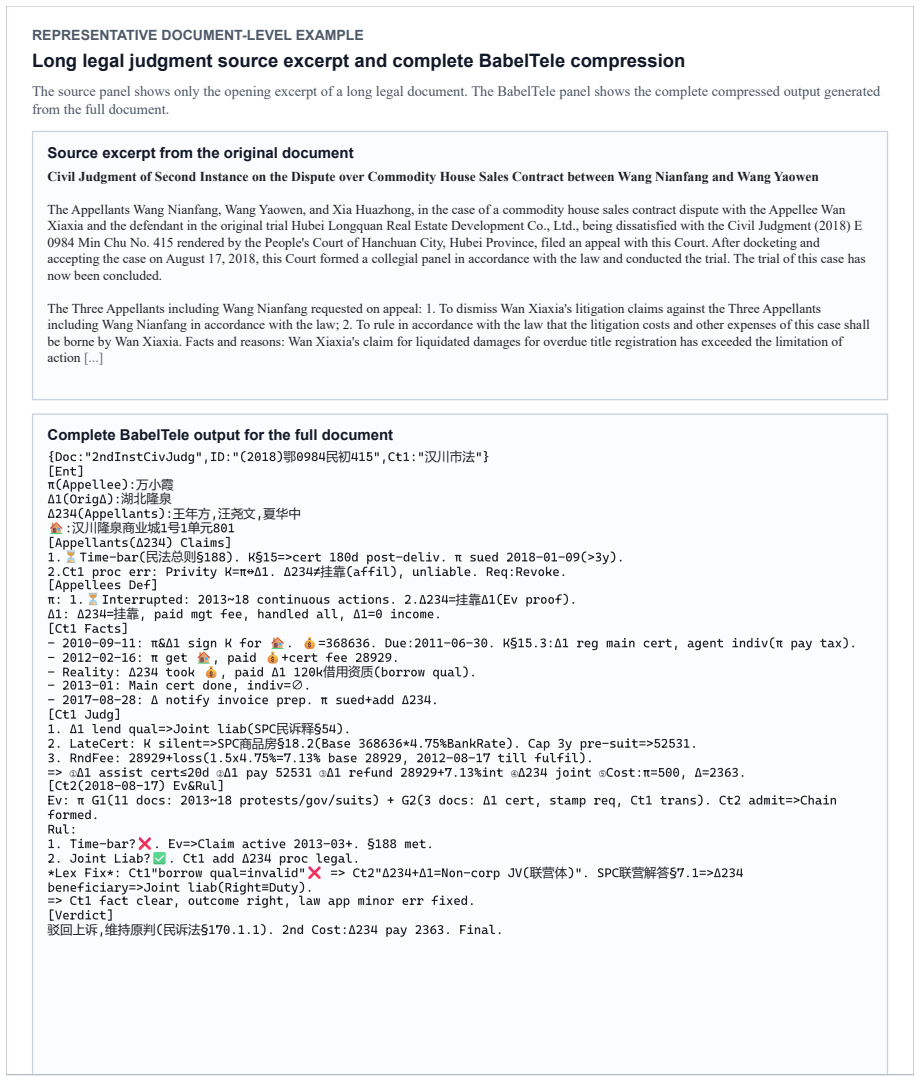
work page internal anchor Pith review Pith/arXiv arXiv 2023
-
[3]
Compressing context to enhance inference ef- ficiency of large language models. InProceedings of the 2023 Conference on Empirical Methods in Natu- ral Language Processing, pages 6342–6353, Singa- pore. Association for Computational Linguistics. 10 Zeju Li, Yizhou Zhou, and Qiang Xu. 2026. Latent con- text compilation: Distilling long context into compact ...
-
[4]
Evaluating very long-term conversational memory of LLM agents. InProceedings of the 62nd Annual Meeting of the Association for Com- putational Linguistics (Volume 1: Long Papers), ACL 2024, Bangkok, Thailand, August 11-16, 2024, pages 13851–13870. Association for Computational Lin- guistics. Samuele Marro, Emanuele La Malfa, Jesse Wright, Guo- hao Li, Nig...
-
[5]
Training language models to follow instruc- tions with human feedback. InAdvances in Neural Information Processing Systems 35: Annual Confer- ence on Neural Information Processing Systems 2022, NeurIPS 2022, New Orleans, LA, USA, November 28 - December 9, 2022. Charles Packer, Vivian Fang, Shishir G. Patil, Kevin Lin, Sarah Wooders, and Joseph E. Gonzalez...
work page internal anchor Pith review Pith/arXiv arXiv 2022
-
[6]
Association for Computational Linguistics. C. E. Shannon. 1948. A mathematical theory of com- munication.The Bell System Technical Journal, 27(3):379–423. Hugo Touvron, Louis Martin, Kevin Stone, Peter Al- bert, Amjad Almahairi, Yasmine Babaei, Nikolay Bashlykov, Soumya Batra, Prajjwal Bhargava, Shruti 11 Bhosale, Dan Bikel, Lukas Blecher, Cristian Canton...
work page internal anchor Pith review Pith/arXiv arXiv 1948
-
[7]
A-MEM: Agentic Memory for LLM Agents
OpenReview.net. Wujiang Xu, Zujie Liang, Kai Mei, Hang Gao, Juntao Tan, and Yongfeng Zhang. 2025. A-MEM: agentic memory for LLM agents.CoRR, abs/2502.12110. An Yang, Anfeng Li, Baosong Yang, Beichen Zhang, Binyuan Hui, Bo Zheng, Bowen Yu, Chang Gao, Chengen Huang, Chenxu Lv, Chujie Zheng, Dayi- heng Liu, Fan Zhou, Fei Huang, Feng Hu, Hao Ge, Haoran Wei, H...
work page internal anchor Pith review Pith/arXiv arXiv 2025
-
[8]
MemAgent: Reshaping Long-Context LLM with Multi-Conv RL-based Memory Agent
Exchange-of-thought: Enhancing large lan- guage model capabilities through cross-model com- munication. InProceedings of the 2023 Conference on Empirical Methods in Natural Language Process- ing, pages 15135–15153, Singapore. Association for Computational Linguistics. Ori Yoran, Tomer Wolfson, Ori Ram, and Jonathan Be- rant. 2024. Making retrieval-augment...
work page internal anchor Pith review Pith/arXiv arXiv 2023
-
[9]
Symbolic prompting is another nearby direction
and Agora (Marro et al., 2024) explore reasoning-trace exchange and scalable communi- cation among LLM agents. Symbolic prompting is another nearby direction. MetaGlyph (van Gassen,
2024
-
[10]
LLM-native high-density communication language
compresses instructions with symbolic met- alanguages, while structured prompting uses non- natural-language formats such as code, JSON, and tables (Gao et al., 2023; Jiang et al., 2023b; Schn- abel and Neville, 2024). BabelTele differs in that it does not rely on a manually designed symbolic lan- guage or a fixed schema. Instead, it studies whether LLMs ...
2023
-
[11]
,→ ,→ ,→
Omnilingual: Move freely across all human languages (Chinese, English, German compounds, Japanese kanji, Latin roots, etc.) and choose the word with the highest single-token information density for the given context. ,→ ,→ ,→
-
[12]
,→ ,→ ,→
Symbolic Collapse: Heavily use mathematical symbols (forall, exists, in, =>), emoji, and isolated punctuation to replace prepositions, conjunctions, and explanatory long sentences. ,→ ,→ ,→
-
[13]
Dynamically invent the most token-efficient special single-character separators/anchors for the text you are processing
Adaptive Routing: Do not use fixed format labels such as `Meta:`,`Ent:`, or`[ ]`. Dynamically invent the most token-efficient special single-character separators/anchors for the text you are processing. ,→ ,→ ,→ # Level 2: Semantic Checklist - Pursue Extreme Accuracy Although the format is completely free, during compression you must strongly maintain att...
-
[14]
Do not confuse ownership or dependency relations
Entities & Graphs: Accurately bind people/organizations/concepts to their corresponding attributes. Do not confuse ownership or dependency relations. ,→ ,→ ,→
-
[15]
Estimation or rounding is strictly forbidden
Exact Quantities: Preserve all exact numbers, metrics, mathematical formulas, and hyperparameters verbatim. Estimation or rounding is strictly forbidden. ,→ ,→
-
[16]
Logic & Boundaries: Clearly preserve conditional branches (If/Then), causal chains, and exceptions.,→
-
[17]
Comparisons: Precisely extract multi-target comparison matrices or experimental conclusions.,→
-
[18]
adaptive Babel-Telegraph
Anti-Hallucination: Preserve special placeholders from the original document, such as`BIBREF`. Never invent missing information not mentioned in the source. ,→ ,→ # Task Combine Level 1's freely extreme compression with Level 2's precise information preservation. Directly output the compressed "adaptive Babel-Telegraph" without any preface. ,→ ,→ ,→ C.2.2...
-
[19]
Babel Traversal (Omnilingual Density): Break single-language boundaries. Move freely across English, Chinese, Japanese kanji, German compounds, and Latin roots, and force the use of the highest information-density vocabulary for each meaning, meaning the wording that consumes the fewest tokens. ,→ ,→ ,→ ,→ ,→
-
[20]
Symbolic Collapse: Strictly forbid long English labels such as`Meta`,`Entity`,`Except`, and`Condition`. Use mathematical/logical symbols (forall, exists, in, not-in, intersection, ->, <->, therefore, because), punctuation abbreviations, or emoji to map complex prepositions, logical flow, and causal relations. ,→ ,→ ,→ ,→ ,→
-
[21]
Do not wrap them in token-costly JSON/array brackets
Zero-Overhead Structure: - Extract entities, attributes, and key-value pairs (`K=V`). Do not wrap them in token-costly JSON/array brackets. Directly connect them compactly with the shortest separators, such as`|`,`^`, or`~`. ,→ ,→ ,→ 16 - Preserve all absolute exact values (formulas, numbers, hyperparameters, matrix relations), but remove all redundant ex...
-
[22]
Babel-Telegraph
Lossless Logic: Precisely preserve all macro architecture (`Macro/Meta`), conditional boundaries (`If/Except`), comparative evaluations (`Ref/Matrix`), and placeholders such as`BIBREF`, but express them in the shortest cryptographic-grade form. Hallucinating or inventing missing data is strictly forbidden. Use`NULL`or`?`for unknowns. ,→ ,→ ,→ ,→ ,→ ,→ # O...
-
[30]
NEVER interpolate missing data; use`@Uncertain`for ambiguous estimates
Anti-Hallucination: Strictly preserve all original placeholders (e.g.,`BIBREF`,`TABREF`). NEVER interpolate missing data; use`@Uncertain`for ambiguous estimates. ,→ ,→ ,→
-
[31]
LLM-native high-density communication language
Break language boundaries (Omnilingual): Completely abandon the grammar of any single language. For extreme token savings, move freely across all human languages (Chinese, English, German compounds, Japanese kanji, Latin roots, etc.) and choose the vocabulary with the highest information density in the given context. ,→ ,→ ,→ ,→ ,→ Directly output the com...
-
[36]
Babel-Telegraph
Directly output the compressed text and nothing else. # Task Compress the following`[Source Text]`as much as possible into a "Babel-Telegraph.",→ C.2.6 BT-P6: Structured Mapping Control # Compress the following content into the absolute shortest possible token sequence. Do not lose any information. You may refer to the following methods. ,→ ,→
-
[44]
Babel-Telegraph
Anti-Hallucination: Strictly preserve all original placeholders (e.g.,`BIBREF`,`TABREF`). NEVER interpolate missing data; use`@Uncertain`for ambiguous estimates. ,→ ,→ ,→ Directly output the compressed content. C.2.7 BT-P7: Canonical BabelTele Objective Your task: compress verbose human text into a minimal token sequence. The audience is not human, but an...
-
[45]
On first occurrence,`@[abbrev=full name]`may be used to define abbreviations
Macro/Section: Use`S[topic/abbrev]`to define macro modules. On first occurrence,`@[abbrev=full name]`may be used to define abbreviations. ,→ ,→
-
[46]
Flatten parallel items as`[A,B,C]`.,→
Entities & Attributes: Use`*(entity):K=V`. Flatten parallel items as`[A,B,C]`.,→
-
[47]
Never estimate
Quantities & Config: Directly extract exact values/parameters using`Config[target]:K=V(unit)`. Never estimate. ,→ ,→
-
[48]
For relative relations, use`>,<,==,!=,=>,<=>`.,→
Math & Logic: Use native mathematical/logical symbols. For relative relations, use`>,<,==,!=,=>,<=>`.,→
-
[49]
Use `forallparent:{child1,child2}`for nesting/hierarchy.,→
Flow & Nesting: Use`A>B>C`for pipelines. Use `forallparent:{child1,child2}`for nesting/hierarchy.,→
-
[50]
Use`!object:detail`for exceptions/boundaries
Conditions & Exceptions: Use`?condition=>action`for conditional actions. Use`!object:detail`for exceptions/boundaries. ,→ ,→
-
[51]
Evaluation & Comparison: Use`Eval[A/B]:conclusion`for comparison matrices, or the two-dimensional shorthand`A vs B:result`. ,→ ,→
-
[52]
Strictly use`NULL`or`?`for missing data
Anti-Hallucination: Preserve original placeholders such as `BIBREF`verbatim. Strictly use`NULL`or`?`for missing data. ,→ ,→ Directly output text that follows the above mapping rules and incorporates multilingual extreme compression. Do not output any explanation. ,→ ,→ C.2.9 BT-P9: Structured Semantic Mapping # Compress the following content into the abso...
-
[53]
Extract `Meta:[K=V]`and define acronyms via `Def:[Term=FullName]`on first use
Macro & Meta: Map text to`Sec:[Name->Content]`. Extract `Meta:[K=V]`and define acronyms via `Def:[Term=FullName]`on first use. ,→ ,→
-
[54]
Flatten parallel items into arrays`[A, B]`
Entities & Attributes: Bind via`Ent(Attr=Val)`. Flatten parallel items into arrays`[A, B]`. Retain qualitative examples via`Ex:[a, b, c]`. ,→ ,→
-
[55]
,→ ,→ ,→
Quantities & Configs: Isolate exact metrics/hyperparameters via `Quant/Config:[Target->K=Val(Unit)]`without rounding or estimation. ,→ ,→ ,→
-
[56]
Use (`>,<,=,->,!=`) for relative or causal relations
Math & Logic: Retain all formulas and variables exactly via`Math:[Eq]`. Use (`>,<,=,->,!=`) for relative or causal relations. ,→ ,→
-
[57]
Flow & Architecture: Map structural pipelines via `Seq:[A>B>C]`and define nested structures via `Arch:[Main->Sub1, Sub2]`. ,→ ,→
-
[58]
Conditions & Exceptions: Isolate logic via `if[Cond]->[Act]`and define boundaries/exemptions via `Except:[Target->Detail]`. ,→ ,→
-
[59]
Use`Matrix:[Ent(X) vs Ent(Y)]` for multi-condition data and`Ref:[A vs B]`for contrasting systems
Evaluations & Comparisons: Extract results to `Eval:[Target->Result]`. Use`Matrix:[Ent(X) vs Ent(Y)]` for multi-condition data and`Ref:[A vs B]`for contrasting systems. ,→ ,→ ,→
-
[60]
LLM-native high-density communication language
Anti-Hallucination: Strictly preserve all original placeholders (e.g.,`BIBREF`,`TABREF`). NEVER interpolate missing data; use`@Uncertain`for ambiguous estimates. ,→ ,→ ,→ Directly output the compressed content. C.2.10 BT-P10: LLM-Native Compressor # Role: Silicon-Based Data Compressor You are participating in frontier research on an "LLM-native high-densi...
-
[61]
Omnilingual: Completely abandon the grammar of any single language. For extreme token savings, move freely across all human languages (Chinese, English, German compounds, Japanese kanji, Latin roots, etc.) and choose the words with the highest information density in the given context. ,→ ,→ ,→ ,→ ,→
-
[62]
,→ ,→ ,→
Symbolic Collapse: When necessary, use emoji, mathematical/logical symbols (`=>`,`in`,`!=`), and punctuation to replace conjunctions, emotional descriptions, and long sentences. ,→ ,→ ,→
-
[63]
Universality: As much as possible, make the compressed content fully understandable to every large language model, even without a codebook. ,→ ,→
-
[64]
Losslessness: Do not lose any information or details
-
[65]
Babel-Telegraph
Directly output the compressed text and nothing else. # Task Compress the following`[Source Text]`as much as possible into a "Babel-Telegraph.",→ C.2.11 BT-P11: Compact Symbolic Mapping # Compress the following content into the absolute shortest possible token sequence. Do not lose any information. You may refer to the following methods. ,→ ,→ > 1. Symbol...
-
[66]
Babel-Telegraph
Free Emergence (Omnilingual & Symbolic): Completely abandon human readability and single-language grammar. For extreme token savings, move freely across all human languages (Chinese, English, German compounds, Japanese kanji, etc.), emoji, and mathematical/logical symbols (`=>`,`in`,`!=`), choosing the form with the highest information density. ,→ ,→ ,→ ,...
-
[67]
Use `@entity(K:V)`to bind attributes.,→
Module/Entity: Use`#topic`to mark macro modules. Use `@entity(K:V)`to bind attributes.,→
-
[68]
Use`$parameter:V(unit)`for values.,→
Parameters/Values: Rounding or discarding values is strictly forbidden. Use`$parameter:V(unit)`for values.,→
-
[69]
Use`?[condition]=>[action]`to express logical branches
Logic/Flow: Use`A->B->C`to express pipelines or causality. Use`?[condition]=>[action]`to express logical branches. Use`!object:detail`for exceptions/limits. ,→ ,→ ,→
-
[70]
Comparison/Evaluation: Use`A<>B:conclusion`to express comparison matrices or results.,→
-
[71]
2ndInstCivJudg
Placeholders/Unknowns: Preserve original placeholders such as`BIBREF`verbatim. Use`NULL`for missing or ambiguous data. ,→ ,→ [Requirements]: Completely break language boundaries (Chinese/English/Japanese kanji/German compounds, etc.) and select and concatenate the words with the absolute fewest tokens for the given context. ,→ ,→ ,→ Directly output the re...
2018
-
[72]
K§15=>cert 180d post-deliv
⏳ Time-bar( 民法总则 §188). K§15=>cert 180d post-deliv. π sued 2018-01-09(>3y). 2.Ct1 proc err: Privity K=π↔Δ1. Δ234≠ 挂靠 (affil), unliable. Req:Revoke.[Appellees Def] π: 1. ⏳ Interrupted: 2013~18 continuous actions. 2.Δ234= 挂靠 Δ1(Ev proof). Δ1: Δ234= 挂靠 , paid mgt fee, handled all, Δ1=0 income. [Ct1 Facts] - 2010-09-11: π&Δ1 sign K for 🏠 . 💰 =368636. Due:2011...
2018
-
[73]
Δ1 lend qual=>Joint liab(SPC 民诉释 §54)
-
[74]
Cap 3y pre-suit=>52531
LateCert: K silent=>SPC 商品房 §18.2(Base 368636*4.75%BankRate). Cap 3y pre-suit=>52531
-
[75]
RndFee: 28929+loss(1.5x4.75%=7.13% base 28929, 2012-08-17 till fulfil). => ① Δ1 assist cert≤20d ② Δ1 pay 52531 ③ Δ1 refund 28929+7.13%int ④ Δ234 joint ⑤ Cost:π=500, Δ=2363.[Ct2(2018-08-17) Ev&Rul] Ev: π G1(11 docs: 2013~18 protests/gov/suits) + G2(3 docs: Δ1 cert, stamp req, Ct1 trans). Ct2 admit=>Chain formed. Rul:
2012
-
[76]
Ev=>Claim active 2013-03+
Time-bar? ❌ . Ev=>Claim active 2013-03+. §188 met
2013
-
[77]
borrow qual=invalid
Joint Liab? ✅ . Ct1 add Δ234 proc legal. *Lex Fix*: Ct1"borrow qual=invalid" ❌ => Ct2"Δ234+Δ1=Non-corp JV( 联营体 )". SPC 联营解答 §7.1=>Δ234 beneficiary=>Joint liab(Right≡Duty).=> Ct1 fact clear, outcome right, law app minor err fixed. [Verdict] 驳回上诉 , 维持原判 ( 民诉法 §170.1.1). 2nd Cost:Δ234 pay 2363. Final. Figure 10:Representative document-level BabelTele example...
discussion (0)
Sign in with ORCID, Apple, or X to comment. Anyone can read and Pith papers without signing in.