REVIEW 3 major objections 7 minor 69 references
MoST claims that strategy-guided code optimization improves when strategies are mined from multiple knowledge sources and transferred across languages or architectures.
Reviewed by Pith at T0; open to challenge. T0 means a machine referee read the full paper against a public rubric. the ladder, T0–T4 →
T0 review · deepseek-v4-flash
2026-08-01 10:02 UTC pith:2BAA6HIG
load-bearing objection Solid multi-source extension of SemOpt with real gains on low-resource languages; the Codex comparison in the real-world experiment is apples-to-oranges and needs rework. the 3 major comments →
Multi-Source and Cross-Scenario Strategy-Guided Code Optimization
The pith
A machine-rendered reading of the paper's core claim, the machinery that carries it, and where it could break.
Core claim
The central claim is that the two coverage limits of strategy-guided optimization—single-source strategy libraries and scenario-bound formalization—can be overcome by representing every piece of optimization knowledge as an evidence object (a natural-language description, a before/after code example, scenario tags, and a source type), clustering across sources with source-weighted density clustering, and transferring examples into the target scenario before generating static-analysis rules. The paper argues that this pipeline lets strategies be discovered from documents as well as commits, and makes them applicable to scenarios where no direct example exists, while the functional rule valida
What carries the argument
The load-bearing object is the evidence object e=⟨P,E,T,y⟩, a uniform representation of a strategy from any source, consisting of a natural-language description, a before/after code-modification example, applicable scenario tags, and a source-type label. The self-balanced weighted clustering selects the document weight, similarity threshold, and minimum cluster size so that cross-source clustering preserves single-scenario strategy counts, yielding 356 strategy clusters. The example-transfer procedure, with three cases for exact-tag, partial, and absent target-scenario examples, plus the functional rule validation that checks match-before and reject-after behavior, is what makes cross-scenar
Load-bearing premise
The paper assumes that the single-scenario strategy-cluster counts used as the reference for hyperparameter selection are a correct, noise-free ground truth; if those counts are unreliable because of duplicate or noisy LLM-generated descriptions, the chosen weights would preserve that noise and degrade every downstream step.
What would settle it
Compute the single-scenario cluster counts K_T with a different LLM or after deduplicating descriptions; if the selected hyperparameters change materially and the exact-match and semantic-equivalence results drop by more than the reported margins, the self-balanced selection claim is undermined. Alternatively, run the same benchmark with a rule-validation step that also checks a held-out set of negative examples to see whether the match-before/reject-after check is sufficient to guarantee precision.
If this is right
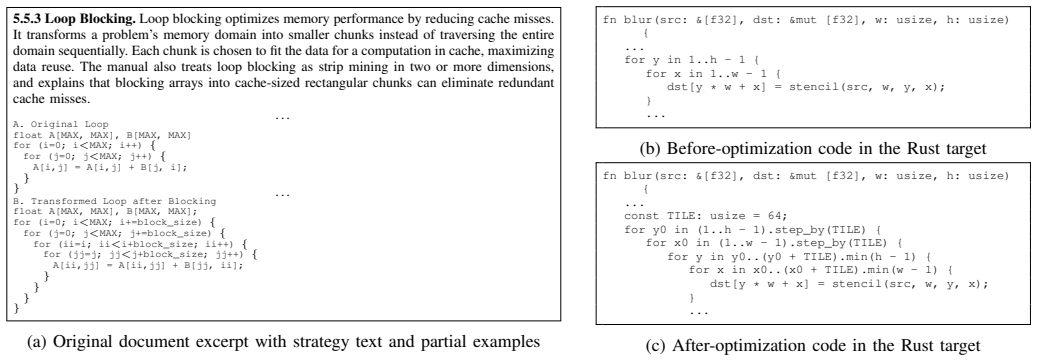
- Multi-source strategy construction expands coverage beyond historical commits; documentation information appears in 45.73% of effective C/C++ optimization results even though it forms a tiny fraction of the evidence.
- Cross-scenario example transfer matters most for low-resource scenarios: 75.53% of effective Python results and 90.91% of effective Rust results came from post-transfer target-scenario candidates.
- Weighted clustering protects high-quality, low-frequency sources; removing it reduces successful optimizations by 8.97%–10.71% in the ablation.
- Reliable rule generation is critical: disabling example transfer and validation reduces EM by 43.59%–50.00%.
- On 15 real-world projects, MoST reports maximum performance improvements of 19.72%–717.42% and average improvements of 4.44%–258.17%, outperforming SemOpt and Codex agents.
Where Pith is reading between the lines
- The evidence-object representation likely generalizes to other knowledge sources such as API documentation, compiler optimization guides, or online Q&A; the current implementation ingests only one optimization manual, so the measured documentation contribution may underestimate what a richer multi-source library would yield.
- The self-balanced selection criterion is a proxy for downstream quality; a more direct validation against pilot task outcomes, or a reference count robust to duplicate LLM-generated descriptions, might change the chosen hyperparameters.
- If the gains are driven mainly by rule-guided localization rather than by the strength of the optimizer model, MoST should remain effective with a smaller or cheaper model—an easily testable extension of the paper's claim.
- Cross-scenario transfer could be extended beyond language and architecture to other scenario properties such as library versions, parallelism models, or cache configurations, which the paper's scenario-tag representation already accommodates.
Editorial analysis
A structured set of objections, weighed in public.
Referee Report
Summary. The paper presents MoST, an LLM-based code optimization framework that converts heterogeneous knowledge sources (historical commits and an Intel optimization manual) into uniform evidence objects, clusters them across sources and scenarios using a self-balanced weighted clustering algorithm, transfers examples to target scenarios when necessary, and generates validated Semgrep rules to guide LLM optimization. The evaluation has two parts: reproduction of 351 historical optimization tasks in C/C++, Python, and Rust, and optimization of 15 real-world projects. The authors report that MoST exceeds SemOpt on historical-task EM/SemEqv by 24.44%–180.00% and 21.88%–37.50% respectively, and that on real-world projects it achieves larger Max/Avg performance improvements than SemOpt and Codex, with ablations and a provenance analysis supporting the design choices.
Significance. MoST addresses two genuine limitations of prior strategy-guided optimizers: it broadens the knowledge sources beyond commits and enables cross-scenario (e.g., cross-language) strategy transfer. The evaluation is broad and mostly careful: three languages, a new Rust benchmark, three baselines, an ablation of both core components, a pilot-based parameter selection, statistical significance checks for performance measurements, and available artifacts. If the claimed results hold, the work is a solid advance for LLM-based code optimization. My main reservation is that the headline comparison with Codex is based on an asymmetric evaluation protocol; a second, lesser concern is that the clustering hyperparameters are selected on the same corpus used for evaluation. Both are addressable and do not, in my view, invalidate the core ideas.
major comments (3)
- [V-A5, Table IV, RQ4] The real-world comparison between MoST/SemOpt and Codex Agent is asymmetric. For MoST and SemOpt, the reported Max/Avg and #≥5%/#≥10% are computed from a final project version assembled by (i) generating candidate optimizations for hotspot functions, (ii) retaining only candidates that improve at least one data point by >5% and degrade none by >2%, and (iii) for each hotspot, keeping the eligible variant with the highest total improvement. Codex Agent, however, contributes a single project patch that is evaluated as that result ('Codex Agent's project patch is evaluated as that result'). Thus the comparison is best-of-many (filtered and composed) versus one-shot. The enormous relative Avg improvements over Codex (up to 27,288.89% per the RQ4 answer) are consistent with this asymmetry. To support the claim that MoST 'significantly outperforms Codex,' the authors must run Codex through the
- [III-B (Eqs. 3–6), IV-C] The self-balanced clustering parameters (w_d=3, τ=0.76, s_min=5) are chosen by minimizing the balance loss L(θ) on the full evidence corpus, and the historical evaluation tasks are drawn from that same corpus (with exact commit/code matches excluded). The 45-task pilot set is disjoint from the formal benchmark and provides supporting evidence that the criterion tracks EM, but the pilot is small and the parameter search is still on the same data distribution as the evaluation. Because the ablation in Table III attributes only 6 EM points (50 vs 56) to weighted clustering, the overall comparative claims are unlikely to be overturned by a different θ; nevertheless, the paper should report a sensitivity analysis over the configurations in Table II for the main benchmark (or at least for a subset), to demonstrate that the reported improvements are not tied to this particular selection.
- [IV-A5, Fig. 3] Success is defined as 'at least one of three runs' satisfying EM/SemEqv. All LLM experiments are run at temperature 0, so the source of run-to-run variation should be clarified; if the three runs are not truly independent, the definition is ambiguous. Even if this protocol is inherited from SemOpt, the reported relative improvements are computed from counts that can be sensitive to a single run (e.g., small-count settings such as Rust with 14 vs 9 successes). I recommend reporting the distribution (e.g., mean±std over the three runs, or majority success) and the per-run rates, so that the stability of the claimed percentages can be assessed. This does not necessarily bias the comparison against baselines, but it is load-bearing for the precise effect sizes in the abstract.
minor comments (7)
- [V-A2] The fallback for Rust SemOpt when no candidate passes the >5% filter should be described more precisely; if SemOpt is not given the same composition opportunities as MoST in such cases, the Rust comparison may still favor MoST.
- [IV-D] The manual applicability evaluation (89.70%) should report how many suggestions were inspected, the criteria for 'valuable', and inter-rater agreement; comparing to SemOpt's 89.86% with a different LLM (DeepSeek-V3) is not apples-to-apples.
- [III-A, Table V] Only 189 document-derived evidence objects are used versus 48,440 commit-derived objects; the claim that documentation contributes 45.73% of effective C/C++ results should be accompanied by counts/confidence intervals, since the absolute numbers are small.
- [V-C] RQ5 counts multiple effective results from the same hotspot/rule; please clarify whether the counts are at the level of data points and report unique hotspot/rule counts as a sanity check.
- [VI] The data-leakage mitigation excludes only exact commit/code matches; near-duplicate versions of the same optimization could still appear in the strategy library. A similarity-based deduplication or an additional leakage analysis would strengthen the threat-to-validity discussion.
- [Table IV] Some entries are hard to parse because spaces are missing between Avg and #≥5%/#≥10% columns (e.g., RocksDB). Please format the table so each column is clearly separated.
- [Abstract and references] Typos: 'otherknowledge' in the abstract should be 'other knowledge'; reference [55] URL contains a space in 'line profiler'; 'super parameters' in Section II-C should be 'hyperparameters'.
Circularity Check
No significant circularity: the central claims are empirical comparisons, and no equation reduces to a fitted value or to a self-citation chain.
full rationale
The paper's central claims are empirical comparisons on externally defined benchmarks (151 C/C++, 150 Python, and 50 Rust historical tasks; 15 real-world projects). The only parameter-selection mechanism, Eqs. (3)-(6), defines a clustering-only balance loss used to choose (document weight, threshold, min size); it does not produce the reported EM/SemEqv or performance numbers, and the selected configuration is checked against a disjoint 45-task pilot set (Table II) before application. No fitted parameter is renamed as a prediction, and no evaluation metric enters the selection loss. Self-citations to SemOpt [15] are used as a baseline and benchmark source, but the MoST-vs-SemOpt results are re-run in this paper rather than imported; the claim that RAPGen and Clang-Tidy are weaker is a published, externally falsifiable comparison and is not load-bearing for the main MoST-vs-SemOpt/Codex results. The real-world evaluation asymmetry (filtered best-of-many composition for MoST/SemOpt versus single-patch Codex) is a protocol-fairness threat, not a circularity of derivation. Therefore no step reduces to its own inputs.
Axiom & Free-Parameter Ledger
free parameters (8)
- document weight w_d =
3
- description-similarity threshold tau =
0.76
- minimum cluster size s_min =
5
- loss hyperparameters epsilon, lambda =
1, 1
- rule-generation budget b =
5
- top N retained pairs =
25
- hotspot threshold =
0.1% of runtime
- composition eligibility thresholds =
>5% improvement, <=2% degradation
axioms (6)
- domain assumption LLM conversion of documents/commits into evidence objects is faithful (Phase 1).
- domain assumption Weighted density clustering on NL descriptions groups semantically identical strategies across sources (Phase 2).
- domain assumption Single-scenario cluster counts K_T are a stable reference for cross-scenario balance (Eq. 3).
- domain assumption The LLM's cross-scenario applicability check is reliable (Phase 3, case 3).
- domain assumption Rule validation on a single before/after example is sufficient for rule quality (Phase 3).
- domain assumption EM, SemEqv, and the project performance protocol capture optimization quality (Sections IV-A4, V-A4).
invented entities (1)
-
Evidence object
no independent evidence
read the original abstract
Automated code optimization improves program performance by refactoring source code, and recent studies use LLMs to generate optimization patches. The newest approaches are strategy-guided: they summarize strategies from historical optimization commits as static analysis rules, and use these rules to match code locations for LLMs to optimize. However, these approaches have two limitations: (1) the strategies may come from other knowledge sources, such as textbooks and web pages, but the existing approaches cannot utilize them; (2) a strategy may be applicable to different scenarios, e.g., different programming languages, but existing approaches can only formalize strategies for the scenario to which the source commit belongs. To address these limitations, we propose MoST, an LLM-based code optimization framework that integrates multiple knowledge sources across scenarios. MoST uniformly represents items in different knowledge sources as evidence objects, clusters them in a cross-source and cross-scenario manner to identify strategies, and transfers them to the target scenario when necessary for generating static analysis rules. To implement this process, MoST employs a novel self-balanced weighted clustering algorithm to balance evidence objects from different knowledge sources, and a novel example transfer procedure to ensure the quality of the generated rules when transferring across scenarios. On a benchmark containing 151 C/C++, 150 Python, and 50 Rust historical optimization tasks, compared with SemOpt, MoST yields 24.44%-180.00% and 21.88%-37.50% more patches that are exactly the same as or semantically equivalent to developer patches, respectively. When optimizing 15 real-world projects, MoST achieves 19.72%-717.42% maximum improvements and 4.44%-258.17% average improvements for the performance tests in the projects, significantly outperforming SemOpt and Codex.
Figures


Reference graph
Works this paper leans on
-
[1]
ISO/IEC 25010:2011 Systems and software engineering – Systems and software Quality Requirements and Evaluation (SQuaRE) – System and software quality models,
ISO/IEC, “ISO/IEC 25010:2011 Systems and software engineering – Systems and software Quality Requirements and Evaluation (SQuaRE) – System and software quality models,” 2011, accessed: 2026-07-01. [Online]. Available: https://www.iso.org/standard/35733.html
2011
-
[2]
Discovering, reporting, and fixing per- formance bugs,
A. Nistor, T. Jiang, and L. Tan, “Discovering, reporting, and fixing per- formance bugs,” in2013 10th Working Conference on Mining Software Repositories (MSR). IEEE, 2013, pp. 237–246
2013
-
[3]
Catch me if you can: performance bug detection in the wild,
M. Jovic, A. Adamoli, and M. Hauswirth, “Catch me if you can: performance bug detection in the wild,” inProceedings of the 2011 ACM International Conference on Object Oriented Programming Systems Languages and Applications, 2011, pp. 155–170
2011
-
[4]
PerfScope: Practical online server performance bug inference in production cloud computing infrastructures,
D. J. Dean, H. Nguyen, X. Gu, H. Zhang, J. Rhee, N. Arora, and G. Jiang, “PerfScope: Practical online server performance bug inference in production cloud computing infrastructures,” inProceedings of the ACM Symposium on Cloud Computing, 2014, pp. 1–13
2014
-
[5]
Peephole optimization,
W. M. McKeeman, “Peephole optimization,”Communications of the ACM, vol. 8, no. 7, pp. 443–444, 1965
1965
-
[6]
Global common subexpression elimination,
J. Cocke, “Global common subexpression elimination,” inProceedings of a Symposium on Compiler Optimization, 1970, pp. 20–24
1970
-
[7]
CodeGen: An open large language model for code with multi-turn program synthesis,
E. Nijkamp, B. Pang, H. Hayashi, L. Tu, H. Wang, Y . Zhou, S. Savarese, and C. Xiong, “CodeGen: An open large language model for code with multi-turn program synthesis,” inInternational Conference on Learning Representations (ICLR), 2023, arXiv:2203.13474. [Online]. Available: https://openreview.net/forum?id=iaYcJKpY2B
Pith/arXiv arXiv 2023
-
[8]
StarCoder: may the source be with you!
R. Li, L. B. Allal, Y . Zi, N. Muennighoff, D. Kocetkov, C. Mou, M. Marone, C. Akiki, J. Li, J. Chimet al., “StarCoder: may the source be with you!”arXiv preprint arXiv:2305.06161, 2023. [Online]. Available: https://arxiv.org/abs/2305.06161
Pith/arXiv arXiv 2023
-
[9]
DeepSeek-Coder: When the large language model meets programming – the rise of code intelligence,
D. Guo, Q. Zhu, D. Yang, Z. Xie, K. Dong, W. Zhang, G. Chen, X. Bi, Y . Wu, Y . K. Li, F. Luo, Y . Xiong, and W. Liang, “DeepSeek-Coder: When the large language model meets programming – the rise of code intelligence,”arXiv preprint arXiv:2401.14196, 2024. [Online]. Available: https://arxiv.org/abs/2401.14196
Pith/arXiv arXiv 2024
-
[10]
Large language models for software engineering: Sur- vey and open problems,
A. Fan, B. Gokkaya, M. Harman, M. Lyubarskiy, S. Sengupta, S. Yoo, and J. M. Zhang, “Large language models for software engineering: Sur- vey and open problems,” in2023 IEEE/ACM International Conference on Software Engineering: Future of Software Engineering (ICSE-FoSE). IEEE, 2023, pp. 31–53
2023
-
[11]
Learning performance-improving code edits,
A. Shypula, A. Madaan, Y . Zeng, U. Alon, J. R. Gardner, Y . Yang, M. Hashemi, G. Neubig, P. Ranganathan, O. Bastani, and A. Yazdanbakhsh, “Learning performance-improving code edits,” in The Twelfth International Conference on Learning Representations (ICLR), 2024, arXiv:2302.07867. [Online]. Available: https://openrevi ew.net/forum?id=ix7rLVHXyY
Pith/arXiv arXiv 2024
-
[12]
RAPGen: An approach for fixing code inefficiencies in zero-shot,
S. Garg, R. Z. Moghaddam, and N. Sundaresan, “RAPGen: An approach for fixing code inefficiencies in zero-shot,” in2025 IEEE/ACM 47th In- ternational Conference on Software Engineering: Software Engineering in Practice (ICSE-SEIP), 2025, pp. 124–135, arXiv:2306.17077
Pith/arXiv arXiv 2025
-
[13]
Search-based LLMs for code optimization,
S. Gao, C. Gao, W. Gu, and M. R. Lyu, “Search-based LLMs for code optimization,” in2025 IEEE/ACM 47th International Conference on Software Engineering (ICSE), 2025, pp. 578–590, arXiv:2408.12159
Pith/arXiv arXiv 2025
-
[14]
PerfCodeGen: Improving performance of LLM generated code with execution feedback,
Y . Peng, A. D. Gotmare, M. R. Lyu, C. Xiong, S. Savarese, and D. Sahoo, “PerfCodeGen: Improving performance of LLM generated code with execution feedback,” in2025 IEEE/ACM Second International Conference on AI Foundation Models and Software Engineering (Forge). IEEE, 2025, pp. 1–13
2025
-
[15]
SemOpt: LLM- driven code optimization via rule-based analysis,
Y . Zhao, Y .-A. Xiao, Q. Xiao, Z. Zhang, and Y . Xiong, “SemOpt: LLM- driven code optimization via rule-based analysis,”ACM Transactions on Software Engineering and Methodology, 2026
2026
-
[16]
Semgrep,
Semgrep, “Semgrep,” 2026, accessed: 2026-07-01. [Online]. Available: https://github.com/semgrep/semgrep
2026
-
[17]
Intel® 64 and IA-32 Architectures Optimization Reference Manual V olume 1,
Intel Corporation, “Intel® 64 and IA-32 Architectures Optimization Reference Manual V olume 1,” 2023, version 050; Accessed: 2026-07-
2023
-
[18]
Available: https://www.intel.com/content/www/us/en/cont ent-details/671488/intel-64-and-ia-32-architectures-optimization-refer ence-manual-volume-1.html
[Online]. Available: https://www.intel.com/content/www/us/en/cont ent-details/671488/intel-64-and-ia-32-architectures-optimization-refer ence-manual-volume-1.html
-
[19]
A density-based algorithm for discovering clusters in large spatial databases with noise,
M. Ester, H.-P. Kriegel, J. Sander, and X. Xu, “A density-based algorithm for discovering clusters in large spatial databases with noise,” inProceedings of the Second International Conference on Knowledge Discovery and Data Mining, 1996, pp. 226–231. [Online]. Available: https://aaai.org/papers/KDD96-037-a-density-based-algorithm-for-dis covering-clusters...
1996
-
[20]
Random search for hyper-parameter optimization,
J. Bergstra and Y . Bengio, “Random search for hyper-parameter optimization,”Journal of Machine Learning Research, vol. 13, no. 10, pp. 281–305, 2012. [Online]. Available: https://jmlr.org/papers/v13/be rgstra12a.html
2012
-
[21]
The statistical analysis of compositional data,
J. Aitchison, “The statistical analysis of compositional data,”Journal of the Royal Statistical Society: Series B (Methodological), vol. 44, no. 2, pp. 139–160, 1982
1982
-
[22]
KNighter: Transforming static analysis with LLM-synthesized checkers,
C. Yang, Z. Zhao, Z. Xie, H. Li, and L. Zhang, “KNighter: Transforming static analysis with LLM-synthesized checkers,” inProceedings of the ACM SIGOPS 31st Symposium on Operating Systems Principles, 2025, pp. 655–669
2025
-
[23]
Write your own CodeChecker: An automated test-driven checker development approach with LLMs,
J. Liu, Y . Xie, J. Yan, J. Huang, J. Yan, and J. Zhang, “Write your own CodeChecker: An automated test-driven checker development approach with LLMs,” inIEEE/ACM International Conference on Software Engineering (ICSE), 2026, arXiv:2411.06796. [Online]. Available: https://arxiv.org/abs/2411.06796
Pith/arXiv arXiv 2026
-
[24]
Neuro-symbolic static analysis with LLM-generated vulnerability patterns,
P. Li, S. Yao, J. S. Korich, C. Luo, J. Yu, Y . Cao, and J. Yang, “Neuro-symbolic static analysis with LLM-generated vulnerability patterns,”arXiv preprint arXiv:2504.16057, 2025. [Online]. Available: https://arxiv.org/abs/2504.16057
Pith/arXiv arXiv 2025
-
[25]
What makes good in-context demonstrations for code intelligence tasks with LLMs?
S. Gao, X.-C. Wen, C. Gao, W. Wang, H. Zhang, and M. R. Lyu, “What makes good in-context demonstrations for code intelligence tasks with LLMs?” in2023 38th IEEE/ACM International Conference on Automated Software Engineering (ASE). IEEE, 2023, pp. 761–773
2023
-
[26]
Clang-Tidy,
LLVM Project, “Clang-Tidy,” 2026, accessed: 2026-07-01. [Online]. Available: https://clang.llvm.org/extra/clang-tidy/
2026
-
[27]
Models & Pricing: DeepSeek-V4-Pro,
DeepSeek, “Models & Pricing: DeepSeek-V4-Pro,” 2026, accessed: 2026-07-01. [Online]. Available: https://api-docs.deepseek.com/quick s tart/pricing
2026
-
[28]
GPT-5.2 Model,
OpenAI, “GPT-5.2 Model,” 2026, accessed: 2026-07-01. [Online]. Available: https://developers.openai.com/api/docs/models/gpt-5.2
2026
-
[29]
RocksDB,
Facebook, “RocksDB,” 2026, accessed: 2026-07-01. [Online]. Available: https://github.com/facebook/rocksdb
2026
-
[30]
[Online]
Redis, “Redis,” 2026, accessed: 2026-07-01. [Online]. Available: https://github.com/redis/redis
2026
-
[31]
[Online]
gRPC Authors, “gRPC,” 2026, accessed: 2026-07-01. [Online]. Available: https://github.com/grpc/grpc
2026
-
[32]
LevelDB,
Google, “LevelDB,” 2026, accessed: 2026-07-01. [Online]. Available: https://github.com/google/leveldb
2026
-
[33]
[Online]
Gabi Melman, “spdlog,” 2026, accessed: 2026-07-01. [Online]. Available: https://github.com/gabime/spdlog
2026
-
[34]
Click Documentation,
Click Project, “Click Documentation,” 2026, accessed: 2026-07-01. [Online]. Available: https://click.palletsprojects.com/
2026
-
[35]
Flask Documentation,
Flask Project, “Flask Documentation,” 2026, accessed: 2026-07-01. [Online]. Available: https://flask.palletsprojects.com/
2026
-
[36]
Jinja Documentation,
Jinja Project, “Jinja Documentation,” 2026, accessed: 2026-07-01. [Online]. Available: https://jinja.palletsprojects.com/
2026
-
[37]
Requests,
Python Software Foundation, “Requests,” 2026, accessed: 2026-07-01. [Online]. Available: https://github.com/psf/requests
2026
-
[38]
[Online]
Scrapy, “Scrapy,” 2026, accessed: 2026-07-01. [Online]. Available: https://github.com/scrapy/scrapy
2026
-
[39]
[Online]
Dimforge, “Rapier,” 2026, accessed: 2026-07-01. [Online]. Available: https://github.com/dimforge/rapier
2026
-
[40]
[Online]
image-rs, “image,” 2026, accessed: 2026-07-01. [Online]. Available: https://github.com/image-rs/image
2026
-
[41]
[Online]
Rust Project Developers, “regex,” 2026, accessed: 2026-07-01. [Online]. Available: https://github.com/rust-lang/regex
2026
-
[42]
datafusion-sqlparser-rs,
Apache Software Foundation, “datafusion-sqlparser-rs,” 2026, accessed: 2026-07-01. [Online]. Available: https://github.com/apache/datafusion-s qlparser-rs
2026
-
[43]
[Online]
Tokio Contributors, “Tokio,” 2026, accessed: 2026-07-01. [Online]. Available: https://github.com/tokio-rs/tokio
2026
-
[44]
[Online]
OpenAI, “Codex,” 2026, accessed: 2026-07-01. [Online]. Available: https://developers.openai.com/codex
2026
-
[45]
Codex Models: gpt-5.3-codex-spark,
OpenAI Codex, “Codex Models: gpt-5.3-codex-spark,” 2026, accessed: 2026-07-01. [Online]. Available: https://developers.openai.com/codex/ models
2026
-
[46]
GPT-5.4 mini Model,
OpenAI API, “GPT-5.4 mini Model,” 2026, accessed: 2026-07-01. [Online]. Available: https://developers.openai.com/api/docs/models/gp t-5.4-mini
2026
-
[47]
GPT-5.4 Model,
OpenAI, “GPT-5.4 Model,” 2026, accessed: 2026-07-01. [Online]. Available: https://developers.openai.com/api/docs/models/gpt-5.4
2026
-
[48]
The generalization of Student’s problem when several different population variances are involved,
B. L. Welch, “The generalization of Student’s problem when several different population variances are involved,”Biometrika, vol. 34, no. 1-2, pp. 28–35, 1947
1947
-
[49]
Robust benchmarking in noisy environments,
J. Chen and J. Revels, “Robust benchmarking in noisy environments,” arXiv preprint arXiv:1608.04295, 2016. [Online]. Available: https: //arxiv.org/abs/1608.04295
Pith/arXiv arXiv 2016
-
[50]
Minotaur: A SIMD-oriented syn- thesizing superoptimizer,
Z. Liu, S. Mada, and J. Regehr, “Minotaur: A SIMD-oriented syn- thesizing superoptimizer,”Proceedings of the ACM on Programming Languages, vol. 8, no. OOPSLA2, pp. 1561–1585, 2024
2024
-
[51]
Unveiling overlooked performance variance in serverless computing,
J. Wen, Z. Chen, F. Sarro, and S. Wang, “Unveiling overlooked performance variance in serverless computing,”Empirical Software Engineering, vol. 30, no. 2, p. 59, 2025
2025
-
[52]
On measuring large language models performance with inferential statistics,
J. M. Fraile-Hern ´andez and A. Pe ˜nas, “On measuring large language models performance with inferential statistics,”Information, vol. 16, no. 9, p. 817, 2025
2025
-
[53]
perf: Linux profiling with performance counters,
Linux Kernel Organization, “perf: Linux profiling with performance counters,” 2026, accessed: 2026-07-01. [Online]. Available: https: //perfwiki.github.io/
2026
-
[54]
[Online]
Free Software Foundation, “Gcov,” 2026, accessed: 2026-07-01. [Online]. Available: https://gcc.gnu.org/onlinedocs/gcc/Gcov.html
2026
-
[55]
The Python profilers,
Python Software Foundation, “The Python profilers,” 2026, accessed: 2026-07-01. [Online]. Available: https://docs.python.org/3/library/profil e.html
2026
-
[56]
line profiler,
pyutils, “line profiler,” 2026, accessed: 2026-07-01. [Online]. Available: https://github.com/pyutils/line profiler
2026
-
[57]
Performance problems you can fix: A dynamic analysis of memoization opportunities,
L. Della Toffola, M. Pradel, and T. R. Gross, “Performance problems you can fix: A dynamic analysis of memoization opportunities,”ACM SIGPLAN Notices, vol. 50, no. 10, pp. 607–622, 2015
2015
-
[58]
CADET: Debugging and fixing misconfigurations using counterfactual reasoning,
R. Krishna, M. S. Iqbal, M. A. Javidian, B. Ray, and P. Jamshidi, “CADET: Debugging and fixing misconfigurations using counterfactual reasoning,”arXiv preprint arXiv:2010.06061, 2020. [Online]. Available: https://arxiv.org/abs/2010.06061
Pith/arXiv arXiv 2010
-
[59]
Genetic optimisation of C++ applications,
R. Giavrimis, A. Butler, C. C. Petrescu, M. Basios, and S. K. Dash, “Genetic optimisation of C++ applications,” in2021 36th IEEE/ACM International Conference on Automated Software Engineering (ASE). IEEE, 2021, pp. 1180–1182
2021
-
[60]
CLion: A cross-platform IDE for C and C++,
JetBrains, “CLion: A cross-platform IDE for C and C++,” 2026, accessed: 2026-07-01. [Online]. Available: https://www.jetbrains.com/ clion/
2026
-
[61]
Learning to improve code efficiency,
B. Chen, D. Tarlow, K. Swersky, M. Maas, P. Heiber, A. Naik, M. Hashemi, and P. Ranganathan, “Learning to improve code efficiency,”arXiv preprint arXiv:2208.05297, 2022. [Online]. Available: https://arxiv.org/abs/2208.05297
Pith/arXiv arXiv 2022
-
[62]
Supersonic: Learning to generate source code optimizations in C/C++,
Z. Chen, S. Fang, and M. Monperrus, “Supersonic: Learning to generate source code optimizations in C/C++,”IEEE Transactions on Software Engineering, vol. 50, no. 11, pp. 2849–2864, 2024
2024
-
[63]
DeepDev-PERF: a deep learning-based approach for improving software performance,
S. Garg, R. Z. Moghaddam, C. B. Clement, N. Sundaresan, and C. Wu, “DeepDev-PERF: a deep learning-based approach for improving software performance,” inProceedings of the 30th ACM Joint European Software Engineering Conference and Symposium on the Foundations of Software Engineering, 2022, pp. 948–958
2022
-
[64]
Knowledge transfer from high-resource to low-resource programming languages for code LLMs,
F. Cassano, J. Gouwar, F. Lucchetti, C. Schlesinger, A. Freeman, C. J. Anderson, M. Q. Feldman, M. Greenberg, A. Jangda, and A. Guha, “Knowledge transfer from high-resource to low-resource programming languages for code LLMs,”Proceedings of the ACM on Programming Languages, vol. 8, no. OOPSLA2, pp. 677–708, 2024
2024
-
[65]
Enhancing code gener- ation for low-resource languages: No silver bullet,
A. Giagnorio, A. Martin-Lopez, and G. Bavota, “Enhancing code gener- ation for low-resource languages: No silver bullet,” in2025 IEEE/ACM 33rd International Conference on Program Comprehension (ICPC), 2025, pp. 478–488, arXiv:2501.19085
Pith/arXiv arXiv 2025
-
[66]
A survey on LLM-based code gen- eration for low-resource and domain-specific programming languages,
S. Joel, J. J. W. Wu, and F. H. Fard, “A survey on LLM-based code gen- eration for low-resource and domain-specific programming languages,” ACM Transactions on Software Engineering and Methodology, 2025
2025
-
[67]
EffiCoder: Enhancing code generation in large language models through efficiency-aware fine- tuning,
D. Huang, G. Zeng, J. Dai, M. Luo, H. Weng, Y . Qing, H. Cui, Z. Guo, and J. M. Zhang, “EffiCoder: Enhancing code generation in large language models through efficiency-aware fine- tuning,”arXiv preprint arXiv:2410.10209, 2024. [Online]. Available: https://arxiv.org/abs/2410.10209
Pith/arXiv arXiv 2024
-
[68]
PEACE: Towards efficient project-level efficiency optimization via hybrid code editing,
X. Ren, J. Wan, Y . Peng, Z. Liu, M. Liang, D. Chen, W. Jiang, and Y . Li, “PEACE: Towards efficient project-level efficiency optimization via hybrid code editing,” in2025 40th IEEE/ACM International Conference on Automated Software Engineering (ASE). IEEE, 2025, pp. 1831– 1843
2025
-
[69]
POLO: An LLM-powered project-level code performance optimization framework,
J. Bai, R. Xu, S. Wu, D. Yang, J. Zhao, and G. Chen, “POLO: An LLM-powered project-level code performance optimization framework,” inProceedings of the Thirty-Fourth International Joint Conference on Artificial Intelligence, IJCAI-25. International Joint Conferences on Artificial Intelligence Organization, 2025, pp. 7319–7328. [Online]. Available: https:/...
discussion (0)
Sign in with ORCID, Apple, or X to comment. Anyone can read and Pith papers without signing in.